Master thesis Psychology, Economic and Consumer Psychology Institute of Psychology
Faculty of Social and Behavioral Sciences – Leiden University Date: February 13, 2017
R. H. Lemmen, S1115073
First examiner of the university: E. de Kwaadsteniet Second examiner of the university: E. van Dijk
The intuitive information
processing system and its effects
on prosocial behavior.
An experiment investigating the influence of
time-pressure and cognitive load on charitable donations.
Index
1. Abstract ……….. p. 1
2. Introduction ……… p. 2
2.1. Why would people help? ………... p. 3
2.2. When would people help? ……… p. 4
2.3. Hypotheses and aims ………... p. 7
3. Method ………... p. 9
3.1. Participants and design ...……… p. 9
3.2. Pilot study ……… p. 9
3.3. Manipulation and procedure ..……… p. 10
4. Results ………... p. 12
4.1. Exclusion of participants ……… p. 12
4.2. Statistical analysis and results ……… p. 12
5. Discussion ………. p. 15
5.1. Findings ……….. p. 15
5.2. Theoretical explanations ……… p. 15
5.2.1. Criticism on the dual-process theory ………... p. 17
5.2.2. The cognitive continuum theory ………... p. 18
5.3. Methodological inaccuracies ……….. p. 18
5.3.1. Effects of income and age ………. p. 19
5.4. Recommendations for further research ………... p. 20
5.5. Conclusion ………... p. 21
1
1. Abstract
Prosocial behavior, explicitly charitable donations, is very important for charities to achieve
their goals. However, obtaining enough donations is not that easy. In the present study we
examined whether prosocial behavior can be evoked by System 1, a cognitive information
processing system characterized by its automatic and fast processes. We manipulated this by
using time-pressure and cognitive load. Kahneman stated that System 1 would reduce
prosocial behavior, whereas Rand stated that this would increase prosocial behavior. Both
statements were transferred into hypotheses and tested in an experiment. However, neither
hypothesis was corroborated by the results. Possibly, methodological inaccuracies contributed
to these results. The impact of the direction of the affective motivation may be an influence as
well. Moreover, several sceptics criticize the impact of the dual-process theory. Further
research should determine to what extent the underlying motivation is an influence and
2
2. Introduction
In the society we live in today, helping each other becomes more important. The world is
getting more terrorized by religious wars, earthquakes, epidemics and other disasters that can
lead to hunger, sickness even to death. As such, helping each other is necessary, sometimes
even to survive. Charity becomes more and more dependent on individual donations since
federal support becomes less and less (Sherman & Yoo, 2007). Volunteer organizations and
charities try to attract those people that are able and willing to help. Acts of charitable giving
come in many shapes: donating money, clothes and food, or help with services as first aid or
whatever talent or service is needed. However, attracting donators appears to be not that easy.
People are busy, do not have the supplies or money to help or simply do not want to.
Nevertheless, charitable actions are the mainspring for voluntary organizations (Murninghan,
Kim, & Metzger, 1993).
Helping each other goes far back in time. Although evolution is based on the idea of
competition and survival of the fittest, thus should reward selfishness, helping each other is
not only pretty common between humans but also between lots of other organisms of the
same species (Axelrod & Hamilton, 1981).
A term that is often used to describe behavior where people are helping, is prosocial
behavior. Prosocial behavior is described as a category of behavior that is generally beneficial
to others (Penner, Dovidio, Piliavin, & Schroeder, 2005). A type of prosocial behavior that is
driven by the eagerness to help other human beings, without expecting any benefits for the
self, is also referred to as altruism (Lay & Hoppman, 2015; Kinnunen and Windmann, 2013).
The evolutionary perspective on altruism states that human beings rather show reciprocal
altruism than pure altruism. Brosnan and De Waal (2002) define reciprocal altruism as the
exchange of services and/or goods such that individual benefits are being returned to the other
3
a system of enduring mutual benefits (Murninghan, Kim, & Metzger, 1993). They shared food
and knowledge in order to survive. In this exchange of goods and knowledge, they expected
that the exchange would be balanced and fair overtime and that in the end everyone would
have given and received approximately the same (Murninghan, Kim, & Metzger, 1993).
To get a clearer view on prosocial behavior, I will elaborate on why and when people
tend to help.
2.1. Why would people help?
Why people would engage in prosocial behavior is generally explained by a couple of
psychological mechanisms. One of these mechanisms is about social and personal standards
(Penner, Dovidio, Piliavin, & Schroeder, 2005). This mechanism explains how norms, such as
reciprocity, social responsibility and personal norms influence the tendency to help. Social
standards arise in favor of the group. They restrict egoistic impulses to positively influence
collective outcomes (Biel & Thøgersen, 2007). Social standards imply that certain behavior is
undesirable and other behavior is preferred. Such standards can imply for instance norms
about social justice, equality, protecting the environment or helping others (Biel & Thøgersen,
2007). Violations of these standards are often sanctioned. Personal standards are internal and
include the feeling of obligation you have when others are in need of help, regardless of what
others expect (Biel & Thøgersen, 2007; Schwartz, 2010). Schwartz (2010) explains in his
values theory how values, which are included in personal norms, contribute to prosocial
behavior. He identified 10 values that are recognizable for all cultures. These values are:
conformity, tradition, benevolence (welfare of the ingroup), universalism (welfare of all),
self-direction, stimulation, hedonism, achievement, power and security (Schwartz, 2010). The
relations that can be formed between those values, can provide motivation for prosocial
4
accessible a value is, the more likely it will be activated. Schwartz (2010) described four steps
in the activation of these values. First, you must be consciously aware that others need help.
Then the awareness that viable actions can reduce this need is needed. The third step includes
the awareness of perceiving yourself as able to help. The last step in the activation of values is
the perception of responsibility to get involved in the helping (Schwartz, 2010).
Schwartz (2010) also mentions arousal and affect as other important motivators to help
others. It contains the important emotions that play a role in motivating prosocial behavior.
The distress of others can get people empathically aroused and can get people motivated to
improve their own welfare (egoistic motivation) or the welfare of others (altruistic
motivation). This emphatic concern appears to be an important characteristic of the
motivation underlying altruism (Dickert, Sagara and Slovic, 2010; Verhaert & Van den Poel,
2011). This is also explained by the empathy-altruism theory (Basil, Ridgway and Basil,
2008). It argues that empathy motivates people to focus on the well-being of others in need.
The greater someone’s emphatic concern, the more likely this person will show prosocial
behavior (Dickert, Sagara and Slovic, 2010; Dickert, 2008; Verhaert & Van den Poel, 2011).
In charity, it can lead to high donations (Verhaert & Van den Poel, 2011, Dickert, 2008).
People can also show prosocial behavior towards others for egoistic or self-focused
reasons, as helping others can benefit the self as well. Dunn, Aknin and Norton (2014) found
that prosocial spending, which is a type of prosocial behavior where people spend their money
for other’s happiness, made the spenders themselves also happier.
2.2. When would people help?
Now we know that people can help for own or others interests, it is also important to elaborate
on when people tend to help. Piliavin and colleagues tried to explain this according to the
5
& Schroeder, 2005). This economic view of behavior assumes that people are usually
motivated to maximize their own benefits and to minimize their costs. This perspective is
rational and concerned about self-interests. Some see helping others as an opportunity to
develop themselves. For personal development, they try to increase the possible benefits,
decrease the costs of helping and increase the costs of not helping. Such costs can contain
shame or guilt for inaction (Penner, Dovidio, Piliavin, & Schroeder, 2005). When the overall
costs exceed the rewards or gains, helping others becomes an act of unselfishness, also
referred as altruism (Hinde & Groebel, 1991).
Psychological research states that information processing can influence the decision to
help as well (Dickert, Sagara and Slovic, 2010; Dickert, 2008; Evans, 2003). The dual-process
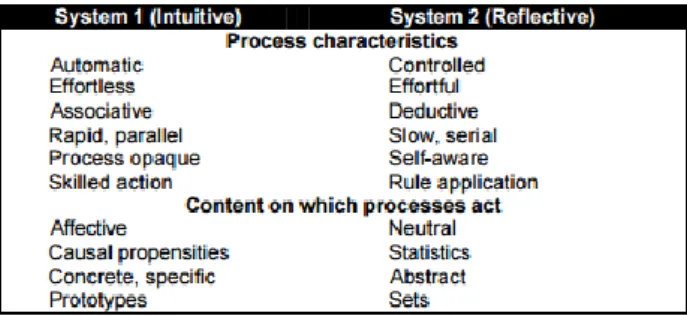
theory distinguishes two information processing systems. System 1 includes an effortless,
quick, concrete, automatic and emotional process, while System 2 includes a slower,
controlled, abstract, flexible, reflective and effortful process (Kahneman, 2011; Dickert,
Sagara and Slovic, 2010). Also, System 1 provides intuitive decisions, while System 2
provides hypothetical thinking that cannot be done by System 1 (Evans, 2003; Rand, Greene
and Nowak, 2012). The system a person uses to process information in order to make a
decision may also have an influence on whether a person makes egoistic or altruistic choices,
and if these choices are intuitive or controlled. Rand, Greene and Nowak (2012) did some
research to investigate these differences. They stated that intuition based decisions are
automatic and effortless, thus made under System 1. Kahneman (2011) makes a similar point
and also states that System 1 includes personal and social norms. System 2 does not create
those norms by itself, but adopts the suggestions of System 1 and turns these suggestions into
beliefs, without any (or very little) modifications (Kahneman, 2011). A clear overview of the
characteristics of the systems is shown in Table 1 (Kahneman & Frederick, 2002). Controlled
6
than intuitive decisions. These kinds of decisions are made under System 2 (Rand, Greene and
Nowak, 2012; Kahneman, 2011). The studies of Rand, Greene and Nowak (2012) also
showed that when a person makes intuitive decisions, thus under System 1, those decisions
are more prosocial.Rand, Dreber, Ellingsen, Fudenberg and Nowak (2009) elaborate in their
experiment review on a one-shot public good game (controlled experiment where anonymous
individuals need to decide over contributing to public goods) that intuitive, automatic
responses include reciprocal cooperation strategies and thereby faster and more cooperative
decisions are made. According to these findings, it is likely that people who are making
decisions under System 1 are more inclined to help others (Dickert, Sagara and Slovic, 2010;
Dickert, 2008).
Table 1. Overview of the cognitive systems (Kahneman & Frederich, 2002).
As mentioned before, it is more favorable for charity when people make altruistic,
prosocial or cooperative decisions. According to Rand, such decisions are intuitive. As such, a
way to induce people to make those decisions is to let them make faster decisions, thus under
System 1. Rand, Greene and Nowak (2012) proved in their studies that time-pressure can
cause suppression of System 2 and thereby induce people to make decisions under System 1.
This would mean that their choices are likely to be more intuitive and more altruistic. They
manipulated these choices by giving participants only 10 seconds to decide how much money
7
Kahneman (2011) has other ideas about suppressing System 2 and how System 1
affects prosocial behavior. By manipulating someone’s cognitive load by making them
cognitively busy, he says he can suppress System 2. When a person is cognitively busy, there
remains less cognitive space to handle other tasks and therefore the brain is forced to use
System 1 for these such tasks. However, Kahneman states, in contrast to Rand, that persons
with a high cognitive load tend to make more selfish choices. Kahneman (2011) argues that
System 1 takes over in emergencies, hence this system allocates priority to self-protective
actions, which dates back to a long evolutionary history (Kahneman, 2011). Besides,
Kahneman (2011) argued that helping others takes effort. And when you are cognitively busy
increasing effort is not an option.
As such, there is a clear discrepancy between Kahneman’s statement and the theory of
Rand, Greene and Nowak (2012). Both state that when people are cognitively busy, they have
to use System 1 for others tasks. However, according to Kahneman’s statement about
cognitive load these people will make more selfish decisions, whereas according to Rand they
will make more cooperative, prosocial and emphatic decisions. Not only Kahneman, but also
Dickert, Sagara and Slovic (2010) proved in their study that cognitive load can restrict system
2. By participants having to remember a 10-letter sequence, they made sure that their
cognitive load was high. But, in their study this resulted in more emphatic feelings and
charitable giving, which is in line with the statement of Rand. However, this is in contrast to
the selfish choices that Kahneman would predict.
2.3. Hypotheses and aims
Considering all of the above, more research about prosocial behavior under System 1 is
necessary, because currently there are contrary findings about prosocial behavior under the
8
is right.This will be examined through an experiment concerning donating to charity. The
amount of donated money will be used to measure the extent of prosocial behavior. With
time-pressure and cognitive load manipulated, participants are forced to use System 1. Based
on Rand and Kahneman we can formulate two opposing hypotheses. The first hypothesis is
that, based on Rand and his theory about time pressure and altruism, donations will be higher
under the use of System 1 (as opposed to System 2). The second hypothesis is that, based on
Kahneman and his theory about cognitive load and selfishness, donations will be lower under
the use of System 1 (as opposed to System 2).
Since donations are the most important revenue for charities1, it is important for them
to know how to collect them in the most efficient manner. As demonstrated in the
introduction, there is not one specific factor that moves people to donate. Therefore collecting
donations is a time-consuming task. My results may be of interest for charities to help them
choose a working method that moves people to donate the most. In this way, it may be easier
and less time-consuming for charities to collect the needed money, and maybe even to achieve
their goals.
1 Consulted ‘Goede Doelen Nederland’:
9
3. Method
3.1. Participants and design
This study is designed and executed in collaboration with Myrthe van der Leegte. All 155
participants (81,9% female) in the study were recruited in the building of Social Sciences of
Leiden University or in our own social network. Participants could enroll in the experiment
through a website of the university. They could earn money or credits by participating.
The study was approved by the ethics committee of psychology of Leiden University.
The experiment was a 2 (no time-pressure – time pressure) x 2 (no cognitive load – cognitive
load) design, with four conditions. The first condition was a control condition. In the second
condition, only time-pressure was manipulated and in the third condition only cognitive load
was manipulated. In the last condition, both time-pressure and cognitive load were
manipulated.
Participants were asked to choose how much they were willing to donate to Amnesty
International. They had to choose an amount somewhere between €0,00 and €1,50. Amnesty
International was chosen as charity used in the experiment through a pilot study.
3.2. Pilot Study
Prior to the actual experiment, we conducted a pilot study in order to choose a charity
participants could donate to. In this pilot study participants had to indicate to what extent they
were willing to donate to several charities. The 64 participants who participated in this pilot
study where friends and family of the researchers (Mage= 30.51, 50% man), and could
participate through a link on the internet. Charities that were included in the pilot were: De
Nederlandse Hartstichting, Nationaal Ouderenfonds, Diabetesfonds, Ronald McDonalds
Kinderfonds, Amnesty International, WarChild, Artsen Zonder Grenzen, KNGF
10
participants could indicate to what extent they were willing to donate to each charity.
Choosing 1, they indicated that they were not willing to donate at all, whereas choosing 9 they
indicated that they were very willing to donate. The charity that scored the most ‘neutral’, was
Amnesty International. A charity scored neutral when participants were not explicitly
unwilling to donate, but also not explicitly willing to donate. Most participants (34.4%) chose
around the middle of the scale (4, 5 & 6). A small minority (7.8%) was explicitly not willing
to donate at all to Amnesty International (1), also a small minority (9.4%) was explicitly
willing to donate (9). We concluded that Amnesty International is a relative neutral charity, so
in this way the experiment is the least influenced by explicit and strong opinions about the
charity participants could donate to. In this way, time-pressure and high cognitive load are
expected to be relatively strong influencers in our experiment.
3.3. Manipulation and procedure
This experiment was combined with another experiment. The other experiment was about
dividing money and punishment in social groups. First, participants received a small briefing
about what was expected from them in both experiments. The researchers showed them the
computer where the experiment took place. Each participant sat in a closed room, so
participants could not see or influence each other. The other experiment came before ours and
was a computer task as well. When the set of experiments started, a few demographic
questions were asked first. After completing the first experiment, this experiment followed
immediately.
At the start of the experiment, participants were randomly assigned to a condition,
with or without manipulation. Participants in the time-pressure condition received a
manipulation as in the study of Rand, Green and Nowak (2012). This means that they had to
11
remember the following character sequence: DKZZVHTRKJ. They were asked to reproduce
this sequence in the end of the experiment. This is the same manipulation as in the study of
Dickert, Sagara and Slovic (2010; Dickert, 2008).
After they were assigned to a condition and some of them received their manipulation,
they were asked to donate to Amnesty International. Participants could set a slider at an
amount somewhere between €0,00 and €1,50. The amount that was left over of the €1,50, thus
not donated, would be given to the participants to keep for themselves. So, when participants
chose to donate €0,00, they would receive €1,50 for themselves. When they chose to donate
€0,50, they would receive €1,00 for themselves, and so on.
When participants were done with their questions, they received the amount they
decided not to donate in the experiment. The donated amount was collected by the researchers.
The donations from all participants were added up and donated to Amnesty
12
4. Results
4.1. Exclusion of participants
In the condition where we manipulated time pressure, some of the participants took more time
for their decision than the given 10 seconds. This may have happened because some of them
did not understand they had to click to the next question themselves, or because they simply
needed more time to make their decision. I made a new condition for time-pressure were I
filtered out the participants who took longer than 10 seconds for their decision, because for
those people I cannot be sure our manipulation did work properly. Of the 155 participants
who originally participated in our research, 131 (84,7 % female) of them were taken into my
calculations.
4.2. Statistical analysis and results
To test the research question and both hypotheses, I performed an independent two-way
ANOVA with use of the statistical programme SPSS. The dependent variable ‘donation’ was
used to examine the amount of donations. An independent variable for time-pressure was used
to test the hypothesis about System 1, based on the theory of Rand. An independent variable
for cognitive load was used to test the hypothesis about System 1 based on the theory of
Kahneman. Before the ANOVA was performed, several assumption checks were done, which
showed that all the assumptions were met.
In order to test the effect for time-pressure, 55 participants received the time-pressure
manipulation and 76 participant did not receive the manipulation. The main effect of
time-pressure on donation appeared to be non-significant (F(1,27) = 1.156, p > .284). This means
that I did not find a main effect for time-pressure and that the hypothesis based on Rand was
13
In order to test the effect for cognitive load, 68 participants were assigned to have the
manipulation and 63 did not undergo the load manipulation. The main effect of cognitive
load on donation appeared to be non-significant (F(1,127) = .117, p = .733). This means I did
not find a main effect for cognitive load as well and that the hypothesis based on the theory of
Kahneman is not proven in this experiment.
Table 2. Means of donations in eurocents of the different groups.
Time-pressure No Time-pressure Marginals
Cognitive Load 75.17 (n = 29) 76.67 (n = 39) 76.03 (n = 68)
No Cognitive Load 84.23 (n = 26) 60.54 (n = 37) 70.32 (n = 63)
Marginals 79.45 (n = 55) 68.81 (n = 76) 73.28 (n = 131)
Table 2 summarizes my findings. Although both main effects were non-significant, I
also look at the means of the donations to get a better understanding of the donating behavior
amongst the different groups. The overall average (M = 73.28, SD = 58.21) is relatively low.
The group who donated the least, was the group that did not receive a manipulation at
all (M = 60.54, SD = 53.43). The group who donated the highest (M = 84.23, SD = 60.01)
where the ones that only received time-pressure as manipulation, and no cognitive load. Even
though it is not significant, this donation behavior resembles to be similar to what Rand
predicted.
If I only look at the means of cognitive load and the theory of Kahneman, I see
something happening that resembles the opposite of what Kahneman would predict.
According to his theory, he predicts that once a person is cognitively busy, he would donate
less. If I compare the amount of donations under cognitive load (M = 76.03, SD = 59.60) with
14
cognitive load still are higher. This result seems to be more similar to results of the study of
Dickert (2008; Dickert, Sagara & Slovic, 2010), where donations made under high cognitive
load were also higher than donations made under low cognitive load.
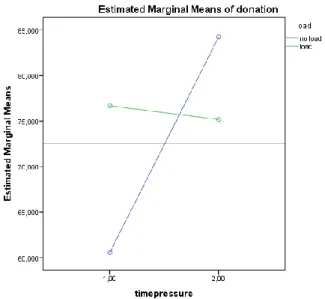
Although I did not have a hypothesis for an interaction effect, I did find a result that
resembles an interaction. Figure 1 shows this interaction (F(1,127) = 1.49, p = 0.225) between
cognitive load and time- pressure. Once you add time-pressure to cognitive load, thus
participants receive a double manipulation, the donations become less than the donations of
the participants who only receive the cognitive load manipulation.
15
5. Discussion
5.1. Findings
The main goal of this experiment was to examine whether the theory of Rand or the theory of
Kahneman held true. To test this question, two hypotheses were formulated. The first
hypothesis was based on the theory of Rand: donations will be higher under the use of System
1. The second hypothesis was based on the theory of Kahneman: donations will be lower
under the use of System 1. System 1 was manipulated using cognitive load and time-pressure.
Results of the independent two-way ANOVA showed that both my hypotheses were not
supported. This means that I had to search for explanations why all of my results were
non-significant, on which I will elaborate below.
5.2. Theoretical explanations
An important thing that has to be mentioned, is that the origin of the ideas of Kahneman are
hard to verify. Supporting experiments were not found and the exact theories where
Kahneman based his ideas on, were not clearly mentioned in both his books and articles.
Based on the available literature of Kahneman and his ideas of the effect of System 1 on
prosocial decisions, it is plausible that his ideas are only based on evolutionary ideas. Dickert,
Sagara and Slovic (2010; Dickert, 2008) conducted an experiment based on Kahneman’s idea
that System 2 can be suppressed by making someone cognitively busy, which we replicated,
and they could not support the idea of Kahneman that it makes a person more selfish either. In
fact, they found that people made higher donations under high cognitive load than under low
cognitive load. Although my results were not significant, the behavior of the participants
seemed to be more into the direction of the results that Dickert, Sagara and Slovic (2010;
Dickert, 2008) found than what Kahneman would predict. This makes it questionable how
16
The theories discussed in the introduction supported my hypotheses, but neglected the
influence of participants’ prior donating behavior. The effect of decision routines describes
the influence of previously decided behavior in similar cases (Betsch, Fiedler & Brinkmann,
1998). It aims that once a person had to decide over a similar situation in the past, he or she
figured out a working solution that becomes a behavioral routine which will be used later on
as well. The routine serves as first guess in many situations and is superior over other
strategies. It is likely that this strategy can be used under System 1, because System 1 is not
equipped to doubt (Kahneman, 2011). If this was the case with some of our participants, they
may have not made their decision at the moment we asked them to, because they already
knew what to do.
According to Dickert (2008), the effects of cognitive load on the emotional processing
within System 1 are not that straight-forward. He states that these effects depend partly on the
type of involved decisions and emotions. Dickert (2008) did some more research on donating
decisions and the underlying mechanisms of affective reactions, especially in case of where
these affective reactions guide the amount of donations. Affective reactions (in the specific
case of donations) are in their turn guided by the identification of victims and the number of
victims. He concludes that the amount of donations rise when a person is able to identify one
victim, so the person can exclusively attend to him or her. The entitativity and a vivid mental
image of that victim generates high affective reactions, which leads to higher donations.
System 1 becomes less engaged when the victims are numerically represented and thus
difficult to identify. In that case System 2 becomes relatively more important (Dickert, 2008).
Important note is that this is only the case for people who have a prosocial intention with
donating. It does not apply for people who have more egoistic reasons for helping and are thus
more self-focused. It is possible though to manipulate a shift of the focus on the self to others
17
objects and people in an affective manner prior to the donation task. However, his suggestion
is not based on data collected by his experiment, so further research is necessary.
5.2.1. Criticism on the dual-process theory
Lately there has been much criticism on the dual-process theory, on which my hypotheses are
based. The theory is criticized on the limited explanation of how System 1 and System 2 may
interact (Dhami and Thomson, 2012). One of these skeptics is Evans (2008). A point that he
makes is that emotions are set in System 1, but have a more slow and deliberative cognitive
basis. Emotions are fundamental for decision making, especially in charity. According to
Evans (2008), this would mean that System 2 was at the basis of the decision that was made in
our experiment.
Skeptics also state that System 1 is not one particular system with one particular
evolutionary history. They state that there is a single conscious working memory system
(System 2), which they find to be the only firm foundation of the dual-process theory, and that
there is ‘everything else’ of the information processing which cannot be categorized.
Kahneman refers to this as System 1 (Evans, 2008). Evans (2008) came to this statement by
the arguments that there are many forms of implicit processing (System 1) and that there are
multiple learning and memory systems (Carruthers, 2006; as described in Evans, 2008). Some
of these processes are evolutionary old and shared with animals, while others are more
modern and recent and particular for humans (think of language and the theory of mind). If it
is true that there are many different systems within the bigger System 1, which is probable
according to most skeptics, I cannot just assume that time-pressure and cognitive load
influence System 1 as a whole, like Kahneman and Rand state, but that they would only
18
the different systems, before I generalize the ideas of the systems Kahneman and Rand
investigated on all the other possible systems.
5.2.2. The cognitive continuum theory
Given all the criticism on the dual-process theory, the cognitive continuum theory of
Hammond (Evans, 2008) might be a better fit. Hammond states that the information
processing system is rather a continuum than two distinct processes. He describes a
continuum range with two ends: intuition and analysis, with quasi-rationality in the central
region. Hammond (1975; as described in Cader, Campbell & Watson, 2005) is also taking
situational influences into account within his theory. The dual-process theory where
Kahneman and Rand encounter on draws on processing information in general and loses little
on the way people eventually make decisions in particular situations.
There are some methodological inaccuracies that imply that at some points my
manipulations may have lost influence, which will be discussed below. When I look at the
means, I see that there has been a difference in donating behavior under both manipulations
into the direction of what Rand predicted, but it is not significant. This could mean that these
participants may have made their decision more intuitive than the participants without any
manipulation, but they did not move enough into the intuition part of the scale to make the
difference big enough for significance. In this case the dual-process theory may be
oversimplified and the cognitive continuum theory may be a better fit.
5.3. Methodological inaccuracies
Participants could have been a ‘victim’ of social proof (Cialdini, 2007; Shearman & Yoo,
2007) and followed the actions of others. At a few points in the research, more participants
19
experiment. I cannot guarantee that none of the participants who were signing in, did not see
the amount of money which the previous participants decided to keep, since I had to hand
over the amount. It is possible that the waiting participants followed the norm set by the
previous ones. In this case, our manipulation may have lost its influence.
Before taking part in our experiment, participants had the idea that they would get the
full €5 afterwards. During the experiment and before the manipulation took place, they were
told that the amount of money they would donate, would be subtracted from their final
compensation for participating. This means that before they thought about whether to donate
to charity under our manipulations, they already could have decided to keep the full amount
of money, because beforehand they assumed they would get that money. Thereby, people
perceive outcomes in terms of the value function of the prospect theory (Kahneman &
Tversky, 1979, as described in Thaler, 1999). It is possible been that the participants felt like
losing money if they donated, because they already counted on the money and thereby
decided not to donate. Due to this procedure our manipulation may have become less
influential, due to the interference of the effect of the prospect theory (Rand, Greene and
Nowak, 2012; Kahneman, 2011).
5.3.1. Effects of income and age
Several studies show that income is associated with donations. All of our participants were
students in the Netherlands and the income of students is generally lower than the income of
other adults (Maguire, Taylor & Gurmu, 2003; NIBUD, 20152). Pharoah & Tanner (1997)
suggest that this lower income explains why they donate less. Donations and income are
positively correlated, so they rise when income rises as well (Pharoah & Tanner, 1997; Hood,
2Consulted NIBUD, National Institution for Budget Education:
20
Martin & Osberg, 1977; Bussell & Forbes, 2002). Our database shows that 28.4% decided to
keep all the money for themselves, perhaps due to their low student income.
Besides that, our participants had an average age of 20.9. According to (Pharoah &
Tanner, 1997), only 10 per cent of people aged 18-24 give to charity. Pharoah and Tanner
(1997) even found a trend that younger households not only donate less than older households,
but young households now also donate less than the older households did when they were
younger. This could explain why the average donation in this experiment is relatively low
(M = 73.28 eurocents, SD = 58.21) and that more than one-quarter did not donate at all.
The total amount that our participants could donate was only €1,50. This is a relatively
small amount, given that the total monthly income of students in the Netherlands is €7683.
Laboratory experiments show that participants report more happiness when they gain a small
amount of money, than they report unhappiness when they had to imagine ‘losing’ (in our
experiment this would be donating) the same small amount (Harinck, Van Dijk, Van Beest &
Mersmann, 2007). According to the hedonic principle, people try to maximize their pleasure
(Harinck, Van Dijk, Van Beest & Mersmann, 2007). This might explain why 59.4% of our
participants chose to keep a bigger amount of money than what they donated.
5.4. Recommendations for further research
It would be interesting to have a closer look at the underlying motivations of people for
donating when testing the influence of System 1 on donations. As mentioned before, there are
several reasons why people donate. They can be divided into self-focused motivation or
other-focused motivation. According to Dickert (2008), the amount of donations will vary among
those types of motivations, even under the influence of System 1. When this will be studied in
3Consulted NIBUD, National Institution for Budget Education:
21
combination with replicating this study, a more varied sample of the Dutch population is
needed, given the effects of income and age on donation.
Given the criticism on the dual-process theory, it will be very interesting to test
whether the cognitive continuum is applicable for explaining prosocial behavior. Till now,
this theory is mostly literary studied in medical and managerial environments. Future research
should also focus on this theory in prosocial decision making and behavioral contexts.
5.5. Conclusion
Neither the theory of Rand nor the theory of Kahneman have been corroborated in this
experiment. Having the previous discussed criticism on the dual-process theory in mind, it is
probable that these processing systems do not operate in a black and white manner as
Kahneman and Rand predict. It is possible that in a perfect isolated situation those systems
indeed operate as Kahneman and Rand argue, but those isolated situations do not occur in
everyday life, so it would be difficult to eliminate System 2 completely in prosocial decision
making. Further research on the criticism and the cognitive continuum theory is necessary
before I make hard statements about this theory and prosocial behavior. Results can be very
interesting for charities to increase their collected donations. The trend that Pharoah and
Tanner (1997) mentioned, as described in the introduction, has to become reversed again so
that younger households in the future will spend more on donations again.
22
6. Reference list
Axelrod, R., Hamilton, W. D. (1981). The evolution of cooperation. Science, 211(4489),
1390-1396.
Basil, D. Z., Ridgway, N. M., Basil, M. D. (2008). Guilt and giving: a process model of
empathy and efficacy. Psychology & Marketing, 25(1), 1-23.
Betsch, T., Fiedler, K., & Brinkmann, J. (1998). Behavioral routines in decision making: The
effects of novelty in task presentation and time pressure on routine maintenance and
deviation. European Journal of Social Psychology, 28(6), 861-878.
Bussell, H., & Forbes, D. (2002). Understanding the volunteer market: The what, where, who
and why of volunteering. International journal of nonprofit and voluntary sector
marketing, 7(3), 244-257.
Biel, A., & Thøgersen, J. (2007). Activation of social norms in social dilemmas: A review of
the evidence and reflections on the implications for environmental behaviour. Journal
of economic psychology, 28(1), 93-112.
Brosnan, S. F., De Waal, F. B. M. (2002). A proximate perspective on reciprocal altruism.
Human Nature, 13(1), 129-152.
Cader, R., Campbell, S., & Watson, D. (2005). Cognitive Continuum Theory in nursing
decision-making. Journal of Advanced Nursing, 49(4), 397-405.
Cialdini, R. B. (2007). Influence: The psychology of persuasion. New York: Collins.
Dhami, M., K., & Thomson, M., E. (2012). On the relevance of Cognitive Continuum Theory
and quasirationality for understanding management judgment and decision making.
European Management Journal, 30, 316-326.
Dickert, S. (2008). Two routes to the perception of need: The role of affective vs. deliberative
information processing in prosocial behavior (Doctoral dissertation, University of
23
Dickert, S., Sagara, N., & Slovic, P. (2010). Affective motivations to help others: A
two‐stage model of donation decisions. Journal of Behavioral Decision Making,
24(4), 361-376.
Dunn, E., W., Aknin, L., B., & Norton, M., I. (2014). Prosocial spending and happiness:
using money to benefit others pays off. Current Directions in Psychological
Science, 23(1), 41-47.
Evans, J. S. B. (2003). In two minds: dual-process accounts of reasoning. Trends in cognitive
sciences, 7(10), 454-459.
Evans, J. S. B. (2008). Dual-processing accounts of reasoning, judgement, and social
cognition. Annual Review of Psychology, 59, 255-278.
Harinck, F., Van Dijk, E., Van Beest, I., & Mersmann, P. (2007). When gains loom larger
than losses reversed loss aversion for small amounts of money. Psychological
science, 18(12), 1099-1105.
Hinde, R. A., & Groebel, J. (1991). Cooperation and prosocial behaviour. Cambridge
University Press.
Hood, R. D., Martin, S. A., & Osberg, L. S. (1977). Economic determinants of individual
charitable donations in Canada. Canadian Journal of Economics, 4, 653-669.
Kahneman, D. (2011). Thinking, fast and slow. New York: Farrar, Straus and Giroux.
Kahneman, D., & Frederick, S. (2002). Representativeness revisited: Attribute substitution in
intuitive judgment. Heuristics and biases. The psychology of intuitive judgment, 49.
Kinnunen, S. P., & Windmann, S. (2013). Dual-processing altruism. Frontiers in psychology,
4.
Lay, J. C., Hoppman, C. A. (2015). Altruism and prosocial behavior. Encyclopedia of
24
Maguire, K. B., Taylor, L. O., & Gurmu, S. (2003). Do students behave like adults? Evidence
from valuation experiments. Applied Economics Letters, 10(12), 753-756.
Murninghan, J. K., Kim, J. W., & Metzger, A. R. (1993). The volunteer dilemma.
Administrative Science Quarterly, 515-538.
Nowak, M. A. (2006). Five rules for the evolution of cooperation. Science, 314(5805),
1560-1563.
Penner, L. A., Dovidio, J. F., Piliavin, J. A., & Schroeder, D. A. (2005). Prosocial behavior:
Multilevel perspectives. Annu. Rev. Psychol., 56, 365-392.
Pharoah, C., & Tanner, S. (1997). Trends in charitable giving. Fiscal Studies,18(4), 427-443.
Rand, D. G., Dreber, A., Ellingsen, T., Fudenberg, D., & Nowak, M. A. (2009). Positive
interactions promote public cooperation. Science, 325(5945), 1272-1275.
Rand, D. G., Greene, J. D., & Nowak, M. A. (2012). Spontaneous giving and calculated
greed. Nature, 489(7416), 427-430.
Schwartz, S. H. (2010). Basic values: How they motivate and inhibit prosocial
behavior. Prosocial motives, emotions, and behavior: The better angels of our
nature, 14, 221-41.
Shearman, S. M., & Yoo, J. H. (2007). “Even a penny will help!”: Legitimization of paltry
donation and social proof in soliciting donation to a charitable organization.
Communication Research Reports, 24(4), 271-282.
Small, D. A., Loewenstein, G., & Slovic, P. (2007). Sympathy and callousness: The impact of
deliberative thought on donations to identifiable and statistical victims. Organizational
Behavior and Human Decision Processes, 102(2), 143-153.
Thaler, R. H. (1999). Mental accouting matters. Journal of Behavioral Decision Making,
25
Verhaert, G. A., & Van den Poel, D. (2011). Empathy as added value in predicting donation behavior. Journal of Business Research, 64(12), 1288-1295.
Winterich, K. P., Mittal, V., & Ross Jr., W. T. (2009). Donation Behavior towards In-Groups
and Out-Groups: The role of gender and moral identity. Journal of Consumer