DIFFUSION OF META-ANALYSIS, SYSTEMATIC REVIEW, AND RELATED RESEARCH SYNTHESIS METHODS: PATTERNS, CONTEXTS, AND IMPACT
Laura Sheble
A dissertation submitted to the faculty at the University of North Carolina at Chapel Hill in partial fulfillment of the requirements for the degree of Doctor of Philosophy in the School of Information
and Library Science.
Chapel Hill 2014
Approved by:
Diane Kelly
Bradley M. Hemminger
Joanne Gard Marshall
Lokman I. Meho
ABSTRACT
Laura Sheble: Diffusion of Meta-Analysis, Systematic Review, and Related Research Synthesis Methods: Patterns, Contexts, and Impact
(Under the direction of Diane Kelly)
Like collaboration and interdisciplinary scholarship, research synthesis methods are used to integrate science knowledge. Unlike collaboration and interdisciplinary scholarship, research
synthesis is a scientific method researchers apply to systematically and explicitly integrate knowledge from primary research studies to estimate the best answer to a specific question based on
accumulated research findings. This study investigates the diffusion and impact of research synthesis methods at the macro- and meso-levels. At the macro-level, diffusion from 1972-2011 is described using bibliometric methods. Relatively modest engagement with the methods in the 1970s and 1980s was followed by increased engagement across a greater diversity of fields in the 1990s. Engagement with the methods continued to increase and spread across fields through the first decade of the 2000s. Engagement with research synthesis methods was strongly correlated with engagement with evidence-based practice (ρ=0.893, p < 0.001) and the number of years a field engaged with the
ACKNOWLEDGEMENTS
I am grateful to all of you who have, knowingly and not, contributed to my dissertation experience. This work would not have been possible, and there would not have been joy in doing it, without you.
Diane Kelly, thank you for being an ideal mentor. I discovered my dissertation topic through conversation with you, and this project benefitted greatly under your guidance in all the days that followed. Thank you again.
Brad Hemminger, Joanne Gard Marshall, Lokman Meho, and Barbara Wildemuth, together, you have been an ideal committee for this research. Your guidance and feedback have improved my research and stretched my perspectives on the impact of open science practices, evidence-based practice, bibliometrics and information resources, and research methods and practices.
your knowledge and engaging discussions.
Ismael Rafols, thank you for sharing your expertise on diversity and bibliometric mapping. Thank you, Joanne Marshall, for providing me the opportunity to attend graduate school with the Triangle Research Libraries Network (TRLN) Fellowship. Thanks also to Thomas Wall, and
colleagues at the Duke University Libraries and involved in the TRLN Fellows program, you were generous hosts. Gary Marchionini and Helen Tibbo, thank you for the opportunity to work on the VidArch Project, and Todd Vision, for continued support at NESCent.
I would like to thank my students: I have been inspired by your enthusiasm and the diversity of experiences and perspectives you shared in class. Thank you for your feedback and reflections on my work, and especially on your experience with the abbreviated systematic review assignments.
My friends and colleagues in the SILS Doctoral program, thank you. Carolyn Hank, Songphan Choemprayong, and Sanghee Oh, it has been some time, but our early projects were most enjoyable. Annie Chen, it has been terrific to work with you. Thank you for your contributions to coding for this project. Kathy Brennan, Yan Zhang, Dana Hanson-Baldauf, Amber Cushing, Rachael Clemens, and many others whom I have failed to name, you have been terrific comrades in this experience. It has been a delight and honor to learn from you.
To my long-time friends, Penny, Vernay, Rick, and Shannon: Thank you for always being there. Penny, thank you for drawing on your expertise for coding!
TABLE OF CONTENTS
LIST OF FIGURES ... XIII
LIST OF TABLES ... XVI
CHAPTER 1. INTRODUCTION ... 1
PURPOSE,OBJECTIVES, AND RESEARCH QUESTIONS ... 4
Stage I: Diffusion of Research Synthesis Methods ... 4
Stage II: Contexts of Diffusion and Adaptation ... 5
Stage III: Impact of Research Synthesis Methods ... 5
SIGNIFICANCE ... 6
CHAPTER 2. LITERATURE REVIEW ... 11
RESEARCH SYNTHESIS ... 11
Methods of research synthesis: Diversity and processes ... 13
Historical overview of research synthesis ... 15
FUNCTIONS OF REVIEWS AND RESEARCH SYNTHESES ... 22
DIFFUSION OF INNOVATIONS ... 24
Defining diffusion ... 26
Innovations ... 27
Communication ... 29
Diffusion of ideas over multiple dimensions of distance: Diffusion across populations ... 31
Consequences of innovation diffusion ... 36
Epidemiological analogies for the spread of ideas ... 37
Import and export of ideas: An economic analogy ... 38
Scientific and Intellectual Movements (SIMs Theory) ... 39
CHAPTER 3. STAGE I: DIFFUSION OF RESEARCH SYNTHESIS METHODS ... 42
DEFINITIONS ... 42
DATA COLLECTION ... 49
DATA ANALYSIS ... 50
RESULTS:DIFFUSION OF RESEARCH SYNTHESIS METHODS ACROSS SCIENCE FIELDS ... 51
Query sets: Summary of results and comparison of research strategies ... 51
Diffusion of research synthesis methods ... 58
Characteristics associated with research synthesis methods diffusion ... 76
TRANSITION FROM STAGE I TO STAGES II AND III ... 88
Selection of fields for more in-depth examination ... 88
Translation: From Web of Science categories to science fields ... 92
SUMMARY:STAGE IRESULTS ... 94
CHAPTER 4. STAGES II AND III: FIELD-LEVEL DIFFUSION CONTEXTS AND IMPACTS ... 96
STAGE II:DATA COLLECTION ... 98
Coding ... 98
Descriptive publication data ... 101
STAGE II:DATA SUMMARIZATION, ANALYSIS, AND VISUALIZATION ... 102
STAGE III:DATA COLLECTION ... 105
Citation and collaboration data ... 108
STAGE III:DATA ANALYSIS ... 109
DATA CLEANING ... 109
RELIABILITY ... 112
EVOLUTIONARY BIOLOGY ... 115
Findings: Research synthesis in the context of Evolutionary Biology ... 117
Impact: Shifts in practice ... 132
CONSERVATION BIOLOGY ... 133
Findings: Research synthesis in the context of Conservation Biology ... 135
Impact: Shifts in practice ... 150
SOCIAL WORK ... 151
Findings: Research synthesis in the context of Social Work ... 153
Impact: Shifts in practice ... 167
WOMEN’S STUDIES ... 170
Findings: Research synthesis in the context of Women’s Studies ... 171
Impact: Shifts in practice ... 179
INFORMATION AND LIBRARY SCIENCE ... 181
Findings: Research synthesis in the context of Information and Library Science ... 183
Impact: Shifts in practice ... 197
CONTEXTS OF DIFFUSION:CROSS-FIELD COMPARISON ... 199
Modes of engagement with research synthesis methods ... 200
Resources ... 209
Relationship to evidence-based practice and other intellectual movements ... 213
Characteristics of research and research concerns in the context of research synthesis ... 215
Impacts of research synthesis methods ... 220
CHAPTER 5. CONCLUSION ... 225
IMPLICATIONS ... 233
BROADER IMPLICATIONS:PROFESSIONAL PRACTICE AND OPEN SCIENCE ... 234
Implications for practice ... 234
Open science ... 235
LIMITATIONS ... 236
FUTURE RESEARCH ... 239
APPENDIX A. COMPARISON OF RESEARCH AREA AND WEB OF SCIENCE CATEGORIES ... 242
APPENDIX B. KEYWORD SEARCH PHRASES ... 250
APPENDIX C. SEED PUBLICATIONS ... 251
APPENDIX D. SEARCH STRATEGY DEVELOPMENT ... 255
APPENDIX E. EXAMPLE PANDAS CODE ... 257
APPENDIX F. SEARCH STRATEGY YIELDS BY YEAR ... 259
APPENDIX G. SEARCH STRATEGY YIELDS BY RESEARCH AREA ... 261
APPENDIX H: 2012 JOURNAL CITATION REPORTS TITLE LISTS ... 265
EVOLUTIONARY BIOLOGY ... 269
CONSERVATION BIOLOGY ... 273
SOCIAL WORK ... 277
WOMEN’S STUDIES ... 277
INFORMATION AND LIBRARY SCIENCE ... 278
APPENDIX J. TOPIC MODEL TERMS ... 280
APPENDIX K. ALTERNATIVE STAGE III DATA COLLECTION STRATEGY ... 291
EVOLUTIONARY BIOLOGY ... 293
CONSERVATION BIOLOGY ... 294
SOCIAL WORK ... 295
WOMEN’S STUDIES ... 296
INFORMATION AND LIBRARY SCIENCE ... 297
LIST OF FIGURES
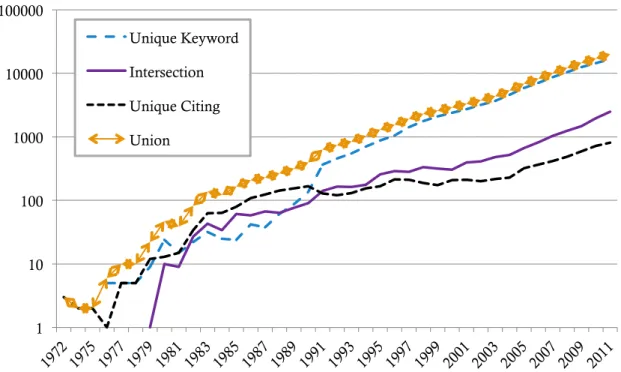
FIGURE 1.UNIQUE RECORDS RETRIEVED WITH KEYWORD AND CITING REFERENCE QUERIES, 1972-2011 ... 53
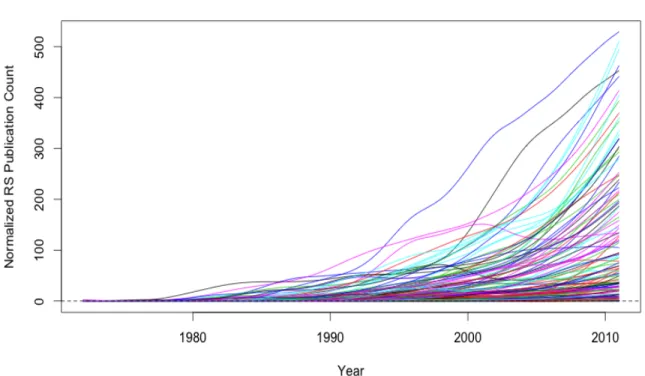
FIGURE 2.SPAGHETTI PLOT OF THE SECOND DERIVATIVE OF THE PUBLICATION YEAR-FIELD COUNTS ... 55
FIGURE 3.PROPORTION OF RECORDS RETRIEVED BY SEARCH STRATEGIES ... 58
FIGURE 4. YEAR OF FIRST RSM PUBLICATIONS ACROSS RESEARCH FIELDS. ... 59
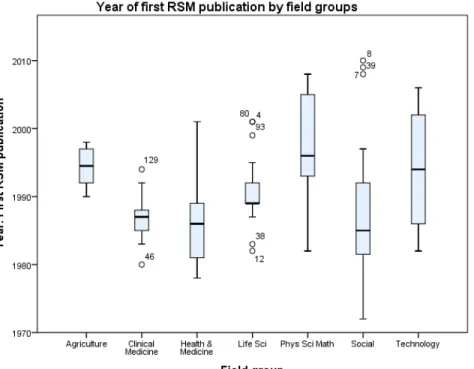
FIGURE 5.YEAR OF FIRST RSM PUBLICATION BY GROUPS FOR FIELDS WITH A “FIRST YEAR” PUBLICATION. ... 61
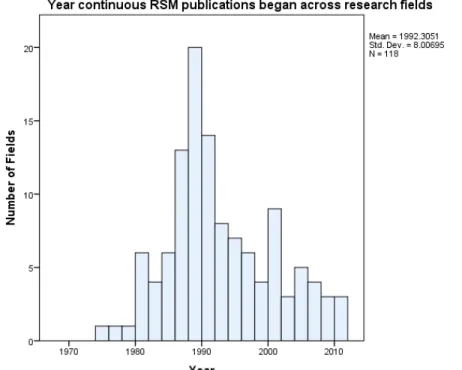
FIGURE 6.FIRST YEAR OF CONTINUOUS RSM PUBLICATION ACROSS RESEARCH FIELDS RANGES 1975-2010 ... 62
FIGURE 7.YEAR CONTINUOUS RSM PUBLICATION BEGAN BY FIELD GROUPS. ... 64
FIGURE 8. ADOPTION CURVE: WHEN CONTINUOUS RSM PUBLICATIONS BEGAN BY FIELDS AND FIELD GROUPS ... 65
FIGURE 9. COUNT OF RSM PUBLICATIONS ACROSS FIELDS ... 68
FIGURE 10.RATE OF RESEARCH SYNTHESIS PUBLICATION DIFFERS ACROSS SCIENCE FIELDS ... 71
FIGURE 11. VELOCITY OF RESEARCH SYNTHESIS PUBLICATIONS IN SCIENCE FIELDS ... 71
FIGURE 12A.RSM DIFFUSION PROJECTED ON A SCIENCE CITATION MAP, 1972-1991 ... 74
FIGURE 12B.RSM DIFFUSION PROJECTED ON A SCIENCE CITATION MAP, 1992-2011 ... 75
FIGURE 13.RELATIONSHIP BETWEEN PROPORTIONS OF EBP- AND RSM-RELATED PUBLICATIONS ... 78
FIGURE 14.NUMBER OF EBP PUBLICATIONS PER 10,000 PUBLICATIONS ... 80
FIGURE 15.PROPORTION OF REVIEWS BY FIELD AND FIELD GROUP ... 82
FIGURE 16. SCATTER PLOT OF REVIEW PREVALENCE AND ENGAGEMENT WITH RSM ... 84
FIGURE 17. COMPLEMENTARY CHARACTERISTICS OF SELECTED FIELDS ... 91
FIGURE 18. PRIMARY, SECONDARY, OR NO RELATIONSHIP WITH RSM: PERCENT OF PUBLICATIONS BY FIELD ... 111
FIGURE 19. EVOLUTIONARY BIOLOGY: DISTRIBUTION OF PUBLICATIONS ACROSS JOURNALS ... 118
FIGURE 21. EVOLUTIONARY BIOLOGY: NUMBER OF PUBLICATIONS, MODES OF ENGAGEMENT, BY YEAR ... 121
FIGURE 22. TOPICS ASSOCIATED WITH RESEARCH SYNTHESIS IN EVOLUTIONARY BIOLOGY ... 128
FIGURE 23. CONSERVATION BIOLOGY: DISTRIBUTION OF PUBLICATIONS ACROSS JOURNALS ... 136
FIGURE 24.CONSERVATION BIOLOGY:KNOWLEDGE BASE OF RSM-RELATED PUBLICATIONS ... 139
FIGURE 25. CONSERVATION BIOLOGY: NUMBER OF PUBLICATIONS, MODES OF ENGAGEMENT, BY YEAR ... 140
FIGURE 26. TOPICS ASSOCIATED WITH RESEARCH SYNTHESIS IN CONSERVATION BIOLOGY ... 149
FIGURE 27. SOCIAL WORK: DISTRIBUTION OF PUBLICATIONS ACROSS JOURNALS ... 154
FIGURE 28. SOCIAL WORK: KNOWLEDGE BASE OF RSM-RELATED PUBLICATIONS ... 156
FIGURE 29. SOCIAL WORK: NUMBER OF PUBLICATIONS, MODES OF ENGAGEMENT, BY YEAR ... 157
FIGURE 30. TOPICS ASSOCIATED WITH RESEARCH SYNTHESIS IN SOCIAL WORK ... 166
FIGURE 31.WOMEN’S STUDIES:DISTRIBUTION OF PUBLICATIONS ACROSS JOURNALS ... 172
FIGURE 32.WOMEN’S STUDIES:KNOWLEDGE BASE OF RSM-RELATED PUBLICATIONS ... 174
FIGURE 33. WOMEN’S STUDIES: NUMBER OF PUBLICATIONS, MODES OF ENGAGEMENT, BY YEAR ... 175
FIGURE 34. TOPICS ASSOCIATED WITH RESEARCH SYNTHESIS IN WOMEN’S STUDIES ... 179
FIGURE 35. INFORMATION AND LIBRARY SCIENCE: DISTRIBUTION OF PUBLICATIONS ACROSS JOURNALS ... 184
FIGURE 36. INFORMATION AND LIBRARY SCIENCE: KNOWLEDGE BASE OF RSM-RELATED PUBLICATIONS ... 186
FIGURE 37. INFORMATION AND LIBRARY SCIENCE: NUMBER OF PUBLICATIONS, MODES OF ENGAGEMENT ... 187
FIGURE 38. TOPICS ASSOCIATED WITH RESEARCH SYNTHESIS IN INFORMATION AND LIBRARY SCIENCE ... 196
FIGURE 39.MODES OF ENGAGEMENT WITH RESEARCH SYNTHESIS METHODS, BY FIELD ... 201
FIGURE 40.RELATIVE EXTENT OF DIFFUSION WITHIN RESEARCH FIELDS ... 207
FIGURE 41. TIMING, EXTENT, AND MODES OF ENGAGEMENT WITH RESEARCH SYNTHESIS METHODS ... 208
FIGURE K2. SCOPUS APPROACH: CONSERVATION BIOLOGY PUBLICATIONS BY YEAR ... 294
FIGURE K1. SCOPUS APPROACH: SOCIAL WORK PUBLICATIONS BY YEAR ... 295
FIGURE K1. SCOPUS APPROACH: EVOLUTIONARY BIOLOGY PUBLICATIONS BY YEAR ... 296
LIST OF TABLES
TABLE 1. PROCESSES OF RESEARCH SYNTHESIS FROM TWO DIVERSE PERSPECTIVES ... 14
TABLE 2. SEARCH AND PRE-PROCESSING OF RESULT SETS ... 53
TABLE 3. YEAR OF FIRST RSM PUBLICATION BY FIELD GROUPS ... 60
TABLE 4. YEAR CONTINUOUS RSM PUBLICATION BEGAN BY FIELD GROUPS ... 63
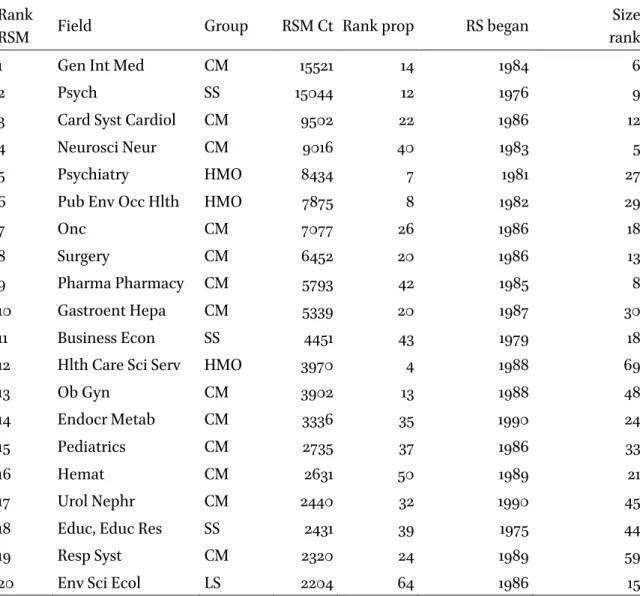
TABLE 5. RESEARCH FIELDS WITH THE GREATEST NUMBER OF RSM PUBLICATIONS ... 67
TABLE 6. NUMBER OF RESEARCH SYNTHESIS PUBLICATIONS ... 69
TABLE 7. RSM PUBLICATIONS PER 10,000 PUBLICATIONS FROM THE YEAR OF CONTINUOUS RSM USE ... 69
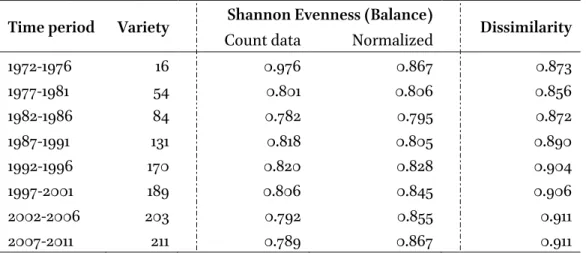
TABLE 8. DIVERSITY OF SCIENCE FIELDS ENGAGED WITH RSM OVER TIME. ... 72
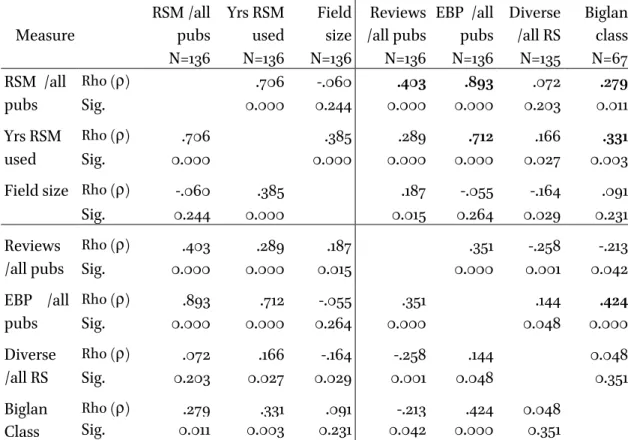
TABLE 9. BIVARIATE SPEARMAN’S RHO (ρ) CORRELATIONS ... 77
TABLE 10. DIVERSE RESEARCH SYNTHESIS METHODS ... 85
TABLE 11. MACRO-LEVEL OVERVIEW OF FIELD CHARACTERISTICS ... 92
TABLE 12. WEB OF SCIENCE CATEGORY SCOPE NOTES FOR SELECTED FIELDS ... 93
TABLE 13. CODING CATEGORIES ASSIGNED TO SAMPLE RESEARCH SYNTHESIS PUBLICATIONS ... 100
TABLE 14. PUBLICATIONS FOR CODING BY MULTIPLE CODERS, BY FIELD ... 101
TABLE 15. DATA EXTRACTED FROM S/SCI RECORDS WITHOUT CODER INTERMEDIATION ... 102
TABLE 16.CATEGORIES ASSIGNED TO PUBLICATIONS OF DOCUMENT TYPE “REVIEW” ... 106
TABLE 17. DIRECTNESS OF RELATIONSHIP WITH RESEARCH SYNTHESIS METHODS BY FIELD ... 110
TABLE 18. INTER-RATER AGREEMENT ... 114
TABLE 19. EVOLUTIONARY BIOLOGY JOURNALS WITH THE MOST RSM-RELATED PUBLICATIONS ... 117
TABLE 20. EVOLUTIONARY BIOLOGY: DIVERSITY OF FIELDS REFERENCED ... 120
TABLE 22. MOST PROLIFIC AUTHORS, TOPICS STUDIED, AND ASSOCIATED ORGANISMS ... 131
TABLE 23. SUMMARY STATISTICS: IMPACTS ASSOCIATED WITH USE OF RESEARCH SYNTHESIS ... 132
TABLE 24. CONSERVATION BIOLOGY JOURNALS WITH THE MOST RSM-RELATED PUBLICATIONS ... 136
TABLE 25.CONSERVATION BIOLOGY:DIVERSITY OF FIELDS REFERENCED ... 139
TABLE 26. MODES OF ENGAGEMENT WITH RESEARCH SYNTHESIS IN CONSERVATION BIOLOGY ... 140
TABLE 27. NUMBER OF REVIEWS AND SYNTHESES, BY YEAR ... 150
TABLE 28. SUMMARY STATISTICS: IMPACTS ASSOCIATED WITH USE OF RESEARCH SYNTHESIS ... 150
TABLE 29. SOCIAL WORK JOURNALS WITH THE MOST RSM-RELATED PUBLICATIONS ... 154
TABLE 30. SOCIAL WORK: DIVERSITY OF FIELDS REFERENCED ... 155
TABLE 31. MODES OF ENGAGEMENT WITH RESEARCH SYNTHESIS IN SOCIAL WORK ... 156
TABLE 32.NUMBER OF REVIEWS AND SYNTHESES, BY YEAR ... 167
TABLE 33.SUMMARY STATISTICS:IMPACTS ASSOCIATED WITH USE OF RESEARCH SYNTHESIS ... 168
TABLE 34. WOMEN’S STUDIES JOURNALS WITH THE MOST RSM-RELATED PUBLICATIONS ... 172
TABLE 35. WOMEN’S STUDIES: DIVERSITY OF FIELDS REFERENCED ... 173
TABLE 36. MODES OF ENGAGEMENT WITH RESEARCH SYNTHESIS IN WOMEN’S STUDIES ... 174
TABLE 37. NUMBER OF REVIEWS AND SYNTHESES, BY YEAR ... 180
TABLE 38. SUMMARY STATISTICS: IMPACTS ASSOCIATED WITH USE OF RESEARCH SYNTHESIS ... 180
TABLE 39. INFORMATION AND LIBRARY SCIENCE JOURNALS WITH THE MOST RSM-RELATED PUBLICATIONS ... 184
TABLE 40.INFORMATION AND LIBRARY SCIENCE:DIVERSITY OF FIELDS REFERENCED ... 185
TABLE 41.MODES OF ENGAGEMENT WITH RESEARCH SYNTHESIS IN INFORMATION AND LIBRARY SCIENCE ... 186
TABLE 42. NUMBER OF REVIEWS AND SYNTHESES, BY YEAR ... 198
TABLE 44. MODES OF ENGAGEMENT WITH RESEARCH SYNTHESIS METHODS, BY FIELD ... 202
TABLE 45. RELATIVE BALANCE OF RESEARCH SYNTHESIS PUBLICATIONS ACROSS JOURNALS ... 206
TABLE 46. RESOURCES ASSOCIATED WITH RESEARCH SYNTHESIS ... 210
TABLE 47.INTERSECTION OF RESEARCH SYNTHESIS METHODS AND EVIDENCE BASED PRACTICE ... 214
TABLE 48. RESEARCH RELATED ISSUES ... 215
TABLE 49. RESEARCH CONCERNS ACROSS FIELDS ... 219
TABLE 50. COLLABORATION PATTERNS ASSOCIATED WITH RESEARCH SYNTHESES AND REVIEWS ... 221
TABLE 51. CITATION OF REVIEWS AND RESEARCH SYNTHESES PRODUCED 2006-2008, AT 5 YEARS ... 222
TABLE 52. COMPARABLE DOCUMENT TYPES AND EXTENT OF ENGAGEMENT WITH PAST RESEARCH ... 223
TABLE A1. WOS CATEGORIES AND RESEARCH AREAS WITH APPROXIMATELY ONE-TO-ONE RELATIONSHIPS ... 243
TABLE A2.RESEARCH AREAS THAT CONTAIN TWO OR THREE WEB OF SCIENCECATEGORIES ... 246
TABLE A3.RESEARCH AREAS THAT CONTAIN FOUR OR MORE WEB OF SCIENCECATEGORIES ... 247
TABLE C1. SEED PUBLICATIONS, SEARCH PHRASES, AND RECORDS IDENTIFIED ... 251
TABLE D1. SEARCH WORKSHEET FOR OCLC WORLDCAT ... 256
TABLE F1. NUMBER OF RECORDS RETRIEVED WITH SEARCH STRATEGIES BY YEAR. ... 259
TABLE F2. PROPORTIONAL CONTRIBUTIONS OF KEYWORD VERSUS CITED REFERENCE SEARCHES ... 260
TABLE G1. RECORDS RETRIEVED BY SEARCH STRATEGY AND BY SUBJECT CATEGORY ... 261
TABLE H1. EVOLUTIONARY BIOLOGY JOURNAL TITLES ... 265
TABLE H2.BIODIVERSITY CONSERVATION JOURNAL TITLES ... 266
TABLE H3.SOCIAL WORK JOURNAL TITLES ... 266
TABLE H4. WOMEN’S STUDIES JOURNAL TITLES ... 267
TABLE I1. PUBLICATION VENUES OF SUPPORTED PROJECTS IN EVOLUTIONARY BIOLOGY ... 269
TABLE I2. ORGANIZATIONS RECOGNIZED IN FUNDING TEXT AND YEARS OF PUBLICATIONS ... 270
TABLE I3. PUBLICATION VENUES OF SUPPORTED PROJECTS IN CONSERVATION BIOLOGY ... 273
TABLE I4.ORGANIZATIONS RECOGNIZED IN FUNDING TEXT AND YEARS OF PUBLICATIONS ... 273
TABLE I5. ORGANIZATIONS RECOGNIZED IN FUNDING TEXT AND YEARS OF PUBLICATIONS ... 277
TABLE I6. ORGANIZATIONS RECOGNIZED IN FUNDING TEXT AND YEARS OF PUBLICATIONS ... 278
TABLE J1. EVOLUTIONARY BIOLOGY TOPICS ... 280
TABLE J2. CONSERVATION BIOLOGY TOPICS ... 282
TABLE J3. SOCIAL WORK TOPICS ... 284
TABLE J4. WOMEN’S STUDIES TOPICS ... 286
TABLE J5.INFORMATION AND LIBRARY SCIENCE TOPICS ... 289
TABLE K1.RECORD PROCESSING YIELDS (REVIEWS,2006-2011) ... 292
TABLE K2. COMPARISON GROUP PUBLICATION COUNTS ... 292
TABLE K3. EVOLUTIONARY BIOLOGY REVIEWS AND SYNTHESES BY YEAR ... 293
TABLE K4. CONSERVATION BIOLOGY REVIEWS AND SYNTHESES BY YEAR ... 294
TABLE K5. SOCIAL WORK REVIEWS AND SYNTHESES BY YEAR ... 295
TABLE K6. WOMEN’S STUDIES REVIEWS AND SYNTHESES BY YEAR ... 296
CHAPTER 1. INTRODUCTION
Like collaboration and interdisciplinary scholarship, research synthesis methods are used to integrate science knowledge. Unlike collaboration and interdisciplinary scholarship, research
synthesis is a scientific method researchers apply to systematically and explicitly integrate knowledge from primary research studies to estimate the best answer to a specific question based on the
accumulation of scientific findings. Additionally, research synthesis methods are often used with the intention of translating research-based knowledge for use in professional practice and policy contexts.
Following the development of contemporary procedures of research synthesis methods in the 1970s by psychology and education researchers, the methods, under the labels “systematic review” and “meta-analysis” became an integral component of the evidence-based practice (EBP) movement that revolutionized how research is done in the health and medical sciences. In psychology, research synthesis is credited with providing empirical procedures that enable cumulation of knowledge (Hedges, 1987). Diffusion of the methods has been driven in part by the EBP movement, and in part by beliefs in the benefits of the accumulation of scientific knowledge and consensus formation.
Receptivity across science fields has varied.
understandings gained through methods or processes that are not congruent with prevalent forms of research synthesis are at best, ignored; at worst, delegitimized.
The politics of knowledge notwithstanding, research synthesis has changed approaches to research integration within and at the boundaries of many fields of science. This is consequential for Information and Library Science because use of the method requires intensive use of information systems by researchers; and changes in research practices associated with the method may affect bibliometric patterns.
In work focused on the impact of research synthesis, Murphy (2003) and DeGeest and Schmidt (2010) examined developments in the field of industrial and organizational psychology following adoption of psychometric validity generalization meta-analysis beginning in the late 1970s1;
Miller and Pollock (1994a) analyzed the challenges and potential benefits of meta-analysis as an innovation in social psychology; and Boyle (2012) examined the transformation of research methods and research culture in complementary and alternative medicine (CAM) during the period in which the Office of Alternative Medicine (OAM)2 and funding for complementary and alternative medicine
were initiated at the National Institutes of Health (NIH). Cadotte, Mehrkens, and Menge (2012) found that in ecology, the number of papers, datasets, species, and range of publication dates has increased in meta-analytic studies over time; and that meta-analyses, when compared to papers in the same issue of the same journal, are written by larger groups of authors. About 15% of these authors were associated with a synthesis center (e.g., the National Center for Ecological Analysis and Synthesis, NCEAS).
Recently, a few comparative studies have been performed: Researchers in criminal justice (Wells, 2009) and social work (Lundahl & Yaffe, 2007) examined trends in the use of meta-analysis in their own fields versus that of others. Wells found adoption of meta-analysis in criminal justice was lagging that in psychology and sociology; and Lundahl and Yaffe found production and commentary on meta-analyses in social work lagged that of psychiatry, psychology, and nursing; but was similar to
1 Psychometric validity generalization (VG) meta-analysis is a type of meta-analysis “conducted to determine
whether a particular psychological construct, test, or measure” is a valid predictor across a variety of contexts
family studies. Meanwhile, in the medical and health sciences, systematic reviews of systematic reviews (umbrella reviews or overviews) (Smith, Devane, Begley, & Clarke, 2011) have arrived (Moore & Jull, 2006), though there continue to be questions about the scalability of the systematic review approach as it is currently implemented (Bastian, Glasziou, & Chalmers, 2010), as well as whether different types of reviews and research syntheses are better for different purposes (Card, 2012; Dijkers, 2009; Gurevitch, Curtis, & Jones, 2001).
Purpose, Objectives, and Research Questions
The intent of this study is to describe the diffusion of research synthesis across science;
examine and compare contextual factors within and across science fields that may influence adoption and lead to methodological adaptations; and investigate whether and how research synthesis has affected research practices as reflected in collaboration and citation patterns. This study was conducted in three stages, briefly outlined below.
Stage I: Diffusion of Research Synthesis Methods
guided by the following research question:
RQ 1: When and to what extent has research synthesis diffused across fields of science?
Stage II: Contexts of Diffusion and Adaptation
Though we often describe patterns of diffusion at the macro level, the decisions to adopt and adapt innovations occur in specific contexts. In Stage II of this research, I investigate the intersection of a select number of fields and research synthesis in more depth. Goals of this stage are to refine estimates of diffusion and develop an understanding of the contexts of research fields as they relate to the extent and nature of diffusion and adaptation within the fields. Selection of fields for this meso-level examination of diffusion of research synthesis methods is informed by observations at the macro level. The four selected fields are paired within the biological and social sciences; and based on the extent to which research is typically more “pure” or “applied”. A fifth field, Information and Library Science (ILS), was selected in advance because key research problems in ILS align with procedures essential to performing research synthesis, including literature search and retrieval and information organization and management. Three questions guide Stage II:
RQ2.1. To what extent has research synthesis diffused within the selected fields? RQ2.2. How do field contexts influence adoption and use of research synthesis?
RQ2.3. What trends emerge when adoption and use are examined across science fields?
Stage III: Impact of Research Synthesis Methods
published reviews and syntheses as reflected in citation patterns. Stage III research was guided by the following research questions:
RQ 3.1: How do research syntheses and traditional literature reviews differ in terms of the number of collaborating authors?
RQ 3.2: How do research syntheses and traditional literature reviews differ in terms of the extent to which they are used by researchers?
RQ 3.3 What do findings of RQ3.1 and RQ3.2 reveal when compared across science fields?
Significance
approaches to facilitate literature retrieval (Harris, Beatty, Lecy, Cyr, & Shpiro, 2011) for the purposes of review and research synthesis has been recognized by researchers in their own fields. These topics have received some direct attention in ILS research (Chen & Chen, 2005; Dang et al., 2009; Hood & Wilson, 2001; Porter, Kongthon, & Lui, 2002; Small, 1986), and are strongly related to broader research interests in specialties that focus on information retrieval, scholarly communications, bibliometrics, and science literature visualization. ILS skills and research are relevant to the practice and continued development of the methods research synthesis. In the health sciences and medicine, ILS
practitioners play key roles as consultants to and members of research teams that perform research syntheses (Beverley, Booth, & Bath, 2003; Harris, 2005; Knight & Brice, 2006; McKibbon, 2006; Shell, Hofstetter, Carlock, & Amani, 2006; Swinkels, Briddon, & Hall, 2006).
Increased use of research synthesis may affect construction, perceptions, and use of research reviews. To date, reviews have generally been treated as a relatively homogeneous type of publication in science literature studies, though this does not necessarily reflect perspectives across science fields. Traditional narrative reviews may be replaced by research syntheses; or writers of traditional reviews may selectively adopt characteristics of research synthesis. Finally, in some fields, researchers have suggested that secondary analysis of data collected in the context of multiple studies should be considered a type of research synthesis (e.g., individual participant data (IPD) meta-analysis, Cooper & Patall, 2009; Riley, Lambert, & bo-Zaid, 2010; Mengersen, Gurevitch, & Schmid, 2013), which suggests links with data archiving and curation research.
the citation system (Persson, Glänzel, & Danell, 2004; Wallace, Larivière, & Gingras, 2009), including trends towards increasing levels of co-authorship (Cronin, 2001; Leahey & Reikowsky, 2008; Morris & Goldstein, 2007; Persson, et al., 2004) and shifts in how research is used and evaluated. In some fields, collaboration is considered beneficial to literature review and synthesis activities because (a) it enables triangulation between researcher evaluations of the relevance and quality of research, (b) the large scale of some research synthesis projects, and (c) needs for multiple types of expertise as it relates to topic-based knowledge and role differentiation associated with instrumental
specializations. Review practiced as a collaborative research study differs substantially from the traditional notion of reviews as a genre dominated by expert researchers using the sole authorship model to share perspective as well as research-informed expertise (Peters & van Raan, 1994; c.f., Cooper, 1986) to “shape the literature of a field into a story in order to enlist the support of readers to continue that story” (Myers, 1991, p. 45).
Beliefs related to hierarchies of evidence that are based on research design, and expectations regarding the most appropriate types of research to reference may influence how researchers select papers to reference; and how those selections are evaluated by others. Examination of a set of
Communications Board Working Group, 2008) or based on beliefs related to hierarchies of evidence, which often place systematic reviews at or near the top (see, e.g., Merlin, Weston, & Tooher, 2009), suggest that research synthesis may indirectly impact citation patterns (Bhandari et al., 2004;
Montori, Wilczynski, Morgan, Haynes, & the Hedges Team, 2003; Patsopoulos, Analatos, & Ioannidis, 2005).
This study has the potential to contribute to diffusion research within ILS. There have been a few studies of diffusion processes across science at a broad level (e.g., Kiss, Broom, Craze, & Rafols, 2010), that focus on research methods (Tonta & Darvish, 2010) or topics related to research evaluation (e.g., Zhang, Thijs, & Glänzel, 2011), and that incorporate a comparative approach (e.g., Martens, 2011). This research seeks to focus these approaches on a topic that has had broad implications for research in a number of fields. By examining the impact – or outcomes of the use of research synthesis,
conceptualized as shifts in practice when compared to reviews as measured by citations, I corroborate whether, to what extent, and how use of research synthesis methods is important from the
perspective of the audience of research authors. Similarly, through examination of collaboration patterns, this study will provide evidence on whether and to what extent collaborative practices have shifted with the adoption of the methods. Focus on variation and outcomes in a comparative context provides the opportunity to examine how disciplinary cultures and practices moderate use and acceptance of research synthesis, and perhaps enables us to theorize how contextual factors limit and facilitate acceptance of this complex type of innovation.
with the evaluation and publication of reviews, and researchers interested in scientific integration and synthesis more broadly. There has been relatively little research related to the diffusion of research methods and practices in general. The current research has the potential to add to this literature and further our knowledge of how methods diffuse, which may be of interest to
CHAPTER 2. LITERATURE REVIEW
The literature reviewed below provides an overview of research synthesis, the diffusion of innovations, the conceptual framework that guides this inquiry, and the functions of research synthesis and traditional literature review in scholarly communications. Literature on research synthesis and diffusions is vast, and therefore I have selected research most relevant to my study. I have included a somewhat extended discussion of the historical development of research synthesis – which centers primarily on psychology and medical and health sciences, fields that contributed heavily to the early development of research synthesis – to contextualize the diffusion process and suggest important factors related to the diffusion of this family of methods.
Research synthesis
Research synthesis is a document-based empirical research method in which primary
research reports are analyzed with the goal of generating new knowledge or interpretations. Research synthesis involves formulating a research problem, retrieving relevant literature, evaluating,
those conducting the study. As a documentary method in which reports of previous research studies form the basis of evidence, the characteristics of a synthesis will be determined in part by the nature and extent of previous studies; and the availability and documentation of these studies in reports.
The “synthesist” (Cooper & Hedges, 2009) uses recorded research reports as surrogates for direct observation (Alvarez-Dardet & Ruiz, 1993). In a sense, documents serve as a bridge that affords the researcher access to the primary study, mediated by the researcher, documentary genre
conventions, and systems that enable access to reports (Platt, 2006). Oxman (1994) likens the process of research synthesis to a survey: “In a review a question must be posed, a target population of
information sources identified and accessed, appropriate information obtained from that population in an unbiased fashion, and conclusions derived” (¶13). Oxman’s description highlights the similarity of the process of research synthesis to that of other methods of empirical research. A close
examination will also reveal that research synthesis, like other methods, offers the researcher opportunities for creativity, and necessitates potentially difficult decisions.
(Chamberlin, 1890; Pawson, 2006), or develop theory (Lajeunesse, 2010; Miller & Pollock, 1994b; Pawson, 2006). Researchers have augmented syntheses with novel primary data collection. For example, in a study designed to compare three models purported to explain the relationship between negative mood and helping behaviors, Carlson and Miller (1987) incorporated assessments made by expert judges to examine the degree to which theoretical variables presented in models received empirical support in experimental contexts as documented in research reports.
Methods of research synthesis: Diversity and processes
In the case of research synthesis, epistemic and ontic beliefs are revealed by how the method is used, from criteria used to select primary studies, study evaluation or appraisal, analysis, synthesis (or interpretation), and presentation (or representation) of findings. Research syntheses that can broadly be described as post-positivist are prevalent in research fields such as medicine and
psychology, which are also the most prolific producers of research syntheses. This tradition generally focuses on synthesizing quantitative evidence from primary research, though some studies
incorporate qualitative research either through quantitative analysis of qualitative data, or by using qualitative findings to inform or structure the synthesis. Research synthesis methods developed for an interpretive perspective include Noblit and Hare (1988; Thorne, Jensen, Kearney, Noblit, &
Sandelowski, 2004). Realist synthesis can be considered a third category. Realism is sometimes discussed as a “middle road” between post-positivist naturalism and relativism (e.g., interpretivism), perhaps because both quantitative and qualitative data are compatible with a realist perspective – though this is a simplistic view of realism (see, e.g., Elster, 2007; Hedström & Swedberg, 1998).
developed such that it may be more accurate to refer to research synthesis as a family of methods that a researcher may adopt in the context of research in which s/he believes analysis of data from reports of prior studies is likely to culminate in new knowledge or understandings of central interest to a question or problem. Across different types of synthetic studies, researchers generally strive for transparency; and develop an inquiry such that it may be described procedurally. Different
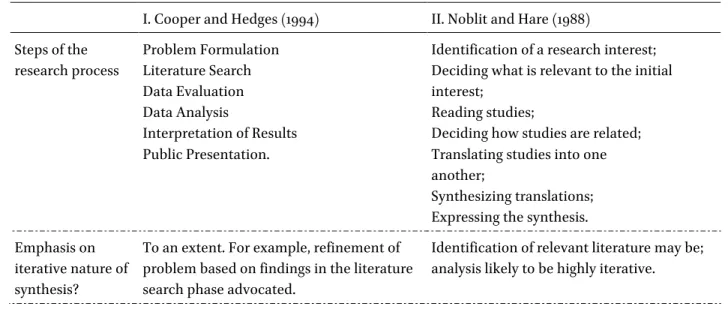
approaches diverge in how procedural components are implemented, the nature and timing of steps, and other factors such as the degree to which the steps may be iterative. Table 1 presents research synthesis as presented by Cooper and Hedges (1994) from a post-positivist orientation; and Noblit and Hare (1988) from a meta-ethnographic interpretivist orientation. This presentation is intended to illustrate the processes of two select but diverse approaches to research synthesis in summary form. Similarity between (I) Cooper and Hedges (1994, 2009) and (II) Noblit and Hare (1988) may be traced in part to the influence of Cooper and Hedges on Noblit and Hare (Thorne et al., 2005). However, similarities in processes across research synthesis methods are noted in methodological writings by several authors (e.g., Gough, 2004).
Table 1. Processes of research synthesis from two diverse perspectives
I. Cooper and Hedges (1994) II. Noblit and Hare (1988)
Steps of the research process
Problem Formulation Literature Search Data Evaluation Data Analysis
Interpretation of Results Public Presentation.
Identification of a research interest; Deciding what is relevant to the initial interest;
Reading studies;
Deciding how studies are related; Translating studies into one another;
Synthesizing translations; Expressing the synthesis.
Emphasis on iterative nature of
To an extent. For example, refinement of problem based on findings in the literature
I. Cooper and Hedges (1994) II. Noblit and Hare (1988)
Criticisms Narrow range of research designs considered.
Literature selection purposive. If repeated, different results likely.
Historical overview of research synthesis
Historical accounts identify the 1960s and 1970s as critical to the development of research synthesis (e.g., Glass, McGaw & Smith, 1981). A turning point was reached when Gene Glass described the statistical analysis of findings from a large number of independent studies in a presidential address to the American Educational Research Association (Kulik & Kulik, 1988) and subsequently published two landmark papers. In the first, Glass (1976) discussed the difference between primary data analysis, secondary data analysis, and “meta-analysis”, a term he coined to describe the use of statistical methods to examine the results of multiple compatible primary studies in combination and synthesize the data. The second paper, by Smith and Glass (1977), used meta-analytic techniques to adjudicate between conflicting opinions expressed in reviews about the relative efficacy of drug treatments alone versus drug treatments with psychotherapy for psychological disorders. In
combination, these publications served to heighten awareness of meta-analysis (Kulik & Kulik, 1988). While Glass notes (Glass, McGaw & Smith, 1981) that others, including Robert Rosenthal and Light and Smith (1971), had been working with similar methods at the time, most prior work might be described as the “pre-history” of research synthesis though this might be due more to a lack of continuity, connection, and widespread awareness of other work rather than large conceptual differences between meta-analytic approaches and prior statistical analyses of primary research reports (see, e.g., Cochran, 1937; Leitch, 1958).
research synthesis include methodological advances – especially from statistics – and early reviews that used systematic approaches to literature review and integration. More recently, Bastian, Glasziou, and Chalmers (2010) provided a broader perspective of the history of “the development of trials and the science of reviewing trials” (p. 2) in medicine, which includes the development of information indexes and systems (e.g., Index Medicus, MEDLINE, trial registries), organizations (e.g., the Office of Technology Assessment (OTA), the Cochrane Collaboration, the Agency for Healthcare Research Quality Evidence-based Practice Centers (AHRQ - EPC)), regulations (e.g., Food and Drug Administration Amendments Act of 2007), and guidelines such as evidence hierarchies, practice guidelines, publication guidelines (e.g., MARS3, JARS4, MAER-Net5), and reporting standards (e.g.,
PRISMA6, MOOSE7, QUORUM8), in addition to landmark studies and publications.
Within science, diffusion of enabling technologies and techniques (Altman, 2000; Altman & Goodman, 1994) and reconciliation of epistemic beliefs with approaches to synthesis (Strike & Posner, 1983) influence the nature of research syntheses, and likely both the extent to which research
synthesis methods are used and the importance of synthesis publications across fields. A secondary
3 MARS: Meta-analysis Reporting Standards (APA Publications & Communications Board Working Group,
2008).
4 JARS: Journal Article Reporting Standards (APA Publications & Communications Board Working Group,
2008).
5 MAER-Net: Meta-analysis of Economics Research Reporting Guidelines (Stanley et al., 2013).
6 PRISMA: Preferred Reporting Items for Systematic Reviews and Meta-Analyses (Moher, Liberati, Tetzlaff, &
Altman, 2009).
7 MOOSE: Meta-analyses Of Observational Studies in Epidemiology (Stroup et al., 2000).
thread in the history of research synthesis is the impact these methods and the structures that support them do or ought to have on science practice. This is clearest in the context of publication guidelines. For example, one goal of the recent revisions to the American Psychological Association research reporting guidelines was to accommodate secondary analyses of aggregate findings documented in research reports (APA Publications & Communications Board Working Group, 2008). It has been suggested that wide-spread use of evidence hierarchies that identify meta-analyses and randomized control trials as the “highest” level of evidence (based on internal validity) influence citation patterns directly and through influence on article submission guidelines (Dijkers, 2009). Finally, Clarke, Chalmers, and others have repeatedly called for guidelines necessitating pre- and post-study
systematic reviews to assess the contributions of each study (Chalmers & Altman, 1999; Clarke, 2004; Clarke, Alderson & Chalmers, 2002; Clarke & Chalmers, 1998; Clarke, Hopewell, & Chalmers, 2007, 2010).
Research synthesis is framed as having been developed in response to the failings of
McGaw & Smith, 1981; Light & Pillemer, 1984; Light & Smith, 1971; Schulze, 2004).
A number of influential works were published in the 1980s (e.g., Hedges & Olkin, 1985; Rosenthal, 1984; "Statistics in Medicine," 1987; Yusuf, Peto, Lewis, Collins, & Sleight, 1985). Jointly, these publications contributed to the stature of quantitative research synthesis among statisticians (Chalmers, Hedges, & Cooper, 2002). Interest in use of research synthesis for policy decisions continued during the 1980s as well. In 1982, the Office of Technology Assessment (OTA) published a report that discussed the potential uses of meta-analysis and systematic reviews in assessments of health technologies. In 1983, the National Institute of Education published a collection of
commissioned essays that explored the potential of secondary research studies to contribute to knowledge in education research, policy, and practice (Ward & Reed, 1983). A notable difference between Ward and Reed (1983) and the 1982 OTA publication is the stronger emphasis on the implications of diverse epistemologies and approaches to research in the context of integrative syntheses of primary studies and also a more integrated discussion of meta-analysis and research synthesis in education. Issues related to divergent research orientations would become important to the diffusion of research synthesis in other fields such as nursing and complementary and alternative medicine (Boyle, 2012).
inseparable from the methods used in medical research, first with his emphasis on RCTs,9 and second,
on systematic review of RCT findings10 (Alvarez-Dardet & Ruiz, 1993; Chalmers, 2006). Just prior to the
establishment of the Cochrane Collaboration, and the declaration of the evidence-based practice (and later, policy) movement (Evidence-Based Medicine Working Group, 1992), publications from two important high-profile lines of research were released, the Effective Care in Pregnancy and Childbirth (ECPC)11 project (Fox, 2011; Mosteller, 1993) and a study on treatments for myocardial infarction
(Antman, Lau, Kupelnick, Mosteller, & Chalmers, 1992). ECPC effectively advocated for and
demonstrated the benefit of a systematic approach to review. The ECPC project, which was led by Iain Chalmers at Oxford, resulted in the two volume work, Effective Care in Pregnancy and Childbirth
(1989), which contained “syntheses provided by scores of meta-analyses of randomized and quasi-randomized trials…” (Mosteller, 1993 p. 524); a companion guide to practice recommendations, and the Oxford Data Base of Perinatal Trials. In the myocardial infarction study, the authors were able to demonstrate the need for research syntheses through a comparison of textbook advice on treatment for myocardial infarction with results from systematic research syntheses (Chalmers et al., 2002). This research showed that “valid advice on some lifesaving treatments had been delayed for more than a decade, and other forms of care had been promoted long after they had been shown to be harmful”
9 Cochrane, A. L. (1972). Effectiveness and efficiency: Random reflections on health services. London: Nuffield
Provincial Hospitals Trust. Note: Cochrane also explicitly recognized that the RCT approach was not universally suitable for research.
10 Cochrane, A. L. (1979). 1931-1971: a critical review with particular reference to the medical profession. In:
Medicines for the year 2000 (pp. 1-11). London: Office of Health Economics.
11 Chalmers, I., Enkin, M., & Keirse, M. J. (1989). Effective care in pregnancy and childbirth. Oxford: Oxford
(Chalmers et al., p. 21), with the implication that, for some patients, the cost of not performing clear and valid syntheses was premature death.
EBP catalyzed the diffusion of research synthesis methods. As observed by Lee, Bausell, and Berman (2001), the rapid increase in use of research synthesis in most medical and health sciences is readily apparent from a simple review of search results retrieved by queries for meta-analyses and systematic reviews in databases such as PubMed and the Web of Science. The high visibility and apparent success of EBP12 fostered the development of evidence-based movements in other practice
disciplines, including nursing, social work, and librarianship (Trinder & Reynolds, 2000). More than two decades later, it appears that the message of EBP still engenders initiatives in a widening spectrum of fields.
Publications that introduced research synthesis to wider audiences began to appear more frequently beginning in the 1990s. These included Lipsey and Wilson’s (1993) critical assessment of over 300 quantitative syntheses on the efficacy of psychological, educational, and behavioral treatments; and Cooper and Hedges’s (1994) Handbook of Research Synthesis. Meta-Ethnography by Noblit and Hare (1988) is generally recognized as the work that translated the concept of synthetic research methods to an approach congruent with an interpretive perspective.
Despite the apparent success of early studies, reports of research synthesis studies were not
12 The “apparent success” of evidence-based medicine refers especially to the intersection of EBM research and
immediately recognized as important research contributions on par with primary research. In 2002, Chalmers, Hedges, and Cooper described the acceptance of research synthesis in academia as follows:
Over recent decades, research synthesis has been widely seen within academia as second class, scientifically derivative work, unworthy of mention in reports and documents intended to confirm the scientific credentials of individuals and institutions. Indeed, systematic reviews are sometimes characterized as “parasitic recycling” of the work of those engaged in the real business of science... (pp. 21-22)
Recent studies suggest that this is no longer the case in at least some medical and health science fields (Bastian, Glasziou & Chalmers, 2010; Dijkers, 2009). Acceptance and use of research synthesis in other fields appears to vary greatly, though may be greater in practice-oriented fields due to the association between research synthesis and EBP (Trinder & Reynolds, 2000) and the efforts of influential individuals and highly visible boundary organizations13
(Cash, 2001; Guston, 1999,2001) that have been pivotal to the evidence-based movement. Other factors that may contribute to the growing number of studies that use research synthesis include the perception that syntheses can integrate relatively large or diverse bodies of knowledge; the identification of approaches that can be used to synthesize research across and within groups of studies aligned with different philosophical
perspectives; and publications that examine or promote the potential of research synthesis methods within various disciplinary contexts (e.g., Dyba, Kitchenham, & Jorgensen, 2005 in software
engineering; Okoli & Schabram, 2010, in information systems; Osenberg, Sarnelle, & Goldberg, 1999, in ecology; Rousseau, Manning, & Denyer, 2008 in management and organization science).
13 Such boundary organizations include the Cochrane and Campbell Collaborations and the EPPI-Centre in the
Functions of reviews and research syntheses
Generally, research synthesis is regarded as a relatively new form and method for literature review. Noguchi (2006) suggests that review articles serve as bridges between different audiences.14
This metaphor is especially relevant in the case of reviews and research syntheses since they may be used to integrate previously unconnected lines of research (Leitch, 1958); aggregate and summarize prior findings (Leitch, 1958; Cooper, 1994; Major & Savin-Baden, 2010); translate ideas across
disciplinary boundaries (Altman & Goodman, 1994; Noguchi, 2006), across language barriers (Gordon & Santman, 1981), between generalists and specialists (Cooper, 1986; Noguchi, 2006), across time (Price, 1963), into interdisciplinary contexts (Dijkers, 2009) and for new comers to a field (Luck, 1981).15
Garfield, who often wrote about reviews and their functions, emphasized the role of reviews in literature discovery: “…every time an author makes a reference he is in effect indexing that work from his point of view. This is especially true of review articles…” (Garfield, 1955, p. 470).
It is important to consider how use of research synthesis may be contributing to changes in how reviews are written and used more broadly. While it has long been recognized that reviews serve many purposes, it is possible that the development of research synthesis, in effect, represents the emergence of the codification of different types of reviews and their associated functions – at least in some fields that have made extensive use of research synthesis. Discussion in research synthesis
14 The bridge metaphor is conceptually similar to that of boundary objects (Star & Griesemer, 1989), though
perhaps more specific with respect to how bridging documents are used: One would expect fewer differences in how a bridging document is used by different audiences compared to how a boundary document is used by different communities – based on the description of boundary objects Star and Griesemer (1989).
methods texts (Card, 2012; Cooper, Hedges, & Valentine, 2009; Petticrew & Roberts, 2006;
Sandelowski & Barroso, 2007) and on the roles and uses of traditional literature reviews and research syntheses (e.g., Dijkers, 2009; Hammersley, 2002; Sherman, 2009; Squires, 1989), suggests that this process, though underway in the medical and health sciences, has yet to stabilize. In these fields, this may be especially true in relation to reestablishing the legitimacy of some functions of traditional literature reviews. In other fields, it is less clear whether the distinctions between different types of research synthesis and reviews will be seen as helpful to achieving the goals of research and of research as it relates to practice and policy.
Recent citation analyses in several health and medical science fields seem to support the notion of different functions for different types of research syntheses and reviews. Though past research has shown that review articles tend to be more highly cited than other types of articles (Aksnes, 2003; Ketcham & Crawford, 2007; Moed & van Leeuwen, 1995; Moed, van Leeuwen, & Reedijk, 1996; Peters & van Raan, 1994), studies of health/medical literature indicate that systematic reviews (including meta-analyses) (Bhandari, et al., 2004; Montori, et al., 2003), and meta-analyses (Patsopoulos, et al., 2005) are more highly cited than other types of review. While this may be a reflection of (a) publishing recommendations for authors made available by journals or (b) beliefs about evidence hierarchies, differences do seem to exist.
Relationship between research synthesis methods and the diffusion and integration of research
is the process of bringing together a relatively disperse set of ideas and findings. In some ways, this can be viewed as analogous to other practices that bring together diffuse ideas, such as collaboration and interdisciplinary research. This observation is in accord with that of Rafols and Meyer (2010) as it relates to interdisciplinarity and integration; and Liu, Rafols and Rousseau (2012) on the relationship between diffusion and integration. Accordingly, in order to indicate the extent to which diffuse ideas are integrated in a review or synthesis, it seems appropriate to draw on measures designed to assess interdisciplinarity and outcomes of collaboration.
Diffusion of Innovations
Research in the tradition of the diffusion of innovations is focused on how innovations, which may be ideas, technologies, methods, convention, behaviors, or other definable entities, are
Greenhalgh and colleagues (Greenhalgh, Robert, Bate, et al., 2005; Greenhalgh, Robert, Macfarlane, et al., 2005) suggest that diffusion research may have been a case of ‘multiple discovery’ (Merton, 1996), which were brought together under the umbrella of the diffusion of innovations by Katz and Rogers in the 1960s (Rogers, 2003; Ruttan, 1996). Though Chatman, in 1986, wrote that diffusion research was “relatively new to the field of library and information science” (p. 377), by 2006, Case (2007) noted that the “diffusion paradigm” was one of the more prevalent frames in ILS research.
Examples of topics in studies of scientific fields from ILS and cognate fields that draw on the diffusion of innovations include communication practices among scientists (Crane, 1969; Garvey & Griffith, 1971), the development of research fields (Estabrooks et al., 2008; Valente & Rogers, 1995), use of research methods (Tonta & Darvish, 2010), resources (Chen, 2004; Shachak, 2006), and the spread of technologies and ideas in the science system (Chen & Hicks, 2004; Leydesdorff & Rafols,
2011a,2011b; Tonta & Darvish, 2010). In addition to these studies that explicitly draw on diffusion, it is possible to interpret many studies from ILS and cognate fields that focus on the spread of ideas and change within populations over time within the framework of diffusion. Such studies are especially prevalent in research that focuses on change represented in the scientific literature.
observed. Hilgartner (1990) examined changes in how a broad estimate of the relationship between diet/nutrition and cancer presented in the highly publicized review Causes of Cancer16 was
represented in popular, scientific, and professional media. Across these contexts, there was the tendency to simplify the estimate such that it was represented as more certain and precise than was indicated in the original report. Littell (2008a) observed similar patterns in how results of a trial intervention were reported in reviews. Small (1978) discusses the use of highly cited Chemistry articles to symbolize concepts by the group of authors who cite them, a process that may emerge through convergence on meaning after an article is referenced many times (Elkiss et al., 2008) – or may result from other related factors or features of the articles studied.
Defining diffusion
Rogers (2003) defines diffusion as “the process in which an innovation is communicated through certain channels over time among members of a social system” (p. 5). The four main elements of interest to classic diffusion researchers are, as indicated in the above definition: (1) the innovation; (2) communication (over certain channels); (3) time (and diffusion decisions and processes); and (4) individuals in a social system. In diffusion studies, researchers typically investigate a subset of these elements. Another way to frame diffusion research is through the specification of dimensions of difference in relation to social, cognitive (or psychological), spatial, temporal, cultural-institutional, and organizational space (Boschma, 2005; see, e.g., Leydesdorff & Rafols, 2011c for an application of this approach in information science). This frame may be especially valuable to studies concerned
16 Doll, R. & Peto, R. (1981). The causes of cancer: Quantitative estimates of avoidable risks of cancer in the
with the diffusion of innovations across populations. The discussion below draws on a combination of these frames of reference.
Innovations
Rogers (2003) identifies six innovation attributes that contribute to increased rates of adoption: (1) relative advantage, (2) compatibility, (3) complexity, (4) trialability, (5) observability, and (6) reinvention potential. According to Rogers (1995, in Rogers, 2003), the first five of these attributes account for 49% to 87% of the variance in rates of adoption. Of these, relative advantage, compatibility, reinvention potential, and by extension, complexity are most central to my interests.
Relative advantage
Relative advantage is the degree to which an innovation is perceived as better than the idea it supersedes. The ultimate relative advantage of an innovation is the potentially complex set of
attributes that relate to the relative costs and benefits of adoption and use of an innovation. Relative advantage may be considered according to the extent to which an innovation is (a) perceived as better than its precursor; and (b) perceived as useful for a given purpose (Moore & Benbasat, 1991). Additionally, an innovation may be considered better because it is perceived to be more economic or efficient or because it is believed to contribute positively to social image or prestige (Strang & Soule, 1998; Yuan & Woodman, 2010). Low initial investment requirements and immediacy of rewards may further contribute to the likelihood of adoption.
advantages of the outcomes of research synthesis: findings are believed to be more objective, transparent, and representative of the work of a field related to a stated problem or question (e.g., Mulrow, 1994). Other advantages include that researchers are directed to focus on what researchers actually did – through close engagement with the findings of research – rather than what researchers say they did, as one might if focusing on conclusions or discussions (Cooper & Rosenthal, 1980). Potential advantages include the ability to account for publication bias (Ferguson & Brannick, 2011; Rothstein, Sutton, & Borenstein, 2005), and providing a framework for study inclusion criteria. The latter may be especially important for interdisciplinary reviews (White, 1996). Distinct disadvantages generally accorded to research synthesis include the time and resources necessary to conduct them and the length of time required to establish confidence in findings through the accumulation of studies and their subsequent analysis (Kissin, 2010). Syntheses that include meta-analyses are often perceived as technically complex and therefore challenging for both readers and researchers. Compatibility, complexity, and reinvention potential
extent to which the components of an innovation are cohesive, or how easily they are separated may influence how completely an innovation is adopted, or the extent to which it is changed during the implementation process (Pelz, 1985). Denis, Hébert, Langley, Lozeau, and Trottier (2002) argue innovations are complex packages composed of an irreducible hard core of essential elements plus multiple layers of technologies and knowledge. The boundaries of the innovation are fuzzy, and feature a ‘soft periphery’ of supporting structures and systems at the interface between the innovation and its use context.In a given context, the essential elements of the innovation are kept intact, and others translated (Latour & Woolgar, 1986) and edited (Shalin & Wedlin, 2008) to fit the needs of the use context. Carlile (2004) differentiates between transfer, translation, and transformation based on the degree of difference, dependence, and novelty associated with an innovation as it crosses a boundary from one use context to another. These concepts related to how an innovation or idea is changed present a different perspective of reinvention, which Rogers (2003) defines as change or modification by a user in the process of adoption and implementation; or the degree to which an individual’s use of a new idea departs from the core or main version of an innovation (i.e., “fidelity”). The term “adaptation” may also be used in studies that emphasize the heuristic process of negotiating and distributing changes between the use context and the innovation. Ansari, Fiss, and Zajac (2010) suggest technical, cultural, and political factors influence the adaptation of practice in organizational settings.
Communication
importance in a particular diffusion process. Communication may be considered in terms of mass media versus interpersonal communication, or communications that are external or internal to a social group (for an overview of mathematical diffusion models focused on internal and external communication, see, e.g., Sultan, Farley, & Lehmann, 1990). On another level, the affordances of different modes of communication might be considered (Schramm, 1973). From a strong
informational perspective, communication could be interpreted as an individual’s attendance to, acquisition, and interpretation of any of diverse types of information within an environment (e.g., Brookes, 1980; Yu, 2011).
In studies of science, it is common to distinguish between formal and informal
communications; and between communication and collaboration networks. Informal structures can be thought of in terms of interpersonal communication networks. Formal communications, however, are generally operationalized in terms of citation patterns. It should be noted, however, that
references are generally made for a variety of reasons (e.g., Bornmann & Daniel, 2008; White & Wang, 1997), and should therefore be considered rather coarse indications of relationships. Additionally, scientists interested in the same topic may approach the topic from a different perspective, or be associated with different disciplines, and may not cite each other’s work.
a network, which may provide a more descriptive assessment of the frequency or importance of communication and information exchange. The position of a paper within the network of citations may also be associated with the reception of ideas presented in the paper.
Diffusion of ideas over multiple dimensions of distance: Diffusion across populations
Degrees of distance between individuals moderate the accessibility and effectiveness of communication. Broadly, differences along distance dimensions can be collapsed into the concepts of homogeneity and heterogeneity, both of which are integral to a given diffusion process. To an extent, homogeneity ensures effective communication (Rogers, 2003; Weenig, 1993), but heterogeneity or distance is important to the introduction of ideas (Granovetter, 1973,1983), to overcome deficit thinking (Medin, Bennis, & Chandler, 2010), and is necessary for the development of novel
combinations of ideas (e.g., Swanson, 1986; Upham, Rosenkopf, & Ungar, 2010). Ideas of individuals who bridge heterogeneous groups may be especially well received (Burt, 2004). At a more granular level, distance may be defined based on a number of interrelated (Trope & Liberman, 2010) dimensions, including spatial, cultural, organizational, social, cognitive or psychological, and temporal dimensions.
Spatial distance
some cases, the effects of spatial distance appear to be diminishing (e.g., with respect to collaboration relationships (Jones, Wuchty, & Uzzi, 2008; Yan & Sugimoto, 2011).
Cultural distance and institutions
Cultural distances, defined here as including institutional distances (the inverse of Boschma, 2005, who included cultural distances in institutional distances), relate to political geographies (Lancho Barrantes, Guerrero Bote, Rodríguez, & de Moya Anegón, 2012), language (Liu, 1997), trends in use of research published in different languages (Manten, 1970), political (or power) differences (Bourdieu, 1988; Evans, 2005; Frickel & Gross, 2005; Leahey, 2002); and also behavioral norms that may compel compliance or engender assimilation based on cultural- (e.g., Wouters, 1999) and role-based identification (March, 1999). An example of the latter might include the assumption of different authorial roles, which leads to variations in writing and referencing practices (White & Wang, 1997). Organizational distance and organizations
be indicated categorically or through measures of other distances centered on the organization. DiMaggio and Powell (1983) argued that diffusion often occurs through mimesis, with organizations adopting new ideas based on observations of prior adoption decisions of others with whom they identify or seek to emulate. This may be referred to as a contagion effect. Processes related to mimicry can be understood as either non-rational bases of decision-making, or decisions based on a different logic of rationalization. Abrahamson (1991) noted that in the business environment, adoption of management innovations does not necessarily reflect the efficacy of the adopted
approach. It is possible for innovations that would be effective to fail; and for innovations that are not especially effective to be widely adopted. Abrahamson suggests that these behaviors can be explained based on mimicry (“fads”) and also through limits on available options imposed by third parties (“fashions”). Though contagion effects and rational decisions made based on the “goodness” or suitability of an innovation to a context are often presented as contrasting mechanisms through which adoption occurs, in at least some cases, these may work in concert as innovations diffuse (Strang & Macy, 2001).
Social distance
Duguid, 2005; Leahey, 2006; Polanyi, 1966), cultural (Emirbayer & Goodwin, 1994; Pachucki & Breiger, 2010), and social distance dimensions.
Cognitive distance
Conceptually, it is possible to distinguish between social relationships and cognitive interest-based affiliations in a social network. Topical focus is a type of intellectual affiliation, or alignment with a research field; and collaboration a working group-based social affiliation. Individuals who are connected via collaboration-based affiliations may or may not have the same intellectual interests. The extent to which they do is likely related to the extent of role differentiation and specialization in a collaborative group. Cognitive similarity is often assessed using measures of conceptual similarity, deduced, for example by co-occurrence of terms or sets of terms in documents (Callon, Courtial, Turner, & Bauin, 1983; He, 1999).
Interrelationship of social distance and referencing behaviors
direction (i.e., whether positive assessments of work lead authors to seek out social ties, or whether social ties lead to increased rates of citation) of the association between social closeness and referencing behaviors is unclear (Case & Miller, 2011).
Temporal distance
Temporal distance is a primary interest in diffusion studies. Many early diffusion studies were performed with the intention of learning how to increase the speed of adoption of innovations (Rogers, 2003). Time may also be observed in terms of lags in the diffusion process, from awareness of (or exposure to) an innovation to adoption or rejection. Temporal distance also has a unique role in the context of document-based studies. Recorded communications are preserved over time, which extends the life of messages encoded in documents, though interpretations and use (Larivière, Archambault, & Gingras, 2008) of these messages may vary over time, and other factors.
Preservation of access to recorded information over time is, of course a central function of libraries, archives, and other types of repositories (e.g., Furman & Stern, 2011); and in fact, one that may be viewed as rising in importance compared to functions of these organizations in bridging access over spatial distances (Neavill, 1984). In this capacity, information service organizations function as boundary organizations (Cash, 2001; Furman & Stern, 2011; Guston, 1999,2001). Boundary organizations facilitate disclosure and access (Murray & O'Mahony, 2007) to information across distances, dimensions, and scale (Cash, 2001; Cash et al., 2006), and thereby contribute to the