ARTIGO ORIGINAL
AMP
STUDENT
RESUMO
Introdução: A anafilaxia é significativamente subdiagnosticada e o conhecimento médico acerca da mesma é precário. Pretende-se caracterizar a população de doentes e a abordagem clínica da anafilaxia no Serviço de Urgência.
Material e Métodos: Estudo retrospetivo da população adulta que recorreu ao Serviço de Urgência de um hospital terciário português durante um ano, com anafilaxia. Os dados foram obtidos dos registos clínicos de cada paciente e anonimizados. Um questionário para avaliar conhecimentos sobre notificação de reações anafiláticas foi aplicado aos médicos do Serviço de Urgência.
Resultados: O estudo incluiu 69 doentes. Os sintomas cutâneos (97%) e respiratórios (80%) foram os mais prevalentes; 22% apresentaram-se com choque ou sintomas associados. Não se registaram reações bifásicas ou óbitos. O alergénio provável foi identificado em 73%; maioritariamente foram alimentos; 12% das reações foram com um alergénio previamente conhecido. Adrenalina foi administrada em 15%; 36% foram encaminhados para Imunoalergologia; 10% receberam ou já possuíam adrenalina autoinjetável. Em 70% dos casos, menos de metade dos seis parâmetros das Normas de Orientação Clínica foram cumpridos. Apenas 13% dos médicos sabia que era obrigatório registar todos os casos no Catálogo Português de Alergias e Outras Reações Adversas e apenas 4% sabiam como fazê-lo; relativamente à notificação das reações a fármacos à Autoridade Nacional do Medicamento e Produtos de Saúde, I.P., obtiveram-se resultados ligeiramente melhores.
Discussão: Muitos doentes recorrem ao Serviço de Urgência com reações anafiláticas e a sua abordagem não está em concordância com as normas de orientação clínica nacionais.
Conclusão: É necessário implementar ações de formação relativamente à abordagem clínica e notificação da anafilaxia.
Palavras-chave: Anafilaxia/epidemiologia; Anafilaxia/etiologia; Serviço de Urgência Hospitalar
Anaphylactic Reactions in the Emergency Department of a
Portuguese Tertiary Hospital: Clinical Characterization and
Disease Notification
Reações Anafiláticas no Serviço de Urgência de um
Hospital Terciário Português: Caracterização Clínica e
Notificação
1. Aluno de Mestrado Integrado em Medicina. Instituto de Ciências Biomédicas Abel Salazar. Universidade do Porto. Porto. Portugal. 2. Unidade de Cuidados Intensivos Polivalente. Hospital de Santo António. Centro Hospitalar Universitário do Porto. Porto. Portugal.
Autor correspondente: Ana Teresa Fróis. [email protected]
Recebido: 20 de maio de 2018 - Aceite: 26 de outubro de 2018 | Copyright © Ordem dos Médicos 2019
Ana Teresa FRÓIS1, Teresa CARDOSO2
Acta Med Port 2019 Feb;32(2):91-100 ▪ https://doi.org/10.20344/amp.10820 ABSTRACT
Introduction: Anaphylaxis is significantly underdiagnosed, and the medical community’s knowledge about it is precarious. The aim of this study is to characterize the patient population and the Emergency Department approach of anaphylaxis.
Material and Methods: Retrospective study of adult patients attending the Emergency Department of a tertiary care Portuguese hospital, over a year, with anaphylaxis. Data were obtained from each patient’s clinical records and anonymized. A questionnaire evaluating knowledge about the notification of anaphylaxis was applied to Emergency Department physicians.
Results: The study included 69 patients. Cutaneous (97%) and respiratory features (80%) were most prevalent; 22% of patients presented with shock or related symptoms. There were no reported biphasic reactions or deaths. The likely allergen was identified in 73%, most commonly food; 12% of reactions were related to a previously known allergen. Epinephrine was administered to 15%. Referral to an Immunoallergologist was done in 36% of patients, and 10% received or already possessed an epinephrine autoinjector. Among six parameters recommended for auditing clinical practice, 70% of cases fulfilled less than half. Only 13% of physicians knew it was mandatory to register all cases in the Portuguese Catalogue of Allergies and Other Adverse Reactions, and only 4% knew how to do it; regarding notification to the National Authority of Medicines and Health Products results were slightly better.
Discussion: Many patients with anaphylaxis present to the Emergency Department every year, and their clinical approach is not in agreement with national guidelines.
Conclusion: An educational program to increase medical awareness of the national guidelines and mandatory notification of all anaphylactic reactions should be implemented.
Keywords: Anaphylaxis/epidemiology; Anaphylaxis/etiology; Emergency Service, Hospital
INTRODUCTION
Anaphylaxis is a serious allergic reaction that is rapid in
onset and may cause death.1
Anaphylaxis is a frequent situation and its incidence is rising. Two studies conducted in the same county of the United States of America (USA), the first between 1983 and 1987 and the second between 2001 and 2010,
dem-onstrated a rise from 21 to 42 per 100 000 person-years.2,3
Another USA study recorded a 101% increase in Emergen-cy Department (ED) visits due to anaphylaxis between 2005
and 2014.4 Despite this, both inpatient and overall mortality
rates in the USA appear to have remained stable between
1999 and 2009, and well below 1 per million.5
ARTIGO ORIGINAL
AMP
STUDENT
a high level of underdiagnosis and under notification. The Health General Directorate, through the Clinical Standard no. 002/2012 of 04/07/2012 updated in 11/08/2015, re-quired the registration of all allergy and adverse reaction cases, including anaphylaxis, in the Portuguese Catalogue
of Allergies and Other Adverse Reactions (CPARA).6 Data
registered between 2012 and 2013 demonstrates an inci-dence of anaphylaxis of 11.2 per 100 000. However, even though this estimate can serve as guidance, it probably
un-derestimates the real incidence of the problem.7,8
In essence, any agent capable of activating mast cells
or basophiles can cause an anaphylactic reaction.9 There
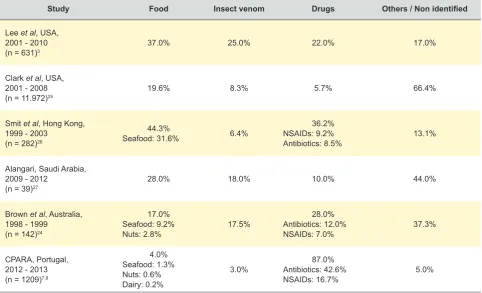
seems to be a variation in the etiologic agents according to geographic distribution (Table 1).
According to worldwide epidemiology studies, anaphy-laxis manifests mostly with mucocutaneous symptoms, as-sociated with one or more symptoms from the respiratory, cardiovascular or digestive systems (Table 2).
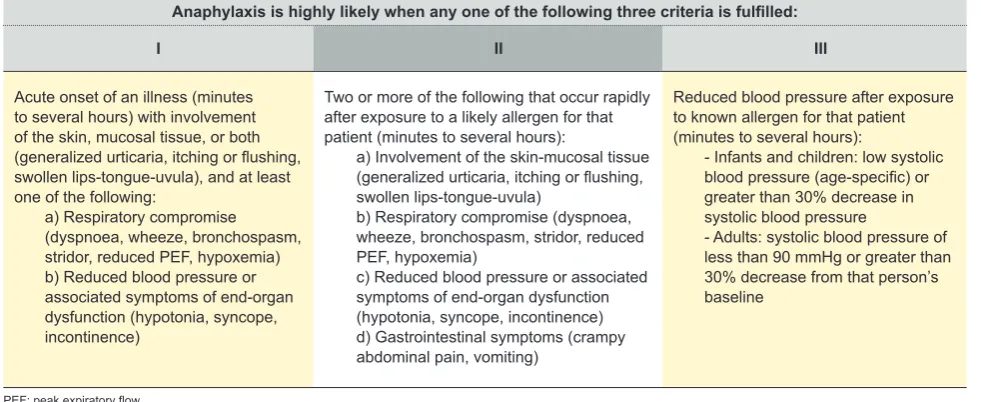
The currently accepted clinical criteria for the diagnosis of anaphylaxis were first defined in the Second Symposium on the Definition and Management of Anaphylaxis by the National Institute of Allergy and Infectious Disease/Food Allergy and Anaphylaxis Network and later adopted by the
World Allergy Organization (Table 3).1,10 These criteria were
adopted by the Portuguese Health General Directorate, in
2012.11
Diagnosis is mainly based on clinical suspicion and confirmed by clinical examination. Laboratory tests can be helpful in establishing if the patient experienced an anaphy-lactic reaction. Marked increases in total tryptase are seen
during an anaphylactic event, especially in subjects with
anaphylaxis of sufficient severity to cause hypotension.12
The best time to measure serum tryptase is between 1 to 2 hours after the onset of symptoms, and no longer than
6 hours after.13 Portuguese guidelines recommend tryptase
measurements in the initial management of anaphylaxis, ideally with three blood samples: 1) immediately after be-ginning treatment; 2) 1 - 2 hours after symptom onset; 3)
upon discharge or during follow-up.11
The Portuguese guidelines for the initial evaluation and treatment approach of anaphylaxis are defined on Clinical Standard No. 014/2012 of 16/12/2012 updated in
18/12/2014, and summarized in Table 4.11 Also, all cases
of adverse reactions to drugs, including anaphylactic reac-tions, should be notified to the National Authority of Medi-cines and Health Products, I.P. (INFARMED).
After the treatment of an anaphylactic reaction, all pa-tients should remain in observation, since there may be ei-ther a recurrence of the reaction after the effect of
epineph-rine disappears or a biphasic reaction.1 Clinically important
biphasic reactions are defined as recurrent or new signs or symptoms of anaphylaxis without obvious re-exposure to
an allergen.14 Its incidence is highly variable, ranging
be-tween 0.4% and 18%.14,15
There is a significant underdiagnosis of ED events ful-filling the diagnostic criteria for anaphylaxis, which are fre-quently misdiagnosed, for example, as a mild allergic
reac-tion.16 In a USA study, only 43% of events meeting
ana-phylaxis criteria were correctly diagnosed and reported in
the clinical registries.17 Another American study determined
Table 1 – Incidence of different causative agents in epidemiologic studies
Study Food Insect venom Drugs Others / Non identified
Lee et al, USA, 2001 - 2010
(n = 631)3 37.0% 25.0% 22.0% 17.0%
Clark et al, USA, 2001 - 2008
(n = 11.972)25 19.6% 8.3% 5.7% 66.4%
Smit et al, Hong Kong, 1999 - 2003
(n = 282)26
44.3%
Seafood: 31.6% 6.4%
36.2% NSAIDs: 9.2%
Antibiotics: 8.5% 13.1%
Alangari, Saudi Arabia, 2009 - 2012
(n = 39)27
28.0% 18.0% 10.0% 44.0%
Brown et al, Australia, 1998 - 1999
(n = 142)24
17.0% Seafood: 9.2%
Nuts: 2.8% 17.5%
28.0% Antibiotics: 12.0%
NSAIDs: 7.0% 37.3%
CPARA, Portugal, 2012 - 2013 (n = 1209)7,8
4.0% Seafood: 1.3% Nuts: 0.6% Dairy: 0.2%
3.0% Antibiotics: 42.6%87.0%
NSAIDs: 16.7% 5.0%
ARTIGO ORIGINAL
AMP
STUDENT
that only 53% of patients with food-related al-lergic reactions and 87% of patients with insect sting-related allergic reactions were correctly diagnosed with the 9th version of International
Classification of Diseases (ICD-9).18 A possible
reason for the under diagnosis of anaphylaxis may be the lack of knowledge by health pro-fessionals regarding this subject. A study con-ducted in France with medical residents deter-mined that two thirds considered anaphylaxis approach throughout the medical degree insuf-ficient and that anaphylaxis knowledge in the
medical community was precarious.19
Considering the high importance of ana-phylaxis and its ubiquity within clinical and sur-gical specialties, it is of utmost importance to approach this subject.
Globally, the aim of this study is to charac-terize the patient population and clinical ap-proach of all anaphylactic reactions admitted to the ED of a tertiary care university hospital, and specifically, to describe the patient popula-tion as well as the diagnostic and therapeutic approach of patients admitted to the ED with anaphylaxis, comparing collected data with na-tional and internana-tional data, auditing the com-pliance with Clinical Standard No. 014/2012 of 16/12/2012 updated 18/12/2014 regarding the clinical approach of anaphylaxis, and de-termining the notification rate of anaphylaxis to CPARA and INFARMED.
MATERIAL AND METHODS
Ethical approval was obtained from the Ethical Committee for Health of Hospital de Santo António – Centro Hospitalar do Por-to (HSA-CHP), in March 2018 – N/REF.ª 2017.224(193-DEFI/185-CES).
Clinical characterization and approach This is a retrospective study, based on a consecutive series of adult patients (≥ 18 years of age at the date of admission) diagnosed with anaphylaxis, admitted in the ED of HSA-CHP,
between November 1st, 2015, and October 31st,
2016. The sample included all cases registered with discharge ICD-9 codes 995.0, 995.1, 995.2, 995.3, 995.6, 995.60, 995.61, 995.62, 995.63, 995.64, 995.65, 995.66, 995.67, 995.68, 995.69 and 995.7, who, after careful analysis of the clinical registries by the authors, were found to meet the currently accepted clinical criteria for the diagnosis of anaphy-laxis (Table 3). The demographic and clinical data (sex, age, comorbidities, functional status, admission date, clinical presentation, sever-ity grade, onset time, occurrence of biphasic
Table 2
– Incidence of dif
ferent clinical manifestations reported in epidemiologic studies
Study
Mucocutaneous manifestations
n (%)
Respiratory symptoms
n (%)
Cardiovascular symptoms
n (%)
Grastrointestinal symptoms
n (%)
Lee
et al
, USA,
2001-2010 (n = 631)
3
608 (96)
Urticaria: 435 (69) Angioedema: 214 (34) Erythema or generalized pruritus: 177 (28)
485 (77)
Dyspnoea: 414 (66) Wheezing/bronchospasm: 92 (15) Hoarseness: 49 (8)
223 (35)
Syncope/pre-syncope: 130 (21) Chest pain: 104 (16) Hypotension: 49 (8)
118 (19)
Vomiting: 66 (10) Nausea: 46 (7) Abdominal pain: 32 (5) Diarrhoea: 21 (3)
Smit
et al
, Hong Kong,
1999 - 2003 (n = 282)
26
Urticaria: 223 (79.1) Erythema or generalized pruritus: 209 (74.1) Angioedema: 171 (60.6) Dyspnoea: 185 (65.6) Wheezing/bronchospasm: 85 (30.1) Laryngeal oedema: 31 (1
1)
Tongue oedema: 21 (7.5)
Hypotension: 33 (1
1.7)
Chest pain: 17 (6) Syncope: 16 (5.7) Abdominal pain or diarrhoea: 27 (9.6) Vomiting: 23 (8.2) Dysphagia: 1 (0.35)
Alangari,
Saudi
Arabia,
2009 - 2012 (n = 39)
27
39 (100)
35 (90)
6 (15)
6 (15)
Brown
et al
, Australia,
1998-1999 (n = 142)
24
133 (94)
Dyspnoea: 61 (43) Wheezing: 50 (35.2) Bronchospasm: 26 (18.3) Laryngeal oedema: 15 (10.6) Hoarseness: 14 (9.9)
13 (9.2)
27 (19)
CP
ARA, Portugal,
2012 - 2013 (n = 1209)
7,8
Urticaria or angioedema (85 - 90) Flushing (45 - 55) Pruritus (2 - 5) Upper airway oedema (50-60) Dyspnoea, wheezing/bronchospasm (45 - 50) Rhinitis (15 - 20)
(30 - 35)
(25 - 30)
CP
ARA: Portuguese Catalogue of
Allergies and Other
Adverse Reactions; USA: United States of
ARTIGO ORIGINAL
AMP
STUDENT
reaction, likely allergen, treatment, hospitalization time, out-come, follow-up) were obtained from the clinical records of each patient and registered anonymously in the database. The comorbidities were determined using the Charlson
co-morbidity index (CCI).20 Functional status was determined
with the Karnofsky scale.21 The severity of anaphylactic
reactions was classified using Ring and Messmer severity
scale.22
To audit the compliance with Clinical Standard No. 014/2012 of 16/12/2012 updated 18/12/2014, the audit
in-strument available in the same document was used.11
Case notification
Data regarding CPARA and INFARMED notifications
and compliance with the Clinical Standard were requested from the Quality, Risk, Hygiene, Health and Safety Man-agement Department of HSA-CHP, the Ministry of Health Shared Services, and INFARMED.
A questionnaire evaluating medical knowledge about notification of anaphylaxis cases to CPARA and INFARMED was applied to ED physicians that attend patients triaged to Internal Medicine or General Practice / Family Medicine physicians. This included: all HSA-CHP physicians from the Internal Medicine Department, who have weekly shifts in the ED; General Practice / Family Medicine physicians hired by HSA-CHP to work exclusively in the ED; physi-cians hired from an external company who work shifts in Internal Medicine or General Practice / Family Medicine in
Table 3 – Clinical criteria for the diagnosis of anaphylaxis1,11
Anaphylaxis is highly likely when any one of the following three criteria is fulfilled:
I II III
Acute onset of an illness (minutes to several hours) with involvement of the skin, mucosal tissue, or both (generalized urticaria, itching or flushing, swollen lips-tongue-uvula), and at least one of the following:
a) Respiratory compromise (dyspnoea, wheeze, bronchospasm, stridor, reduced PEF, hypoxemia) b) Reduced blood pressure or associated symptoms of end-organ dysfunction (hypotonia, syncope, incontinence)
Two or more of the following that occur rapidly after exposure to a likely allergen for that patient (minutes to several hours):
a) Involvement of the skin-mucosal tissue (generalized urticaria, itching or flushing, swollen lips-tongue-uvula)
b) Respiratory compromise (dyspnoea, wheeze, bronchospasm, stridor, reduced PEF, hypoxemia)
c) Reduced blood pressure or associated symptoms of end-organ dysfunction (hypotonia, syncope, incontinence) d) Gastrointestinal symptoms (crampy abdominal pain, vomiting)
Reduced blood pressure after exposure to known allergen for that patient (minutes to several hours):
- Infants and children: low systolic blood pressure (age-specific) or greater than 30% decrease in systolic blood pressure
- Adults: systolic blood pressure of less than 90 mmHg or greater than 30% decrease from that person’s baseline
PEF: peak expiratory flow
Table 4 – Portuguese guidelines for the initial management of anaphylaxis11
Removing known or likely allergen
Evaluate
Airway (A), Breathing (B), Circulation (C), Disability (D), Exposure (E)
Call for help
Administer epinephrine aqueous solution 1:1000 IM Dosing: adjusted to age group
- < 6 years: 0.15 mg - 6 - 12 years: 0.3 mg - > 12 years: 0.5 mg
Adjusted to weight: 0.01 mg/kg/dosing (adults) or 0.3 mg (children < 12 years or < 40 kg) Injection site: anterolateral side of mid-thigh
General measures
Position the patient according to signs and symptoms:
- loss of consciousness (breathing) or vomit: lateral decubitus
- hypotension or hypotonia: dorsal decubitus with elevation of the lower limbs (Trendelemburg) - respiratory distress: semi-seated (position comfortable for the patient)
- pregnancy: left lateral decubitus
Administer supplementary oxygen(O2 10-15L/min; FiO2 ~40% - 80%)
Monitor the patient (heart rate, blood pressure, respiratory rate, oxygen saturation) Consider placement of peripheral venous access
Consider blood sample for tryptase (ideally 3 samples: 1st – immediately after beginning treatment; 2nd – 1 to 2 hours after the beginning of the symptoms; 3rd – upon discharge or during follow-up)
ARTIGO ORIGINAL
AMP
STUDENT
the ED; and physicians that work in the Emergency Room (attend patients who are given red Manchester triage our at admission). Questionnaires were distributed and
col-lected within a period of a week (between April 9th and 15th,
2018) to all above mentioned HSA-CHP ED physicians.
Statistical analysis
Categorical variables are described as absolute fre-quencies (n) and relative frefre-quencies (%). For continuous variables, median, percentiles minimum and maximum or mean and standard deviation (SD) are used, regarding the distribution. Comparisons between categorical variables are made using Chi-Square and Fisher exact test. For con-tinuous variables, Mann-Whitney test and Kruskal-Wallis test are used. The significance level used is 0.05. Statisti-cal analysis was performed using the software StatistiStatisti-cal Package for the Social Sciences v. 24.0.
RESULTS
Clinical characterization and approach
Medical records of 972 patients satisfying the elligible discharge ICD-9 codes were analysed; 69 patients met the criteria for anaphylaxis. Reasons for exclusion included the presence of only mucocutaneous symptoms, respira-tory symptoms, or gastrointestinal symptoms, exposure to a known allergen without clinical symptoms, intra-hospital anaphylactic reactions, or other conditions mistakenly cod-ed as allergic reactions. The mean age was 43.7 years (SD 18.4; range: 19 - 88 years). Females accounted for 60.9% of patients.
Based on the CCI score, 43.5% of patients had no co-morbidities, 40.6% were categorized as mild (CCI scores of 1 - 2), and 11.5% were categorized as both moderate or severe (CCI scores of 3 - 4 and ≥ 5, respectively). Regard-ing the Karnofsky performance scale, prior to this acute epi-sode, 79.7% of patients had no evidence of disease, 15.9% were able to carry on normal activity with minor signs or symptoms of disease, and 2.9% required assistance and frequent medical care.
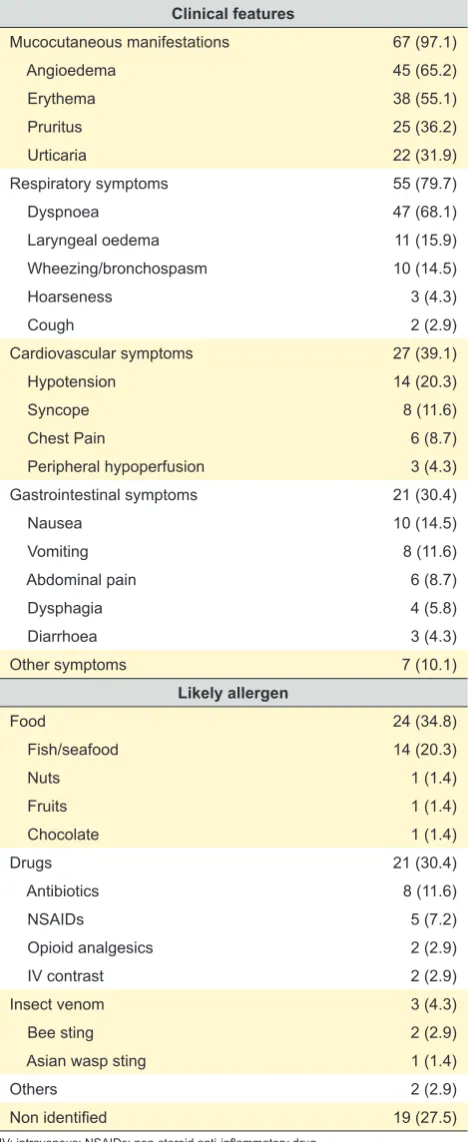
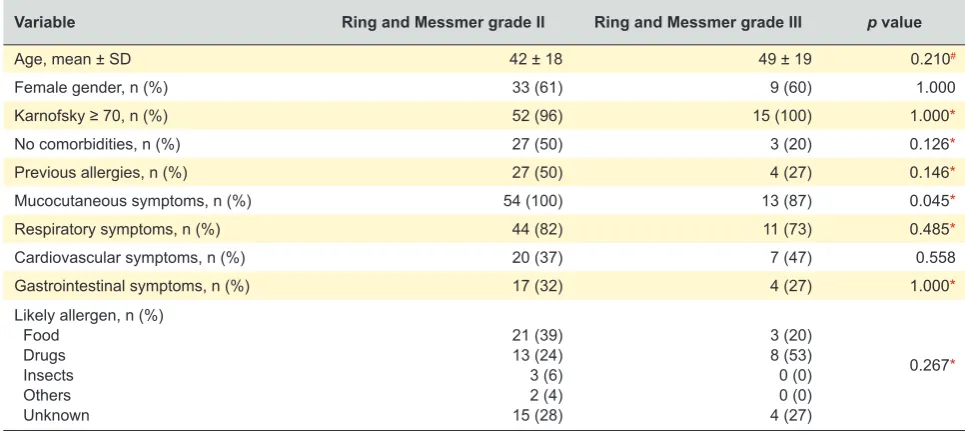
The clinical features of the 69 patients studied are pre-sented in Table 5. Overall, mucocutaneous symptoms were the most prevalent, followed by respiratory, cardiovascular, and gastrointestinal features. Using the Ring and Messmer severity scale, 54 patients (78.3%) presented with grade II (measurable, but not life-threatening cardiovascular, gastrointestinal or respiratory disturbances), and 15 pa-tients (21.7%) presented with grade III (shock or related symptoms). There were no recorded deaths in this study. The median onset time was 30 minutes [(IQR) = 30 (0 - 60)]. In 43 patients (62.3%), no data regarding onset time was available in the registries. None of the 69 patients developed a biphasic reaction. There was no statistically significant association of patients’ previous characteristics (age, gen-der, functional status or comorbidities) with the severity of the anaphylactic reaction (Table 6).
The likely causative agents found in this study are presented in Table 5. The most common category was
food, followed by drugs, and lastly by insects. Causative foods mainly included fish and seafood. Drugs included antibiotics and nonsteroidal anti-inflammatory agents in most cases. Insects included bee and Asian wasp stings. No cause was apparent in 27.5% of patients. Of the stud-ied patients, 44.9% had previously identifstud-ied allergies, and,
Table 5 – Clinical features and likely causative agents of the 69
patients with anaphylaxis, n (%)
Clinical features
Mucocutaneous manifestations 67 (97.1)
Angioedema 45 (65.2)
Erythema 38 (55.1)
Pruritus 25 (36.2)
Urticaria 22 (31.9)
Respiratory symptoms 55 (79.7)
Dyspnoea 47 (68.1)
Laryngeal oedema 11 (15.9)
Wheezing/bronchospasm 10 (14.5)
Hoarseness 3 (4.3)
Cough 2 (2.9)
Cardiovascular symptoms 27 (39.1)
Hypotension 14 (20.3)
Syncope 8 (11.6)
Chest Pain 6 (8.7)
Peripheral hypoperfusion 3 (4.3)
Gastrointestinal symptoms 21 (30.4)
Nausea 10 (14.5)
Vomiting 8 (11.6)
Abdominal pain 6 (8.7)
Dysphagia 4 (5.8)
Diarrhoea 3 (4.3)
Other symptoms 7 (10.1)
Likely allergen
Food 24 (34.8)
Fish/seafood 14 (20.3)
Nuts 1 (1.4)
Fruits 1 (1.4)
Chocolate 1 (1.4)
Drugs 21 (30.4)
Antibiotics 8 (11.6)
NSAIDs 5 (7.2)
Opioid analgesics 2 (2.9)
IV contrast 2 (2.9)
Insect venom 3 (4.3)
Bee sting 2 (2.9)
Asian wasp sting 1 (1.4)
Others 2 (2.9)
Non identified 19 (27.5)
ARTIGO ORIGINAL
AMP
STUDENT
of these, 25.8% had the present reaction with a previously known allergen.
Of the 69 patients admitted with anaphylaxis, 22 (31.9%) received yellow, 44 (63.8%) orange, and 3 (4.3%) red Man-chester triage colour at hospital admission. Overall, the me-dian time from triage to first medical contact was 15 minutes [(IQR) = 15 (9 - 31)]. The median time between triage to first medical contact was shorter for patients whose Manchester triage colour was more emergent, with median (IQR): 29 (16 - 76) for yellow, 11 (7 - 20) for orange and 12 (2 - 38) for
red (p = 0.001).
Overall, only four patients (5.8%) had blood collected for tryptase measurements. In these patients, only one sample was collected, and median time until sample collection was 14 minutes [(IQR) = 14 (4 - 42)]. Regarding administered medications, 63 patients (91.3%) received corticosteroids, 59 (85.5%) H1-antihistamines, 15 (21.7%) H2-antihista-mines, and 10 (14.5%) epinephrine. Of the latter, one tient self-administered an epinephrine auto-injector, four pa-tients received epinephrine from the pre-hospital emergen-cy team, and five patients received epinephrine at the ED. Epinephrine was administered intravenously in one patient, subcutaneously in two patients, and intramuscularly in the other 7 cases. The median time between first medical con-tact and epinephrine administration was 59 minutes [(IQR) = 59 (15 - 82)]. Median surveillance time after epinephrine administration was 369 minutes [(IQR) = 369 (214 - 426)]. Other therapies included intravenous fluids in 18 (26.1%), bronchodilators in 8 (11.6%), proton pump inhibitors or anti-emetics in 9 (13%), and benzodiazepines in 4 (5.8%) pa-tients.
In the 69 patients with anaphylaxis, median hospital stay before discharge was 239 minutes [(IQR) = 239 (168 - 385)], with 67 patients (97.1%) discharged directly from the ED after the monitoring period, 1 (1.4%) admitted to the ED ob-servation ward, and 1 (1.4%) admitted to the Intensive Care Unit. Upon discharge, 25 patients (36.2%) were referred to
an Immunoallergology outpatient clinical appointment, and 16 (23.2%) were referred to their local general practitioner / family physician. Seven patients (10.1%) received or were confirmed to already possess an epinephrine autoinjector. Upon discharge, the most frequently attributed ICD-9 codes were: 995.3 Allergy, unspecified – 56 (81.2%); 995.1 An-gioneurotic oedema – 5 (7.2%); 995.65 Anaphylactic shock due to fish – three (4.3%); 995.0 Other anaphylactic shock – three (4.3%).
Case notification
Upon contact with the Quality, Risk, Hygiene, Health and Safety Management Department of HSA-CHP, there were no registered cases of anaphylaxis reported within the studied period. While contacting the Ministry of Health Shared Services, it was ascertained that no registered clini-cal data was submitted to CPARA from HSA-CHP in this period. INFARMED provided a list of all cases of allergic reactions reported from HSA-CHP within the studied time frame and none of the cases from our study were reported to INFARMED.
Compliance with clinical standard
Using the parameters considered for the evaluation of compliance with Clinical Standard No. 014/2012 of 16/12/2012 updated 1/12/2014, the most achieved param-eter was detailing in the clinical registry signs and symp-toms referring to two or more systems (94.2%), followed by evidence that the known or likely allergen was removed (42.0%), and by making sure that, after the episode, the patient is referred to observation by an Immunoallergology specialist for confirmation of diagnosis and management (36.2%). Parameters with lower rates of achievement were maintaining the patient in observation for at least 8 to 24 hours after clinical stability was achieved (17.3%), early ad-ministration of intramuscular epinephrine (8.7%), and reg-istering all cases in CPARA (0%). No cases (0%) had all
Table 6 – Patients’ and anaphylactic reaction characteristics, according to the grades of severity of anaphylaxis
Variable Ring and Messmer grade II Ring and Messmer grade III p value
Age, mean ± SD 42 ± 18 49 ± 19 0.210#
Female gender, n (%) 33 (61) 9 (60) 1.000
Karnofsky ≥ 70, n (%) 52 (96) 15 (100) 1.000*
No comorbidities, n (%) 27 (50) 3 (20) 0.126*
Previous allergies, n (%) 27 (50) 4 (27) 0.146*
Mucocutaneous symptoms, n (%) 54 (100) 13 (87) 0.045*
Respiratory symptoms, n (%) 44 (82) 11 (73) 0.485*
Cardiovascular symptoms, n (%) 20 (37) 7 (47) 0.558
Gastrointestinal symptoms, n (%) 17 (32) 4 (27) 1.000*
Likely allergen, n (%) Food
Drugs Insects Others Unknown
21 (39) 13 (24) 3 (6) 2 (4) 15 (28)
3 (20) 8 (53) 0 (0) 0 (0) 4 (27)
0.267*
ARTIGO ORIGINAL
AMP
STUDENT
six or five out of six parameters achieved; six cases (8.7%) had four out of six parameters achieved; 15 cases (21.7%) achieved three parameters; 24 cases (34.8%) achieved two parameters; 22 cases (31.9%) achieved one parameter; and two cases (2.9%) did not achieve any parameter.
Medical knowledge
In this study, 117 physicians met the inclusion criteria and 75 (64.1%) returned the filled questionnaire. One form had incomplete data.
Of all respondents, 18 (24.0%) were physicians hired from an external company or directly by HSA-CHP to work exclusively in the ED, 29 (38.7%) HSA-CHP physicians from the Internal Medicine Department, and 28 (37.3%) physicians that work in the Emergency Room. Overall, 30 physicians (40.0%) were Internal Medicine specialists, 15 (20.0%) were specialists in another medical specialty, which included, in alphabetical order, Endocrinology, Gastroen-terology, Infectious Diseases, Intensive Care, Nephrology and Oncology, 15 (20.0%) in Anaesthesiology, 14 (18.7%) in General Practice / Family Medicine, and 1 (1.3%) in Sur-gery. Of these, 44 (58.7%) were residents, 13 (17.3%) were consultants, and 7 (9.3%) were senior consultants. In the previous year, 44 physicians (58.7%) had contact with a suspected or proven anaphylactic reaction in an emergency setting.
Only 15 (20.0%) physicians confirmed that they were aware of the CPARA platform’s existence. Of these, three heard about it in this hospital, four heard about it in another hospital, one on the Internet, one in a congress and one in a Health Centre; the remaining 5 did not know where they heard about it. Of all physicians, only 10 (13.3%) knew it was mandatory to register all allergy and anaphylaxis cases in CPARA, and only three (4.0%) knew how to make the registration. Only two physicians (2.7%) reported having registered a case in CPARA before and it was not on this ED. Of the 13 physicians who have heard about CPARA but never reported a case in the platform, five (38.5%) did not have contact with a suspected or proven case of anaphy-laxis in the previous year; five (38.5%) did not know that the
registry was mandatory,and 12 (92.3%) did not know how
to make the notification.
Regarding knowledge of INFARMED notifications, 59 (79.7%) physicians were aware of the need to register aller-gic and anaphylactic reactions to drugs to INFARMED, 26 (35.1%) knew how to make that notification, and 14 (18.9%) had done at least one. Of the 60 physicians who never made a notification to INFARMED, 48 (80.0%) reported not knowing how to do it.
All physicians in this study agreed that more training was needed regarding this subject. Regarding the ways to provide physicians with the necessary information and increase notification rates, 74.3% elected as the preferred method creating a direct link for notifications within the hos-pital access platform, 59.5% training initiatives, 51.4% infor-mation by e-mail, 48.6% inforinfor-mation posters within the ED, 44.6% information by SMS, 35.1% providing information
within the hospital intranet, and 17.6% chose distribution of flyers with selected information.
DISCUSSION
From the initial sample of 972 cases fulfilling the ICD-9 codes selected, only 69 (7%) patients met the clinical cri-teria for anaphylaxis. This is mainly due to the fact that a specific code for anaphylaxis is missing in the ICD-9 clas-sification. ICD-9 codes either consider “allergy” or “anaphy-lactic shock”, which leaves out the rest of the spectre of anaphylactic reactions. For this reason, physicians have difficulty in attributing a specific ICD-9 code for an anaphy-laxis event, and reactions such as mild allergic reaction are attributed the same code as an anaphylactic reaction. This issue persisted in the 10th version of International Classifi-cation of Diseases (ICD-10) but is being addressed in the forthcoming 11th version of International Classification of Diseases (ICD-11), with the ellaboration of a “Allergic and hypersensitivity conditions” section within the chapter “Dis-orders of the Immune System”. This section will be divided in 8 subsections, including allergic or hypersensitivity dis-orders involving the respiratory tract, the eye, skin and mu-cous membranes, the gastrointestinal tract and of unspeci-fied nature, complex allergic or hypersensitivity reactions
and anaphylaxis.23 The authors believe this will be a major
improvement from the ICD-10 classification and will hope-fully resolve present issues with anaphylaxis classification, with the end result of improving future audits and quality of care.
The mean age of patients included in the study was 43,7 years, which is in agreement with previous studies, that re-ported mean ages between 32 and 52 years, and lower
than previous Portuguese reports (51.8 years).7,8 Females
outnumbered males by a ratio of 3:2, which is similar to data
reported by Brown et al24 in Australia, Clark et al25 and
Moto-sue et al4 in the USA, but contrary to data reported by Smit
et al26 in Hong Kong or Alangari27 in Saudi Arabia, which had
males outnumbering women by a ratio of 3:2.
Like other studies, mucocutaneous manifestations were the most prevalent, followed by respiratory symptoms. Mu-cocutaneous manifestations were not present in all patients, but patients with acute anaphylaxis may present without mucocutaneous features for many reasons, including treat-ment before hospital admission, the rapid onset of airway oedema or circulatory shock, or the spontaneous resolu-tion of cutaneous signs. Regarding severity, our 21.7% incidence of severe life-threatening reactions is similar to
the incidence reported by Clark et al25 in the USA (22%),
but lower than that reported by Brown et al24 in Australia
(42.25%). However, the severity criteria used in these stud-ies were different, which may in part justify the differences found in the prevalence of severity grades.
ARTIGO ORIGINAL
AMP
STUDENT
Food was the main class of allergens in our study
(34.8%), and had a minor representation in CPARA (4%).7,8
Drug hypersensitivity reactions had an important role in our
study, but less than in CPARA (30.4% vs 87%).7,8 As
ex-pected, in Portugal insect venom remains a minor cause
(4.3% in our study vs 3% in CPARA).7,8 No cause was
ap-parent in 30.4% of our cases, which is similar to rates
re-ported by Brown et al24 (27%), lower than rates reported by
Clark et al25 (66%) or Alangari27 (44%), but higher than in
CPARA7,8 (5%). A pre-existing allergy to the etiologic agent
was known in 11.6% of cases, two cases with insect stings and six cases with food. Regarding food allergies, a better explanation or reinforcement to the patient about the impor-tance of avoiding the allergen is beneficial to prevent subse-quent cases. Of notice is the fact that none of the cases of anaphylaxis to a previously known allergen were iatrogenic, which might reflect a good compliance of the medical com-munity in researching the information concerning allergies to avoid prescription of previously identified allergy-inducing medications.
Regarding the patient approach, there was a significant lack of compliance with national guidelines. Despite the existence of a clear national recommendation for tryptase
measurement in anaphylaxis11, tryptase blood samples were
collected in a minority (5.8%) of cases, and only one sam-ple was collected, ranging between three and 48 minutes after admission. The correct use of the tryptase test could be improved with the generation of a tryptase measurement option within the diagnostic tests, which would prescribe au-tomatically the three samples needed, and the nursing staff would receive information about all correct blood collecting times.
With intramuscular epinephrine being considered stand-ard of care for all patients with anaphylaxis, it is disconcert-ing that only 10.1% of patients received early intramuscular administration of the drug, either pre- or intra-hospital. As the initial approach is similar in all cases of anaphylaxis, in-formation regarding management guidelines (Table 4) could be available at all ED or easily accessible on the computer programme for consultation when needed. Other medica-tions administered were mainly corticosteroids (91.3%),
within similar rates reported by Smit et al26 (91.5%), and
higher than those reported by Brown et al24 (74.5%) or Lee
et al3 (64%). The use of H1-antihistamines is in the range of
previous reported values (85.5% vs 72% - 94.5%), and the
same was observed for H2-antihistamines (21.7% vs 1.42%
- 60.5%).
Despite there being no cases of biphasic allergic reac-tions in our study, its occurrence is well described in the literature, and patients should remain in observation for 8 to 24 hours, which was only achieved in 17.3% of cases. The proportion of patients discharged directly from the ED
was higher in our study (97.10%), than in Lee et al3 (74%),
Brown et al24 (33%), or Smit, et al26 (1.4%). This may
re-flect the lack of monitoring time after stabilization, as the percentage of patients admitted to the ED observation ward (1.4%) was drastically lower than in the other studies,
including Brown et al24 (61%), or Smit et al26 (54.6%). This
can be due to external determinants, such as the bed avail-ability, but can be increased if a clear protocol recommends monitoring time, so that economic or political factors do not override good clinical practice.
Although 10.1% of our patients received or already possessed an epinephrine autoinjector, which is higher
than rates reported by Brown et al24 (5.3%), it is lower than
desirable. Only 36.2% of patients were referred to an Im-munoallergology outpatient clinic, and 23.2% were referred to their local general practitioner / family physician, which
is higher than reported by Brown, et al.24 (23% and 10%,
respectively), but still lower than acceptable. This rate of referral could be increased if, for example, when discharg-ing a patient with a diagnostic code of anaphylaxis, an alert message box requiring scheduling an appointment would appear on the computer programme.
Considering that, in Portugal, it is mandatory to report all allergic and anaphylactic reactions to CPARA, it is appalling that only 20% of physicians in this tertiary care university hospital were aware of the platform’s existence. Since none of the 69 anaphylactic cases studied was notified, we can presume that this might be due to a lack of knowledge re-garding the obligation to report these cases and how to do it, which was confirmed by the survey done. Results were substantially better concerning knowledge of the need to notify reactions to drugs to INFARMED.
Most importantly, the quality of clinical registries re-quires improvement to make sure all relevant information is documented, and this need cannot be stressed enough within the medical community.
Taking into consideration the data found in this study, the authors think it could be of great benefit for the Por-tuguese medical community the future development of a national study evaluating physician’s knowledge about ana-phylaxis diagnosis and treatment.
This is an ongoing concern of the Sociedade Portu-guesa de Alergologia e Imunologia Clínica (SPAIC) that prompted the release, in 2018, of a clinical poster on the diagnosis and treatment of anaphylaxis, to be disseminated
throughout the acute clinical setting.28
Limitations
ARTIGO ORIGINAL
AMP
STUDENT
relation. Immunoallergology clinical referral rates in our se-ries were low; in referred cases, it would be important to confirm that the patient attended the consultation and how long it was after the ED discharge.
The sample of surveyed physicians was obtained from those working in the ED at the time of this study (March and April 2018), which was not the same period as the clinical cases included in the study. The answers reported by these physicians may or may not be representative of the knowl-edge of the physicians that, during 2015 and 2016, worked in this ED and were responsible for the approach and notifi-cation of the studied cases.
CONCLUSION
Data obtained from this study suggests that more knowl-edge regarding the National Clinical Standard for clinical management of anaphylaxis in Portugal is needed, with particular emphasis on detailed clinical records, epineph-rine administration, tryptase measurement, Immunoaller-gology referral and CPARA notification. This can be im-proved through a pre-designed template for clinical registry, that includes a link to generate a tryptase measurement re-quest with the three samples needed, and the nursing staff would receive information about all correct blood collecting hours; when discharging a patient with a diagnostic code of anaphylaxis or allergic reaction, an alert message box re-quiring scheduling an appointment for a Immunoallergology specialist would appear on the computer programme
auto-matically as well as a direct link in the Emergency Depart-ment IT system, requiring the physician to report the case to CPARA and, in the event of a reaction to a medication, to INFARMED.
These recommendations could be summarized and dis-tributed by posters or flyers in the Emergency Department, on the hospital intranet, by e-mail, by SMS or through prac-tical training initiatives, to increase compliance and improve patients’ prognoses. The authors also recommend the use of the SPAIC poster.
PROTECTION OF HUMAN AND ANIMAL SUBJECTS The authors declare that the research procedures were performed according to the regulations of the institution’s ethics committee and the Code of Ethics of the World Medi-cal Association (Declaration of Helsinki).
CONFIDENTIALITY OF DATA
The authors declare that they have followed the proto-cols of their work centre regarding the publication of data from patients.
CONFLICT OF INTEREST
No conflict of interest has been declared by any author.
FUNDING
No financial support was received by any author.
REFERENCES
1. Sampson HA, Muñoz-Furlong A, Campbell RL, Adkinson NF Jr, Bock SA, Branum A, et al. Second symposium on the definition and management of anaphylaxis: summary report - second National Institute of Allergy and Infectious Disease/Food Allergy and Anaphylaxis network symposium. Ann Emerg Med. 2006;47:373-80.
2. Yocum MW, Butterfield JH, Klein JS, Volchek GW, Schroeder DR, Silverstein MD. Epidemiology of anaphylaxis in Olmsted county: a population-based study. J Allergy Clin Immunol. 1999;104:452-6. 3. Lee S, Hess EP, Lohse C, Gilani W, Chamberlain AM, Campbell RL.
Trends, characteristics, and incidence of anaphylaxis in 2001-2010: a population-based study. J Allergy Clin Immunol. 2017;139:182-8. 4. Motosue MS, Bellolio MF, Van Houten HK, Shah ND, Campbell RL.
Increasing emergency department visits for anaphylaxis, 2005-2014. J Allergy Clin Immunol Pract. 2017;5:171-5.
5. Ma L, Danoff TM, Borish L. Case fatality and population mortality associated with anaphylaxis in the United States. J Allergy Clin Immunol. 2014;133:1075-83.
6. Direção-Geral da Saúde. Norma nº 002/2012 de 04/07/2012 atualizada a 11/08/2015 - Registo de Alergias e Outras Reações Adversas. 2015. [acedido 2018 abr 20]. Disponível em: https://www.dgs.pt/directrizes-da-dgs/normas-e-circulares-normativas/norma-n-0022012-de-04072012. aspx.
7. Mota I, Pereira AM, Pereira C, Tomaz E, Ferreira MB, Sabino F, et al. Abordagem e registo da anafilaxia em Portugal. Acta Med Port. 2015;28:786-96.
8. Amaral R, Morais-Almeida M, Gaspar A, Sá-Sousa A, Martins H, Fonseca J. A anafilaxia em Portugal: primeiros registos do Catálogo Português de Alergias e outras Reacções Adversas. Rev Port Imunoalergol. 2014;22:23-32.
9. Kemp SF, Lockey RF. Anaphylaxis: a review of causes and mechanisms. J Allergy Clin Immunol. 2002;110:341-8.
10. Simons FE, Ardusso LR, Bilò MB, El-Gamal YM, Ledford DK, Ring J, et al. World Allergy Organization Guidelines for the Assessment and Management of Anaphylaxis. World Allergy Organ J. 2011;4:13-37. 11. Direção-Geral da Saúde. Norma nº 014/2012 de 16/12/2012 atualizada
a 18/12/2014 - Anafilaxia: abordagem clínica. 2014. [acedido 2018 abr 20]. Disponível em: https://www.dgs.pt/directrizes-da-dgs/normas-e-circulares-normativas/norma-n-0142012-de-16122012.aspx.
12. Schwartz LB. Diagnostic value of tryptase in anaphylaxis and mastocytosis. Immunol Allergy Clin North Am. 2006;26:451-63. 13. Laroche D, Vergnaud MC, Sillard B, Soufarapis H, Bricard H.
Biochemical markers of anaphylactoid reactions to drugs – comparison of plasma histamine and tryptase. Anesthesiology. 1991;75:945-9. 14. Grunau BE, Li J, Yi TW, Stenstrom R, Grafstein E, Wiens MO, et al.
Incidence of clinically important biphasic reactions in emergency department patients with allergic reactions or anaphylaxis. Ann Emerg Med. 2014;63:736-44.
15. Brazil E, MacNamara AF. “Not so immediate” hypersensitivity - the danger of biphasic anaphylactic reactions. J Accid Emerg Med. 1998;15:252-3.
16. Sclar DA, Lieberman PL. Anaphylaxis: underdiagnosed, underreported, and undertreated. Am J Med. 2014;127:S1-5.
17. Ross MP, Ferguson M, Street D, Klontz K, Schroeder T, Luccioli S. Analysis of food-allergic and anaphylactic events in the National Electronic Injury Surveillance System. J Allergy Clin Immunol. 2008;121:166-71.
18. Clark S, Gaeta TJ, Kamarthi GS, Camargo CA. ICD-9-CM Coding of Emergency Department Visits for Food and Insect Sting Allergy. Ann Epidemiol. 2006;16:696-700.
19. Klein R, Lefevre S. Étude du savoir déclaratif des étudiants en médecine générale d’Alsace et de Lorraine à propos de l’anaphylaxie. Rev Fr Allergol. 2017;57:292-7.
20. Charlson ME, Pompei P, Ales KL, MacKenzie CR. A new method of classifying prognostic comorbidity in longitudinal studies: development and validation. J Chronic Dis. 1987;40:373-83.
21. Karnofsky D, Burchenal J. The clinical evaluation of chemotherapeutic agents in cancer. In: MacLeod C, editor. Evaluation of chemotherapeutic agents. New York: Columbia University Press; 1949. p.191-205. 22. Ring J, Messmer K. Incidence and severity of anaphylactoid reactions to
ARTIGO ORIGINAL
AMP
STUDENT
23. Tanno LK, Chalmers RJ, Calderon MA, Aymé S, Demoly P. Reaching multidisciplinary consensus on classification of anaphylaxis for the eleventh revision of the World Health Organization’s (WHO) International Classification of Diseases (ICD-11). Orphanet J Rare Dis. 2017;12:53. 24. Brown AF, McKinnon D, Chu K. Emergency department anaphylaxis:
a review of 142 patients in a single year. J Allergy Clin Immunol. 2001;108:861-6.
25. Clark S, Wei W, Rudders SA, Camargo CA. Risk factors for severe anaphylaxis in patients receiving anaphylaxis treatment in US emergency
departments and hospitals. J Allergy Clin Immunol. 2014;134:1125-30. 26. Smit DV, Cameron PA, Rainer TH. Anaphylaxis presentations to an
emergency department in Hong Kong: incidence and predictors of biphasic reactions. J Emerg Med. 2005;28:381-8.
27. Alangari AA. Characteristics of patients presenting to the emergency department with anaphylaxis in Riyadh, Saudi Arabia. J Taibah Univ Sci. 2014;9:318-21.