Research Article
a
August
2017
Computer Science and Software Engineering
ISSN: 2277-128X (Volume-7, Issue-8)
Future of e-Wallets: A Perspective From Under Graduates’
Madhu Chauhan, Isha Shingari IITM (Affiliated to GGSIPU)
Delhi, India
DOI: 10.23956/ijarcsse/V7I8/0140
Abstract– This paper study about e-payments specifically mobile wallets. As we all know that after demonetization, there is a tremendous increase in number of e-payments. This paper specifically targets undergraduate students and portrays their preferred mode of payment. It also suggest some steps that should be taken for betterment of e-payment facilities.
Keywords– e-wallet, Demonetization, m-wallets, Digital Payment, Digital India
I. INTRODUCTION
An electronic wallet can be defined as a virtual cashless service which can replace hard cash notes.
For purchasing anything, the person do not have to rush to ATMs or banks to withdraw cash, rather transaction can be done there and then in a fraction of seconds. It has become an upcoming way of purchasing goods and services without any physical movement of cash. The main objective of e-wallets is to make quick transactions thereby discouraging people to make use of use cash. This boom is the aftereffects of Demonetization.
II. CATEGORIES OF E-WALLETS
E wallets can be categorized into four parts: open wallets, semi open wallets, closed wallets, semi close wallets.
Open Wallets: As the name suggests, open wallets are open to multiple services i.e. it allows a customer to buy goods and services, transfer funds and also to withdraw cash from banks or ATMs.
Semi-open Wallets: This type of wallet is subject to a condition that it has to be associated with some specific company. The customer can load money in some application and spend it.
Closed Wallets: These are most popular specifically amongst e-commerce companies. Some minimum amount is reserved with the merchant in case of return or cancellation of product.
Semi-Closed Wallets: These types of wallets are in high demand by merchants with the limitation that they do not provide redemption or withdrawals. This wallet allows you to buy goods and services from listed merchants thereby opening an account in your name.
III. LITERATURE REVIEW
Ambarish Salodkar et al. [1] discusses that there are numerous applications like Paytm, freecharge, mobiquick etc. These applications can be downloaded and used for different purposes like making bill payments, doing online shopping and recharging phones etc.
Some of these applications have their own portals a person can perform all the above mentioned and many more tasks via app itself. In all the applications a person has to link his credit/ debit card number with the application to make use of services provided by app. This paper also discusses different characteristics, various needs and risks of electronic payments. The author agrees on the fact that e-wallets allow the users to enjoy comfortable and easy going platform to shop and pay, that too in minimal possible time.
Pinal Chauhan [2] elaborated how e-Wallets are going to make money transaction less cumbersome for the users. The people who use mobile applications just need to make payment at point of sale just after doing the purchasing. Autor also throw light on server side e-wallets and client side e-wallets. An encryption algorithm, known by the name RC4 is used for providing a secure transaction. Even after having some demerits like interoperability, advantages overweigh the disadvantages.
Roopali et al.[3] worked upon studying how digitalization of payments can be considered as a boon to growth of a country’s economy. Authors also done an in depth analysis of adoption patterns i.e. how people reacts and adopts digital wallets. In his analysis, he concluded that the number of users incorporating the habit of believing and using digital wallets has increased tremendously. People find it a more convenient and less time consuming way for making the payments. It also elaborates about top five digital wallets in India. However the question of security remains unanswered. People feel helpless at the time of making international transactions. A lot of security mechanisms are yet to be explored to make the transactions foolproof.
ISSN(E): 2277-128X, ISSN(P): 2277-6451, DOI: 10.23956/ijarcsse/V7I8/0140, pp. 146-150
Author also discusses four types of e-wallets in India: open, closed, semi-open and semi-closed. He also emphasize that companies should offer certain kinds of coupons, cash back, gifts to promote the usage of m-wallets among users. Many more applications of m-wallets are yet to be discovered.
Pawan Kalyani [5] presents usage, scope, advantages and disadvantages of virtual wallets specifically in India. He also gives recommendation for adopting the technology within the minimum possible time frame. He categorizes virtual wallets into four categories: Open wallets, semi-open wallets, closed wallets and semi-closed wallets. He also focuses on the issues and challenges that wallet companies are struggling with. The major issues of concern are data security, phone battery, dispute resolution, market penetration and user acceptance etc. Technology has to walk a long way ahead to educate people to increase the customer base.
Author talks compares the transaction in ancient time and in modern world. Earlier people had barter system, then people started making use of cash now-a-days majority is drifting towards transaction through mobile devices. Today, people are using credit cards, debit cards and m-wallets for payments. Author also discusses about advantages and risks that are associated to e-currency and also about types of e-wallets. Modern transactions make use of ATM, Debit and Credit Cards, NEFTs and m-wallets etc. According to a survey done by author, customers are using e-wallets mostly for the purpose of recharging and payment of bills. A lot of effort is required to make the mass aware about importance and ease of using e-wallets to perform myriad operations.
Hem Shweta [6] states that smart phones have spread all over the markets and people have now started to make different kinds of payments through mobile phones. He also explores various challenges faced by digital wallet users. Customers, banks and financial institutions are benefitted by the use of Digital wallets. Tech-savvy customers are increasing at a tremendously faster speed.
IV. e-WALLET COMPANIES
After analyzing pros and cons of demonetization and looking at awareness of general public, many companies have launched their e-wallets in the market with different terms and conditions to gain competitive advantages. Although many of them are not able to survive in the market, but some are very popular amongst people. These are as follows:
Paytm
Paytm is the most popular e-wallet in the market today having a user base of 20 million or probably more. It was launched in 2010. Majority of stores accept payments through Paytm. All the credit goes to Mr. Vijay Shekhar Sharma and his team. One just needs to load money into wallet and he can directly use it anytime and anywhere.
Paytm can be used in myriad applications areas which includes payment of gas/ electricity/ water bills. It can be used for booking tickets for buses, cabs, fights, hotel rooms etc. In addition to all this, it can be for recharging bobile phones, DTH services etc.
Oxigen
Oxigen is among one of the larger payment solution provider. It uses a 6 digit one time password for making your payment secure. This code is sent on your registered mobile number. Additionally, this mobile wallet is integrated with NPCI that allow instant money transfer to and from more that 50 banks. This feature is approved by RBI. According to a recent report published by VCCirle in April’16, mobile application claims to have 20 million users, 10000 websites and 9000 merchants. It includes services like money transfer, bill payment, bookings and many more.
Freecharge
This mobile wallet was introduced in 2010. It has gained popularity in recent past and claims to have 20 million registered users. With this app also, customers can make payments of DTH, utility bills, prepaid and postpaid bills, bookings etc. Apart from online stores FreeCharge offers offline stores like Hypercity, MsDonalds, Cinepolis and Shoppers Stop.
PayU Money
PayU has mobile wallets over 4000 merchants which includes prestigious companies like-Goibibo, Zomato, Snapdeal and Bookmyshow, to name a few. It is a key company of Naspers Group. PayUMoney gain competitive advantage by offering advanced payment gateway solution to various online businesses by making use of progressive technology.
V. APPLICATIONS
A person can make use of m-wallets in different application areas depending upon his need and preferences. Some of the major applications include:
Recharging pre-paid mobile phones
Pay for travel booking and movie shows
Book hotel rooms
Transfer money into other’s account
Purchase movie tickets
ISSN(E): 2277-128X, ISSN(P): 2277-6451, DOI: 10.23956/ijarcsse/V7I8/0140, pp. 146-150
VI. A SURVEY CONDUCTED
As the study mainly emphasize on undergraduates, so a survey has been conducted. They survey was conducted on 100 students (approx), who belonged to heterogeneous courses and in belonged to different universities. Out of all the questions asked from students, some of the major questions are listed as follows.
Fig 1. Which wallet do you use the most
As we all know that number of payments have increased many folds just after the demonetization. A number of e-wallets have been introduced in the market. Out of all the m-e-wallets Paytm won the race with a huge majority. Most of the undergraduate students are using Paytm for payment. A possible reason could be that most of the vendors have implemented Paytm.
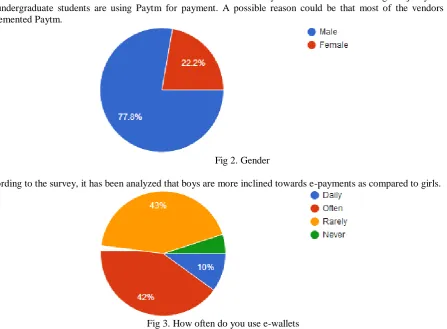
Fig 2. Gender
According to the survey, it has been analyzed that boys are more inclined towards e-payments as compared to girls.
Fig 3. How often do you use e-wallets
The students those who use e-wallets use it most often. Although approximately equal number of users opted for rarely. As the analysis is done between age groups of 15-21 years of age, so students are not in a need to purchase a wide variety of products. In other words we can say that their purchasing extent is limited.
ISSN(E): 2277-128X, ISSN(P): 2277-6451, DOI: 10.23956/ijarcsse/V7I8/0140, pp. 146-150
Mostly the students are making use of e-payment options for payment of electricity and water bills. However, a significant number of users are using it for purchasing of products.
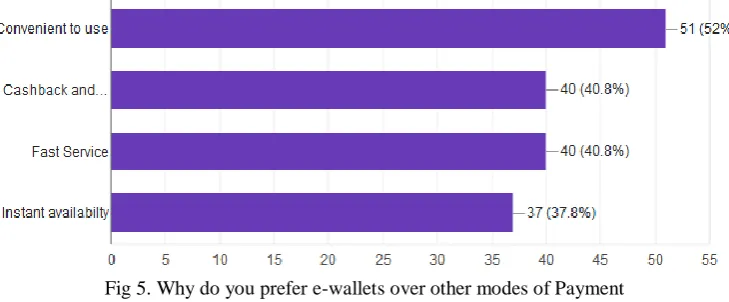
Fig 5. Why do you prefer e-wallets over other modes of Payment
There are numerous reasons for which youngsters are drifted towards electronic payment through m-wallets. Majority feels that it is convenient to use. People are also influenced by lucrative cash back and discount offers provided by these wallets. In addition to this, customers find it’s service fast and appreciates its easy availability.
Fig 6. Do you think digital wallets will replace other modes of payment
Although the number of e-payments options are many, still they are not certain about future of digital money. Every coin has two sides. The gray side of this technology is not hidden from anyone. There are certain security and operational breaches and IT sector has to work upon.
Fig 7. What are obstacles that people face while using e-wallets
According to the survey, many breaches have come into picture. Most of the users are hesitant to use mobile devices because of security issues. Till now, mobile payments are not considered secure. Apart from this, one major reason is that there are chances of losing money. Many respondents specified that it takes days to get the money back and this reconciliation is a time consuming task.
VII. CONCLUSION
After discussing many aspects, it is analyzed that youngsters are becoming more aware and responsible towards digital payments and are contributing in some or the other way towards growth and success of making India digital. In spite of many security issues, people are inclined towards e-payments because of its convenience, ease of use, quick service and availability.
VIII. FUTURE SCOPE
ISSN(E): 2277-128X, ISSN(P): 2277-6451, DOI: 10.23956/ijarcsse/V7I8/0140, pp. 146-150
should be consistency in as transaction. Either transaction should be completely executed or should not be executed at all to avoid reconciliation issues. Mobile wallets could be introduced in transportation services in busses as a lot of cash transaction is involved on daily basis.
REFERENCES
[1] Ambarish Salodkar, Karan Morey and Prof. Mrs. Monali Shirbhate, “Electronic Wallet”, International Research
Journal of Engineering and Technology (IRJET), Volume 2, Issue 9, December 2015
[2] Pinal Chauhan, “E-Wallet: The Trusted Partner in our Pocket”, International Journal for Research in Management and Pharmacy , Vol. 2, Issue 4, April 2013
[3] Roopali Batra, Neha Kalra, “Are Digital Wallets The New Currency?”, Apeejay Journal of Management and Technology, Vol 11, No 1, January 2016
[4] Trilok Nath Shukla, “Mobile Wallet: Present And The Future”, International Journal in Multidisciplinary and
Academic Research (SSIJMAR),Vol. 5, No. 3, June 2016
[5] Pawan Kalyani, “An Empirical Study about the Awareness of Paperless E-Currency Transaction like E-Wallet
Using ICT in the Youth of India”, Journal of Management Engineering and Information Technology (JMEIT),Volume -3, Issue- 3, Jun. 2016
[6] Hem Shweta Rathore, “Adoption Of Digitalwallet By Consumers”, Bharati Vidyapeeth's Institute of
Mnagement Studies & Research, Navi Mumbai
[7] Vidya shree DV, Yamuna N, Nithya Shree G, “A Study on New Dynamics in Digital Payment System – with
special reference to Paytm and Pay U Money“,International Journal of Applied Research 2015; 1(10): 1002-1005