Proceedings of the
Seventh International Workshop on
Graph Transformation and Visual Modeling Techniques
(GT-VMT 2008)
Negative Application Conditions for
Reconfigurable Place/Transition Systems
A. Rein, U. Prange, L. Lambers, K. Hoffmann, J. Padberg
14 pages
Guest Editors: Claudia Ermel, Reiko Heckel, Juan de Lara
Managing Editors: Tiziana Margaria, Julia Padberg, Gabriele Taentzer
Negative Application Conditions for
Reconfigurable Place/Transition Systems
A. Rein, U. Prange, L. Lambers, K. Hoffmann, J. Padberg
Technische Universit¨at Berlin
Institut f¨ur Softwaretechnik und Theoretische Informatik
Abstract: This paper introduces negative application conditions for reconfigurable place/transition nets. These are Petri nets together with a set of rules that allow changing the net and its marking dynamically. Negative application conditions are a control structure that prohibits the application of a rule if certain structures are already existent. We motivate the use of negative application conditions in a short example. Subsequently the underlying theory is sketched and the results – con-cerning parallelism, concurrency and confluence – are presented. Then we resume the example and explicitly discuss the main results and their usefulness within the example.
Keywords:Petri net, net transformation, control structure, negative application con-dition
1
Introduction
As the adaptation of a system to a changing environment gets more and more important, Petri nets that can be transformed during runtime have become a significant topic in recent years. Ap-plication areas cover, among others, computer supported cooperative work, multi-agent systems, dynamic process mining and mobile networks. Moreover, this approach increases the expressive-ness of Petri nets and allows a formal description of dynamic changes. In [HEM05], this concept of reconfigurable place/transition (P/T) systems has been introduced where the main idea is the stepwise development of P/T systems by rules where the left-hand side is replaced by the right-hand side preserving a context. We use rules and transformations for place/transition systems in the sense of the double pushout approach for graph transformation (see [EP04]). More precisely, adhesive high-level replacement (HLR) systems – a suitable categorical framework for double pushout transformations [EEPT06] – have been instantiated to P/T systems.
For the suitable application of such rules specific control structures are needed, especially the possibility to forbid certain rule applications. These are known from graph transformation systems as negative application conditions (NACs). These conditions restrict the application of a rule forbidding a certain structure to be present before or after applying a rule in a certain context. Such a constraint influences thus each rule application or transformation and therefore changes significantly the properties of the replacement system.
This paper is organized as follows: first we introduce our example and discuss the need of additional control structures for the application of rules in Section2. Then we review the formal notions for reconfigurable P/T systems in Section3. Based on these notions we define nega-tive application conditions and present the main results concerning parallelism, concurrency and confluence in Section4. We discuss some of the general results with respect to the example in Section2. Concluding remarks concern future and related work.
2
Example: Airport
In this section, we present an example for a reconfigurable P/T system with NACs. We model an airport control system (AirCS) that organizes the starting and landing runways of an airport. The P/T system has to ensure that certain safety properties of an airport are fulfilled, for example that some areas of the airport like the actual runways are secure, i.e. exclusively used by one airplane at the time. The AirCS is able to adapt to various changes of the airport. Changes at runtime may concern the opening or closing of a runway or its kind of use, i.e. for starting or landing. As a basic condition we require that there has to be at least one landing runway to ensure the landing of arriving airplanes, especially in emergency situations.
In addition, the use of the starting runways depends on the weather. Under fair weather con-ditions, no limitations occur. But it is possible for the system to receive a storm warning from a weather information channel. In this case, no more starting runways shall be opened and when the storm arrives it shall be forbidden for airplanes to depart.
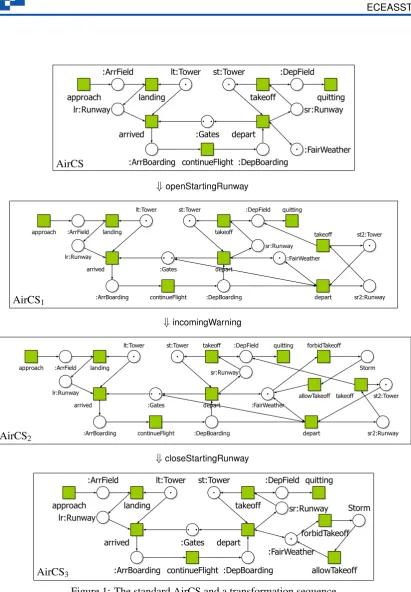
In the top of Fig. 1, the standard AirCS with one starting and one landing runway is depicted. Each runway consists of two places of typeRunwayandTower, with exactly one token on either the one or the other place. A token on Runwayrepresents an airplane on this runway, while a token onTowermeans that this runway is currently not in use. In addition, a landing runway consists of transitionslandingandarrived, and a starting runway of transitionsdepartandtakeoff, respectively. By firing the transitionapproachan airplane appears in the airspace of the AirCS. The transitionlandingmay fire if the runway is currently not used leading to a token representing an airplane on the runway. In the lower part of the P/T system, the gates area is modeled. The place Gates is a counter for the available gates. If a gate is available, the airplane may proceed to a gate by firing the transitionarrived. If the deboarding process is completed, the firing of the transitioncontinueFlightinitiates the boarding process, and using the transitions depart andtakeoffan airplane may depart over an available starting runway. In contrast to transition approach, the firing of the transitionquittingmodels that the airplane leaves the airspace of the AirCS.
AirCS :DepBoarding st:Tower
:Gates
:ArrBoarding lt:Tower
lr:Runway
:ArrField :DepField
:FairWeather sr:Runway
arrived landing approach
continueFlight depart
takeoff quitting
⇓openStartingRunway
AirCS1 :DepBoarding
st:Tower
:Gates
:ArrBoarding lt:Tower
lr:Runway :ArrField
:DepField
:FairWeather sr:Runway
st2:Tower
sr2:Runway arrived
landing approach
depart takeoff
continueFlight
depart takeoff
quitting
⇓incomingWarning
AirCS2 :DepBoarding
st:Tower
:Gates
:ArrBoarding lt:Tower
lr:Runway :ArrField
:DepField
:FairWeather sr:Runway
st2:Tower
sr2:Runway Storm
arrived landing approach
depart takeoff
continueFlight
forbidTakeoff
depart
takeoff quitting
allowTakeoff
⇓closeStartingRunway
AirCS3 :DepBoarding
st:Tower
:Gates
:ArrBoarding lt:Tower
lr:Runway
:ArrField :DepField
:FairWeather
sr:Runway Storm
arrived landing approach
continueFlight
forbidTakeoff depart
takeoff
quitting
allowTakeoff
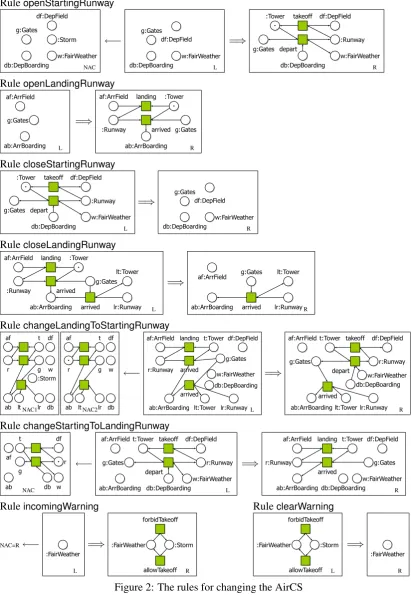
NAC to our P/T system via the match. For the match ofopenStartingRunway, the NAC is ful-filled as long as no place of typeStormexists. In addition, a gluing condition has to be fulfilled to make sure the rule is applicable (see Def.2in Section3). Then, we first delete those elements that are no longer needed and insert those elements that shall be created. They are glued to the already existing elements, for example when applyingopenStartingRunwaythe new transitions are connected to the places in the match. The application of the ruleopenStartingRunwayto the AirCS from Fig.1is the P/T system AirCS1in the upper middle of Fig. 1.
The rules closeStartingRunwayandcloseLandingRunway in the upper middle of Fig. 2 are used to close a runway.closeStartingRunwayis the inverse rule ofopenStartingRunwaywithout a NAC, since closing a starting runway is always allowed. ForcloseLandingRunway, we have to make sure that we do not delete the last landing runway, thus another landing runway has to be present in the match.
In the lower middle of Fig. 2, the ruleschangeLandingToStartingRunway and changeStart-ingToLandingRunwayfor changing the kind of a runway are shown. For both rules, we have a NAC that forbids that the runway is currently used by an airplane, represented by a token on the runway which is not present in the left-hand side. This ensures that the type of the runway is not changed during its use causing strange behaviour for incoming or outgoing flights. In addition, there is a second NAC that forbids the application ofchangeLandingToStartingRunwayin case of a storm. In the NACs, the place types are omitted if they are obvious from the left-hand side.
The arriving of a storm warning is also modeled by a rule as shown in the bottom of Fig. 2. A new place of typeStormis created and two transitions between this place and the place FairWeather. As soon as the storm warning has arrived, no starting runways can be opened. But it is still possible to take off for waiting airplanes using the already existing starting runways. The airport system itself can decide when the weather situation is that bad that no airplan shall depart. Then the transition forbidTakeoff is fired and since there is no longer a token on the placeFairWeather, no more takeoffs are possible. As soon as the weather gets better, by firing the transitionallowTakeoff airplanes may depart. Then the ruleclearWarningdeletes the storm warning and the regular airport operations may continue.
Altogether, in Fig.1a transformation sequence is depicted which first opens a starting runway, then receives a storm warning and afterwards, the starting runway is closed again.
3
Reconfigurable Place/Transition Nets
In this section, we formalize reconfigurable P/T systems based on our results in [HEM05]. As net formalism we use the algebraic notation of “Petri nets are Monoids” in [MM90], but extend this notation by a label function for places. So, a P/T net is given byPN= (P,T,pre,post,label)
with pre- and post domain functionspre,post:T→P⊕and a label functionlabel:P→L, where Lis a fixed alphabet for places andP⊕ is the free commutative monoid over the setPof places, and a P/T system is given by(PN,M)with markingM∈P⊕.
RuleopenStartingRunway db:DepBoarding g:Gates :Storm df:DepField w:FairWeather NAC ←− db:DepBoarding g:Gates df:DepField w:FairWeather L =⇒ db:DepBoarding :Tower g:Gates df:DepField w:FairWeather :Runway depart takeoff R RuleopenLandingRunway g:Gates ab:ArrBoarding af:ArrField L =⇒ g:Gates ab:ArrBoarding :Tower :Runway af:ArrField arrived landing R RulecloseStartingRunway db:DepBoarding :Tower g:Gates df:DepField w:FairWeather :Runway depart takeoff L =⇒ db:DepBoarding g:Gates df:DepField w:FairWeather R RulecloseLandingRunway lt:Tower lr:Runway g:Gates ab:ArrBoarding :Tower :Runway af:ArrField arrived landing arrived L =⇒ lt:Tower lr:Runway g:Gates ab:ArrBoarding af:ArrField arrived R RulechangeLandingToStartingRunway db t g lr lt ab af df w r :Storm NAC1 db t g lr lt ab af df w r NAC2 ←− db:DepBoarding t:Tower g:Gates lr:Runway lt:Tower ab:ArrBoarding af:ArrField df:DepField w:FairWeather r:Runway arrived arrived landing L =⇒ db:DepBoarding t:Tower g:Gates lr:Runway lt:Tower ab:ArrBoarding af:ArrField df:DepField w:FairWeather r:Runway arrived depart takeoff R RulechangeStartingToLandingRunway db t g ab af df w r NAC ←− db:DepBoarding t:Tower g:Gates ab:ArrBoarding af:ArrField df:DepField w:FairWeather r:Runway depart takeoff L =⇒ db:DepBoarding t:Tower g:Gates ab:ArrBoarding af:ArrField df:DepField w:FairWeather r:Runway arrived landing R RuleincomingWarning NAC=R←− :FairWeather :Storm :FairWeather allowTakeoff forbidTakeoff L =⇒ :FairWeather :Storm :FairWeather allowTakeoff forbidTakeoff R RuleclearWarning :FairWeather :Storm :FairWeather allowTakeoff forbidTakeoff L =⇒ :FairWeather :Storm :FairWeather allowTakeoff forbidTakeoff R
Definition 1 (P/T Morphism) Given P/T systems PSi= (Pi,Ti,prei,posti,labeli,Mi) for i=
1,2, a P/T morphism f :PS1→PS2 is given by f = (fP,fT) with functions fP:P1→P2 and
fT :T1→T2satisfying
(1) fP⊕◦pre1=pre2◦fT and fP⊕◦post1=post2◦fT,
(2) label1=label2◦fPand
(3) M1(p)≤M2(fP(p))for allp∈P1.
Moreover, the P/T morphism f is called strict if (4) fP and fT are injective and M1(p) =
M2(fP(p))for allp∈P1.
The category defined by P/T systems and P/T morphisms is denoted byPTSwhere the compo-sition of P/T morphisms is defined component-wise for places and trancompo-sitions. The class of all strict P/T morphisms is denoted byM.
Next we define the gluing condition which has to be satisfied in order to apply a rule at a given match. The characterization of specific points is a sufficient condition for the existence and uniqueness of the so-called pushout complement which is needed for the first step in a transformation.
Definition 2 (Gluing Condition) Given P/T systems PSi = (Pi,Ti,prei,posti,labeli,Mi) for
i∈ {L,K,1}, and let PSL m
−→PS1 be a P/T morphism and PSK l
−→PSL a strict morphism,
then the gluing points GP, the dangling points DPand the identification points IPof PSL are
defined by
GP= l(PK∪TK)
DP= {p∈PL|∃t∈(T1\mT(TL)):mP(p)∈pre1(t)⊕post1(t)}
IP= {p∈PL|∃p0∈PL:p6=p0∧mP(p) =mP(p0)}
∪{t∈TL|∃t0∈TL:t6=t0∧mT(t) =mT(t0)}
The P/T morphisms m and l with l strict satisfy the gluing condition, if all dangling and identification points are gluing points, i.eDP∪IP⊆GP, andmis strict on places to be deleted, i.e.∀p∈PL\l(PK):ML(p) =M1(m(p)).
Next we present rule-based transformations of P/T systems following the double-pushout (DPO) approach of graph transformations in the sense of [Roz97,EEPT06].
Definition 3(P/T System Rule) Given P/T systemsPSi= (Pi,Ti,prei,posti,labeli,Mi)fori∈
{L,K,R,1}, then a rule rule= (PSL l
←−PSK r
−→PSR)consists of P/T systemsPSL,PSK, and
PSR, called the left-hand side, interface, and right-hand side ofrule, respectively, and two strict
P/T morphismsPSK l
−→PSLandPSK r
−→PSR.
The ruleruleis applicable at the matchPSL m
−→PS1 if the gluing condition is satisfied forl andm. In this case, we obtain a P/T systemPS0 leading to a transformation stepPS1rule=⇒,mPS2 consisting of the following pushout diagrams (1) and (2). The P/T morphismn:PSR→PS2 is
PSL m
(1)
PSK l
o
o r //
c
(2)
PSR n
PS1oo l∗ PS0 r∗ //PS2
Now we are able to define reconfigurable P/T systems, which allow the modification of the net structure using rules and transformations of P/T systems.
Definition 4(Reconfigurable P/T Systems) Given a P/T systemPSand a set of rulesRU LES, a reconfigurable P/T system is defined by(PS,RU LES).
In the example in Section2 the reconfigurable P/T system consists of the P/T system in the top of Fig. 1and the set of rules depicted in Fig. 2. Note, that the application of some of these rules is restricted by NACs and we will present the notion of reconfigurable P/T systems with NACs in Section4.
4
Negative Application Conditions
In this section, we first state the main technical result that P/T systems are a weak adhesive HLR category with NACs. As a consequence we can define NACs for P/T system rules and transformations. Afterwards we summarize the main results available for reconfigurable P/T systems with NACs.
In addition to the classM in Section3we need two other classes of morphisms. The classQ denotes those morphisms that connect the NAC to the source net, which is the class of injective P/T system morphisms. Note that morphisms in this class do not need to be marking strict. The classE is a class of minimal jointly surjective morphism pairs, where minimal means that the markings in the codomain are as small as possible, i.e. for e1:PS1→PS3, e2 :PS2 →PS3
with (e1,e2)∈E we have that e1,e2 are jointly surjective and M3(p) =max({M1(p0) | p0 ∈
e−11(p)} ∪ {M2(p0)k p0∈e−21(p)}). This class is mainly used for constructions and proofs.
Definition 5 (Morphism classes in PTS) Given the category PTS of P/T systems and P/T morphisms, then the following morphism classes are defined:
M : strictPTSmorphisms (injective and marking strictPTSmorphisms) Q : injectivePTSmorphisms (monomorphisms in the categoryPTS) E : minimal jointly surjectivePTSmorphisms
Theorem 1(PTSis weak adhesive HLR category with NACs) Given the weak adhesive HLR categoryPTSand the morphism classesM,QandE as defined above then we have
1. uniqueE-Qpair factorization,
2. unique epi-M factorization,
4. initial pushouts overQ-morphisms,
5. Qis closed under pushouts and pullbacks alongM-morphisms,
6. induced pullback-pushout property forM andQand
7. Qis closed under composition and decomposition.
Altogether,(PTS,M,E,Q)is a weak adhesive HLR category with NACs.
Proof. In [EEH+07], it has been shown that(PTS,M)is a weak adhesive HLR category. Ac-cording to [LEOP08], for a weak adhesive HLR category with NACs Items 1–7 have to be proven additionally. Note, that in [LEOP08] an additional morphism classM0 is used and some more properties have to be checked. In the case ofPTS,QandM0coincide, which reduces the effort for the proof. Here we only explain the properties and give proof ideas, the detailed proof can be found in [Rei08].
1. uniqueE-Qpair factorization: For a morphism pair f1:L1→P, f2:L2→P, anE-Qpair
factorization is a paire1:L1→K,e2:L2→Kwith(e1,e2)∈E andm:K→P∈Qsuch
thatm◦e1= f1andm◦e2=f2. Uniqueness means that twoE-Qpair factorizations of f1
and f2are isomorphic.
For the construction of thisE-Qpair factorization inPTS, we first construct the coproduct L of L1 andL2 with coproduct inclusions i1 and i2, obtain a morphism f :L→P and
construct an epi-mono factorization(e:L→K,m:K→P) of f in P/T nets. Defining MK(p) =max({ML(p0)| p0∈e−1(p)})ande1=e◦i1,e2=e◦i2leads to a uniqueE-Q
pair factorization. This property is needed mainly for the embedding and extension of transformation pairs.
2. unique epi-M factorization: For a morphism f :L→P, an epi-M factorization is an epimorphisme:L→Kand a morphismm:K→P∈M such thatm◦e= f. Uniqueness means that two epi-M factorizations of f are isomorphic.
For the construction, we use the epi-mono factorization of f in P/T nets, and obtain the marking from the marking ofPleading to a strict morphismm∈M. Uniqueness follows directly from uniqueness of the epi-mono factorization in P/T nets and strictness ofM. This property is needed for the translation of NACs over a morphism.
3. M-Q pushout-pullback decomposition property: Given the following commutative dia-gram withl∈M andw∈Q, where(1+2) is a pushout and(2)is a pullback, then(1) and(2)are both pushouts.
In P/T nets, this property holds for injectivelandw, thus we obtain pushouts(1)and(2) in P/T nets. It remains to show the additional pushout properties inPTS, which can be verified. This property is needed for the embedding and extension of transformation pairs and for the equivalence of left and right NACs.
includes all places where f is not marking-strict. This property is needed for the extension of transformations.
5. Qis closed under pushouts and pullbacks alongM-morphisms: In a pushout or pullback square alongM, if the other given morphism is inQ then the opposite morphism is also aQ-morphism.
This property follows directly from the corresponding properties in P/T nets and is used for the translation of NACs as well as for the embedding and extension of transformations. 6. induced pullback-pushout property forM andQ: Given the following pushout(PO)and
the pullback(PB)then the induced morphismx:PS3→PS4is aQ-morphism.
This property can be shown using the fact that f0 andg0 are jointly surjective, which can be shown for the pushout construction. It is needed for the translation of NACs over a morphism.
7. Qis closed under composition and decomposition: This is a standard result for monomor-phisms from category theory. This property is needed for the translation of NACs and for the completeness of critical pairs.
A B E
(1) (2)
C D F
k
l s
u
r
v
w
P S0 P S1
(P B)
P S2 P S4
f
g
h0
h
P S0 P S1
(P O)
P S2 P S3
f
g
f0
g0
Now, we can state negative application conditions for P/T system transformation in the fol-lowing sense:
Definition 6((Left) Negative Application Condition) A (left) negative application condition of a rulerule= (PSL
l
←PSK r
→PSR)in the weak adhesive HLR category with NACs(C,M,E,Q)
is of the formNAC(n), wheren:PSL→PSNis a P/T morphism.
A morphism m:PSL→PS1 satisfiesNAC(n), writtenm|=NAC(n), if there does not exist a
morphismq:PSN→PS1∈Qwithq◦n=m.
Definition 7(Rule with NACs) A rule in a weak adhesive HLR category with NACs(C,M,E,
Q)with a set of negative application conditionsNACSis called rule with NACs.
Remark1 Analogously to left NACs we can define right NACs on the right-hand side of a rule which have to be satisfied by the comatch of the transformation. In this paper, we only consider rules with an empty set of right NACs. This is without loss of generality since each right NAC can be translated into an equivalent left NAC as shown in [EEPT06,LEOP08].
Definition 8(Applicability of a Rule with NACs) Given a rulerule= (PSL l
←PSK r
→PSR)
with a set of negative application conditionsNACSand a matchm:PSL→PS1 such thatrule
For these new rules and their restricted application we obtain the same results as known for net transformations in general. These results have been shown for NACs at the level of weak adhe-sive HLR categories in [LEOP08,LEO06,Lam07]. Their instantiation to P/T systems requires Theorem1above.
Results(For Reconfigurable P/T Systems with NACs)
1. Local Church-Rosser and Parallelism: The local Church-Rosser property for transfor-mations with NACs states that for two rules with two matches, the application of the rules at the matches to the same P/T system in any order (sequentially independence) yields the same result if and only if the transformations are parallel independent. For parallel independence of two transformations with NACs it has to be checked in particular if one transformation does not delete anything the other transformation needs, and, in addition, that one transformation does not produce any structure that is forbidden by the other one. For such independent transformations a parallel transformation with NACs can be built obtaining the same result in one transformation step.
In our airport example it makes e.g. no difference if a starting or a landing runway is opened first. After opening a starting runway it is still possible to open a landing runway, since nothing is deleted and there is no NAC on the rule openLandingRunway. After opening a landing runway a starting one can be opened: Nothing is deleted and the NAC of the ruleopenStartingRunwaythat forbids the existence of a place of typeStormremains satisfied. Moreover now both runways can be constructed in parallel. This construction leads to the same result consisting of an airport with one more starting and one more landing runway.
2. Conflicts and Critical Pairs: If two transformations are not parallel independent as described in Item 1 then they are in conflict. This means in particular that one of the transformations deletes some structure which is needed by the other one, or it produces a structure which is forbidden by the other one. A critical pair describes such a conflict be-tween two transformations in a minimal context. Critical pairs are proven to be complete [LEO06], i.e. each conflict occurring in the system between two transformations is repre-sented by a critical pair expressing the same conflict in a minimal context. The morphism classE is required to express this minimal context.
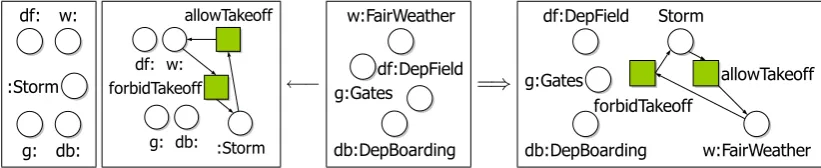
In our example a transformation adding a warning (i.e. applying the ruleincomingWarning) is in conflict with a transformation which opens a starting runway (i.e. applying rule openStartingRunway). This conflict is caused by the NAC of the ruleopenStartingRunway as it cannot be applied if a place of typeStormis present. This conflict occurs regardless of the number of runways already present in the airport and is expressed in a minimal context by the critical pair shown in Figure3.
db:DepBoarding g:Gates
Storm df:DepField
w:FairWeather forbidTakeoff
allowTakeoff incomingWarning
⇐=
db:DepBoarding g:Gates
df:DepField w:FairWeather
openStartingRunway
=⇒
db:DepBoarding :Tower
g:Gates
df:DepField
w:FairWeather :Runway depart
takeoff
Figure 3: The critical pair for the rulesincomingWarningandopenStartingRunway
db: g: :Storm
df: w:
db:
g: :Storm
df: w:
allowTakeoff
forbidTakeoff ←−
db:DepBoarding g:Gates
df:DepField w:FairWeather
=⇒
db:DepBoarding g:Gates
Storm df:DepField
w:FairWeather forbidTakeoff
allowTakeoff
Figure 4: The concurrent rule with NACs
transformation sequence. The Concurrency Theorem states that a concurrent rule with NACs equivalent to a sequence of rules with NACs is applicable with the same result if and only if the rule sequence with NACs is applicable. The construction of the concurrent rule is analogous to the case without NACs. Additionally, all NACs occurring in the rule sequence need to be translated into equivalent NACs for the concurrent rule. The con-struction of such a concurrent rule with NACs is explained in [LEOP08]. A concurrent rule summarizes in one rule which parts of the net should be present, preserved, deleted and produced when applying the corresponding rule sequence to this net. Moreover we have a summarized set of NACs on the concurrent rule expressing which net parts are forbidden when applying the corresponding rule sequence with NACs to the net.
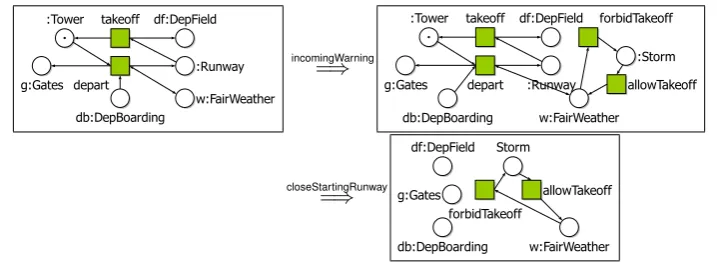
Consider for our example the transformation sequence in Fig.1. First, a starting runway is opened followed by an incoming warning after which the starting runway is closed again. This transformation sequence can be summarized to one transformation step via a new concurrent rule with concurrent NACs as depicted in Fig. 4. Note that this concurrent rule now holds two single NACs, one originating from the first ruleopenStartingRunway and the other one originating from the second ruleincomingWarningin the sequence. Note, moreover, that this rule adds no new behavior to our system, but merely adds the possibility of performing these three transformations in one step with the same result.
4. Embedding and Extension: Consider a transformation t:N0
∗
⇒Nn and a morphism
k0:N0→N00, then the transformationtcan be embedded into the larger contextN00 if and only if the extension morphismk0:N0→N00 satisfies two consistency conditions. First, it
[LEO06]. Intuitively, the transformationtcan be summarized into one steptc:N0⇒Nn
using the new concurrent rule with concurrent NACs. Now the extension morphism k0 may not map to a larger P/T system N00 with added structures which are forbidden by this concurrent NAC. Note that boundary consistency and NAC-consistency are not only sufficient, but also necessary conditions for the construction of extended transformations with NACs. So, whenever it is possible to repeat a transformationtinto a bigger context N00 the extension morphism was boundary and NAC-consistent.
In our example, we can embed the transformation described in the last item into the P/T system AirCS1from Fig. 1which is not the initial one, but already contains two starting
and one landing runway. On the contrary, this transformation cannot be embedded into the airport AirCS2 from Fig. 1which already contains a storm warning. This is because the
extension morphismk0 adds a place of typeStormwhich is forbidden by the concurrent
NACs as depicted in Fig.4.
5. Confluence:Critical pairs as described in Item 2 are not only complete, their confluence behavior has an impact on the confluence behavior of the whole system. Intuitively this means that if a conflict can be resolved in a certain way in its minimal context, the same conflict is resolvable as well if it occurs in a larger context. A solution of a conflict in a minimal context (or critical pair)P1←K→P2is a pair of transformation sequencest1and
t2such thatt1 transformsP1 into a certain netX andt2 transforms it into the same netX. Thus the same system state can be reached again if a conflict occurred. The solution of the critical pair needs to be strict. Intuitively speaking, this means thatt1andt2preserve
ev-erything which is preserved in common by the critical pair itself. Moreover, whenever it is possible to embed the critical pair into some larger context the extension morphism should be NAC-consistent with respect to the critical pair solution (NAC-confluence [Lam07] ). This means in particular that all NACs occurring in the solution of the critical pair are still satisfied by the embedding into the larger context. Under these conditions, this conflict can be resolved in the same way also in a larger context. Otherwise, the solution of the critical pair is no solution for the larger context, and no prediction for confluence can be infered. In particular, if all critical pairs of the reconfiguration system are strictly NAC-confluent then the system is locally confluent.
db:DepBoarding :Tower
g:Gates
df:DepField
w:FairWeather :Runway depart
takeoff
incomingWarning
=⇒
db:DepBoarding :Tower
g:Gates
:Storm df:DepField
w:FairWeather
:Runway allowTakeoff forbidTakeoff
depart takeoff
closeStartingRunway
=⇒
db:DepBoarding g:Gates
Storm df:DepField
w:FairWeather forbidTakeoff
allowTakeoff
Figure 5: The solution for the critical pair
warning and opening a starting runway by having an incoming warning and closing the runway in each bigger airport as well.
5
Conclusion
We conclude with a short discussion of related and future work:
Related Work Reconfigurable nets have been defined based on net transformations that aim directly at changing the net in arbitrary ways. This approach can be restricted to transformations that preserve specific properties as safety or liveness (see [PU03]). Dynamic nets [BS01] are based on the join calculus and allow the dynamic adaption of the network configuration and are considered to be a special case of zero-safe nets [BMM04]. In a series of papers [LO04,LO06a, LO06b] rewriting of Petri nets in terms of graph grammars is used for the reconfiguration of nets as well. These marked-controlled reconfigurable nets (MCRN) are extended by some control technique that allows changes of the net for specific markings. The enabling of a rule is not only dependent on the net topology, but also dependent on the marking of specific control places.
MCReNet [LO06a] is the corresponding tool for the modeling and verification of MCRNs. Future Work One ongoing research task is the extension of this paper’s results to algebraic high-level nets, a Petri net variant with additional data types in terms of algebraic specifications. Therefore, the same conditions have to be proved considering additionally the specification and algebra morphisms. Another one are algebraic higher order (AHO) nets that can be used as a controlling mechanism for reconfigurable Petri nets. AHO nets have dynamical tokens like Petri systems as well as transformation rules. This specification technique has been targeted at modeling workflows of mobile ad-hoc networks. Up to now we have not made use of the new feature of NACs in AHO nets. To do so we have to integrate the NACs into the algebra underlying the AHO net.
References
Nets. LNCS 3098, pp. 291–327. Springer, 2004.
[BS01] M. Buscemi, V. Sassone. High-Level Petri Nets as Type Theories in the Join Calcu-lus. InProceedings of FoSSaCS ’01. Springer, 2001.
[EEH+07] H. Ehrig, C. Ermel, K. Hoffmann, J. Padberg, U. Prange. Concurrency in Reconfig-urable Place/Transition Systems: Independence of Net Transformations as well as Net Transformations and Token Firing. Technical report 2007-02, TU Berlin, 2007. [EEPT06] H. Ehrig, K. Ehrig, U. Prange, G. Taentzer.Fundamentals of Algebraic Graph
Trans-formation. EATCS Monographs. Springer, 2006.
[EP04] H. Ehrig, J. Padberg. Graph Grammars and Petri Net Transformations. In Lectures on Concurrency and Petri Nets. LNCS 3098, pp. 496–536. Springer, 2004.
[HEM05] K. Hoffmann, H. Ehrig, T. Mossakowski. High-Level Nets with Nets and Rules as Tokens. InProceedings of ICATPN’05. LNCS 3536, pp. 268–288. Springer, 2005. [Lam07] L. Lambers. Adhesive High-Level Replacement Systems with Negative Application
Conditions. Technical report, TU Berlin, 2007.
[LEO06] L. Lambers, H. Ehrig, F. Orejas. Conflict Detection for Graph Transformation with Negative Application Conditions. InProceedings of ICGT’06. LNCS 4178, pp. 61– 76. Springer, 2006.
[LEOP08] L. Lambers, H. Ehrig, F. Orejas, U. Prange. Parallelism and Concurrency in Adhesive High-Level Replacement Systems with Negative Application Conditions. ENTCS, 2008. to appear.
[LO04] M. Llorens, J. Oliver. Structural and Dynamic Changes in Concurrent Systems: Re-configurable Petri Nets.IEEE Transactions on Computers53(9):1147–1158, 2004. [LO06a] M. Llorens, J. Oliver. A Basic Tool for the Modeling of Marked-Controlled
Recon-figurable Petri Nets.ECEASST2:13, 2006.
[LO06b] M. Llorens, J. Oliver. Marked-Controlled Reconfigurable Workflow Nets. In SYNASC. Pp. 407–413. IEEE Computer Society, 2006.
[MM90] J. Meseguer, U. Montanari. Petri Nets are Monoids. Information and Computation 88(2):105–155, 1990.
[PU03] J. Padberg, M. Urb´aˇsek. Rule-Based Refinement of Petri Nets: A Survey. InPetri Net Technology for Communication-Based Systems. LNCS 2472, pp. 161–196. Springer, 2003.
[Rei08] A. Rein. Reconfigurable Petri Systems with Negative Application Conditions. Tech-nical report 2008/01, TU Berlin, 2008. Diploma Thesis, to appear.