135
Evaluation of gEnotoxic and antigEnotoxic propErtiEs of EssEntial
oils of SeSeli rigidum Waldst. & Kit. (apiacEaE)
Lada Živković1, Andrea Čabarkapa1,*, Mirjana Marčetić2, Nada Kovačević2, Vladan Bajić3, Snežana Jovičić4
and Biljana Spremo-Potparević1
1 Faculty of Pharmacy, Department of Physiology, Laboratory of Biology and Human Genetics, University of Belgrade, Belgrade, Serbia
2 Faculty of Pharmacy, Department of Pharmacognosy, University of Belgrade, Belgrade, Serbia
3 Institute for Nuclear Sciences “Vinca”, Department of Radiobiology and Molecular Genetics University of Belgrade, Belgrade, Serbia
3 Faculty of Pharmacy, Center for Biological Research, University of Belgrade, Belgrade, Serbia
*corresponding author: [email protected]
received: May 12, 2015; revised: June 15, 2015; accepted: June 18, 2015; published online: December 14, 2015
abstract: The essential oils of genus Seseli are known for their beneficial biological activities and could present novel targets in the development of safe and effective preparations of plant products. The objective was to test the essential oils of different parts of Seseli rigidum from two natural habitats for potential genotoxic and antigenotoxic activities against H202-induced DNA damage in human whole blood cells in vitro, by the comet assay. The essential oil analysis showed a high falcarinol content in oil from the root, while oils of the fruit and aerial parts contained α-pinene as the main compound. Genotoxicity was not detected at any of the concentrations of the essential oils from the three parts of the plant from localities I and II. Although the antioxidant activity (established by the FRAP and DPPH tests) of the investigated oils was low, all oils dem-onstrated a strong antigenotoxic effect against H2O2-induced damage post-treatment, when the oils were applied after the oxidant. Based on the lack of pretreatment activity and the post-treatment reduction in DNA damage, the antigenotoxic effect of S. rigidum essential oils was probably based on the stimulation of DNA repair mechanisms. Environmental condi-tions did not affect the antigenotoxic properties of the oils. In conclusion, our results revealed the antigenotoxic properties of S. rigidum essential oils and appropriate and safe doses with beneficial effects under the described conditions.
Key words: Seseli rigidum; essential oils; antioxidant; DNA damage; comet assay
introduction
Genomic damage may lead to chronic diseases, cancer and premature ageing. Compared to other macromol-ecules, DNA is more sensitive to oxidative damage, making it a suitable marker for examination of the effects of oxidant-induced damage in the cell (Cooke et al., 2003). Reactive oxygen species (ROS) are con-stantly generated during normal cellular activity (Bar-zilai and Yamamoto, 2004). However, an imbalance between the generation of ROS and the antioxidant capacity of cells can lead to oxidative stress. ROS in-crease can cause severe damage to macromolecules,
especially to DNA. When DNA damage in cell occurs, repair mechanisms are activated in order to prevent genomic instability (Polo and Jackson, 2011). Unre-paired DNA damage can be detected by comet assay (Anderson et al., 1994).
Seseli rigidum Waldst. & Kit. (Apiaceae) is an her-baceous perennial plant native to the Balkan Penin-sula (Ball, 1968). Species of the genus Seseli are used in traditional medicine as anti-inflammatory agents, and for their carminative, stomachic, anthelmintic and antibacterial properties (Küpeli et al., 2006; Gonçalves et al., 2012). The essential oil of species of the genus
Seseli showed antibacterial, antifungal (Gonçalves et al., 2012; Milosavljević et al., 2007; Stojković et al., 2009; Skalicka-Wozniak et al., 2010) and moderate cytotox-ic activity (Gonçalves et al., 2012; Shahabipour et al., 2012). Ethyl acetate extracts of Seseli species from Tur-key exerted anti-inflammatory and antinociceptive ac-tivity (Küpeli et al., 2006). The essential oil of the root, aerial parts and fruit of S. rigidum showed antimicrobial effects against laboratory control strains of bacteria and methicillin-resistant strains of Staphylococcus aureus
(MRSA) (Marčetić et al., 2012). Also, S. rigidum flower essential oil demonstrated moderate antimicrobial and low antioxidant effects (Stojković et al., 2009).
Despite the potential beneficial activities, there are no published reports on the genotoxicity or antigeno-toxicity of S. rigidum essential oils. Since the use of es-sential oils in therapeutic approaches may require high doses, screening for potentially genotoxic properties is of great significance in order to determine the optimal concentration for safe use. In this work, the effect of different concentrations of plant essential oils in attenu-ating DNA damage induced by hydrogen peroxide in human whole blood (WB) cells. The comet assay, as a well-established and sensitive test was used to evaluate DNA damage (Anderson and McGregor, 1998).
The production of essential oil is strongly influ-enced by genotype, environmental factors and interac-tions between genotype and environment. Among the abiotic environmental factors, climate and soil type can strongly influence the terpene biosynthesis and compo-sition of the essential oil. Subsequently, the biological activity can vary depending on the composition of the essential oils from the plants that grow under different environmental conditions (Figueiredo et al., 2008).
The aim of this investigation was to study the anti-oxidant potential, genotoxic and antigenotoxic activity
of the essential oil of root, aerial parts and fruit of S. rigidum from two natural populations in Serbia.
MatErials and MEtHods plant material
Root and aerial parts were collected in June 2010 during the flowering of Seseli rigidum and fruits in September 2010, in the Brdjanska gorge (longitude 43.986, latitude 20.418, altitude 288 m a.s.l) in west-ern Serbia, from a humid climate and serpentine soil (locality I), and in Golubac (longitude 44.660, lati-tude 21.671, altilati-tude 100 m.a.s.l) in eastern Serbia, from a semi-arid climate and calcareous soil (locality II). Specimens were deposited at the Herbarium of the Faculty of Pharmacy in Belgrade (3240HFF, 3233 HFF). Essential oils were obtained from dried and ground plant material by hydrodistillation in a Clev-enger-type apparatus according to procedure given in European Pharmacopoeia 7.0 (2011).
Essential oil analysis
retention indices (RI), retention times (tR) and mass spectra with those obtained from authentic samples and/or the NIST AMDIS (Automated Mass Spectral Deconvolution and Identification System) software, Wiley libraries, Adams database and literature (Ad-ams, 2001). Relative percentages of the identified com-pounds were computed from the GC/FID peak area.
ferric reducing antioxidant power
The total antioxidant potentials of essential oils were determined using ferric reducing antioxidant power (FRAP) assay based on a reduction of ferric ions (Fe3+)
to ferrous ions (Fe2+) and formation of a blue complex
(Fe2+-2,4,6-tripyridyl-s-triazine; Fe2+-TPTZ), which
increases the absorption at 593 nm (Benzie and Strain, 1996; Szőllősi and Varga Szőllősi, 2002). The amount of reduced Fe2+-TPTZ complex was calculated from
an equation of regression line constructed from the absorbance of water solutions of FeSO4 × 7 H2O (0.1-1.0 mM) under experimental conditions. Results are expressed as μmol Fe2+/mg extracts. All measurements
were performed in triplicate. The natural antioxidants rutin and ascorbic acid served as a control. All reagents were supplied by Sigma-Aldrich, St. Louis, MO, USA.
dppH radical scavenging activity
DPPH (2,2-diphenyl-1-picrylhydrazyl) radical scav-enging activity is based on the reduction of the free radical DPPH and the decrease of absorbance at 517 nm (Bondet, et al., 1997). The SC50 value, which is the concentration of the tested extract that reduces 50% of the free-radical concentration, was calculated as mg/ mL from plot of logarithms of concentration versus probit of scavenging effect. All determinations were performed in triplicate. The natural antioxidants rutin and ascorbic acid were used as a control. All reagents were supplied by Sigma-Aldrich, St. Louis, MO, USA.
subjects
Heparinized human whole blood samples were ob-tained by venipuncture from six healthy donors aged under 25 years. Subjects were non-smokers who
re-ported no alcohol consumption, were receiving no therapy or medication, nor taking dietary supple-ments.
study design
Essential oils were dissolved in ethanol and then dilut-ed with the phosphate-bufferdilut-ed saline solution. Final concentrations of essential oils were chosen according to the range of concentrations previously found to be effective in antimicrobial assessment of S. rigidum
studies (Marčetić et al., 2012). As the highest activity was obtained with root essential oil, it was studied at a wider range of concentrations (12.5, 25, 50 and 100 µg/mL). The activity of the essential oil of aerial parts and fruit were investigated at three concentrations, 25, 50 and 100 µg/mL.
In order to estimate the genotoxic potential of the essential oils of root, aerial parts and fruit at differ-ent concdiffer-entrations we used the following protocol. Suspensions of WB cells embedded in agarose gel on slides were made and treated with a 50 µL solution of essential oils at the indicated concentrations for 30 min at 37°C to evaluate the oils’ ability to cause DNA damage. The experiment was simultaneously done with samples treated only with the solvent phosphate-buffered saline (PBS, Torlak Institute of Immunology and Virology, Belgrade, Serbia) as negative control, and 50 µM hydrogen peroxide (H202, CAS No. 7722-84-1, ZORKA Pharma, Šabac, Serbia) as positive con-trol. Treatment with 50 µM H2O2 for 20 min on ice was the smallest concentrations that produced a con-sistently high level of DNA fragmentation in exposed cells as compared to the untreated controls.
To examine the genoprotective potential of S. rigi-dum essential oils on human WB cells against H2O2
oils was performed, where WB cells were first exposed to H2O2 and afterwards treated with the oils under the same conditions as before. After the last treatment, cells were washed once more with PBS and DNA dam-age was evaluated. All experiments were carried out in duplicate and repeated six times.
the single cell gel electrophoresis assay
The comet assay was performed essentially as de-scribed by Singh et al. (1988). The alkaline comet test was used to detect DNA strand breaks and alkali-labile sites; the extent of DNA migration indicated the de-gree of DNA damage in the cell. First, cell viability was determined by the trypan blue exclusion method, and was found to be above 90% (Anderson et al., 1994). Af-ter the cell viability check, 6 μl of whole blood was sus-pended in 0.67% low-melting-point agarose (Sigma-Aldrich, St. Louis, MO) and pipetted onto SuperFrost™ glass microscope slides precoated with a layer of 1% of normal-melting-point agarose (Sigma-Aldrich, St. Louis, MO), spread using a coverslip, and maintained for 5 min on ice to solidify. After gently removing the coverslips, the WB cell suspension in agarose gel on slides were treated with the oil solutions and H2O2 as described above. Following the treatments, the slides were rinsed with PBS and covered with the third layer of 0.5% low melting agarose and again allowed to solid-ify on ice for 5 min. After removal of the coverslips, the slides were placed in cold lysing solution (2.5 M NaCl, 100 mM EDTA, 10 mM Tris, 1% Triton X100 and 10% dimethyl sulfoxide, pH 10 adjusted with NaOH) at 4°C overnight and afterwards subjected to electrophoresis and staining with ethidium bromide, as described by Singh et al. (1988). The comets were observed and ana-lyzed using an Olympus X 50 microscope (Olympus Optical Co., GmbH Hamburg, Germany), equipped with a fluorescence recording device at 100× magni-fication. Evaluation of DNA damage was performed as described by Anderson et al. (1994). Namely, cells were graded visually into five categories corresponding to the following amount of DNA in the tail: (A) no dam-age, <5%; (B) low level damdam-age, 5-20%; (C) medium level damage, 20-40%; (D) high level damage, 40-95%; (E) total damage, >95%.
Analysis was performed on a 100 randomly select-ed cells per subject (50 cells from each of 2 replicate slides). In order to obtain semiquantitative analysis of data, DNA damage was characterized as DNA migra-tion greater than 5% (total number of damaged cells from comet classes B+C+D+E), and the mean value was calculated for all subjects.
statistical analysis
Statistical analysis of the comet assay results was per-formed using one-way analysis of variance (ANOVA). Values are expressed as mean±standard error of the mean (SEM) for n=6. GraphPad Prism 5.0 software was used. A difference at p<0.05 was considered sta-tistically significant.
rEsults
Essential oil analysis and antioxidant activity of the oils
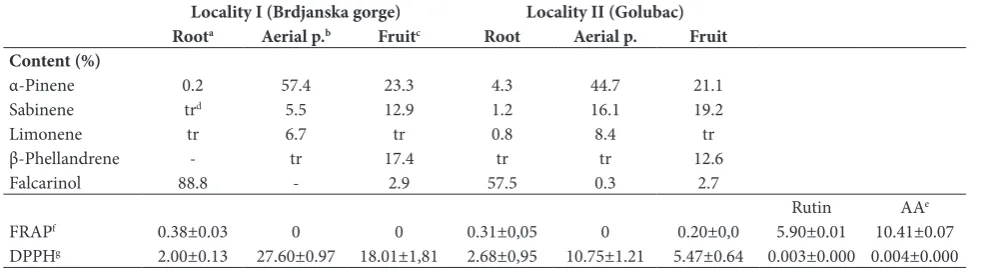
The essential oil of S. rigidum root is characterized by a high content of polyacetylene falcarinol (Marčetić et al., 2012; 2013). In samples of root essential oil from locality I (Brdjanska gorge), the content of falcarinol (88.8%) was higher than in oil from locality II (Golu-bac, 57.5%) (Table 1). The essential oil of S. rigidum
aerial parts is mainly composed of the monoterpenes α-pinene, sabinene and limonene (Marčetić et al., 2012; Šavikin-Fodulović et al., 2006). In the essential oils of aerial parts α-pinene (57.4% locality I and 44.7% lo-cality II), sabinene (5.5% lolo-cality I and 16.1% lolo-cality II) and limonene (6.7% locality I and 8.4% locality II) also dominated. In accordance with previous inves-tigations (Marčetić et al., 2012), the monoterpenes α-pinene (23.3% locality I and 21.1% locality II), sab-inene (12.9% locality I and 19.2% locality II) and ses-quiterpene β-phellandrene (17.4% locality I and 12.6% locality II) were the main constituents in fruit oil.
The total antioxidant potential of the investigated essential oils was in the range 0-0.38 μmol Fe2+/mg
the locality II did not show reducing ability. The total antioxidant potential of the essential oils of the root from the both localities (0.38±0.03 and 0.31±0.05 μmol Fe2+/mg) and the oil of fruit from locality II (0.20±0.0
μmol Fe2+/mg) was modest when compared with the
control antioxidants rutin (5.90±0.01 μmol Fe2+/mg)
and ascorbic acid (10.41±0.07 μmol Fe2+/mg).
In the DPPH assay, the reactivity of the potential antioxidant with stable, free DPPH radical is measured. The concentrations of essential oils that reduce 50% of the DPPH radical were from 2.00 to 27.60 mg/mL (Table 1). The best DPPH-scavenging activity was ob-tained with the essential oil of root from both localities (2.00±0.13 and 2.68±0.95 mg/mL). Essential oils of aerial parts and fruit (10.75±1.21 and 5.47±0.64 mg/ mL, respectively) from locality II showed a more pro-nounced DPPH-scavenging ability than the oil from locality I, but nonetheless moderate activity in compar-ison with the control antioxidants rutin (0.003±0.000 mg/mL) and ascorbic acid (0.004±0.000 mg/mL).
Evaluation of genotoxic activity of essential oils
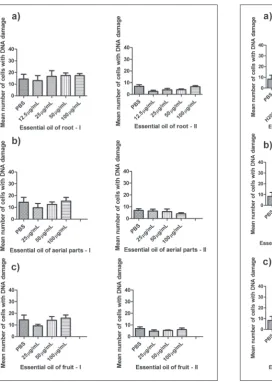
The comet assay was employed to assess the ability of essential oils of S. rigidum to cause DNA damage, visible as DNA migration. The analyzed results dem-onstrated that the concentrations (12.5-100 μg/mL) of root essential oil from localities I and II did not sig-nificantly increase the total number of DNA-damaged cells in regard to the control treated only with PBS,
which clearly shows that the tested essential oils did not display a genotoxic effect (Fig. 1a). Although cells treated with the essential oil of root from locality I displayed a slight increase in the number of DNA-damaged cells, no statistically significant differences were found between treated cells and the control (Fig. 1a). The results of treatment with three concentrations (25, 50 and 100 μg/mL) of the essential oil of aerial parts from both localities demonstrated the absence of genotoxicity, since the tested concentrations did not cause the induction of DNA damage (Fig. 1b). Similar results were shown after incubation with fruit essential oils at concentrations of 25, 50 and 100 µg/mL from both localities, i.e. fruit oils did not produce any sta-tistically significant rise in DNA damage compared to the control (PBS), indicating a lack of genotoxicity (Fig. 1c). When the genotoxicity of root, aerial parts and fruit essential oils of the two different localities was compared, we found that there was no statistically significant difference (ANOVA, p>0.05).
Evaluation of antigenotoxic activity of essential oils
The antigenotoxic effect of the root, aerial parts and fruit essential oils from localities I and II against H2O2 -induced DNA damage were examined using two ex-perimental protocols, i.e. pre- and post-treatment. No statistically significant difference was observed in the number of DNA-damaged cells between cells treated with the oils before the treatment and the positive control treated only with H2O2. The root, aerial parts
table 1. Phytochemical analysis and antioxidant activities of essential oils.
locality i (Brdjanska gorge) locality ii (golubac) roota aerial p.b fruitc root aerial p. fruit
content (%)
α-Pinene 0.2 57.4 23.3 4.3 44.7 21.1 Sabinene trd 5.5 12.9 1.2 16.1 19.2
Limonene tr 6.7 tr 0.8 8.4 tr
β-Phellandrene - tr 17.4 tr tr 12.6
Falcarinol 88.8 - 2.9 57.5 0.3 2.7
Rutin AAe
FRAPf 0.38±0.03 0 0 0.31±0,05 0 0.20±0,0 5.90±0.01 10.41±0.07
DPPHg 2.00±0.13 27.60±0.97 18.01±1,81 2.68±0,95 10.75±1.21 5.47±0.64 0.003±0.000 0.004±0.000 a essential oil of root; b essential oil of aerial parts; c essential oil of fruit; d trace (<0.1%); e ascorbic acid; f μmol Fe2+/mg; g SC
50 concentration of the oil that
and fruit essential oils from the two localities applied in pretreatment (before the oxidant), did not prevent the induction of DNA damage by H2O2, indicatingthe absence of genoprotective activity of the examined oils (data not shown). The results of post-treatment conditions are given in Fig. 2. It was determined that all essential oils from the two localities applied post-treatment significantly decreased the number of cells displaying H2O2-induced DNA damage, pointing to strong antigenotoxic properties (Fig. 2). When the ef-fect of root essential oil from locality I was examined,
it was found that the number of cells with DNA dam-age was decreased compared to the control (H2O2) for all tested concentrations, although a significant difference (p<0.05) was obtained only for the lowest concentration of the root oil (12.5 µg/mL) (Fig. 2a). The results showed a concentration-dependent trend where a reduction in the concentrations of the root oil led to the decrease of H2O2-induced DNA dam-age. However, the antigenotoxic effect of the root oil from the locality II under the same conditions was more pronounced (Fig. 2a). Namely, incubation with
fig. 1. Evaluation of the genotoxic potential of different concen-trations of Seseli rigidum essential oils from root (A) aerial parts (B) and fruit (C) from locality I and II at the level of DNA damage. Graphs show the mean number of cells with damaged DNA±SEM.
all tested concentrations of root oil from locality II displayed a statistically significant (p<0.05) decrease in H2O2-induced DNA damage compared to the positive control (45.4-67.1% of damage reduction). It should be noticed that the root oils from both locali-ties showed the same concentration-dependent trend with smaller doses being more effective.The essential oils of aerial parts from both localities showed statisti-cally significant (p<0.05) attenuation of H2O2-induced DNA damage (66.9-79.8%) for all tested concentra-tions (25-100 μg/mL) (Fig. 2b). Contrary to the effect of the root essential oil, the most pronounced DNA-damage reduction was achieved (79.8%) after incuba-tion with the highest concentraincuba-tion of the oil of aerial parts (100 μg/mL). A significant antigenotoxic effect was also observed with the essential oil of fruit (55.6-81.4%) (Fig. 2c). The reduction in concentrations led to an increase in antigenotoxic effect and decrease in the number of DNA-damaged cells, in locality I.
Statistical analysis (ANOVA, p>0.05) showed that there were no significant differences between the an-tigenotoxic effects of S. rigidum root, aerial parts and fruit essential oils from the different localities.
discussion
Cell damage caused by oxidative stress can lead to a variety of degenerative changes linked with progres-sion of a variety of diseases, including (Halliwell and Gutteridge, 1984). When the antioxidant defenses of a cell are overwhelmed by an excessive production of ROS, cellular macromolecules such as DNA undergo damage. The most common kind of damage due to an increase in ROS production is DNA oxidation (Azqueta et al., 2009). Since oxidative stress is recog-nized as an important factor in the etiology of many chronic diseases, the examination of dietary compo-nents with antioxidant activity is of increasing inter-est. Consequently, attention has been focused towards natural products as the source of novel antioxidants..
Significant protective effects and antioxidant ac-tivity of constituents of essential oils, like monoter-pene hydrocarbons, have been described in several
studies (Sinha et al., 2011; Lone et al., 2014; Woguem et al., 2013). In addition, α-pinene was considered as a natural antioxidant compound that may have beneficial health effects (Türkez and Aydin, 2013). Although the essential oils from aerial parts and fruit contained high amounts of monoterpenes (66.6-93.2%), especially α-pinene (21.1-57.4%) and sabinene (5.5-19.2%), their ferric reducing abilities (0-0.20 μmol Fe2+/mg) and DPPH radical scavenging
activities (SC50 5.47-27.60 mg/mL) were low. On the other hand, such weak activity was comparable to the previously investigated DPPH scavenging activity of S. rigidum flower essential oil (24.5 μl/mL, which corre-sponds to about 24 mg/mL, depending on the density of the oil) (Stojković et al., 2009). The essential oil of root with its high polyacetylene falcarinol content showed higher reducing ability (0.38 μmol Fe2+/mg
locality I and 0.31 μmol Fe2+/mg locality II) and DPPH
radical scavenging activity (2.00 mg/mL locality I and 2.68 mg/mL locality II). Aliphatic C17-polyacetylenes of the falcarinol type occur in common food plants of the Apiaceae family and have demonstrated many activities such as antibacterial, anti-inflammatory, antiplatelet-aggregatory and cytotoxic effects (Chris-tensen, 2011). Their bioactivity is probably based on the formation of stable carbocations, which act as very reactive alkylating agent towards biomolecules (Chris-tensen and Brandt, 2006).
When the impact of essential oils of root, aerial parts and fruit of S. rigidum on nuclear DNA was in-vestigated, no genotoxic effect was determined. How-ever, the beneficial role of essential oils of S. rigidum
in reduction of H2O2-induced DNA damage in whole blood cells was demonstrated. Essential oils of root and fruit from both localities displayed the same trend in antigenotoxic action. It was shown that a reduction in concentration led to higher antigenotoxic ability, indicating that the smaller concentrations were more effective.
biologi-cal effects in living cells. It was previously shown that some volatile terpenic and phenolic components of essential oils can function as antioxidant properties in silico, but after penetrating the cells, they are oxidized by ROS and converted into prooxidants. Conversion into a prooxidant may not occur if the antioxidant concentration is too weak and the switch from anti- to prooxidant reactions occurs in a very narrow range (Bakkali et al., 2008). Similar our results, Aydin et al. (2005) reported the low concentrations of thymol, carvacrol and γ-terpinene protected against oxida-tive DNA damage in lymphocytes, whereas high con-centrations increased DNA breakage, implying that smaller concentrations were more effective against DNA damage.
Previous publications on the genoprotective activities of plant essential oils showed that some components of oils were able to protect cells against DNA damage induced by H2O2 (Slamenova et al., 2008; 2009). In our study, the essential oils of Ses-eli rigidum applied in pretreatment did not display protective ability against the damaging effect of H2O2. However, when the oils were incubated after exposure to H2O2 in the post-treatment regimen, a significant reduction in DNA damage was observed. Despite the evident differences in the composition of essential oils between the two localities, no statistically sig-nificant difference in their antigenotoxic activity was observed. The results of several studies showed that the antioxidant activity of whole plant essential oils is usually higher than that of a single biologically active compound. Also, the same authors suggested that the content of plant essential oils may vary according to the geographical origin of the same species, possibly affecting the antioxidant activity (Lado et al., 2004; Sacchetti et al., 2005). Our findings lead to the as-sumption that environmental conditions at the two different localities affected the composition of the oils but not their antigenotoxic abilities, since there were no significant dissimilarities in DNA damage reduc-tion by the oils from roots, aerial parts and fruits of
S. rigidum between different localities.
To elucidate the possible mechanism behind the antigenotoxic action of the essential oils, we
pre-formed two experiments, pretreatment and post-treatment, where the antigenotoxic activity of the oils could be displayed at a prevention or intervention lev-el. In pretreatment conditions, the essential oils were added to cells 30 min before administration of the oxi-dant, allowing them to be active at the prevention level (Franke et al., 2005). Under pretreatment conditions oils may act by increasing the antioxidant capacity of the cells and free radical scavenging, making them more resistant to oxidative DNA damage (Cabarkapa et al., 2014). The results of pretreatment showed a very modest ability to decrease the number of DNA-dam-aged cells. The inability of S. rigidum oils to increase the protective capacity of the cells is in agreement with the obtained results of low antioxidant activity in the investigated oils. However, the post-treatment applied in our study led to significant attenuation of the deleterious effects of hydrogen peroxide at the in-tervention level. The antigenotoxic effect of essential oils seen in post-treatment could be assigned to the synergistic action of two independent mechanisms that possibly contributed in DNA-damage reduction: free radical scavenging and stimulation of DNA repair. Berić et al. (2008) demonstrated the ability of basil essential oil derivatives to remove already induced DNA damage by promoting mismatch DNA repair in E. coli K12 strains. Previous studies showed that 30 min are enough for DNA repair mechanisms to be-come active in cells (Chiaramonte et al., 2001). In our stydy, the cells were incubated with oil up to 30 min after administration of the oxidant, so the activation of DNA repair could significantly contribute to the overall antigenotoxic effect of the oils. Considering the above mentioned results of pre- and post-treatment,
S. rigidum essential oils most likely have the ability to stimulate DNA repair mechanisms that significantly contribute to their antigenotoxic properties.
conclusions
oils of all parts of S. rigidum from both localities ex-erted antigenotoxic activity, oils from the aerial parts and fruit showed the best antigenotoxic effect. Con-sidering these findings, the S. rigidum oils could be proposed as a novel beneficial source of compounds with potential use in medical, cosmetic and pharma-ceutical industries.
acknowledgments: The research was funded by the Ministry of Education, Science and Technological Development of the Repub-lic of Serbia, Grant No. OI 173034, 173021. We thank the subjects who participated in this study.
authors’ contribution: The authors alone are responsible for the content and writing of the paper.All authors listed have substan-tiallycontributed to the analytical methods used, to the research concept, and to the experiment design of this paper.
conflict of interest disclosure: The authors report no conflicts of interest.
rEfErEncEs
Adams, R.P. (2001). Identification of essential oil components by gas chromatography/quadrupole mass spectroscopy, Vol. 3. Allured Publishing Corporation, Illinois, USA.
Anderson, D., Yu, T.W., Phillips, B.J. and P. Schmezer (1994). The effect of various antioxidants and other modifying agents on oxygen-radical-generated DNA damage in human lym-phocytes in the comet assay. Mutat. Res. 307, 261-271.
Aydin, S., Basaran, A.A. and N. Basaran (2005). The effects of thyme volatiles on the induction of DNA damage by the het-erocyclic amine IQ and mitomycin C. Mutat. Res. 581, 43-53.
Azqueta, A., Shaposhnikov, S. and A.R. Collins (2009). DNA oxida-tion: Investigating its key role in environmental mutagen-esis with the comet assay. Mutat. Res. 674, 101-108.
Ball, P.W. (1968) Genus Seseli, In: Flora Europaea (Eds. T.G. Tutin, V.H. Heywood, N.A. Burges, D.M. Moore, D.H. Val-entine, S.M. Walters and D.A. Webb), 334 -338, Cambridge University Press, London.
Bakkali, F., Averbeck, S., Averbeck, D. and M.Idaomar (2008). Biological effects of essential oils - A review. Food Chem. Toxicol.46, 446-475
.Barzilai, A. and K. Yamamoto (2004). DNA damage responses to oxidative stress. DNA Repair(Amst).3(8-9), 1109-1115.
Benzie, I.F. and Strain, J.J (1996). The Ferric Reducing Ability of Plasma (FRAP) as a Measure of “Antioxidant Power”: The FRAP Assay. Anal. Biochem. 239, 70-76.
Berić, T., Nikolić, B., Stanojević, J., Vuković-Gačić, B. and J. Knežević-Vukčević (2008). Protective effect of basil (
Oci-mum basilicum L.) against oxidative DNA damage and
mutagenesis. Food Chem.Toxicol. 46, 724-732.
Bondet, V., Brand-Williams, W. and C. Berset (1997). Kinetics and mechanisms of antioxidant activity using the DPPH˙ free radical method. Lebensm.-Wiss. U.-Technol.30, 609-615.
Čabarkapa, A., Živković, L., Žukovec, D., Djelić, N., Bajić, V., Dekanski, D. and B. Spremo-Potparević (2014). Protective effect of dry olive leaf extract in adrenaline induced DNA damage evaluated using in vitro comet assay with human peripheral leukocytes. Toxicol. In Vitro. 28, 451-456.
Chiaramonte, R., Bartolini, E., Riso, P., Calzavara, E., Erba, D., Testolin, G., Comi, P. and G.V. Sherbet (2001). Oxidative Stress Signalling in the Apoptosis of Jurkat T-Lymphocytes.
J. Cell. Biochem. 82, 437-444.
Christensen, L. and K. Brandt (2006). Bioactive polyacetylenes in food plants of the Apiaceae family: occurrence, bioactivity and analysis. J. Pharm. Biomed. Anal. 41, 683-693.
Christensen, L.P. (2011). Aliphatic C17-Polyacetylenes of the Fal-carinol Type as Potential Health Promoting Compounds in Food Plants of the Apiaceae Family. Recent Pat. Food Nutr. Agric. 3, 64-77.
Cooke, M.S., Evans, M.D., Dizdaroglu, M. and J. Lunec (2003). Oxidative DNA damage: mechanisms, mutation, and dis-ease. FASEB J. 17, 1195-1214.
European Pharmacopoeia Commission (2011) European
Phar-macopoeia,7th Edition. Strasbourg, Council of Europe. Figueiredo, A.C., Barroso, J.G., Pedro, L.G. and J.J.C. Scheffer
(2008). Factors affecting secondary metabolite production in plants: volatile components and essential oils. Flavour. Fragr. J. 23, 213-226.
Franke, S.I.R., Pra, D., Erdtmann, B., Henriques, J.A.P. and J. Da Silva (2005). Influence of orange juice over the genotoxicity induced by alkylating agents: an in vivo analysis. Mutagen-esis. 20, 279-283.
Gonçalves, M.J., Tavares, A.C., Cavaleiro, C., Cruz, M.T., Lopes, M.C., Canhoto, J. and L. Salgueiro (2012). Composition, antifungal activity and cytotoxicity of the essential oils of
Seseli tortuosum L. and Seseli montanum subsp. peixotoa-num (Samp.) M. Laínz from Portugal. Ind. Crop. Prod.39, 204-209.
Halliwell, B. and J.M.C. Gutteridge (1984). Oxygen toxicity, oxy-gen radicals, transition metals and disease. Biochem. J.219, 1-14.
Küpeli, E., Tosun, A. and E. Yesilada (2006). Anti-inflammatory and antinociceptive activities of SeseliL. species (Apiaceae) growing in Turkey. J. Ethnopharmacol.104, 310-314.
Lado, C., Then, M., Varga, I., Szoke, E. and K. Szentmihalyi (2004).
Antioxidant property of volatile oils determined by the Fer-ric Reducing Ability. Z. Naturforsch.59, 354-358.
Lewis, W.H. and M.P Elvin-Lewis (1995). Medicinal plants as sources of new therapeutics. Ann. Mo. Bot. Gard.82, 16-24.
Lone, S.H., Bhat, K.A., Bhat, H.M., Majeed, R., Anand, R., Hamid, A. and M.A. Khuroo (2014). Essential oil composition of
Senecio graciliflorus DC: Comparative analysis of different parts and evaluation of antioxidant and cytotoxic activities.
Marčetić, D.M., Lakušić, S.B., Lakušić, V.D. and N.N. Kovačević
(2013). Variability of the Root Essential Oils of Seseli rigi-dum Waldst. & Kit. (Apiaceae) from Different Populations in Serbia. Chem. Biodivers. 10, 1653-1666.
Marčetić, M., Božić, D., Milenković, M., Lakušić, B. and N. Kovačević (2012). Chemical composition and antimicrobial activity of essential oil of different parts of Seseli rigidum.
Nat. Prod. Commun.7(8), 1091-1094.
Masood, S., Abbas, R.Z., Iqbal, Z., Mansoor, M.K., Sindhu, Z.U.D., Zia, M.A. and J.A. Khan (2013). Role of natural antioxi-dants for the control of coccidiosis in poultry. Pak. Vet. J.
33(4), 401-407.
Milosavljević, S., Tešević, V., Vučković, I., Jadranin, M., Vajs, V., Soković, M., Janačković, P. and A. Jovanović (2007). Com-position and antifungal activity of the essential oil of Seseli annuum wild-growing in Serbia. Fitoterapia.78, 319-322.
Polo, S.E. and S.P. Jackson (2011). Dynamics of DNA damage response proteins at DNA breaks: a focus on protein modi-fications. Genes. Dev.25, 409-433.
Sacchetti, G., Maietti, S., Muzzoli, M., Scaglianti, M., Manfredini, S., Radice, M. and R. Bruni (2005). Comparative evalua-tion of 11 essential oils of different origin as funcevalua-tional antioxidants, antiradicals and antimicrobials in foods. Food Chem.91, 621-632.
Šavikin-Fodulović, K.P., Zdunić, G.M. and S.R. Tasić (2006).
Essential oil of Seseli rigidum Waldst. et Kit. var. rigidum.
J.E.O.R.18, 156-157.
Shahabipour, S., Javidnia, K., Firuzi, O. and R. Miri (2012). Chem-ical constituents and cytotoxic activity of the essential oil of
Libanotis transcaucasica Schischk from Iran. Res. Pharm. Sci.7(5), S745.
Singh, N.P., McCoy, M.T., Tice, R.R. and E.L. Schneider (1988).
A simple technique for quantitation of low levels of DNA damage in individual cells. Exp. Cell. Res.175, 184-191.
Sinha, S., Biswas, D. and A. Mukherjee (2011). Antigenotoxic and antioxidant activities of palmarosa and citronella essential oils. J. Ethnopharmacol.137(3), 1521-1527.
Skalicka-Wozniak, K., Los, R., Glowniak, K. and A. Malm (2010). Comparison of hydrodistillation and headspace solid-phase microextraction techniques for antibacterial volatile compounds from the fruits of Seseli libanotis. Nat. Prod.
Commun.5, 1427-1430.
Slamenova, D., Horvathova, E., Maršalkova, L. and L.Wsolova
(2008). Carvacrol given to rats in drinking water reduces the level of DNA lesions induced in freshly isolated hepato-cytes and testicular cells by H2O2. Neoplasma.55, 394-399.
Slamenova, D., Horvathova, E., Wsolova, L., Šramkova, M. and
J. Navarova (2009). Investigation of anti-oxidative, cyto-toxic, DNA-damaging and DNA-protective effects of plant volatiles eugenol and borneol in human-derived HepG2, Caco-2 and VH10 cell lines. Mutat. Res.677, 46-52.
Stojkovic, S., Petrovic, S., Kukic, J., Dzamic, A., Ristic, M., Milenko-vic, M,. Glamoclija, J., SokoMilenko-vic, M. and D. Stojkovic (2009). Chemical composition and antimicrobial and antioxidant activity of Seseli rigidum flower essential oil. Chem. Nat. Compd.45, 253-256.
Szőllősi, R. and I. Varga Szőllősi (2002). Total antioxidant power in some species of Labiatae (Adaptation of FRAP method).
Acta Biol. Szeg.46(3-4), 125-127.
Türkez, H. and E. Aydin (2013). In vitro assessment of cytogenetic and oxidative effects of α-pinene. Toxicol. Ind. Health. 1-9.