355
EDAPHIC CHARACTERISTICS OF AUSTRIAN PINE (
Pinus nigra Arn
.) FORESTS IN THE
VIŠEGRAD AREA
Velibor D. Blagojević1,*, Milan N. Knežević2, Olivera D. Košanin2, Marijana B. Kapović-Solomun3,
Radovan J. Lučić1 and Saša M. Eremija4
1Public Enterprise “Šume Republike Srpske” a.d. Sokolac, 78000 Banja Luka, Republic of Srpska, Bosnia and Herzegovina 2University of Belgrade, Faculty of Forestry, 11000 Belgrade, Serbia
3University of Banja Luka, Faculty of Forestry, 78000 Banja Luka, Republic of Srpska, Bosnia and Herzegovina 4Institute of Forestry, 11000 Belgrade, Serbia
*Corresponding author: [email protected]
Received: July 6, 2015; Revised: August 8, 2015; Accepted: August 31, 2015; Published online: March 21, 2016
Abstract: This paper presents the results of soil research in Austrian pine (Pinus nigra Arn.) forest communities in the Višegrad area, carried out to determine the basic soil characteristics and eco-production potential of forest habitats as an important basis and framework for the successful management of these forests on the principles of sustainable develop-ment. Austrian pine forests in this region are an important and ecologically valuable community. The complexity of the geological structure and relief dynamics are dominant environmental factors that condition the expressed variability of soils in the study area. Forest communities of Austrian pine are formed on the peridotites and serpentinites, eutric ranker (haplic leptosol), eutric cambisol (haplic cambisols) and pseudogley (haplic planosol), dense granular and marl limestones calcomelanosol (mollic leptosol), rendzina (rendzic leptosol) and calcocambisol (leptic cambisol). The productivity of these soils is highly correlated with depth and texture composition, and the impact of these factors is linked with soil type, climate and other site conditions. In the research area, soil types with low production potential such as rankers, rendzinas, limestone and dolomite calcomelanosol are dominant. Deeper variants of eutric cambisol, pseudogley and calcocambisol can be classified as soils with moderate to high production potential.
Key words: Austrian pine; Višegrad; soil; parent rock
INTRODUCTION
Forests and forest soils are one of the most important natural resources of the Republic of Srpska entity, be-cause one of the basic assumptions of economic pros-perity and society welfare is the sustainable manage-ment and use of natural resources, including forests. Management should provide a balance between differ-ent societal demands on forestry and the conservation of forest ecosystems.
The forests of Austrian pine (Pinus nigra Arn.) in the Višegrad area are widely distributed and have special social significance, primarily because of their protective and regulatory functions. These forests
oc-cupy an area of 12620 ha, which represents 36.2% of the total area of Austrian pine forests in the Republic of Srpska.For this reason, it is very important that all management activities are focused on maximum use and preservation of real site production capacity and that can be done only with a good knowledge of soil characteristics, which is the goal of this study.
ecological quality of soil [1]. A relevant basis for the assessment of soil production potential is an under-standing of the morphological and physicochemical characteristics of defined soil units and the link of these characteristics with the physicogeographical environmental conditions [2].
MATERIALS AND METHODS Study area
The research area is located in the easternmost part of the Republic of Srpska (Bosnia and Herzegovina), in the Podrinje area. It extends to 43°47’ north latitude and 19°17’ east longitude, in line with the state bor-der of Serbia. Geomorphologically, this area belongs to the upland zone; the altitude range is 290-1475 m above sea level. The geological structure comprises peridotite, serpentinite, diabase, gabbro, dense granu-lar and marl limestones. The complexity of geological structure on this relatively small area reflects on the soil types and quality, but also on other environmental elements. Forest communities of Austrian pine belong to the following plant communities: Erico-Pinetum nigrae serpentinicum, Daphne cneori-Pinetum and Pi-netum illyricum calcicolum [3]. The Višegrad area has a temperate continental climate, characterized by long, hot summers and cold winters. Climate conditions are an important factor that directly affect the trends and changes in current diameter increments. Austrian pine has a great capacity to react to humidity increase [4].
Data collection and processing
In the research area, 12 soil profiles were opened, ex-ternal and inex-ternal soil morphology was studied and genetic soil horizons were identified. An appropriate number of soil samples in disturbed condition was taken for laboratory testing of standard physical and chemical properties. Laboratory analyses were per-formed in the laboratories of the Faculty of Forestry of the University of Belgrade. Stones, roots and other recognizable plant parts contained in the samples were removed and the soil was dried, homogenized and
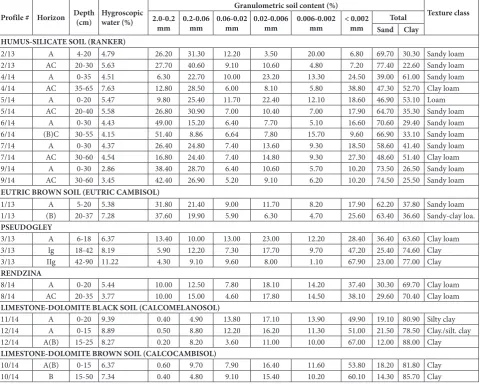
separated through a 2-mm sieve. Soil texture was de-termined by combined pipette and elutriation method with sieves according to Atteberg [5]. The pH values (active and substitution) of the soil samples were mea-sured in a water and CaCl2 suspension using a soil vs. solution ratio of 1:2.5 (w/w). A laboratory pH meter was used for pH determination in the aqueous phase [6]; hydrolytic acidity and the sum of adsorbed bases were determined by Kappen’s method [7]; the total capacity of adsorption and the cation exchange ca-pacity were calculated according to Hissink’s method [5]; the content of humus was calculated according to Simakov and Cipljenikov [8]; the nitrogen content was determined by Kjeldahl’s method [9], and the content of phosphorus and potassium as described [10]. Ana-lytical values of the physical and chemical properties of the defined soil types are shown in Tables 1 and 2. Pedosystematic units and the production potential are defined according to the principles of the National Classification System [11].
RESULTS AND DISCUSSION
Characterization of soils under the Austrian pine for-est was done based on morphogenetic characteristics and the analytical values of soil properties. Hetero-geneity of geological structure, relief dynamics and climate influence caused the formation of several soil types with different properties and production poten-tial. Soil types defined on silicate parent material are humus-silicate (ranker), eutric brown and pseudogley. Soil types defined on limestone geological formations are rendzina, black soil on limestone and brown on limestone
Humus-silicate soil (Ranker)
variable, depending on the characteristics of the geo-logical substrate. Peridotites are different from other silicate rocks; their ultrabasic characteristics reflect the vegetation cover and soils which have specific physicochemical properties inherited from the sub-strate. These rocks easily decompose, forming detritus that very often, more or less, permeates the entire soil profile [12].
Depending on the characteristics of the habitats and soil-forming factors, rankers appear in different development stages and varieties. The profiles are lithic regolith even though there are colluvial, browned and vertical varieties. This is evident on all exposures at altitudes 290-590 m a.s.l. The arrangement of the
pro-file horizons is mainly O-A-AC-C, but O-A-(B)C or O-A(B)-C is also present. The depth of the soil profile is 22-65 cm. A joint feature of the provided profiles, on the ultrabasic rocks, is a stone fraction of 20-50%, and up to 60% in some profiles The absence of stone frac-tion is noticeable in profiles on basic eruptive parent material. The texture of the siliceous-humus soil is san-dy-loam, silty-loam and sandy-clay-loam with granular structure and high porosity. Thanks to good structure, the soil is porous and well aerated. The amount of hu-mus ranges from low to high (1.37-8.51%), and it is highly varied depending on the developmental stage and altitude. A greater part of the humus content is located in the topsoil, while the transitional horizons Table 1. Physical properties of the analyzed soil profiles.
Profile # Horizon Depth (cm) Hygroscopicwater (%)
Granulometric soil content (%)
Texture class 2.0-0.2
mm 0.2-0.06mm 0.06-0.02mm 0.02-0.006mm 0.006-0.002mm < 0.002 mm Sand ClayTotal HUMUS-SILICATE SOIL (RANKER)
2/13 A 4-20 4.79 26.20 31.30 12.20 3.50 20.00 6.80 69.70 30.30 Sandy loam 2/13 AC 20-30 5.63 27.70 40.60 9.10 10.60 4.80 7.20 77.40 22.60 Sandy loam 4/14 A 0-35 4.51 6.30 22.70 10.00 23.20 13.30 24.50 39.00 61.00 Sandy loam 4/14 AC 35-65 7.63 12.80 28.50 6.00 8.10 5.80 38.80 47.30 52.70 Clay loam 5/14 A 0-20 5.47 9.80 25.40 11.70 22.40 12.10 18.60 46.90 53.10 Loam 5/14 AC 20-40 5.58 26.80 30.90 7.00 10.40 7.00 17.90 64.70 35.30 Sandy loam 6/14 A 0-30 4.43 49.00 15.20 6.40 7.70 5.10 16.60 70.60 29.40 Sandy loam 6/14 (B)C 30-55 4.15 51.40 8.86 6.64 7.80 15.70 9.60 66.90 33.10 Sandy loam 7/14 A 0-30 4.37 26.40 24.80 7.40 13.60 9.30 18.50 58.60 41.40 Sandy loam 7/14 AC 30-60 4.54 16.80 24.40 7.40 14.80 9.30 27.30 48.60 51.40 Clay loam 9/14 A 0-30 2.86 38.40 28.70 6.40 10.60 5.70 10.20 73.50 26.50 Sandy loam 9/14 AC 30-60 3.45 42.40 26.90 5.20 9.10 6.20 10.20 74.50 25.50 Sandy loam
EUTRIC BROWN SOIL (EUTRIC CAMBISOL)
1/13 A 5-20 5.38 31.80 21.40 9.00 11.70 8.20 17.90 62.20 37.80 Sandy loam 1/13 (B) 20-37 7.28 37.60 19.90 5.90 6.30 4.70 25.60 63.40 36.60 Sandy-clay loa.
PSEUDOGLEY
3/13 A 6-18 6.37 13.40 10.00 13.00 23.00 12.20 28.40 36.40 63.60 Clay loam 3/13 Ig 18-42 8.19 5.90 12.20 7.30 17.70 9.70 47.20 25.40 74.60 Clay 3/13 IIg 42-90 11.22 4.30 9.10 9.60 8.00 1.10 67.90 23.00 77.00 Clay
RENDZINA
8/14 A 0-20 5.44 10.00 12.50 7.80 18.10 14.20 37.40 30.30 69.70 Clay loam 8/14 AC 20-35 3.77 10.00 15.00 4.60 17.80 14.50 38.10 29.60 70.40 Clay loam
LIMESTONE-DOLOMITE BLACK SOIL (CALCOMELANOSOL)
11/14 A 0-20 9.39 0.40 4.90 13.80 17.10 13.90 49.90 19.10 80.90 Silty clay 12/14 A 0-15 8.89 0.50 8.80 12.20 16.20 11.30 51.00 21.50 78.50 Clay./silt. clay 12/14 A(B) 15-25 8.27 0.20 8.20 3.60 11.00 10.00 67.00 12.00 88.00 Clay
LIMESTONE-DOLOMITE BROWN SOIL (CALCOCAMBISOL)
contain about half of that amount. The nitrogen con-tent mainly correlates with the humus concon-tent. The C:N relationship has a value of 15, which shows that mineralization is moderately favorable and leads to the formation of a moder type of humus. In some soils, the C:N ratio indicates a certain regularity of their geographic distribution on a bioclimatic basis. If the ratio of carbon to nitrogen is lower, mineralization is faster and the amount of organic carbon is smaller [13]. The soil is mainly neutral and rarely has a weak acidity. The adsorption complex has a high degree of base saturation of 62.77-88.98%. The total adsorption capacity and sum of the bases have nearly equal values
of 21.15-47.39 cmol/kg. The phosphorus content in the topsoil is 5.3 mg/100g of soil. The easily accessible potassium content is 2.8-10.6 mg/100 g (deeper layers) and 5.8-19.1 mg/100g (top layers).
Eutric brown soil (Eutric Cambisol))
At the research area, eutric brown soil is developed on ultrabasic parent material (peridotite, serpentinized and serpentinite). Humus-siliceous soil leads to the formation of brown soil [12], which from an eco-logical perspective, presents a specific appearance, Table 2. Chemical properties of analyzed soil profiles.
Profile # Horizon Depth(cm) pH Y1 ccm n/10 NaOH
Adsorption Complex
CaCO3 Humus C N C/N
Easily accessible
T-S S T V P2O5 K2O
H2O CaCl2 cmol/kg (%) (%) (%) (%) (%) mg/100g
HUMUS-SILICATE SOIL (RANKER)
2/13 A 4-20 6.71 5.61 16.75 10.89 36.50 47.39 77.02 - 7.73 4.48 0.18 24.91 5.30 19.10 2/13 AC 20-30 6.97 5.90 11.50 7.48 38.60 46.08 83.78 - 3.84 2.23 0.08 27.84 2.02 6.10 4/14 A 0-35 6.35 5.38 14.25 9.26 28.10 37.36 75.21 - 3.48 2.02 0.15 13.46 1.73 9.00 4/14 AC 35-65 6.71 5.83 11.25 7.31 36.30 43.61 83.23 - 1.79 1.04 0.07 14.83 0.86 7.90 5/14 A 0-20 5.66 4.77 25.00 16.25 27.40 43.65 62.77 - 3.70 2.15 0.15 14.31 1.26 11.20 5/14 AC 20-40 6.92 5.98 6.00 3.90 31.00 34.90 88.83 - 1.65 0.96 0.00 - 0.60 5.50 6/14 A 0-30 7.05 6.21 8.25 5.36 32.05 37.41 85.67 - 5.28 3.06 0.19 16.12 0.63 11.60 6/14 (B)C 30-55 7.51 6.64 6.25 4.06 32.80 36.86 88.98 - 1.84 1.07 0.09 11.86 1.21 2.80 7/14 A 0-30 6.82 5.82 8.00 5.20 29.90 35.10 85.19 - 4.07 2.36 0.16 14.75 1.72 5.80 7/14 AC 30-60 7.18 6.16 6.50 4.23 29.95 34.18 87.64 - 1.37 0.79 0.00 - 0.17 5.50 9/14 A 0-30 6.36 5.32 12.25 7.96 21.15 29.11 72.65 - 2.92 1.69 0.11 15.40 3.62 18.00 9/14 AC 30-60 6.84 5.90 9.00 5.85 24.90 30.75 80.98 - 2.14 1.24 0.09 13.79 4.26 10.60
EUTRIC BROWN SOIL (EUTRIC CAMBISOL)
1/13 A 5-20 6.67 5.76 13.75 8.94 34.50 43.44 79.42 - 4.24 2.46 0.11 22.36 - 16.80 1/13 (B) 20-37 7.38 6.30 9.17 5.96 37.50 43.46 86.29 - 1.11 0.64 0.00 - - 5.70
PSEUDOGLEY
3/13 A 6-18 6.66 5.82 14.50 9.43 34.50 43.93 78.54 - 7.53 4.37 0.29 15.06 - 14.00 3/13 Ig 18-42 7.11 5.90 10.94 7.11 35.70 42.81 83.39 - 2.69 1.56 0.11 14.18 - 12.50 3/13 IIg 42-90 7.40 6.25 8.33 5.41 40.30 45.71 88.16 - 1.12 0.65 0.00 - 0.66 16.40
RENDZINA
8/14 A 0-20 8.00 7.48 0.00 0.00 0.00 0.00 - 26.73 9.82 5.70 0.35 16.27 0.24 31.60 8/14 AC 20-35 8.22 7.52 0.00 0.00 0.00 0.00 - 37.61 4.01 2.33 0.20 11.63 0.13 23.40
LIMESTONE-DOLOMITE BLACK SOIL (CALCOMELANOSOL)
11/14 A 0-20 7.18 6.52 10.00 6.50 45.40 51.90 87.48 - 12.39 7.19 0.47 15.29 0.19 14.60 12/14 A 0-15 6.94 6.17 13.44 8.74 44.85 53.59 83.70 - 11.11 6.44 0.42 15.34 0.71 24.20 12/14 A(B) 15-25 6.72 5.75 3.62 2.35 38.30 40.65 94.21 - 6.20 3.60 0.25 14.38 0.97 24.90
LIMESTONE-DOLOMITE BROWN SOIL (CALCOCAMBISOL)
primarily due to the natural parent substrate, setting it apart through its characteristic chemical compo-sition. So-called ‘serpentinite’ flora (Genista pilosa, Erica carnea, Brachypodium pinnatum and Teucrium chamaedrys) inhabits this soil. Mainly, this is a xe-rophilous, thermophilous to mesophilous forest com-munity mixed with exuberant grass vegetation (Poa nemoralis and Poa angustifolia) The soils are shallow to moderately deep and always very stony. They are associated with steep slopes and they have high wa-ter permeability, which makes them pedoclimatically dry. The isometry and inclination of the relief is very pronounced on peridotite. Due to the higher rocki-ness of the soil and nonexistence of an impervious, compacted layer, the profiles are physiologically active throughout their entire depth. Dealkalization through weak acidification is a characteristic process in the formation of eutric brown soil. In topsoil, biological base accumulation and adsorptive complex saturation occur, which stabilize the humus [1].
Profiles formed on the ultrabasic igneous rocks have an O-A-(B)-C arrangement. Decomposed and half-decomposed plant residue (usually from Austrian pine) has an O-A-(B)-C arrangement. These plant res-idues form a thick organic horizon with a domination of ‘l’ and ‘f’ subhorizons that are intertwined with the roots of well-developed top-layer flora. The organic horizon is characterized by sandy-loam texture. The content of the hygroscopic humidity is 5.38%, and active acidity pH value is 6.67. The degree of base satu-ration increases with profile depth and in the (B) hori-zon it amounts to 79.42%. A horihori-zon is rich in humus (4.24%), which correlates to the nitrogen content. The content of humus and nutritional elements decreases with depth. There is no phosphorus, and potassium is within the limits of being moderately available.
Rendzina
This pedological profile reaches a depth of 35cm, where a horizon of soft silicified limestone chert is apparent (C horizon). Horizons Ol-A-AC are sepa-rated and defined. The organic horizon, with a lot of litter, has a thickness of 3cm. The topsoil is not fully
developed, and it indirectly migrates into the AC ho-rizon. The soil has a light grey color, the texture is clayey-loam, the aggregate structure is polyhedric and in the deeper parts significant fragments of limestone substrate are evident. The surpassing AC horizon is a bit more clayey, reaching a thickness of 15 cm, and large limestone fragments are present, which occupy up to 70% of the horizon. The ground flora is well developed and protects the soil from erosion by its rhizosphere.
The reaction is weakly alkaline (pH value is up to 8.22) and the C:N ratio (approximately 14), sug-gesting a very favorable course of humification and mineralization. Rendzina is very humus-rich and the content of humus is between 4 and 9%. Along with the high quantity of humus, there is a high content of nitrogen (0.20-0.35%). The phosphorus content is low (up to 0.24 mg/100 g), while there is a high con-tent of potassium (up to 31.60 mg/100 g). The active carbonate is high (up to 37.6%), which is both a very important feature of this soil and crucial for its chemi-cal performance [14].
Limestone-dolomite black soil (Calcomelanosol)
Calcomelanosols are formed on hard limestones and dolomites with a content of over 98% of CaCO3 in limestone and MgCO3 in dolomite. Such properties are found in Mesozoic and Paleozoic limestones and dolomites. This type of soil is characteristic for higher elevations (research area is at 960-983 m a.s.l.). The surface rockiness is very high, and the same goes for the stoniness of the soil, which is shallow and does not exceed 25cm depth.
composition, aerability is fairly good and biological activity is satisfactory.
Calcomelanosols in the researched area have an O-A-A(B) profile arrangement. Underneath the organic horizon that has a thickness of 2-3 cm, the humus-accumulated A horizon is located, with well-humified organic matter and colloid characteristics mixed with mineral parts in the form of an organomineralic com-plex. The thickness of this horizon is 6-17 cm. The lower part of the A horizon is stony and passes into an AC or A(B) horizon (browned). The transition ho-rizons have a lot of limestone fragments (up to 80%). An important feature of the organomineralic calco-melanosol is the mixture of humified material with clay, whereby organomineralic aggregates arise. This process takes place in conditions of good biological activity and a favorable water regime [16].
Hygroscopic moisture of the soil is 8.89-9.39% and the active acidity value is 6.72-7.18; therefore, these soils can be characterized as neutral reaction soils. The C:N ratio is average (approximately 15), which influences the acceleration of the process of transforming the organic matter, increase in humus matter quality and faster mineralization of nitrogen. The soil is very humus-rich and the total adsorption capacity for the cations (T) is high (up to 53.59cmol/ kg), just like the degree of base saturation, which is around 90 cmol/kg. The quantities of easily accessible P2O5 are small and uniform as long as K2O is readily available (up to 24.90 mg/100 g).
Brown soil on limestone and dolomite (Calcocambisol)
Brown soil on limestone belongs to the moderately deep soil category. The average depth of the analyzed profiles is approximately 50 cm. Between blocks of limestone and at the foot of the Sjemeć mountain slopes, the depth may be even deeper. This soil has a O-A(B)-(B) profile structure and the surface soil is loose and intertwined with roots, with stoniness at around 20%. Brown soil is well-aerated despite the high clay content. The moisture regime is dependent on external conditions, which regulate affluence and
loss of moisture [17]. From an ecological perspective, these soils have favorable air and moisture qualities due to the favorable mechanical content, making them suitable for forest vegetation [18].
A significant characteristic of this calcocambisol is the presence of an A/(B) horizon complex with a thickness of 15cm. The productivity of the brown soil on limestone can vary in a wide interval.
The clay and silt content in the A horizon is over 80%. With the increase of depth, the participating fraction of clay and silt increases as well, and in the (B) horizon it amounts to over 90%. This affects the mechanical composition of the horizons, which be-long to the clay texture class. The reaction of both horizons is basic (pH is above 7.2), and the humus content is 3.65-7.12% (low humus to high humus con-tent), which decreases with increasing profile depth. High nitrogen content (about 0.18%) characterizes this soil, which is in strong correlation with the humus content and decreases with depth of the profile. The C:N ratio is mainly favorable; in the transitional hori-zon it amounts to 18.77 and in the subsoil it amounts to 15.12. These conditions facilitate transformation processes of organic matter and nitrogen mineral-ization (moder humus type forms). Brown soils are poorly endowed with phosphorus, but they are well supplied with potassium.
Pseudogley
mild slopes of wavy hilly terrains. The analyzed pseu-dogley is a dense and impermeable soil with a depth of 95cm and a soil profile structure of Olf-A-Ig-IIg-C1. The topsoil is well developed and reaches up to 18cm in depth. It is characterized by a clay-loam tex-ture and nut-sized, poorly expressed aggregate struc-tures. The horizon is moist and relatively permeable, gradually and indirectly transitioning into the Ig ho-rizon (24 cm thickness). In the Ig hoho-rizon, an increase of clay content, clay texture and polyhedric aggregate structures are evident. The increase in clay is reflected in the decrease of permeability, which is even more pronounced in deeper parts of the soil. Additionally, the increase of clay characterizes the IIg horizon (49 cm thickness).
The mollic A horizon has a low acidic reaction and, with increased depth, the pH value increases so that the IIg horizon has a value of 7.4. The pH value increase together with soil depth increase can be caused by secondary carbon enrichment of the deeper horizons from rinsing through soil cracks on steep ter-rain [19]. The total adsorption capacity for the cations (T) is very high (over 40 cmol/kg) and the degree of saturation is from 78.54% in the A horizon to 88.16% in the IIg horizon. The Amo horizon has a high humus content (7.53%) and with increasing depth, the humus content usually decreases. The lowest humus content value is in the IIg horizon (1.12%).
Lowland pseudogley contains considerably more humic acid. The humus content is significantly differ-ent in forest pseudogley than in grass and field pseu-dogley; it contains significantly more fulvic acid, less humic acid and has a smaller Ch:Cf ratio [20]. Based on the total nitrogen content, the Amo horizon is well supplied, the Ig horizon considerably poorer, and in the IIg horizon nitrogen is absent. The C:N ratio in A and Ig horizons is narrow (14.8-15.6), which indicates favorable biological activity and good conditions for the mineralization of organic matter in these soils. The easily accessible phosphorus level is low to none in the soil, but easily accessible potassium is moderately available especially in the IIg horizon (16.40 mg/100 g).
CONCLUSIONS
The pedological coverage underneath Austrian pine forests in the Višegrad area is exceptionally diverse and complex. Ranker has a low efficacy, the main lim-iting factors being its shallowness and low biological activity. Deep varieties of eutric brown soil and pseu-dogley can be classified as moderately to highly pro-ductive soils. Shallow limestone brown soil, just like combinations of black soils, are soils of low productive potential. Deep limestone brown soils are of moderate productive potential. The productive characteristics of rendzina on marly limestone and soil combinations of rendzina with shallow and deep limestone brown soils are similar to shallow soils on compact limestones.
Author’s contributions: Velibor Blagojević and Milan Knežević, collected and analyzed the data, coordinated the research and set the research goal. Olivera Košanin, Marijana Kapović-Solomun, Radovan Lučić and Saša Eremija collected samples and analyzed the ion data.
REFERENCES
1. Kapović M. Šumska zemljišta planine Javor u Republici Srp-skoj. [dissertation]. [Belgrade]: Faculty of Forestry, Univer-sity of Belgrade. 2012. 264 p.
2. Košanin O, Knežević M. Edafski uslovi nekih hrastovih zajed-nica na silikatnim supstratima Srbije. Šumarstvo. 2006;1-2:47-57.
3. Stefanović V, Beus V, Manuševa L, Pavlič J, Vukorep I. Tipovi šuma crnog i bijelog bora u Bosni i Hercegovini. Radovi Šumarskog fakulteta i Instituta za šumarstvo. 1997; XX:20:1-2:1-91.
4. Ćirković-Mitrović T, Popović V, Brašanac-Bosanac Lj, Rakonjac Lj, Lučić A. The impact of climate elements on the diameter increment of Austrian pine (Pinus nigra Arn.) in Serbia. Arch Biol Sci. 2013;65(1):161-70.
5. Bošnjak Đ, Hadžić V, Babović D, Kostić N, Burlica Č, Đoro-vić M, PejkoĐoro-vić M, MihajloĐoro-vić D, StojanoĐoro-vić S, Vasić G, Stri-čević R, Gajić B, Popović V, Šekularac G, Nešić Lj, Belić M, Đorđević A, Pejić B, Maksimović L, Karagić Đ, Lalić B, Arse-nić I. Metode istraživanja i određivanja fizičkih svojstava zemljišta. Novi Sad: Jugoslovensko društvo za proučavanje zemljišta; 1997. 278 p.
6. Soil Survey Laboratory Staff: Soil Survey Laboratory Meth-ods Manual. USDA-SCS Soil Survey Investigation Report N0 42 Version 2.0. Washington DC: US Government Printing Office; 1992. 400 p.
ind der Bestimmung des Kalkbedarfes der sauren Böden. In: Blanck E, editor. Handbuch der Bodenlehre Vol 3. Berlin: Julius Springer; 1931. p. 317-20.
8. Simakov VN, Cipljenikov VP. Modifikacija objomnovo metoda opredeljenija gumusa (dlja masovih analizov). Počvovedenie. 1960;9:113-19.
9. Bremer J M, Mulvaney C . Nitrogen-Total. In: Page AL, Miler RH, Keeney DR, editors. Methods of Soil Analysis, ASA and SSSA. Madison: American Society of Agronomy; 1982. p. 595-624.
10. Egner H, Reihm H, Domingo WR. Untersuchungen über die chemische Bodenanalyse als Grundlage für die Beurteilung des Nährstoffzustandes der Böden II. Lantbrukshögskolans Annaler.1960;26:199-15.
11. Škorić A, Filipovski G, Ćirić M. Klasifikacija zemljišta Jugo-slavije. Sarajevo: Akademija nauka i umjetnosti BiH; 1985. 75 p.
12. Košanin O, Gajić B. Karakteristike nekih serpentinskih zemljišta u sastojinama crnog bora na području Divčibare-Bukovi. Šumarstvo. 2008;4:89-98.
13. Kadović R, Belanović S, Knežević M, Danilović M, Košanin O, Beloica J. Organic carbon stock in some forest soils in Serbia. Forestry. 2012; 105:81-98.
14. Eremija S, Knežević M, Kapović M. Soils of the mycological reserve on Lisina mountain in the Republika of Srpska. Arch Biol Sci. 2014;66(1):299-06.
15. Ćirić M. Pedologija. 3 izdanje. Sarajevo: Svjetlost-Zavod za udžbenike i nastavna sredstva; 1991. 307 p.
16. Stefanović V, Beus V, Burlica Č, Dizdarević H, Vukorep I. Eko-loško-vegetacijska rejonizacija Bosne i Hercegovine. Sarajevo: Šumarski fakultet, Univerzitet u Sarajevu; 1983. 46 p. 17. Knežević M, Košanin O. Šumska zemljišta Zlatara.
Šumar-stvo. 2008;3:137-44.
18. Govedar Z. Načini prirodnog obnavljanja mješovitih šuma jele i smrče (Abieti-Picetum illyricum) na području zapadnog dijela Republike Srpske. [dissertation]. [Belgrade]: Faculty of Forestry, University of Belgrade. 2005. 298 p.
19. Burlica Č, Vlažnost zemljišta u ocjenjivanju ekološke vrijed-nosti šumskih zemljišta. Zemljište i biljka. 1972;21(1):1-10. 20. Dugonjić M, Cupać S, Đorđević A, Vićentijević M, Knežević