655
© 2018 by the Serbian Biological Society How to cite this article: Zangeneh MM, Zangeneh A, Tahvilian R, Moradi R. Antidiabetic, hematoprotective and nephroprotective effects of the aqueous extract of Falcaria vulgaris in diabetic male mice. Arch Biol Sci. 2018;70(4):655-64.
Antidiabetic, hematoprotective and nephroprotective effects of the aqueous extract
of
Falcaria vulgaris
in diabetic male mice
Mohammad Mahdi Zangeneh1,2,*, Akram Zangeneh1,2, Reza Tahvilian3 and Rohallah Moradi2
1 Department of Clinical Science, Faculty of Veterinary Medicine, Razi University, Kermanshah, Iran
2Biotechnology and Medicinal Plants Research Center, Ilam University of Medical Sciences, Ilam, Iran
3Pharmaceutical Sciences Research Center, Faculty of Pharmacy, Kermanshah University of Medical Sciences, Kermanshah, Iran
*Corresponding author: [email protected]
Received: February 22, 2018; Revised: June 11, 2018; Accepted: June 11, 2018; Published online: June 15, 2018
Abstract: Falcaria vulgaris has been used in medicine as an antimicrobial agent. The aims of this study were to evaluate the
hypoglycemic and nephroprotective activities of the aqueous extract of F. vulgaris in diabetic mice. Diabetes was
experi-mentally induced by intraperitoneal injection of streptozotocin (STZ). The mice were divided randomly into 6 groups as follows: nondiabetic, untreated diabetic, a group that received orally 0.5 mg/kg glibenclamide, and three groups that were
given orally 200, 600 and 1800 µg/kg of F. vulgaris, respectively, for 20 days. On the 20th day, the mice were dissected, and
blood and kidney samples were collected for analysis of hematological, biochemical and stereological parameters. F.
vul-garis at all doses, particularly 1800 µg/kg, significantly (p≤0.05) reduced the levels of urea, creatinine, WBC, eosinophils,
basophiles, platelet and increased RBC, Hb, PCV, MCV, MCH, MCHC, lymphocytes and monocytes that were raised
after diabetes induction, compared to the untreated diabetic group. Multipledoses of F. vulgaris, particularly1800 µg/kg,
significantly (p≤0.05) decreased the total volumes of the kidney cortex, medulla, vessels and renal tubules, as well as the
lengths of the vessels and renal tubules, compared to the untreated diabetic group. Also, F. vulgaris at all doses significantly
prevented glomerular hypertrophy and reduction of glomeruli numbers in comparison with the untreated diabetic group.
In conclusion, F. vulgaris possesses antidiabetic, hematoprotective and nephroprotective properties and can improve renal
structural and blood biomarkers in STZ-induced nephrotoxicity in mice.
Key words:Falcaria vulgaris; aqueous extract; hypoglycemic activity; nephroprotective activity; streptozotocin
Abbreviations and acronyms: collecting ducts (CD); diabetic mice treated with 200, 600, 1800 µg/kg of F. vulgaris aqueous extract (FV200, FV600, FV1800, respectively); fasting blood glucose (FBG); glomeruli (G); hemoglobin (Hb); interstitial tissue (IT); loop of Henle (LH); mean corpuscular hemoglobin (MCH); mean corpuscular hemoglobin concentration (MCHC); mean corpuscular volume (MCV); packed cell volume (PCV); proximal and distal convoluted tubules (PCT, DCT, respectively); red blood cells (RBC); streptozotocin (STZ); vessels (V); white blood cells (WBC)
INTRODUCTION
Diabetes mellitus is a disease characterized by a dis-ordered metabolism, resulting from either low insulin levels or insulin resistance in many body cells. Dia-betes is the most important cause of renal failure and legal blindness and is one of the major risk factors of cardiovascular diseases [1]. Diabetic patients are five times more likely than nondiabetic patients to develop severe chronic leg ischemia, leading to foot ulceration and amputation [1].
glomerular hyperfiltration can be ameliorated by the strict control of blood glucose concentration; however, renal hypertrophy is irreversible [6]. Although renal hypertrophy and glomerular hyperfiltration play a pivotal role in increasing diabetic nephropathy, the relationship between them is still unclear [3].
Hematological parameters such as erythrocyte ag-gregation, erythrocyte deformability, hematocrit and plasma proteins in diabetes mellitus are often disturbed [7]. The resultant disturbance may be a risk factor for the progression of retinal failure in diabetic retinopa-thy, and renal failure in diabetic nephropathy [7].
The enormous costs of modern medicines indi-cate that other strategies are needed for better man-agement of diabetes and its related problems [8]. Some plants have high contents of alkaloids, flavonoids, naphthoquinone, saponins, tannins and triterpenes, and they can decrease the rate of diabetes develop-ment [9,10]. The World Health Organization (WHO) has suggested that there should be further studies of the antidiabetic effects of medicinal plants [11].
In Iranian traditional medicine, herbal medicines have been used for prevention and treatment of dia-betic complications [12-17]. A list of medicinal plants in Iran that are consumed for their antidiabetic prop-erties includes Vaccinium arctostaphylos, Trigonella foenum, Thea sinensis, Silybum marianum, Securig-era securidaca, Satureja khuzistanica, Plantago ovate, Opuntia streptacantha, Ocimum sanctum, Ipomoea batatas, Ginkgo biloba, Cuminum cyminum, Citrullus colocynthis and Allium sativum [18].
One of the most important herbal medicines that is widely consumed in Iranian traditional medicine for the treatment of diabetes is Falcaria vulgaris, from the order Apiales, family Apiaceae [19]. The consumption and cooking of parts of F. vulgaris is because of the variety of flavors and textures of the species. F. vulgaris has been cultivated from the earliest times and it is economically important as a garden vegetable. F. vulgaris is one of the edible plants that has generated considerable interest throughout human history as a medicinal plant. Several extracts of this plant have traditionally been used to treat gastric ulcers and parasitic, viral, fungal and bacterial diseases [20]. One study demonstrated that a diet en-riched with 5% F. vulgaris improved wound healing in the rat, and 10% F. vulgaris had an effect on skin tensile
strength [21]. In phytochemical studies, spathulenol and carvacrol were identified as effective substances of F. vulgaris in the treatment of disease [22]. To the best of our knowledge, there are very little data about the antidiabetic, hematoprotective and nephroprotective effects of the aqueous extract of F. vulgaris, collected from Kermanshah province in western Iran. The present study was conducted to assess the antidiabetic, hemato-protective and nephrohemato-protective effects of the aqueous extract of F. vulgaris in diabetic mice.
MATERIALS AND METHODS
Plant collection
Mature F. vulgaris was collected around Kermanshah city during April 2017. The plant was identified for the first time, and a voucher specimen was deposited at the Herbarium of the research center of the Faculty of Agriculture, Razi University, Kermanshah, Iran.
Plant extraction
The leaves of the plant were shade-dried for one week. The dried aerial parts of the plant were ground, and about 150 g of the obtained powder was extracted with 450 mL distilled water for 2 h at 40°C by continuous shaking. The extract was left for 24 h at room tem-perature. It was then filtered through Whatman paper no. 2. The extract was concentrated and lyophilized using a rotary evaporator (Panchun Scientific Co., Kaohsiung, Taiwan).
Animals
Male BALB/c mice weighing between 38-40 g were procured from the animal center of Kermanshah Uni-versity of Medical Sciences. The animals were housed in an airconditioned room (22±2°C) with a 12 h light/ dark cycle, and free access to standard pellet and wa-ter. All procedures were performed in accordance with the Institutional Animal Ethics Committee.
Induction of diabetes
as-sessed every day with an Easy Gluco glucometer (Ames, Korea). After 3 days, mice with a blood glu-cose concentration above 350 mg/dL were considered diabetic.
Experimental design
The mice were divided into six groups (n=10) as fol-lows: the control group received 200 µL saline orally for 20 days; untreated-diabetic mice received 200 µL saline orally for 20 days; a group of STZ-induced dia-betic mice treated with glibenclamide received 600 µg/kg glibenclamide for 20 days; and three groups, FV200, FV600 and FV1800, of the STZ-induced dia-betic mice received 200, 600 and 1800 µg/kg aqueous extract of F. vulgaris for 20 days, respectively.
Blood sampling and determination of biochemical parameters
Blood samples were taken on days 0, 4, 7, 10, 13, 16 and 20 from the tail vein to measure the blood glucose concentrations. At the end of day 20 of treatment, the animals of all groups were euthanized by xylazine (5 mg/kg) and ketamine HCl (40 mg/kg). Blood samples were drawn immediately from the animals’ hearts. To separate the serum, the samples were centrifuged at 2000 x g for 15 min. Creatinine and urea concentra-tions were measured in the serum [16,17].
Determination of hematological parameters
Blood samples collected in EDTA bottles were ana-lyzed for hematological parameters using a Hematol-ogy Analyzer (Mindray Auto, BC-5200, USA) follow-ing the manufacturer’s instructions. The parameters analyzed included Hb, MCV, MCH, MCHC, PCV, RBC, WBC, as well as the differentials and platelets.
STEREOLOgICAL STUDy
Volume density
Nephrons and cells are functional units in a kidney. The number, size, and distribution of nephrons, cells, and other components contain important information
about the function and organization of the kidney. Therefore, it is important that the various structural components are measured correctly. Quantification of these components is also important when examining how kidneys react to trauma, chemicals, and disease [23,24]. To achieve these objectives, the stereology method was used. To perform the stereology method, the left kidney was removed and weighed and fixed in 10% neutral buffered formalin solution for one week. The immersion method was then used to de-termine the primary volume of the kidney. To estimate the final volume of the organs, the amount of tissue shrinkage must be specified [23,24]. Isotropic uniform random (IUR) sections must be obtained to estimate tissue shrinkage and tubular lengths [24,25]. In total, 7-10 slabs were obtained from each kidney using the orientator method. A circular piece was sampled from a kidney slab and the area of this piece was calcu-lated. The slabs and circular pieces were processed, sectioned (5 µm thickness) and stained by the periodic acid-Schiff (PAS) method. The area of the circular piece was calculated again, and tissue shrinkage was estimated by the following relation [26]:
Volume shrinkage : = 1 – (AA)AB1.5
where AA and AB are the areas of the circular piece after and before tissue processing. The total volume of the organ was then estimated using:
Vfinal : = Vprimary × (1 – volume shrinkage)
Tissue sections were examined using a video mi-croscopy system composed of a microscope (Olympus CX2, Japan) connected to a video camera (Dinocap-ture ver.5, dino-lit.com 30.5 mm) and a P4 PC, and the stereological parameters were estimated. The fraction-al volume of the renfraction-al structures was estimated using a point probe (with an area of 100 cm2 and containing
25 points), and the following formula (Fig. S1A): Vv : = P
reference
Pstructure
Length density
The length density of the tubules and vessels was esti-mated using an unbiased counting probe (740×740 µm). The tubule structures were considered in such a man-ner so that they lay completely or partly inside the counting probe and did not touch the down and left lines. Otherwise, they were not considered (Fig. S1B). The length density was estimated by the following for-mula:
a(frame) × Σ frame Lv : = 2 × ΣQ
ΣQ = the sum of the tubules counted, a (frame)=
probe area, 547600 μm2, Σ
frame = total number of the
counted frames.
Numerical density
The physical dissector procedure was applied to esti-mate the numerical density of the glomeruli. Two par-allel sections with 20 μm distance (1th and 5th sections)
were prepared; the firstsection served as the reference plane and the fifth section as the look-up plane. Two counting probes with an area of 547 600 μm2 were
at-tached to the monitor at a final magnification of 135×. The counting rules of the physical dissector were ap-plied. Thus, a glomerulus was considered if it was found in the reference plane and not in the look-up plane, and if it did not hit the down and left lines of the probe. The numerical density of the glomeruli was estimated using:
a(frame) × h × ΣP
Σ
Q-Nv : =
ΣQ-= the sum of the counted glomeruli, a (frame)=
probe area, ΣP= total number of the examined fields
and h= dissector height. The absolute value of each parameter was calculated by multiplying its density by the reference space [26].
Statistical analysis
All data were expressed as mean and standard de-viation. Statistical comparison between group means was done by one-way ANOVA followed by Duncan’s post-hoc test, with p≤0.05 considered as significant.
RESULTS
Effect ofF. vulgaris on fasting blood glucose concentration
The effect of F. vulgaris intake on FBG in the diabetic mice is presented in Table 1. There was no significant change in the blood glucose concentration of control mice throughout the study. The blood glucose concen-tration of untreated diabetic mice increased by about 550% (p≤0.05) in a time-dependent manner. Treatment of STZ-induced diabetic mice with F. vulgaris at all dos-es significantly (p≤0.05) decreased the blood glucose concentration similar to the glibenclamide-treated mice at days 16 and 20 of the experiment. F. vulgaris exerted its maximum effect on day 20 of the experiment.
Effect of F. vulgaris on the biochemical parameters of kidneys
The values of the kidney biochemical parameters are presented in Table 2. STZ-induced diabetes increased the concentrations of urea and creatinine significantly (p≤0.05) as compared to the control group. Different
Table 1. Effects of F. vulgaris aqueous extract on blood glucose of diabetic mice. groups
(n =10) 0 days 4 days 7 daysBlood glucose concentration (10 days mg/dL13 days) 16 days 20 days
C 78.9±4.2a 82.1±3.8a 80.5±6.4a 79.6±3.5a 78.2±6a 83.5±5.5a 80.8±4.5a
UD 420.2±16b 412.5±13.7b 421.7±22.5c 410.8±16.8c 412.9±20.2c 408.6±14.9c 407.3±15.1c
G 417.5±14.2b 374.9±16.4b 343.9±12.8bc 311.2±17.1b 294.7±17.3b 263.7±11.2b 217.3±9.4b
FV200 423.2±13.2b 401.7±12.9b 372.7±18.9c 339.8±14.5bc 329.1±22.2bc 296.5±11.7b 250.6±12.7b
FV600 421.7±11.8b 396.9±14.7b 352.1±18.6bc 309.7±20.1b 287.4±13.2b 262.8±18.6b 223.7±10.2b
FV1800 425.0±17.3b 361.3±15.2b 320.4±19.5b 287.5±13.2b 257.1±18.1b 227.4±14.1b 179.5±7.4ab
C – Control, UD – untreated diabetic, G – glibenclamide-treated
doses of F. vulgaris significantly (p≤0.05) ameliorated the above values. There were no significant differences in the concentrations of urea and creatinine (p≤0.05) among the FV200, FV600 and glibenclamide groups.
Effect of F. vulgaris on hematological parameters
The number of WBC and platelets, and the percent-ages of eosinophils and basophils significantly (p≤0.05) increased in untreated diabetic mice. Also, the percent-ages of lymphocytes and monocytes, the concentration of Hb and the levels of MCV, MCH, MCHC, PCV and
RBC were significantly (p≤0.05) reduced in the un-treated diabetic group. There were no significant dif-ferences in hematological parameters (p≤0.05) among the glibenclamide and FV200 and FV600 groups, with the treatment with F. vulgaris significantly (p≤0.05) ameliorating the above parameters. The percentages of eosinophils and basophils were significantly (p≤0.05) decreased in the glibenclamide and FV200, FV600 and FV1800 groups, and were similar to the control values. Also, the concentration of Hb was significant-ly (p≤0.05) increased in the FV1800 group and was similar to the control group. No significant difference (p≤0.05) was found among all groups in the percentage of neutrophils (Tables 3 and 4).
Effect of F. vulgaris on stereological parameters
The body weight and mean absolute weight and vol-umes of the kidney and its components in treated and untreated groups are presented in Tables 5-7. The body weight decreased significantly (p≤0.05) in untreated diabetic mice compared to the controls. Intake of F. vulgaris at all doses, similar to the glibenclamide and control groups significantly (p≤0.05) increased the body weight in comparison with the untreated group.
Table 2. Effect of F. vulgaris aqueous extract on urea and creati-nine serum concentrations of diabetic mice
groups (n =10) Urea (mg/dL) Creatinine (mg/dL)
C 13.92±1.16a 1.18±0.04a
UD 39.76±1.04d 2.67±0.12d
G 28.87±1.21c 1.86±0.08c
FV200 32.13±1.12c 2.19±0.06c
FV600 28.89±0.85c 1.91±0.06c
FV1800 21.65±0.72b 1.47±0.04b
C – Control, UD – untreated diabetic, G – glibenclamide-treated Non-identical letters indicate a significant difference between the groups (p≤0.05)
Table 3. Effects of F. vulgaris aqueous extract on WBC parameters of diabetic mice. groups
(n =10) WBC (×109/L) Lymphocytes (%) Monocytes (%)ParametersNeutrophils (%) Eosinophils (%) Basophils (%)
C 7.92±0.24a 52.96±0.75a 11.35±0.33a 34.54±0.79a 0.57±0.02a 0.42±0.02a
UD 15.87±0.43d 48.23±0.83d 8.89±0.25c 34.12±1.01a 2.95±0.05a 1.43±0.06b
G 11.24±0.18c 50.86±0.64c 10.79±0.28b 34.19±0.89a 0.34±0.03b 0.28±0.01a
FV200 11.99±0.33c 49.99±0.71c 10.05±0.17b 34.32±0.62a 0.75±0.04a 0.51±0.04a
FV600 11.16±0.24c 50.67±0.63c 10.67±0.2b 34.63±0.74a 0.31±0.02a 0.26±0.02a
FV1800 9.68±0.23b 51.73±0.55b 11.19±0.19ab 34.56±0.82a 0.22±0.03a 0.19±0.01a
C – Control, UD – untreated diabetic, G – glibenclamide-treated; non-identical letters indicate a significant difference between the groups (p≤0.05).
Table 4. Effects of F. vulgaris aqueous extract on platelet and RBC parameters of diabetic mice. groups
(n =10)
Parameters Platelets
(×109/L) (×10RBC 12/L) PCV(%) MCV(fL) (g/dL)Hb MCH(pg) MCHC(g/dL)
C 206.78±7.21a 8.26±0.12a 50.13±0.98a 71.98±1.13a 15.12±0.52a 23.82±0.86a 37.12±0.46a
UD 679.34±9.34d 3.72±0.23d 22.13±0.47d 46.34±1.86c 9.42±0.21c 17.44±0.72d 21.54±0.74d
G 399.56±9.1c 6.02±0.36c 41.57±0.78bc 60.12±1.1b 13.24±0.33b 20.76±0.65c 28.44±0.62c
FV200 456.13±7.62c 5.35±0.24c 37.87±0.83c 57.04±1.32b 12.46±0.18b 19.94±0.51c 25.62±0.58c
FV600 388.72±11.25c 5.89±0.27c 41.04±0.72bc 59.78±1.05b 13.11±0.27b 20.66±0.73c 28.33±0.73c
FV1800 307.62±8.42b 6.89±0.21b 44.76±0.68ab 63.89±1.04b 14.64±0.3a 22.14±0.92b 32.18±0.39b
Kidney weight and volume were increased by 53% and 58% (p≤0.05), respectively, in untreated diabetic mice compared to the control group; also, cortical and medullary volumes increased by 79% and 23% (p≤0.05), respectively. The body weight increased by 23% (p≤0.05) in untreated mice, compared to the controls. Intake of F. vulgaris significantly (p ≤ 0.05) ameliorated the renal, cortical and medullary volumes in comparison to the untreated group. In addition, there were no significant differences in body weight and medullary volumes among the glibenclamide and FV600 and FV1800 groups (p≤0.05).
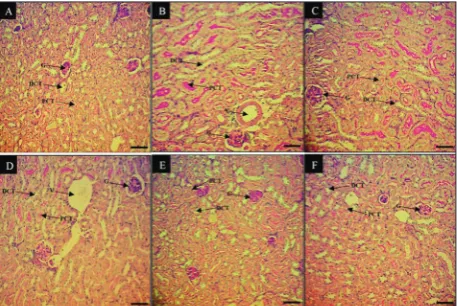
The volumes of the CD, DCT, IT, PCT, LH and V were significantly increased (p≤0.05) in untreated mice as compared to the control (Table 6, Fig. 1). Intake of F. vulgaris by mice at all doses significantly (p≤0.05) decreased the volumes of the above structures. In the FV1800 group, the volumes of CD and V were signifi-cantly (p≤0.05) reduced and were similar to values ob-tained in the control group. There were no significant differences in the LH among the glibenclamide, FV200, FV600, FV1800 and control groups (p≤0.05).
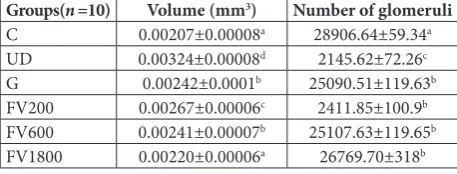
The GV increased significantly (p≤0.05) following diabetes induction, and treatment with all doses of
F. vulgaris and glibenclamide significantly (p≤0.05) improved glomerular hypertrophy. The GV was sig-nificantly (p≤0.05) reduced in the FV1800 group and was similar to the control group (Table 7).
The number of glomeruli in untreated diabetic mice was reduced significantly (p≤0.05) in compari-son with the control. The decline in the number of glomeruli was prevented significantly (p≤0.05) by F. vulgaris at all doses. There was no significant differ-ence between the glibenclamide and F. vulgaris groups (p≤0.05) (Table 7).
Table 5. Effects of F. vulgaris aqueous extract on body weight, kidney weight, absolute volumes of the kidney, cortex and medulla (mean±SD).
groups
(n =10) Body weight (g) Kidney weight (mg) Kidney volume (mmParameters 3) Cortex volume (mm3) Medulla volume (mm3)
C 39.97±0.22a 141.6±3.92a 113.6±4.35a 76.0±1.82a 33.7±1.7a
UD 32.66±0.3b 216.6±7.29d 180.4±4.78d 135.4±2.22d 46.1±1.28c
G 37.38±0.45a 169.8±3.76b 142.3±3.12b 107.8±2.2b 34.0±2.7a
FV200 36.25±0.56a 191.9±3.03c 165.8±4.07c 124.6±2.11c 40.6±1.34b
FV600 37.41±0.4a 171.7±3.26b 143.7±3.19b 109.1±1.59b 35.1±1.52a
FV1800 38.26±0.38a 157.4±3.62b 130.5±2.67b 100.0±2.26b 34.7±1.76a
C – Control, UD – untreated diabetic, G – glibenclamide-treated; non-identical letters indicate a significant difference between the groups (p≤0.05).
Table 6. Effects of F. vulgaris aqueous extract on the absolute volumes of different kidney structures (proximal and distal convoluted tubules, collecting ducts, loop of Henle, interstitial tissues and vessels (mean±SD)).
groups
(n =10) PCT DCT CD Structures LH V IT
C 63.27±1.84a 15.50±0.49a 21.04±3.01a 1.23±0.01a 8.85±0.19a 11.21±0.15a
UD 120.68±2.95d 26.91±0.55d 29.88±0.59c 1.83±0.04b 17.17±0.31c 18.83±0.27c
G 89.14±3.09bc 20.58±0.32bc 24.79±0.28b 1.45±0.02a 12.43±0.21b 14.55±0.14b
FV200 99.90±2.86c 22.11±0.3c 25.46±0.53b 1.51±0.02a 13.22±0.29b 15.17±0.24b
FV600 87.85±3.15b 20.74±0.26bc 24.42±0.29b 1.44±0.02a 12.50±0.13b 14.63±0.21b
FV1800 79.18±2.36b 18.89±0.42b 22.4±0.33a 1.35±0.01a 10.00±0.28a 13.47±0.22b
C – Control, UD – untreated diabetic, G – glibenclamide-treated; non-identical letters indicate a significant difference between the groups (p≤0.05).
Table 7. Effects of F. vulgaris aqueous extract on the absolute volume and number of glomeruli (Mean ± SD).
groups(n =10) Volume (mm3) Number of glomeruli
C 0.00207±0.00008a 28906.64±59.34a
UD 0.00324±0.00008d 2145.62±72.26c
G 0.00242±0.0001b 25090.51±119.63b
FV200 0.00267±0.00006c 2411.85±100.9b
FV600 0.00241±0.00007b 25107.63±119.65b
FV1800 0.00220±0.00006a 26769.70±318b
The mean absolute length of kidney subcompo-nents in treated and untreated groups are shown in Table 8 and Fig. 1. The lengths of the CD, DCT, PCT, LH and V were significantly (p≤0.05) increased in untreated mice as compared to the controls, while F. vulgaris at all doses significantly (p≤0.05) decreased the lengths of the CD, DCT, PCT, LH and V when compared to the untreated group (p≤0.05). No signifi-cant difference (p≤0.05) was found between FV1800 and the control group in the lengths of the CD, DCT and LH. Moreover, there were no significant differ-ences (p≤0.05) in the lengths of V in the glibencla-mide, FV600, FV1800 and controls.
DISCUSSION
Diabetes is the most prevalent endocrine disorder, af-fecting more than 285 million people worldwide. By 2030, this number is expected to rise to 438 million or 7.8% of the adult population [27]. This disease is accompanied by many risk factors such as hypergly-cemia, dyslipidemia, hypertension, atherosclerosis, decreased fibrinolytic activity, poor wound healing, hematological disorders such as enhanced platelet ag-gregation, as well as renal hypertrophy [27].
Ethnomedicinal herbs are used to prevent and treat various diseases, including diabetes [16-18, 28-32]. In this study, we examined the nephroprotective effect of the aqueous extract of F. vulgaris in STZ-induced mice. The problems in estimating structural parameters such as size, number and distribution in the three-dimensional kidney from two-dimensional sections or projections of the kidney were overcome by the use of stereological methods. These methods are practical tools based on sound mathematical and statistical principles [33, 34].
Hypoglycemic effect of F. vulgaris
In our study, diabetes was induced by a single intra-peritoneal injection of STZ, a naturally occurring chemical that is particularly toxic to insulin-producing β-cells of the pancreas [35,36]. STZ as an alkylating agent of nitrosourea class causes DNA inconvenience and cell death [37,38]. The kidney is susceptible to STZ toxicity, and it is difficult to differentiate between diabetic nephropathy-related events and direct effects of STZ [39,40]. In this regard, a single high dose of STZ possesses a nonspecific cytotoxic property that causes renal failure in rodents such as mice [41-43]. The results of serum glucose concentrations revealed that F. vulgaris at all doses on days 16 and 20 caused
Table 8. Effects of F. vulgaris aqueous extract on the absolute lengths of kidney structures (proximal and distal convoluted tubules, col-lecting ducts, loop of Henle and vessels (mean±SD)).
groups(n =10) Structures (m)
PCT DCT CD LH V
C 31.78±0.72a 22.79±0.47a 39.88±0.49a 19.32±0.57a 51.20±0.64a
UD 60.75±0.75d 45.85±0.51c 55.45±0.54c 30.94±0.63c 79.24±0.79c
G 41.53±0.64c 31.97±0.47b 45.97±0.67b 23.25±0.42b 56.93±0.42a
FV200 44.92±0.66c 35.20±0.71b 47.44±0.93b 24.89±0.56b 61.53±0.66b
FV600 41.47±0.8c 31.63±0.39b 45.67±0.48b 22.53±0.42b 57.56±0.62ab
FV1800 37.28±0.35b 26.98±0.49a 42.90±0.58ab 19.47±0.55a 52.50±0.36a
C – Control, UD – untreated diabetic, G – glibenclamide-treated; non-identical letters indicate a significant difference between the groups (p≤0.05).
significant differences in treated diabetic groups when compared to the untreated diabetic group, but there was no significant difference between the experi-mental doses of F. vulgaris and the antidiabetic drug glibenclamide. It is generally accepted that glibencla-mide, a sulfonylurea-family drug, causes a reduction in blood glucose predominantly via stimulation of in-sulin release from pancreatic β-cells, and that during long-term treatment, an insulin-independent blood glucose-decreasing mechanism may operate [44]. It can be assumed that a plant extract such as F. vulgaris, similarly to glibenclamide, produced hypoglycemic and antidiabetic effects by enhancing insulin release or insulin-like effects [16,17,44]. In agreement with the results of the present research, in a similar study [45], F. vulgaris (100 and 150 mg/kg) significantly reduced serum glucose concentrations (p<0.01) and ameliorated the diameter of islets (p<0.05) in diabetic rats when compared to the diabetic group.
Hematoprotective effect of F. vulgaris
Changes in different cellular components of the im-mune system and of hematological indices in chemi-cally-induced nephrotoxicity have been reported [46-48]. One study revealed that the administration of toxic chemicals such as STZ produced pancytopenia, indi-cated by microcytic hypochromic anemia in the blood and by a reduction in RBC and Hb, as well as PCV, MCV, MCH and MCHC [45]. Also, diabetes-associated anemia is reported to be due to the increased nonenzy-matic glycosylation of RBC membrane proteins, which correlates with hyperglycemia [46]. Oxidation of these membrane proteins in the presence of chronic hyperg-lycemia in uncontrolled diabetes mellitus increases the production of lipid peroxides, leading to hemolysis of the RBC and their reduced survival [45].
Acute stress associated with toxic chemicals has been widely shown to be associated with enhanced WBC and platelet counts, a significant increase in the neutrophil count and the neutrophil/lymphocyte ratio [46,47]. It was suggested that the higher platelet count may contribute to vascular events in patients with insulin resistance [46]. Raised platelet values are commonly seen in inflammatory and infectious dis-eases and are considered as part of the acute phase reaction [46,47].
In the present study, the number of WBC and per-centage of eosinophils and basophiles increased, but the percentage of lymphocytes and monocytes and the levels of RBC, Hb, PCV, MCV, MCH and MCHC decreased significantly (p≤0.05) in untreated diabetic mice. Treatment with F. vulgaris at all doses (espe-cially FV1800) and with glibenclamide significantly (p≤0.05) ameliorated the above parameters in com-parison with untreated diabetic mice.
Nephroprotective effect of F. vulgaris
Renal damage is determined by measuring biochemi-cal and histologibiochemi-cal parameters. The enhanced serum parameters such as urea and creatinine have been at-tributed to the damaged structural integrity of the kid-ney because these are released in the circulation after cellular damages [46-48]. In our study, we observed acute renal damage following STZ administration as an increase in urea and creatinine concentration as compared to control mice. But, F. vulgaris at all doses and glibenclamide could significantly (p≤0.05) de-crease urea and creatinine parameters.
Similar to the glibenclamide-administered group, in mice exposed to F. vulgaris intake, the renal struc-tural changes at all doses, especially at 1800 dose, were improved. Untreated diabetic mice revealed some degree of renal hypertrophy, which was mainly due to the enlargement of the cortex, medullary and its subcomponents. These changes were ameliorated sig-nificantly with F. vulgaris. The pathogenesis of renal hypertrophy can be attributed to the overproduction of oxygen-free radicals following toxic chemical ad-ministration [48-51]. Thus, compounds with antioxi-dant activity can ameliorate these changes and prevent the progression of nephropathy [52]. F. vulgaris as a medicinal plant rich in antiinflammatory and anti-oxidant compounds such as spathulenol, carvacrol, alpha-pinene and limonene, and it has strong anti-inflammatory and antioxidant properties [20,53,54]. Previous studies have indicated that ethnomedici-nal plants rich in antiinflammatory and antioxidant compounds decrease weight, volumes and lengths of kidney and its subcomponents in STZ-induced neph-rotoxicity in mice [55,56].
activi-ties of F. vulgaris, suggesting its possible use as a thera-peutic supplement or drug. Additional clinical trials are needed to further evaluate the clinical potential of this plant in humans.
Funding: The authors would like to thank the Kermanshah Uni-versity of Medical Science for the financial support.
Acknowledgments: The technical assistance of Dr. Massomi is
highly appreciated.
Author contributions: Mohammad Mahdi Zangeneh prepared
the manuscript. Mohammad Mahdi Zangeneh and Reza Tahvil-ian performed the biochemical and hematological analysis. Mo-hammad Mahdi Zangeneh and Akram Zangeneh designed and performed the stereological plan. Mohammad Mahdi Zangeneh contributed in the statistical analysis. Mohammad Mahdi Zan-geneh and Akram ZanZan-geneh were involved in animal handling and treatments. Reza Tahvilian and Rohallah Moradi prepared the plant extract.
Conflict of interest disclosure: The authors declare that there is no conflict of interest.
REFERENCES
1. Le Devehat C, Khodabandehlou T, Vimeux M. Impaired hemorheological properties in diabetic patients with lower limb arterial ischaemia. Clin Hemorheol Microcirc. 2001;25(2):43-8.
2. Musabayane CT. The effects of medicinal plants on renal function and blood pressure in diabetes mellitus. Cardiovasc J Afr. 2012;23(8):462-8.
3. Hostetter TH, Troy JL, Brenner BM. Glomerular hemody-namic in experimental diabetes. Kidney Int. 1981;19(3):410-5. 4. Mogensen CE, Anderson MJF. Increased kidney size and
glomerular filtration rate in untreated juvenile diabe-tes: normalization by insulin-treatment. Diabetologia. 1975;11(3):221-4.
5. Christiansen JS, Gammelgaard J, Tronier B, Svendsen PA, Parving HH. Kidney function and size in diabetes before and during initial insulin treatment. Kidney Int. 1982;21(5):683-8. 6. Wiseman MJ, Saunders AJ, Keen H, Viberti GC. Effect of
blood glucose control on increased glomerular filtration rate and kidney size in insulin dependent diabetes. N Engl J Med. 1985;312(10):617-21.
7. Barnes A, Willars E. “Diabetes” in Clinical Hemorheology. In: Chien S, Dormandy J, Ernst E, A Matrai A, editors. Dor-drecht: Martinus Nijhoff; 1987. p. 275-309.
8. Rahimi R, Nikfar S, Larijani B, Abdollahi M. A review on the antioxidants in the management of diabetes and its compli-cations. Biomed Pharmacother 2005;59(7):365-73. 9. Abdel-Barry JA, Abdel-Hassan IA, Al-Hakiem MHH.
Hypo-glycaemic and antihyperHypo-glycaemic effects of Trigonella foe-num-graecum leaf in normal and alloxan induced diabetic rats. J Ethnopharmacol. 1997;58(3):149-55.
10. Pushparaj P, Tan CH, Tan BKH. Effects of Averrhoa Bilimbi
leaf extract on blood glucose and lipids in streptozotocin-diabetic rats. J Ethnopharmacol. 2000;72(1):69-76. 11. WHO Expert Committee on Diabetes mellitus. Technical
Report Series 646, Second Report. World Health Organiza-tion Geneva, 1981.
12. Najafi F, Tahvilian R, Zangeneh MM, Zangeneh A, Moradi R. Screening of essential oil of Allium sativum for anti-bacterial effects against Bacillus subtilis. Int J Rec Sci Res. 2016;7(11):14172-6.
13. Tahvilian R, Moradi R, Hajialiani M, Zangeneh MM, Zan-geneh A, Yazdani H, Zhaleh H. Evaluation of Antibacterial properties of essential oil of Pistacia khinjuk. Int J Res Pharm Sci. 2017;7(1):1-6.
14. Poorshamohammad C, Souri N, Amini Z, Kosari F, Jamshid-pour R, Zangeneh MM, Zangeneh A. Cucurbita moschata: A plant with antibacterial properties. Int J Curr Med Pharm Res.2017;3(2):1356-9.
15. Faramarzi E, Zangeneh MM, Zangeneh A, Moradi R. Effect of Cinnamomum zelanicumon oil on hyponeophagia anxiety test in Balb C male mice. Onl J Vet Res.2017;21(2):77-80. 16. Hagh-Nazari L, Goodarzi N, Zangeneh MM, Zamgeneh
A, Tahvilin R, Moradi R. Stereological study of kidney in streptozotocin-induced diabetic mice treated with ethano-lic extract of Stevia rebaudiana (bitter fraction). Comp Clin Pathol. 2017;26 (2):455-63.
17. Najafi F, Goodarzi N, Zangeneh MM, Zangeneh A, Hagh-Nazari L. Antidiabtic and Hepatoprotective Effects of Bitter Fraction of Stevia rebaudiana Alcoholic Extract on Strepto-zotocin-Induced Diabetic Male Mice. J Rafsanjan Univ Med Sci. 2017;16(6):493-504.
18. Shojaii A, Hashem-Dabaghian F, Goushegir A, Abdollahi-Fard M. Antidiabetic Plants of Iran. Acta Medica Iranica. 2011;49(10):637-42.
19. Ahvazi M, Khalighi-Sigaroodi F, Charkhchiyan MM, Mojab F, Mozaffarian VA, Zakeri H. Introduction of medicinal plants species with the most traditional usage in Alamut region. Iran J Pharm Res. 2012;11(1):185-94.
20. Jaberian H, Piri K, Nazari J. Phytochemical composition and in vitro antimicrobial and antioxidant activities of some medicinal plants. Food Chem. 2013;136(1):237-44. 21. Shakibaie D, Pasharavesh L, Khoshboo S, Kaboodi B. The
Effect of the “Falcaria Vulgaris” on Deep Skin Wound Remodeling Time and Skin Tension Power in Rats. J Ker-manshah Univ Med Sci. 2007;10(3):187-94.
22. Jivad N, Bahmani M. A review of important medicinal plants native to Iran effective on recovery from peptic ulcer. Der Pharm Lett. 2016;8(2):347-52.
23. Braendgaard H, Gundersen HJ. The impact of recent ste-reological advances on quantitative studies of the nervous system. J Neurosci Methods. 1986;18(1-2):39-78.
24. Gundersen HJ, Bendtsen TF, Korbo L, Marcussen N, Møller A, Nielsen K, Nyengaard JR, Pakkenberg B, Sørensen FB, Vesterby A, West MJ. Some new, simple and efficient stereo-logical methods and their use in pathostereo-logical research and diagnosis. APMIS. 1992;96(5):379-94.
26. Mandarim-de-Lacerda CA. Stereological tools in biomedical research. An Acad Bras Cienc. 2003;75(4):469-86.
27. Ahmed D, Kumar V, Verma A, Gupta PS, Kumar H, Dhingra V, Mishra V, Sharma M. Antidiabetic, renal/hepatic/pan-creas/cardiac protective and antioxidant potential of meth-anol/dichloromethane extract of Albizzia Lebbeck Benth. stem bark (ALEx) on streptozotocin induced diabetic rats. Complementary altern med. 2014;14:243-60.
28. Tahvilian R, Moradi R, Zhaleh H, Zangeneh MM, Zangeneh A, Yazdani H, Hajialiani M. Chemical composition and screening of antibacterial activity of essential oil of Pistacia khinjuk against two selected pathogenic bacteria. Ann Trop Med Public Health. 2017;10(5):1159-64.
29. Foroughi A, Zangeneh MM, Zangeneh A, Kazemi N. A sur-vey on antibacterial activities of Allium eriophyllum alco-holic extract: an ethnomedicinal plant. Iran J Publ Health. 2016;45(2):32.
30. Moradi R, Hajialiani M, Zangeneh MM, Zangeneh A, Faizi S, Zoalfaghari M, Marabi A. Study a plant extract as an anti-bacterial agent. Int J Curr Med Pharm Res. 2017;3(2):1360-2. 31. Ghashghaii A, Hashemnia M, Nikousefat Z, Zangeneh MM,
Zangeneh A. Wound healing potential of methanolic extract of Scrophularia striata in rats. Pharm Sci. 2017;23(4):256-63. 32. Zangeneh MM, Najafi F, Tahvilian R, Salmani S, Haghnazari L, Zangeneh A, Moradi R. Ethnomedicinal plants: in vitro
antibacterial effects of ethanolic extract of Stevia rebaudiana.
Int J Ayu Pharm Chem. 2017;6(1):251-9.
33. Miles RE, Davy P. On the choice of quadrats in stereology. J Microsc. 1977;110(1): 27-44.
34. Cruz-Orive LM. On the estimation of particle number. J Microsc. 1980;120(1): 15-27.
35. Breyer MD, Bottinger E, Brosius FC, Coffman TM, Har-ris RC, Heilig CW, Sharma K. Mouse models of diabetic nephropathy. J Am Soc Nephrol. 2005;16(1);27-45. 36. Brosius FC, Alpers CE, Bottinger EP, Breyer MD, Coffman
TM, Gurley SB, Harris RC, Kakoki M, Kretzler M, Leiter EH, Levi M, McIndoe RA, Sharma K, Smithies O, Susztak K, Takahashi N, Takahashi T. Mouse models of diabetic nephropathy. J Am Soc Nephrol. 2009;20(12):2503-12. 37. Tesch GH, Allen TJ. Rodent models of
streptozotocinin-duced diabetic nephropathy. Nephrology (Carlton). 2007;1(3):261-6.
38. Lenzen S. The mechanisms of alloxan- and streptozotocin-induced diabetes. Diabetologia. 2008;51(2):216-26. 39. Weiss RB. Streptozocin: a review of its pharmacology,
effi-cacy, and toxicity. Cancer Treat Rep. 1982;66(3):427-38. 40. Rerup CC. Drugs producing diabetes through damage of the
insulin secreting cells. Pharmacol Rev. 1970;22(4):485-518. 41. Tay YC, Wang Y, Kairaitis L, Rangan GK, Zhang C, Har-ris DCH. Can murine diabetic nephropathy be sepa-rated from superimposed acute renal failure? Kidney Int. 2005;68(1):391-38.
42. Kraynak AR, Storer RD, Jensen RD, Kloss MW, Soper KA, Clair JH, DeLuca JG, Nichols WW, Eydelloth RS. Extent and persistence of streptozotocin-induced DNA damage and cell proliferation in rat kidney as determined by in vivo alkaline elution and BrdUrd labeling assays. Toxicol Appl Pharmacol. 1995;135(2):279-86.
43. Palm F, Ortster H, Hansell P, Liss P, Carlsson PO. Differen-tiating between effects of streptozotocin per se and subse-quent hyperglycemia on renal function and metabolism in the streptozotocin diabetic rat model. Diabetes Metab Res Rev. 2004;20(6): 452-9.
44. Rafiey Z, Jalili F, Sohrabi M, Salahshoor M, Jalili C. Effects of hydro- alcoholic extract of Falcaria vulgaris on pancreas tissue in streptozotocin-induced diabetic rats. Iranian J Endocrinol Metab. 2017;9(2):91-9.
45. Saba AB, Oyagbemi AA, Azeez OI. Amelioration of carbon tetrachloride-induced hepatotoxicity and haemotoxicity by aqueous leaf extract of Cnidoscolus aconitifolius in rats. Nig J Physiol Sci. 2010;25(2):139-47.
46. Huff GR, Huff WE, Balog JM, Rath NC, Anthony NB, Nestor KE. Stress response differences and disease sus-ceptibility reflected by heterophil to lymphocyte ratio in turkeys selected for increased body weight. Poult Sci. 2005;84(5):709-17.
47. Larson CT, Gross WB, Davis JW. Social stress and resistance of chicken and swine to Staphylococcus aureus challenge infections. Can J Comp Med. 1985;49(2):208-10.
48. Halliwell B, Gutteridge J. Oxygen toxicity, oxygen radicals, transition metals and disease. Biochem J. 1984;219(1):1-14. 49. Masuda Y. Learning toxicology from carbon tetrachloride-induced hepatotoxicity. Yakugaku Zasshi. 2006;126(10):885-99. 50. Rood AS, McGavran PD, Aanenson JW, Till JE. Stochastic
estimates of exposure and cancer risk from carbon tetrachlo-ride released to the air from the rocky flats plant. Risk Anal. 2001;21(4):675-95.
51. Slater TF. Free radical mechanisms in tissue injury. Biochem J. 1984;222(1):1-15.
52. Mishra S, Ranjan-Pani S, Sahoo S. Anti-nephrotoxic activity of some medicinal plants from tribal rich pockets of Odisha. Pharmacogn Res. 2014;6(3):210-7.
53. Khanahmadi M, Shahrezaei F. Review and identify the chemical constituents of volatile oils of Falcaria vulgaris
Bernh. J Med Plants.2008;6(3):52-7.
54. Shafaghat A. Volatile oil constituents and antibacterial activ-ity of different parts of Falcaria vulgaris Bernh. growing wild in two localities from Iran. Nat Prod Res. 2011;25(4):368-73. 55. Zangeneh MM, Goodarzi N, Zangeneh A, Najafi F,
Tahvil-ian R. Hypoglycemic and nephroprotective effects of aque-ous extract of Stevia rebaudiana (sweet fraction) in strep-tozotocin-induced diabetic mice. J Ardabil Univ Med Sci. 2018;17(4):437-46.
56. 56. Kishore L, Kaur N, Randhir S. Nephroprotective effect of Paeonia emodi via inhibition of advanced glycation end products and oxidative stress in streptozotocin–nicotin-amide induced diabetic nephropathy. J Food Drug Anal. 2017;25(3):576-88.
Supplementary Data
Supplementary Fig. S1. Estimation of volume density using a
point probe.