© 2019 by the Serbian Biological Society How to cite this article: Radišić D, Mišković M, Jovanović S, Nikolić T, Sekulić G, 111 Vujić A, Milić D. Protected area networks are insufficient for the conservation of
threatened farmland species: A case study on corncrake (Crex crex) and lesser grey shrike (Lanius minor) in Serbia. Arch Biol Sci. 2019;71(1):111-21.
Protected area networks are insufficient for the conservation of threatened farmland species:
a case study on corncrake (
Crex crex
) and lesser grey shrike (
Lanius minor
) in Serbia
Dimitrije Radišić1,*, Milica Mišković2, Sandra Jovanović2, Tijana Nikolić3, Goran Sekulić4, Ante Vujić1 and Dubravka Milić1
1University of Novi Sad, Faculty of Sciences, Department of Biology and Ecology, Trg Dositeja Obradovića 3, Novi Sad, Serbia 2Bird Protection and Study Society of Serbia, Vladike Ćirića 24/19, Novi Sad, Serbia
3BioSense Institute, University of Novi Sad, Dr Zorana Đinđića 1, Novi Sad, Serbia 4WWF Adria, Zelinska 2, Zagreb, Croatia
*Corresponding author: [email protected]
Received: September 24, 2018; Revised: November 25, 2018; Accepted: November 28, 2018; Published online: December 4, 2018
Abstract: To conserve threatened farmland species requires an estimate of the representation of their habitats within pro-tected areas, especially in countries with inadequate mechanisms for protecting and managing habitats outside of propro-tected areas. We conducted a gap analysis to evaluate the conservation status of suitable habitats for two threatened farmland bird species — corncrake (Crex crex) and lesser grey shrike (Lanius minor) — within the networks of national protected areas (NPAs) and important bird areas (IBAs) in Serbia. We determined the distribution of suitable habitats using MaxEnt based on climate, topography and land-cover variables. We found that the proportion of suitable habitats within the NPAs is very low (12.31% and 2.04% for the corncrake and lesser grey shrike, respectively), although it is significantly higher for both species within IBAs (25.86% and 9.91%, respectively). Upland farmland habitats (preferred by corncrake) are better represented within both networks (especially IBAs) than lowland habitats (preferred by lesser grey shrike). Our spatially explicit distribution models identify suitable habitats within and beyond the NPAs and IBAs that require monitoring and appropriate conservation measures. The low representation of suitable habitats within these networks is an obstacle to the conservation of both species and other farmland birds in Serbia.
Keywords:farmland birds; protected areas; Lanius minor; Crex crex; gap analysis
INTRODUCTION
Declining farmland biodiversity has been well docu-mented worldwide, but especially in Europe and North America [1-3]. Population declines among farmland birds in the European Union (EU) is a clear example of the impact that application of the Common Agricul-tural Policy has on biodiversity, particularly through land-use intensification [4,5] and land abandonment [5,6]. In eastern and southern European countries, population declines have been slower due to less in-tensive agricultural activities as compared to Western Europe [8,9]. The effects of agricultural intensification and land abandonment on populations of farmland birds are largely unstudied in countries outside the EU, including Serbia, where their potential negative impacts are also thought to apply [10].
dif-ferent effects on bird populations within and outside of the protected areas [14,15].
Agricultural landscapes cover nearly 55% of Serbia [16] and harbor a rich biodiversity. Not being a member of the European Union, Serbia does not participate in the Natura 2000 network and does not apply any AES. Thus, the only realistic system of nature protection is through its network of national protected areas (NPAs) that include national parks, nature reserves, landscapes of outstanding features and natural monuments. To-gether, NPAs cover approximately 7% of Serbia [17]. Additionally, 42 important bird areas (IBAs), defined in 2009 based on the expert knowledge of professional and amateur ornithologists, encompass 14.5% of Serbian territory [18]. The proportion of agricultural habitats within the network of NPAs and IBAs (largely forests) is relatively small (14.5% and 24.9%, respectively). No scientific studies on the efficacy of NPAs or IBAs for farmland bird conservation have been conducted in Serbia, even though conservation of these species is of national and European importance [19]. Furthermore, although the significance of NPAs and IBAs for certain species has been evaluated, though solely on the basis of estimated population abundances [18], these analyses did not include spatially explicit information about the distributions of species or their suitable habitats.
Corncrake and lesser grey shrike are two threat-ened farmland species exhibiting population decline in much of Europe [20,21]. Population and population trends of both species in Serbia have been evaluated differently in recent decades [10,16,18,22]. Accurate distribution maps of corncrake and lesser grey shrike in Serbia do not exist due to lack of systematic large-scale surveys, preventing confident evaluations of the efficacy of protected areas for conserving them. Both species are listed in Annex I of the Birds Directive and in the national list of strictly protected species in Serbia (Code on declaration and protection of strictly protected and protected wild species of plants, animals and fungi, “Official Gazette of RS”, no. 5/2010), which necessitates effective conservation. The aim of this study was to evaluate the amount of potentially occupied suitable habitats within the networks of NPAs and IBAs in Serbia. We combined field data and species distribution modelling to generate maps of suitable habitats and then conducted a gap analysis to assess the conservation status of habitats for both target species.
Additionally, we wanted to produce spatially explicit recommendations for enlarging conservation networks in Serbia, representing areas with the greatest potential for habitat occupancy by both species. We believe that our research will facilitate conservation decisions and direct limited resources towards improving species protection in agricultural settings.
MATERIALS AND METHODS
Studied species
The corncrake is distributed throughout Europe and a significant part of central Asia [23]. It is a typical grass-land species that breeds in different types of habitats with high and medium-high grasses, including steppes, peat bogs and hay meadows [24]. Their population has declined rapidly in Europe due to agricultural intensification and the disappearance of grassland habitats in farmland landscapes over the course of the 20th century [25]. Previously, the corncrake was considered globally threatened [23,26], but the spe-cies was down-listed because of large populations in its eastern range, whose sizes had been significantly underestimated due to insufficient research [27-29]. Increasing corncrake populations, attributed to chang-ing agricultural practices, have been observed in Russia [27] and some other eastern European countries [30]. Conservation measures, including restoration and maintenance of habitats, are being successfully carried out throughout Europe [31]. In Serbia, the corncrake mainly inhabits hay meadows in hilly and mountain-ous areas [10], with a stable population estimated at 1240-1870 breeding pairs [16]. The distribution of corncrake in Serbia is thought to have changed during the 20th century, when the species began disappearing from the plains of the northern and central parts of the country [10,32].
hunting large insects and small vertebrates [35,36]. The largest populations are found in Russia, Turkey and Romania, but populations are declining in most European countries [21]. The population in Serbia is estimated at 730-1120 breeding pairs and is considered stable [16]. However, the population decreased in the second half of the 20th century, which is why it was considered quite rare during the early 2000s [22,32].
Description of the study area
Serbia is located in the central part of the Balkan Pen-insula and covers an area of 88361 km2. It has three major biogeographic regions: Continental, Pannonian and Alpine [37], and its complex relief, climate and geological history have resulted in a rich biodiversity [38]. Plains dominate the northern part of the country, whereas most of the land south of the Sava and Danube rivers is made up of hills and mountains. Forests cover 29.1% of the country’s territory, mostly dominated by deciduous communities of oak and beech [39]. The majority of open habitats in Serbia are of anthropo-genic origin, although there are preserved fragments of Pannonian steppe and alpine meadows. Agriculture is fairly intensive in the northern plains, with crop monocultures predominating. The landscape south of the Sava and Danube rivers is more heterogeneous, comprising cropland, meadows, orchards, hedges and small forests. Serbia is experiencing rural depopulation, as in most southeastern European countries, leading to changes in agricultural habitats such as transitioning of meadows and pastures towards shrub and forest.
In Serbia, NPAs are classified into seven categories according to national legislation (“Official Gazette of RS”, no. 36/2009, 88/2010 and 91/2010 – corr. and 14/2016), with only a small proportion of these being strict nature reserves that preserve pristine habitats. The Serbian categories for protected areas are not equivalent to those of the International Union for Conservation of Nature (IUCN) [40]. Forests dominate in most Serbian NPAs. The Serbian IBA network was established during the 1980s, and it has been revised several times so that it now comprises 42 recognized by Birdlife International and five nationally important sites [18,41]. The IBA network is part of the “Ecological Network of Serbia” that unifies NPAs, IPAs (Important Plant Areas), PBAs (Prime Butterfly Areas), Ramsar
sites, and other ecologically significant areas (Regu-lation on the ecological network, “Official Gazette of RS” no. 102/2010), and these areas are included in the Spatial Plan of the Republic of Serbia (“Official Gazette of the RS” no. 88/2010) [42].
Species occurrence data
We used published and unpublished data from pro-fessional and amateur ornithologists associated with the Bird Protection and Study Society of Serbia, col-lected between 2000 and 2014, to model the poten-tial distributions of corncrake and lesser grey shrike.
Most of the data for corncrake were obtained from an inventory published by Sekulić [10]. Only data from the two species’ breeding periods were used, defined here as 1st May to 15th July. In most cases, precise co-ordinates of locations where individuals were seen or heard were recorded in the data. In a few other cases of published data where specific locations were not provided, we contacted the authors who kindly provided precise information. We excluded from our analysis the remaining records for which no precise locations could be obtained. We used a total of 302 lesser grey shrike records and 142 corncrake records. Only a few records from the Kosovo and Metohija area could be collected for the study period due to insufficient research. In order to avoid sampling bias, we have not used data from Kosovo and Metohija to build our model. However, we projected our model into Kosovo and Metohija, which allowed us to predict species distributions in that region and to evaluate local NPAs and IBAs.
Species distribution modelling
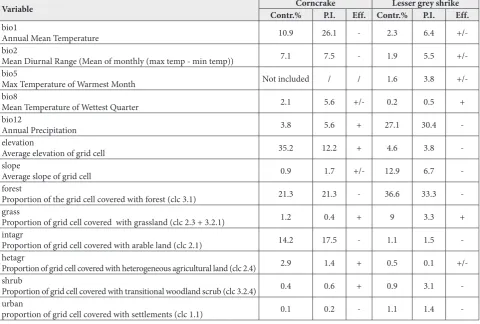
total). We performed variance inflation factor (VIF) analysis to measure the collinearity among climate variables. Climate variables with high multicollinear-ity were removed until all remaining variables had VIF<10 [45], which resulted in us retaining four and five climatic variables for the corncrake and lesser grey shrike models, respectively (Table 1). The topographi-cal variables of elevation and slope were derived from the Shuttle Radar Topography Mission (STRM) digital elevation model at a resolution of 250 m [46], so that we could calculate the mean height and mean slope of the terrain for each 1x1 km cell. Habitat variables were derived from the Coordination of Information on the Environment Land Cover (Corine Land Cover) map at a resolution of 100 m [47]. We chose six habitat types and calculated their areas in each 1x1 km cell (Table 1). Our habitat classification generally matched the second or third levels of the Corine classification, but we combined the Natural Grassland (3.2.1) and Pastures (2.4) categories due to their similarity and
mosaic characteristics in Serbia, where large areas of grassland are occasionally mowed and sometimes extensively grazed.
We created our models of potential species dis-tributions using MaxEnt (ver 3.3.4), a widely adopted approach that identifies the distribution closest to maximum entropy (closest to the uniform), subject to a set of constraints that represents spatial distribu-tion of target species and environmental variables [48,49]. MaxEnt is a machine-learning tool that uses presence-only data and a set of background points [50]. For each of the predictors (environmental variables), Maxent derives a number of features (mathematical transformation of the predictors), and the mean of each feature closely matches the empirical average of the occurrence data [49,50]. Duplicate data (i.e. multiple findings from a single cell) were removed. We used the territory of Serbia as background and excluded Kosovo and Metohija since there are no
Table 1: Variables used for modelling of corncrake and lesser grey shrike distribution in Serbia with MaxEnt.
Variable Contr.%CorncrakeP.I. Eff. Contr.%Lesser grey shrikeP.I. Eff.
bio1
Annual Mean Temperature 10.9 26.1 - 2.3 6.4
+/-bio2
Mean Diurnal Range (Mean of monthly (max temp - min temp)) 7.1 7.5 - 1.9 5.5
+/-bio5
Max Temperature of Warmest Month Not included / / 1.6 3.8
+/-bio8
Mean Temperature of Wettest Quarter 2.1 5.6 +/- 0.2 0.5 +
bio12
Annual Precipitation 3.8 5.6 + 27.1 30.4
-elevation
Average elevation of grid cell 35.2 12.2 + 4.6 3.8
-slope
Average slope of grid cell 0.9 1.7 +/- 12.9 6.7
-forest
Proportion of the grid cell covered with forest (clc 3.1) 21.3 21.3 - 36.6 33.3
-grass
Proportion of grid cell covered with grassland (clc 2.3 + 3.2.1) 1.2 0.4 + 9 3.3 +
intagr
Proportion of grid cell covered with arable land (clc 2.1) 14.2 17.5 - 1.1 1.5
-hetagr
Proportion of grid cell covered with heterogeneous agricultural land (clc 2.4) 2.9 1.4 + 0.5 0.1
+/-shrub
Proportion of grid cell covered with transitional woodland scrub (clc 3.2.4) 0.4 0.6 + 0.9 3.1
-urban
proportion of grid cell covered with settlements (clc 1.1) 0.1 0.2 - 1.1 1.4
relevant data from this region for the study period. Ten thousand background points were automatically selected. Set features were linear, quadratic and hinge, and 15 replicates of cross-validation type were run. We used area under receiver-operator curve (AUC) values for model evaluation. Maps of the probability of species presence were translated into binary maps using the maximum training sensitivity plus specific-ity threshold [51], in which grid cells have a value of either 1 (“suitable”) or 0 (“unsuitable”).
Gap analysis
MaxEnt models are often used for gap analyses [12,52,53]. In order to conduct our gap analysis, we converted NPAs and IBAs into rasters at a resolution of 1x1 km. Cells were labeled as NPA or IBA if more than 50% of their surface area overlay either type of protected area network. Consequently, some extremely small areas of either type of network were not ana-lyzed. The results of our gap analysis are presented as percentages of cells hosting suitable habitats located within an NPA or IBA (out of the total number of cells containing suitable habitat for each species). Also, we considered a scenario in which the NPAs and IBAs together formed an ecological network (NPA+IBA). Finally, we calculated the “gap” in protection of habi-tats suitable for both species for all three scenarios of protected areas (NPA, IBA or NPA+IBA).
RESULTS
Studied species distributions
Our species distribution models showed high dis-criminatory power for both modelled species, and can be described as ‘good’ [54]; the AUC was 0.8430 0.037) for the corncrake model and 0.872 (+/-0.043) for the lesser grey shrike model. Five and four variables contributed more than 5% of the descriptive power of the corncrake and lesser grey shrike models, respectively (Table 1). Both species were negatively affected by the proportion of forests (“forest”), arable land (“intagr”) and settlements (“urban”) within grid cells. The probability of lesser grey shrike presence decreased with increases in elevation and annual pre-cipitation (“bio12”), whereas those variables had a
positive effect on the probability of corncrake presence. As might be expected, the probability of presence for both species was positively affected by grassland area, which represents the main habitat for both species in eastern Europe [25,55-57].
Suitable habitats (probability of presence >0.282) for corncrake were found in 22.93% of the 1x1 km cells in Serbia (Table 2). Suitable habitats are located in mountainous and hilly areas throughout the country, with the highest concentration in the mountains of the eastern and western parts of Serbia (Fig. 1A, Fig. 1C). A relatively small number of suitable cells are also scattered throughout the northern plains.
Table 2. Number and percentage of grid cells suitable for corn-crake, lesser grey shrike and for both species within the territory of Serbia and within the networks of protected areas. The per-centage of the total number of suitable cells for species is shown in parentheses.
Species Serbia NPA IBA NPA+IBA
Corncrake 20274 (12.31%)2495 (25.86%)5242 (26.89%)5451
Lesser grey shrike 16240 (2.04%)332 (9.91%)1610 (9.99%)1623 Corncrake and
Lesser grey shrike 1686 (3.5%)59 (15.84%)267 (16.01%)270
NPA – network of nationally protected areas; IBA – network of important bird areas, NPA+IBA – two networks combined.
For lesser grey shrike, 18.37% of the cells in Serbia were designated as suitable (probability of presence >0.303). The highest concentration of suitable cells was located in the north of the country (Fig. 1B and C) where there are large tracts of continuous suitable habitat both in grasslands and cultivated land hosting the single trees, old orchards or hedgerows necessary for lesser grey shrike nesting [58]. South of the Sava and Danube rivers, suitable habitats were located in the valleys of large rivers and the foothills of mountains in the southern, central and eastern parts of the country, but lesser grey shrike is conspicuously absent from the west and southwest of Serbia.
Fig.1. Distribution maps of corncrake and lesser grey shrike in Serbia obtained by MaxEnt. A – probability of presence of corncrake; B – probability of presence of lesser grey shrike; C – distribution of grid cells suitable for corncrake only (CC), lesser grey shrike only (LGS), and suitable for both species (CC+LGS).
Fig.2. Distribution of suitable cells for corncrake with a map of: A – National Protected Areas (NPAs); B – Important Bird Areas (IBAs). Numbers indicate the ten NPAs and IBAs with the larg-est percentages of suitable cells for corncrake from Table 3. The borders of NPAs and IBAs with more than 1% of suitable cells for corncrake in Serbia are marked in red.
Fig.3. Distribution of suitable cells for lesser grey shrike with a map of: A – National Protected Areas (NPAs); B – Important Bird Areas (IBAs). Numbers indicate the ten NPAs and IBAs with the largest percentages of suitable cells for lesser grey shrike from Table 3. The borders of NPAs and IBAs with more than 1% of suitable cells for lesser grey shrike in Serbia are marked in red.
Table 3. List of the ten most important Nationally Protected Areas (NPAs) and Important Bird Areas (IBAs) for corncrake and lesser grey shrike in Serbia. The percentage of the total number of suitable cells for species is shown in parentheses.
NPA IBA
Corncrake Lesser grey shrike Corncrake Lesser grey shrike
Stara Planina (3.9%)* Deliblatska Peščara (0.4%) Stara Planina (5.4%)* Subotička Jezera and Pustare (1.4%)*
Golija (2.7%)* Okanj Bara (0.4%) Golija (2.7%)* Pašnjaci velike droplje (1.2%)*
Šar Planina (1.6%)* Carska Bara (0.2%) Kopaonik (2.5%)* Gornje Potamišje (1.1%)*
Vlasina (0.6%) Subotička Peščara (0.2%) Uvac and Mileševka (2.0%)* Deliblatska Peščara (1.0%)*
Ozren-Jadovnik (0.4%) Gornje Podunavlje (0.1%) Pešter (2.0%)* Titelski Breg (0.7%)
Uvac (0.3%) Đerdap (0.1%) Valjevske Planine (1.7%)* Okanj-Rusanda (0.6%)
Kopaonik (0.3%) Selevenjske Pustare (0.1%) Šar Planina (1.7%)* Carska Bara (0.6%)
Kamena Gora (0.3%) Pašnjaci velike droplje (0.1%) Prokletije (1.4%)* Slano Kopovo (0.6%)
Šargan - Mokra Gora (0.3%) Ludaško Jezero (0.1%) Vlasina (1.0%)* Srednje Potamišje (0.5%)
Tara (0.3%) Mali Vršački Rit (0.1%) Sićevačka Klisura (0.9%) Stara Planina (0,4%)
Gap analysis
The number of corncrake-suitable cells within NPAs accounted for 12.31% of the total number of cells with habitat suitable for the species, and this increased to 25.86% or 26.89% for the IBA or NPA+IBA networks, respectively (Table 2). Suitable cells were located in a total of 39 NPAs (Fig. 2A) or within 24 IBAs (Fig. 2B). More than 10 cells of suitable habitat occurred in 17 of these NPAs or in 21 IBAs. More than 1% of suitable cells could be found in three NPAs or in nine IBAs (Table 3, Fig. 2A, Fig. 2B). Our models of potential corncrake distribution indicate larger areas of suitable habitats within IBAs where breeding has previously been well documented (e.g. the IBAs “Stara Planina”, “Uvac and Mileševka”, and “Vlasina”), but also in areas with sparse records (e.g. IBA “Golija”). Large areas of suitable habitat for corncrake in eastern and south-western Serbia are located outside the boundaries of NPAs and IBAs (Fig. 2A, Fig. 2B).
For lesser grey shrike, worryingly, there were only 2.04% of cells with suitable habitat for the species within NPAs (Table 2). These lesser grey shrike suit-able cells were located in 23 different NPAs. Again, the percentage of lesser grey shrike-suitable cells increased within the IBA network (9.91%, 30 IBAs) and for our NPA+IBA network (9.99%) (Table 2). More than 10 cells of suitable habitats could be found in 10 NPAs and in 18 IBAs. No NPA contained more than 1% of suitable cells for lesser grey shrike, and only four IBAs met this criterion (Table 3, Fig. 3A, Fig. 3B). NPAs harboring slightly higher numbers of cells of suitable habitat are located in the northern parts of the coun-try and represent typical Pannonian ecosystems that include fragments of steppe, salt pastures and mead-ows (Fig. 3A). South of the Sava and Danube rivers, suitable habitats for lesser grey shrike are located in the peripheral parts of several NPAs. Similarly, lesser grey shrike mainly inhabits the peripheries of IBAs that contain some agricultural habitats (Fig. 3B). Areas south of the Sava and Danube rivers with the highest density of suitable cells for this species (e.g. in the val-leys of the Velika Morava, Južna Morava, Timok and Nišava rivers) are located outside the boundaries of NPAs and IBAs (Fig. 3A, Fig. 3B).
NPAs cover only 3.5% of the cells containing habi-tat suitable for both species, IBAs cover 15.84% and,
combined, these networks cover 16.01% of the cells we predict to harbor suitable habitat for corncrake and lesser grey shrike (Table 2).
DISCUSSION
The species distribution modelling we used enabled us to identify patterns of corncrake and lesser grey shrike distribution in the absence of systematically-collected data from the field. Our results indicate relatively large areas of suitable habitat for both species in Serbia, which implies a somewhat larger national population than previously estimated. Nevertheless, population estimates based on habitat occupancy maps obtained by modelling have two limitations. First, occupancy patterns are shaped not only by abiotic environmental factors but also by biological interactions, dispersal, population dynamics and evolution [59], so all mod-elled locations deemed suitable may not necessarily be occupied. Second, uneven species distributions across a landscape limit the ability of habitat occupancy maps to predict local population abundances [60]. However, the probability of species presence obtained by species distribution models has been linked to abundances [61] or reproductive parameters [62]. Thus, it is reasonable to assume similar ratios for populations of species and amounts of suitable habitat within and outside NPAs and IBAs.
with corncrake and lesser grey shrike (e.g. Emberiza hortulana,Sylvia nisoria,Lanius collurio and Saxicola rubetra). Notably, the mosaic agricultural landscapes of lowland plains suitable for lesser grey shrike are far less represented in NPAs than upland agricultural habitats. Non-intensively-used agricultural habitats suitable for corncrake are more represented within large NPAs in the mountains (e.g. Stara Planina, Šar Planina, Golija), where it was not possible to exclude these agricultural plots from the protection zones due to the complex-ity of the landscape. As in many European countries, lowland farmland species in Serbia are significantly less well protected relative to upland species [12,64].
Unlike NPAs that are defined by criteria other than simply species protection, IBAs are defined with the clear objective of preserving populations of native bird species and all of the criteria used to delineate them are based on quantitative parameters for spe-cies of conservation concern [41]. IBAs in Serbia are considered potential future “Special Protected Areas” (SPAs) as part of the Natura 2000 network [18]. For lesser grey shrike, the proportion of the population within IBAs is very low (less than 10%) and is prob-ably insufficient to protect the species. This clear lack of representation of suitable habitats for lesser grey shrike within the IBA network may pose a serious obstacle to the conservation of this species, since the Natura 2000 network is recognized as the most im-portant mechanism for lesser grey shrike conservation in some EU countries [57]. Our results highlight the need to define new IBAs (or SPAs within the Natura 2000 network) and for expansion of existing ones so that habitats important to lowland farmland species, such as lesser grey shrike, can be better represented. The lesser grey shrike is particularly dependent on grassland habitats and most of the occurrence data originates from areas with fragments of steppe, salt meadows or pastures. Inclusion of larger areas of these semi-natural habitats in NPAs and IBAs would contribute greatly to the conservation of a significant portion of the Serbian lesser grey shrike population.
The situation for corncrake is somewhat different. IBAs cover about 1/3 of suitable habitats for this spe-cies, partially due to there being better knowledge of its distribution, but also because large IBAs in Serbia were actually created as major extensions into zones around existing and relatively well-researched moun-tain NPAs. Similar ratios of corncrake pair numbers
within and outside the boundaries of IBAs have been estimated [18]. In Serbia, not a single IBA has been designed to encompass only agricultural habitats. In-stead, they are typically sited at the edges of protected forest, alpine or wetland zones. Consequently, many valuable heterogeneous farmland landscapes, which do not have well-preserved natural habitats in their vicinity, are not recognized as IBAs. Most of the cells designated as containing suitable habitats for both analyzed species lie outside IBAs, and we expect that these locations also support a high diversity of other farmland birds.
Expansions of existing NPAs and IBAs in western Serbia (i.e. the areas of Ozren-Jadovnik, Zlatibor, Uvac and Mileševka, Pešter), and establishing new ones in the eastern part of the country (e.g. Svrljiške Planine, Vidlič, Ozren, Devica, Dubašnica, Homoljske Planine, Kučajske Planine) would contribute significantly to the conservation of habitats suitable for corncrake. For lesser grey shrike, completely new NPAs and IBAs should be defined in eastern Serbia (in the surroundings of Negotin, Kladovo, Žagubica and in the Timok and Nišava river valleys), as well as in the lowland valleys of the Velika and Južna Morava rivers. Improvements to the conservation status of very fragmented grassland habitats suitable for lesser grey shrike in northern Serbia will require both establishment of new NPAs and IBAs, as well as the enlargement of some exist-ing ones (e.g. Pašnjaci velike droplje, Okanj-Rusanda, Slano Kopovo).
supervise habitat management in NPAs in Serbia, so the likelihood for implementation of appropriate measures in them is largely better. Therefore, the only long-term mechanism for conserving species such as corncrake and lesser grey shrike is through the creation of a functional network of protected areas in Serbia (particularly Natura 2000 areas, which are focused on species and habitat conservation). It is important to note that even in protected areas, the management of habitats for strictly protected spe-cies is often inadequate, sometimes due to a lack of fundamental information about species distributions or their habitat requirements. Our spatially explicit modelling results represent a significant contribution to knowledge about the distribution of suitable habitats for corncrake and lesser grey shrike,both within and outside of protected networks. Our identification of large areas of suitable habitat enables allocation of management efforts to good candidate localities, even in very poorly investigated areas.
We acknowledge that the distribution of suitable habitats for corncrake and lesser grey shrike is likely to be significantly altered in the future due to climate change and changing land use [57], so changes in spe-cies’ distribution and abundance should be carefully monitored. Serbia is not a member of the EU so it still does not implement the Common Agricultural Policy, but the agricultural intensification associated with this policy is a continent-wide trend that has been identified as the most important factor leading to reduced farmland biodiversity in Europe [7]. Populations of farmland birds are widely used indicators of the declining biodiversity associated with agricultural land in Europe [67], which is why more detailed studies are needed to determine the abundances and population trends of threatened species, and population monitoring is necessary to understand their responses to the complex processes of land use and climate change and ecosystem succession in Serbia. Considering the lack of systematically col-lected data in Serbia, spatially explicit maps of suitable habitats of species could be a useful tool for developing monitoring schemes and conservation strategies for farmland biodiversity, both within the boundaries of protected area networks and beyond them.
Funding: This work was financially supported by the Ministry of Education, Science and Technological Development of the
Republic of Serbia (Grant No. OI 173002, “Conservation strategy for protected and strictly protected hoverflies (Insecta: Diptera: Syrphidae) species in Serbia – Case study“) and the Provincial Secretariat for Science and Technological Development (Grant No. 142-451-2591/2017: “Evaluation of Ecological Networks in AP Vojvodina as support for nature conservation”).
Acknowledgements: The authors are sincerely grateful to all pro-fessional and amateur ornithologists from the Bird Protection and Study Society of Serbia who kindly provided data on corncrake and lesser grey shrike distribution. Special appreciation is extended to Marija Miličić who helped us in the analysis of environmental variables used for species distribution modelling and to John O’Brien for proofreading the English version of the manuscript. Author contributions: DR, GS and SJ participated in collecting data on corncrake and lesser grey shrike in the field. GS and MM prepared the database on corncrake distribution. SJ prepared the database on lesser grey shrike distribution. DR, MM, SJ, TN and DM performed the species distribution modelling with MaxEnt. Gap analysis was performed by DR, TN and DM. The interpretation of the results was done and approved by all authors. DR, MM, SJ and TN wrote the manuscript. AV and DM supervised the activi-ties and reviewed several drafts of the manuscript.
Conflict of interest disclosure: The authors state that this manu-script has not been published before and is not under consideration for publication anywhere else. Publication of this article was ap-proved by all authors.
REFERENCES
1. Krebs JR, Wilson JD, Bradbury RB, Siriwardena GM. The second Silent Spring? Nature. 1999;400:611-2
2. Butler SJ, Vickery JA., Norris K. Farmland biodiversity and the footprint of agriculture. Science. 2007;315:381-4. 3. Van Dyck H, Van Strien AJ, Maes D, Van Swaay CAM.
Declines in common, widespread butterflies in a landscape under intense human use. Conserv Biol. 2009;23:957-65 4. Donald PF, Green RE, Heath MF. Agricultural intensification
and the collapse of Europe’s farmland bird populations. Proc R Soc Lond B Biol Sci. 2001;268:25-9.
5. Kleijn D, Kohler F, Báldi A, Batáry P, Concepción ED, Clough Y, Díaz M, Gabriel D, Holzschuh A, Knop A, Kovács A, Marshall EJP, Tscharntke T, Verhulst J. On the relation-ship between farmland biodiversity and land-use intensity in Europe. Proc Biol Sci. 2009;276:903-9.
6. Wretenberg J, Lindstrom A, Svensson S, Part T. Linking agricultural policies to population trends of Swedish farm-land birds in different agricultural regions. J Appl Ecol. 2007;44:933-41.
7. Butlera SJ, Boccaccio L, Gregory RD, Vorisek P, Norrisa K. Quantifying the impact of land-use change to Euro-pean farmland bird populations. Agric Ecosyst Environ. 2010;137:348-57.
TH, Tworek S, Wuczýnski A,˙Zmihorski M. Conservation of farmland birds faces different challenges in Western and Central-Eastern Europe. Acta Ornithol. 2011;46: 1-12. 9. Baldi A, Batary P. Spatial heterogeneity and farmland birds:
different perspectives in Western and Eastern Europe. Ibis. 2011;153:875-6.
10. Sekulić G. [Corncrake Crex crex in Serbia]. Ciconia. 2011;20:28-45. Serbian.
11. Soulé ME. Conservation: tactics for a constant crisis. Sci-ence. 1991;253: 744-50.
12. Campedelli T, Tellini Florenzano G, Londi G, Cutini S, For-nasari L. Effectiveness of the Italian national protected areas system in conservation of farmland birds: A gap analysis. Ardeola. 2010;57:51-64.
13. Science for Environment Policy. Agri-environmental schemes: how to enhance the agriculture-environment rela-tionship. Agri-environment Schemes. 2017;57:1-44. 14. Kleijn D, Sutherland WJ. How effective are European
agri-environment schemes in conserving and promoting biodi-versity? J Appl Ecol. 2003;40:947-69.
15. Princé K, Moussus JP, Jiguet F. Mixed effectiveness of French agri-environment schemes for nationwide farmland bird conservation. Agric Ecosyst Environ. 2012;149: 74-9. 16. Puzović S, Radišić D, Ružić M, Rajković D, Radaković M,
Pantović U, Janković M, Stojnić N, Šćiban M, Tucakov M, Gergelj J, Sekulić G, Agošton A, Raković M. [Birds of Ser-bia: Breeding population estimates and trends for the period 2008-2013]. Novi Sad: Društvo za zaštitu i proučavanje ptica Srbije i Prirodno-matematički fakultet, Univerzitet u Novom Sadu; 2015. 160 p. Serbian.
17. Zavod za zaštitu prirode Srbije. Osnovni podaci. [Internet]. Beograd: Zavod za zaštitu prirode Srbije. 2018 Jan [cited 2018 Jun 30]. Available from: http://www.zzps.rs/novo/ index.php?jezik=sr&strana=zastita_prirode_osnovni_ podaci.
18. Puzović S, Sekulić G, Stojnić N, Grubač B, Tucakov M. [Important Bird Areas in Serbia]. Beograd: Republika Srbija, Ministarstvo životne sredine i prostornog planiranja; Zavod za zaštitu prirode Srbije i Autonomna pokrajina Vojvodina, Pokrajinski sekretarijat za zaštitu životne sredine i održivi razvoj; 2009. 277 p. Serbian.
19. BirdLife International. European birds of conservation con-cern: populations, trends and national responsibilities. Cam-bridge (UK): BirdLife International; 2017. 171 p.
20. BirdLife International. Crex crex. The IUCN Red List of Threatened Species. [Internet]. 2015 [cited 2018 June 10]. Available from : http://www.iucnredlist.org/ details/22692543/1. e.T22692543A60016665.
21. BirdLife International. Lanius minor. The IUCN Red List of Threatened Species [Internet]. 2015 [cited 2018 June 10]. Available from: http://www.iucnredlist.org/details/ full/22705038/1. e.T22705038A60179080.
22. Puzović S, Simić D, Saveljić D, Gergelj J, Tucakov M, Stojnić N, Hulo I, Ham I, Vizi O, Šćiban M, Ružić M, Vučanović M, Jovanović T. [Birds of Serbia and Montenegro – breed-ing population estimates and trends: 1990-2002]. Ciconia. 2003;12:35-120. Serbian
23. BirdLife International. Crex crex. The IUCN Red List of Threatened Species [Internet]. 2016 [cited 2018 June 10].
Available from: http://dx.doi.org/10.2305/IUCN.UK.2016-3. RLTS.T22692543A86147127.en. e.T22692543A86147127. 24. del Hoyo J, Elliott A, Sargatal J. Handbook of the Birds of the
World. Vol. 3, Hoatzin to Auks. Barcelona: Lynx Edicions; 1996. 821 p.
25. Green RE, Rocamora G, Schäffer N. Populations, ecology and threats to the Corncrake Crex crex in Europe. Vogelwelt. 1997;118:117-34.
26. Collar NJ, Crosby MJ, Stattersfield AJ. Birds to Watch 2: The World List of Threatened Birds. Cambridge (UK): BirdLife International; 1994. 407 p. (Birdlife International Conserva-tion Series; no. 3).
27. Mischenko A. Corncrake Crex crex monitoring in Euro-pean Russia in 2002- 2003: a pilot study. Revista Catalana d’Ornitologia. 2008;24:65-70.
28. Sukhanova O, Mischenko A. Monitoring Corncrake Crex crex numbers in European Russia: the first stage. Ornis Hun-garica. 2003;12:135-41.
29. Fourcade Y, Engler JO, Besnard AG, Rödder D, Secondi J. Confronting expert-based and modelled distributions for spe-cies with uncertain conservation status: A case study from the corncrake (Crex crex). Biol Conserv. 2013;167:161-71. 30. Keišs O. Recent increases in numbers and the future of
Corncrake Crex crex in Latvia. Ornis Hungarica. 2003;12-13:151-6.
31. Bellebaum J, Koffijberg K. Present agri-environment mea-sures in Europe are not sufficient for the conservation of a highly sensitive bird species, the Corncrake Crex crex. Agric Ecosyst Environ.2018;257: 30-7.
32. Šćiban M, Rajković D, Radišić D, Vasić V, Pantović U. [Birds of Serbia - critical list of species]. Novi Sad: Pokrajinski zavod za zaštitu prirode, Društvo za zaštitu i proučavanje ptica Srbije; 2015. 194 p. Serbian.
33. BirdLife International. Lanius minor. The IUCN Red List of Threatened Species [Internet]. 2016 [cited 2018 June 10]. Available from: http://dx.doi.org/10.2305/IUCN.UK.2016-3. RLTS.T22705038A87339356.en. e.T22705038A87339356. 34. Yosef R, International Shrike Working Group. Handbook
of the Birds of the World. Vol. 13, Penduline-tits to Shrikes. Barcelona: Lynx Editions; 2008. Chapter 16, Family Laniidae (shrikes); p. 732-73.
35. Lefranc N, Worfolk T. Shrikes: a guide to the shrikes of the world. Mountfield: Pica Press; 1997. 192 p.
36. Chiatante G, Brambilla M, Bogliani G. Spatially explicit con-servation issues for threatened bird species in Mediterranean farmland landscapes. J Nat Conserv. 2014;22(2):103-12. 37. Sekulić N, Šinžar-Sekulić J, editors. [Emerald Ecological
Network in Serbia]. Beograd: Republika Srbija: Ministarstvo životne sredine i prostornog planiranja, Zavod za zaštitu prirode Srbije; 2010. 100 p. Serbian.
38. Stevanović V, Vasić V, editors. [Biodiversity of Yugoslavia with overview of Species of International Importance]. Beo-grad: Biološki fakultet i Ecolibri; 1995. p. 562. Serbian. 39. Banković S, Medarević M, Pantić D, Petrović N, Šljukić B,
Obradović S. The growing stock of the Republic of Serbia - state and problems. Bulletin of the Faculty of Forestry. 2009;100:7-30.
Getzner M, Jungmeier M, editors. Protected Areas in Focus: Analysis and Evaluation. Proceedings in the Management of Protected Areas, vol. 4. 2013 Klagenfurt: Verlag Johannes Heyn. p. 26-31.
41. Heath MF, Evans MI. Important Birds Areas in Europe: priority sites for conservation. Cambridge (UK): BirdLife International; 2000. 804 p. (BirdLife International Conserva-tion Series; no. 8).
42. Republic of Serbia, Ministry of agriculture and environ-mental protection. The fifth national report to the United Nations Convention on biological diversity. Belgrade: Republic of Serbia, Ministry of agriculture and environ-mental protection; 2014. 121 p. CBD Fifth National Report – Serbia.
43. Budka M, Kokociński P. The efficiency of territory map-ping, point-based censusing, and point-counting methods in censusing and monitoring a bird species with long-range acoustic communication - The Corncrake Crex crex. Bird Study. 2015;62(2):153-60.
44. Hijmans RJ, Cameron SE, Parra JL, Jones PG, Jarvis A. The WorldClim Interpolated Global Terrestrial Climate Surfaces. [Internet]. Berkeley (CA, USA): University of Berkeley. 2005 [cited 2016 Jan 15]. Available: http://www.worldclim.org/ current.
45. Marquardt DW. Generalized inverses, ridge regression, biased linear estimation and non-linear estimation. Tech-nometrics. 1970;1:591-612.
46. Jarvis A., Reuter HI, Nelson A, Guevara E. Hole-filled seam-less SRTM data V4. [Internet] International Centre for Trop-ical Agriculture (CIAT). 2008 [cited 2016 Jan 15]. Available from.: http://srtm.csi.cgiar.org.
47. Corine Land Cover 2006 raster data [Internet]. Europeand Environmental Agency: 2006 [cited 2016 Jan 15]. Avail-able from: http://www.eea.europa.eu/data-and-maps/data/ corinland-cover-2006-raster-2.
48. Phillips SJ, Anderson RP, Schapire RE. Maximum entropy modeling of species geographic distributions. Ecol Modell. 2006;190:231-59.
49. Phillips SJ, Dudik M. Modeling of species distributions with Maxent: new extensions and a comprehensive evaluation. Ecography. 2008;31:161-75.
50. Elith J, Phillips SJ, Hastie T, Dudík M, Chee YE, Yates CJ. A statistical explanation of MaxEnt for ecologists. Divers Distrib. 2011;17:43-7.
51. Liu C, Berry P, Dawson T, Pearson R. Selecting thresholds of occurrence in the prediction of species distributions. Ecog-raphy. 2005;28:385-93.
52. Brambilla M, Bergero V, Bassi E, Falco R. Current and future effectiveness of Natura 2000 network in the central Alps for the conservation of mountain forest owl species in a warm-ing climate. Eur. J. Wildl. Res. 2015;61(1):35-44.
53. Vujić A, Radenković S, Nikolić T, Radišić D, Trifunov S, Andrić A, Markov Z, Jovičić S, Mudri Stojnić S, Janković M, Lugonja P. Prime Hoverfly (Insecta: Diptera: Syrphidae)
Areas (PHA) as a conservation tool in Serbia. 2016; Biol Conserv. 2016;198:22-32.
54. Araújo M, Pearson R,Thuiller W, Erhard M. Validation of species-climate impact models under climate change. Glob Chang Biol. 2005;11:1504-13.
55. Moga CI, Hartel T, Öllerer K, Szapanyos A. Habitat use by the endangered Lesser Grey Shrike Lanius minor in Central Romania. Belg. J. Zool. 2010;140(2):223-6.
56. Ajder V, Baltag SE. Factors Affecting Occurrence of Red-Backed Shrike (Lanius collurio) and Lesser Grey Shrike (Lanius minor) in Low-Intensify Agriculture Areas from Eastern Europe. Pol J Ecol. 2017;65(2):285-94.
57. Sándor AD, Domşa C. Climate change, predictive modelling and grassland specialists: assessing impacts of changing cli-mate on the long-term conservation of Lesser Grey Shrikes (Lanius minor) in Romania. J Ornithol. 2018;159(2):413-24. 58. Rajković D.[Population size, density and nest site selection
of Lesser Grey Shrike Lanius minor in northwest Bačka]. Ciconia. 2010;19:20-4. Serbian
59. Wiens JA, Stralberg D, Jongsomjit D, Howell CA, Snyder MA. Niches, models, and climate change: Assessing the assumptions and uncertainties. Proc Natl Acad Sci U S A. 2009;106:19729-36.
60. Nielsen SE, Johnson CJ, Heard DC, Boyce MS. Can models of presence-absence be used to scale abundance? two case studies considering extremes in life history. Ecography. 2005;28:197-208.
61. VanDerWal J, Shoo LP, Johnson CN, Williams SE. Abun-dance and the environmental niche: environmental suitabil-ity estimated from niche models predicts the upper limit of local abundance. Am Nat. 2009;174(2):282-91.
62. Brambilla M, Ficetola GF. Species distribution models as a tool to estimate reproductive parameters: a case study with a passerine bird species. J Anim Ecol. 2012;81(4):781-7. 63. Аraújo M, Lobo J, Moreno J. The effectiveness of Iberian
protected areas in conserving terrestrial biodiversity. Con-serv Biol. 2007;21(6):1423-32.
64. Maiorano L, Falcucci A, Garton EO, Boitani L. Contribution of the Natura 2000 network to biodiversity conservation in Italy. Conserv Biol. 2007;21(6):1433-44.
65. Birrer S, Spiess M, Herzog F, Jenny M, Kohli L, Lugrin B. The Swiss agrienvironment scheme promotes farmland birds: but only moderately. J Ornithol. 2007;148:295-303.
66. Keenleyside C, Elts J, Figeczky G, Fier B, Galvánek D, Helli-car M, Ira L, Jobda M, Koorberg P, Kounnamas C, Kurlaviius P, Maderiè B, Medved A, Metera D, Pezold T, Priednieks J, Rainskis E, Raudonikis L, Szilvácsku Z, Vaičūnaitė R, Zámecník V. Farmland birds and agri-environment schemes in the New Member States: a report for the Royal Society for the Protection of Birds. Sandy (UK): RSPB; 2006. p. 137. 67. Gregory RD, van Strien A, Vorisek P, Meyling AWG, Noble