ISSN-L: 2501 - 1235 Available on-line at: www.oapub.org/edu
doi: 10.5281/zenodo.2604535 Volume 5 │ Issue 7 │ 2019
RESEARCH ON THE MARKETING AND PUBLIC RELATIONS
EFFECT AND SPORT EVENT SATISFACTION OF
THE TAIPEI 2017 UNIVERSIADE
Shan-Ying Huang1
Wen-Sheng Chiu2
Ching-Hui Lin3
Kuo-Wei Lin4i
1Physical Education Office, National Chiao Tung University, Taiwan, R.O.C. 2Physical Education Office, National Central University, Taiwan, R.O.C. 3Physical Education Office, Yuan Ze University, Taiwan, R.O.C. 4Physical Education Office, National Central University, Taiwan, R.O.C.
Abstract:
The purpose of this study is to investigate the spectators’ marketing and public relations and sport event satisfaction with their participation in the Taipei 2017 Universiade. Meanwhile, based on the comparison of different personal background variables, this study compares the attractiveness and satisfaction of the spectators’ marketing and public relations recognition, marketing and public relations attitude, event planning and sport event services. A random sampling method is adopted in this study. Among spectators, university students of the Taipei 2017 Universiade are selected. A total of 700 questionnaires are distributed and 680 valid questionnaires are collected. The effective recovery rate is 97.14%. The research tool of this study is “Satisfaction scale of marketing and public relations effect and sport event satisfaction of the Taipei 2017 Universiade”. This study uses statistical methods such as descriptive statistics, independent sample t-tests, and so forth. The results of this study are: (1) In the Taipei 2017 Universiade, spectators have the highest attractiveness with “Internet” in “media tools” of marketing and public relations recognition, followed by the factor of “TV”; (2) In “marketing and public relations attitude” of the Taipei 2017 Universiade,
“marketing and public relations present efforts and earnest of Taiwan” ranks the highest, followed by “marketing and public relations are impressed”; (3) In “sport event services” of the Taipei 2017 Universiade, “auditorium” ranks the highest, followed by “broadcast notification”; (4) There is no significant difference in the attractiveness and satisfaction among spectators with different personal background for “marketing and public relations recognition”, “marketing and public relations attitude”, and “sport event services” in the Taipei 2017 Universiade.
Keywords: Taipei 2017 Universiade, sport event satisfaction, marketing and public relations effect.
1. Introduction
1.1. Research Background and Motivation
In recent years, for large-scale sports events, it is an important activity for urban development. In addition to driving tourism benefits, gaining international recognition, and being able to gain exposure in the international media. Therefore, in order to become an international metropolis, all major cities in the world could achieve this goal by applying for a large-scale sport event (Hung, 2017). All countries in the world host international sport events to create economic benefits and employment opportunities (Li, Blake, & Thomas, 2013).
After five rounds of bidding, Taipei finally succeeded in winning the host city of Universiade which is known as the “Little Olympics”. The main effect of the Taipei 2017 Universiade would be: increase international exposure. It would attract global media to compete for interviews, increase popularity of Taiwan and marketing Taipei, and it would also expand opportunities for exchanges between Taiwan and the rest of the world, and enhance urban competitiveness and increase Taiwan’s exposure (Chen, Lin, & Hung, 2015).
By organizing international sport events, in addition to breaking the gap between people and promoting the people’s recognition of sport events and the contact between national people and international community, it could also attract the attention of the media and the public, provide positive benefits to the country’s popularity and image, and promote international exchanges and cooperation (Liu, & Yeh, 2003; Cheng, 2004). The sport events could be reported by the mass media to expand the promotion effect and promote the development of sports. Sport marketing has become an indispensable factor in sport events (Giatsis, Kollias, Panoutsakopoulos, & Papaiakovou, 2004). In Liu’s (2011) research of college students’ understanding of the Shenzhen 2011 Universiade, it is pointed out that the lack of publicity of the Universiade and the lack of information in the public media revealed that some students have no idea that the 2011 Universiade is held in Shenzhen.
the marketing and public relations effect. The results of this research would provide a reference for Taiwan’s attempted international sport events and relevant research, and enhance the quality and the effectiveness of marketing and public relations of other international sport events.
1.2. Research Purposes
According to the research background and motivation, this study explores marketing and public relations effect, sport event satisfaction, and the correlation between these two. The specific purposes are as follows: investigate the “marketing and public relations effect” and “sport event satisfaction” of the college students among spectators in the Taipei 2017 Universiade; explore the differences in the effectiveness of “marketing and public relations” between different genders on the spot; explore the differences in “sport event satisfaction” between different genders on the spot.
2. Research Methods
2.1. Research Object
In this study, the spectators of Volleyball Championships in the Taipei 2017 Universiade are officially sampled. The questionnaires are issued from August 20 to 29, 2017. A total of 700 questionnaires are issued, and 680 valid questionnaires are collected. The effective questionnaire recovery rate of this study is 97.14%.
2.2. Research Tools
This study refers to the “sport event services management scale” compiled by Chiang (2006) and the “marketing and public relations effect scale” compiled by Lin (2007) as the framework, and uses self-editing “international sport event’s marketing and public relations effect and sport event satisfaction of the Taipei 2017 Universiade” as study tools.
The reliability analysis of this study uses Cronbach’s α system to obtain the internal consistency of the scale and the α value of the activity planning subscale is .923; the α value of the sport event services subscale is .928; the α value of the total scale is .936. The α value of the marketing and public relations recognition subscale is .935; the α value of the marketing and public relations attitude subscale is .872; the α value of the total table is .965, indicating that the reliability of the scale is good, and the internal consistency is high.
2.3. Data Processing
3. Results
3.1. Narrative Analysis of Sample Characteristics
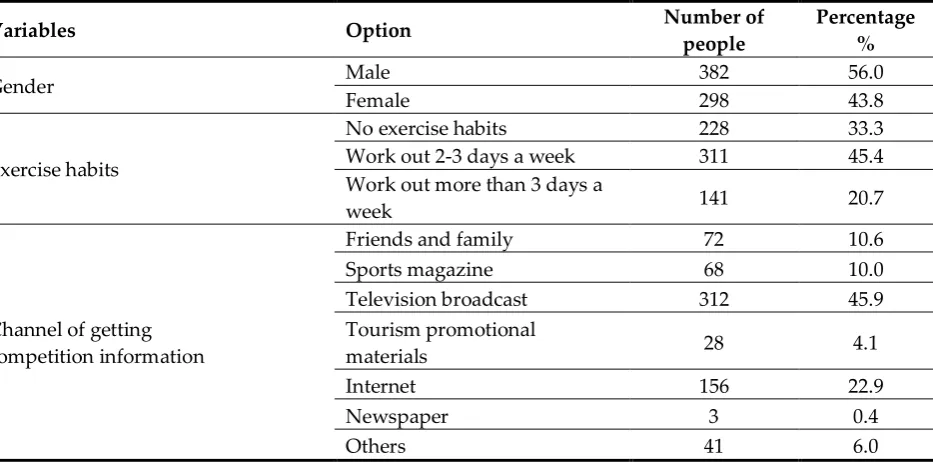
This study collects 680 valid questionnaires. The personal characteristics include gender, exercise habits, and channel of getting competition information. The personal characteristics of the respondents are shown in Table 1. It shows that most of the respondents are male, the majority work out 2-3 days a week, and most of them get the information on television broadcasts.
Table 1: Sample Basic Data Number Allocation Table
Variables Option Number of
people
Percentage %
Gender Male 382 56.0
Female 298 43.8
Exercise habits
No exercise habits 228 33.3
Work out 2-3 days a week 311 45.4 Work out more than 3 days a
week 141 20.7
Channel of getting competition information
Friends and family 72 10.6
Sports magazine 68 10.0
Television broadcast 312 45.9
Tourism promotional
materials 28 4.1
Internet 156 22.9
Newspaper 3 0.4
Others 41 6.0
3.2. Analysis of Marketing and Public Relations Recognition’s Attraction on Spectators in the Taipei 2017 Universiade
Table 2: The Analysis Summary of
“Marketing and Public Relations Recognition’s Attraction” in the Taipei 2017 Universiade
Facets Variables Mean Standard
deviation Rank
Media tool (M=3.57) Newspaper 3.27 1.11 9
Magazine 3.28 1.05 8
Marketing and public relations (M=3.66)
TV 3.89 1.10 2
Broadcast 3.38 1.06 7
Internet 4.07 1.14 1
Public place poster 3.65 1.03 5
Spokesperson promotional activity 3.75 0.98 3 Cooperation with foreign tourism
bureaus 3.55 0.86 6
Promotion in large sport events 3.72 0.83 4
3.3. Analysis of Marketing and Public Relations Attitude on Spectators in the Taipei 2017 Universiade
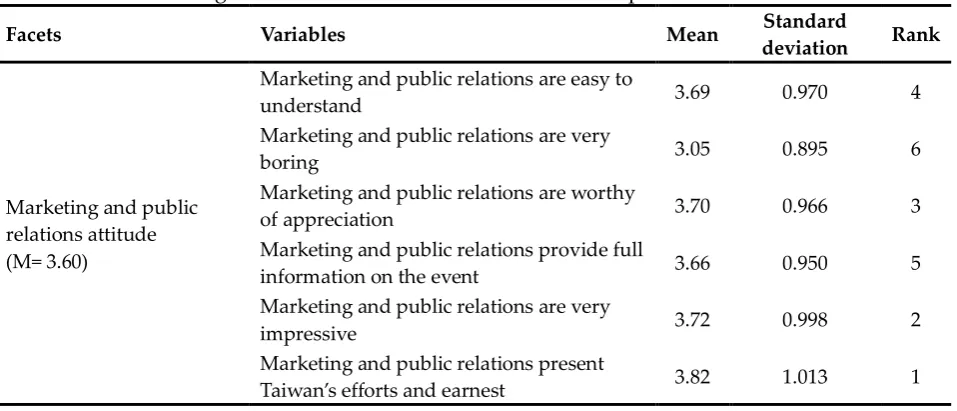
In the Taipei 2017 Universiade, the spectators’ attitude of “marketing and public relations” is shown in Table 3. The mean of each facet is 3.60. According to the results of this study, the spectators have a positive attitude towards marketing and public relations. Among these items, the highest is “marketing and public relations present Taiwan’s efforts and earnest”, with a mean of 3.82; followed by “marketing and public relations is very impressive”, with a mean of 3.72. The differences in personal marketing background do not reach significant differences in marketing and public relations attitude.
Table 3: Analysis Summary Table of
“Marketing and Public Relations Attitude” in the Taipei 2017 Universiade
Facets Variables Mean Standard
deviation Rank
Marketing and public relations attitude (M= 3.60)
Marketing and public relations are easy to
understand 3.69 0.970 4
Marketing and public relations are very
boring 3.05 0.895 6
Marketing and public relations are worthy
of appreciation 3.70 0.966 3
Marketing and public relations provide full
information on the event 3.66 0.950 5
Marketing and public relations are very
impressive 3.72 0.998 2
Marketing and public relations present
3.4. Satisfaction Analysis on Sport Event Services in the Taipei 2017 World Universiade
Among each factor, the highest score of “event services” satisfaction, “auditorium” (M=3.74) is the highest, followed by “broadcast notification” (M=3.67), “peripheral products” (M = 3.66), “peripheral activities” (M = 3.63), and “marking guidelines” (M = 3.59), while the lowest score is “service personnel” (M = 3.51), as shown in Table 4. The mean of each factor shows that spectators do not reach the satisfaction level for the Taipei 2017 Universiade. In each item, the highest score is “How do you feel about the cleanliness of the auditorium” in the “auditorium” factor, with a mean of 3.78. Huang (2000) points out that if the overall consideration of the hardware facilities and convenient transportation of the sport event venues, it would be helpful for spectators’ participation.
Table 4: Satisfaction Analysis of Spectators on “Sport Event Services”
Facets Variables Mean Standard
deviation Rank
Auditorium (M=3.74)
How do you feel about the brightness and comfort
of the auditorium 3.71 1.03 2
How do you feel about the cleanliness of the
auditorium 3.78 1.03 1
Service personnel (M=3.51)
How do you feel about the overall service attitude
of the service personnel 3.52 0.99 11
How do you feel about the interpretation ability of
the service personnel 3.51 0.98 12
Broadcast notification (M=3.67)
How do you feel about the venue audio playback
quality 3.68 1.00 4
How do you feel about the clarity of the
interpretation of the conference broadcasters 3.67 0.98 5
Marking guidelines (M=3.59)
How do you feel about the marking guidelines for
conference service offices 3.57 0.99 10
How do you feel about the traffic flow guidelines for the sport event venue provided by the
conference
3.62 0.99 8
Peripheral products (M=3.66)
How do you feel about the design and quality of
the souvenirs sold by the conference 3.70 1.04 3 How do you feel about the contents of the event
manual produced by the conference 3.63 1.00 7
Peripheral activities (M=3.63)
How do you feel about the travel information
provided by the conference 3.65 1.02 6
How do you feel about the peripheral activities
information provided by the conference 3.61 0.99 9
3.5. Differences in Marketing and Public Relations Recognition’s Attraction of spectators between Different Genders
in media tools (p<.05) and marketing and public relations (p<.05). Media tools are more attractive for female spectators (M=3.60) than males (M=3.59). In these facets, marketing and public relations, females (M=3.67) are significantly higher than males (M=3.63).
Table 5: Analysis Summary Table of Differences in Marketing and Public Relations Recognition’s Attraction of spectators between Different Genders
Facets Gender Number of
people Mean
Standard deviation t value p value Media tool M F 382 298 3.59 3.60 1.12 1.30
0.795 0.323
Marketing and public relations M F 382 298 3.63 3.67 1.12 1.11
0.539 0.890
* p<.05
3.6. A Summary Analysis on the Differences in Marketing and Public Relations Attitude of Spectators with Different Genders
The independent sample t test verifies the difference in marketing and public relations attitude of spectators with different genders in the Taipei 2017 Universiade. The spectators with different genders have no significant difference in marketing and public relations attitude. The male spectators’ (M=3.60) marketing and public relations attitude is significantly higher than the female’s (M = 3.56), which could be seen in Table 6.
Table 6: Summary of the difference analysis on Marketing and Public Relations Attitude of Spectators with Different Genders
Facets Gender Number of
people Mean
Standard deviation t value p value
Marketing and public relations attitude M F 382 298 3.60 3.56 1.023 0.979
0.539 0.580
* p<.05
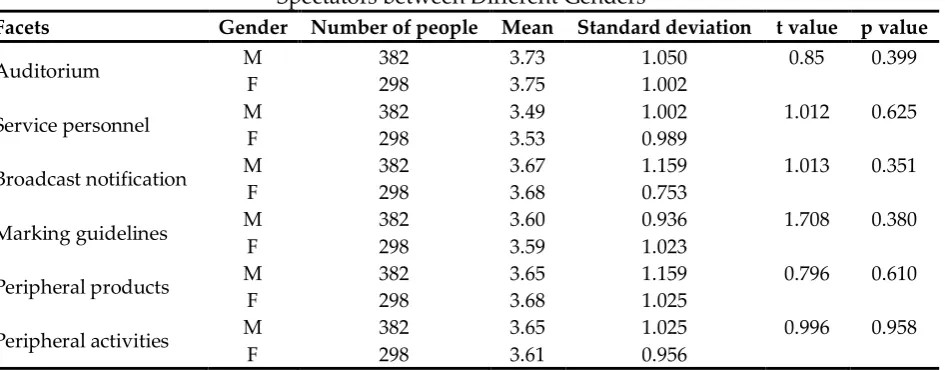
Table 7: Analysis Summary of Differences in Service Satisfaction of Spectators between Different Genders
Facets Gender Number of people Mean Standard deviation t value p value
Auditorium M
F 382 298 3.73 3.75 1.050 1.002
0.85 0.399
Service personnel M F 382 298 3.49 3.53 1.002 0.989
1.012 0.625
Broadcast notification M F 382 298 3.67 3.68 1.159 0.753
1.013 0.351
Marking guidelines M F 382 298 3.60 3.59 0.936 1.023
1.708 0.380
Peripheral products M F 382 298 3.65 3.68 1.159 1.025
0.796 0.610
Peripheral activities M F 382 298 3.65 3.61 1.025 0.956
0.996 0.958
* p<.05
4. Conclusion and Recommendations
4.1. Conclusion
From the personal background variable analysis of the spectators in the Taipei 2017 Universiade, it could be seen that most of them are male, the majority work out 2-3 days a week, and most of them get the information on television broadcasts.
Among each facet of marketing and public relations recognition’s attraction, the “marketing and public relations” factor ranks the highest (M=3.66), followed by the factor “media tools” (M=3.57). The highest score is “Internet”, followed by “TV”, indicating that Internet and TV are more attractive media tools. “Auditorium” (M=3.74) is the highest in “event services” satisfaction, while the lowest is “service personnel”.
The marketing and public relations effect is highly positively related to sport event satisfaction in the Taipei 2017 Universiade. The higher the appeal of the use of marketing and public relations media tools and marketing and public relations method, the higher the spectators’ satisfaction with the event.
4.2. Recommendations
4.2.1. Marketing and Public Relations
It is recommended that when organizers hold a sport event, they could invite sport stars to webcast in order to expand the publicity effect and gain exposure.
Promote public relations by sport spokespersons or combined with public
welfare, and organize carnivals related to sport events for people of different ethnic groups to enhance the public relations efficiency of sport events.
Universiade in Taipei, which would catch world attention and increase international competitiveness (Chen, 2009; Yang, & Lin, 2013).
4.2.2. Sport Event Services
When selecting a service person, the personality traits of self-confidence, willing to serve others, and sense of humor should be considered, so that the service staff could enjoy the work and bring good service to the customer.
For peripheral activities, the following considerations should be paid attention to: combine local characteristics and traditional culture, plan leisure trips with sports and sightseeing, deepen the impression of the people on the event, and let the sport event continue to sustainable develop.
References
Chen H.C., Lin L.H., Hung I.J., 2015. A Study on Taipei City Citizens’ Recognition and Support of the 2017 Taipei Universiade. Physical Education Journal of NTU 29: 27-41. doi: 10.6569/NTUJPE.2015.29.03
Chen K.F., 2009. Benefit Evaluation of Competing for International Comprehensive Competitions - Taking the 2009 Kaohsiung World Games as an Example. Commission report commissioned by the Sports Commission of the Executive Yuan. Taipei City: The Sports Commission of the Executive Yuan.
Cheng S.T., 2004. Principles and Practice of Sport Event Management. Taipei City, Taiwan.
Chiang C.S., 2006. Research on Service Management of National Track and field events. Journal of Sport and Recreation Management 3(2): 190-207.
Giatsis G., Kollias I., Panoutsakopoulos V., Papaiakovou G., 2004. Volleyball: Biomechanical Differences in Elite Beach-Volleyball Players in Vertical Squat Jump on Rigid and Sand Surface. Sports Biomechanics 3(1): 145-158. doi: 10.1080/14763140408522835
Huang M.J., 2000. A Study on the Determinants and Satisfaction of the Spectators Watching in the National Table Tennis Match. Kaohsiung City, Taiwan.
Hung Y.Y., 2017.A Study of Taipei Citizens’ Attitude and Behavioral Intention before
the 2017 Taipei Summer Universiade. Unpublished Master’s Thesis, National
Taiwan Normal University, Taipei City.
Li S.N., Blake A., Thomas R., 2013. Modelling the Economic Impact of Sports Events: The Case of the Beijing Olympics. Economic Modelling 30: 235-244. doi: 10.1016/j.econmod.2012.09.013
Liu C.C., Yeh K.T., 2003. An Analysis of Economic Impact of the 2002 Intercollegiate Athletic Competitions of Taiwan on Kaohsiung Area. Journal of Taiwan Sports Management 2: 14-30. doi: 10.6547/tassm.2003.0002
Liu T.B., 2011. Investigation and Analysis of College Students’ Attention on 2011 Universiade. Journal of Sichuan College of Education 27(5): 35-51.
Robinson M.J., Trail G.T., Dick R.J., Gillentine, A.J., 2005. Fans vs. Spectators an Analysis of Those Who Attend Intercollegiate Football Games. Sport Marketing Quarterly 14(1): 43-53.
Yang T.M., Lin T.H., 2013. Study on the Benefits, Costs, Value and Support of Residents in the Late Years of the 2009 Kaohsiung World Games. NCYU Physical
Education, Health & Recreation Journal 12(1): 1-12. doi:
Creative Commons licensing terms