ISSN: 2278-3369 International Journal of Advances in Management and Economics
Available online at: www.managementjournal.info
RESEARCH ARTICLE
Entrepreneurial Intention of the Participants of the Startup
Weekend: Longitudinal Analysis
Amélia Silveira1*, Flávio Santino Bizarrias2,Hermani Magalhães Olivense do Carmo2
1Doctorate in Administration, University of Western Santa Catarina, Brazil.
2Postgraduate Program in Administration, Nove de Julho University, Brazil.
*Corresponding Author: Amélia Silveira
Abstract
The objective was to analyze longitudinally the Entrepreneurial Intention (EI) of participants in a Startup Weekend (SW) eventin order to investigate to what extent, after four months of an SW event, the EI of the participant’s remains. Thus, the measurement of the IE occurred in three moments: before the event (t1), after its completion (t2), and four months later (t3).The data collection instrument was a psychometric scalechecked, adjusted and improved by Liñán, Urbano and Guerrero [1]. The theory is based on Azjen[2,3,4,5]– Theory of Planned Behavior (TCP)– and constructs Attitude Staff (PA), Subjective Norms (NS) and Perceived Behavioral Control (SPC), which support the understanding of EI. The research is descriptive and quantitative, with statistical procedures and structural equation modeling (SEM). It was found that the variable EI of participants remained stable in most of the analyzed items, over time. There was a decrease between Subjective Norms and Entrepreneurial Intention, since they are related to the social pressure perceived by the individual in the sense ofperforming certain behavior, and they may be discouraging entrepreneurial activity, in times of crisis.
Keywords
:
Entrepreneurial intention, Longitudinal analysis, Startup Weekend, Subjective norms.Introduction
The study of the new businesses creation process is focused on the comprehension of the importance attributed to the cognitive factors, mainly motivation and intention, as a way to increase the comprehension about the creation of new enterprises. In the course of studies on the construction of a model to measure the entrepreneurial intention (EI), Azjen’s [2] work, with the proposition of the Theory of Planned Behavior (TPB), is considered to be appropriate to support their proposition.
Authors such as Kolvereid [3], Tkachev and Kolvereid [4], Liñán[5], Fayolle and Gailly [6, Krueger [7], Fayolle and DeGeorge [8] and Liñan and Chen [9] considered the TPB as a way of understanding the business creation process. In general, the TPB and its three antecedents of motivation, Personal Motivation (PM), Subjective Norm (SN) and Perceived Behavioral Control (PBC) serve as reference to support the comprehension of
the entrepreneurial intention.It is important to highlight that, like the TPB [2], the Entrepreneurial Event Model, proposed by Shapero and Sokol [10] and by Shapero [10], was also considered an important support on the research of the intention to undertake a business and to create new businesses. In more specific studies, such as Krueger and Brazeal [11] and Krueger, Reilly and Carsrud [12], it was revealed that these two theoretical models merge into one another in more than one element.
Web of Science, Azjen’s book is cited about 1,500 times. Azjen’s [2] work, in turn, as a scientific article, is cited over 5,000 times. They also say that [...] almost all the citations for the 1988 book also cites the 1991 article.” These citation counts are an evidence for the generalization of the TPB as a theory to support, explain and predict any kind of planned behavior. Understanding that, the model called TPB was adopted in this article to analyze the intention of individuals to become an entrepreneur before, during and after a Startup Weekend (SW), which is a specific event focused on an entrepreneurship immersion.
Regarding the instrument to measure the three theoretical constructs of the TPB in relation to the EI in the study context, this one was selected based on theoretical studies and empirical researches, and among the ones that apply the TPB to the entrepreneurship. From the authors who studied the evolution of the models focused on the entrepreneurial intention, it is worth highlighting Guerrero, Rialp and Urbano[18], Black[19] and Souza[20]. And among other models, the studies of Liñan and Santos [21], Liñan [22] and Liñan and Chen [8] arise, which present a psychometric measurement instrument to measure the EI, the Entrepreneurial Intention Questionnaire
(EIQ). This Questionnaire was defined to measure the cognitive constructions, supported by the set of constructs indicated by Azjen [2, 23,24]: Personal Attitudes (PA), Subjective Norms (SN) and Perceived Behavioral Control (PBC), in relation to the intention of undertaking a business (cognitive behavior).
A list of 20 basic questions represents these constructs. The first validation of the EIQ took place with Liñán and Chen [8]. However, this measurement instrument was reviewed, verified, and improved in Liñán, Urbano and Guerrero’s [1] work. Also, Liñán, Nabi and Krueger [25] presented suggestions to improve the instrument and its questions, as well as the expansion of the model to greater integration, incorporating culture, motivation, skills and entrepreneurial knowledge, and seeking a cross-cultural application. It is important to highlight that, according to the authors’ interest and the research context, new
groups of variables started to be proposed, complementing the 20 main questions. It is also worth highlighting that most of the national and international researches on this subject and that adopt the EIQ, partly or in whole, have been held in the university context, with students. Rueda, Moriano and Liñan [26] describe the researches developed overtime in different environments.
This article, however, does not have the university environment as research context. The Startup Weekend (SW) is an event focused on an entrepreneurship immersion, in which the participants are challenged to put an idea into practice within 54 hours. More than an entrepreneurship event, the SW is a manner of experiential education. The event begins on Friday afternoon and ends on Sunday night; the participants form teams and are challenged to develop a business idea with the support of mentors, who are experienced professionals, entrepreneurs and university students who cooperate voluntarily to the formation of new entrepreneurs.
The creators of the Startup Weekend believe that the entrepreneurs need to make (perform) to be able to learn [27]. This kind of event arose in the United Stated, in June 2007, and it has had thousands of editions in more than 100 countries. In Brazil, the SW has already been held dozens of times, and the realization rights are reserved to Techstars; it is a nonprofit event. Its motto is: “No talk, all action. Launch a startup in 54 hours.” Its mission is to inspire, educate and empower individuals, groups and communities through knowledge related to entrepreneurship.
It is believed that more than 3,000 businesses were created from ideas developed during a SW, for example, Easy Taxi. Hand Talk, Meu Tutor, Quanto Gastei
However, up to now, it is unknown if the entrepreneurial intention of the SW participants increased, decreased or remained the same after this event.
Therefore, the question that guides this research investigates to what extent, after four months of the realization of a SW, the Entrepreneurial Intention of the participants remains the same. Thus, a measure of the theoretical constructs of Azjen’s [2] Theory of the Planned Behavior (TPB), through the psychometric scale proposed by Liñan, Urbano and Guerreiro [1], is necessary. It is expected the Entrepreneurial Intention of the participants of the SW, under study, to have its greater effect over the Subjective Norms (SN), since when the society around these individuals aims to support the entrepreneurial spirit (with the SW, for example), they feel inclined towards an action in this sense.
However, when there is an economic, social and political crisis scenario, like in current Brazilian moment, this tendency may dilute and dissipate. Likewise, the Perceived Behavioral Control (PBC) and the Personal Attitudes (PA) can change after the SW. Thus, it is necessary to evaluate several moments when there are stimuli to undertake a business. Therefore, the objective of this work is to analyze longitudinally the Entrepreneurial Intention of the participants of the SW, based on Azjen [2], using the 20 questions proposed on the psychometric scale, which was verified, adjusted and improved by Liñán, Urbano and Guerrero[1].
Models of Entrepreneurial Intention
Researchers, over time, have presented different models intending to measure the individual’s willingness to undertake a business. Even so, according to Armitage and Conner [28] and Liñán and Chen [31], however, there is still no instrument to measure the EI that servers as a pattern, despite the numberless researches accomplished until this moment. Lortie and Castogiovanni [14] enhance this understanding, affirming that few studies sought to develop measurement scales to the Entrepreneurial Intention.Black [19] reviewed, in turn, the models focused on the EI and, among others,
highlighted Liñán and Chen [8], who presented a psychometric measurement instrument called Entrepreneurial Intention Questionnaire (EIQ). In later studies, some possible problems with the EIQ were found, as acquiescence bias. The acquiescence can be understood as a tendency of the respondents to agree, systematically, with the declarations in measurement scale or instrument. According to Liñán, Urbano and Guerrero [1], the construction of balanced scales that are generally composed of Likert type items, written in a positive way. And in which half of the items measure in one direction of the trace, whilst the other measures in the opposite one.
This, the main hypothesis of this kind of measure is that the acquiescence of the items in one direction will be canceled by acquiescence for the items in the opposite direction [1]. For his reason, a modified version was developed, in which Liñán, Urbano, Guerrero [1] prosposed to minimize the possible existence of a statistical problem. Therefore, the model adopted in Liñan and Chen’s[12] study was modified and adopted in new field researches, considering that the items that measure the key constructs should be ordered randomly, and some of them, reversed. This recommendation is found in Liñán, Urbano and Guerrero [1]. Fayolle, Liñán and Moriano [29] and Souza and Silveira[30] also refer to the subject.
In literature, according to more recent studies of Schlaegel and Koeing [13], Lortie and Castogiovanni [14] and Liñán and Fayolle [15], it seem to have a consensus that there is a basis in common that supports the literature on EI.
Azjen’s [2] Theory of the Planned Behavior (TPB) prevails among the citations of the scientific articles that support this subject to predict and explain the human behavior in specific contexts and considers the individual’s intention of having certain behavior a central factor [2,31].
evaluation of certain behavior. The second indicator is a social factor called Subjective Norm (SN) and is related to the social pressure perceived to perform or not certain behavior. The third antecedent of intention is the degree of Perception of Behavior Control (PBC) or Control of Perceived Behavior (CPB), which is referred to the facility or difficulty of the individual in performing the perceived behavior, since it is presumed that it will reflect the past experience, as well as the foreseen impediments and obstacles.
The more favorable is the Personal Attitude towards the Subjective Norm in relation to a behavior, and the greater is the Control of Perceived Behavior, the stronger must be the intention of an individual to perform certain behavior[2]. Therefore, the general principle of the psychological theory of the planned behavior, created by Azjen [2], is that the foreseen behaviors are intentional and may be predicted by the intention of this behavior. The intentionality of the action (action of undertaking a business, in the specific case of the entrepreneurship) is grounded on the cognitive psychology. It tries to predict and explain the human behavior, since the planned behavior is based on the individuals’ intention.
In this theoretical context, Shapero and Sokol [9] and Shapero [10] should also be considered because of their contribution to the study of entrepreneurship with the formulation of the Entrepreneurial Event Model (EEM). Desirability and viability form two steps of this model. Desirability is the beginning of the business decision-making process. Viability, in turn, potentiates or inhibits the individual’s desirability, according to the environment in which he is inserted. It is worth highlighting that, after testing and comparing these two theories, the TPB [2] and the EEM, Schlaegel and Koening [13] affirm that they are more widely tested and incorporated to explain the intention to undertake a business.
Method and Research Procedures
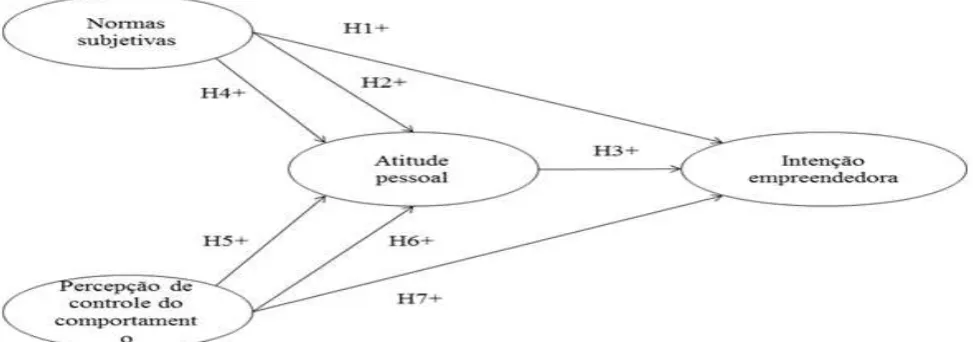
The research was descriptive and quantitative; the analysis was conducted through statistic procedures and Structural Equation Model (SEM).This study measures the entrepreneurial intention in the Startup Weekend event, before the event, during the event and four months after it. Figure 1 presents the theoretical model tested in this study in the three measurement moments.
Figure 1: Azjen’s theoretical model
In the theoretical model proposed by Azjen [2,31] it is observed that the Subjective Norms indicate social pressures for certain behaviors to be performed, and the behaviors to be preceded by the intentions or propensity to act. So, in this research, it is expected that there is a positive and significant relation between the Subjective Norm and the Entrepreneurial Intention (H1). The Subjective Norm, in turn, must have a positive and significant relation with
the Personal Attitude (H2), because the attitudes precede the behavioral intentions, constituting the third hypothesis (H3).
perception is related to the Personal Attitude as antecedent of the intentions. Therefore, it is expected that there is a positive and significant relation between the Perception of Behavioral Control and the Personal Attitude (H6) and between the Perception of Behavioral Control and the Entrepreneurial Intention (H7), since people plan their future behaviors by means of the perception they have of themselves.
In this longitudinal research, it is also expected that the Subjective Norms, regarding the environment in which the individual is in his daily life, not always favorable to the entrepreneurship, and after four months of a Startup Weekend event (July 2015 – t3) show differences in relation to the two previous moments (t1 and t2), in the phase of the SW event, in March 2015.
Definitions of the Constructs
The constructs used in this study are the ones proposed by Ajzen [2]: Personal Attitude, understood as the degree of general evaluation, positive or negative, that people have in relation to the result of their behavior[2,3,4]; the Subjective Norms, in other words, the social pressure perceived by the individuals in relation to themselves and to the behavior expected because of the guidelines and rules that prevail in the society in which they are inserted; and the Perception of Behavioral Control, understood as the extension in which people see their capability of performing and action. The Entrepreneurial Intention is understood as people’s propensity to perform an entrepreneurial activity.
Measurement Scales
The inventory of Entrepreneurial Intention, as well as the measurement of the Personal Attitude, the Subjective Norms and the Perception of Behavioral Control, are based on the instrument proposed on Liñan, Urbano and Guerrero’s [1] study, which was composed by 20 basic questions and six items substantiated by a 7-point Likert scale, which vary from strongly disagree (1) to strongly agree (7). This scale is presented next, according to the constructs recommended by Azjen [2,31].
Personal Attitude
A02. A career of entrepreneur is completely not attractive for me.
A10. If I had the opportunity and resources, I’d like to start a company.
A12. Among various options, I would rather be anything but an entrepreneur.
A15. Being an entrepreneur would entail great satisfactions for me.
A18. Being an entrepreneur implies to me more advantages than disadvantages.
Subjective Norms
A03. If I decided to create a company my friends would approve of that decision. A08. If I decided to create a company my close family would approve of that decision. A11. If I decided to create a company my colleagues would approve of that decision. Perception of Behavioral Control
A01. To start and maintain my own business would be easy for me.
A05. I believe I would be completely unable to start a business.
07. I can control the creation process of a new firm.
A14. If I tried to start a firm, I would have a high probability of succeeding.
A16. It would be very difficult for me to develop the idea of a new business.
A20. I know the necessary practical details to start a firm.
Entrepreneurial Intention
A04. I am ready to do anything to be an entrepreneur.
A06. I will make every effort to start and run my own firm.
A09. I have very seriously thought of starting a firm.
A13. I am determined to create a firm in the future.
A17. My professional goal is to become an entrepreneur.
A19. I do not really intent to start a business someday.
It is important to clarify that, based on Liñán, Urbano and Guerrero’s [1] study, in this study it was used the one-dimensional scale to measurement of the EI, preveiously translated, adapted and tested in previous Brazilian studies that adopted the EIQ, such as Carmo Bizarrias and Nascimento’s [30].
Data Collection
Startup Weekend event (before, during and after it). Therefore, the choice of the sample was non-probabilistic, or intentional, since the respondents should follow the volunteer participation criterion at all times of collection. For this purpose, the initial procedure was to keep an active registration of all the participants, since they were aware of their participation of a scientific research in more than one moment. From the beginning, all the social subjects participants of the Startup Weekend event agreed to participate.
In the initial phase of the research, in March 2015 (t1 and t2), the participants cooperated in two moments in the Startup Weekend, which took place from March 27 to 29, 2015 in the municipality of Santana do Ipanema, Alagoas, Brazil. In the first day of the event, March 27, 2015, the entrepreneurs were welcomed by the researchers, who asked for their voluntary participation in the research about Entrepreneurial Intention. Since all of them (83 people) were in accordance, they received the questionnaire for the data collection, in which the questions were arranged randomly, some reversed, according to Liñán, Urbano, e Guerrero’s [1] recommendation. At that time, they also answered the social demographic questions and questions to identify personal and professional characteristics (moment t1), which constituted a database for longitudinal monitoring of the respondents. The data collected and analyzed in the first collection (t1) formed a database as well.
The second measurement (moment t2) took place in 29 March 2015, after the end of the event. The respondents received a questionnaire, and after a given time handed them in in their way out of the event. At the closing ceremony of the SW, there was an acknowledgement in relation to the participation of the respondents of the research. At that moment, it was announced that the participants would be invited to participate of the research one more time. The data collected and analyzed in this second collection (t2) integrated the database of the research, with a total of 83 valid answers, the same number of the initial collection (t1).
The third collection (t3) was done by e-mail, individually, when the respondents were
invited, again, to cooperate for the research. Therefore, the EIQ was sent by e-mail to the participants between July 06 and 11, 2015. In the body of the e-mail, the objective and the academic nature of the research was explained, and it was requested the return of the completed questionnaire within 10 days. In this phase of data collection, however, not everybody involved returned the questionnaire completed correctly. And others simply did not return it. Thus, for this third collection, 44 questionnaires returned on time, completed and correct were considered valid. The data collected and analyzed (t3) were added to the research database.
Data Analysis Criteria
For the data analysis, the Structural Equations Model (SEM) was adopted; it enables to observe the relations between the variables simultaneously. It was used the
Partial Least Square – PLS based on
correlation matrix, since, such as previous studies, the possibility of not occurring the normality of the data was considered [32,33]. For the data analysis, the software SmartPLS2.0M3 was used [34, 35]. The validity and reliability of the indicators of the model were also evaluated for its acceptance.
The reliability of the model was observed through internal consciousness indicators. It was sought to identify the convergent validity and the discriminant validity of the model. This last validity was analyzed through the Fornell-Larcker criterion, which assesses the square root of AVE from the higher construct to any of its correlation with other constructs of the model, and also through the correlation of the items as being greater in their dimensions than in their correlation with other constructs (crossloadings).
The general explanation of the model was observed through the determination coefficient (R-squared) and other quality adjustment indicators. The internal consciousness of the model was verified through the indicators Cronbach’s Alpha (values between 0.6 and 0.7) and Composite Reliability (values between 0.7 and 0.9).
variables with the bootstrapping technique through the t-test with acceptance criterion at 10% (t ≥ 1.67, p ≤ 0.10), observing the Stone-Geisser indicators for predictive validity (Q2) and the Cohen indicator (f2), which verifies the size of the effect of the construct in the model. Q2 must be higher than zero, and f2 has 0.02, 0.15 and 0.35 as parameters to indicators of low, medium and high effect, respectively.
The Goodness of Fit – GoF index was also considered; it is obtained by the geometric mean of the average communality and the average R2. This indicator is considered
appropriate, in the applied social sciences, when it is higher than 0.36.
Results
For the moment’s t1 and t2, 83 questionnaires were obtained, and for the moment t3, 44 valid questionnaires from the same respondents who participated of the two previous collections were obtained. Structural Equations Model
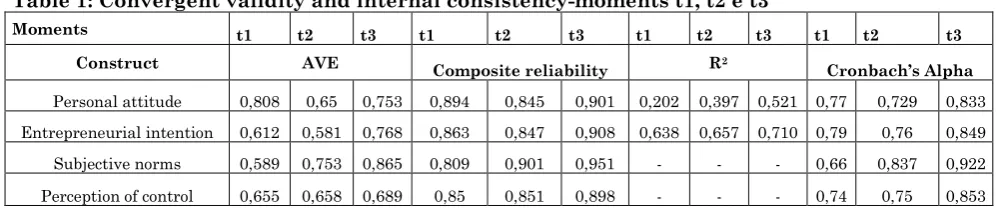
The quality of the GoF in moment’s t1, t2 and t3 was 0.535, 0.590 and 0.691, respectively, what indicates reliable values. The analysis of the convergent validity proved to be appropriate after three rounds of initial validation, with the removal of items with a factorial load below 0.7. The internal consistencies were appropriate, with Cronbach’s Alpha and Reliability within the stipulated parameters.
Table 1: Convergent validity and internal consistency-moments t1, t2 e t3
Moments t1 t2 t3 t1 t2 t3 t1 t2 t3 t1 t2 t3
Construct AVE Composite reliability R2
Cronbach’s Alpha
Personal attitude 0,808 0,65 0,753 0,894 0,845 0,901 0,202 0,397 0,521 0,77 0,729 0,833
Entrepreneurial intention 0,612 0,581 0,768 0,863 0,847 0,908 0,638 0,657 0,710 0,79 0,76 0,849
Subjective norms 0,589 0,753 0,865 0,809 0,901 0,951 - - - 0,66 0,837 0,922
Perception of control 0,655 0,658 0,689 0,85 0,851 0,898 - - - 0,74 0,75 0,853
The discriminant validity was also observed when comparing the square root of the AVE and
its correlation with the other variables. After that, the cross loadings of the items were observed in their own variables.
Table 2: Discriminant validity, square root of the ave, moment’s t1, t2 e t3
Construct Personal atittude Entrepreneurial
intention Subjective norms
Perception of control
Moments t1 t2 t3 t1 t2 t3 t1 t2 t3 t1 t2 t3
Personal atittude
0,899 *
0,806 *
0,868
* - - - -
Entrepreneurial
intention 0,684 0,767 0,813 0,782* 0,762* 0,876* - - - -
Subjective norms 0,402 0,338 0,645 0,388 0,347 0,6099
0,768 *
0,868 *
0,930
* - -
Perception of control 0,342 0,611 0,669 0,622 0,671 0,7077 0,387 0,311 0,66 0,810* 0,811* 0,830*
Table 3: Crossloadings, discriminant validity – moment’s t1, t2 e t3
Item Personal atittude Entrepreneurial intention Subjective norms Perception of control Moment
AAP10 0,871 0,519 0,31 0,286 t1
AAP15 0,926 0,693 0,403 0,326 t1
AIE04 0,436 0,822 0,408 0,589 t1
AIE06 0,562 0,756 0,171 0,448 t1
AIE13 0,582 0,766 0,367 0,413 t1
AIE17 0,558 0,784 0,271 0,496 t1
ANS03 0,299 0,33 0,749 0,261 t1
ANS08 0,177 0,149 0,656 0,251 t1
ANS11 0,394 0,355 0,881 0,366 t1
APCC01 0,193 0,448 0,302 0,803 t1
APCC07 0,38 0,618 0,342 0,887 t1
APCC20 0,215 0,406 0,293 0,733 t1
AAP10 0,857 0,629 0,266 0,567 t2
AAP15 0,909 0,767 0,325 0,566 t2
AAP18 0,625 0,393 0,217 0,287 t2
AIE04 0,449 0,735 0,262 0,543 t2
AIE13 0,637 0,772 0,335 0,515 t2
AIE17 0,625 0,76 0,127 0,526 t2
ANS03 0,239 0,264 0,829 0,189 t2
ANS08 0,291 0,306 0,87 0,32 t2
ANS11 0,339 0,327 0,904 0,289 t2
APCC07 0,446 0,561 0,254 0,851 t2
APCC14 0,667 0,655 0,327 0,886 t2
APCC20 0,269 0,343 0,121 0,682 t2
AAP10 0,869 0,661 0,462 0,564 t3
AAP15 0,947 0,810 0,689 0,676 t3
AAP18 0,779 0,628 0,503 0,485 t3
AIE04 0,673 0,875 0,520 0,624 t3
AIE06 0,725 0,866 0,480 0,563 t3
AIE17 0,736 0,887 0,599 0,670 t3
ANS03 0,594 0,510 0,939 0,634 t3
ANS08 0,631 0,609 0,940 0,651 t3
ANS11 0,573 0,578 0,910 0,564 t3
APCC01 0,409 0,454 0,376 0,807 t3
APCC07 0,573 0,611 0,594 0,852 t3
APCC14 0,747 0,730 0,736 0,872 t3
APCC20 0,371 0,467 0,368 0,786 t3
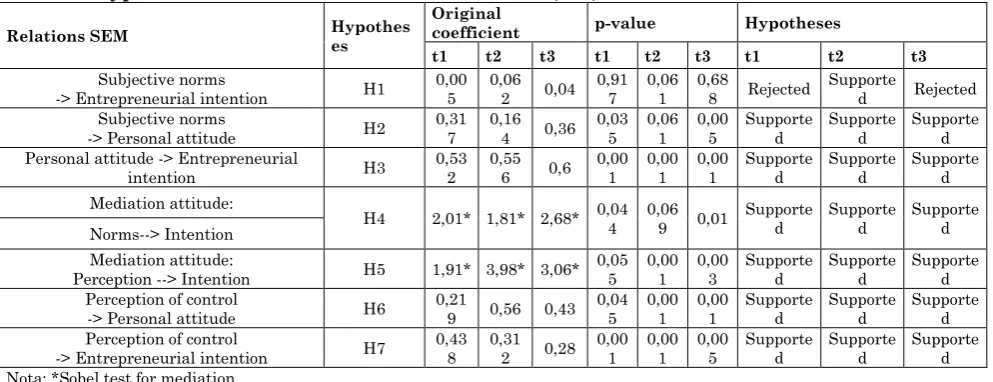
The final model achieved a good quality of adjustment (Table 4). The final structuring model showed positive and significant relations
for all the variables, confirming them, except hypothesis 1, which was not confirmed in moment’s t1 and t3.
Table 4: Hypothesis in the Three Collection Moments, T1, T2 E T3
Relations SEM Hypotheses
Original
coefficient p-value Hypotheses
t1 t2 t3 t1 t2 t3 t1 t2 t3
Subjective norms
-> Entrepreneurial intention H1
0,00 5
0,06
2 0,04
0,91 7
0,06 1
0,68
8 Rejected
Supporte
d Rejected
Subjective norms
-> Personal attitude H2 0,317 0,164 0,36 0,035 0,061 0,005 Supported Supported Supported Personal attitude -> Entrepreneurial
intention H3
0,53 2
0,55
6 0,6
0,00 1
0,00 1
0,00 1
Supporte d
Supporte d
Supporte d Mediation attitude:
H4 2,01* 1,81* 2,68* 0,044 0,069 0,01 Supported Supported Supported Norms--> Intention
Mediation attitude:
Perception --> Intention H5 1,91* 3,98* 3,06* 0,055 0,001 0,003 Supported Supported Supported Perception of control
-> Personal attitude H6
0,21
9 0,56 0,43
0,04 5
0,00 1
0,00 1
Supporte d
Supporte d
Supporte d Perception of control
-> Entrepreneurial intention H7 0,438 0,312 0,28 0,001 0,001 0,005 Supported Supported Supported Nota: *Sobel test for mediation.
Hypothesis 1 showed oscillation in its behavior, what demonstrates a weak relation between the constructs, not allowing its acceptance at the beginning and end of the study. The indicators of
explained variance (R2), accuracy (Q2) and
predictive value (f2) of the model can be
observed in Table 5.
Table 5; Quality Indicators of Sem – Moments T1, T2 E T3
Indicator R2 Q2 F2
E t1 t2 t3 t1 t2 t3 t1 t2 t3
E 0,638 0,657 0,71 0,36 0,33 0,52 - - -
PA 0,202 0,397 0,52 0,11 0,226 0,369 0,386 0,334 0,496
SN - - - 0,221 0,481 0,679
PC - - - 0,323 0,351 0,476
It is observed that in all measurement moments the variables had similar behavior. The temporal oscillations of the collection had little influence on the results. These results corroborate the best explanation (R2
e Q2) of the dependent variable
entrepreneurial intention in relation to the others of the model. It was also possible to observe the greater predictive relevance (f2)
The structuring model achieved a good adjustment in all measurement moments. It means that the choice of the theoretical model was representative of the objectives of the study.
The Entrepreneurial Intention reached explained variance of 63.8%, 65.7% and 71%
in moments t1, t2 and t3, respectively, evincing the adequacy of the adopted theoretical model. Table 6 shows the average achieved in each variable over time and the comparison between the averages of the moments t1 and t3 before and after the event, through t-test of independent samples [32].
Table 6: Comparison between the averages – moment’s t1, t2 e t3
T1 T2 T3 P-value
Subjective norms
0,626**
5,765 6,095 5,659
Personal attitude
0,008*
6,352 5,932 5,795
Behavior perception of control 0,153**
4,439 5,019 4,778
Entrepreneurial intention 0,028*
5,299 5,576 4,864
Notes: *significant difference. ** the difference was not significant.
It is observed that there was an oscillation between the variables, without any specific pattern, because half of the variables showed increase of value, and the other half, reduction of the average scores. Therefore, the results show that the construct Subjective Norms had a statistically significant average reduction in all its items. According to Ajzen [2], the subjective norms are related to the environment in which the individual is, such as social, economic and cultural conditions, as well as the coexistence rules around him. It may represent problems in the institutional environment that foments the entrepreneurship in the region where the respondents of this study live.
Analysis of the Results
The aim of analyzing the Entrepreneurial Intention of the Startup Weekend participants in three different moments can be considered achieved, because two out of the three hypotheses were confirmed. It was possible to observe the moderation of the event on the relations established by the model. The entrepreneurial intention reached a significant explanation value in the three steps (63.8%, 65.7% and 71% in steps t1, t2 and t3, respectively), demonstrating the good adjustment of the model.
The t-test of additional independent samples was performed for the EI averages in the three moments and in the other constructs [35]. The EI achieved significant difference between the first moment, before the event,
and the third moment, after the event
(Aentrepreneurial intention t1=5.299, versus
Aentrepreneurial intention t3=4.864, p=0.028). The
average of the entrepreneurial intention decreased. It is believed that it happened due to the expectations raised by the event. When people had the expectation that the course would take place, they declared greater entrepreneurial intention. It remained unchanged during the course
(Aentrepreneurial intention t2=5.576, p>0.05),
however, when the course was over, it is believed that the participants set aside the objective of the course and started focusing their energies on their usual routine. However, it is important that the concepts adopted in the course remain in the participants’ agenda. The course provides immersion and tries to ensure that people embody the capacities that foster the mental model focused on entrepreneurship. But it cannot be assured.
The same happened to the personal attitude (Apersonal attitude t1=6.352, versus Apersonal attitude t3=5.795, p=0.008), which started high but
reduced after the course, supposedly in part because of the individual’s own motivation, which could range over time.
The perception of behavior control (Aperception of behavior control t1=4.439 versusAperception of behavior
control t3=4.778, p=0.153) and the subjective
norms (Asubjective norms t1=5.765, versusAsubjective
norms t3=5.659, p=0.626) remained unchanged
individual presents a behavior related to the intention to undertake a business.
The relation between subjective norms and entrepreneurial intention (H1) was fragile in more than one step, being confirmed only in step t2 (Γ=0.062, p=0.061). This aspect seems to suggest that the environment is not favorable for the individual who wants to undertake a business, what is justified by the current scenario of social, economic and political uncertainties in Brazil, unfavorable and discouraging to start a business. It is assumed that this political-economic turbulence makes the relation between the constructs weaker. Another possibility is that in this sample it was identified fragility in the direct relation between subjective norms and entrepreneurial intention; because when this relation is mediated by the personal attitude the indirect influence is observed.
The other hypotheses were confirmed. The perception of behavior control is highlighted, since it had strong relation with the personal attitude (H6, Γ=0.219, 0.56 and 0.43 in each moment), always with high significance degree (p<0,001). Similarly, the relation of this construct with the entrepreneurial intention remained strong and significant in all of the steps (H7, Γ=0.438, 0.312 and 0.280, p<0.001). It demonstrates that this construct plays a relevant role in the model.
The most predictive construct of the model was the subjective norms (f2=0.679) in t3,
while in t1, the most important construct in the model prediction was the personal attitude (f2=0.386), although very similar to
the other variables. It indicates that, initially, personal beliefs have influence in the prediction of the entrepreneurial intention; however, the context that surrounds the participant of the event gain strength and shall have great impact in the prediction of the entrepreneurial intention after the event.
It is also observed the mediator role of the personal attitude for the relation between the subjective norms and the entrepreneurial intention (Sobel test=2.01, p=0.044 in t1 and Sobel test=2.680, p<0.001 in t3) and for the relation between the perception of behavior control and
entrepreneurial intention (Sobel test=1.91, p=0.05 in t1 e Sobel test=3.06, p<0.003 in t3).
The mediation of the personal attitude indicates an important finding of this study, because it represents an alternative path for the fragile relation between the subjective norms and the EI. In other words, besides the adverse environment, the personal attitudes of the individual who has the intention to undertake a business and seeks an event like SW to obtain better learning remain strong, almost unwavering by the time. According to Kautonen, Van Gelderen and Tornikoski[39], the entrepreneurial behavior occurs when there is connection/union between the entrepreneur and the business opportunity, because there can be the entrepreneurial will but not the moment for this applicability or vice-versa.
Conclusion
Aiming at analyzing longitudinally the Entrepreneurial Intention of the participants of the Startup Weekend of Santana do Ipanema, Alagoas, Brazil, a third data collection was performed four months after the event. A few studies are focused on monitoring egresses of an entrepreneurship event to monitor their entrepreneurial intention, overtime and after the event.
In this study, the participants answered the Entrepreneurial Intention Questionnaire (EIQ) in three moments: before the event (t1), after the event (t2) and four months after (t3). Comparing the results of the three collections, it was verified that, at the end of the event, considering the individuals who participated of all the collections, there was significant reduction of the averages obtained in two variables (Personal attitude, Apersonal attitude t1=6.35, versusApersonal attitude t3=5.80, p=0.008, and Entrepreneurial
Intention Aentrepreneurial intention t1=5.29, versusAentrepreneurial intention t3=4.86, p=0.028).
These results suggest that in a more specific understanding of the context in which the event takes place, the Subjective Norms, for being related to the environment that surrounds the individual, may be discouraging the entrepreneurial activity, especially in times of crisis. Subjective Norms are related to the social pressure perceived by the individual in the sense of performing or not certain behavior, in this case, the action of undertaking a business.
In these Norms, it is also found the attitude that an individual notice about what the reference groups and others expect, or not, and approve of, or not, about him performing certain behavior [2]. The same is observed for the behavior control. The participant did not feel that his entrepreneurial capacity decreased during the event. In all the moments he believes in his entrepreneurial capacity. However, this confidence is not high (averages of 4.439 for t1, 5.019 for t2 and 4.778 for t3).
The findings of this research reveal that, if most of the individuals did not suffer any changes in their beliefs and attitudes on account of the event, once the subjective norms and the perception of behavior control remained stable, while the personal attitude and the entrepreneurial intention decreased, it is necessary to think it over. To what extent is it necessary the politics and institutions that promote entrepreneurship to concentrate greater efforts and resources on the construction of a training program of an entrepreneurial ecosystem in peripheral regions such as northeast Brazil? And how these motivating events could be performed more systematically, seeking to support especially the young people who present innovative ideas and entrepreneurial desire, as an alternative to entering the labor market? These and other questions deserve attention. They are worrisome and may constitute the objectives of new studies.
Finally, it is worth highlighting that this study is innovative regarding the research
context, once most of the works for the measurement of the entrepreneurial intention were performed in university environments, considering students as respondents. Here the respondents are a heterogeneous public, formed by common individuals, not university students.
Similarly, there was innovation when it adopted a psychometric scale proposed by Liñán, Urbano and Guerrero [1] to measure longitudinally the entrepreneurial intention in three moments in the same entrepreneurship event, assessing the maintenance of the entrepreneurial intention. This article enables to consider that this questionnaire is able to assess results over time in terms of entrepreneurial intention. Therefore, this article brings something new. And it deserves to be continued. For future works, it is suggested the continuity of this research with a new moment, i.e. a fourth step, to verify the behavior of the participants of this SW, specifically. It is also suggested these social subjects participants of the research in this SW to be even more involved in a qualitative research, with inductive method, so that specific questions about the entrepreneurial intention may be discussed and understood.
And may this study be reference to present ideas and new actions to be offered to continue stimulating entrepreneurial intention in this environment in which activities are developed. It is also suggested to study the SW event more broadly in other Brazilian regions for future comparisons. Also, to know the way they feel this learning, during and after its conclusion. Yet, may the theoretical pillars proposed by Ajzen [2] in relation to the Theory of the Planned Behavior be investigated subjectively, giving opportunities for the improvement of its understanding to support studies on the entrepreneurial intention. It is also suggested to study the Startup Weekend event in other Brazilian regions, for future comparisons.
References
1 F Liñan, D Urbano, M Guerrero (2011) Regional variations in Entrepreneurial cognitions: start-up Intentions of university students in Spain. Entrepreneurship & Regional Development, 23(3-4):187-215.
2 I Ajzen (1991) the theory of planned behavior. Organizational Behavior and Human Decision Processes, 50(2):179-211.
students. Entrepreneurship and Regional Development, 11(3): 269-280.
4 FLiñán,( 2004) Intention-based models of entrepreneurship education. Piccola Impresa/Small Business, 3:11-35.
5 A Fayolle, B Gailly ( 2005) Using the theory of planned behavior to assess entrepreneurship teaching programmes (Center for Research in Change, Innovation and Strategy of Louvain School of Management,
6 NF Krueger (2007) what lies beneath? The experiential essence of entrepreneurial thinking. Entrepreneurship Theory and Practice, 31(1):123-138.
7 A Fayolle JM (2006) Degeorge, Attitudes, intentions, and behavior: new approaches to evaluating entrepreneurship education, in A. Fayolle, and H. Klandt (Eds.), International Entrepreneurship Education: Issues and Newness (Cheltenham, UK: Edward Elgar, 8 F Liñán, Y Chen (2009) Development and
cross-cultural application of a specific instrument to measure entrepreneurial intentions. Entrepreneurship Theory and Practice, 33(3):593-617.
9 A Shapero, L Sokol (1982) The social dimensions of entrepreneurship, in C. A. Kent, D. L. Sexton, and K. H. Vesper, Encyclopedia of Entrepreneurship (Englewood Cliffs, NJ: Prentice-Hall,) p. 72-90:
10 A Shapero (1984) The entrepreneurial event,in CA Kent (Ed.), The environment for entrepreneurship(Lexington, Mass: Lexington Books.
11 NF Krueger, DV Brazeal (1994)
Entrepreneurial potential and potential entrepreneurs. Entrepreneurship Theory and Practice, 18(3):91-104.
12 NF Krueger , MD Reilly, AL Carsrud (2000) Competing models of entrepreneurial intentions. Journal of Business Venturing, 15(5-6):411-432.
13 C Schlaegel, M Koenig (2014) Determinants of entrepreneurial intent: a meta-analytic test and integration of competing models. Entrepreneurship Theory and Practice, 38(2):291-332.
14 J Lortie, G Castogiovanni (2015) The theory of planned behavior in entrepreneurship research: what we know and future directions. International Entrepreneurship and Management Journal,
15 F Liñán, A Fayolle (2015) A systematic literature review on entrepreneurial intentions: citation, thematic analyses and
research agenda. International
Entrepreneurship Management Journal,
16 EBA Santos, FS.Martins, A Silveira,(2016) Intenção Empreendedora: Categorização, Classificação de Constructos e Predição de Modelo, Proc. 40th Encontro nacional dos
programas de pós-graduação em
administração, Costa do Sauipe,
17 Ajzen (1988) Attitudes, personality, and behavior (Milton Keynes: Open University Press.
18 M Guerrero, J Rialp, D Urbano (2006) The impact of desirability and feasibility on entrepreneurial intentions: a structural
equation model. International
Entrepreneurship and Management Journal, 4(1):35-50.
19 MM Black (2012) Exploring the multi-focus influence of identity on students’ entrepreneurial intent.[Blog post].
20 SR Souza (2015) Intenção empreendedora: validação de modelo em universidades federais de Mato Grosso do Sul Brasil, doctoral diss., Universidade Nove de Julho, São Paulo, SP, 21 F Liñan, FJ Santos (2007) Doe’s social capital
affects Entrepreneurial Intentions? International Advances in Economic Research, 13(4): 443-453.
22 F Liñan, (2008) Skill and value perceptions: how do they affect entrepreneurial intentions? International Entrepreneurship and Management Journal, 4(3):257-272.
23 I Ajzen (2001) Nature Operation of attitudes. Annual Review of Psychology, 52:27-58.
24 I Ajzen (2002) Perceived behavioral control, self-efficacy, locus of control, and the theory of planned behavior. Journal of Applied Social Psychology, 32(4):665-683.
25 F Liñán G Nabi, N Krueger (2013) British and Spanish entrepreneurial intentions: a comparative study. Revista de Economia Mundial, 33:73-103.
26 S Rueda,JA Moriano F Liñán,(2015)Validating a theory of planned behavior questionnaire to measure entrepreneurial intentions, in A. Fayolle, P. Kyrö, and F. Liñán, (Eds.), Developing, Shaping And Growing Entrepreneurship (Cheltenham, UK: Edward Elgar, 60-78.
27 MNager, C Nelsen F Nouyrigat,( 2012) Startup Weekend: como levar uma empresa do conceito à criação em 54 horas (Rio de Janeiro: Alta Books.
29 A Fayolle, F Liñán, JA Moriano, beyond (2014) entrepreneurial intentions: values and motivations in entrepreneurship. International Entrepreneurship Management Journal, 10:679-689.
30 ASilveira, HMO.Carmo, FBizarrias, S Nascimento,(2015) Intenção empreendedora dos participantes do Startup Weekend: o antes e depois da capacitação empreendedora. Proc. 39th Encontro Nacional dos Programas de Pós-Graduação em Administração, Belo Horizonte.
31 I Ajzen,(1996) Constructing a TpB Questionnaire: Conceptual and Methodological Considerations.
32 JFHair, GTM Hult, CMRingle, M
Sarstedt,(2014)A primer on Partial Least Squares Structural Equation Modeling (PLS-SEM) (Los Angeles: SAGE.
33 CM Ringle, SWende, A Will,(2010) Finite mixture partial least squares analysis: methodology and numerical examples. Handbook of partial least squares. (Berlin: Springer Berlin Heidelberg.
34 CM Ringle, DSilva, DBido,( 2014) Modelagem de equaçõesestruturais com utilização do SmartPLS. Brazilian Journal of Marketing – BJM e RevistaBrasileira de Marketing – ReMark, 13(2):56-73.