Research Article
a
November
2017
Computer Science and Software Engineering
ISSN: 2277-128X (Volume-7, Issue-11)
A Groundwork Based Novel Routing Protocol for Vehicular
Ad hoc Networks
Amolkirat Singh, Guneet Saini
Department of Computer Science and Engineering, Student, DAV University, Jalandhar, India
Abstract: Many people lose their life and/or are injured due to accidents or unexpected events taking place on road networks. Besides traffic jams, these accidents generate a tremendous waste of time and fuel. Undoubtedly, if the vehicles are provided with timely and dynamic information related to road traffic conditions, any unexpected events or accidents, the safety and efficiency of the transportation system with respect to time, distance, fuel consumption and environmentally destructive emissions can be improved. In the field of computer and information science, Vehicular Ad hoc Network (VANET) have recently emerged as an effective tool for improving road safety through propagation of warning messages among the vehicles in the network about potential obstacles on the road ahead. VANET is a research area which is in more demand among the researchers, the automobile industries and scientists to discover about the loopholes and advantages of the vehicular networks so that efficient routing algorithms can be developed which can provide reliable and secure communication among the mobile nodes.In this paper, we propose a Groundwork Based Ad hoc On Demand Distance Vector Routing Protocol (GAODV) focus on how the Road Side Units (RSU’s) utilized in the architecture plays an important role for making the communication reliable. In the interval of finding the suitable path from source to destination the packet loss may occur and the delay also is counted if the required packet does not reach the specified destination on time. So to overcome delay, packet loss and to increase throughput GAODV approach is followed. The performance parameters in the GAODV comes out to be much better than computed in the traditional approach.
Keyword: VANET, GAODV, RSUs, Delay and Throughput.
I. INTRODUCTION
VANET is the network among vehicles. Vehicular ad-hoc Networks is special kind of Mobile Ad-hoc networks. VANETs are composed for a set of communicating vehicles equipped with wireless network devices that are able to interconnect each other without any pre-existing infrastructure (ad-hoc mode). The most important network technology available nowadays for establishing VANETs is the IEEE 802.11b (Wi-Fi) standard, nevertheless new standards as IEEE 802.11p or IEEE 802.16 (WiMax) are promising.
The exchange of information among the vehicles provides a great opportunity for the development of new driver assistance systems. These systems will be able to disseminate and to gather real time information about the other vehicles and the road traffic and environmental conditions. Such data will be processed and analyzed to facilitate the driving by providing the user with useful information. It supports vehicle to vehicle and vehicle to infrastructure communications. Vehicle to Vehicle communication works on infrastructure less networks where vehicles moving freely within the networks can stay connected and interact with other vehicles equipped with on boards units. Vehicles to infrastructure communication works on infrastructure networks where vehicles interact with the road side units which are the access points located at the road side units which are the access points located at the roadside.
1.1 Vanet Architecture
ISSN(E): 2277-128X, ISSN(P): 2277-6451, pp. 121-128
by the provider using OBU connection capabilities. The RSU can also connect to the Internet or to another server which allows AU's from multiple vehicles to connect to the Internet.
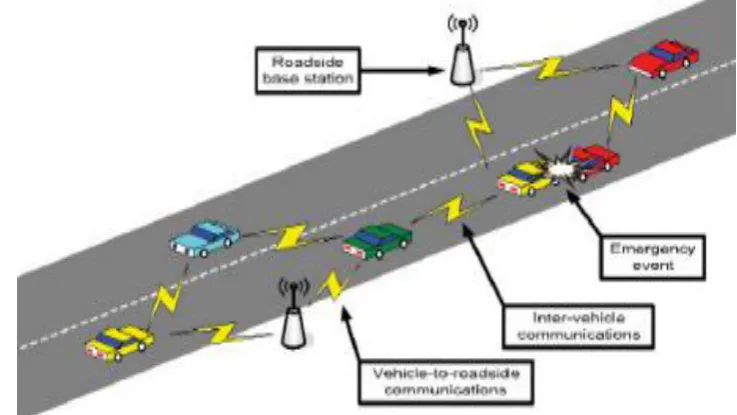
VANET are short lived and self-organizing networks established among vehicles. Vehicles equipped with wireless communication devices (OBUs). Vehicles itself are the nodes within the network. They convey and interchange messages with the alternative vehicles within the network to improve the road safety. Vehicles can communicate either with other vehicles on Board units (OBUs) in an infrastructure less network or with Road Side Units in an infrastructure network. Vehicles change their positions frequently and exchange data when comes in a range and communicate with the vehicles coming into their range. It works on Dedicated Short Range Communication. Dedicated short range communication is employed as a communication medium and it operates on 4.9 GHz frequency band provided with a bandwidth of 74 MHz DSRC is predicated on IEEE 802.11a standard and wireless access in vehicular environment. VANET applications specialize in the security of the users and user necessities throughout the journey. It’s aimed at delivering the security applications, non-safety applications and luxury applications. Safety applications give secure information to the users and trim the death rate thanks to the frequent road accidents. This information directly relates to the user and save their lives.
Figure 1.1: Architecture in VANET
It includes warnings such as lane change warnings, reporting accidents, warnings on departing the highways, accommodating ambulances fire trucks etc. Non- safety applications gives non-secure information to the users and increase the possibilities of collision moreover death rate. Comfort applications aim to produce information and amusement to the folks on move.
*1 http://comp.ist.utl.pt/~rmr/WSN/CaseStudies2007-no/WSN_Transportation/
These are bandwidth exigent and require network capability to supply continuous access to the web with a controlled Quality of service. It provides web surfing, file downloads, email movie download and gaming.
ISSN(E): 2277-128X, ISSN(P): 2277-6451, pp. 121-128
i. OBU (On Board units): An OBU is a wave device usually mounted on-board a vehicle used for exchanging information with RSUs or with other OBUs. It consists of a resource command processor (RCP), and resources include a read/write memory used to store and retrieve information, a user interface, a specialized interface to connect to other OBUs and a network device for short range wireless communication based on IEEE 802.11p radio technology. It may additionally include another network device for non-safety applications based on other radio technologies such as IEEE 802.11a/b/g/n. The OBU connects to the RSU or to other OBUs through a wireless link based on the IEEE 802.11p radio frequency channel, and is responsible for the communications with other OBUs or with RSUs; it also provides a communication services to the AU and forwards data on behalf of other OBUs on the network. The main functions of the OBU are wireless radio access, ad hoc and geographical routing, network congestion control, reliable message transfer, data security and IP mobility.
ii. AU (Application Unit): The AU is the device equipped within the vehicle that uses the applications provided by the provider using the communication capabilities of the OBU. The AU can be a dedicated device for safety applications or a normal device such as a personal digital assistant (PDA) to run the Internet, the AU can be connected to the OBU through a wired or wireless connection and may reside with the OBU in a single physical unit; the distinction between the AU and the OBU is logical.
*2 http://teacher.buet.ac.bd/rifatahsan/projects.htm
iii. RSU (Road Side units): The RSU is a wave device usually fixed along the road side or in dedicated locations such as at junctions or near parking spaces. The RSU is equipped with one network device for a dedicated short range communication based on IEEE 802.11p radio technology, and can also be equipped with other network devices so as to be used for the purpose of communication within the infrastructural network.
Main functions and procedures associated with the RSU are:
Extending the communication range of the ad hoc network byre-distributing the information to other OBUs and
by sending the information to other RSUs in order to forward it to other OBUs.
Running safety applications such as a low bridge warning, accident warning or work zone, using infrastructure
to vehicle communication (I2V) and acting as an information source.
Providing Internet connectivity to OBUs.
II. RELATED WORK
K.Sivakumar et.al presented views as Vehicular ad-hoc network (VANET) is self-organizing network that facilitate communication in between high speed moving road vehicles like cars, trucks, busses etc. In VANET network each vehicle behaves as a mobile terminal and can stir in any direction with varying speeds. The existing mobile ad-hoc network (MANET) routing protocol lacks in some aspects for VANET because of recurrent change in motion and topology of the network. So there is need for an efficient algorithm which can contribute to the reliable communication. The paper evaluates performance of AODV, DSDV and DSR routing protocol on the basis performance metric packet delivery ratio, end to end delay, and throughput of the network. AODV is much preferred routing algorithm used in VANET for secure efficient and reliable communication [5].
ISSN(E): 2277-128X, ISSN(P): 2277-6451, pp. 121-128
the performance under higher traffic condition unlike Ad hoc on demand distance vector (AODV) protocol [12].Dharmendra Sutariya et.al. mentioned about VANET a new research area and presented their views as VANET is a new communication paradigm that enables the communication between vehicles on the road network which falls in two categories Vehicle to Vehicle (V2V) and Vehicle to Infrastructure (V2I). In this paper, they have proposed a routing protocol IAODV (Improved AODV) that ensures giving timely and accurate information to drivers in V2V communication compare to AODV protocols in city scenarios of vehicular ad hoc networks. In proposed IAODV RSU’s deployed act as a medium to felicitate the communication among vehicles which are in range of the RSU’s whereas in traditional AODV no such architecture component was used. The performance of the proposed IAODV protocol is compared with basic AODV protocol in terms of Avg. End-to-End Delay, Packet Loss Ratio, Packet Delivery Ratio and Normalized Routing Load. Simulation results show that IAODV performs better than AODV protocol in given city scenarios of VANET’s [11].C. Campolo et.all stated that the purpose of paper is to design techniques that make use of Road Side Unit by supporting the spreading of network initialization advertisement from RSU’s when considering multichannel features of recently published IEEE 802.11p/IEEE 1609.4 standards for wireless access in vehicular environment(WAVE).Simulation under different RSU density, vehicular networking technology penetration rate, data rate and packet size to improve effective and efficiency of proposed solution [9].Faisal Iqbal et.al stated in the paper, performance of Ad Hoc On-demand Distance Vector (AODV) routing protocol has been optimized by introducing fixed roadside wireless nodes for data transmission in a VANET environment. The concept is based on the presence of such wireless nodes along the road sides in major cities in the world. Directional antennas are employed at the fixed wireless nodes to achieve Line Of Sight (LOS) communication between them. The comparison is laid down between the Traditional AODV and the Infrastructure based AODV and significant improvements in latter part is shown based on key performance metrics of hop count, route discovery time, network control traffic, end to end delay, media access delay, data dropped and throughput [10].
III. PRESENT WORK IN VANET
This paper describes the usage of components of architecture of VANET. The RSU’s provide LOS communication between the vehicles which are in range of the RSU’s
3.1 Routing Protocols in VANET
There are different approaches to get an efficient routing protocol for reliable routing with high Qos parameters such as minimum End to End Delay, security, low interference. These are reviewed with respect to their achievements and limitations. The routing protocols for routing are classified: Position based, Topology, cluster based, Geo cast based, multicast based and broadcast based.
3.1.1 Position Based Routing: Position based routing protocol is based on positional information. In this case nodes come to know about their and neighbor’s position using Geographic positioning system which aid in locating the nodes in geographic area.
i. Delay Tolerant Network (DTN) Protocols:The DTN is a wireless network which involves mobile nodes which communicate with other nodes when they reach in transmission range of the node. DTN Protocols:
GeographicalOpportunisticrouting (GeOpps): GeOpps uses store and forward technique but uses navigating
system for packet transmission. The navigation system helps in collecting the geographical position information which aid in identifying the nodes which are in range of the source node and transfer those packets. The steps involved in the source to destination includes are:
ii. Non Delay Tolerant Network Protocols:This geographic routing protocol uses nearest neighbor to forward the packet to the destination and in case if there is no nearest neighbor to the destination this approach may not be successful. There is no issue of disconnectivity as there is available more number of nodes to achieve successful communication. The problem of nearest neighbor node to destination can be solved through routing strategies. GPSR and CBF are the Non Delay Protocols.
ISSN(E): 2277-128X, ISSN(P): 2277-6451, pp. 121-128
iii. Hybrid Position based routing: Position routing reduces the routing overhead and it does not focus on constructing and maintaining a routing table as it is location based protocol which fetches information about destination and source through geographical processing.. This position based approach may fail if node closer to the destination is not found. This problem of nearest neighbor can be solved but it requires packet to travel large distance with loopy routes and may drop data packets. Hybrid approach is followed protocol HLAR is example to this approach.
IV. SIMULATION ENVIRONMENTS
VANET’s is most popular network which is called vehicular ad-hoc network. The researchers make a lot of work on the network. From the literature review, VANET work upon the basis of real time system where all the vehicles are moving nodes and travel with high speed on the road in the urban areas. There are many security problems like authentication, tunnel attacks, intelligent system approach, collision detection, congestion avoidance, communication system approach. In existing work, Packets are passed by traditional AODV approach in which the path has to be set up by sending RREQ request followed by RREP request. In the interval of finding the suitable path from source to destination the packet loss may occur and the delay also is counted if the required packet does not reach the specified destination on time. So to overcome delay, packet loss and to increase throughput I-AODV approach is followed. The RSU’s may stop working due to some technical error then the proposed paper follows traditional approach. This problem is a future concern and can be handled by using Location Aided Multicasting.
4.1 Parameters Considered:
The parameters that were considered in the paper for I-AODV scenario are as follows:
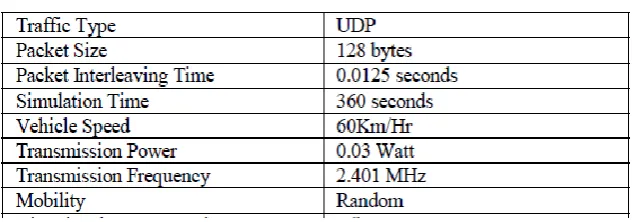
Table 1: Parameters for AODV
The above table shows the various parameters considered in the simulation. UDP traffic is considered for communication among vehicles and the RSU’s .The vehicle speed is random at 60Km/hr which is defined during initializing the positions of the vehicles. The simulation is considered the same.
4.1.1Evaluation of Different Parameters:
i. Throughput: The throughput is defined as the total amount of data a receiver receives from he sender divided by the time it takes for the receiver to get the last packet. The throughput is measured in bits per second (bit/s or bps).Formula is as:
Throughput= (number of delivered packet * packet size)/total duration of simulation
ii. End-End Delay: The end-to-end delay is the time needed to traverse from the source node to the destination node in a network. This includes all possible delays caused by buffering during route discovery latency, queuing at the interface queue, retransmission delays at the MAC, propagation and transfer times.
iii. Packet Drop: It is the number of dropped packet to the total packets. Packet drop is result of buffer overflow, delay in data transmission and flooding of messages. To reduce the packet drop use efficient algorithm and avoid buffer overflow thus improving drop ratio.
Formula is:
Packet Loss [%] = (dropped Packets/ (total packets))*100)
4.2 Results Analysis and Discussion
X-Graph results have been described in the report which shows throughput, delay and packet drop.
ISSN(E): 2277-128X, ISSN(P): 2277-6451, pp. 121-128
chosen path may not be appropriate for transmission or the path is not shortest to the destination. Whereas when communication is done via RSU the delay factor decreases as there is no need to find the reliable path. RSU’s are reliable medium for communication.
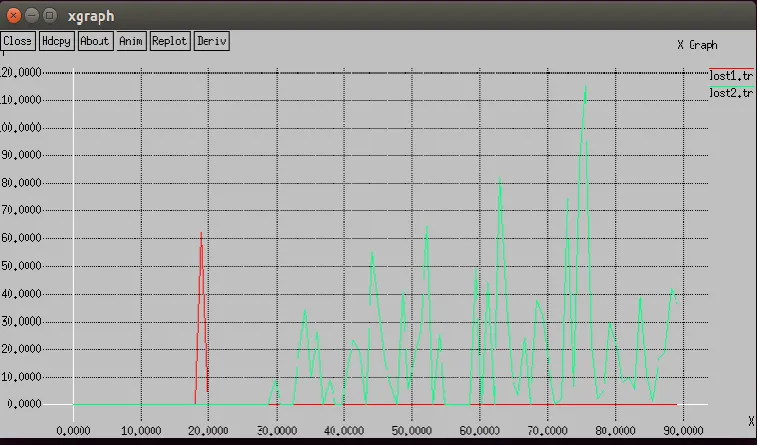
4.2.2 Packet Loss: If the packet keeps on dropping then it tends to inefficient results and the performance graphs are very low. Formula is:
Packet Loss [%] = (dropped Packets/ (total packets))*100)
Figure 1.3: X-graph showing Delay in packets reaching the Destination node
In Figure 1.4 the red curve shows result for communication through RSUs and the green curve shows result for communication through nodes. The number of packet loss is the successful packets delivered to the number sent packets. The packet loss is there when the reply to route discovery is not able to find a reliable path and delay increases to find the appropriate path which tends to the packet loss in case of source sends packet via nearby nodes. In case of RSU communication the packet loss is very less the reason being no need to find alternate path.
Figure 1.4: X-graph showing Packet loss during the communication
4.2.3 Throughput: The throughput is defined as the total amount of data a receiver receives from the sender divided by the time it takes for the receiver to get the last packet. The throughput is measured in bits per second (bit/s or bps).Formula is as:
Throughput= (number of delivered packet * packet size)/total duration of simulation
ISSN(E): 2277-128X, ISSN(P): 2277-6451, pp. 121-128
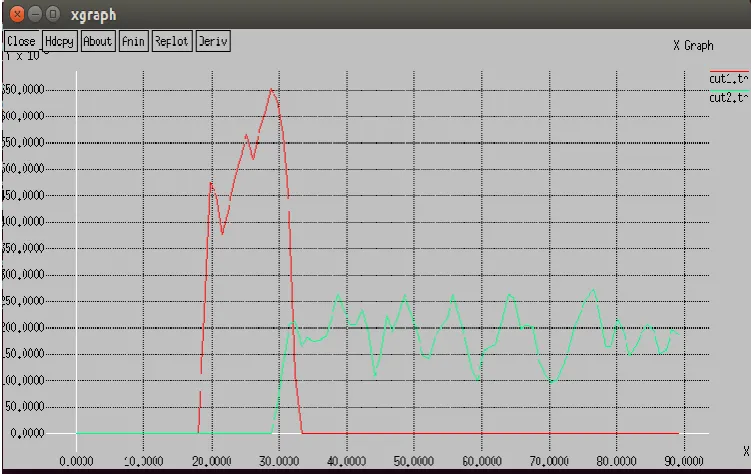
Figure 1.5: X-graph showing the Throughput achieved during the Communication
When the delay and packet loss factor in case of red curve i.e. RSU communication is less, this led to increase in the throughput in communication. Whereas when the communication is taking place via the nearby nodes or by following traditional AODV then the throughput id found to be decreased to more delay and packet loss. The RSU deployment hence proved be a good solution when there is need for enhancement in the throughput and decrease the delay and packet loss.
V. CONCLUSION &FUTURE SCOPE
Because of the high mobility of nodes and rapid changes of topology, designing an efficient routing protocol that can deliver a packet in a minimum period of time with few dropped packets is considered to be a critical challenge in VANET. I-AODV is infrastructure based Ad Hoc On Demand Distance vector routing protocol which utilizes Road Side units for communication between the mobile nodes (Vehicles) and communicating among themselves. RSU’s introduction in the architecture solves the purpose of reliable and efficient routing along with better results than the traditional Ad Hoc On Demand Distance Vector protocol. In traditional approach the Mobile nodes have direct communication with each other or V2V communication but in case VANET possessing high mobilit y pattern if any vehicle moves out of the path set for communication then other vehicles becomes out of range for communication whereas adds in to delay and packet drops. The Future scope of VANET is improving the delay, throughput and packet loss if the RSU’s fail using multicasting algorithm.
REFERENCES
[1] J. Bernsen and D. Manivannan, “Greedy Routing Protocols for Vehicular Ad Hoc Networks”, Wireless Communications and Mobile Computing Conference IWCMC 08, vol. 632, no. 637, pp. 6-8, Aug.2008.
[2] Aki Anttila, “Multicast routing with AODV Routing Protocol”, J. of Computation In Biosciences and
Engineering, Volume 1/ Issue 3, ISSN: 2348-7321,2010.
[3] Boazhu Li, Yeu Lieu and Guoxin Chu, ”Improved AODV Routing for Vehicular Ad-hoc networks”, 3rd
International Conference on Advanced Computer Theory and Engineering(ICACTE),2010.
[4] J. Luo, X. Gu, T. Zhao and W.Yan, “A Mobile Infrastructure Based VANET Routing Protocol in the Urban
Environment”, CMC'10 Proceedings of the 2010 International Conference on Communications and Mobile Computing, pp. 432-437, 2010.
[5] K.Sivakumar, G.A.Preethi and C.Chandrasekar, “Performance Inquiry of AODV, DSDV and DSR Based On
VANET Environment”, Journal of computation in Bio Science and Engineering, 2010.
[6] B. Ding, Z. Chen, Y. Wang and H. Yu, “An Improved AODV Routing Protocol for VANETs”, 2011
International Conference on Wireless Communications and Signal Processing (WCSP), pp. 1–5, Nov. 2011.
[7] C. Lochert, M. Mauve, H. Fubler and H. Hartenstein, “Geographic routing in city scenarios”, ACM
ISSN(E): 2277-128X, ISSN(P): 2277-6451, pp. 121-128
[8] H. Saleet, R. Langar, K. Naik, R. Boutaba, A. Nayak and N.Goel Intersection-Based Geographical Routing Protocol for VANETs: A Proposal and Analysis”, IEEE transactions on vehicular technology, vol. 60, no. 9, pp. 4560–4574, Nov. 2011.
[9] C. Campolo,H.A.Cozzetti, A.Molinaro, R.Scopigno, “Augmenting Vehicle-to-Roadside connectivity in
multi-channel vehicular Ad Hoc Networks”, Journal of Network and Computer Applications,pp.1275–1286,2013.
[10] Faisal Iqbal, Mohammad Inayatullah Khan Babar, Mohammad Haseeb Zafar and Megat Farez Zuhairi,
“I-AODV: Infrastructure Based Ad Hoc On Demand Distance Vector Routing Protocol for Vehicluar Ad-Hoc Networks”, Proc. of the IEEE International Conference on Smart Instrumentation, Measurement and Applications (ICSIMA), Kuala Lumpur, Malaysia,26-27 November 2013.
[11] Dharmendra Sutariya and Dr Shrikant Pradhan, ”An Improved AODV Routing protocol for VANET in City Scenarios”,International Conference on Electronic Systems, Signal Processing and Computing Technologies,2014.