SPECTROSCOPIC, THEORETICAL AND BIOLOGICAL
STUDIES OF BINUCLEAR Mn(II), Ni(II), Cu(II) AND Cd(II)
COMPLEXES WITH POLYDENTATE LIGAND DERIVED FROM
DEHYDROACETIC ACID AND DIETHYLENETRIAMINE
Mahmoud N. Al-Jibouri,
[a]*Taghreed M. Musa
[a]and Omar Hamad Al-Obaidi
[b]Keywords: binuclear complexes, dehydroacetic acid, biological activity; 3,3'-[iminobis(ethane-2,1-diylnitrilo-(1E)-eth-1-yl-1-ylidene)]-bis(4-hydroxy-6-methyl-2H-pyran-2-one)]
A series of binuclear acyclic polydentate complexes of Mn(II), Ni(II), Cu(II) and Cd(II) ions with a ligand derived from the condensation of dehydroacetic acid and diethylenetriamine (3,3'-[iminobis(ethane-2,1-diylnitrilo-(1E)-eth-1-yl-1-ylidene)]bis(4-hydroxy-6-methyl-2H-pyran-2-one)]), [Mn2LCl2(H2O4)] and [M2LCl2], M=Ni, Cd and Cu(II), have been prepared and characterized by1H and 13C NMR, FT-IR
and UV-Visible spectroscopy and micro-elemental analysis, as well as with the measurement of the magnetic moments of solid complexes and molar conductivity in DMSO solution. The new acyclic poly dentate ligand 3,3'-[iminobis(ethane-2,1-diylnitrilo-(1E)-eth-1-yl-1-ylidene)]bis(4-hydroxy-6-methyl-2H-pyran-2-one)] are identified on the basis of (CHN) elemental analysis, 1H, 13C NMR, as well as FT-
IR and UV-Visible spectroscopy. The antimicrobial activity of the free ligand and its Mn(II), Ni(II), Cu(II) and Cd(II) complexes were tested against Staphylococcus aureus and Escherichia coli and fungicidal activity against Aspergillus Niger and Candida albicans. The minimum inhibitory concentration (MIC) method revealed that all metal complexes showed enhanced activity toward the selected micro-organisms compared with the free ligand H2L and Amoxicillin. The octahedral geometry is proposed for Mn(II) complex, square planar for Ni(II) and
Cu(II) complexes and tetrahedral symmetry is suggested for Cd(II) complex.
* Corresponding Authors
E-Mail: [email protected]
[a] Chemistry Department, College of Science, Al-Mustansirya University
[b] Chemistry Department,College of Science for Women,Al-Anbar University
Introduction
The binuclear metal complexes containing heterocyclic rings are widely used as antibiotics, antifungal agents and semiconductor sensors.1-4 Development of new microbicides including fungicides has increasing importance in modern medicinal chemistry5 because appearance of large number of provoking factors that depress or destroy the immune system such as chemotherapy of cancer, using drugs to avoid organ rejection in transplanted patients and AIDS.6
3-Acetyl-6-methyl-2H-pyran-2,4(3H)-dione (1) (dehydro-acetic acid or DHA) is a widely used compound usually obtained through the condensation of ethyl acetate.7 It has been modest antifungal properties.8 Dehydroacetic acid is an excellent chelating agent and its various derivatives including theirs metal complexes are promising fungicides, bactericides, herbicides and insecticides.10-11 Dehydroacetic acid is also a versatile starting material for the synthesis of a wide variety of heterocyclic ring systems and other organic compounds.12
Recent studies related to coordination chemistry of (3,3'- [iminobis(ethane-2,1-diylnitrilo-(1E)-eth-1-yl-1-ylidene)]-bis(4-hydroxy-6-methyl-2H-pyran-2-one by Al-Obaidi13 motivated us to prepare and study some new binuclear metal complexes with different stoichiometry.
Experimental
Physical measurements
Electronic spectra of the new ligand and its metal complexes were recorded in the region 800-200 nm on a Shimadzu 670 spectrophotometer. IR-spectra were recorded on PC Shimadzu FT-IR spectrophotometer in KBr in the range of 400 - 4000 cm-1. The 1H and 13C NMR spectra of the ligand were recorded in DMSO-d6 on a 300MHZ Bruker spectrometer. The effective magnetic moment measurements of the solid complexes were carried out on a Magnet Balance MG. The molar conductivity of metal complexes in DMSO solution was measured on a HPG G-3001 digital conductivity meter. The carbon, hydrogen and nitrogen analysis of ligand and its metal complexes were done on Carlo Elba 1108 instrument, the metal content in the complexes were measured on a Shimadzu 670 spectrophotometer by using standard addition method.
Calculation method
The quantum chemical calculations were made with using Hyper Chem-8 program.14
Reagents and solvents
Synthesis of ligand 3,3'-[iminobis(ethane-2,1-diylnitrilo-(1E)-eth-1-yl-1-ylidene)]bis(4-hydroxy-6-methyl-2H-pyran-2-one)] (H2L)
The ligand (H2L) was prepared by refluxing (2 g, 1.1 mol) of dehydroacetic acid in 30 ml absolute ethanol with (0.613 g, 5.91 moles) of diethylenetriamine for about 9 h on water bath. The polydentate acyclic ligand (H2L) formed is deposited upon cooling the mixture to room temperature overnight. (Scheme 1).
.
O OH
O C CH3
O 2
+
H2N N H
NH2
N N H
N
O OH
O C
O OH C
O
H3C H3C CH3
CH3 H3C
Scheme 1. Synthesis of Ligand H2L
Synthesis of metal complexes
2 mmol of CuCl2. 2H2O, MnCl2.4H2O, NiCl2.6H2O and CdCl2 in 20 mL methanol was added to 0.403g, (1 mmol) of H2L ligand dissolved in methanol containing KOH (1 %, w/v). The resulting mixture was refluxed under nitrogen atmosphere until the complex precipitated (ca. 3 h) then the solution was cooled to room temperature, the precipitate was filtered off, washed several times with 15 ml of diethyl ether and dried under vacuum to afford Mn2LCl2.4H2O and M2LCl2 (M=Cu, Ni and Cd) complexes in 51-65 % yield.
H2L + MnCl2.4H2O= Mn2LCl2.4H2O
H2L +MCl2.xH2O = M2LCl2 + xH2O
M=Cu(II), x=2, Cd(II), x=0 and Ni(II), x=6.
Anti-bacterial Activity
The in-vitro biological activity of the investigated free ligand H2L and its metal complexes were tested against the bacteria Escherichia coli and Staphylococcus aureus by disc diffusion method using nutrient agar as medium and streptomycin as control. The antifungal activities of the compounds were also tested by the well diffusion method against the fungi Aspergillus Niger and Candida albicans, on potato dextrose agar as the medium and ketaconazole as control. Each compound was dissolved in DMSO and solutions of different concentrations (25, 50 and 100 ppm) were prepared separately. In a typical procedure, a well was made on agar medium inoculated with microorganism. The well was filled with the test solution using a micropipette and the plate was incubated 24 h for bacteria at 37 oC and 72 h for fungi at 30 oC. During this period, the test solutions were diffused into the gel, the growth of the inoculated microorganism was affected, and the inhibition zone was developed. All determinations were performed three times.
The bacteria subcultures, Staphylococcus aureus and
Escherichia coli were used for antibacterial test, whereas
Aspergillus flavus and Candida albicans were used for antifungal test using the modified Kirby-Bayer disc diffusion method.11 Briefly, 100 ml of the tested bacteria/
fungi were grown in 10 ml of breath media until they reached 100 cells ml-1 for bacteria and 110 cells ml-1 for fungi. 100 ml of microbial suspension was spread on the agar plate corresponding to the broth in which they were maintained.
Result and Discussion
The new acyclic Schiff base [H2L] ligand derived from condensation of one mole diethylenetriamine with two moles of dehydroacetic acid behaves as tetradentate dibasic chelating agent towards the studied metal(II) ions. The stoichiometry of the complexes was confirmed by their elemental analysis. (Table 2). All the complexes were sparingly soluble in common organic solvents but completely soluble in DMF, DMSO, and acetonitrile. The analytical data (Table 1) indicate that the complexes are binuclear. The molar conductance (Table 3) values measured in DMF solution (1x10⁻³ mol dm-3) fall in the range 9.0-22 ohm-1 cm2 mol-1. These observed values of the molar conductance agree well within the expected values for non-electrolytes.15
1H and 13C NMR spectra
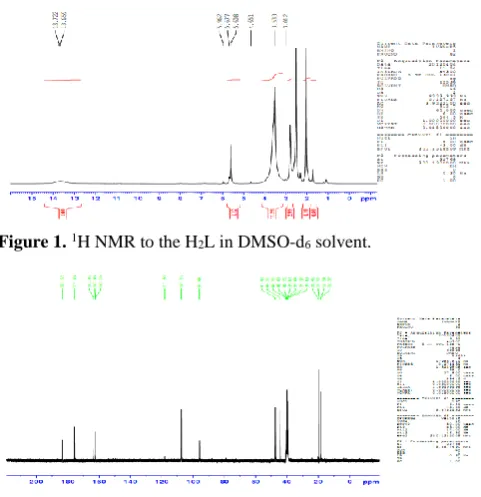
The 1H NMR spectra of free ligand in DMSO-d
6 shows six signals for the ligand in the regions 13.6-13.7, 5.96-5.60, 4.65 and 3.53- 3.10 ppm which merged with each other except high deshielded –OH proton of pyranone-ring14 (Figure 1).
Figure 1. 1H NMR to the H
2L in DMSO-d6 solvent.
Figure 2.13C NMR to the H
2L in DMSO-d6 solvent
Table 1. Analytical data for ligand and its metal complexes
aAnalysis of metal content were done on the basis of FAAS
assigned (Me-C6 group-107.55 ppm, Me-C6 (ring)-163.50 ppm, C5H(ring)-183.5 ppm, C4(OH)(ring)-96.9 ppm, C5CMeN(ring)-162.4 ppm, C6=O(ring)-20.45 ppm,
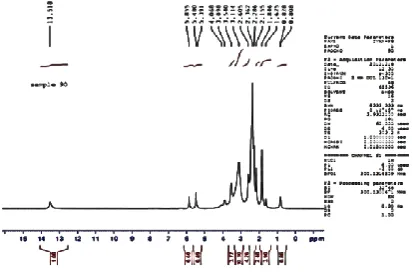
C(CH3)=N-175.8 ppm and CH3C=N-19.57 ppm, and methyl or methylene groups respectively.29 The residual signals belong to the diethylenetriamine link and to the tautomer forms of the pyranone part.(Figure 2).The 1H NMR spectra of Cd(II) complexes in DMSO-d6 solution can be seen in Figure 3). The changes of 1H signals belong to the Schiff base ligand reveals the coordination of nitrogen –C=N- and –OH groups with the metal ions.15,29
Figure 3. 1H NMR of the [Cd
2LCl2] in DMSO-d6 solvent.
Infrared Spectra
The FT-IR spectrum of the free ligand (H2L) in KBr disk displays broad and strong absorptions in the regions 3400 cm-1 and 1695-1655cm-1 that could be assigned to -OH and C=O bands located on the pyrane ring.13,16 The medium intensity absorption band at 3571-3357 cm-1may be assigned to υ(NH) stretching of diethylenetriamine moiety. The IR spectra of all metal complexes show bands in the regions 3160-3550, 1655-1688 and 1522-1560 cm-1 that are assignable to υ
NH, υC=O and υC=N bands, respectively. These band positions confirm the coordination of bivalent metal ions to C=N and deprotonated C-O groups active sites. Moreover, the far infrared spectra of all metal complexes show weak
absorption bands in the range 510-422 and 468-414 cm-1 which may be confirmed as υM-N and υM-O bands. The Mn(II) complexes show broad bands at 3650 cm-1 and strong bands at 1590 cm-1 that related to coordinated water molecules. The bands at 1581, 1431, 1259 cm-1 may be assigned to bending of NH, and asymmetrical vibration modes of C=C and C-N stretching, respectively. This confirms the condensation of carbonyl group of dehydroacetic acid with amino groups of diethylentriamine.11,13 The bands around 3400 cm-1 and 1656cm-1 can be assigned to υ
OH and υC=N stretchings.17 The band at 1695cm-1 can be attributed to the υ
C=O of the pyranone ring. The NH bands are probably overlapped by the OH bands and did not appear for the free NH2 group bands of diethylenetriamine.16-18 The Cd(II) complex shows weak bands in the far infrared spectra between 336 and 370 cm-1 which probably belong to Cd-Cl bonds.
Electronic spectra and magnetic properties
The free ligand (H2L) spectrum in methanol exhibits three distinct absorptions around 42735, 37878 and 31847 cm-1 which are assigned to →* of benzenoid ring and
E1, E2 and n→* transitions of C=N, and C=O chromophores.18 The diamagnetic properties of Ni(II) reveals the square planar symmetry of low spin d8 state, and agree well with the high energy absorptions in the region 23255 – 25316 cm-1 of 1A
1g 1B1g and 1A1g 1B
2g transitions, respectively.19 However, the diamagnetic properties of binuclear copper(II) complex indicate the spin–spin coupling of Cu-Cu form.17 The weak intensity peak of copper(II) complex in DMF in the region 19500 cm-1 with a shoulder on the low energy side at 15500 cm-1 may confirms the transitions of distorted octahedral, with LFSE=17 500cm-1.19-20 The pale pink solution of manganese(II) complex in DMF displays weak intensity peak at 22333 cm-1 which may be assigned to 6A
1g 4T1g and other in the UV region 33421 cm-1 that are entirely related to LMCT transitions. The magnetic moment obtained (5.30 B.M.) was within the range expected for magnetically high spin Mn(II) complex with octahedral symmetry.21-22
Composition Calculated (Found) Colour Molecular weight Formula M% Cl% H% N% C% - - 6.20 (6.25) 11.91 (10.42) 59.55 (59.54) Off white 403 H2L, C20H25N3O6
19.91 (18.52) 12..05 (11.88) 4.24 (3.01) 8.14 (7.20) 40.72 (39.55) Brown 589.4 [Ni2LCl2]
21.21 (20.88) 11.85 10.98 4.17 (4.66) 8.01 (7.96) 40.06 (39.09) Green 599.1 [Cu2LCl2]
16.80 (15.89) 10.86 (9.97) 5.05 (4.88) 7.34 (6.61) 36.70 (35.77) Brown 653.8 [Mn2LCl2.4H2O]
Table 2. IR spectral data of the free ligand and its metal complexes
sh=shoulder, br=broad. s=strong, m=medium,vw = very weak , w=weak and a,b=absorption of O-H for coordinated H2O.
Table 3. UV-Vis spectra data, magnetic moments and molar conductance results of the prepared complexes.
a=molar conductance in DMF solutions, INCT-intraligand field
The metal (II) complexes in DMF solutions showed nonelectrolyte properties with 15-30 ohm-1 cm2 mol-1 conductivity valuesindicating that there are no chloride ions in the outer sphere of metal complexes.15 The cadmium(II) complex in DMF solution exhibits two sharp peak in the region 34300-29800 cm-1 that belong to ligand to metal charge transfer and 𝜋→𝜋* transitions, respectively.
Theoretical Study
The optimized geometry of manganese-complex and some selected bond lengths and angles can be seen in Fig. 4 and Table 4 respectively.
The values of the bond lengths and angles are quite similar to the experimental results of analogous compounds.23-24
Figure 4. The geometry of Mn(II) complex optimized with Hyperchem MP3 semi-empirical method using Hyperchem-8 program.
υM-N, υM-O, υM-Cl υAr-H, υCH2CH2
δOH, δNH, υC-N υOH, υNH
υC=O, C=N Compound
- 2995-29249(m) 1581
1509, 1259 3400(br)
3571 1695(s),
1656, 1595 H2L
510(m), 440, 330(w) 2988,
3044(w) 1433,
1200, 1207 3160(m)
1688, 1522(s) [Ni2LCl2]
468, 422, 310(w) 3030(w)
2804 1450,
1188, 1233(m) 3419( br)
1680 1537, [Cu2LCl2]
522, 414(w), 280-333 2890,
3060(w) 1522,
1388, 1188(m)
a3550(br) a3510 b1590
1670(s), 1505(s) [Mn2LCl2.4H2O]
422, 414, 336-370(w) 3080(w),
2966(m) 1544(s)
3350(m) 1669-1655
1560(s) [Cd2LCl2]
a, S cm2 mol-1 µ, BM
Geometry Assignment
Absorption bands, υ (cm-1) Compound
- -
- INCT
→*
n→𝜋* 42735
37878 31847 H2L
9 0
square planar
1A
1g 1B1g 1A
1g 1B2g
23255 25316 [Ni2LCl2]
18 1.2
square planar
2B
1g2B2g 2B
1g2Eg
19500 15500 [Cu2LCl2]
11 5.43
octahedral LMCT
6A
1g 4T1g
33421 27567 [Mn2LCl2.4H2O]
22 0
tetrahedral LMCT
→*
Table 4. Structural parameters, bond lengths (Å) and angles (º) of the [Mn2L2] complex.
Biological Study
The inhibition zone was measured by the disc method,13,25 the diameters of the inhibition zone were measured in millimeters. Standard disc of Amoxycilline
(antibacterial agent) and Ketoconazole (antifungal agent) were used as controls for antimicrobial activity. However, the filter discs impregnated with 10 ml of (DMSO solvent + distilled water) were used as a negative control. The used agar (Mueller-Hinton) was rigorously tested for composition and pH.
where
A= area of inhibition sample plate.
B= area of inhibition in the DMSO (control).
C= area of inhibition in the standard plate.
The effect of free ligand H2L and it complexes on gram-negative and gram-positive bacteria and fungi were compared and the results are given in Table 5.
The ligand and its metal complexes were screened for their antibacterial and fungal activities at the same concentration and conditions.
Bond lengths (Å) Bond angles(º) Bond angles(º)
N(1)-C(2) 1.4700 C(20)-C(27)-H(50) 109.4993 C(16)-C(28)-H(53) 109.4999
N(1)-C(16) 1.2600 C(20)-C(27)-H(51) 109.4416 C(16)-C(28)-H(54) 109.4419
N(1)-Mn(29) 1.8460 C(20)-C(27)-H(52) 109.4617 C(16)-C(28)-H(55) 109.4618
C(2)-C(3) 1.5230 H(50)-C(27)-H(51) 109.4419 H(53)-C(28)-H(54) 109.4419
C(2)-H(35) 1.1130 H(50)-C(27)-H(52) 109.4620 H(53)-C(28)-H(55) 109.4618
C(2)-H(36) 1.1130 H(51)-C(27)-H(52) 109.5209 N(1)-Mn(29)-O(15) 72.8134
C(3)-N(4) 1.4380 C(20)-C(21)-C(22) 94.9350 N(1)-Mn(29)-Cl(32) 109.4999
C(3)-H(37) 1.1130 C(20)-C(21)-H(46) 132.5325 N(1)-Mn(29)-Cl(33) 90.0000
C(3)-H(38) 1.1130 C(22)-C(21)-H(46) 132.5324 O(15)-Mn(29)-Cl(32) 109.5001
N(4)-C(5) 1.7721 C(17)-C(22)-C(21) 115.0000 O(15)-Mn(29)-Cl(33) 90.0001
N(4)-H(31) 1.0200 C(17)-C(22)-O(23) 122.5000 Cl(32)-Mn(29)-Cl(33) 155.4959
C(5)-C(6) 1.5230 O(19)-C(18)-O(25) 130.3984 N(1)-C(16)-C(12) 115.0997
N(7)-Mn(30) 1.8460 C(18)-O(25)-Mn(30) 109.5005 N(1)-C(16)-C(28) 122.4499
C(8)-C(9) 1.3491 C(24)-C(34)-H(56) 109.5006 C(12)-C(16)-C(28) 122.4504
C(13)-C(8) 1.3510 C(24)-C(34)-H(57) 109.4422 C(2)-N(1)-C(16) 108.0001
Mn(29)-O(15) 1.7097 C(24)-C(34)-H(58) 109.4617 C(2)-N(1)-Mn(29) 119.9999
C(16)-C(28) 1.4970 H(56)-C(34)-H(57) 109.4416 C(16)-N(1)-Mn(29) 120.0000
C(17)-C(18) 1.5090 H(56)-C(34)-H(58) 109.4617 C(6)-C(5)-H(39) 113.5837
O(19)-C(20) 1.4100 H(57)-C(34)-H(58) 109.5195 C(6)-C(5)-H(40) 119.2535
C(20)-C(21) 1.6036 C(18)-C(17)-C(22) 109.4698 H(39)-C(5)-H(40) 99.9980
C(20)-C(27) 1.4970 C(18)-C(17)-C(24) 154.3598 C(3)-N(4)-C(5) 127.8364
C(21)-C(22) 1.3510 C(18)-C(17)-H(45) 65.2800 C(3)-N(4)-H(31) 116.0821
C(21)-H(46) 1.1000 C(22)-C(17)-C(24) 96.1702 C(5)-N(4)-H(31) 116.0815
C(22)-O(23) 1.2080 C(22)-C(17)-H(45) 174.7458 C(2)-C(3)-N(4) 109.4697
C(24)-C(34) 1.4970 C(24)-C(17)-H(45) 89.0805 C(2)-C(3)-H(37) 109.4491
Mn(30)-O(25) 1.8100 N(7)-Mn(30)-O(25) 109.4997 C(2)-C(3)-H(38) 109.4791
Cl(32)-Mn(29) 2.1600 N(7)-Mn(30)-Cl(32) 90.0000 N(4)-C(3)-H(37) 109.4491
Cl(33)-Mn(29) 2.1600 N(7)-Mn(30)-Cl(33) 33.3581 N(4)-C(3)-H(38) 109.4798
Cl(32)-Mn(30) 2.1600 O(25)-Mn(30)-Cl(32) 109.4999 H(37)-C(3)-H(38) 109.5005
Cl(33)-Mn(30) 4.3970 O(25)-Mn(30)-Cl(33) 89.7988 Mn(29)-Cl(33)-Mn(30) 39.4475
N(1)-Mn(29) 1.8460 Cl(32)-Mn(30)-Cl(33) 71.0216 Mn(29)-Cl(32)-Mn(30) 90.0002
N(4)-C(5) 1.7721 N(7)-C(24)-C(17) 67.6349 C(9)-C(26)-H(47) 109.5003
N(4)-H(31) 1.0200 N(7)-C(24)-C(34) 146.1829 C(9)-C(26)-H(48) 109.4421
C(5)-H(39) 1.1130 C(17)-C(24)-C(34) 146.1822 C(9)-C(26)-H(49) 109.4620
C(5)-H(40) 1.1130 C(6)-N(7)-C(24) 107.9999 H(47)-C(26)-H(48) 109.4418
C(6)-N(7) 1.4700 C(6)-N(7)-Mn(30) 120.0001 H(47)-C(26)-H(49) 109.4614
N(7)-Mn(30) 1.8460 C(24)-N(7)-Mn(30) 120.0003 H(48)-C(26)-H(49) 109.5197
Mn(29)-O(15) 1.7097 C(5)-C(6)-N(7) 110.7399 C(11)-O(15)-Mn(29) 91.9842
Mn(30)-O(25) 1.8100 C(5)-C(6)-H(41) 109.1315 C(9)-O(10)-C(11) 120.0000
Cl(32)-Mn(29) 2.1600 N(4)-C(5)-C(6) 92.1467 C(8)-C(9)-O(10) 123.3719
Cl(33)-Mn(29) 2.1600 N(4)-C(5)-H(39) 113.5836 C(8)-C(9)-C(26) 118.3141
Cl(32)-Mn(30) 2.1600 N(4)-C(5)-H(40) 119.2539 O(10)-C(9)-C(26) 118.314
Cl(33)-Mn(30) 4.3970
(%) 100 A B
RI
C B
Table 5. Antibacterial activity of ligand and its metal complexes
Compound Inhibition, mm
Escherichia Coli Staphylococcus aurea Fungi
G- G+ A. flavus C. albicans
H2L 27.22+0.22 33.7+0.03 35.3+0.31 18.0+0.1
Mn(II) 22.01+0.55 34.51+0.11 20.91+0.09 12.11+0.1
Ni(II) 19.41+0.29 12.95+0.84 34.05+0.10 17.0+0.2
Cu(II) 34.43+0.16 39.51+0.11 42.71+0.23 20.0+0.33
Cd(II) 11+1.2 19.51+0.21 12.71+0.93 15.0+0.77
Control DMSO
Reagent Antibacterial Antifungal
G+ G- A. flavus. C. albicans
Amoxycilline 18 +0.2 22+0.2 - -
Ketoconazole - - 31.89+0.2 32.5+0.2
G+, G- = gram Positive and gram negative bacteria
The ligand and all its metal complexes exhibit inhibition zone against E. Coli bacteria in the range 19-34 mm, supporting their activity toward gram-negative bacteria against Amoxycilline control.13,27 It is found obviously (Table 5) that Cu(II) complex proved to be a potentially better antifungal agent against A. Flavus than the Ketoconazol (standard) and this complex has improved antimicrobial activity than the free ligand. It cannot be explained on the basis of chelation theory26,28 but would rather with the releasing of Cu(II) ion form the complex. Although the decrease in the polarizing ability of the metal could enhance the lipophilicity of the complexes, which would lead to a breakdown of the permeability of the cells, resulting in interference in normal cell processes,27-29 but only the Cu(II) complex showed higher value of inhibition against all types of microorganisms than the free eligand comparing it with nickel, manganese(II) or cadmium(II) chelates.
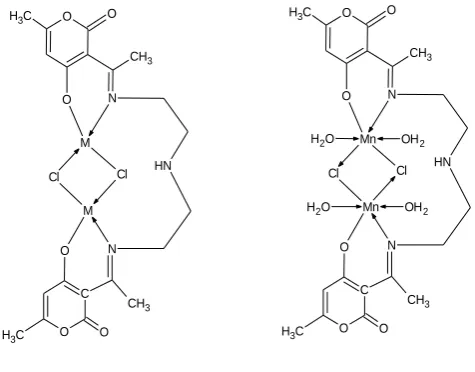
Figure 5. Proposed structure of metal(II) complexes.
Conclusion
According to the results obtained from elemental analyses, spectroscopic studies and magnetic moment measurements, square planar central atom geometry was proposed for Ni and Cu(II) complexes, while the Mn(II) complex was found to be octahedral, and the Cd(II) complex was found to be tetrahedral. Theoretical study for the Mn(II) complex supported the expected structure derived foerm spectroscopic data. Except cadmium complex, the all studied compounds have antimicrobial activity toward gram negative and gram positive bacteria and fungi.
References
1Constable, E. C., Coordination Chemistry of Macrocyclic Compounds, Oxford University Press, Oxford, 1999.
2Singh, D. P. Kumar, Malik V. R. and Tyagi, P., Transition Met.Chem., 2007, 32, 1051-55.
3Mane, P. S., Salunke, S,. M., More, B. S., E-J. Chem., 2011, 8(1), 245-252.
4Munde, A. S., Jagdale, A. N., Jadhav, S. M. and Chondhaker, T.
K., J.Korean Chem. Soc., 2004, 53, 407.
5Munde, A. S., Jagdale, A. N., Jadhav, S. M. and Chandhekar,
T. K., J. Serb. Chem. Soc., 2010, 75, 349.
6Zucolotto, M., Danicl, C. J., Javior, A. E. and Castellana, E. E., Inorg. Chim. Acta, 2000, 328, 45-50.
7Sakurai, H., Inohara, T., Adachi, Y., Kawabe, K., Yasui, H., Bioorg. Med. Chem., 2004, 14(5), 1093-1096.
8Levai, A. Jeko, J., Monatsh.Chem., 2006, 137, 339-346.
9Mane, P. S., Shirodkar, S. G., Arbad, B. R., Chondhekar, T. K., Indian J. Chem., 2001, 40, 648-655.
10Rao, P. V., Narasaiah, A. V., IndianJ. Chem., 2003, 42A, 896. 11Raman, N.,Johnson, S. R and Sukthicevel, A., J. Coord.
Chem., 2009, 62, 691.
12Vandpitte J, , Basic laboratory procedures in clinical
bacteriology,WHO, Geneva, 1991, 78-110. Cl
Mn
C
O O
C
H3 O
CH3
N
O O
C H3
N CH3
O
Mn
Cl
OH2
OH2 H2O
H2O
N H Cl
M
C
O O
C
H3 O
CH3
N
O O
C H3
N CH3
O
M
Cl HN
13Al-Obaidi, O. H., J. Chem., Biol. Phys. Sci., 2014, 4(1), 31-37.
14Chojnacki, H. and Pruchnik, F., Int. J. Mol. Sci., 2001, 2, 44.
15Geary W. J., Coord. Chem. Rev., 1971, 7(1), 81-122.
16Silverstein, R. M., Bassler, G. C. and Morrill, T. C., Spectrometric methods for Identification of organic compounds, 4th Ed., Wiley, London, 1986
17Raman, N.,Johnson, S. R and Sukthicevel, A., J. Coord. Chem., 2009, 62, 691.
18Nakamato, K., Infrared and Raman spectra of Inorganic and coordination Compounds, 4th ed., Wiley, New York, 1986 19Dyer, J. R., Application of absorption spectroscopy of organic
compounds, Prentice Hall., Eaglewood Cliffs, N.J., 1965,
20Lever, A. B., Inorganic Electronic Spectroscopy, 2nd,
Elsevier.,1984.
21Sutton, D., Electronic Spectra of Transition Metal Complexes,
McGraw Hill., London, 1968,
22Cotton, F. A., Wilkinson, G., Murillo, C. A., Bochmann, M., Advanced Inorganic Chemistry, 6th Edition, John Wiley and Sons., 1999.
23Satyanarayane D. N., Electronic Absorption spectroscopy and Related Techniques, Universities press, Hyderabad, 2001.
24Manku, G. S., Theoretical Principles of Inorganic Chemistry,
McGraw-Hill Offices, 2004, 21st, 449-500.
25Stewart, J. P., J. Comput. Chem., 1999, 10(2), 209-220.
26Chandra, S., Sharma, D., Transit. Met. Chem., 2002, 27,
732-735.
27Negam, N. A., Said, M. M., Morsy, S. M. I., J. Surfactants Detergents, 2008, 13(4), 521-528.
28Perrin, D. D., Armarego, W. L. F., Purification of laboratory chemicals, 3rd Ed., Pergamon Press, Oxford, UK, 1988.
29Ullah, H., Wattoo, F.-H., Wattoo, M. H. S., Gulfraz. M.,
Tirmizi, S. A., Ata, S., Wadood, A., Turk. J. Biochem.,
2012; 37(4) ; 386–391.

![Table 4. Structural parameters, bond lengths (Å) and angles (º) of the [Mn2L2] complex](https://thumb-us.123doks.com/thumbv2/123dok_us/7832768.2089476/5.595.45.548.79.593/table-structural-parameters-bond-lengths-a-angles-complex.webp)