ISSN: 2347-7474
International Journal Advances in Social Science and Humanities
Available online at: www.ijassh.com
RESEARCH ARTICLE
Action/Problem-Based Learning in a General Education Art Course
Wu Feng-Chu
1*, Wu, Pei-Fen
1Humanities and Science Education Center Lecturer /National Il an University. 2Department of Information Management, National Changhua University of Education.
Abstract
In a diverse, complex age when information is easy to obtain, using a one-way instillation teaching method no longer motivates students to learn, or to obtain good teaching interactions and effective learning. This is especially true for aesthetic and creative learning, which cultivates diverse abilities by connecting the lesson to the students’ experiences. This study’s methods combine “Action Learning” (AL) with “Problem-Based learning” (PBL) to solve problems, and emphasizes learning-by-doing in a general education arts course. Through an eight-stage plan of action, students form groups and exert their collective creativity to create art. The researcher (teacher) takes on a guiding role by guiding students through collecting information, asking questions, participating in discussions, finding problems, solving the problems, reflecting, and revising until a viable program is created for collaborative practice. With “art representation” as the theme, the class begins with art appreciation and cycles through imitating representational art (AL), representing creative activities (PBL), and representing results (problem solving). Observations of the course, discussions between the students, and the process of art representation, reviews, specific reproduction, and quantitative and qualitative data collected from questionnaires show that students benefit from the course. The course helps the students to develop diverse abilities such as self-learning, communication, cultivation of aesthetics, creative thinking, problem solving, and collaboration, which allows them to gain a deeper understanding and the ability to re-interpret art. Overall, this art course helps students combine knowledge, feelings, and meanings, and become a “whole person,” which is the objective of an arts education.
Keywords: Creative learning, Action/problem-based learning, Art representation, Diverse abilities.
Introduction
Facing the trend of globalization and various complex changes, narrow professional training- a unidirectional way of thinking-and individual learning styles have made it difficult for people to handle the fast-changing, new environment. In recent years, under the wave of “creative economy,” everyone has begun to agree that aestheticism, imagination, and creativity are essential to elevating the competitiveness and victories of a company. Taiwan must leave behind a labor economy focused on equipment manufacturing as soon as possible and learn to grasp a creative economy that emphasizes aesthetics and creativity. In addition, education in the arts should no longer adhere to traditional teaching methods. A general education arts course must consider how to instill new teaching
methods, bring together different fields, develop creative thinking, and increase diverse abilities.
commence collecting and analyzing information, asking questions, presenting and communicating, reflecting critically, and solving the problems to reach the main goal: collaboration. The teacher takes on a guiding role to stimulate learning.
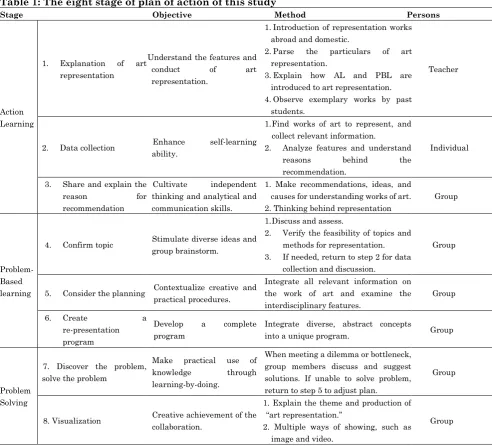
Through an eight-stage action plan, the researcher introduces AL and PBL to a general education arts course that spans three semesters. The class was well received by many students and had a positive outcome each semester. According to the student questionnaires collected at the end of each semester, the students favored “art representation” as a highly beneficial teaching method.
Literature Review
Action/Problem-Based Learning
AL and PBL were both developed to solve practical problems. AL emphasizes “learning-by-doing” and utilizes a chain of learning and reflection. Team members accomplish their objective via group discussions and teamwork [1]. PBL emphasizes the student as the learning subject. The teacher is the guide, leading students to motivate themselves, reflect, communicate, integrate theory and practice through teamwork, and solve problems through collective collaboration [2].
AL and PBL differ from the traditional one-way distillation method, as they belong to the “learning though experience” model [2, 3] which at its core emphasizes the student. Students reflect upon the problem in a clear context and effectively construct self-awareness and meaningfulness. Moreover, through discussion, sharing, collaboration, and support with a peer group, students understand the thoughts and experiences of peers with a different background and can view their own thoughts differently, accommodating diversity to develop new thoughts [3].
Facing the trend of globalization and the various complex changes of modern society, a unidirectional way of thinking can no longer handle the fast-changing, new environment. Communication, collaboration, and problem-solving skills are now the core soft powers society needs. The general education
outline (2007-2010) from the Ministry of Education states that “action and problem-based” learning is a major objective of promoting general education. Cultivating analytic skills, critical thinking, ethical reasoning, effective communication, and practical wisdom lays the foundation for correct actions. By overcoming the barrier between general and professional studies, students obtain the ability to integrate and apply knowledge [4].
Art Representation
To reach an effective aesthetic, general education courses can cultivate a sense of the beautiful through an artistic education or train students in aesthetics through creativity and technology. In our current technology-led society, if a sense of artistic beauty can be elevated and an education in the aesthetics can be conducted alone or in small groups, we can move towards a creative industry with a trend in aesthetics and reach an effective aesthetic in the entire economy. Aesthetics is not merely a personal accomplishment, but it also exists within groups. An education in the aesthetics can not only elevate one’s skills in communication, but also aid one’s entrance to society [5]. Cultivating a sense of beauty is different from receiving an aesthetic education: cultivating a sense of beauty involves channeling the student’s observations and senses towards beauty, while an aesthetic education cultivates the student’s critical and creative skills [6]. An aesthetic education is an art directly developed from the body’s experiences, and a deep understanding of any art requires imagination [7].
words, humans are “representational animals” [8]. From childhood, humans have the innate ability to imitate; artistic imitation is natural to humans. Through imitation, we receive our earliest knowledge and pleasure in an achievement [9]. Representation theory represents classical Western artistic concepts, claims that the origin of all art is imitation, and that reality is what art imitates; art is an objective imitation and representation of reality [10]. Zhu [11] mentioned that art is essentially a form of creation, and the act of creation is self-aware and purposeful. This act must have a basis in nature or objective reality and cannot come out of nothing; however, it must transcend nature and objective reality, not simply follow suit to give a dynamic reflection of reality. However, art has another important property: art is closely related to personal experiences, as Dewey’s “art as experience” states [12]. Experience is the result of the interaction between a person and nature (or environment). The most complete, prominent, and self-contained experiences are the essence of experience, or aesthetic experience [12].
The nature of art is to open man’s knowledge, feelings, and meanings the traits of a whole life and it carries a holistic meaning [10]. In this study, the process of artistic representation begins with art appreciation, and carries out the theme “artistic representation” with personal perceptions, images, feelings, experiences, and knowledge. The imitation of artistic representation (AL), representative creative activities (PBL), and representative results (problem solving) are expected to link to each other.
Methods
Research Methods and Designs
This study’s methods combine AL and PBL. As the main learners, the students create art by working in groups and exerting their collective creativity. The researcher (teacher) takes on a guiding role, leading students to collect information, ask questions, have discussions, find a problem, solve said problem, reflect, and revise until a viable program and collaborative practice is reached. The entire process emphasizes
learning-by-doing, or learning through experience. Besides improving students’ abilities to achieve a deeper understanding of art and to reinterpret, this process can also encourage diverse skills such as self-learning, communication, a cultivation of aesthetics, creative thinking, problem solving, and collaboration. Therefore, the development of this class is the main focus of this study.
Object of Implementation
The objects of this course are the students who have chosen the general education course “The Secret of Art” at National Ilan University. This course is offered to university students and employees of companies attending work-related training. Of the 140 students enrolled on the course, 38 were enrolled in the second semester of the 2011 school year, 56 were enrolled in the first semester of the 2012 school year, and 46 were enrolled in the second semester of the 2012 school year. The aforementioned course material consists of a two-hour class each week for eight weeks, making the total class time 16 hours each semester. This researcher takes on the role of teacher, participating in the planning and design of the course and guiding the students in learning about art representation.
Research Process
characters, and symbols of art and artists is no longer simply a unidirectional appreciation. During the process, students are seen attempting to break through dualistic thinking, from feelings, observations, and analyses to connecting with limited resources and environment through a theme or narrative methods. Through discussions, brainstorming, and
collaboration, artistic works are assimilated into the creativity of the young generation. Two-dimensional works not only become three dimensional, but they also become more dynamic and humorous, and even seem edible. Three-dimensional sculptures come alive and speak with their audience, bringing new life to the artistic work.
Analysis of the Effect
Table 1: The eight stage of plan of action of this study
Stage Objective Method Persons
Action Learning
1. Explanation of art representation
Understand the features and
conduct of art
representation.
1.Introduction of representation works abroad and domestic.
2.Parse the particulars of art representation.
3.Explain how AL and PBL are introduced to art representation. 4.Observe exemplary works by past
students.
Teacher
2. Data collection Enhance self-learning ability.
1.Find works of art to represent, and collect relevant information.
2. Analyze features and understand
reasons behind the
recommendation.
Individual
3. Share and explain the
reason for
recommendation
Cultivate independent thinking and analytical and communication skills.
1. Make recommendations, ideas, and causes for understanding works of art. 2. Thinking behind representation
Group
Problem- Based learning
4. Confirm topic Stimulate diverse ideas and group brainstorm.
1.Discuss and assess.
2. Verify the feasibility of topics and methods for representation. 3. If needed, return to step 2 for data
collection and discussion.
Group
5. Consider the planning Contextualize creative and practical procedures.
Integrate all relevant information on the work of art and examine the interdisciplinary features.
Group
6. Create a
re-presentation program
Develop a complete program
Integrate diverse, abstract concepts
into a unique program. Group
Problem Solving
7. Discover the problem, solve the problem
Make practical use of
knowledge through
learning-by-doing.
When meeting a dilemma or bottleneck, group members discuss and suggest solutions. If unable to solve problem, return to step 5 to adjust plan.
Group
8. Visualization Creative achievement of the collaboration.
1. Explain the theme and production of “art representation.”
2. Multiple ways of showing, such as image and video.
Group
According to questionnaires created by the University (Table 2), the class “The Secret of Art” received marks over 4.60 (out of 5.0) for all aspects of the course, including content, teaching attitude, teaching method, teaching quality, and learning assessment. For each semester, the marks for all aspects were higher than those averaged by the department, school, and university.
Table 2 Comparison of the multi-front score received in learning assessment between “The Secret of Art” and the department, school, and university
Semester conducted Average scores for teaching commentary
School year Semes-
ter Class: Secret of Art” “The department School University
2011 2 4.67 4.10 4.12 4.11
2012 1 4.65 4.35 4.33 4.13
2012 2 4.59 4.37 4.30 4.08
Source: Questionnaires from the Education Development Center of National Ilan University
Table 3: Favorability of the “art representation” unit among students
Semester conducted Course design for art representation
School year Semes- ter
Responses Liked Liked very
much
Total of “liked” and “liked very much”
Ratio
100 2 32 13 15 28 87%
101 1 50 24 17 41 82%
101 2 35 19 13 32 91%
Source:Questionnaires from the Education Development Center of National Ilan University
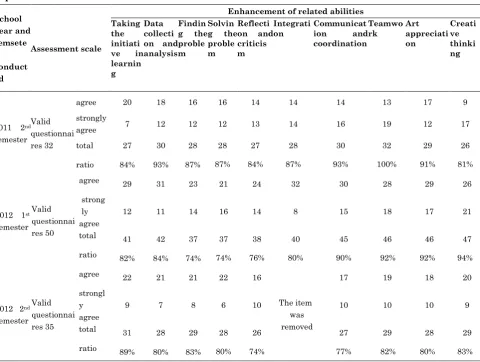
Table 4: Abilities that students believed were improved by AL and PBL in the “art representation” unit
School year and semsete r conduct ed
Assessment scale
Enhancement of related abilities Taking
the initiati ve in learnin g
Data collecti on and analysis
Findin g the proble m
Solvin g the proble m
Reflecti on and criticis m
Integrati on
Communicat ion and coordination
Teamwo rk
Art appreciati on
Creati ve thinki ng
2011 2nd
semester Valid questionnai res 32
agree 20 18 16 16 14 14 14 13 17 9
strongly
agree 7 12 12 12 13 14 16 19 12 17
total 27 30 28 28 27 28 30 32 29 26
ratio 84% 93% 87% 87% 84% 87% 93% 100% 91% 81%
2012 1st
semester Valid questionnai res 50
agree 29 31 23 21 24 32 30 28 29 26
strong ly agree
12 11 14 16 14 8 15 18 17 21
total 41 42 37 37 38 40 45 46 46 47
ratio 82% 84% 74% 74% 76% 80% 90% 92% 92% 94%
2012 2nd
semester Valid questionnai res 35
agree 22 21 21 22 16
The item was removed
17 19 18 20
strongl y agree
9 7 8 6 10 10 10 10 9
total 31 28 29 28 26 27 29 28 29
ratio 89% 80% 83% 80% 74% 77% 82% 80% 83%
Source: Questionnaire designed by the researcher
By observing discussions between the students, and examining the content of the process of art representation, reviews, visualization, and quantitative and qualitative data collected from the questionnaires, data were collected for
generalized with the following statements: art became more interesting, the students gained a deeper understanding of the connotations of art and the thoughts of artists, self-learning was easier to stimulate, the ideological level was expanded, the students’ ability to think about problems was enhanced, new inspiration was gained from the process, interdisciplinary learning stimulated lively thinking and creativity, art and life were connected, collective strength was born from the communication learned from teamwork, observational skills were learned from learning-by-doing, and the ability to solve problems and integrate practices was boosted. Overall, the teaching method in this study not only let students cultivate a diversity of thought through art appreciation, but also extended to real life, showcasing the creativity of the individual. The teaching method also made students think about the relevance between the individual and the group.
Limitations
Even though the scene, student participation, specific creative participation, and assessment have all shown good results, students have rarely experienced AL/PBL in the past, especially in art classes. Therefore, during the course of this study, the teacher and students faced some difficulties and limitations. For example, as the students were unfamiliar with this method of teaching and had little experience of being involved in group discussions and group work, the discussions, program development, and process were often indecisive, wandering, and repeatedly changed, which consumed time and affected the conduct of the main course. Raising questions and reflecting on an arts-related issue was more difficult for students with non-arts backgrounds, and the depth of their reflections and their problem-solving abilities were weaker than those of students with arts backgrounds. Some students, who experienced problems with the production of materials, props, and post-production, created easy-to-make, easy-to-understand projects with simple composition and were unable to fully reflect the artistic content. Moreover, some students felt that this work, while novel, was more complicated, bothersome, and time-consuming than the work required for
their other courses. Students in general education courses come from a variety of departments and year groups; thus, owing to the high level of heterogeneity, communicating, coordinating discussion time outside of class and jointly creating practices was difficult. The above limitations and problems could provide areas for improvement for future classes [13,14].
Conclusion and Suggestion
Arts education in Taiwan is generally focused on teaching drawing techniques and introducing Western art genres. The teaching of creative art is typically regulated to personal learning, and studies introducing AL/PBL to a general education arts course are rare. Facing the trend of creative economy brought about by globalization and an age when information is easy and fast to obtain and the division of labor encourages specialization, aesthetics and creativity are no longer relegated. The student is at the core of the learning process, and diverse skills such as self-learning, communication, problem solving, and integration practice are stimulated by combining the strength of the group. This method meets the goals of education reform and the spirit of learning that all members of modern society should be able to access in line with the latest trends in education.
the importance of art in their own life experiences. Understanding the diverse soft power that general education cultivates aids their future employment and life issues.
Students in a general education course come from different major and year groups, creating a high level of heterogeneity. The teacher must encourage management and interaction within the class and make the students familiar with each other to facilitate their discussions and collaboration. However, as their heterogeneity has a positive effect on the creativity of their work, a future study could explore how they can utilize their advantages for further enhancement.
This study emphasizes introducing “learning-by-doing” to a general education arts course. Through AL, PBL, and problem solving, an eight stage plan is implemented. With “art representation” as the theme,
students are guided through collecting information, asking questions, participating in discussions, finding problems, solving the problems, reflecting, and revising until a viable program is created for collaborative practice. The quantitative and qualitative data showed that students were positively affected by the design of the course. Overall, the course helped students combine their knowledge, feelings, and meanings, and become a “whole person,” which is the objective of an arts education.
Acknowledgement
This study gives special thanks to the National Ilan University students attending the course “The Secret of Art” during the second semester of the 2011 school year and both semesters of the 2012 school year. Without them, this study could not have been completed.
References
1 Huang Jun Ru (2011) How to use
action/problem-based learning in a general education course, Bringing concepts into the classroom-Practical tips for general education
teachers. Taipei: Liwen Wenhua.
2 Guan Chao Ran, Li Meng Zhi (2009) Concepts,
Methods, Practices and Experiences in Problem-based Learning – The New Wave in Medical Education. Taipei: Elsevier, Taiwan.
3 Delisle R translated by Zhou Tian Ci (2003)
How to use problem-based learning in the classroom. Taipei: Psychology.
4 Ministry of Education Advisory Office (2006)
Ministry of Education Outline of Plan for
General Education (First Year/2007-2010)-
Action and Integrating Plan for General Education (General Education Pilot Project
Outline). From
http://hss.edu.tw/upload/user/file/GE/9699gepr oject.pdf
5 Kester G (1997) Learning from Aesthetics, Art
Journal, Spring.
6 Reid, LA (1968) The Need for Aesthetic
Education, Educational Journal, 1(1):29-41
7 Shieh Philip (2008) Aesthetics and Artistic
Education. Da-Yeh Journal of General Education, 2, 145-156.
8 National Taiwan Normal University (2009)
Holistic Education Gallery. From
http://hep.ccic.ntnu.edu.tw/browse2.php?s=9
9 Aristotle, McKeon R (2001) The Basic Works of
Aristotle (Reprint edition), Modern Library.
10 Tsai Shu-Li (2008). A Discussion on the
Essences and Qualities of Art: from the Points of View of Holistic Signification. Holistic Education, 3, 71-96.
11 Zhu Guang Qian (1982) History of Western
Aesthetics (Vol 2). Taipei: Hanjing Wenhua Publications, Ltd.
12 Liu Feng-Jung (2004). An Analysis of
Theoretical Foundation for Research Methods
of Visual Art Production: Qualitative
Perspectives. Research in Arts Education, 8, 73-94.
13 Guan Bing Yin (2006) Action and
Problem-based General Education. Outline of General Education Plan, 2007-2010: 2006 sub-program, Taipei: Ministry of Education Advisory Office.
14 Dewey J (1958) Art as Experience. New York: