International Journal Advances in Social Science and Humanities
Available online at: www.ijassh.com
RESEARCH ARTICLE
Marital Status and Sexuality in Later Life
Hyunsook Kang
1,
Bonnie Ahn
2*1
School of Human Sciences, Stephen F. Austin State University, United States.
2 Departments of Health & Human Sciences, Southeastern Louisiana University.
Abstract
Sexuality is considered an aspect of quality of one’s life course because it is a source of fundamental psychological reinforcement as well as an important factor in one’s self-concept. However, studies regarding sexuality have been mainly focused on young people and young adults while information concerning sexuality in later life has been largely neglected. Although aging tends to bring a decline in sexual activity, it remains important to older persons of all sexual orientations, and while a history of an active sex life is carried into older age for those with partners, access to such partners can prove to be difficult, especially for women. Thus, studies on aging must pay more attention to the significance of sexual intimacy and activity to older persons. This study examines the relationships between older adults’ marital statuses and their sexual life satisfaction. Data from the National Social Life, Health, and Aging Project (NSHAP) survey were used, which sampled persons 57-85 years of age (n=3005). It was hypothesized that married older adults will report a higher score in frequency of sexual activities and sexual life satisfaction than non-married older adults. The current study’s findings build on a convoy model to account for how older adults’ marital statuses and sexual life satisfaction are differentially associated with their aging process. A directive for future research is to examine more diverse variables that can explain the dynamic relationships among older adults’ demographic factors.
Keywords:
Older adults’ martial statues, Sexual life satisfaction, Older adults’ sexuality.
Marital Status and Sexuality in Later Life
Currently, the percentage of older adults that are living alone increases with age. By age 65, almost 50% of women and 25% of men live alone due to divorce, death of a spouse, or lifelong single status, and by age 85, about 80% of women and 43% of men live alone [1]. These statistics have been known to be a crucial factor for predicting the quality of adults’ lives and indicate that a change in marital status in later life resulting in relationship loss may merit needs for additional support like intensifying existing relationships or forming new ones. It is commonly agreed upon that human beings are sexual from the moment of conception until death; Sexuality is a basic, fundamental aspect of human development, personality, and behavior, which can determine one’s feelings of femininity or masculinity, and can influence how a person acts, dresses, speaks, and relates to others [2].
In reviewing the literature on life satisfaction in later life, it is noteworthy that much attention has been focused on mood state, cognitive function, health beliefs, and stress, and researchers have consistently supported the findings that married older adults hold higher life satisfaction, including sexual satisfaction and better health, than unmarried older adults, regardless of whether or not they were divorced, widowed, or never-married. However, sexuality for elderly people, for the most part, has been neglected. Many people seem to consider that with the onset of old age, sexual activity ceases to exist. These stereotypes are inherently wrong because they are based on prejudiced misconceptions and deny individuality.
a difficult topic for researchers to address. Very few studies have been actually carried out due to potential social barriers such as aged subjects’ reticence in divulging information regarding their sexuality. Consequently, much of the information about elderly sexuality that does exist resulted from data collection and analysis that were adjunct to various other interests of researchers.
Hooyman and Kiyak [2] state that in the interaction between the elderly and society, issues of dependency, deprivation, and indifference force the elderly to be devalued, stereotyped, excluded from social opportunities, confronted by role loss and ambiguity, and then must struggle to preserve esteem through youthful self-images. Many elderly conform to these social pressures by negating their sexuality and taking on a non-sexual role, but in light of recent research, the strong correlation between their marital statuses and their sexual lives can provide a better understanding and an avenue to a more meaningful life for them. As a result, aging, changes in marital status, and sexual life satisfaction have become issues of growing popularity and importance, especially as the average life span in developed countries has grown longer and the number of people over 60 years of age has grown appreciably as well.
Given that the majority of older adults may experience changes in marital status, which affects their sexual life satisfaction, it is likely that negative biases and attitudes contribute more to observed changes in sexual behavior [2]. Therefore, in terms of understanding older adults’ marital statuses and their sexual life satisfaction, further investigation is needed before clear statements can be made about the needs and behaviors of the elderly people.
Convoy Model
Kahn and Antonucci [3] developed the basic concept of the convoy model to explain social relationships and social relationships’ longitudinal characteristics. The convoy model moves with the individual through time, social circumstance, and each individual’s ability to cope with life
challenges [3]. The basic tenet of the convoy model is that social relationships are dynamic in nature; in other words, members of a social network change over time [3]. Individuals join or leave social networks, move into and out of relationships over the course of their lifetime. Each individual’s social relationships with people close to them, such as family and friends, may influence their lives positively or negatively [3]. In addition, while some social relationships may be consistent in patterns and quality, most social relationship patterns and quality do change with time. Accordingly, the convoy model proposes that each individual’s social relationships may change in frequency and quality based on that individual’s changing social needs and roles [4].
Kahn and Antonucci [3] noted that convoy model concepts include interpersonal and intrapersonal aspects of social relationships in which differences in marital status might contribute to family relationships and behaviors. In terms of the inter-individual aspect, people’s sexual relationships are evolving, developing, and changing with the individual’s development with time. In respect to older adults’ sexual activities and satisfaction, marital changes are related to the changes in frequency in sexual activities and their individual personal and social resources (e.g., health, age, and social contexts). With the convoy model, marital relations in later life are important for sexual activities and satisfaction [4]. Therefore, the convoy model will support the hypothesis by providing the notion of adaptation of older adults’ sexual activities and satisfaction.
Literature Review
expectancy longer than a man’s, but men also usually tend to marry younger women U.S. Bureau of the Census [1] revealed that there are two times as many widows as there are widowers by age 85, in which 79% of women are widowed, compared with only 34% of men. A possible reason for the gender gap in widowhood is that widowers have ample opportunity to remarry. For this reason, most of the research has been conducted on widowed women rather than men. Birditt and Antonucci [5] found that widowed older women are more likely to experience financial difficulties than men, whereas widowed older men are more likely to suffer from depression and experience difficulties with daily household work (e.g., management of the house, cooking). Also, both widowed men and women experience difficulties in sexual life satisfaction because it is not easy to find sexual partners after widowhood.
Although divorced and separated older adults represent 8% of all older adults, half of American adults experience divorce from their first marriage and the rate is increasing [1]. The divorce experience has been known to cause lower levels of life satisfaction and self-esteem, less frequent involvement in social relationships, and higher levels of depression. Separated or divorced adults are more likely to suffer from sexual life difficulties than their married counterparts. Guan [6] found that more than 50% of men and women of age 70 and over mentioned being sexually active, which indicates that the majority of the elderly continues to be sexually active even in their later years, but, this research still didn’t explore or reveal how older people’s sexual activities are related to their marital statuses. Along the same line, upon examining those who are over 65, Henry and McNab [7] concluded that older people are indeed still sexually active, just as many other studies indicate that older people maintain their sexual activity if they are physically healthy and have sexual partners, particularly through marriage.
Several studies examined the relationship between older people’s sexuality with their demographic and environmental factors. For example, Sharpe [8] found that the older
people who did express sexual receptivity or interest were more sexually active, but differences in expressing such receptivity can be attributed to social stigmas in mainstream society that associate sexual behavior and desirability with youth, while sexuality amongst the elderly is often censored and shunned. It is possible that when the elderly remove themselves from the mainstream and live in age-matched communities, they can begin to develop new standards of attractiveness and self-esteem and feel freer to express sexuality without risking disapproval. In a different study, Laumann, Paik, and Glasser [9] compared sexually active women with abstinent women and found that the sexually abstinent women were slightly older and had lower income levels than those who were active. The sexually active women had significantly higher levels of sexual interest than those who were abstinent whereas the two groups were not significantly different in psychological aspects, particularly with respect to levels of anxiety or depression. However, it was interesting to note that some demographic and environmental factors significantly affected the differences in older persons’ sexuality. The sexually abstinent women were more likely to report poor health of their sexual partner, lower sexual desire on the part of their sexual partner, and lack of privacy. Based on existing literatures, we hypothesize that married older adults have more frequent sexual activities and higher sexual satisfaction than divorced, widowed, and never married older adults.
Methods
The National Social Life, Health, and Aging Project [10] was used for the secondary data analysis. The NSHAP examined older adults’ health and social factors with a national sample. Face-to-face interviews took place in participants’ homes from 2010 to 2011.
Participants
other ethnic groups. Gender composition was 48% male and 52% female.
Measurement
Independent Variables
Marital status was a nominal level of measurement (e.g., 1=”married”, 2= “divorced”, 3= “widowed”, 4=”never married”).
Dependent Variables
Self-rated sexual satisfaction was calculated as ordinal variables, a score consisting of a 0-4 Likert type scale for each question (0=”not at all”, 1=”slightly”, 2=”moderately”, 3=”very”, 4=”extremely”). The mean scores of sexual satisfaction were 2.8 (SD = 0.8). Responses were summed with higher scores reflecting higher levels of satisfaction. Frequency of sexual activities were calculated as ordinal variables, a score consisting of a 0-9 Likert type scale for each question (e.g., 0= “not at all this year”, 1= “1-2 times a year”, “1-2= “3-5 times a year”, 3= “every week”, 4= “once a month”, 5= “ 2-3 times a month”, 6= “ once a week”, 7= “several times a week”, 8= “every day”, 9= “more than once a day”). The mean scores of frequency of sexual satisfaction were 4.8 (SD
= .8). Responses were summed with higher scores reflecting higher frequency of sexual activities. Sexual activities include frequency of kissing and touching, frequency of oral and/or any types of sexual and physical activities. Gender was coded as dummy variables (1= “male”, 2=“female”). Relative income was assessed with a Likert type scale (1= “far below average”, 2= “below average”, 3= “average”, 4=“above average”, 5=“far above average”). The following question was used: “What is your household income relative to American families?” The income was participants’ perceived income level. The mean score was 1.2 (SD = 3.2). The continuous variable of age was assessed in years. The mean age was 69.3 (SD = 7.9).
The Interaction Effects on the
Regression Model
We generated the interaction terms using marital status and sexual activity frequency. Each category of marital status was
multiplied by sexual activity frequency, producing four interaction terms (e.g., married older adults ×sexual activity frequency, divorced older adults ×sexual activity frequency, widowed older adults ×sexual activity frequency, and never married older adults × sexual activity frequency).
Results
The participants’ range in age is from 57-85 years. The mean age of the sample was 69.3 (SD = 7.9). Forty-eight percent of the total sample (n=3005) was male and fifty-two percent were female. Marital status composition was 22% widowed, 62% married and living with partner, 4% never married (life-long single), and 12% divorced or separated. As the non-singled older adults group, widowed, married, and divorced older adults were included in this study.
Hypothesis was supported by the results in which married older adults have more frequent sexual activities and higher score of sexual satisfaction than divorced, widowed, and never married older adults (β= .05, p
< .05).
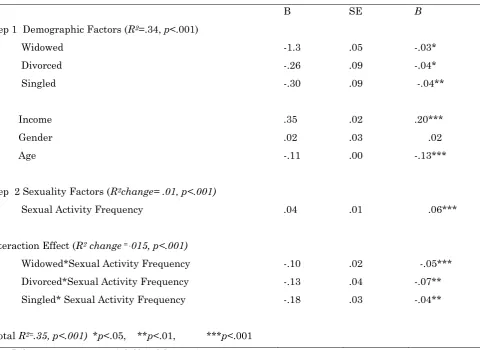
Therefore, it is clear that older adults’ marital statuses were significantly related to their frequency of sexual activities and levels of sexual life satisfaction. In comparison to non-married older adults, married older adults have more frequent sexual activities and higher level of sexual satisfaction. Therefore it is possible to expect that non-married older adults may have difficulties in finding sexual partners and it may affect their perception of life satisfaction. Among marital status, widowed, divorced, and never married older adults’ sexual activity frequency was associated with sexual life satisfaction. The interaction term between widowed older adults and sexual activity frequency was significant (β
= -.05, p < .001), the interaction term between divorced older adults and sexual activity frequency was significant (β = -.07, p
<.01), and the interaction term between singled older adults and sexual activity frequency was significant (β = -.04, p < .01).
Table 1: Regression results of marital status & sexual life satisfaction (N=2338)
B SE B
Step 1 Demographic Factors (R2=.34, p<.001)
Widowed -1.3 .05 -.03*
Divorced -.26 .09 -.04*
Singled -.30 .09 -.04**
Income .35 .02 .20***
Gender .02 .03 .02
Age -.11 .00 -.13***
Step 2 Sexuality Factors (R2change= .01, p<.001)
Sexual Activity Frequency .04 .01 .06***
Interaction Effect (R2 change = .015, p<.001)
Widowed*Sexual Activity Frequency -.10 .02 -.05***
Divorced*Sexual Activity Frequency -.13 .04 -.07**
Singled* Sexual Activity Frequency -.18 .03 -.04**
(Total R2=.35, p<.001) *p<.05, **p<.01, ***p<.001
(Note. Reference groups were married older adults group).
In the first step, older adults’ self-rated sexual life satisfactions were regressed on demographic factors. Collectively, the factors accounted for 34% variance in sexual life satisfaction (R2 adjusted=.34, p<.001) and beta values indicated that marital status (e.g., widowed, divorced, and singled older adults groups), income, and age were unique predictors.
In the second step, the sexual activity frequency variable was added to the regression equation. There was a 1% increase in sexual life satisfaction variance explained (total R2=.35, p<.001). Beta values indicated that sexual activity frequency was a positive predictor of sexual life satisfaction. On the third step, interactions of marital status x frequency of sexual activity were entered with significant results for all interactions. The interaction term between widowed older adults and sexual activity frequency was significant (β = -.05, p < .001), the interaction term between divorced older
adults and sexual activity frequency was significant (β = -.07, p < .01), and the interaction term between singled older adults and sexual activity frequency was significant (β = -.04, p < .01).
In sum, those with better incomes, those who were married, those that were relatively younger, and those that reported higher frequency of sexual activity reported significantly better sexual life satisfaction. Regarding the interaction effect between marital statuses and sexual activity frequencies, widowed, divorced, and single older adults less frequently engaged in any type of sexual activity than married older adults.
Discussion
but are not limited to, physical health,
marital
status,
self-esteem,
and
knowledge
and
attitude
towards
sexuality. Sexuality does not inevitably
vanish with age, but instead, the
changes in sexuality are more dependent
on the combination of above-mentioned
factors [2]. Among these factors, marital
status plays a significant role in sexual
activities and sexual life satisfaction in
later life. On the other hand,
psychosocial factors as well as medical
factors can affect the sexual function of
aging individuals negatively. Depression,
anxiety, body-image concerns, and
societal attitudes can all serve to
decrease the potential sexual function of
men and women over and above the
physical changes associated with normal
aging.
Older people’s various levels of sexual
activity are a result of many interrelated
demographic, environmental and societal
factors. Therefore, the aging process,
illness, or loss of a partner as
independent
factors
cannot
by
themselves adequately explain the
relative sexual inactivity of some older
people.
Despite
some
negative
circumstantial factors, aging people can
now
avoid
making
these
wrong
assumptions about their sexuality and
can constructively oppose their life
obstacles. The data on older adults’
marital statuses, demographic factors,
and sexual life satisfactions present
quite consistent results revealing that
older adults’ marital relations may bring
greater opportunity for sexual life
satisfaction, while improving emotional
attachment and self-esteem. Because
sexual activity within a marital
relationship may promote positive
attitudes and beliefs about life in general,
it can buffer the effects of further
functional decline and may increase the
life span for older people [2].
Given that marital status in later life
may have a significant influence on older
adults’ well-being and their increased
life expectancy after retirement, it is
crucial to better understand older adults’
sexuality and its association with
various
demographic
factors,
particularly in light of the
ever-increasing population of older people. A
directive for future research is to
examine more diverse variables, which
can explain the dynamic relationships
among older adults’ demographic factors.
By understanding these associations
more clearly, it will be possible to create
social policies that are more responsive
to the needs of older people and can
ultimately bolster the social support
systems for them [11-30].
References
1 U. S. Bureau of the Census (2012) Population Estimates. Retrieved April 15, 2008 from http://www.census.gov/
2 Hooyman NR, Kiyak HA (2010) Social
Gerontology: Multidisciplinary perspective. Pearson Education, Inc.
3 Kahn RL, Antonoucci TC (1992) Convoys over the life-course: attachment, roles, and social support. In P. B. Baltes & O. G. Brim (Eds.), Life-span development and behavior, p. 253-286. San Deiago, CA: Academic Press.
4 Antonucci TC, Lansford JE, Schaberg L, Baltes M, Takahashi K, Akiyama H, Fuhrer R (2002) Widowhood and illness: a comparison of social network characteristics in France, Germany, Japan, and United States. Psychology and
Aging, 16(4):655-665.
5 Bauer M, McAuliff L, Nay R (2007) Sexuality, health care, and the older person: An overview of the literature. International Journal of Older People Nursing, 2(1):63-68.
6 Guan J (2004) Correlates of spouse
relationship with sexual attitude, interest, and activity among Chinese elderly. Sexuality & Culture: An Interdisciplinary Quarterly, 8(1):104-131.
7 Henry J, McNab W (2003) Forever young: A health promotion focus on sexuality and aging. Gerontology & Geriatrics Education, 23(4):57-74.
cross-national study of subjective well-being among older women and men: Findings from the global study of sexual attitudes and behaviors. Archives of Sexual Behavior, 35:145-161.
10 Waite LJ, Laumann EO, Levinson W, Lindau ST, McClintock MK, O’Muircheartaigh, CA, Schumm LP (2015) National social life, health, and aging project. Inter-university Consortium for Political and Social Research.
11 Bachmann GA, Leiblum, SR (1991) Sexuality in sexagenarian women. Maturitas, 13: 43-50.
12 Bergstorm-Walan, MB, Nielsen HH (1990)
Sexual expression among 6080 year old men and women: A sample from Stockholem, Sweden, Journal of Sex Research, 27:289-295. 13 Bretschneider JG, McCoy NL (1988) Sexual
interest and behavior in healthy 80-102 year-olds.
14 Brecher EM (1984) Love, sex, and aging. Boston: Little Brown.
15 Bretschneider JG, McCoy NL (1988) Sexual interest and behavior in healthy 80-102 years old. Archives of Sexual Behavior, 17:109-129. 16 Delamater JD, Sill M (2005) Sexual desire in
later life. Journal of Sex Research, 42(2):138-149.
17 Katz S, Marshall BL (2004) Is the functional ‘normal’? Aging, sexuality and the bio-marking of successful living. History of the Human Sciences, 17(2):53-75.
18 Kinsey AC, Pomeroy WB, Martin CR, Gebhard
PH (1953) Sexual behavior in the human female. Philadelphia: saunders.
19 Leiblum SR, Segraves RT (1989) Sex therapy and aging adults. In S. R. Leiblum and R. C. Rosen (eds). Principles and practice of sex therapy: Update of the 1990s. New York: Guiford.
sexual functioning of elderly hypertensive women. Journal of Sex and Marital Therapy, 20:259-270.
21 Masters WH, Johnson VM (1966) Human
sexual response. London: Churchill Livingstone. 22 Mulligan T, Palguta RF (1991) Sexual interest,
activity, and satisfaction among male nursing home residents. Archives of Sexual Behavior, 20:199-204.
23 Newton E (1984) The mythic mannish Lesbian:
Radclyffe hall and the new women. Signs: Journal of Women in Culture and Society 9:557-575.
24 Poggi RG, Berland DI (1985) The therapist’s reactions to the elderly. Gerontologist, 25:508-513.
25 Schover LR, Jeusen SB (1988) Sexuality and chronic illness: A comprehensive approach. New. NY: Guilford.
26 Spector IP, Rosen RC, Leiblum SR (1988) Sexuality.
27 Trudel G, Turgeon L, Piche L (2000) Marital and sexual aspects of old age. Sexual and Relationship Therapy, 15:381-406.
28 Weeks DJ (2002) Sex for the mature adult: Health, self-esteem and countering ageist stereotypes. Sexual and Relationship Therapy, 17:231-240.
29 Weizman R, Hart J (1987) Sexual behavior in healthy married elderly men. Archives of Sexuality Behavior, 16:39-44.