A ONE POT THREE-COMPONENT SYNTHESIS OF
SPIROOXOINDOLES USING Cu-NANOPARTICLES GRAFTED
ON CARBON MICROSPHERES AS CATALYST
N. S. Kaminwar
[a], S. B. Patwari
[a], Santosh P. Goskulwad
[a], Santosh D. More
[b],
Sanjay K. Vyawahare
[b], T. Pasinszki
[c], L. Kotai
[d], and R. P. Pawar
[e]*Keywords: Heterogeneous catalyst; spirooxoindoles; Enolisable ketones; copper nanoparticle/C.
The copper nanoparticles grafted on carbon microsphere is employed for an efficient one-pot three-component synthesis of spirooxoindole derivatives involving isatin, malononitrile and enolizable ketones such as 3-methyl-1-phenyl-2-pyrazolin-5-one, 3-methyl-1-(2-chlorophenyl)-2-pyrazoline 5-one, 4-hydroxy-6-methyl-2-pyrone and 1-methyl-4-hydroxyquinoline-2-one. The cheap starting material, easy separation, high catalytic efficiency and reusability of the catalyst for several times without loss of its efficiency, good yield of products, and simple workup are promising features of the reaction in 1:1 (v/v) aqueous-alcoholic medium.
*Corresponding Author
E-Mail:[email protected]
[a] Department of Chemistry, L.B.S. College, Dharmabad. [b] Department of Physics, Deogiri College, Aurangabad. [c] Fiji National University, Nasinu, Fiji
[d] Research Centre for Natural Sciences, Hungarian Academy of Sciences, Budapest, Hungary.
[e] Department of Chemistry, Deogiri College, Aurangabad.
Introduction
Multicomponent reactions (MCRs) involve an effective combination of three or sometimes more reactants simultaneously in a one-pot synthesis and do not require the separation of intermediates. MCR can be widely used for in the synthesis of most of the heterocyclic compounds to form new C-C bonds. These reactions are highly selective, energy efficient, environmental-friendly, involves simple purify-cation techniques, and requires low cost with short reaction time.1 Some examples which involve MCRs are the Biginelli,2 Mannich,3 and Robinson4 reactions.Heterocycles containing the indole moiety exhibit antifungal and antibacterial activities, and pyrazole ring derivatives are useful in the development of insecticides, fungicides and herbicides.5,6 The spirooxoindole moiety is an essential unit of natural products and pharmaceuticals,7 for example the cytostatic alkaloids Spirotryprostatins A and B. The structural characteristics of these compounds are the spiro ring fused at the C3 position of the oxoindole unit with various heterocyclic motifs.8
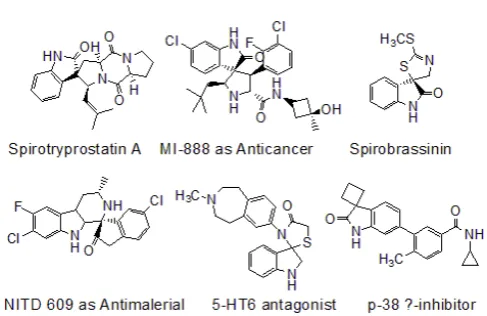
A large number of bioactive natural products containing the indole moiety9 exhibit antifungal and antibacterial activities. In the structure of spirooxoindoles, the indole 3-carbon is shared in the formation of spiroindolines and it is a carbonyl group at the C-2 position. Compounds containing spirooxoindole as the structural unit exhibit different biological activities like antimicrobial, antioxidant, antitubercular, anticancer, anti-HIV and anti-inflammatory activities.10 Some representative examples of spiro-oxoindoles are provided in Figure 1.
Figure 1. Some bioactive spirooxoindole derivatives.
Synthesis of various spirooxoindole derivatives involves the one-pot condensation reaction of isatin, activated methylene and a 1,3-dicarbonyl compound. This reaction can be achieved using different catalysts and conditions such as SnCl4,11 triethylamine,12 basic alumina under microwave irradiation,13 triethylbenzylammonium chloride (TEBA),14 β-cyclodextrin,15 NaCl under sonication,16 ZnS nanoparticles,1 piperidine under ultrasound irradiation,18 CaCl2 under ultrasound irradiation,19
1,8-diazabicyclo[5.4.0]undec-7-ene (DBU),20
ethylenediammonium diformate (EDDF),21 mesoporous silica (SBA-15)-PrNH2,22 L-prolin,23 silica bound ionic liquids,24 tris(hydroxymethyl)aminomethane (THAM),25,19 1,8-diazabicyclo[5.4.0]undec-7-ene (DBU)-Ac,26 ultraso-und,27 cerium oxide,28 microwave irradiation,29 1,4-diazabi-cyclo[2.2.2]octane (DABCO),30 sodium acetate or potassium fluoride,31 and 1-(carboxymethyl) pyridinium iodide.32
Nanoparticles have high specific surface areas, various shapes and sizes, and high reactivity. Handling of nanoparticles is not easy because they lead to self- aggregation and it is also difficult to separate them from the reaction medium. To overcome these limitations, nanoparticles are used by some supports. Such developed catalytic metallic nanoparticles that are inexpensive, non- or minimally poisonous, highly active, stable and easily separable from reaction mixture are highly useful. Copper nanoparticles are one of the alternatives to heavy metal nanoparticle catalysis.34 Therefore. copper nanoparticles grafted on carbon microsphere find alternatives to these problems. 35,36
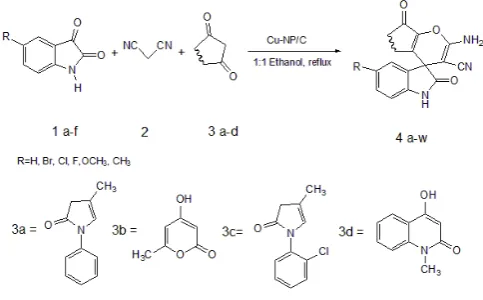
In the present work, an effective, copper nanoparticle grafted on carbon microsphere catalysed method for the one-pot synthesis of spirooxoindole derivatives in aqueous ethanol is reported herein (Scheme 1).
Experimental
Chemicals were purchased from Sigma Aldrich, Alpha Caesar, TCS and Spectochem, and used as such without further purification. Products were characterized by 1H and 13C NMR and Mass spectra. 1H and 13C NMR spectra were recorded on a Bruker (400 MHz) spectrometer using DMSO-d6 as deuterated solvent and tetramethylsilane (TMS) as an internal standard. Reactions were monitored by TLC using TLC Silica gel 60 F254 aluminium sheet (Merck). The Cu-NP/C catalyst was prepared as described in our previous papers.35,37
General procedure for the synthesis of spirooxoindole derivatives:
A mixture of isatin (1 mmol), malononitrile (1 mmol) and enolisable ketone (1 mmol) were refluxed with stirring in the presence of Cu-NP/C (10 mg) in 1:1 aqueous ethanol (2 mL) in oil bath. The progress of the reaction was monitored by TLC. After completion of the reaction, the mixture was filtered and the remaining was washed with warm ethanol to separate the Cu-NP/C catalyst. After cooling the filtrate, the precipitated solid was filtered off. The crude products were purified by recrystallization from 95 % ethanol.
6’-Amino-3’-methyl-1’-phenyl-2-oxo-1’H-spiro[indoline-3,4’-pyrano[2,3-c]pyrazole]-5’-carbonitrile (4a)
Mp. 237-238 °C,16 1H NMR (400 MHz, DMSO d 6): δ (ppm) 1.545 (S, 3H, CH3), 6.94-7.054 (m, 2H, Ar), 7.174 (d, 1H, Ar), 7.273-7.504 (m, 2H, Ar), 7.525-7.544 (m, 2H, Ar), 7.590 (s, 2H, NH2), 7.780-7.802 (d, 2H, Ar), 10.756 (s, 1H, NH); ESI-MS: m/z = 370.
2’-Amino-5-iodo-7’-methyl-2,5’-dioxo 5’H-spiro[indoline-3,4’-pyrano[4,3-b]pyran]-3’-carbonitrile (4g)
Mp. > 280 °C, 1H NMR (400 MHz, DMSO-d
6): δ (ppm) 2.247 (s, 3H, CH3), 6.352-6.354 (m, 1H, Ar), 6.667-6.684 (d, 1H, Ar), 7.509 (s, 2H, NH2), 7.523-7.527 (d, 1H, Ar), 7.539-7.543 (d, 1H, Ar),10.705 (s, 1H, NH)., 13C NMR: 19.21,
46.90, 56.25, 84.75, 97.99, 111.79, 116.96, 132.13, 135.57, 137.25, 141.91, 158.63, 159.76, 163.75, 176.65.
2’-Amino-5-methoxy-7’-methyl-2,5’-dioxo-5’H-spi-ro[indoline-3,4’-pyrano[4,3-b]pyran]-3’-carbonit-rile (4h)
Mp. 262-264 °C, 1H NMR (400 MHz, DMSO-d
6): δ (ppm) 2.235 (s, 3H, CH3), 3.662 (S, 3H, OCH3), 6.339 (s, 1H, Ar), 6.728-6.768 (m, 3H, Ar), 7.427 (s, 2H, NH2), 10.396 (s, 1H, NH), 13C NMR: 19.23, 47.39, 55.40, 57.02, 97.92, 98.32, 109.73, 110.66, 113.45, 117.09, 134.27, 135.40, 155.16, 158.53, 159.56, 159.96, 163.58, 177.09.
6’-Amino-5-methoxy-3’-methyl-1’-phenyl-2’-chloro-2-oxo-1’H-spiro[indoline-3,4’-pyrano[2,3-c]pyrazole]-5’-carbonitrile (4m)
Mp. 222-224 °C, 1H NMR (400 MHz, DMSO-d
6): δ (ppm) 1.560 (s, 3H, CH3), 3.702 (s, 3H, OCH3), 6.719 (m, 1H, Ar), 7.397-7.554 (d, 1H, Ar), 7.563-7.576 (m, 2H, Ar), 7.578-7.590 (m, 2H, Ar), 7.713 (s, 2H, NH2), 7.727 (d, 2H, Ar), 10.552 (s, 1H, NH); ESI-MS: m/z = 434; 13C NMR: 11.66, 48.33, 54.82, 55.45, 94.95, 110.25, 113.88, 117.91, 128.24, 130.26, 133.51, 144.23, 146.04, 155.5, 160.95, 177.25.
6’-Amino-5-methyl-3’-methyl-1’-phenyl-2’-chloro-2-oxo-1’H-spiro[indoline-3,4’-pyrano[2,3-c]pyrazole]-5’-carbonitrile (4n)
Mp. 252-254 °C,1H NMR (400 MHz, DMSO-d
6): δ (ppm) 1.546 (s, 3H, CH3), 2.260 (s, 3H, CH3), 7.399 (d, 1H, Ar), 7.516 (s, 1H, Ar), 7.540-7.560 (d, 1H, Ar), 7.583 (s, 2H, NH2), 7.634-7.642 (m, 2H, Ar), 7.656-7.665 (d, 1H, Ar), 7.715-7.742 (d, 1H, Ar), 10.632 (s, 1H, NH), 13C NMR: 11.65, 20.55, 47.89, 56.29, 95.01, 109.47, 117.91, 125.01, 128.26, 129.44, 130.25, 132.24, 133.81, 139.02, 144.24, 145.99, 160.91, 177.32.
6’-Amino-3’-methyl-1’-phenyl-2’-chloro-2-oxo-1’H-spiro[indo-line-3,4’-pyrano[2,3-c]pyrazole]-5’-carbonitrile (4p)
Mp. 250-252 °C,28 1H NMR (400 MHz, DMSO-d 6): δ (ppm) 1.536 (s, 3H, CH3), 6.940-6.955 (d, 1H, Ar), 7.033-7.050 (t, 1H, Ar), 7.108-7.123 (d, 1H, Ar), 7.277-7.307 (t, 1H, Ar), 7.409 (s, 2H, NH2), 7.530-7.644 (m, 2H, Ar), 7.655-7.659(d, 1H, Ar), 7.715-7.731(d, 1H, Ar), 10.731 (s, 1H, NH); ESI-MS: m/z = 404; 13C NMR 94.91, 109.75, 117.86, 122.56, 124.61, 128.27, 129.16, 129.79, 130.24, 131.25, 132.16, 133.81, 141.49, 144.20, 146.04, 160.96, 177.37.
6’-Amino-5-chloro-3’-methyl-1’-phenyl-2’-chloro-2-oxo-1’H-spiro[indoline-3,4’-pyrano[2,3-c]pyrazole]-5’-carbonitrile (4r)
Mp. 266-268 °C,1H NMR (400 MHz, DMSO-d
2’-Amino-5-chloro-6’-N-methyl-2,5’-dioxo-5’,6’-dihydrospiro-[pyrano[2,3-c]quinoline-3’,4-indoline]-3’-carbonitrile (4s)
Mp. > 280 °C,25 1H NMR (400MHz, DMSO-d
6): δ (ppm) 3.495 (S, 3H, CH3), 6.838-6.854 (d, 1H, Ar), 7.197-7.231 (t, 2H, Ar), 7.433-7.466 (t, 1H, Ar), 7.541(s, 2H, NH2), 7.596-7,613 (d, 1H, Ar), 8.076(d, 1H, Ar), 10.663 (s, 1H, NH); 13C NMR: 29.23, 48.36, 56.44, 105.71, 111.07, 112.32, 113.36, 115.00, 117.32, 122.44, 126.34, 130.99, 132.26, 136.62, 138.66, 141.79, 151.72, 158.96, 177.50.
2’-Amino-5-methyl 6’-N-methyl-2,5’-dioxo-5’,6’-dihydrospi-ro[pyrano[2,3-c]quinoline-3’,4-indoline]-3’-carbonitrile (4t)
Mp. > 280 °C,25 1H NMR (400 MHz, DMSO-d
6): δ (ppm) 2.166(s, 3H, CH3), 3.486 (s, 3H, CH3), 6.711-6.727 (d, 1H, Ar), 6.827 (s, 1H, Ar), 6.959-6.977 (d, 1H, Ar), 7.429-7.442(s, 2H, NH2), 7.442-7.458 (d, 1H, Ar), 7.743-7.760(d, 1H, Ar), 7.760-7.778(t, 1H, Ar), 8.061-8.077(d, 1H, Ar), 10.410 (s, 1H, NH); ESI-MS: m/z = 385; 13C NMR: 20.50, 29.18, 48.16, 57.39, 106.54, 108.94, 112.24, 114.98, 117.46, 122.33, 123.31, 128.54, 130.49, 132.18, 134.30, 138.59, 139.97, 151.39, 158.76, 177.76.
Results and discussion
A method for the synthesis of spirooxoindole derivatives in 1:1 aqueous ethanol by a one-pot three-component reaction of isatin, malononitrile and 3-methyl-1-phenyl-2-pyrazolin-5-one, 4-hydroxy-6-methyl-2-pyrone or 1-methyl-4-hydroxyquinoline-2-one catalysed by copper nanoparticles grafted on carbon microsphere is presented in the present article (see Scheme 1).
Scheme 1. Synthesis of spirooxoindole derivatives using Cu-NP/C catalyst under reflux for 40-63 min in 1:1 aq. ethanol.
To optimize the reaction conditions, the reaction between isatin (1 mmol), malononitrile (1 mmol) and 3-methyl-1-phenyl-2-pyrazoline-5-one (1 mmol) was chosen as a model reaction in 1:1 aqueous ethanol in order to optimize the
reaction conditions. Starting materials of this model reaction were converted to 4a in high yield using 10 mg Cu-NP/C catalyst (Table 1).
Table 1. Optimization of reaction between 1 mmol of isatin, 1 mmol of malononitrile and 1 mmol of 3-methyl-1-phenyl 2-pyrazoline-5-one under reflux.
Entry Solvent Time, h Catalyst, mg
Isolated yield, %
1 DMF 3.5 h 5 52
2 THF 3.0 h 5 44
3 MeOH 1.0 h 5 78
4 EtOH 55 min 5 84
5 EtOH:H2O (1:1) 50 min 5 88 6 EtOH:H2O (1:1) 40 min 10 92 7 EtOH:H2O (1:1) 40 min 15 90
The set of reactions were examined in various solvents and different amounts of catalyst under reflux (Table 1). Firstly, reactions were conducted in five different solvents (entries 1-5, Table 1). The best deal was obtained in EtOH:H2O (1:1) (entry 5, Table 1) using 5 mg of catalyst. The reactions using other solvents gave moderate to low yield of the product (entries 1-4, Table 1). Different catalytic conditions were also applied in EtOH:H2O (1:1), high yield was found when 10 mg of the catalyst wais used (entry 6, Table 1). The workup of reaction involves only filtration and washing with hot ethanol. The catalyst was separated from the product by filtering it with hot ethanol and reused by washing with ethanol and then with acetone.
The following series of compounds have been prepared:
6’-Amino-3’-methyl-1’-phenyl-2-oxo-1’H-spiro[indoline-3,4’-pyrano[2,3-c]pyrazole]-5’-carbonitrile (entry 1-6, Table 2),
2’-Amino-7-methyl-2,5’-dioxo-5’H-spiro[indoline-3,4’-pyrano[4,3-b]pyran]-3’-carbonitrile (entry 7-12, Table 2)
6’-Amino-3’-methyl-1’-phenyl-2’-chloro-2-oxo-1’H-spi-ro[indoline-3,4’-pyrano[2,3-c]pyrazo-le]-5’-carbonitrile (entry 13-18, Table 2) and
2-Amino 6-methyl-2,5-dioxo-5,6-dihydrospiro[pyrano-[3,2-c]quinoline-4,3’-indoline]-3-carbonitrile (entry 19-23, Table 2).
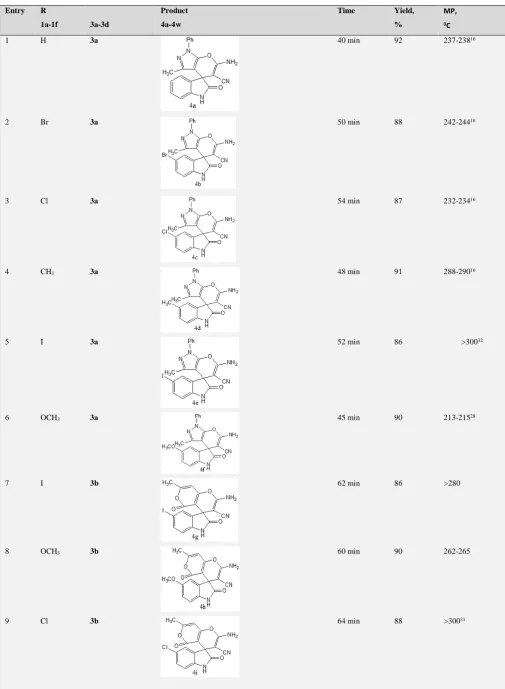
The reactions were conducted under reflux for 40-63 min in 1:1 aqueous ethanol in the presence of 10 mg of Cu-NP/C catalyst. The products were obtained in good yields. The molecular structures of the products were characterized by 1H NMR, ESI-MS and 13C NMR spectroscopic data.
Table 2. One pot synthesis of spiro-oxoindole derivatives in 1:1 aqueous ethanol using Cu-NP/C catalyst.
Entry R
1a-1f 3a-3d
Product
4a-4w
Time Yield,
%
MP, 0C
1 H 3a 40 min 92 237-23816
2 Br 3a 50 min 88 242-24416
3 Cl 3a 54 min 87 232-23416
4 CH3 3a 48 min 91 288-29016
5 I 3a 52 min 86 >30032
6 OCH3 3a 45 min 90 213-21528
7 I 3b 62 min 86 >280
8 OCH3 3b 60 min 90 262-265
10 H 3b 58 min 87 283-28531
11 Br 3b 63 min 90 >30031
12 CH3 3b 60 min 91 >27030
13 OCH3 3c 45 min 92 222-224
14 CH3 3c 50 min 90 251-254
15 Cl 3c 52 min 89 247-24829
16 H 3c 48 min 91 250-25228
18 I 3c 50 min 91 266-269
19 Cl 3d 40 min 93 >28025
20 CH3 3d 45 min 90 >28025
21 Br 3d 50 min 92 >30026
22 I 3d 48
min
90 >30026
23 OCH3 3d 46 min 88 >30027
Acknowledgments
We are thankful to the Principal, Dharmabad Shikshan Sanstha, for providing research facilities.
References
1Jun, J., Hua-Dong, X., Jian-Bei, X., Bai-Yan, R., Feng-Ping, L., Xin G., Li-Qin, J., Zhi-Yong, Z., and Wen-Hao, H., J. Am.
Chem. Soc., 2011, 133(22), 8428-8431.
https://pubs.acs.org/doi/10.1021/ja201589k
2Bose, A.K., Maghar, S.M., Suhas, P., Subhendu, N.G., William, H., Arun, M., Tetrahedron Lett. 2005, 46(11), 1901-1903. https://doi.org/10.1016/j.tetlet.2005.01.087
3Guo, Q., Cong, J., Zhao, G., Arman, H. D., Tetrahedron Lett.,
2012, 53(36), 4866-4869.
https://doi.org/10.1016/j.tetlet.2012.06.140
4Sato, T., Wakahara, Y., Otera, J., Nozaki, H., Tetrahedron Lett.,
1990, 31(11), 1581-1584. https://doi.org/10.1016/0040-4039(90)80022-E
5Elison, M. N., Merkulova, V. M., Lovaisky, A. D., Demchuk, D. V., Belyakov, P. A., Nikishin, G. I., Mol. Divers., 2010,
14(4), 833-839. https://doi.org/10.1007/s11030-009-9207-z.
6Chen, H. and Shi, D., J. Comb. Chem., 2010, 12 (4), 571–576. https://doi.org/10.1021/cc100056p.
7 Ke, D., Yipin, L., Zaneta, N., Guoping, W., Su, Q., Sanjeev, S., Wei, G. Dongguang, Q., Jeanne, S., Krzysztof, K., Peter, P., Shaomeng, W., J. Med. Chem., 2006, 49(12), 3432-3435. https://doi.org/10.1021/jm051122a.
8 Bin, Y., De-Quan, Y., Hong-Min, L., Eur. J. Med. Chem., 2015, 97, 673-698. https://doi.org/10.1016/j.ejmech.2014.06.056
10(a) Abdel-Rahman, A. H., Keshk, E. M., Hanna, M. A. and El-Bady, S. M. Bioorg. Med. Chem., 2004, 12(9), 2483-2488; https://doi.org/10.1016/j.bmc.2003.10.063; (b) Dandia, A., Saini, D.,Bhaskaran, S. and Saini, D. K. Med. Chem. Res.
2014, 23(2), 725-734. https://doi.org/10.1007/s00044-013-0671-8; (c) Garima, K. , Nutan , Manoj, M., Satish, K. G., Ramendra, K. S., Eur. J. Med. Chem. 2011, 46(4), 1181-1188. https://doi.org/10.1016/j.ejmech.2011.01.037
11Liang, B., Kalidindi, S., Porco Jr, J. A., Stephenson, C. R. J., Org.
Lett., 2010, 12(3), 572–575,
https://pubs.acs.org/doi/10.1021/ol902764k
12Redkin, R. G., Shemchuk, L. A., Chernykh, V. P., Shishkin, O. V. and Shishkin, S. V., Tetrahedron, 2007, 63(46), 11444– 11450. https://doi.org/10.1016/j.tet.2007.08.050
13Dandia, A., Singh, R., Sarawgi, P. and Khaturia, S., Chin. J.
Chem., 2006, 24(7), 950–954, https://doi.org/10.1002/cjoc.200690180
14Zhu, S. L., Ji, S. J., Zhang, Y., Tetrahedron, 2007, 63(38), 9365– 9372, https://doi.org/10.1016/j.tet.2007.06.113
15Sridhar, R., Srinivas, B., Madhav, B., Reddy, V. P., Nageswar, Y. V. D. and Rao, K. R., Can. J. Chem., 2009, 87(12),1704– 1707. https://doi.org/10.1139/V09-137.
16Dandia, A., Jain, A. K. and Bhati, D. S., Synth. Commun., 2011,
41(19), 2905–2919.
https://doi.org/10.1080/00397911.2010.515365
17Dandia, A., Parewa, V., Jain, A. K. and Rathore, K. S., Green
Chem., 2011, 13(8), 2135–2145. https://doi.org/
10.1039/c1gc15244k
18Zou, Y., Hu, Y., Liu, H. and Shi, D., ACS Comb. Sci., 2012,
14(1), 38–43. https://doi.org/10.1021/co200128k
19Safaei, H. R., Shekouhy, M., Shirinfeshan, A. and Rahmanpur, S.,
Mol. Divers., 2012, 16(4), 669–683. https://doi.org/ 10.1007/s11030-012-9392-z
20Saluja, P., Aggarwal, K. and Khurana, J. M., Synth. Commun.,
2013, 43(24), 3239–3246.
https://doi.org/10.1080/00397911.2012.760130
21Thakur, A., Tripathi, M., Rajesh, U. C. and Rawat, D. S., RSC
Adv., 2013, 3(39), 18142–18148. https://doi.org/ 10.1039/c3ra42410c
22Mohammadi, Z. G., Hosseini, M. N., Lashgari, N., Badiei, A., Amanlou, M., Bazl, R. M., J. Nanostruct., 2013, 2, 489–500. https://doi.org/10.7508/JNS.2012.04.012
23Liju, W., Ablajan, K., Jun, F., Ultrason.Sonochem. 2015, 22, 113–118. https://doi.org/10.1016/j.ultsonch.2014.05.013 24Khodabakhsh, N., Abolhassan, P., Zahra, K., J. Iran. Chem. Soc.,
2016, 13(5), 859–871. https://doi.org/10.1007/s13738-015-0801-y.
25Khot, S. S., Anbhule, P. V., Desai, U. V., Wadgaonkar, P. P.,
Comptes Rendus Chimie, 2018, 21(9), 814-821.
https://doi.org/10.1016/j.crci.2018.05.005
26Bhupathi, R. S., Madhu, B., Venkata Ramana Reddy, Ch., Rama Devi, B. and Dubey, P. K., J. Heterocycl. Chem., 2017, 54, 2326-2332. DOI 10.1002/jhet.2821
27Shaghyegh, G. and Koorosh, R., Orient. J. Chem., 2013, 29(4), 1637-1641. doi.org/10.13005/ojc/290450.
28Rajeev, S., Kavita, S., Lee, Y.-R., and Wee, Y-J., Mol. Divers,
2016, 20(4), 847-858. https://doi.org/ 10.1007/s11030-016-9670-2
29Zhua, S.-L., Ji, S.-J., Zhao, K. and Zhang, Y., Lett. Org. Chem.,
2008, 5(4), 319-323. https://doi.org/ 10.2174/157017808784049489
30Alireza, H., Fatemeh, M., Maryam, B., Ammar, M., and Gholamhossein, M., Chem. Select, 2017, 2, 6784–6796. https://doi.org/10.1002/slct.201701364
31Elinson, M. N., Ryzhkov, F. V., Korolev, V. A., Egorov, M. P.,
Heterocycl. Commun., 2016, 22(1), 11–15.
https://doi.org/10.1515/hc-2015-0232
32Moosavi-Zare, A. R., Zolfigol, M. A., Salehi-Moratab, R., Ehsan,
N., Can. J. Chem., 2017, 95(2), 194-198.
https://doi.org/10.1139/cjc-2016-0374.
33Gawande, M. B., Goswami, A., Felpin, F.-X., Asefa, T., Huang, X. X., Silva, R., Zou, X. X., Zboril, R., Varma, R. S., Chem. Rev., 2016, 116, 3722. https://doi.org/ 10.1021/acs.chemrev.5b00482
34Din, M. I. and Rehan, R., Anal. Lett., 2017, 50(1), 50-62. https://doi.org/10.1080/00032719.2016.1172081
35Pasinszki, T., Krebsz, M., Lajgut, Gy., Kocsis,T., Kótai, L., Kauthale, S., Tekale, S., Pawar, R., New J. Chem., 2018, 42, 1092-1098. https://doi.org/10.1039/C7NJ03562D
36More, Y. W., Tekale, S. U., Kaminwar, N. S., Kotai, L., Pasinszki, T., Kendrekar, P. S. and Pawar, R. P., Curr. Org.
Chem. 2019, 16, 288‒293. https://doi.org/
10.2174/1570179415666181116104931.
37Pasinszki, T., Krebsz, M., Kotai, L., Sajo, I. E., Homonnay, Z., Kuzmann, E., Kiss, L. F., Vaczi, T., Kovacs, I., J. Mater. Sci.
2015, 50, 7353‒7363. https://doi.org/10.1007/s10853-015-9292-6.