PART 70
PERMIT TO OPERATE
Under the authority ofRSMo 643 and the Federal Clean Air Act the applicant is authorized to operate the air contaminant source(s) described be.ow, in accordance with the laws, rules, and conditions set forth herein.
Operating Permit Number: ~12-~~16 Expiration Date:
Installation ID: 095~0222
Project Number: 2010-02-038
Installation Name and Address
Independence Power & Light - Substation I
35th Street and Lees Summit Road Independence, MO 64055
Jackson County
Parent Company's Name and Address
City ofIndependence . P.O. Box 1019
Independence MO, 64051
Installation Description:
Independence Power & Light - Substation I operates two fuel oil-fired simple cycle
combustion turbines for electrical power generation. Independence Power & Light operates Substation I during periods of emergency and peak: demand. The substation has a maximum output of3 7,200 kW. The combustion turbines are each rated at 282.24 MMBtu/hr. The installation is a major source of Greenhouse Gases (C02e), Nitrogen Oxides (NOx), and Sulfur Oxides (SOx). The installation is located in Jackson County, which is an attainment area for all criteria pollutants.
fEB 25
2011
Effective DateTable of Contents
I. INSTALLATION DESCRIPTION AND EQUIPMENT LISTING...3
II. PLANT WIDE EMISSION LIMITATIONS...4
III. EMISSION UNIT SPECIFIC EMISSION LIMITATIONS...5
PERMIT CONDITION 001...5
10 CSR 10-6.260 Restriction of Emission of Sulfur Compounds ... 5
PERMIT CONDITION 002...6
10 CSR 10-6.075 Maximum Achievable Control Technology Regulations ... 6
40 CFR Part 63, Subpart ZZZZ – National Emission Standards for Hazardous Air Pollutants for Stationary Reciprocating Internal Combustion Engines ... 6
IV. CORE PERMIT REQUIREMENTS...11
V. GENERAL PERMIT REQUIREMENTS...18
VI. ATTACHMENTS...23
ATTACHMENT A ...24
Fugitive Emission Observations ... 24
ATTACHMENT B ...25
I.
Installation Description and Equipment Listing
INSTALLATION DESCRIPTION
Independence Power & Light – Substation I operates two fuel oil-fired simple cycle combustion turbines for electrical power generation. Independence Power & Light operates Substation I during periods of emergency and peak demand. The substation has a maximum output of 37,200 kW. The combustion turbines are each rated at 282.24 MMBtu/hr. The installation is a major source of Greenhouse Gases
(CO2e), Nitrogen Oxides (NOx), and Sulfur Oxides (SOx). The installation is located in Jackson County
which is an attainment area for all criteria pollutants.
Reported Air Pollutant Emissions, tons per year
Year Particulate Matter < Ten Microns (PM10) Sulfur Oxides (SOx) Nitrogen Oxides (NOx) Volatile Organic Compounds (VOC) Carbon Monoxide (CO) 2009 0.17 0.14 2.40 0.05 0.13 2008 0.09 0.07 1.28 0.02 0.07 2007 0.15 0.12 2.10 0.04 0.12 2006 0.10 0.57 1.39 0.03 0.08 2005 0.09 0.08 1.36 0.03 0.08
EMISSION UNITS WITH LIMITATIONS
The following list provides a description of the equipment at this installation that emits air pollutants and that are identified as having unit-specific emission limitations.
Emission Unit # Description of Emission Unit
3 282.24 MMBtu/hr Simple Cycle Combustion Turbine #3
4 282.84 MMBtu/hr Simple Cycle Combustion Turbine #4
3A 500 HP CI Diesel Engine for Turbine #3
4A 500 HP CI Diesel Engine for Turbine #4
EMISSION UNITS WITHOUT LIMITATIONS
The following list provides a description of the equipment that does not have unit specific limitations at the time of permit issuance.
Description of Emission Source
7 Aboveground 51,000 gallon Fuel Oil No. 2 Storage Tank
8 Aboveground 51,000 gallon Fuel Oil No. 2 Storage Tank
9 Underground 500 gallon Waste Oil Storage Tank
II.
Plant Wide Emission Limitations
The installation shall comply with each of the following emission limitations. Consult the appropriate sections in the Code of Federal Regulations (CFR) and Code of State Regulations (CSR) for the full text of the applicable requirements. All citations, unless otherwise noted, are to the regulations in effect as of the date that this permit is issued.
III.
Emission Unit Specific Emission Limitations
The installation shall comply with each of the following emission limitations. Consult the appropriate sections in the Code of Federal Regulations (CFR) and Code of State Regulations (CSR) for the full text of the applicable requirements. All citations, unless otherwise noted, are to the regulations in effect as of the date that this permit is issued.
PERMIT CONDITION 001
10 CSR 10-6.260 Restriction of Emission of Sulfur Compounds
Emission Unit Description
3 282.24 MMBtu/hr Simple Cycle Combustion Turbine #3
4 282.84 MMBtu/hr Simple Cycle Combustion Turbine #4
3A 500 HP CI Diesel Engine for Turbine #3
4A 500 HP CI Diesel Engine for Turbine #4
Emission Limitations:
1. No person shall cause or permit the emission into the atmosphere gases containing more than five
hundred parts per million by volume (500 ppmv) of sulfur dioxide or more than thirty-five milligrams per cubic meter (35 mg/cubic meter) of sulfuric acid or sulfur trioxide or any combination of these gases averaged on any consecutive three (3)-hour time period.
2. No person shall cause or permit the emission of sulfur compounds from any source which causes or
contributes to concentrations exceeding those specified in 10 CSR 10-6.010 Ambient Air Quality Standards.
Pollutant Concentration by Volume Remarks
0.5 ppm (1300 µg/m3) 3-hour average not to be exceeded more than once per year Sulfur Dioxide
(SO2) 75 ppb 1-hour average; 3-year average of the 99
th
percentile of the daily maximum 1-hour average at each site monitor within an area 0.05 ppm (70 µg/m3) ½-hour average not to be exceeded over 2 times per year Hydrogen
Sulfide
(H2S) 0.03 ppm (42 µg/m
3
) ½-hour average not to be exceeded over 2 times in any 5 consecutive days
10 µg/m3 24-hour average not to be exceeded more than once in any 90
consecutive days Sulfuric Acid
(H2SO4)
30 µg/m3 1-hour average not to be exceeded more than once in any 2
consecutive days
Operational Limitation:
These emission units shall only combust Fuel Oil No. 2.
Monitoring/Record Keeping:
1. The permittee shall maintain fuel purchase receipts indicating the sulfur content of the fuel oil is 0.5
percent or less.
2. The permittee shall maintain records of any equipment malfunctions, using Attachment B or an
equivalent form generated by the permittee.
3. These records shall be made available immediately for inspection to the Department of Natural
Resources' personnel upon request.
Reporting:
1. The permittee shall report to the Air Pollution Control Program’s Enforcement Section,
P.O. Box 176, Jefferson City, MO 65102, no later than ten (10) days after any exceedance of any of the terms imposed by this regulation, or any malfunction which could possibly cause an exceedance of this regulation.
2. The permittee shall report any deviations from the emission limitations, monitoring/recordkeeping,
and reporting requirements of this permit condition in the semi-annual monitoring report and compliance certification required by Section V of this permit.
PERMIT CONDITION 002
10 CSR 10-6.075 Maximum Achievable Control Technology Regulations
40 CFR Part 63, Subpart ZZZZ – National Emission Standards for Hazardous Air Pollutants for Stationary Reciprocating Internal Combustion Engines
Emission Unit Description
3A 500 HP CI Diesel Engine for Turbine #3
4A 500 HP CI Diesel Engine for Turbine #4
Note: An existing stationary CI RICE located at an area source of HAP emissions must comply with the applicable emission limitations and operating limitations no later than May 3, 2013. [§63.6595(a)(1)]
Operational Limitations:
1. Owners or operators of an existing stationary CI RICE located at an area source of HAP emissions
must comply with the requirements in Table 2d to this subpart which apply. [§63.6603(a)]
2. The permittee must be in compliance with the emission limitations and operating limitations in this
subpart that apply at all times. [§63.6605(a)]
3. At all times the permittee must operate and maintain any affected source, including associated air
pollution control equipment, in a manner consistent with safety and good air pollution control practices for minimizing emissions. The general duty to minimize emissions does not require the permittee to make any further efforts to reduce emissions if levels required by this standard have been achieved. Determination of whether such operation and maintenance procedures are being used will be based on information available to the Administrator which may include, but is not limited to, monitoring results, review of operation and maintenance procedures, review of operation and
maintenance records, and inspection of the source. [§63.6605(b)]
4. Owners or operators of an existing stationary emergency RICE must operate and maintain the
stationary RICE and after-treatment control device (if any) according to the manufacturer's emission-related written instructions or develop their own maintenance plan which must provide to the extent practicable for the maintenance and operation of the engine in a manner consistent with good air pollution control practice for minimizing emissions. [§63.6625(e)]
5. Owner and operators of an existing stationary engine must minimize the engine's time spent at idle
during startup and minimize the engine's startup time to a period needed for appropriate and safe loading of the engine, not to exceed 30 minutes, after which time the emission standards applicable to all times other than startup in Table 2d to this subpart apply. [§63.6625(h)]
6. Owners or operators of a stationary engine that is subject to the work, operation or management
practices in Item 4 of Table 2d to this subpart have the option of utilizing an oil analysis program in order to extend the specified oil change requirement in Table 2d to this subpart. The oil analysis must be performed at the same frequency specified for changing the oil in Table 2d to this subpart. The analysis program must at a minimum analyze the following three parameters: Total Base Number, viscosity, and percent water content. The condemning limits for these parameters are as
follows: Total Base Number is less than 30 percent of the Total Base Number of the oil when new; viscosity of the oil has changed by more than 20 percent from the viscosity of the oil when new; or percent water content (by volume) is greater than 0.5. If all of these condemning limits are not exceeded, the engine owner or operator is not required to change the oil. If any of the limits are exceeded, the engine owner or operator must change the oil before continuing to use the engine. The owner or operator must keep records of the parameters that are analyzed as part of the program, the results of the analysis, and the oil changes for the engine. The analysis program must be part of the maintenance plan for the engine. [§63.6625(i)]
7. The permittee must demonstrate continuous compliance with each operating limitation in Table 2d
to this subpart that apply according to methods specified in Table 6 to this subpart. [§63.6640(a)]
Table 2d to Subpart ZZZZ of Part 63. Requirements for Existing Compression Ignition Stationary RICE Located at Area Sources of HAP Emissions
As stated in §§63.6600 and 63.6640, you must comply with the following emission and operating limitations for existing compression ignition stationary RICE:
For each . . . You must meet the following requirement, except during periods of startup
a. Change oil and filter every 500 hours of operation or annually, whichever comes first;1
b. Inspect air cleaner every 1,000 hours of operation or annually, whichever comes first; and
4. Emergency CI and black
start CI.2
c. Inspect all hoses and belts every 500 hours of operation or annually, whichever comes first, and replace as necessary
1
Sources have the option to utilize an oil analysis program as described in §63.6625(i) in order to extend the specified oil change requirement in Table 2d of this subpart.
2
If an emergency engine is operating during an emergency and it is not possible to shut down the engine in order to perform the management practice requirements on the schedule required in Table 2d of this subpart, or if performing the management practice on the required schedule would otherwise pose an unacceptable risk under Federal, State, or local law, the
management practice can be delayed until the emergency is over or the unacceptable risk under Federal, State, or local law has abated. The management practice should be performed as soon as practicable after the emergency has ended or the unacceptable risk under Federal, State, or local law has abated. Sources must report any failure to perform the management practice on the schedule required and the Federal, State or local law under which the risk was deemed unacceptable.
Table 6 to Subpart ZZZZ of Part 63.Continuous Compliance With Emission Limitations and Operating Limitations
As stated in §63.6640, you must continuously comply with the emissions and operating limitations as required by the following:
For each . . . Complying
with. . . The permittee must demonstrate continuous compliance by . . .
i. Operating and maintaining the stationary RICE according to the manufacturer's emission-related operation and maintenance instructions; or
9. Existing stationary CI RICE not subject to any numerical emission limitations a. Work or Management practices
ii. Develop and follow their own maintenance plan which must provide to the extent practicable for the maintenance and operation of the engine in a manner consistent with good air pollution control practice for minimizing emissions.
Initial Notification:
1. The permittee must submit all of the notifications in §§63.7(b) and (c), 63.8(e), (f)(4) and (f)(6),
63.9(b) through (e), and (g) and (h) that apply by the dates specified if they own or operate any of the following; [§63.6645(a)]
a) This requirement does not apply if the permittee owns or operates an existing stationary CI RICE
that is not subject to any numerical emission standards. [§63.6645(a)(5)]
Recordkeeping:
1. If the permittee must comply with the operating limitations, the permittee must keep the records
described in Paragraphs (a)(1) through (a)(5), (b)(1) through (b)(3) and (c) of this section. [§63.6655(a)]
a) Records of the occurrence and duration of each malfunction of operation (i.e., process
equipment) or the air pollution control and monitoring equipment. [§63.6655(a)(2)]
b) Records of all required maintenance performed on the air pollution control and monitoring
equipment. [§63.6655(a)(4)]
c) Records of actions taken during periods of malfunction to minimize emissions in accordance
with §63.6605(b), including corrective actions to restore malfunctioning process and air pollution control and monitoring equipment to its normal or usual manner of operation. [§63.6655(a)(5)]
2. The permittee must keep the records required in Table 6 of this subpart to show continuous
compliance with each operating limitation that applies. [§63.6655(d)]
3. The permittee must keep records of the maintenance conducted on the stationary RICE in order to
demonstrate that the permittee operated and maintained the stationary RICE and after-treatment control device (if any) according to their own maintenance plan if they own or operate any of the following stationary RICE; [§63.6655(e)]
a) An existing stationary emergency CI RICE located at an area source of HAP emissions subject to
management practices as shown in Table 2d to this subpart. [§63.6655(e)(3)]
4. Records must be in a form suitable and readily available for expeditious review according to
§63.10(b)(1). [§63.6660(a)]
5. As specified in §63.10(b)(1), the permittee must keep each record for five years following the date of
each occurrence, measurement, maintenance, corrective action, report, or record. [§63.6660(b)]
6. The permittee must keep each record readily accessible in hard copy or electronic form for at least
five years after the date of each occurrence, measurement, maintenance, corrective action, report, or record, according to §63.10(b)(1). [§63.6660(c)]
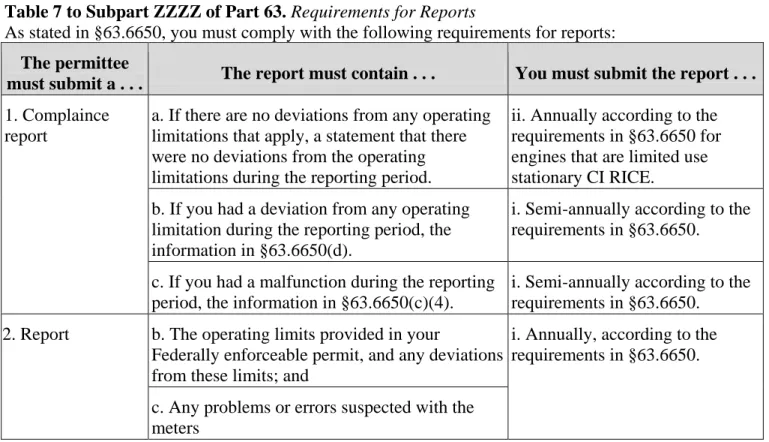
Table 7 to Subpart ZZZZ of Part 63.Requirements for Reports
As stated in §63.6650, you must comply with the following requirements for reports:
The permittee
must submit a . . . The report must contain . . . You must submit the report . . .
a. If there are no deviations from any operating limitations that apply, a statement that there were no deviations from the operating limitations during the reporting period.
ii. Annually according to the requirements in §63.6650 for engines that are limited use stationary CI RICE.
b. If you had a deviation from any operating limitation during the reporting period, the information in §63.6650(d).
i. Semi-annually according to the requirements in §63.6650.
1. Complaince report
c. If you had a malfunction during the reporting period, the information in §63.6650(c)(4).
i. Semi-annually according to the requirements in §63.6650.
b. The operating limits provided in your
Federally enforceable permit, and any deviations from these limits; and
2. Report
c. Any problems or errors suspected with the meters
i. Annually, according to the requirements in §63.6650.
Reporting:
1. The permittee must report each instance in which the permittee did not meet each operating
limitation in Table 2d to this subpart that apply. These instances are deviations from the operating limitations in this subpart. These deviations must be reported according to the requirements in §63.6650. [§63.6640(b)]
2. The permittee shall submit each report in Table 7 of this subpart that applies. [§63.6650(a)]
3. Unless the Administrator has approved a different schedule for submission of reports under
§63.10(a), the permittee must submit each report by the date in Table 7 of this subpart and according to the requirements in Paragraphs (b)(1) through (b)(9) of this section. [§63.6650(b)]
a) For semi-annual Complaince reports, the first Complaince report must cover the period
beginning on the compliance date that is specified for the affected source in §63.6595 and ending on June 30 or December 31, whichever date is the first date following the end of the first
calendar half after the compliance date that is specified for the source in §63.6595. [§63.6650(b)(1)]
b) For semiannual Complaince reports, each subsequent Complaince report must cover the
semi-annual reporting period from January 1 through June 30 or the semi-semi-annual reporting period from July 1 through December 31. [§63.6650(b)(3)]
c) The permittee shall submit the first and subsequent Complaince reports along with the
semi-annual monitoring reports due by October 1st for the monitoring period which covers January
through June and by April 1st for the monitoring period which covers July through December.
[§63.6650(b)(5)]
d) For annual Complaince reports, the first Complaince report must cover the period beginning on
the compliance date that is specified for the affected source in §63.6595 and ending on December 31. [§63.6650(b)(6)]
e) For annual Complaince reports, each subsequent Complaince report must cover the annual reporting period from January 1 through December 31. [§63.6650(b)(8)]
4. The Complaince report must contain the information in Paragraphs (c)(1) through (6) of this section.
[§63.6650(c)]
a) Company name and address. [§63.6650(c)(1)]
b) Statement by a responsible official, with that official's name, title, and signature, certifying the
accuracy of the content of the report. [§63.6650(c)(2)]
c) Date of report and beginning and ending dates of the reporting period. [§63.6650(c)(3)]
d) If the affected source had a malfunction during the reporting period, the Complaince report must
include the number, duration, and a brief description for each type of malfunction which occurred during the reporting period and which caused or may have caused any applicable emission limitation to be exceeded. The report must also include a description of actions taken by an owner or operator during a malfunction of an affected source to minimize emissions in accordance with §63.6605(b), including actions taken to correct a malfunction. [§63.6650(c)(4)]
e) If there are no deviations from any emission or operating limitations that apply to you, a
statement that there were no deviations from the emission or operating limitations during the reporting period. [§63.6650(c)(5)]
5. For each deviation from an emission or operating limitation that occurs for a stationary RICE where
you are not using a CMS to comply with the operating limitations in this subpart, the Complaince report must contain the information in Paragraphs (c)(1) through (4) of this section and the information in Paragraphs (d)(1) and (2) of this section. [§63.6650(d)]
a) The total operating time of the stationary RICE at which the deviation occurred during the
reporting period. [§63.6650(d)(1)]
b) Information on the number, duration, and cause of deviations (including unknown cause, if
applicable), as applicable, and the corrective action taken. [§63.6650(d)(2)]
6. The permittee shall submit the first and subsequent Complaince reports along with the semi-annual
monitoring reports due by April 1st for the monitoring period which covers January through
December. [§63.6650(f)]
IV.
Core Permit Requirements
The installation shall comply with each of the following regulations or codes. Consult the appropriate sections in the Code of Federal Regulations (CFR), the Code of State Regulations (CSR), and local ordinances for the full text of the applicable requirements. All citations, unless otherwise noted, are to the regulations in effect as of the date that this permit is issued. The following is only an excerpt from the regulation or code, and is provided for summary purposes only.
10 CSR 10-6.045 Open Burning Requirements
(1) General Provisions. The open burning of tires, petroleum-based products, asbestos containing
materials, and trade waste is prohibited, except as allowed below. Nothing in this rule may be construed as to allow open burning which causes or constitutes a public health hazard, nuisance, a hazard to vehicular or air traffic, nor which violates any other rule or statute.
(2) Refer to the regulation for a complete list of allowances. The following is a listing of exceptions to
the allowances:
(A)Burning of household or domestic refuse. Burning of household or domestic refuse is limited to
open burning on a residential premises having not more than four dwelling units, provided that the refuse originates on the same premises, with the following exceptions:
1. Kansas City metropolitan area. The open burning of household refuse must take place in an
area zoned for agricultural purposes and outside that portion of the metropolitan area surrounded by the corporate limits of Kansas City and every contiguous municipality;
(B)Yard waste, with the following exceptions:
1. Kansas City metropolitan area. The open burning of trees, tree leaves, brush or any other type
of vegetation shall require an open burning permit;
(3) Certain types of materials may be open burned provided an open burning permit is obtained from the
Director. The permit will specify the conditions and provisions of all open burning. The permit may be revoked if the owner or operator fails to comply with the conditions or any provisions of the permit.
(4) Independence Power & Light - Substation I may be issued an annually renewable open burning
permit for open burning provided that an air curtain destructor or incinerator is utilized and only tree trunks, tree limbs, vegetation or untreated wood waste are burned. Open burning shall occur at least two hundred (200) yards from the nearest occupied structure unless the owner or operator of the occupied structure provides a written waiver of this requirement. Any waiver shall accompany the open burning permit application. The permit may be revoked if Independence Power & Light - Substation I fails to comply with the provisions or any condition of the open burning permit.
(A)In a nonattainment area, as defined in 10 CSR 10-6.020, Paragraph (2)(N)5., the Director shall
not issue a permit under this section unless the owner or operator can demonstrate to the satisfaction of the Director that the emissions from the open burning of the specified material would be less than the emissions from any other waste management or disposal method.
(5) Reporting and Record Keeping. New Source Performance Standard (NSPS) 40 CFR Part 60
Subpart CCCC establishes certain requirements for air curtain destructors or incinerators that burn wood trade waste. These requirements are established in 40 CFR 60.2245-60.2260. The provisions of 40 CFR Part 60 Subpart CCCC promulgated as of September 22, 2005, shall apply and are hereby incorporated by reference in this rule, as published by the U.S. Government Printing Office, 732 N Capitol Street NW, Washington, DC 20401. To comply with NSPS
40 CFR 60.2245-60.2260, sources must conduct an annual Method 9 test. A copy of the annual Method 9 test results shall be submitted to the Director.
(6) Test Methods. The visible emissions from air pollution sources shall be evaluated as specified by 40 CFR Part 60, Appendix A–Test Methods, Method 9–Visual Determination of the Opacity of Emissions from Stationary Sources. The provisions of 40 CFR Part 60, Appendix A, Method 9 promulgated as of December 23, 1971, is incorporated by reference in this rule, as published by the U.S. Government Printing Office, 732 N Capitol Street NW, Washington, DC 20401.
10 CSR 10-6.050 Start-up, Shutdown and Malfunction Conditions
1) In the event of a malfunction, which results in excess emissions that exceed one hour, the permittee shall submit to the Director within two business days, in writing, the following information:
a) Name and location of installation;
b) Name and telephone number of person responsible for the installation;
c) Name of the person who first discovered the malfunction and precise time and date that the
malfunction was discovered.
d) Identity of the equipment causing the excess emissions;
e) Time and duration of the period of excess emissions;
f) Cause of the excess emissions;
g) Air pollutants involved;
h) Best estimate of the magnitude of the excess emissions expressed in the units of the applicable
requirement and the operating data and calculations used in estimating the magnitude;
i) Measures taken to mitigate the extent and duration of the excess emissions; and
j) Measures taken to remedy the situation that caused the excess emissions and the measures taken
or planned to prevent the recurrence of these situations.
2) The permittee shall submit the Paragraph 1 information list to the Director in writing at least ten days prior to any maintenance, start-up or shutdown, which is expected to cause an excessive release of emissions that exceed one hour. If notice of the event cannot be given ten days prior to the
planned occurrence, it shall be given as soon as practicable prior to the release. If an unplanned excess release of emissions exceeding one hour occurs during maintenance, start-up or shutdown, the Director shall be notified verbally as soon as practical during normal working hours and no later than the close of business of the following working day. A written notice shall follow within ten working days.
3) Upon receipt of a notice of excess emissions issued by an agency holding a certificate of authority under Section 643.140, RSMo, the permittee may provide information showing that the excess emissions were the consequence of a malfunction, start-up or shutdown. The information, at a
minimum, should be the Paragraph 1 list and shall be submitted not later than 15 days after receipt of the notice of excess emissions. Based upon information submitted by the permittee or any other pertinent information available, the Director or the commission shall make a determination whether the excess emissions constitute a malfunction, start-up or shutdown and whether the nature, extent and duration of the excess emissions warrant enforcement action under Section 643.080 or 643.151, RSMo.
4) Nothing in this rule shall be construed to limit the authority of the Director or commission to take appropriate action, under Sections 643.080, 643.090 and 643.151, RSMo to enforce the provisions of the Air Conservation Law and the corresponding rule.
5) Compliance with this rule does not automatically absolve the permittee of liability for the excess emissions reported.
10 CSR 10-6.060 Construction Permits Required
The permittee shall not commence construction, modification, or major modification of any installation subject to this rule, begin operation after that construction, modification, or major modification, or begin operation of any installation which has been shut down longer than five years without first obtaining a permit from the permitting authority.
10 CSR 10-6.065 Operating Permits
The permittee shall file a complete application for renewal of this operating permit at least six months before the date of permit expiration. In no event shall this time be greater than eighteen months. [10 CSR 10-6.065(6)(B)1.A(V)] The permittee shall retain the most current operating permit issued to this installation on-site. [10 CSR 10-6.065(6)(C)1.C(II)] The permittee shall immediately make such permit available to any Missouri Department of Natural Resources personnel upon request. [10 CSR 10-6.065(6)(C)3.B]
10 CSR 10-6.080 Emission Standards for Hazardous Air Pollutants and 40 CFR Part 61 Subpart M National Emission Standard for Asbestos
1) The permittee shall follow the procedures and requirements of 40 CFR Part 61, Subpart M for any
activities occurring at this installation which would be subject to provisions for 40 CFR Part 61, Subpart M, National Emission Standard for Asbestos.
2) The permittee shall conduct monitoring to demonstrate compliance with registration, certification,
notification, and Abatement Procedures and Practices standards as specified in 40 CFR Part 61, Subpart M.
10 CSR 10-6.100 Alternate Emission Limits
Proposals for alternate emission limitations shall be submitted on Alternate Emission Limits Permit forms provided by the Department. An installation owner or operator must obtain an Alternate Emission Limits Permit in accordance with 10 CSR 10-6.100 before alternate emission limits may become
effective.
10 CSR 10-6.110 Submission of Emission Data, Emission Fees and Process Information
1) The permittee shall complete and submit an Emission Inventory Questionnaire (EIQ) in accordance
with the requirements outlined in this rule.
2) The permittee may be required by the Director to file additional reports.
3) Public Availability of Emission Data and Process Information. Any information obtained pursuant
to the rule(s) of the Missouri Air Conservation Commission that would not be entitled to confidential treatment under 10 CSR 10-6.210 shall be made available to any member of the public upon request.
4) The permittee shall submit a full paper EIQ to the Air Pollution Control Program by no later than
April 1st after the end of each reporting year. The permittee may instead submit a full electronic EIQ
via MoEIS by no later than May 1st after the end of each reporting year.
5) Emission fees are due by no later than June 1st after the end of each reporting year. The fees shall be
payable to the Missouri Department of Natural Resources.
6) The reporting period shall end on December 31 of each calendar year. Each report shall contain the
required information for each emission unit for the twelve (12)-month period immediately preceding the end of the reporting period.
7) The permittee shall collect, record and maintain the information necessary to complete the required
10 CSR 10-6.130 Controlling Emissions During Episodes of High Air Pollution Potential
This rule specifies the conditions that establish an air pollution alert (yellow/orange/red/purple), or emergency (maroon) and the associated procedures and emission reduction objectives for dealing with each. The permittee shall submit an appropriate emergency plan if required by the Director.
10 CSR 10-6.150 Circumvention
The permittee shall not cause or permit the installation or use of any device or any other means which, without resulting in reduction in the total amount of air contaminant emitted, conceals or dilutes an emission or air contaminant which violates a rule of the Missouri Air Conservation Commission.
10 CSR 10-6.170
Restriction of Particulate Matter to the Ambient Air Beyond the Premises of Origin
Emission Limitation:
1) The permittee shall not cause or allow to occur any handling, transporting or storing of any material; construction, repair, cleaning or demolition of a building or its appurtenances; construction or use of a road, driveway or open area; or operation of a commercial or industrial installation without
applying reasonable measures as may be required to prevent, or in a manner which allows or may allow, fugitive particulate matter emissions to go beyond the premises of origin in quantities that the particulate matter may be found on surfaces beyond the property line of origin. The nature or origin of the particulate matter shall be determined to a reasonable degree of certainty by a technique proven to be accurate and approved by the Director.
2) The permittee shall not cause nor allow to occur any fugitive particulate matter emissions to remain visible in the ambient air beyond the property line of origin.
3) Should it be determined that noncompliance has occurred, the Director may require reasonable control measures as may be necessary. These measures may include, but are not limited to, the following:
a) Revision of procedures involving construction, repair, cleaning and demolition of buildings and their appurtenances that produce particulate matter emissions;
b) Paving or frequent cleaning of roads, driveways and parking lots;
c) Application of dust-free surfaces;
d) Application of water; and
e) Planting and maintenance of vegetative ground cover.
Monitoring:
The permittee shall conduct inspections of its facilities sufficient to determine compliance with this regulation. If the permittee discovers a violation, the permittee shall undertake corrective action to eliminate the violation. If a violation is discovered, the permittee shall maintain the following monitoring schedule:
1) Weekly observations for a minimum of eight (8) consecutive weeks. If the eight weekly observations
demonstrate compliance the permittee may proceed to:
2) Observations every two weeks for a period of eight (8) consecutive weeks. If the four observations
demonstrate compliance the permittee may proceed to:
3) Monthly observations for a period of two (2) months. If the two monthly observations demonstrate
compliance the permittee may proceed to:
4) Semi-annual observations. An observation shall be conducted during each semi-annual reporting
5) If at the time of this operating permit's issuance the permittee has proceeded to steps 2, 3, or 4 of the above monitoring schedule, the permittee may proceed from that point forward in the monitoring schedule. If a violation is noted the permittee shall revert back to the weekly observations in step one.
Recordkeeping:
The permittee shall document all readings on Attachment A, or its equivalent, noting the following:
1) Whether air emissions (except water vapor) remain visible in the ambient air beyond the property
line of origin.
2) Whether the visible emissions were normal for the installation.
3) Whether equipment malfunctions contributed to an exceedance.
4) Any violations and any corrective actions undertaken to correct the violation.
10 CSR 10-6.180 Measurement of Emissions of Air Contaminants
1) The Director may require any person responsible for the source of emission of air contaminants to make or have made tests to determine the quantity or nature, or both, of emission of air contaminants from the source. The Director may specify testing methods to be used in accordance with good professional practice. The Director may observe the testing. All tests shall be performed by qualified personnel.
2) The Director may conduct tests of emissions of air contaminants from any source. Upon request of the Director, the person responsible for the source to be tested shall provide necessary ports in stacks or ducts and other safe and proper sampling and testing facilities, exclusive of instruments and sensing devices as may be necessary for proper determination of the emission of air contaminants. 3) The Director shall be given a copy of the test results in writing and signed by the person responsible
for the tests.
10 CSR 10-6.165 Restriction of Emission of Odors This requirement is not federally enforceable.
No person may cause, permit or allow the emission of odorous matter in concentrations and frequencies or for durations that odor can be perceived when one volume of odorous air is diluted with seven volumes of odor-free air for two separate trials not less than 15 minutes apart within the period of one hour.
10 CSR 10-6.250 Asbestos Abatement Projects – Certification, Accreditation, and Business Exemption Requirements
The permittee shall conduct all asbestos abatement projects within the procedures established for certification and accreditation by 10 CSR 10-6.250. This rule requires individuals who work in asbestos abatement projects to be certified by the Missouri Department of Natural Resources Air Pollution Control Program. This rule requires training providers who offer training for asbestos abatement occupations to be accredited by the Missouri Department of Natural Resources Air Pollution Control Program. This rule requires persons who hold exemption status from certain requirements of this rule to allow the Department to monitor training provided to employees. Each individual who works in asbestos abatement projects must first obtain certification for the appropriate occupation from the Department. Each person who offers training for asbestos abatement occupations must first obtain accreditation from the Department. Certain business entities that meet the requirements for state-approved exemption status must allow the Department to monitor training classes provided to employees who perform asbestos abatement.
Title VI – 40 CFR Part 82 Protection of Stratospheric Ozone
1) The permittee shall comply with the standards for labeling of products using ozone-depleting substances pursuant to 40 CFR Part 82, Subpart E:
a) All containers in which a class I or class II substance is stored or transported, all products containing a class I substance, and all products directly manufactured with a class I substance must bear the required warning statement if it is being introduced into interstate commerce pursuant to §82.106.
b) The placement of the required warning statement must comply with the requirements pursuant to §82.108.
c) The form of the label bearing the required warning statement must comply with the requirements pursuant to §82.110.
d) No person may modify, remove, or interfere with the required warning statement except as described in §82.112.
2) The permittee shall comply with the standards for recycling and emissions reduction pursuant to 40 CFR Part 82, Subpart F, except as provided for motor vehicle air conditioners (MVACs) in Subpart B:
a) Persons opening appliances for maintenance, service, repair, or disposal must comply with the required practices pursuant to §82.156.
b) Equipment used during the maintenance, service, repair, or disposal of appliances must comply with the standards for recycling and recovery equipment pursuant to §82.158.
c) Persons performing maintenance, service, repair, or disposal of appliances must be certified by an approved technician certification program pursuant to §82.161.
d) Persons disposing of small appliances, MVACs, and MVAC-like appliances must comply with record keeping requirements pursuant to §82.166. ("MVAC-like" appliance as defined at §82.152).
e) Persons owning commercial or industrial process refrigeration equipment must comply with the leak repair requirements pursuant to §82.156.
f) Owners/operators of appliances normally containing 50 or more pounds of refrigerant must keep records of refrigerant purchased and added to such appliances pursuant to §82.166.
3) If the permittee manufactures, transforms, imports, or exports a class I or class II substance, the permittee is subject to all the requirements as specified in 40 CFR Part 82, Subpart A, Production and Consumption Controls.
4) If the permittee performs a service on motor (fleet) vehicles when this service involves ozone-depleting substance refrigerant (or regulated substitute substance) in the motor vehicle air
conditioner (MVAC), the permittee is subject to all the applicable requirements as specified in 40 CFR Part 82, Subpart B, Servicing of Motor Vehicle Air conditioners. The term "motor vehicle" as used in Subpart B does not include a vehicle in which final assembly of the vehicle has not been completed. The term "MVAC" as used in Subpart B does not include the air-tight sealed
refrigeration system used as refrigerated cargo, or system used on passenger buses using HCFC-22 refrigerant.
5) The permittee shall be allowed to switch from any ozone-depleting substance to any alternative that is listed in the Significant New Alternatives Program (SNAP) promulgated pursuant to 40 CFR Part
10 CSR 10-6.280 Compliance Monitoring Usage
1) The permittee is not prohibited from using the following in addition to any specified compliance methods for the purpose of submission of compliance certificates:
a) Monitoring methods outlined in 40 CFR Part 64;
b) Monitoring method(s) approved for the permittee pursuant to 10 CSR 10-6.065, “Operating Permits”, and incorporated into an operating permit; and
c) Any other monitoring methods approved by the Director.
2) Any credible evidence may be used for the purpose of establishing whether a permittee has violated or is in violation of any such plan or other applicable requirement. Information from the use of the following methods is presumptively credible evidence of whether a violation has occurred by a permittee:
a) Monitoring methods outlined in 40 CFR Part 64;
b) A monitoring method approved for the permittee pursuant to 10 CSR 10-6.065, “Operating Permits”, and incorporated into an operating permit; and
c) Compliance test methods specified in the rule cited as the authority for the emission limitations. 3) The following testing, monitoring or information gathering methods are presumptively credible
testing, monitoring, or information gathering methods: a) Applicable monitoring or testing methods, cited in:
i) 10 CSR 10-6.030, “Sampling Methods for Air Pollution Sources”; ii) 10 CSR 10-6.040, “Reference Methods”;
iii) 10 CSR 10-6.070, “New Source Performance Standards”;
iv) 10 CSR 10-6.080, “Emission Standards for Hazardous Air Pollutants”; or
b) Other testing, monitoring, or information gathering methods, if approved by the Director, that produce information comparable to that produced by any method listed above.
V.
General Permit Requirements
The installation shall comply with each of the following requirements. Consult the appropriate sections in the Code of Federal Regulations (CFR) and Code of State Regulations (CSR) for the full text of the applicable requirements. All citations, unless otherwise noted, are to the regulations in effect as of the date that this permit is issued,
10 CSR 10-6.065(6)(C)1.B Permit Duration
This permit is issued for a term of five years, commencing on the date of issuance. This permit will expire at the end of this period unless renewed.
10 CSR 10-6.065(6)(C)1.C General Record Keeping and Reporting Requirements
1) Record Keeping
a) All required monitoring data and support information shall be retained for a period of at least five years from the date of the monitoring sample, measurement, report or application.
b) Copies of all current operating and construction permits issued to this installation shall be kept on-site for as long as the permits are in effect. Copies of these permits shall be made immediately available to any Missouri Department of Natural Resources’ personnel upon request.
2) Reporting
a) All reports shall be submitted to the Air Pollution Control Program’s Enforcement Section, P. O. Box 176, Jefferson City, MO 65102.
b) The permittee shall submit a report of all required monitoring by:
i) October 1st for monitoring which covers the January through June time period, and ii) April 1st for monitoring which covers the July through December time period.
iii) Exception. Monitoring requirements which require reporting more frequently than semi annually shall report no later than 30 days after the end of the calendar quarter in which the measurements were taken.
c) Each report shall identify any deviations from emission limitations, monitoring, record keeping, reporting, or any other requirements of the permit, this includes deviations or Part 64
exceedances.
d) Submit supplemental reports as required or as needed. Supplemental reports are required no later than ten days after any exceedance of any applicable rule, regulation or other restriction. All reports of deviations shall identify the cause or probable cause of the deviations and any corrective actions or preventative measures taken.
i) Notice of any deviation resulting from an emergency (or upset) condition as defined in Paragraph (6)(C)7.A of 10 CSR 10-6.065 (Emergency Provisions) shall be submitted to the permitting authority either verbally or in writing within two working days after the date on which the emission limitation is exceeded due to the emergency, if the permittee wishes to assert an affirmative defense. The affirmative defense of emergency shall be demonstrated through properly signed, contemporaneous operating logs, or other relevant evidence that indicate an emergency occurred and the permittee can identify the cause(s) of the emergency. The permitted installation must show that it was operated properly at the time and that during the period of the emergency the permittee took all reasonable steps to minimize levels of emissions that exceeded the emission standards or requirements in the permit. The notice must contain a description of the emergency, the steps taken to mitigate emissions, and the corrective actions taken.
ii) Any deviation that poses an imminent and substantial danger to public health, safety or the environment shall be reported as soon as practicable.
iii) Any other deviations identified in the permit as requiring more frequent reporting than the permittee's semiannual report shall be reported on the schedule specified in this permit, and no later than ten days after any exceedance of any applicable rule, regulation, or other restriction.
e) Every report submitted shall be certified by the responsible official, except that, if a report of a deviation must be submitted within ten days after the deviation, the report may be submitted without a certification if the report is resubmitted with an appropriate certification within ten days after that, together with any corrected or supplemental information required concerning the deviation.
f) The permittee may request confidential treatment of information submitted in any report of deviation.
10 CSR 10-6.065(6)(C)1.D Risk Management Plan Under Section 112(r)
The permittee shall comply with the requirements of 40 CFR Part 68, Accidental Release Prevention Requirements. If the permittee has more than a threshold quantity of a regulated substance in process, as determined by 40 CFR Section 68.115, the permittee shall submit a Risk Management Plan in
accordance with 40 CFR Part 68 no later than the latest of the following dates: 1) June 21, 1999;
2) Three years after the date on which a regulated substance is first listed under 40 CFR Section 68.130; or
3) The date on which a regulated substance is first present above a threshold quantity in a process.
10 CSR 10-6.065(6)(C)1.F Severability Clause
In the event of a successful challenge to any part of this permit, all uncontested permit conditions shall continue to be in force. All terms and conditions of this permit remain in effect pending any
administrative or judicial challenge to any portion of the permit. If any provision of this permit is invalidated, the permittee shall comply with all other provisions of the permit.
10 CSR 10-6.065(6)(C)1.G General Requirements
1) The permittee must comply with all of the terms and conditions of this permit. Any noncompliance with a permit condition constitutes a violation and is grounds for enforcement action, permit termination, permit revocation and re-issuance, permit modification or denial of a permit renewal application.
2) The permittee may not use as a defense in an enforcement action that it would have been necessary for the permittee to halt or reduce the permitted activity in order to maintain compliance with the conditions of the permit
3) The permit may be modified, revoked, reopened, reissued or terminated for cause. Except as provided for minor permit modifications, the filing of an application or request for a permit modification, revocation and reissuance, or termination, or the filing of a notification of planned changes or anticipated noncompliance, does not stay any permit condition.
4) This permit does not convey any property rights of any sort, nor grant any exclusive privilege. 5) The permittee shall furnish to the Air Pollution Control Program, upon receipt of a written request
and within a reasonable time, any information that the Air Pollution Control Program reasonably may require to determine whether cause exists for modifying, reopening, reissuing or revoking the permit or to determine compliance with the permit. Upon request, the permittee also shall furnish to
the Air Pollution Control Program copies of records required to be kept by the permittee. The permittee may make a claim of confidentiality for any information or records submitted pursuant to 10 CSR 10-6.065(6)(C)1.
10 CSR 10-6.065(6)(C)1.H Incentive Programs Not Requiring Permit Revisions
No permit revision will be required for any installation changes made under any approved economic incentive, marketable permit, emissions trading, or other similar programs or processes provided for in this permit.
10 CSR 10-6.065(6)(C)1.I Reasonably Anticipated Operating Scenarios
None.
10 CSR 10-6.065(6)(C)3 Compliance Requirements
1) Any document (including reports) required to be submitted under this permit shall contain a certification signed by the responsible official.
2) Upon presentation of credentials and other documents as may be required by law, the permittee shall allow authorized officials of the Missouri Department of Natural Resources, or their authorized agents, to perform the following (subject to the installation’s right to seek confidential treatment of information submitted to, or obtained by, the Air Pollution Control Program):
a) Enter upon the premises where a permitted installation is located or an emissions-related activity is conducted, or where records must be kept under the conditions of this permit;
b) Have access to and copy, at reasonable times, any records that must be kept under the conditions of this permit;
c) Inspect, at reasonable times and using reasonable safety practices, any facilities, equipment (including monitoring and air pollution control equipment), practices, or operations regulated or required under this permit; and
d) As authorized by the Missouri Air Conservation Law, Chapter 643, RSMo or the Act, sample or monitor, at reasonable times, substances or parameters for the purpose of assuring compliance with the terms of this permit, and all applicable requirements as outlined in this permit.
3) All progress reports required under an applicable schedule of compliance shall be submitted
semiannually (or more frequently if specified in the applicable requirement). These progress reports shall contain the following:
a) Dates for achieving the activities, milestones or compliance required in the schedule of compliance, and dates when these activities, milestones or compliance were achieved, and b) An explanation of why any dates in the schedule of compliance were not or will not be met, and
any preventative or corrective measures adopted.
4) The permittee shall submit an annual certification that it is in compliance with all of the federally enforceable terms and conditions contained in this permit, including emissions limitations, standards, or work practices. These certifications shall be submitted annually by April 1st, unless the applicable requirement specifies more frequent submission. These certifications shall be submitted to EPA Region VII, 901 North 5th Street, Kansas City, KS 66101, as well as the Air Pollution Control Program’s Enforcement Section, P.O. Box 176, Jefferson City, MO 65102. All deviations and Part 64 exceedances and excursions must be included in the compliance certifications. The compliance certification shall include the following:
a) The identification of each term or condition of the permit that is the basis of the certification; b) The current compliance status, as shown by monitoring data and other information reasonably
c) Whether compliance was continuous or intermittent;
d) The method(s) used for determining the compliance status of the installation, both currently and over the reporting period; and
e) Such other facts as the Air Pollution Control Program will require in order to determine the compliance status of this installation.
10 CSR 10-6.065(6)(C)6 Permit Shield
1) Compliance with the conditions of this permit shall be deemed compliance with all applicable requirements as of the date that this permit is issued, provided that:
a) The application requirements are included and specifically identified in this permit, or
b) The permitting authority, in acting on the permit revision or permit application, determines in writing that other requirements, as specifically identified in the permit, are not applicable to the installation, and this permit expressly includes that determination or a concise summary of it. 2) Be aware that there are exceptions to this permit protection. The permit shield does not affect the
following:
a) The provisions of Section 303 of the Act or Section 643.090, RSMo concerning emergency orders,
b) Liability for any violation of an applicable requirement which occurred prior to, or was existing at, the time of permit issuance,
c) The applicable requirements of the acid rain program,
d) The authority of the Environmental Protection Agency and the Air Pollution Control Program of the Missouri Department of Natural Resources to obtain information, or
e) Any other permit or extra-permit provisions, terms or conditions expressly excluded from the permit shield provisions.
10 CSR 10-6.065(6)(C)7 Emergency Provisions
1) An emergency or upset as defined in 10 CSR 10-6.065(6)(C)7.A shall constitute an affirmative defense to an enforcement action brought for noncompliance with technology-based emissions limitations. To establish an emergency- or upset-based defense, the permittee must demonstrate, through properly signed, contemporaneous operating logs or other relevant evidence, the following: a) That an emergency or upset occurred and that the permittee can identify the source of the
emergency or upset,
b) That the installation was being operated properly,
c) That the permittee took all reasonable steps to minimize emissions that exceeded technology-based emissions limitations or requirements in this permit, and
d) That the permittee submitted notice of the emergency to the Air Pollution Control Program within two working days of the time when emission limitations were exceeded due to the
emergency. This notice must contain a description of the emergency, any steps taken to mitigate emissions, and any corrective actions taken.
2) Be aware that an emergency or upset shall not include noncompliance caused by improperly designed equipment, lack of preventative maintenance, careless or improper operation, or operator error.
10 CSR 10-6.065(6)(C)8 Operational Flexibility
An installation that has been issued a Part 70 operating permit is not required to apply for or obtain a permit revision in order to make any of the changes to the permitted installation described below if the changes are not Title I modifications, the changes do not cause emissions to exceed emissions allowable
under the permit, and the changes do not result in the emission of any air contaminant not previously emitted. The permittee shall notify the Air Pollution Control Program’s Enforcement Section, P.O. Box 176, Jefferson City, MO 65102, as well as EPA Region VII, 901 North 5th Street, Kansas City, KS 66101, at least seven days in advance of these changes, except as allowed for emergency or upset conditions. Emissions allowable under the permit means a federally enforceable permit term or condition determined at issuance to be required by an applicable requirement that establishes an emissions limit (including a work practice standard) or a federally enforceable emissions cap that the source has assumed to avoid an applicable requirement to which the source would otherwise be subject.
1) Section 502(b)(10) changes. Changes that, under Section 502(b)(10) of the Act, contravene an express permit term may be made without a permit revision, except for changes that would violate applicable requirements of the Act or contravene federally enforceable monitoring (including test methods), record keeping, reporting or compliance requirements of the permit.
a) Before making a change under this provision, The permittee shall provide advance written notice to the Air Pollution Control Program’s Enforcement Section, P.O. Box 176, Jefferson City, MO 65102, as well as EPA Region VII, 901 North 5th Street, Kansas City, KS 66101, describing the changes to be made, the date on which the change will occur, and any changes in emission and any permit terms and conditions that are affected. The permittee shall maintain a copy of the notice with the permit, and the Air Pollution Control Program shall place a copy with the permit in the public file. Written notice shall be provided to the EPA and the Air Pollution Control Program as above at least seven days before the change is to be made. If less than seven days notice is provided because of a need to respond more quickly to these unanticipated conditions, the permittee shall provide notice to the EPA and the Air Pollution Control Program as soon as possible after learning of the need to make the change.
b) The permit shield shall not apply to these changes.
10 CSR 10-6.065(6)(C)9 Off-Permit Changes
1) Except as noted below, the permittee may make any change in its permitted operations, activities or emissions that is not addressed in, constrained by or prohibited by this permit without obtaining a permit revision. Insignificant activities listed in the application, but not otherwise addressed in or prohibited by this permit, shall not be considered to be constrained by this permit for purposes of the off-permit provisions of this section. Off-permit changes shall be subject to the following
requirements and restrictions:
a) The change must meet all applicable requirements of the Act and may not violate any existing permit term or condition; the permittee may not change a permitted installation without a permit revision if this change is subject to any requirements under Title IV of the Act or is a Title I modification;
b) The permittee must provide written notice of the change to the Air Pollution Control Program’s Enforcement Section, P.O. Box 176, Jefferson City, MO 65102, as well as EPA Region VII, 901 North 5th Street, Kansas City, KS 66101, no later than the next annual emissions report. This notice shall not be required for changes that are insignificant activities under 10 CSR 10-6.065(6)(B)3. This written notice shall describe each change, including the date, any change in emissions, pollutants emitted and any applicable requirement that would apply as a result of the change.
c) The permittee shall keep a record describing all changes made at the installation that result in emissions of a regulated air pollutant subject to an applicable requirement and the emissions resulting from these changes; and
d) The permit shield shall not apply to these changes.
10 CSR 10-6.020(2)(R)12 Responsible Official
The application utilized in the preparation of this permit was signed by Mr. E. Leon Daggett, Power & Light Director. If this person terminates employment, or is reassigned different duties such that a different person becomes the responsible person to represent and bind the installation in environmental permitting affairs, the owner or operator of this air contaminant source shall notify the Director of the Air Pollution Control Program of the change. Said notification shall be in writing and shall be submitted within 30 days of the change. The notification shall include the name and title of the new person
assigned by the source owner or operator to represent and bind the installation in environmental permitting affairs. All representations, agreement to terms and conditions and covenants made by the former responsible person that were used in the establishment of limiting permit conditions on this permit will continue to be binding on the installation until such time that a revision to this permit is obtained that would change said representations, agreements and covenants.
10 CSR 10-6.065(6)(E)6 Re-opening Permit for Cause
This permit may be reopened for cause if:
1) The Missouri Department of Natural Resources (MDNR) receives notice from the Environmental Protection Agency (EPA) that a petition for disapproval of a permit pursuant to 40 CFR § 70.8(d) has been granted, provided that the reopening may be stayed pending judicial review of that determination,
2) The Missouri Department of Natural Resources or EPA determines that the permit contains a material mistake or that inaccurate statements were made which resulted in establishing the emissions limitation standards or other terms of the permit,
3) Additional applicable requirements under the Act become applicable to the installation; however, reopening on this ground is not required if—:
a) The permit has a remaining term of less than three years;
b) The effective date of the requirement is later than the date on which the permit is due to expire; or
c) The additional applicable requirements are implemented in a general permit that is applicable to the installation and the installation receives authorization for coverage under that general permit, 4) The installation is an affected source under the acid rain program and additional requirements
(including excess emissions requirements), become applicable to that source, provided that, upon approval by EPA, excess emissions offset plans shall be deemed to be incorporated into the permit; or
5) The Missouri Department of Natural Resources or EPA determines that the permit must be reopened and revised to assure compliance with applicable requirements.
10 CSR 10-6.065(6)(E)1.C Statement of Basis
This permit is accompanied by a statement setting forth the legal and factual basis for the permit conditions (including references to applicable statutory or regulatory provisions). This Statement of Basis, while referenced by the permit, is not an actual part of the permit.
VI.
Attachments
Attachment A
Fugitive Emission Observations
Visible Emissions Abnormal Emissions Beyond Boundary Date Time No Yes Less Than Normal Normal Greater Than Normal Cause Corrective Action Initial
Attachment B Inspection/Maintenance/Repair/Malfunction Log Emission Unit # or CVM # ______________________________________ Malfunction Activities Date/Time Inspection/ Maintenance Activities
STATEMENT OF BASIS
Permit Reference Documents
These documents were relied upon in the preparation of the operating permit. Because they are not incorporated by reference, they are not an official part of the operating permit.
1) Part 70 Operating Permit Application, received February 9, 2010
2) 2008 Emissions Inventory Questionnaire
3) U.S. EPA document AP-42, Compilation of Air Pollutant Emission Factors; Volume I, Stationary
Point and Area Sources, Fifth Edition
Applicable Requirements Included in the Operating Permit but Not in the Application or Previous Operating Permits
In the operating permit application, the installation indicated they were not subject to the following regulation(s). However, in the review of the application, the agency has determined that the installation is subject to the following regulation(s) for the reasons stated.
None.
Other Air Regulations Determined Not to Apply to the Operating Permit
The Air Pollution Control Program (APCP) has determined the following requirements to not be applicable to this installation at this time for the reasons stated.
10 CSR 10-2.260 Control of Petroleum Liquid Storage, Loading and Transfer is not applicable to the
installation. Although Tank 7 and Tank 8 exceed the 40,000 gallon capacity threshold within 10 CSR 10-2.260(3)(A)1, they contain Fuel Oil No. 2 which does not meet the definition of petroleum liquid within 10 CSR 10-6.020(2)(P)8.
10 CSR 10-6.220 Restriction of Emission of Visible Air Contaminants is not applicable to the
installation. Stationary internal combustion engines operated in the Kansas City metropolitan area are exempt per 10 CSR 10-6.220(1)(A).
10 CSR 10-6.345 Control of NOx Emissions From Upwind Sources is not applicable to the installation.
The installation is located in Jackson County which is not one of the counties listed in 10 CSR 10-6.345(1)(A).
10 CSR 10-6.350 Emission Limitations and Emissions Trading of Oxides of Nitrogen is not applicable to
the installation. The installation does not serve a generator with a nameplate capacity of greater than twenty-five megawatts (25MW) per 10 CSR 10-6.350(1)(A).
10 CSR 10-6.360 Control of NOx Emissions From Electric Generating Units and Non-Electric
Generating Boilers is not applicable to the installation. The installation is located in Jackson County which is not one of the counties listed in 10 CSR 10-6.360(1)(A).
10 CSR 10-6.362 Clean Air Interstate Rule Annual NOx Trading Program is not applicable to the
installation. The installation does not serve a generator with a nameplate capacity of greater than twenty-five megawatts (25MW) per 10 CSR 10-6.362(1)(A)1.
10 CSR 10-6.364 Clean Air Interstate Rule Seasonal NOx Trading Program is not applicable to the
installation. The installation does not serve a generator with a nameplate capacity of greater than twenty-five megawatts (25MW) per 10 CSR 10-6.364(1)(A)1.
10 CSR 10-6.366 Clean Air Interstate Rule SO2 Trading Program is not applicable to the installation.
The installation does not serve a generator with a nameplate capacity of greater than twenty-five megawatts (25MW) per 10 CSR 10-6.366(1)(A)1.
10 CSR 10-6.390 Control of NOx Emissions From Large Stationary Internal Combustion Engines is not
applicable to the installation. The installation is located in Jackson County, which is not one of the counties listed in 10 CSR 10-6.390(1).
10 CSR 10-6.400 Restriction of Emission of Particulate Matter From Industrial Processes is not
applicable to the installation. The combustion turbines and black start engines are restricted to only combusting Fuel Oil No. 2 which does not meet the definition of process weight within 10 CSR 10-6.400(2)(A).
Construction Permit Revisions
The following revisions were made to construction permits for this installation:
The installation does not have any construction permits issued to it. The turbines and tanks were installed in 1971.
New Source Performance Standards (NSPS) Applicability
40 CFR Part 60, Subparts K, Ka, and Kb - Standards of Performance for Storage Vessels for Petroleum
Liquids is not applicable to the installation. Although Tank 7 and Tank 8 exceed the 40,000 gallon applicability threshold of §60.110(a) they do not meet the definition of petroleum liquid
within §60.111(b) and they were constructed prior to the earliest applicability date of March 8, 1974 within §60.110(c)(1).
40 CFR Part 60, Subpart GG – Standardsof Performance for Stationary Gas Turbines is not applicable
to the installation. Although the simple cycle combustion turbines exceed the 10 MMBtu/hr heat input threshold of §60.330(a), they were constructed prior to the applicability date of October 3, 1977 within §60.330(b).
40 CFR Part 60, Subpart IIII – Standards of Performance for Stationary Compression Ignition Internal
Combustion Engines is not applicable to the installation. The engines were constructed in 1971 prior to the earliest compliance date listed within the regulation.