G00219396
Critical Capabilities for Corporate Telephony
Published:
18 October 2011
Analyst(s):
Jay Lassman, Steve Blood, Geoff Johnson
This research will help managers who are responsible for planning and
deploying telephony infrastructure and applications. We outline and evaluate
11 enterprise telephony systems by focusing on the capabilities that
managers should assess when applying these systems in three use cases
— overall, centralized and distributed.
Key Findings
■
All solutions in this research have evolved into mature, reliable enterprise telephony offerings,
making it increasingly difficult to differentiate among the solutions.
■
For this 2011 research, the average overall product score is virtually the same as it was in our
2010 research.
■
Eight of the 11 evaluated vendors were rated as having Good viability; two were rated Excellent
and one Outstanding (the highest rating possible).
Recommendations
■
Use the criteria and vendor rating information in this research to evaluate your telephony
migration partners, their directions and their plans. Match your telephony requirements to each
vendor's product portfolio and strategic road map, and identify your strategic vendors. Any new
investment in telephony should be in Internet Protocol (IP) technology.
■
Use the telephony migration process to evaluate unified communications (UC) capabilities,
solutions and road maps supported by your telephony vendors and other UC vendors in the
market. Consider a UC deployment in conjunction with telephony projects in phased trials with
What You Need to Know
This document was revised on 1 November 2011. The document you are viewing is the corrected
version. For more information, see the
Corrections
page on gartner.com.
This research complements Gartner's corporate telephony Magic Quadrant (see "Magic Quadrant
for Corporate Telephony"), because it focuses on product capability and viability, rather than on the
key aspects of the Magic Quadrant, which are the broader range of corporate criteria, vision and
marketing. It is intended to help organizations define their telephony requirements and select
specific products that match their needs. Analysis also focuses on products in North America,
EMEA and the Asia/Pacific region. These regions have similar vendors and products, and
enterprises in these locations have comparatively similar requirements, despite variations in regional
deployment practices.
The IP telephony communication market is mature in accordance with the criteria presented in this
research, which is why there are many good to excellent solutions. Because there are few
differences in capabilities, decision criteria should also include availability of technical support,
regional distribution differences, price, investment protection, customer satisfaction reports and
overall vendor viability, all of which we evaluate in the Gartner "Magic Quadrant for Corporate
Telephony." Ease of use and total cost of ownership are other factors to evaluate.
To discern the differences, organizations should write RFPs that require descriptive responses,
rather than simple yes or no answers; get at least minimal hands-on experience, especially
regarding the user, system and administrative interfaces; and validate interoperability with UC
clients and applications (see "How to Develop an RFP for Unified Communications"). Furthermore,
require vendors to provide three- and five-year projections for total cost of ownership that include
costs for maintenance, ensuring high reliability and upgrades (see "How to Choose a Corporate
Telephony Vendor in a Turbulent Market" and "User Experiences Reveal Best Practices for
Deploying Unified Communications"). While this research highlights the positives, anecdotal
comments from clients often accentuate the negatives. It is highly recommended that Gartner
clients use the Gartner inquiry process to speak with analysts who can provide their insights and
advice about the best solutions for your organization's specific requirements. Finally, it's important
to talk to users from organizations that have deployments similar to yours to best gauge actual
customer experiences — checking vendor references and using Gartner's Peer Connect service can
play a key role in this step of the evaluation process.
Analysis
Introduction
Many Gartner clients are considering the implementation of voice and IP telephony solutions to
upgrade and enhance their communication portfolios. Potential benefits Gartner clients frequently
cite include infrastructure consolidation, business continuity, centralized management,
administration for local and remote locations, a platform for new applications and features, and
entry into UC. Voice communication is a key component of a UC strategy, and may be sourced in
increasingly different ways (see "Critical Capabilities for Unified Communications" and "Magic
Quadrant for Unified Communications"). This research provides an overview of the leading
telephony systems and products, and evaluates their effectiveness in addressing organizational
needs for a range of use cases — overall, centralized enterprises and distributed enterprises.
Product Class Definition
The vendor solutions in this research basically fall into three classes: pure IP-PBX, hybrid IP-PBX
and software-based IP telephony solutions. Other available approaches to voice and IP telephony
include hosted and managed IP telephony solutions, but they are not covered in this research.
In a pure IP-PBX system, call and application servers and gateways positioned strategically in the IP
network (centrally or distributed) support system call processing, a wide range of telephony
features, management and administration tools, redundancy options and interoperability with UC
capabilities, such as IM and presence awareness. It is often used to replace life or
end-of-support PBX systems.
A hybrid IP-PBX system can handle IP telephony traffic, in addition to time division multiplexing
(TDM) traffic. A hybrid configuration enables the TDM bus in the PBX to communicate with the IP
network and supported IP phones. The system typically uses a standard Ethernet 10Base-T/
100Base-T connection, provides audio processing for multiple voice channels, uses firmware to
support downloadable feature updates and provides IP call control. IP trunk cards enable trunk-side
connectivity among multiple systems, or between a system and a compatible gateway system,
which is typically deployed when customers want to use their existing analog and digital
telephones, in addition to new IP telephones.
In the simplest terms, a software-based voice solution is an application that leverages software
using standard servers and network components, with user capabilities resident in the desktop PC
or laptop that are accessible using the graphical user interface (GUI), much the same as
applications such as email and document creation. One main benefit is that the IT organization can
provision, administer and deploy these applications throughout the organization, regardless of a
user's location. These systems are gaining popularity with organizations that want to integrate
telephony services into a desktop client that also supports UC functions, such as IM, presence,
unified messaging (UM) and conferencing (see "Key Issues for Unified Communications, 2011").
Critical Capabilities Definition
IP telephony consists of a wide range of features and functions. This research examines eight
critical telephony capabilities that enterprises should consider when looking to develop broad IP
telephony and UC migration road maps, and when choosing strategic partners. Enterprises can
"distributed" (see the
Use Cases
section) are often used to describe the type of architecture
supported by the system.
■
Critical Capability 2
— Scalability: This is the ability of the telephony system to grow
seamlessly in size to cost-effectively accommodate thousands of end users in a single domain.
■Critical Capability 3
— High Availability: This refers to the options and capabilities offered with
the telephony solution for provisioning a high level of system reliability and uptime — typically
99.999% (about five minutes of downtime per year) or better. Options offered can include
redundant servers and core system components, local survivable gateways and processors,
and public switched telephone network (PSTN) failover options.
■
Critical Capability 4
— Administration and Remote Support: This refers to the diagnostic tools
and programs supported by the telephony system for main site locations, as well as remote site
offices and locations. These tools and programs can include diagnostic software, as well as
remote monitoring and diagnostic tools designed to help support and management personnel
anticipate and correct system alarms and fault conditions within the telephony solution before,
or soon after, they occur.
■
Critical Capability 5
— Mobility: This is the ability of a solution to provide mobile and wireless
voice and telecommunications functionality. This includes support for extension-to-cellular
features, fixed-mobile convergence, cordless handsets, Wi-Fi systems, softphones, cellular
phones and smartphones. It includes in-building and remote access.
■
Critical Capability 6
— Open-Standards Support: Many traditional voice and data standards
are supported by telephony systems. The ability for solutions to leverage voice over IP (VoIP)
standards for IP telephony systems and UC components and applications is becoming more
important as organizations look to integrate communications and business processes.
Examples of standards include Media Gateway Control Protocol (MGCP), H.323, SIP, SIP for IM
and Presence Leveraging Extension (SIMPLE), SOA and Web services.
■
Critical Capability 7
— UC Integration: This is the ability to integrate the telephony system and
applications with UC solutions (equipment, software and services) from a range of vendors that
facilitates the use of multiple enterprise communication methods. This can include the control,
management and integration of these methods. UC components integrate communication
channels (media), networks and systems, as well as IT business applications and, in some
cases, consumer applications and devices.
■
Critical Capability 8
— Midsize Enterprise Support: This reflects the suitability of the enterprise
product or solution set to cost-effectively support up to 1,000 employees not only in centralized
environments, but also in distributed deployments. Examples include branch office
configurations, which typically require a smaller scale of investment and less-complexity. Key
aspects include ease of installation, as well as simplified management and administration.
Use Cases
Enterprises develop their communication infrastructures at different rates in response to differing
requirements and within the context of differing infrastructure investments. As a result, the
telephony market is driven by a wide range of user needs and environments. However, enterprises
typically address one of three use cases:
■
Overall:
This means "in general" or baseline, and is intended for organizations that do not
closely match one of the other use cases. This is not equivalent to the evaluation criteria used in
the Gartner "Magic Quadrant for Corporate Telephony," which includes factors such as service
support, regional distribution differences, pricing and vendor road maps.
■
Centralized Enterprises:
This typically applies to large or very large organizations looking for
telephony vendors and solutions that have concentrated support requirements. It involves the
consolidation and provisioning of telephony and voice infrastructure at a main site or data
center, where an organization can centrally manage and administer a single system image; or
from a few experienced regional locations, for a large number of end users distributed across
many sites. In contrast, a global telephony system uses a network that connects sites in
multiple countries.
■
Distributed Enterprises:
In this case, a midsize or large enterprise is looking to provision its
telephony and voice infrastructure in a geographically dispersed configuration. In this
deployment, an organization has numerous sites and locations distributed across a wide
geographic area. There are usually one or two main locations, along with a large number of
smaller sites with small numbers of end users that may be managed and administered centrally
or locally, and share common components, including directory databases and a network
infrastructure. In these scenarios, there is little reliance on the WAN to provide either VoIP or
real-time connectivity, because it is possible to have a backup link to the PSTN or IP networks
via a remote, survivable gateway.
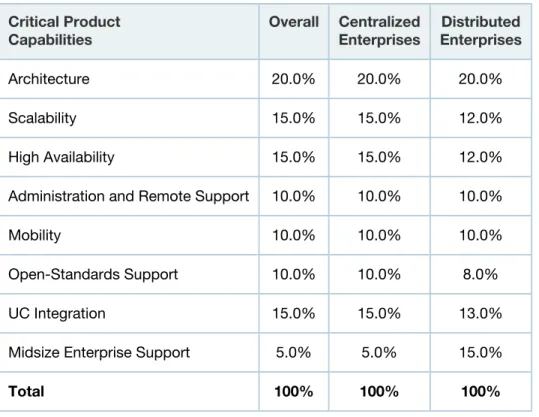
Table 1. Weighting of Critical Capabilities in Use Cases
Critical Product
Capabilities
Overall
Centralized
Enterprises
Enterprises
Distributed
Architecture
20.0%
20.0%
20.0%
Scalability
15.0%
15.0%
12.0%
High Availability
15.0%
15.0%
12.0%
Administration and Remote Support
10.0%
10.0%
10.0%
Mobility
10.0%
10.0%
10.0%
Open-Standards Support
10.0%
10.0%
8.0%
UC Integration
15.0%
15.0%
13.0%
Midsize Enterprise Support
5.0%
5.0%
15.0%
Total
100%
100%
100%
Source: Gartner (October 2011)
Inclusion Criteria
We have included telephony solutions based on the following criteria:
■
Significant global market presence must occur in four or more of the eight critical capabilities
outlined in this research. Global market presence can be demonstrated in one of two ways —
by significant market share across two or more geographic regions worldwide, consistent with
Gartner market share research, or by differentiating innovation.
■
Sufficient sales, revenue and operational presence must support global market objectives.
■Providers must demonstrate an enterprise-premises telephony portfolio and products with
substantial and noteworthy customer references.
■
Vendor solutions must enable a full IP telephony product portfolio, even if components are
offered via partnerships.
Vendors Added
Vendors Dropped
HP was dropped this year because it no longer sells new VCX systems (which HP had acquired
from 3Com), and thus does not meet the inclusion criteria.
Critical Capabilities Rating
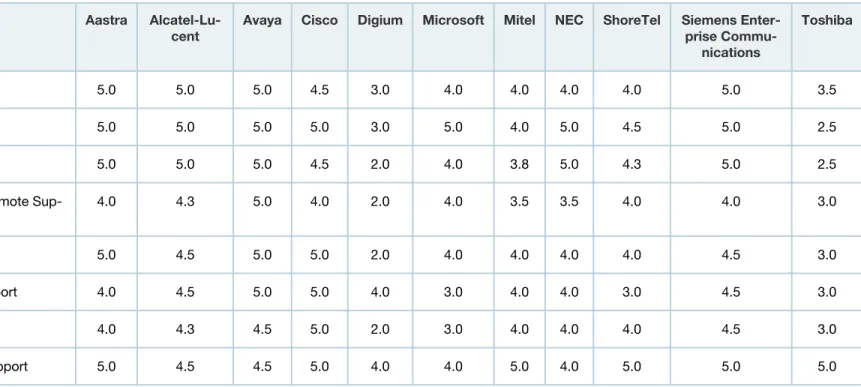
Each of the telephony systems that meets our inclusion criteria has been evaluated on several
critical capabilities (see Table 2 and Figure 1), on a scale from 1.0 (lowest ranking) to 5.0 (highest
ranking). The following vendors/products are included in this review:
■
Aastra
— MX-One
■
Alcatel-Lucent
— OpenTouch
■Avaya
— Avaya Aura
■
Cisco
— Unified Communications Manager (Unified CM)
■Digium
— Asterisk and Switchvox
■
Microsoft
— Lync Server
■
Mitel
— Mitel Communications Director
■NEC
— Univerge SV8500 and Sphericall
■ShoreTel
— ShoreTel 12
■
Siemens Enterprise Communications
— OpenScape Voice
■Toshiba
— IPedge and Strata CIX
Table 2. Product Rating on Critical Capabilities
Product Rating Aastra
Alcatel-Lu-cent Avaya Cisco Digium Microsoft Mitel NEC ShoreTel Siemens Enter-prise Commu-nications
Toshiba
Architecture 5.0 5.0 5.0 4.5 3.0 4.0 4.0 4.0 4.0 5.0 3.5
Scalability 5.0 5.0 5.0 5.0 3.0 5.0 4.0 5.0 4.5 5.0 2.5
High Availability 5.0 5.0 5.0 4.5 2.0 4.0 3.8 5.0 4.3 5.0 2.5
Administration and Remote
Sup-port 4.0 4.3 5.0 4.0 2.0 4.0 3.5 3.5 4.0 4.0 3.0
Mobility 5.0 4.5 5.0 5.0 2.0 4.0 4.0 4.0 4.0 4.5 3.0
Open-Standards Support 4.0 4.5 5.0 5.0 4.0 3.0 4.0 4.0 3.0 4.5 3.0
UC Integration 4.0 4.3 4.5 5.0 2.0 3.0 4.0 4.0 4.0 4.5 3.0
Midsize Enterprise Support 5.0 4.5 4.5 5.0 4.0 4.0 5.0 4.0 5.0 5.0 5.0
Figure 1. Overall Score for Each Vendor's Product Based on the Nonweighted Score for Each Critical
Capability
0 5 10 15 20 25 30 35 40 45
Avaya Cisco Siemens Enterprise Communications Alcatel-Lucent Aastra NEC ShoreTel Mitel Microsoft Toshiba Digium
Product Rating Chart
Architecture Scalability High Availability Administration and Remote Support Mobility Open-Standards Support UC Integration Midsize Enterprise Support
Source: Gartner (October 2011)
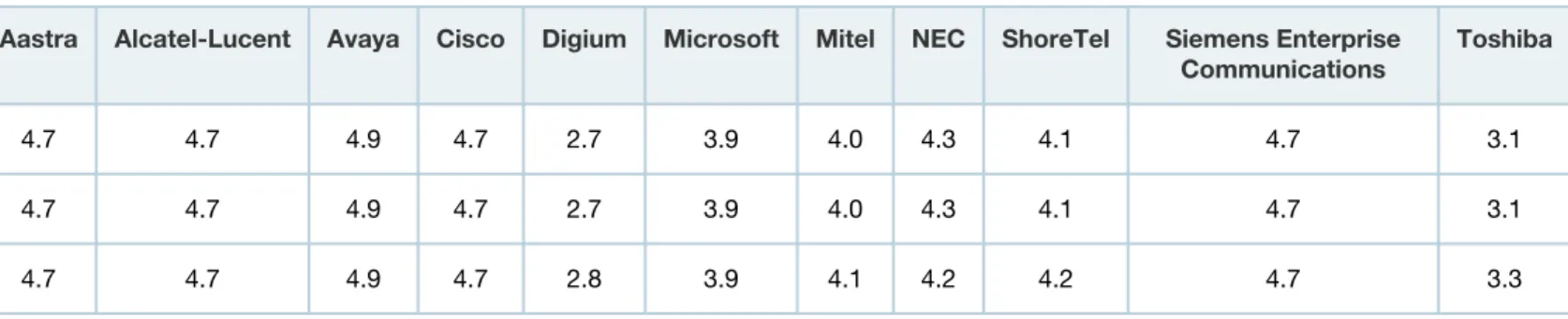
To determine an overall score for each product in the use cases, the ratings in Table 2 are multiplied
by the weightings shown in Table 1. These scores are shown in Table 3.
Table 3. Overall Score in Use Cases
Use Cases Aastra Alcatel-Lucent Avaya Cisco Digium Microsoft Mitel NEC ShoreTel Siemens Enterprise
Communications Toshiba
Overall 4.7 4.7 4.9 4.7 2.7 3.9 4.0 4.3 4.1 4.7 3.1
Centralized Enterprises 4.7 4.7 4.9 4.7 2.7 3.9 4.0 4.3 4.1 4.7 3.1
Distributed Enterprises 4.7 4.7 4.9 4.7 2.8 3.9 4.1 4.2 4.2 4.7 3.3
Product viability is distinct from the critical capability scores for each product. It is our assessment
of the vendor's strategy and the vendor's ability to enhance and support a product throughout its
expected life cycle; it is not an evaluation of the vendor as a whole. Four major areas are
considered: strategy, support, execution and investment. Strategy includes how a vendor's strategy
for a particular product fits in relation to the vendor's other product lines, its market direction and its
business overall. Support includes the quality of technical and account support, as well as customer
experiences with that product. Execution considers a vendor's structure and processes for sales,
marketing, pricing and deal management. Investment considers the vendor's financial health and
the likelihood of the individual business unit responsible for a product to continue investing in it.
Each product is rated on a five-point scale from poor to outstanding for each of these four areas,
and it is then assigned an overall product viability rating.
Table 4. Product Viability Assessment
Vendor/Product
Name Aastra Alcatel-Lu-cent Avaya Cisco Digium Microsoft Mitel NEC ShoreTel prise Communica-Siemens Enter-tions
Toshiba
Product Viability Good Good Excellent Outstanding Good Excellent Good Good Excellent Good Good
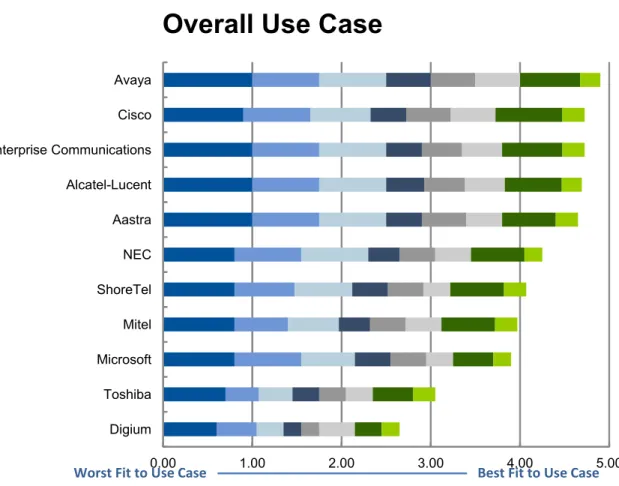
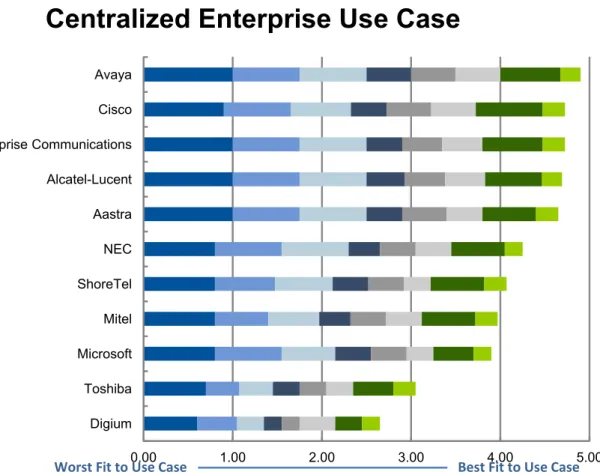
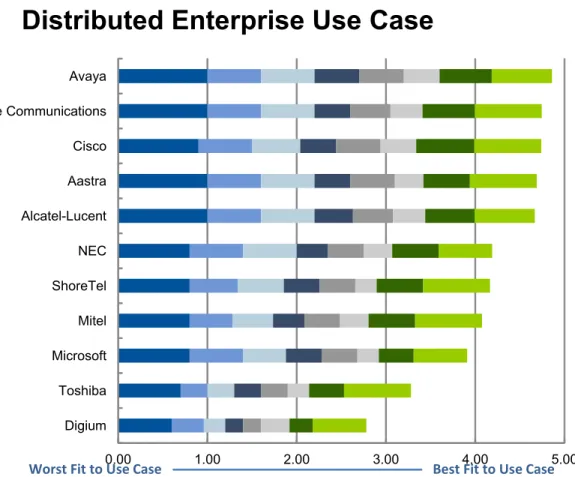
The weighted capabilities scores for all use cases are displayed as components of the overall score.
Figures 2, 3 and 4 show the three uses cases: overall, centralized enterprise and distributed
enterprise.
Figure 2. Overall Use Case
0.00 1.00 2.00 3.00 4.00 5.00
Avaya Cisco Siemens Enterprise Communications Alcatel-Lucent Aastra NEC ShoreTel Mitel Microsoft Toshiba Digium
Overall Use Case
Architecture Scalability High Availability
Administration and Remote Support Mobility Open-Standards Support UC Integration Midsize Enterprise Support
Best Fit to Use Case
Worst Fit to Use Case
Figure 3. Centralized Enterprise Use Case
0.00 1.00 2.00 3.00 4.00 5.00 Avaya
Cisco Siemens Enterprise Communications Alcatel-Lucent Aastra NEC ShoreTel Mitel Microsoft Toshiba Digium
Centralized Enterprise Use Case
Architecture Scalability High Availability
Administration and Remote Support Mobility Open-Standards Support UC Integration Midsize Enterprise Support
Best Fit to Use Case
Worst Fit to Use Case
Figure 4. Distributed Enterprise Use Case
0.00 1.00 2.00 3.00 4.00 5.00 Avaya
Siemens Enterprise Communications Cisco Aastra Alcatel-Lucent NEC ShoreTel Mitel Microsoft Toshiba Digium
Distributed Enterprise Use Case
Architecture Scalability High Availability
Administration and Remote Support Mobility Open-Standards Support UC Integration Midsize Enterprise Support
Best Fit to Use Case
Worst Fit to Use Case
Source: Gartner (October 2011)
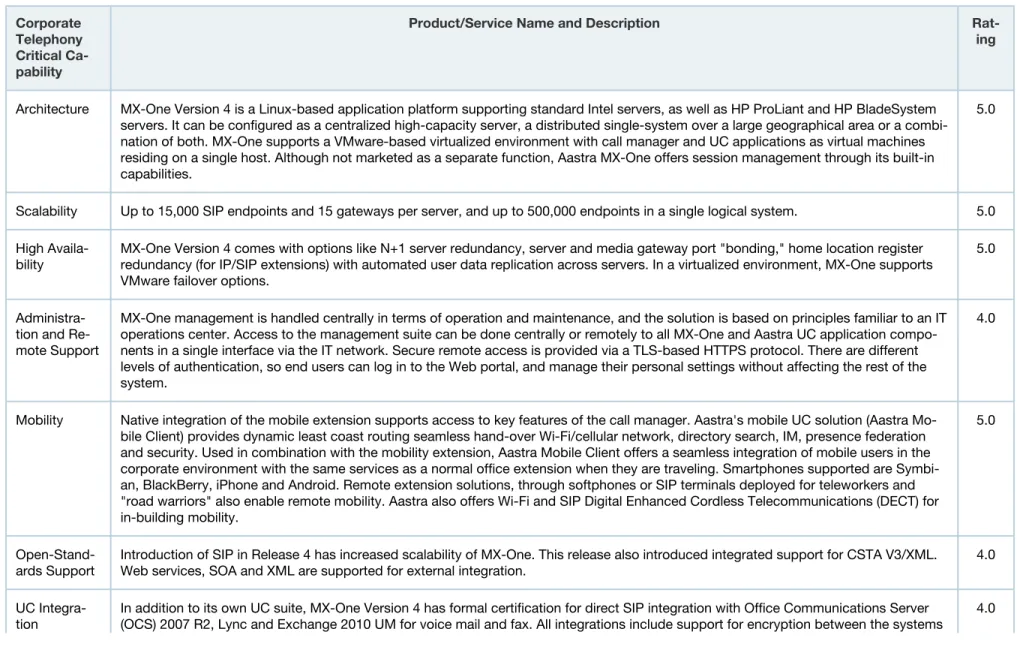
Vendors
Aastra
Table 5. MX-One
Corporate Telephony Critical Ca-pability
Product/Service Name and Description
Rat-ing
Architecture MX-One Version 4 is a Linux-based application platform supporting standard Intel servers, as well as HP ProLiant and HP BladeSystem servers. It can be configured as a centralized high-capacity server, a distributed single-system over a large geographical area or a combi-nation of both. MX-One supports a VMware-based virtualized environment with call manager and UC applications as virtual machines residing on a single host. Although not marketed as a separate function, Aastra MX-One offers session management through its built-in capabilities.
5.0
Scalability Up to 15,000 SIP endpoints and 15 gateways per server, and up to 500,000 endpoints in a single logical system. 5.0 High
Availa-bility
MX-One Version 4 comes with options like N+1 server redundancy, server and media gateway port "bonding," home location register redundancy (for IP/SIP extensions) with automated user data replication across servers. In a virtualized environment, MX-One supports VMware failover options.
5.0
Administra-tion and Re-mote Support
MX-One management is handled centrally in terms of operation and maintenance, and the solution is based on principles familiar to an IT operations center. Access to the management suite can be done centrally or remotely to all MX-One and Aastra UC application compo-nents in a single interface via the IT network. Secure remote access is provided via a TLS-based HTTPS protocol. There are different levels of authentication, so end users can log in to the Web portal, and manage their personal settings without affecting the rest of the system.
4.0
Mobility Native integration of the mobile extension supports access to key features of the call manager. Aastra's mobile UC solution (Aastra Mo-bile Client) provides dynamic least coast routing seamless hand-over Wi-Fi/cellular network, directory search, IM, presence federation and security. Used in combination with the mobility extension, Aastra Mobile Client offers a seamless integration of mobile users in the corporate environment with the same services as a normal office extension when they are traveling. Smartphones supported are Symbi-an, BlackBerry, iPhone and Android. Remote extension solutions, through softphones or SIP terminals deployed for teleworkers and "road warriors" also enable remote mobility. Aastra also offers Wi-Fi and SIP Digital Enhanced Cordless Telecommunications (DECT) for in-building mobility.
5.0
Open-Stand-ards Support
Introduction of SIP in Release 4 has increased scalability of MX-One. This release also introduced integrated support for CSTA V3/XML. Web services, SOA and XML are supported for external integration.
4.0
UC
Corporate Telephony Critical Ca-pability
Product/Service Name and Description
Rat-ing
(SRTP/TLS). It also supports direct SIP integration with IBM's Sametime Unified Telephony (SUT) 1.0 product suite. Aastra has a range of Lync-compliant IP handsets.
Midsize En-terprise Sup-port
The Aastra 700, a scaled down version of the MX-One with call control manager and a comprehensive range of UC applications prein-stalled on a single virtualized server environment, is tailored for the small or midsize business (SMB) market for easy deployment and maintenance. An installation wizard takes the customer data input and automatically runs a script to set up the initial system so that it's up and running in a short time. It can also be a branch office solution in a larger MX-One network.
5.0
Key Differentiators:
■
Aastra's strategy has been to acquire companies in the enterprise communications market,
which has helped the company expand its geographical presence in the global market and be
consistently profitable. However, implications could include higher costs for supporting different
acquired product lines.
■
MX-One offers a low cost of ownership in terms of product life cycle, upgrade costs and energy
consumption. It also has the MX-One-compatible Aastra 700 for 50 to 1,000 users as a branch
office solution.
■
Aastra has completed interoperability testing of all its call managers to support over 40 SIP
requests for comments (RFCs).
■
The MX-One and Aastra 700 platforms are available in EMEA, Central America/Latin America,
North America and Asia/Pacific. However, distribution in North America is very limited,
compared with enterprise platforms from competitors such as Cisco, Avaya and NEC.
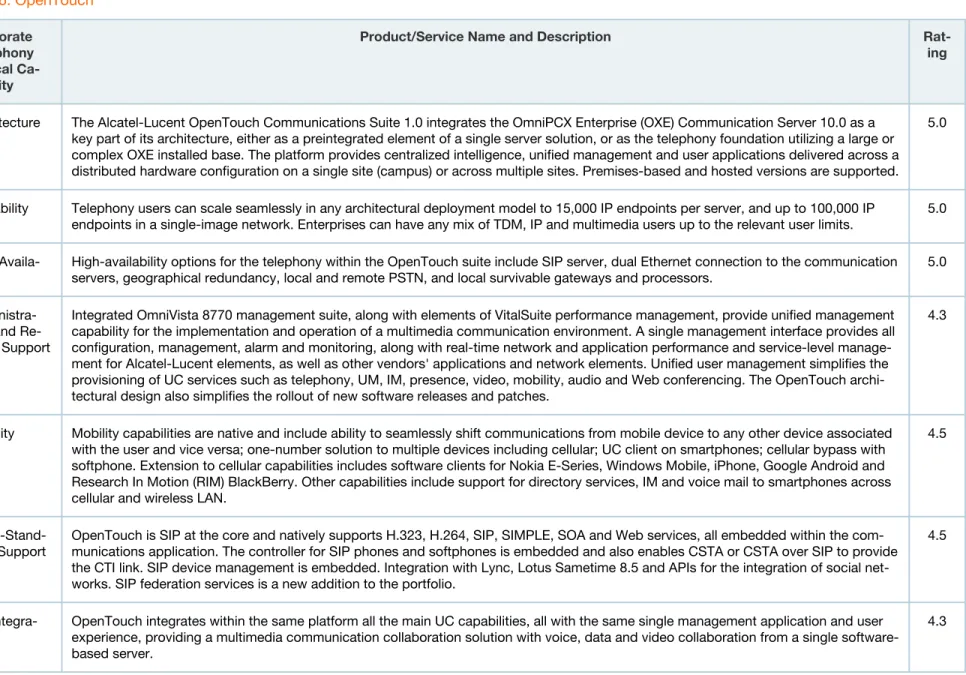
Alcatel-Lucent
Table 6. OpenTouch
Corporate Telephony Critical Ca-pability
Product/Service Name and Description
Rat-ing
Architecture The Alcatel-Lucent OpenTouch Communications Suite 1.0 integrates the OmniPCX Enterprise (OXE) Communication Server 10.0 as a key part of its architecture, either as a preintegrated element of a single server solution, or as the telephony foundation utilizing a large or complex OXE installed base. The platform provides centralized intelligence, unified management and user applications delivered across a distributed hardware configuration on a single site (campus) or across multiple sites. Premises-based and hosted versions are supported.
5.0
Scalability Telephony users can scale seamlessly in any architectural deployment model to 15,000 IP endpoints per server, and up to 100,000 IP
endpoints in a single-image network. Enterprises can have any mix of TDM, IP and multimedia users up to the relevant user limits. 5.0 High
Availa-bility
High-availability options for the telephony within the OpenTouch suite include SIP server, dual Ethernet connection to the communication servers, geographical redundancy, local and remote PSTN, and local survivable gateways and processors.
5.0
Administra-tion and Re-mote Support
Integrated OmniVista 8770 management suite, along with elements of VitalSuite performance management, provide unified management capability for the implementation and operation of a multimedia communication environment. A single management interface provides all configuration, management, alarm and monitoring, along with real-time network and application performance and service-level manage-ment for Alcatel-Lucent elemanage-ments, as well as other vendors' applications and network elemanage-ments. Unified user managemanage-ment simplifies the provisioning of UC services such as telephony, UM, IM, presence, video, mobility, audio and Web conferencing. The OpenTouch archi-tectural design also simplifies the rollout of new software releases and patches.
4.3
Mobility Mobility capabilities are native and include ability to seamlessly shift communications from mobile device to any other device associated with the user and vice versa; one-number solution to multiple devices including cellular; UC client on smartphones; cellular bypass with softphone. Extension to cellular capabilities includes software clients for Nokia E-Series, Windows Mobile, iPhone, Google Android and Research In Motion (RIM) BlackBerry. Other capabilities include support for directory services, IM and voice mail to smartphones across cellular and wireless LAN.
Corporate Telephony Critical Ca-pability
Product/Service Name and Description
Rat-ing
Midsize En-terprise Support
OpenTouch Business Edition supports telephony, UC and management capabilities with a single, industry-standard server for up to 1,500 users or 3,000 devices. To optimize the costs, the platform is provided in two platform sizes: up to 500 users and up to 1,500 users. Preintegrating all the software within OpenTouch enables customers to access the UC elements they require, but simplifies de-ployment and management.
4.5
Key Differentiators:
■
The combined R&D function of Alcatel-Lucent across enterprise, carrier and mobile offers
opportunities for sharing intellectual property that may enable Alcatel-Lucent to offer enterprise
customer stronger hybrid solutions such as OpenTouch. However, this differentiator is only
relevant if the company doesn't sell the enterprise business (see "OpenTouch Strategy in Flux
as Alcatel-Lucent May Sell Enterprise").
■
OpenTouch is a fully integrated communication platform supporting multimedia conversations
and rapid session shift across media and devices within the same conversation.
■
Alcatel-Lucent has a strong track record for deployment of scalable and highly available
communication systems, and offers incentives for platform migrations.
■
Alcatel-Lucent's historical market share and growth in Europe, strong position in the Middle
East and Africa, Central America/Latin America, Southeast and Northeast Asia, China, Australia
and New Zealand contribute to its ability to roll out global projects in North America. However,
distribution in North America is very limited, compared with enterprise platforms from
competitors such as Cisco, Avaya and NEC.
Avaya
Table 7. Avaya Aura
Corporate Telephony Critical Ca-pability
Product/Service Name and Description
Rat-ing
Architecture SIP-based architecture enables a centrally managed, enterprisewide UC architecture using physical or virtualized servers. A key feature is session management, which centralizes shared applications that can be deployed based on location-independent individual user profiles. 5.0 Scalability Avaya Aura scales from 250 users with the single-server midsize solution to 100,000 SIP endpoints in a globally distributed Aura Session
Manager-based configuration, plus analog, digital and H.323 endpoints, all using the same software. 5.0 High
Availa-bility Avaya Aura supports high-availability configurations with many levels of redundancy, including active/active Aura Session Managers, mul-tiple SIP registration paths, automatic application failover through Aura Session Manager, paired feature servers, survivable core server pools, survivable remote servers for branch locations, alternative media paths and alternative session border controllers (SBCs).
5.0
Administra-tion and Re-mote Sup-port
Avaya Aura System Manager is a standard package with Avaya Aura that provides centralized, browser-accessible administration for Avaya Aura core and surrounding applications, allowing IT departments to incorporate new components and applications under a com-mon management umbrella. In addition to previously included session management, presence services and Avaya Communication Man-ager, the company has expanded Aura System Manager 6.1 to cover Avaya Aura SBC, CS 1000, messaging, conferencing, media servers and Avaya one-X clients.
5.0
Mobility Avaya Aura supports broad mobility capabilities across simple cell-phones, smartphones, tablets, in-building Wi-Fi and DECT devices, teleworker and office "hoteling" solutions, and UC soft clients. The Avaya Desktop Video Device, with Avaya Flare Experience, supports campus roaming, home and remote site use of voice, video, IM, email and other communications. Avaya one-X Mobile 6.1 adds mobile presence, consolidated back-end services and expanded smartphone coverage to now cover newest release for Apple iPhone, RIM BlackBerry, Google Android and Nokia Symbian. Any mobile phone can be used for simpler "extension to cellular" mobile functionality, and with Avaya one-X Speech interface.
5.0
Open-Stand-ards Support Avaya support for standards includes MGCP, H.323, SIP, SIMPLE, SOA and Web services. Avaya Aura Session Manager provides nor-malization to a consistent implementation of SIP. Avaya ACE open-standards-based APIs, coupled with prepackaged network adapters, allow simple application integration across a multivendor infrastructure.
5.0
UC Integra-tion
SIP-based architecture integrates telephony into UC solutions. Application sequencing permits telephony integration with UC capabilities. Avaya ACE extends Avaya Aura UC capabilities to Microsoft Lync, IBM Sametime, CRM software, IBM Business Process Manager tool-sets and social business applications, while preserving existing user experiences and supporting device preferences. The Avaya Flare Ex-perience supports multimodal collaboration through a touch-based "spotlight" with consistent presence, context and content for voice,
Corporate Telephony Critical Ca-pability
Product/Service Name and Description
Rat-ing
video, IM, email, Web and social media. Flare for iPad (available in late 2011) and for Windows (available in early 2012) will add similar functionality to mobile devices and desktop PCs.
Midsize En-terprise Sup-port
Avaya Aura Solution for Midsize Enterprise 6.1 provides a complete Avaya Aura solution for up to 1,000 users in a single-server package, with a single point of management, which is video and presence/IM ready, has built-in voice mail and six-party conferencing, and sup-ports basic UC and mobility clients that can be further enhanced with additional application servers. Avaya B5800 Branch Gateways pro-vide centralized, distributed or mixed-mode operation, supporting local phones, including SIP, IP and legacy digital phones, with local telephony, mobility and selected UC functionality, including "key system" features often required in branches, while simultaneously acting as a SIP survivable gateway for other users with SIP devices connected directly to Avaya Aura Session Manager and centralized applica-tions.
4.5
Key Differentiators:
■
Global experience and a large market share in telephony and contact centers enable Avaya to
support midsize and large-scale deployments for organizations that are looking for a
sole-source solution, or need to address a heterogeneous environment.
■
Avaya actively markets Aura Session Manager to provide the basis for centralizing applications,
dial plan and trunking even across multivendor environments and the ability to assign
applications to users based on need, rather than on location.
■
Avaya Agile Communication Environment (ACE) is a SIP-based software platform that enables
UC and communication-enabled business applications. Avaya Flare Experience, Avaya one-X
Communicator and one-X Mobile clients strengthen Avaya's UC portfolio.
■
Avaya Flare Experience leverages context and information to yield a unique user experience
that simplifies collaboration across multiple modes of communication.
■
Enterprisewide, core and remote survivability options can be provided in various combinations
for backing up server failures or WAN outages.
■
Cost reduction initiatives appear to have reduced the quality and availability of Avaya's
technical support personnel, resulting in lengthened response times, which the company is
working to correct.
Cisco
Table 8. Unified CM
Corporate Telephony Critical Capability
Product/Service Name and Description
Rat-ing
Architec-ture Whether Cisco IP telephony is deployed on-premises, via the cloud or via a combination thereof, the same underlying Cisco architecture isutilized, with the same applications supported and same release versions offered. Deploying Cisco Unified Communications applications on virtualized servers supports the same deployment models as when physical servers are used. Also, the integration of physical servers (such as Cisco MCS servers) and Cisco Unified Computing System (UCS) virtual servers is supported in many cases. All the call processing de-ployment models described above are supported over Cisco UCS virtual server platforms, as well as Cisco-certified server options from IBM and HP. A session management version of Unified CM supports a centralized dial plan and call routing in a multivendor environment.
4.5
Scalability Cisco Unified CM is a SIP-based telephony platform that can support up to 40,000 IP phones, with a megacluster capable of supporting a total of 80,000 IP phones. Multiple clusters can scale into the hundreds of thousands. Session Management Edition can be used to inter-connect the clusters and third-party PBXs.
5.0
High
Avail-ability All Unified CM IP phones get a list of Cisco Unified CMs to register to, and if the one they are registered to fails, they will move to the nextone. All connections to TDM gateways can be set up as redundant, and if one fails, another one will be used. Backup servers can be used to avoid single points of failure. They support the Hot-Standby Router Protocol, and the redundancy options on the Cisco Unified Border Element (CUBE) include in-box redundancy with dual forwarding and control plans, as well as Layer 2 box-to-box redundancy with media preservation.
Cisco Enhanced Unified Survivable Remote Site Telephony (E-SRST) and Cisco Unified Survivable Remote Site Voice mail (SRSV) build on Cisco's Unified Survivable Remote Site Telephony (SRST) product to provide feature-rich survivability at the branch. Feature sets are em-bedded in the software running on Cisco Integrated Services Routers.
4.5
Administra-tion and Remote Support
For smaller and less complex implementations, Cisco Unified CM includes native tools for monitoring, managing, provisioning and trouble-shooting IP telephony. For larger implementations with multiple UC applications and infrastructure components, Cisco's Unified CM Suite 8.6 offers four individually available tools that include the following. Unified Operations Manager provides continuous monitoring, fault man-agement and troubleshooting. Unified Service Monitor provides real-time voice quality monitoring and alerting. Unified Provisioning
Corporate Telephony Critical Capability
Product/Service Name and Description
Rat-ing
Open-Standards Support
Supported standards include MGCP, H.323, SIP, SIMPLE, XMPP for IM/presence, SOA and Web services. Video transmission protocols are also supported. Unified CM Session Management Edition can be used to aggregate Unified CM clusters and third-party PBXs using SIP, H.323, Q.931, Primary Rate Interface (PRI), Basic Rate Interface (BRI) and QSIG. Cisco supports video calls between a Tandberg Movi client, a Cisco Telepresence EX90 and typical telepresence endpoints.
5.0
UC Integra-tion
Cisco UC 8.5 offers a full UC suite, as well as a broad range of additional communication functions. Key parts of the UC suite include, but are not limited to, Cisco Unified CM, Cisco Jabber (which includes the desktop client), Cisco Unity Connection, Cisco Unified Presence, Cisco Unified Videoconferencing, Cisco Client Services Framework and a broad range of client and device options. Cisco offers significant portions of its software on VMware, which can now operate under Cisco UCS servers and other qualified servers. Cisco also offers addi-tional communication and collaboration funcaddi-tionality, notably its contact center products, its Quad collaboration portal and the Cius tablet. Cisco partners offer communication-enabled business applications. Integration with Microsoft Lync/OCS and IBM Sametime are also sup-ported.
5.0
Midsize En-terprise Support
The Cisco Unified CM Business Edition 6000 contains voice, UM, mobility, IM/presence availability, contact center agent support and video capabilities. These features are integrated as an all-in-one system using VMware server virtualization technology, and support a capacity of 1,000 users and 100 contact center agents across up to 50 sites. The Cisco Unified CM Business Edition 3000 is a platform for businesses with up to 300 users across up to 10 sites, preloaded with features like messaging, mobility (single-number reach), conferencing, softphone and auto attendant, along with a management interface.
5.0
Key Differentiators:
■
Cisco leads in global market share shipments in enterprise telephony, with an effective
presence in most countries. The company's large global distribution network includes dealers,
system integrators, service providers and network outsourcers, all of which must comply with
Cisco's technology specialization and certification programs.
■
For organizations that prefer a single vendor to satisfy their UC requirements, Cisco UC 8.5
offers a full UC suite, as well as a broad range of additional communication functions. Key parts
of the UC suite include, but are not limited to, Cisco Unified CM, Cisco Jabber (which includes
the desktop client), Cisco Unity Connection, Cisco Unified Presence, Cisco Unified
Videoconferencing, Cisco Client Services Framework and a broad range of client and device
options.
■
Cisco emphasizes that a network composed of Cisco data gear is required to guarantee optimal
Cisco Unified CM performance.
Digium
Table 9. Asterisk and Switchvox
Corporate Tel-ephony Criti-cal Capability
Product/Service Name and Description
Rat-ing
Architecture Asterisk can be deployed in either a centralized or a distributed environment. In Asterisk 1.8, virtualization is supported that can
pro-vide additional deployment options. 3.0
Scalability Asterisk uses clustering to scale the telephony application to thousands of users. There is no specified limit, though a European carrier has scaled a cluster to support 100,000 subscribers.
3.0
High
Availabili-ty Through a clustered designed Asterisk can be implemented to provide high-reliability/high-availability services. This is inherently builtinto Asterisk today, and is restricted only by the customer's design and implementation. 2.0 Administration
and Remote Support
The command line interface (CLI) is accessible remotely via standard, secure tools, such as SSH and SNMP support for various internal data structures. The Asterisk Management Interface allows socket-based (clear or SSL-encrypted) interactions with the process for status and command interactions.
Switchvox has a Web-based GUI that provides access to all configuration, monitoring and diagnostics capabilities of Switchvox. The Extend API integrated into Switchvox enables users to create a custom interface into Switchvox, or to integrate Switchvox directly with their daily business processes.
Both Switchvox and Asterisk can be configured and maintained from anywhere an IP connection is available.
2.0
Mobility Asterisk and Switchvox users have the ability to implement a variety of IP endpoints for call termination and delivery. These endpoints can be desk phones (SIP or analog), Wi-Fi IP phones, DECT IP phones or softphones (PC client). Asterisk and Switchvox support sin-gle-number reach, which allows the IP PBX to deliver calls to a user's desk phone, home phone or cellular phone. Digium also supports iPhone and BlackBerry applications that integrate with Switchvox.
2.0
Open-Stand-ards Support
Asterisk and Switchvox have been certified by multiple Tier 1 and 2 carriers for interconnection to their SIP trunking. The list of stand-ards supported by Asterisk include SIP, IAX, H.323, MGCP, SNMP, H.263, H.264, Web Services, G.729, G.711, G.722 and the list goes on. Most of these standards are incorporated directly into Asterisk, and others are applications that integrate with Asterisk.
4.0
UC Integration Switchvox is Digium's UC solution with one-number reach, visual voice mail, voice mail to email, chat, integrated fax server, fax to email, presence and UM. Switchvox integrates with collaboration tools such as salesforce.com and SugarCRM. Switchvox Web 2.0 capabilities allow ease of integration of other Web-based business applications. Switchvox also integrates with desktop applications such as Outlook, Office and Firefox to support simple point-and-click dialing. These same capabilities are supported in Asterisk, and are available through a number of Asterisk partners.
Corporate Tel-ephony Criti-cal Capability
Product/Service Name and Description
Rat-ing
Midsize Enter-prise Support
Switchvox is targeted at SMBs, with simplified configuration management through a Web-based user interface. Asterisk support for small to large customers is accomplished via customer-specific solutions.
4.0
Key Differentiators:
■
While the development of Asterisk takes place in the community of open-source developers,
Digium has created its own VoIP PBX solution.
■
Digium is the owner, primary developer and maintainer of the Asterisk open-source project.
Digium derives revenue through the sale of telephony interface cards that are installed in
Asterisk deployments.
■
Digium also delivers a software-based VoIP PBX, Switchvox SMB, which is deployed on Digium
appliances and is sold through channel partners as a commercially supported solution. Since
both Asterisk and Switchvox are designed to support open standards, customers are able to
implement complementary solutions from other vendors for components such as Ethernet
switches, IP terminals and gateways.
■
Although most open-source telephony solutions now effectively embrace UC, the UC solutions
typically have more limited functionality than leading commercial proprietary products.
Microsoft
Table 10. Lync Server
Corporate Telephony Critical Ca-pability
Product/Service Name and Description
Rat-ing
Architecture Lync Server utilizes a client/server architecture comprising multiple servers grouped in "pools" for redundancy and scalability. Server virtu-alization using Hyper-V, VMware and other hypervisors is supported for all capabilities in Lync Server. 4.0 Scalability Lync Server supports up to 10,000 users per Enterprise Edition server and 80,000 users per pool. An unlimited number of pools may be
deployed in an enterprise. These numbers are based on a full UC traffic model, and include IM, presence, video, application and presenta-tion sharing and conferencing traffic, in addipresenta-tion to voice and multiple endpoints registered per user.
5.0
High
Availa-bility Lync Server can be architected for high availability, including options to deploy redundant servers within a pool to account for possibleserver failure; and redundant pools in single or multiple data centers to account for systemic data center failures. The servers can appear as a single system to registered clients, with transparent failover and essentially no loss of features, or in two data centers appearing as primary and backup systems with transparent failover, but a subset of features available immediately after failover. Local survivable gate-ways provide PSTN access in the event of a WAN failure, ensure high-quality communications on constrained WAN links, and provide an alternative path when constraint links are oversubscribed.
4.0
Administra-tion and Re-mote Sup-port
Administrators use the same tools to manage Lync that they use to manage other Microsoft data center elements, including Active Direc-tory, PowerShell, and System Center. Lync Server provides multiple levels of reporting and alerts via System Center Operations Manager to help administrators identify problems affecting organizational communications, including issues with equipment or services other than Lync Server. Alerts are provided for hardware and software components, including gateways, server pools and end-to-end service based on aggregate call statistics and mean opinion scores. The Lync client also visually indicates when network conditions are causing audio problems and when the user audio level is too low, either based on speaker volume or device placement. Lync also provides users with the ability to place test calls on demand to validate end-to-end configuration and quality from endpoint devices through the internal and external network.
4.0
Corporate Telephony Critical Ca-pability
Product/Service Name and Description
Rat-ing
party user agents to ensure that system users are properly authenticated, but requires additional effort for companies that wish to reuse existing SIP phones.
UC
Integra-tion Lync Server is a complete UC system, which is highly rated in the Gartner Critical Capabilities for UC research. It integrates with IP PBXsystems via traditional PBX networking methods, including gateways and SIP, and with other public and private IM systems. This research focuses on corporate telephony solutions that can stand alone. Unlike the other profiled vendors, Lync is not a stand-alone corporate ephony solution that integrates with UC offers from disparate vendors; instead, it is a complete UC solution that makes stand-alone tel-ephony optional.
3.0
Midsize En-terprise Support
Lync Server offers a single-server Standard Edition solution that can be paired with a third-party gateway to provide full UC, including all the voice features described herein, for up to 5,000 users. Additionally, Lync capability is available for SMBs as an online service through Office 365, providing for simple deployment, operations and management of your entire information worker software ownership.
4.0
Key Differentiators:
■
The Lync 2010 experience can start with a voice call, video, call, IM or a conference, and allows
the addition of other communication types as needed. That starts with IM and presence, as well
as audio, video and Web conferencing, and extends into voice and video through modification
of the current session. The user experience can be either desktop-oriented or phone-based,
with a range of partner IP desktop devices, with only Lync phones acting like regular phones.
■As a software company, Microsoft relies on partnerships with suppliers of servers, survivable
gateways and devices to provide a complete telephony solution.
■
Lync 2010 is well-suited to a data center deployment, with centralized SIP trunking and
centralized edge servers for remote access via the Internet.
■
Compared with its major competitors, Microsoft does not yet have an established direct or
indirect channel that is as strong in selling voice and telephony services. Furthermore, the
solution has a limited number of enterprise references using Lync as their sole telephony
solution, with most organizations retaining some existing PBX systems for contact center and
other highly specialized functions.
Mitel
Table 11. Mitel Communications Director
Corporate Telephony Critical Capability
Product/Service Name and Description
Rat-ing
Architec-ture Mitel supports an open, flexible hybrid architecture that can be deployed in both centralized and distributed environments. Its Mitel Com-munications Director software can be deployed on industry-standard servers or in a VMware environment, and it can integrate with third-party gateways and applications or its 3300 ICP controllers, which support both TDM and IP communication connectivity integrated within the same system. For distributed architectures, multiple Mitel Communications Directors are deployed, based on site/location across an organization.
4.0
Scalability Mitel Communications Director software scales from 20 users for single-site SMBs to 65,000 users operational as a single domain for large, multisite organizations. A single software stream and hardware family of products seamlessly serves small to large organizations. 4.0 High
Avail-ability For clients looking for redundant processors, Mitel Communications Director call control has been qualified to operate on two fault-tolerantservers from Stratus Technologies (2600 and 4500). As well as processor redundancy, these servers provide redundant array of independ-ent disks (RAID)-protected hard drives, dual hot-swappable power supplies and fans, and redundant network connections. A single copy of the software is installed, and in this model it is possible to remove the CPU module from one plane and the server will continue to function. As a basic service for enterprise users, Mitel Communications Director resilience offers the ability to host users from a third processor. This server can be geographically remote from the primary redundant server to offer protection from failures at a single site. Customers can choose to deploy a similar redundant hardware set up in a second data center, or in the case of a highly distributed organization the prefer-ence may be to use a Mitel 3300 ICP controller in the local site and offer a degree of security of service in the event of a WAN failure.
3.8
Administra-tion and Remote Support
Inherent within Mitel Communications Director and Mitel UC applications is an integrated browser-based management and provisioning ca-pability; i.e., single-screen provisioning per user for call control, messaging and applications. Also inherent in Mitel Communications Direc-tor is an automated database replication capability (called System Data Synchronization). This is a peer-to-peer protocol that is used in multisite configurations, where specific programming or database elements are defined to replicate automatically to all required systems within the network, thereby simplifying the provisioning and ongoing maintenance of common data.
3.5
Mobility
Options Mitel supports a device-neutral approach on its systems, with a high degree of functionality delivered to the mobile user. Mitel Communica-tions Director inherently provides a mobility feature called Dynamic Extension, where up to eight devices, including mobile phones, can be aggregated to a user's service profile, where these devices operate as one from the user's single PBX directory number, for both inbound and outbound calling. All devices ring concurrently on the incoming call. Users can dynamically manage the assignment of devices and numbers against their profile, including automated routing to devices based on simply changing the users' location/status setting. Mitel sells in-building wireless systems from Polycom for Wi-Fi and Ascom for Wi-Fi and DECT applications. Mitel Teleworker capability enables Mitel IP phones to be deployed at home or in remote locations, extensions over the Internet with no virtual private network (VPN)
Corporate Telephony Critical Capability
Product/Service Name and Description
Rat-ing
required. Mobile clients, including a Web client, are supported for smart mobile devices, including iPhones, iPads and Androids. Integration with RIM BlackBerry/RIM Mobile Voice System is also supported.
Open-Standards Support
Mitel's IP telephony solution, consistent with its Freedom Architecture, provides open standards to allow partners and customers to inte-grate custom applications. Open standards include SIP, XML, Web services and CSTA for call control, as well as SMDR, Active Directory, LDAP and CSV import/export and SNMP for management system integration, and a standard property management system interface for specialized vertical application integrations. Mitel Office Link Calling provides the unique ability to allow users to make secure telephony calls directly from their Web and mobile (smartphones/tablets) devices. Calls are controlled by the switch, and are governed by the user's class of service. Protocols supported include SIP, H.323, H.264 and SIMPLE for presence integration.
4.0
UC
Integra-tion The UC portfolio includes Mitel Communications Director for call control/PBX functionality; Mitel Unified Communicator Advanced for UCdesktop client and server-based presence and IM; and Mitel Applications Suite for UM, audio/Web conferencing, business analytics, speech auto attendant, mobile integration and basic customer service utilities. Mitel also supports integration with Microsoft OCS and IBM Sametime UC platforms. All Mitel UC applications are certified for implementation on VMware's virtualization platform, and will soon sup-port integration on VMware View for Desktop Virtualization.
4.0
Midsize En-terprise Support
The Mitel 5000 and Mitel Communications Director portfolio (including 3300 hardware appliances or server implementations) are designed for SMB and branch office implementations. In the case of the 5000, basic UC functionality such as UM and mobility have been embedded directly into the core software, and can be extended with Mitel Applications Suite and its Unified Communicator Advanced client family. The 3300 hardware controllers can also be equipped with an optional processor card, allowing the Mitel Applications Suite or other Linux-based applications to integrate and physically reside on the controller for a single-box UC solution. Mitel Communications Director can also be combined with Mitel UC applications, provisioned on a single server, allowing a complete business UC solution to exist on one server. This can also be deployed with the VMware virtualization platform, enabling a complete Mitel UC solution to coexist with other non-Mitel busi-ness applications on a single server.
5.0
Key Differentiators:
■
Mitel telephony solutions are typically deployed for midsize organizations, or in a network of
branch operations for larger enterprises. Although some of Mitel's solutions are available only in
North America, it also has a globally consistent infrastructure distribution capability, wide choice
in telephony applications from its Solution Alliance partners, and commensurate sales and
technical support.
■
Mitel supports a wide range of integrated UC applications, including wireless and wired remote
access, mobile twining and teleworker applications, data center virtualization, and managed
and hosted telephony services.
■
Partnering with VMware and others for communications server virtualization and telephony and
UC centralization into data centers has paid off. Its plans to maintain telephony integration with
critical UC partners such as Microsoft and IBM are supplemented with its own telephony
applications, services and hosting.
■
As part of Mitel's ongoing work to improve its financial position, the company has scaled back
some of its customer and channel support resources, which has resulted in some clients
reporting a negative impact on channel and customer responsiveness. In May 2011, Mitel
executives implemented structural changes within the company, including realignment of
resources to improve channel management as a key element to address this.
NEC
Table 12. Univerge SV8500 and Sphericall
Corporate Telephony Critical Ca-pability
Product/Service Name and Description
Rat-ing
Architecture Univerge Sphericall Unified Communications and Collaboration (UC&C) architecture has a distributed and multitechnology integrated ar-chitecture that includes the Sphericall and SV8500 product lines. Univerge SV8500 is an IP-based telephony system that can be de-ployed to midsize and large organizations. The system can also apply to small branch offices by integrating and networking with NEC's small system such as SV8300 and SV8100. NEC Univerge SV8500 IP communication server supports existing NEC systems, as well as analog, digital and IP terminals. Systems can be networked using NEC's signaling protocols Fusion Call Control Signaling (FCCS) and Common Channel Inter-Office Signaling (CCIS), as well as QSIG for multisite large network support.
4.0
Scalability Sphericall can scale linearly in a single domain to 30,000 endpoints in a single system. The SV8500 supports 4,000 endpoints per server, up to 16,000 endpoints in a single system, and up to 192,000 in a networked environment.
5.0
High
Availa-bility SV8500 redundancy is supported using hot standby for CPU and switch memory, power supply redundancy and optional survivable re-mote media gateway controllers. Using FCCS enables multiple SV8500 systems to be installed in separate locations, and to maintain call control via a secondary route if the primary control node is lost.
Sphericall's distributed architecture allows also for high availability by utilizing multiple servers running Sphericall software, which can be installed in different parts of the network to allow for dynamic load balancing. Integration with some media gateways allows for remote survivability when connection to the main site is lost.
5.0
Administra-tion and Re-mote Support
NEC's Enterprise Manager (Univerge MA4000) is a Web-based management system for SV Series systems that administrators can use to manage large networks from a local/remote site. Using LDAP, it also supports an autoprovisioning system that helps retrieve user ID information from the corporate directory.
Sphericall provides centralized graphical administration as part of the system's open Web services.
3.5
Corporate Telephony Critical Ca-pability
Product/Service Name and Description
Rat-ing
Internet application technologies used for application delivery enable easy integration with third-party and business Web applications as well.
NEC's UC for Enterprise (UCE) suite of applications enables SV8500 integration with OCS and IBM Sametime. The UCE application plat-form supports a full range of UC functionalities: presence, status, UM, IM, mobility, collaboration and voice/videoconferencing.
Midsize En-terprise Sup-port
The Univerge SV8100 and SV8300 target midsize businesses. They can be networked with the SV8500 for larger organizations that have many remote sites.
Sphericall can adapt to midsize business environments. For the branch office, remote configuration can be provided. A systemwide man-agement tool is provided to reduce the complexity of the branch office manman-agement.
4.0
Key Differentiators:
■
NEC's telephony platforms scale to meet the needs of small, midsize and large organizations.
Users must now evaluate the relative merits of Univerge and Sphericall solutions, depending on
their plans for basic or enhanced voice applications or more complete UC implementations and
integration into IT applications.
Buyer preferences will depend on the availability of NEC
distribution channels and support, which can vary by region.
■
Univerge SV8500 is highly compatible with NEC's previous generations of appliance-based
telephony. This preserves many options for NEC to migrate its large installed base of customers
to server-based IP telephony and Sphericall, NEC's software-based communications platform
for UC.
■
NEC is poised to benefit from its early development of virtualized telephony and UC
environments in data centers and cloud solutions with VMware and Hyper-V. Although NEC
maintains its strong abilities in telephony infrastructure, its focus on competing with other
telephony vendors is based on ensuring integration with UC suppliers like Microsoft, IBM and
Polycom for messaging, collaboration and videoconferencing.
■
NEC has an established channel and offers dealer certification programs to sell NEC's IP, PBX
and UC systems. However, not all dealers have the same level of experience supporting large
corporations.
ShoreTel
Table 13. ShoreTel 12
Corporate Teleph-ony Critical Capa-bility
Product/Service Name and Description Rating
Architecture Growing ShoreTel system capacity for software, trunks and users is accomplished by adding switch appliances that can be
ad-ministered collectively from a single Web-based centralized interface, regardless of where the switches are physically located. 4.0 Scalability The rack-mounted design enables users to increase the capacity of the system from four ports to 20,000 ports by adding
stack-able switches in a single image.
4.5
High Availability An N+1 distributed switch architecture supports telephony services in the event of a WAN or switch failure, with continued
avail-ability of core voice services. 4.3
Administration and
Remote Support System management and user provisioning tools are standard with an intuitive Web browser user interface. 4.0 Mobility The acquisition in 2010 of Agito Networks adds a seamless automatic hand-off between enterprise Wi-Fi networks and service
provider cellular networks for most popular smartphones. Mobility features include simultaneous ring and midcall moves to mo-bile devices, and support user interfaces resembling smartphones' native dialing application. Solution can also emulate Shore-Tel's desktop UC client, as well as those from other providers.
4.0
Open-Standards Support
ShoreTel supports popular standards, including SIP trunking, and third-party SIP telephones. ShoreTel's newest phones support MGCP and can support SIP. All future phones will exclusively be SIP-based.
3.0
UC Integration Integrated UC client supports IM, video, conferencing, presence and click to call. Interoperation with Microsoft Lync and IBM
Sametime is also supported. 4.0
Midsize Enterprise
Support The same ShoreTel system that scales from 10 to 20,000 users in a single system image can cost-effectively support midsizeorganizations with centralized or distributed deployments. 5.0
Key Differentiators:
■
ShoreTel switches are independent appliances, with software that supports built-in gateway
and server functions. Growing system capacity for software, trunks and users is accomplished
by adding switch modules that can be administered from a centralized interface, regardless of
where switches are physically located.
■
Gartner clients consistently report ShoreTel's low total cost of ownership, ease of installation
and administrative simplicity.
■
ShoreTel scales to 20,000 users without foregoing any initial investments, all on a single
platform.
■