1
Extended Master HRS
2015-2016
Contents
1. Goals /criteria 2. Content & structure 3. Certification
4. Admission and selection of students 5. Set up & schedule master 2014-2015
Contact:
Marianne van Woerkom, coordinator of the extended master’s program Human Resource Studies, T: (+31) 13-4662165 / 4662371, E: [email protected]
2
1.
Goals /criteria
The Extended Master Human Resource Studies (EMHRS) is a master’s program of one and half year, including three semesters. Within this extended master we offer three different tracks:
1. International/comparative HR (EMHRS-I). In this track students get the opportunity to broaden
and deepen their insights in international and comparative dimensions of HR. Students are offered a specific program at one of the universities who participate in this program, and are required to participate in courses for one semester at the partner university.
2. Professional traineeship (EMHRS-P). This track is open for students who want to get acquainted
to HR policies, systems and practices in a real life organizational setting. In this track students will do an internship in one of the partner organizations of the People Management Centre1 (PMC)
3. HR Analytics (EMHRS-A). This track has been developed for students who want to broaden and
upgrade their knowledge regarding HR workforce analytics. Within this track students will combine their master thesis project with participating in an ongoing research project within the department HRS and will be supervised by a senior researcher of the department.
During the first semester EMHRS students follow the courses of the regular (one-year) Master HRS at Tilburg University. The EMHRS-P students (track 2) will do an internship during semester two, and finish their master thesis in the third semester. The EMHRS-A students (track 3) will combine a HR-analytics/thesis project in semester two and three. The students who will follow the international/ comparative HR track (EMHRS-I, track 1) will follow courses at the partner university in the second or third semester depending on their choice for a specific partner university.
The general goal of the EMHRS is to provide our excellent students with relevant experiences and learning opportunities and to enhance their professional and academic skills and knowledge. The EMHRS is an extension and deepening of the regular graduate program. The specific goals for each track are listed below.
1The PMC is a platform for professionalization of human resources management (work, well-being and performance) aligned to the Department HRS for spreading and gaining knowledge in cooperation with professionals from the field.
3 Goals of track 1: International/ comparative HR
The student:
- gets to know different international and comparative perspectives on employment relationships and the management of employees;
- develops a critical and analytical perspective due to the confrontation with different cultural environments;
- develops the ability to operate in an international environment;
Goals of track 2: Professional traineeship
The student:
- broadens knowledge about organizational life and HR policies, systems and practices in a specific organizational setting and gets a better understanding for the strategic context of HR;
- has the opportunity to apply scientific theories and methods to practical problems; - develops social skills needed in occupational practice;
- gains insight in individual strengths and points for improvement;
- gets acquainted with a situation in which you have to maneuver between the interests and wishes of different stakeholders like managers, employees, work council;
- gets the opportunity to orientate on the labor market, and gets to know a potential employer.
Goals of track 3: HR Analytics
The student:
- gets the opportunity to analyze high quality data on work, wellbeing and performance in organizations;
- develops advanced research skills;
- has the opportunity to conduct advanced empirical research around academically relevant questions;
- has a head start position at the labor market because work force analytics become more and more important;
4
- gets the opportunity to deepen the knowledge of themes and issues that are relevant for research in HR Studies.
2.
Content & Structure
Track 1: International comparative HR
Content
The extended master in International/comparative HR takes a cross-cultural approach in order to provide the student with an -in depth understanding of the employment relationship in different international settings. Students can choose topics/courses from a broad range of subjects like organizational change and development, strategic management, international management and organizational behavior, comparative and/or international HRM and employee relationships. This track entails an international exchange in order to integrate theory and experience of living and studying abroad. Studying abroad will strengthen a critical and analytical perspective on human resource issues due to the confrontation with different international and cultural environments. Besides, it will enhance the understanding of cultural diversity. To accomplish an exchange of master students among different universities, we have put together an alliance of academic institutions dedicated to educating students in the field of human research studies and related topics like International Management, Industrial Relations, Work and Organizational Psychology, and
International Business Studies and Strategic Management. Each of the alliance members will offer a special program during one semester (30 ECTS) for the visiting students. This will give the selected students the opportunity to get a guaranteed place to follow a well-considered program of graduate courses at one of the host universities as an addition to and next to their regular master courses at their own university.
In 2015-2016 we will collaborate with five partner institutions: Catholic University of Leuven (KUL) in Belgium, Norwegian Business School (NBI) in Oslo in Norway, Bocconi University in Milan, Italy, University of Innsbruck in Innsbruck, Austria and North West University in Potchefstroom, South Africa. The emphasis of the exchange program at KUL will be on strategic management and labor economics, at NBI on organizational behavior and change, at NWU on HRM and labor relations, at
5
the University of Innsbruck on consulting and change and at Bocconi on management in general. All institutions have excellent academic reputations and are institutional preferred partners of Tilburg University.
Structure
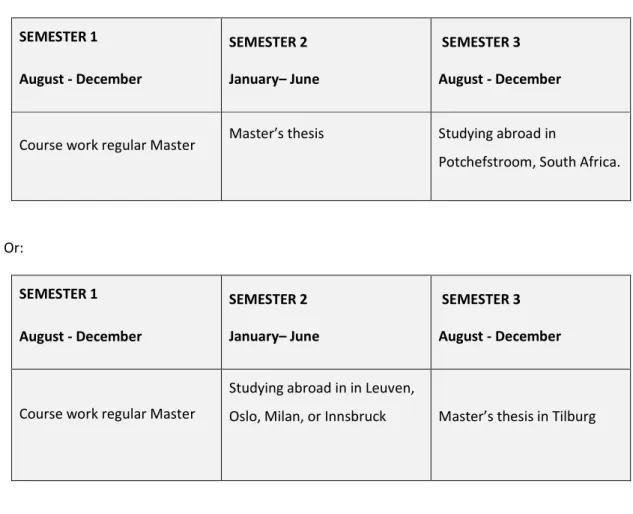
The duration of the Extended Master program is one and half year. The program offers the course work of the regular Master HRS in the first semester. Students will study abroad during the second semester (for all partner universities except for NWU in South Africa) or the third semester (for NWU in South Africa). The structure of the EMHRS-I is as follows:
SEMESTER 1 August - December SEMESTER 2 January– June SEMESTER 3 August - December
Course work regular Master Master’s thesis Studying abroad in
Potchefstroom, South Africa.
Or: SEMESTER 1 August - December SEMESTER 2 January– June SEMESTER 3 August - December
Course work regular Master
Studying abroad in in Leuven,
Oslo, Milan, or Innsbruck Master’s thesis in Tilburg
6 Track 2: Professional traineeship
Content
The reason to offer a professional traineeship is to provide students with relevant work experience and to enhance their professional skills and knowledge. In the traineeship, students participate in regular work activities within the partner organization. They perform a wide range of HR activities for and commissioned by the partner organization. Their prime task is to take part in the various stages of new or existing HR projects. This can vary from projects on talent management, flexible workforce, new (digital) operating HR models, performance management and strategic personnel planning. Other tasks involve regular professional tasks normally undertaken by junior HR professionals at their level of qualification.
In order for the students to develop as a professional during their traineeship, their professional development is supervised by a representative of the partner organization, the professional supervisor. The professional supervisor and the student should have feedback/coaching sessions at least twice a month, in which the professional development of the student is discussed and in which the student gets feedback on his/her performance as a junior trainee. The basis for these sessions should be a personal development plan to be written at the start.
At the end of the traineeship students will have to hand in a trainee-report. This report gives an account of the activities performed and summarizes the students’ learning experiences during the traineeship against the background of the learning goals stated in the personal development plan. This personal development has to be agreed with the professional supervisor and written in the first few (3-5) weeks of the traineeship. In the report, students should also describe the HRM roles, and HRM systems and practices in the organization, and reflect upon them by using their knowledge and skills acquired during their Bachelor and (Pre) Master’s program.
The trainee-report should be written in English (10-12 pages), unless otherwise agreed with the partner organization. The trainee-report will be assessed by a committee consisting of the professional and the academic supervisor as either sufficient or insufficient. A short written evaluation of the trainee by the professional supervisor will be attached to the trainee-report.
7
Structure
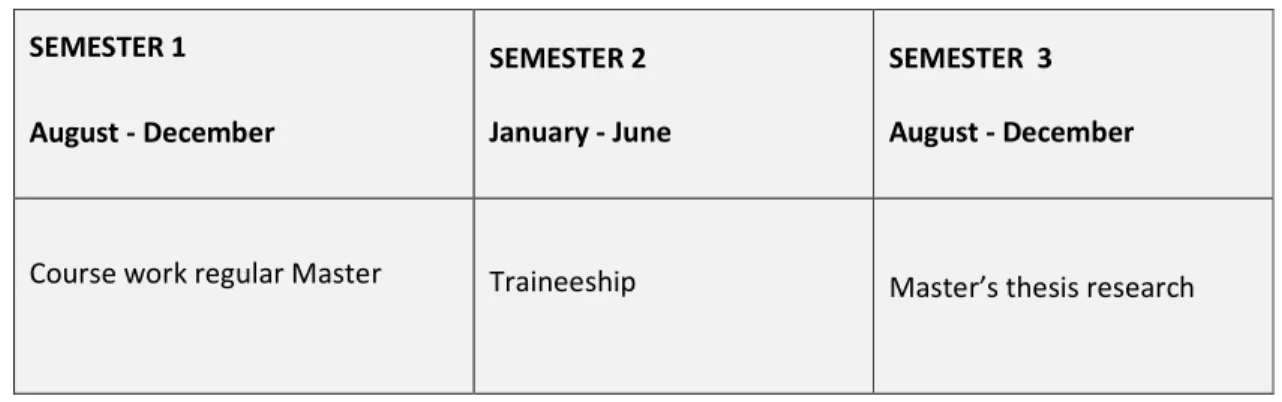
The duration of the Extended Master program track Professional Traineeship is one and half year. The program offers the course work of the regular Master HRS in the first, the traineeship in the second, and the Master’s thesis in the third semester. In the second semester students take part in an organizational HR project and participate in regular work activities for one of the partner
organizations of the PMC. In the third semester students will write their master’s thesis. The topic of the master’s thesis could focus around the work done in the HR project at the partner organization, but this does not necessarily need to be the case. The structure of the EMHRS-P is as follows:
SEMESTER 1 August - December SEMESTER 2 January - June SEMESTER 3 August - December
Course work regular Master Traineeship Master’s thesis research
Table 2: Global structure EMHRS-P
Track 3: HR Analytics
Content
The main reason to offer the HR analytics track is to provide students with relevant research
experience and advanced methodological skills for analyzing organizational data related to the theme of ‘work, employee wellbeing and performance’. In this traineeship, the students participate in an ongoing project on HR analytics within the department HRS. They perform a wide range of research activities for and commissioned by a senior researcher of the department (the supervisor). The students take part in various stages of the empirical cycle. This can vary from a review of the literature; the formulation of hypotheses; the setup of a research design; data collection; data analyses; co-authorship of a paper, presenting at a conference etc. Furthermore, if the research project is conducted at a client organization, students will communicate with the organizations, give
8
presentations etc. Additionally the students have to attend and pass an advanced statistics & methods course (6 ECTS) that is included in the Research Master program.
Within the boundaries of the broader research project, students formulate their own research question and hypotheses for their master thesis. The master thesis of the EMHRS-A student will be more advanced than a regular master’s thesis in at least one aspect of the research trajectory. This can be a ground-breaking theoretical framework, an inventive research design, innovative data collection, advanced data analyses etc.
On average, participating in activities for the whole project should amount to about 50% of the working time per week of the student. The rest of the week, students are occupied with writing their IRP, doing research for their Master’s thesis and writing their Master’s thesis.
In order to monitor the progress of their master thesis and to provide students with feedback, the students’ ongoing work will be at least fortnightly discussed with the supervisor. Furthermore, the supervisor also provides the student during these sessions with feedback on his/her development and on his/her performance as a researcher. The basis for this part of these sessions should be a personal development plan to be written at the start of the traineeship.
At the end of the traineeship students will have to hand in a report. This report gives an account of the activities performed and summarizes the students’ learning experiences during the traineeship against the background of the learning goals stated in the personal development plan. This personal development has to be agreed with the supervisor and written in the first few (3-5) weeks of the traineeship.
The trainee-report should be written in English (10-12 pages). The report will be assessed as either sufficient or insufficient by a committee consisting of the academic supervisor and a second reader of the department HRS. A short written evaluation of the trainee by the academic supervisor will be attached to the research trainee-report.
Structure
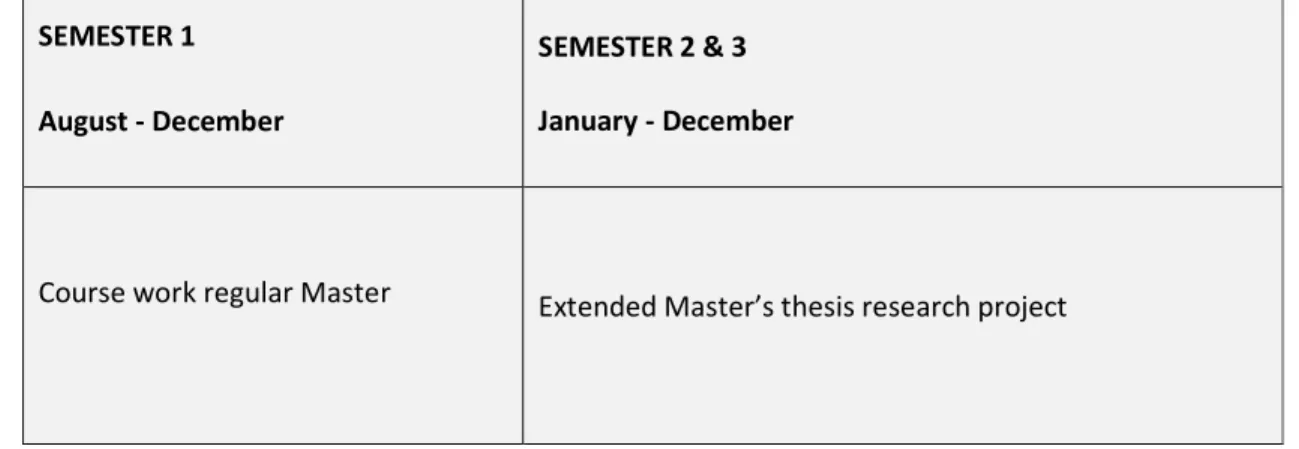
The duration of the Extended Master program is one and half year. The program offers the course work of the regular Master HRS in the first semester, in the second and third semester (12 months)
9
the student participates in an ongoing research project in the department HRS and write his/her Master’s thesis on a subproject of the research project. The structure of the EMHRS-R is as follows:
SEMESTER 1 August - December
SEMESTER 2 & 3 January - December
Course work regular Master Extended Master’s thesis research project
10
3.
Certification
Track 1: International comparative HR
Graduation will take place during an individual graduation ceremony (the procedure for the
graduation will be the same as in the master HRS). Students will receive a Master’s diploma HRS of 60 ECTS and a certificate of the international program of 30 ECTS issued by the Department of HRS and the partner university. The international program certificate is only awarded if the student receives the Master’s diploma.
In order to receive the Master’s diploma and the International comparative HR certificate, students who participate in the Extended Master (EMHRS-I) have to pass all courses of the Master HRS and of the international program, as well as their Master’s thesis.
Track 2: Professional traineeship
Graduation will take place during an individual graduation ceremony (the procedure for the
graduation will be the same as in the master HRS). Students will receive a Master’s diploma HRS of 60 ECTS and a professional certificate of 30 ECTS issued by the Department of HRS and the partner organization. The professional certificate is only awarded if the student receives the Master’s diploma.
In order to receive the Master’s diploma, students who participate in the Extended Master (EMHRS-P) have to pass all courses of the Master HRS as well as the Master’s thesis. Students have to complete the professional traineeship and their trainee-report should be positively evaluated by a committee made up of the academic supervisor and the professional supervisor (of the partner organization) in order to receive the professional certificate.
Track 3: HR Analytics
Graduation will take place during an individual graduation ceremony (the procedure for the
graduation will be the same as in the master HRS). Students will receive a Master’s diploma HRS of 60 ECTS and a HR analytics certificate of 30 ECTS issued by the Department of HRS. The research
11
In order to receive the Master’s diploma and the HR analytics certificate, students who participate in the Extended Master (EMHRS-A) need to pass all courses of the Master HRS, an extra advanced statistics & methods course as well as the Master’s thesis. Besides, students need to complete the research traineeship and their research-report should be positively evaluated by a committee made up of the academic supervisor and a second researcher (of the university).
12
4.
Admission and selection of students
The maximum number of students to participate in the extended master HRS program 2015-2016 for the different tracks will be:
- International comparative HR: max. 8 outgoing and 8 incoming students* - Professional traineeship: max. 8 students
- HR analytics: max. 6 students
*: At all partner institutions there will be two places reserved for HRS students to start in a special program, except for NBI (3 places) and Bocconi (1 place) .
This means that there will be places in the extended master for approximately one fifth of our master student population (the 20% most excellent master students).
Students who qualify for entry in the extended program have: I. chosen the MSc in Human Resource Studies;
II. completed their bachelor program in Human Resource Studies of 180 ECTS2; or III. completed the pre-Master program in Human Resource Studies of 60 ECTS; IV. not experienced study delay ( N.B.: an exception to this rules can be made if the
student can provide a proper reason) and obtained a GPA of 7 or higher (scale 1-10), and additional for the HR analytics track: GPA of 7 or higher (scale 1-10) on the Statistic & Method courses;
V. excellent social skills (as observed by the tutor in HR seminar)
VI. proven their sufficient motivation (also additional experiences and qualification will be taken in account) .
For the EMHRS-P track the partner organization will also be involved in the selection. Students interested in the EMHRS-P can only indicate their preference for a profit or non-profit organization but not for a specific organization! Their placement at a specific company will depend on the outcome of a matching process, including an interview with the PMC director Mr. Wilbert Buiter, an interview at the organization and sometimes also an assessment at the partner organization.
13
5.
Set up & Schedule master 2015-2016
Exact dates will be communicated on blackboard
What When
Kick off Master HRS with information on the extended master August/ early September
Extra information meeting for students interested in EMHRS Early September
Deadline application EMHRS-I September 15
Deadline application EMHRS-A and EMHRS-P End of September
Decision about admission to EMHRS-I by department HRS End of September
Decision about admission to EMHRS-A and EMHRS-P by department HRS October
EMHRS-A: job interview with supervisor of preferred project(s) October/ November