
Supporting Information
for
Tracking Surface Electron Shuttle using X-ray Spectroscopies in
La/Zr Hydroxide for Reconciliation of Charge Transfer Interaction
and Coordination towards Phosphate
Chao Xiang,a, b Hongjie Wang,*a Qinghua Ji,b Gong Zhang,*b and Jiuhui Qub,c
a College of Environmental Science and Engineering, Beijing Forestry University, Beijing 100083, China
b Center for Water and Ecology, State Key Joint Laboratory of Environment Simulation and Pollution Control, School of Environment, Tsinghua University, Beijing 100084, China
*Corresponding Author
E-mail address: [email protected] (H.J. Wang)
S1
Supplementary Notes
Supplementary Materials. Lanthanum nitrate hexahydrate (LNO, La(NO3)3·6H2O, AR) was purchased from Aladdin Industrial Co., China. Zirconium nitrate pentahydrate (ZNO, Zr(NO3)4·5H2O, AR), ethanol (EtOH, AR), Propylene oxide (PO, AR), potassium dihydrogen phosphate (KH2PO4, AR), HCl (AR) and KOH (AR) were all purchased from Sinopharm Chemical Co., China. All the dilutions were conducted by using Milli-Q water with a resistivity higher than 18.2 MΩ. All reagents were used without any further refinement.
S2
Supplementary Figures
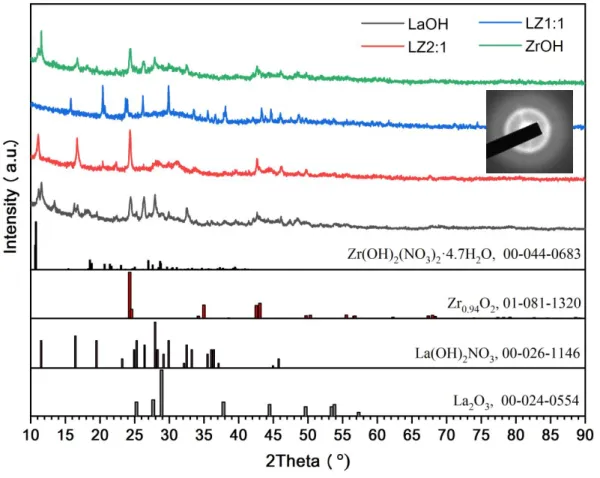
Figure S1. XRD patterns of the as-prepared La-, Zr-, and La/Zr hydroxide adsorbents (LaOH, LZ2:1, LZ1:1 and ZrOH samples). The inset image is the diffraction pattern was obtained with
S3
XRF
LaOH
LZ2:1
LZ1:1
ZrOH
Figure S2. SEM images of the as-prepared La-, Zr-, and La/Zr hydroxide adsorbents (LaOH, LZ2:1, LZ1:1 and ZrOH samples).
200nm
1μm
200nm
1μm
200nm 200nm
S4
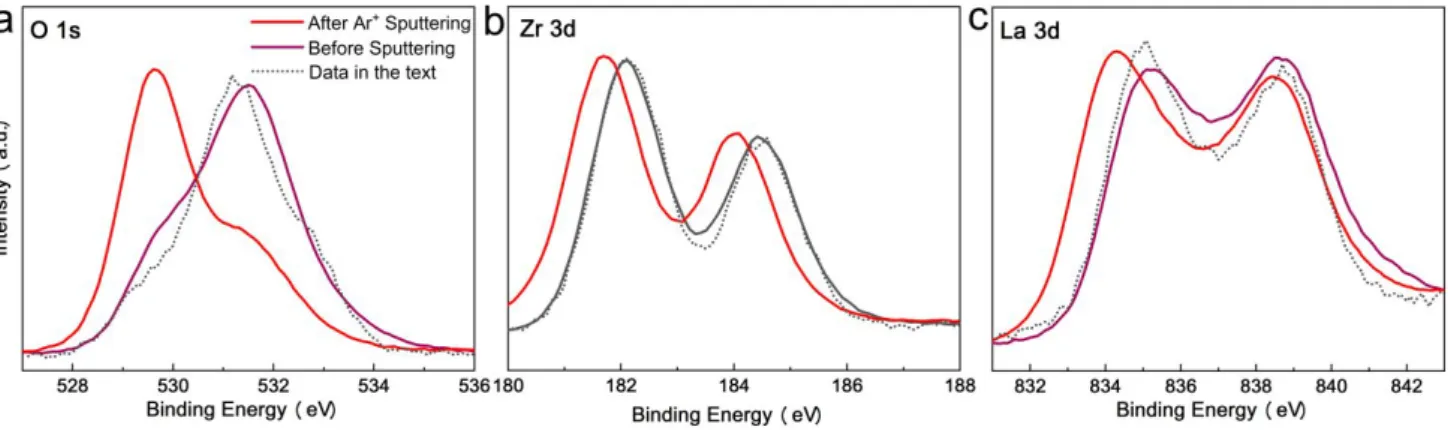
Figure S3. (a)O 1s, (b) Zr 3d and (c) La 3d XPS for the LZ1:1 sample before and after 2000 eV Ar+ sputtering, comparing with that of spectra in text. Firstly, the spectra for the sample before sputtering and shown in original manuscript are very close both in spectral profile and peak position, showing the effectiveness of XPS technique. After sputtering, the spectral profile of O 1s has changed significantly, and the peaks position of Zr 3d and La 3d shifted to lower energy. The results suggested that the sputtering treatment exposed the bulk composite (lattice oxygen increased) and thus reduce the oxides (the shift to lower energy for Zr 3d and La 3d XPS). Although it is difficult to determine the true chemical state during the depth profiling using the ion sputtering, the elemental composition analysis is still reliable. The results showed that the deeper La/Zr composite is very close to the surface composite for the LZ1:1 sample.
S5
Figure S4. The qm of Langmuir isotherm model for as-prepared La-, Zr-, and La-Zr hydroxide adsorbents (qm – the maximum P-adsorption capacity).
S6
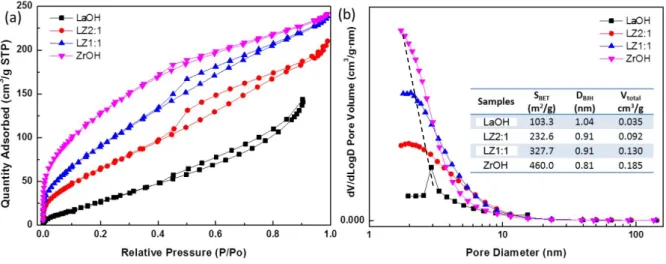
Figure S5. (a) N2 adsorption-desorption isotherms and (b) BJH distributions of the as-prepared La-, Zr-, and La-Zr hydroxide adsorbents (LaOH, LZ2:1, LZ1:1 and ZrOH), respectively. Inset table: BET parameters.
S7
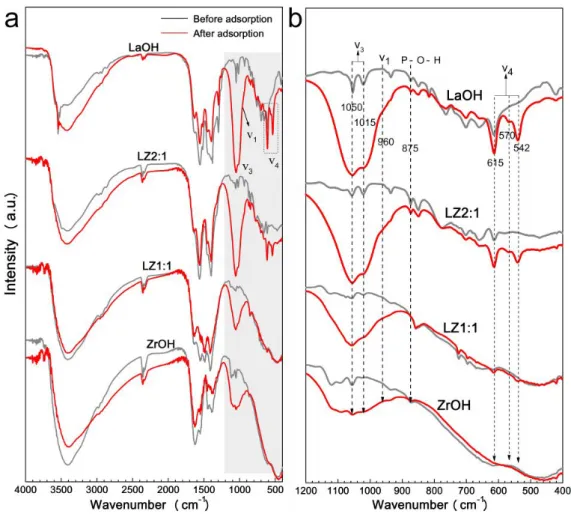
Figure S6. (a) FTIR spectra of the as-prepared La-, Zr-, and La/Zr hydroxide adsorbents before and after P
adsorption. (b) Magnified FTIR spectra of the rectangular area in (a). Experimental conditions: adsorbent dosage = 0.5 g L-1; initial P concentration = 50.0 mg L-1; pH = 7.0; adsorption time = 24 h.
S8
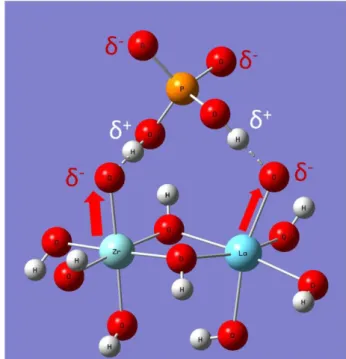
Figure S7. Schematic polarization interactions for the dipolar of aqueous HPO42-/H2PO4- on surface of the bimetallic La/Zr hydroxides.
S9
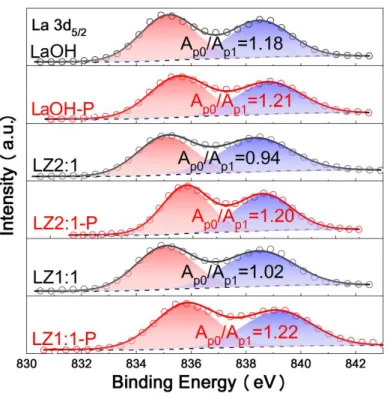
Figure S8. The analysis of two-splitting composition of La 3d5/2 XPS before and after phosphate adsorbed on La- and La/Zr hydroxide samples. Experimental conditions: adsorbent dosage = 0.5 g L-1; initial P concentration = 50.0 mg L-1; pH = 7.0; adsorption time = 24 h.
S10
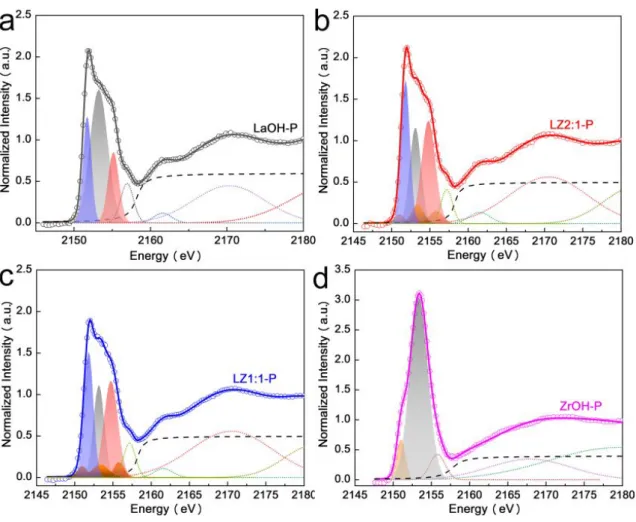
Figure S9. The peak fitting of P K-edge XANES for phosphate adsorbed LaOH (a), LZ2:1 (b), LZ1:1 (c) and ZrOH (d) samples. The detail fitting results were seen in Table S6.
S11
Figure S10. (a) the comparison of O K-edge XANES spectra for La-, Zr- and La/Zr hydroxide samples before and after phosphate adsorption, and (b) the schematic of their [MO6] MOs before and after phosphate adsorption.
S12
Supplementary Tables
Table S1. Detailed dosages in the synthesis process for La-, Zr, and La-Zr hydroxide adsorbents.
NO. Samples LNO(mg) ZNO(mg) PO(ml) EtOH(ml)
1 LaOH 5196 0 1.60 80
2 LZ5:1 4330 859 1.60 80
3 LZ2:1 3464 1717 1.60 80
4 LZ1:1 2598 2576 1.60 80
5 LZ1:2 1732 3435 1.60 80
6 LZ1:5 866 4293 1.60 80
S13
Table S2. Kinetic parameters for phosphate adsorption on La-, Zr-, and La-Zr hydroxide adsorbents. Samples
Models Parametersa
LaOH LZ2:1 LZ1:1 ZrOH
qe,exp (mg g−1) 32.7847 34.6487 36.4412 31.8563
qe,cal (mg g−1) 19.2752 24.2661 21.9786 22.9615
k1(h−1) 0.1626 0.1612 0.1893 0.1695
R2 0.8874 0.7597 0.9367 0.9559
Pseudo-first order model
Rate equation y=-0.0706x+1.285 y=-0.07x+1.385 y=-0.0822x+1.342 y=-0.0736x+1.361 qe,cal(mg g−1) 32.6797 34.7222 36.4964 32.0513
k2 (mg g−1h−1) 0.0620 0.0372 0.0552 0.0388
R2 0.9969 0.9927 0.9974 0.9941
Pseudo- second
order
model Rate equation y=0.0306x+0.0151 y=0.0288x+0.0223 y=0.0274x+0.0136 y=0.0312x+0.0251
a – qe,exp: the equilibrium adsorption capacity obtained by the adsorption kinetics experiment, mg g-1;
qe,cal: the equilibrium adsorption capacity calculated by the model of adsorption kinetics, mg g-1. Pseudo-first order kinetic model: qe qt qe k t
303 . 2 lg )
lg( 1
Pseudo-second order kinetic model:
e e t q t q k q t 2 2 1
To better understand the adsorption behavior, the data of kinetic studies were fitted to the pseudo-first-order model and the pseudo-second-order model seen in Table S2. It is known that if the calculated qe does not equate to the experimental qe, then the reaction is not likely to be a first-order reaction. From the experimental data, it can be observed that the calculated qe values are too low compared to experimental qe values and the correlation coefficient R2 (0.75-0.97) is bad. Thus, it can be concluded that adsorption of phosphate by the La/Zr hydroxide adsorbent samples does not follow pseudo first-order kinetics. However, the calculated qe values fit well with the experimental qe values and the correlation coefficient R2 is high (>0.99) for pseudo-second order mode, which indicates that the phosphate adsorption process by the La/Zr hydroxide adsorbent samples follows pseudo second-order kinetics, suggesting a chemisorption process.
S14
Table S3. Langmuir isotherm parameters for phosphate adsorption on La-, Zr-, and La-Zr hydroxide adsorbents with initial pH 7.0.
Samples qm
(mg g-1)
KL
(L mg-1) R2
LaOH 39.37 0.10 0.974
LZ5:1 70.42 0.12 0.984
LZ2:1 125.00 0.06 0.952
LZ1:1 163.93 0.04 0.945
LZ1:2 73.53 0.07 0.987
LZ1:5 38.31 0.11 0.980
ZrOH 39.37 0.09 0.992
Langmuir isotherm: qe=qm KLCe /(1+KLCe)
Table S3 shows fitting results the Langmuir adsorption isotherm model for phosphate adsorption on La-Zr hydroxide adsorbents at pH 5.0, 7.0 and 9.0. The fitting results of adsorption isotherm model indicated that the data of phosphate adsorption on the La/Zr hydroxide adsorbent samples were fitted better to the Langmuir model, clearly displaying that P adsorption behavior is a chemisorption process.
S15
Table S4. Comparisons of P adsorption capacity of various metal composites.
Adsorbents pH&T qm (mg g-1) Ref.
Fe-Mn binary oxide pH 5.6, 25 °C 10.83 Zhang, G. et al.1
Fe–Al binary oxide nanosorbent pH 4.0 16.40 Tofik A S et al.2
Ce-incorporated zinc ferrite no data 41.60 Wei Gu et al.3
Mg/Al-LDHs biochar pH 3.0, 23°C 81.83 Ronghua Lia et al.4
Manganese (Mg) oxide-doped aluminum
(Al) oxide (MODAO) pH 6.0, 25 °C 59.80 Wu, K. et al.
5
Zirconium (IV) hydroxide pH 4.0, 22°C 30.40 M.A.H. Johir et al.6
Am-ZrO2 nanoparticles pH 6.2, 25 °C 32.29 Su, Y. et al.7
ZrO2@Fe3O4 pH 7.0 15.98 Liping Fang et al.8
Fe3O4/ZrO2/ chitosan pH 3.0, 25 °C 26.50 Jiang H et al.9
ACF-ZrFe pH 4.0 26.30 Weiping Xiong et al.10
ZrO2@CMK-3 pH 3.0, 25 °C 29.82 Xiaoqiu Ju et al.11
Fe-Zr binary oxide pH 5.5, 25 °C 33.36 Ren, Z. et al.12
Ce0.8Zr0.2O2 pH 6.2, 25 °C 36.60 Yu Su et al.13
Fe3O4@C@ZrO2 pH 6.0, 25 °C 40.00 Wang W et al.14
Zirconic chitosan beads (ZCB) pH 4.0, 15 °C 61.70 Xin Liu et al.15
Lanthanum-modified zeolite pH 7.0, 40 °C 9.10 He Y et al.16
Lanthanum loaded biochar no data 15.12 ZH Wang et al.17
Flower-like mesoporous La@silica spheres pH 5.0, 25°C 44.80 Weiya Huang et al.18
La-MOFs pH 6.32, 25°C 46.32 Hua Liu et al.19 La(OH)3/ La0.5-PC composite pH 8.2, 25 °C 59.60/32.40 Koilraj P et al.20 Biomass-supported nano-La(III)
(hydr)oxides Ws-N-La pH 6.0, 25 °C 67.10 Qiu H et al.
21
La/Al−hydroxide composite pH 4.0, 25 °C 76.30 Rui Xu et al.22
Fe–Mg–La composite pH 6.0, 25 °C 135.41 Yang Yu et al.23
La hydroxides (LOH sample) pH 7.0, 25 °C 39.37 This study
La-Zr hydroxide
S16
Table S5. The deconvolution fitting results of O K-edge XANES spectra for the La-Zr bimetallic hydroxides.
Sample
s Eπ* Eσ* Esp Iπ* Iσ* Iπ*/Iσ*
LaOH 532.78 537.29 544.56 3.397 2.331 1.457
ZrOH 532.76 534.93 545.65 2.232 1.483 1.505
The energy positions and intensity of the first two (O 2p + M nd) orbitals (π* and
σ* ) and the broad [O 2p + M (n+1)sp] peak (n+1 sp) are designated as Eπ*, Eσ*, Esp
S17
Table S6. The fitting results of P K-edge XANES spectra for the phosphate adsorbed La/Zr hydroxides.
Samples EA’ EA EB IA’ IA IB σA' σA σB
LaOH-P 2151.73 2153.24 2155.16 1.773 4.708 1.551 0.548 1.168 0.724
LZ2:1-P 2151.81 2153.10 2154.81 2.492 2.13 2.839 0.574 0.731 0.912
LZ1:1-P 2151.83 2153.15 2154.73 2.287 1.983 2.654 0.601 0.709 0.908
ZrOH-P 2151.02 2153.37 / 0.981 9.102 / 0.574 1.194 /
E – Energy of the fitting peaks; I – Intensity of the fitting peaks; σ– Sigma of the fitting peaks. The peaks are fitted by Gaussian function. All values of La/Zr materials only show the La components owing to the negligible Zr.
Table S7. The comparison of the white-line peak position (EA) in P K-edge XANES spectra for the phosphate adsorbed La-/Zr-hydroxides with KH2PO4.
Samples EA ΔEA
KH2PO4 2152.60 0
LaOH-P 2153.24 0.64
ZrOH-P 2153.37 0.77
S18
Supplementary Reference
1. Zhang, G.; Liu, H.; Liu, R.; Qu, J., Removal of phosphate from water by a Fe-Mn binary oxide adsorbent. Journal of colloid and interface science 2009,335, (2), 168-74.
2. Tofik, A. S.; Taddesse, A. M.; Tesfahun, K. T.; Girma, G. G., Fe–Al binary oxide nanosorbent: Synthesis, characterization and phosphate sorption property. Journal of Environmental Chemical Engineering 2016,4, (2), 2458-2468.
3. Gu, W.; Xie, Q.; Xing, M.; Wu, D., Enhanced adsorption of phosphate onto zinc ferrite by incorporating cerium. Chemical Engineering Research and Design 2017,117, 706-714.
4. Li, R.; Wang, J. J.; Zhou, B.; Awasthi, M. K.; Ali, A.; Zhang, Z.; Gaston, L. A.; Lahori, A. H.; Mahar, A., Enhancing phosphate adsorption by Mg/Al layered double hydroxide functionalized biochar with different Mg/Al ratios. The Science of the total environment 2016,559, 121-9.
5. Wu, K.; Liu, T.; Ma, C.; Chang, B.; Chen, R.; Wang, X., The role of Mn oxide doping in phosphate removal by Al-based bimetal oxides: adsorption behaviors and mechanisms. Environmental science and pollution research international 2014,21, (1), 620-30.
6. Johir, M. A.; Pradhan, M.; Loganathan, P.; Kandasamy, J.; Vigneswaran, S., Phosphate adsorption from wastewater using zirconium (IV) hydroxide: Kinetics, thermodynamics and membrane filtration adsorption hybrid system studies. Journal of environmental management 2016,167, 167-74. 7. Su, Y.; Cui, H.; Li, Q.; Gao, S.; Shang, J. K., Strong adsorption of phosphate by amorphous zirconium oxide nanoparticles. Water research 2013,47, (14), 5018-5026.
8. Fang, L.; Wu, B.; Lo, I. M. C., Fabrication of silica-free superparamagnetic ZrO 2 @Fe 3 O 4 with enhanced phosphate recovery from sewage: Performance and adsorption mechanism. Chemical Engineering Journal 2017,319, 258-267.
9. Jiang, H.; Chen, P.; Luo, S.; Tu, X.; Cao, Q.; Shu, M., Synthesis of novel nanocomposite Fe3O4/ZrO2/chitosan and its application for removal of nitrate and phosphate. Applied Surface Science
2013,284, 942-949.
10. Xiong, W.; Tong, J.; Yang, Z.; Zeng, G.; Zhou, Y.; Wang, D.; Song, P.; Xu, R.; Zhang, C.; Cheng, M., Adsorption of phosphate from aqueous solution using iron-zirconium modified activated carbon nanofiber: Performance and mechanism. Journal of colloid and interface science 2017, 493, 17-23.
11. Ju, X.; Hou, J.; Tang, Y.; Sun, Y.; Zheng, S.; Xu, Z., ZrO2 nanoparticles confined in CMK-3 as highly effective sorbent for phosphate adsorption. Microporous and Mesoporous Materials 2016,230, 188-195.
12. Ren, Z.; Shao, L.; Zhang, G., Adsorption of Phosphate from Aqueous Solution Using an Iron– Zirconium Binary Oxide Sorbent. Water, Air, & Soil Pollution 2012,223, (7), 4221-4231.
13. Su, Y.; Yang, W.; Sun, W.; Li, Q.; Shang, J. K., Synthesis of mesoporous cerium–zirconium binary oxide nanoadsorbents by a solvothermal process and their effective adsorption of phosphate from water. Chemical Engineering Journal 2015,268, 270-279.
14. Wang, W.; Zhang, H.; Zhang, L.; Wan, H.; Zheng, S.; Xu, Z., Adsorptive removal of phosphate by magnetic Fe3O4@C@ZrO2. Colloids and Surfaces A: Physicochemical and Engineering Aspects
2015,469, 100-106.
15. Liu, X.; Zhang, L., Removal of phosphate anions using the modified chitosan beads: Adsorption kinetic, isotherm and mechanism studies. Powder Technology 2015,277, 112-119.
S19
by alkaline-activated and lanthanum-impregnated zeolite. Chemosphere 2016,164, 387-395.
17. Wang, Z.; Shen, D.; Shen, F.; Li, T., Phosphate adsorption on lanthanum loaded biochar. Chemosphere 2016,150, 1-7.
18. Huang, W.; Yu, X.; Tang, J.; Zhu, Y.; Zhang, Y.; Li, D., Enhanced adsorption of phosphate by flower-like mesoporous silica spheres loaded with lanthanum. Microporous and Mesoporous Materials
2015,217, 225-232.
19. Liu, H.; Guo, W.; Liu, Z.; Li, X.; Wang, R., Effective adsorption of phosphate from aqueous solution by La-based metal–organic frameworks. RSC Adv. 2016,6, (107), 105282-105287.
20. Koilraj, P.; Sasaki, K., Selective removal of phosphate using La-porous carbon composites from aqueous solutions: Batch and column studies. Chemical Engineering Journal 2017,317, 1059-1068. 21. Qiu, H.; Liang, C.; Yu, J.; Zhang, Q.; Song, M.; Chen, F., Preferable phosphate sequestration by nano-La(III) (hydr)oxides modified wheat straw with excellent properties in regeneration. Chemical Engineering Journal 2017,315, 345-354.
22. Xu, R.; Zhang, M.; Mortimer, R. J.; Pan, G., Enhanced Phosphorus Locking by Novel Lanthanum/Aluminum-Hydroxide Composite: Implications for Eutrophication Control. Environmental science & technology 2017,51, (6), 3418-3425.
23. Yu, Y.; Chen, J. P., Key factors for optimum performance in phosphate removal from contaminated water by a Fe-Mg-La tri-metal composite sorbent. Journal of colloid and interface science 2015,445, 303-11.


![Figure S10. (a) the comparison of O K-edge XANES spectra for La-, Zr- and La/Zr hydroxide samples before and after phosphate adsorption, and (b) the schematic of their [MO 6 ] MOs before and after phosphate adsorption.](https://thumb-us.123doks.com/thumbv2/123dok_us/8468806.2257733/12.892.257.637.107.622/figure-comparison-hydroxide-phosphate-adsorption-schematic-phosphate-adsorption.webp)
