Solution Overview
Network Service Points
In the developing world the cost of digital connectivity using traditional communications tech-nologies becomes increasingly prohibitive outside of urban areas. First Mile Solutions provides products and services that break this cost barrier and deliver the benefits of digital communica-tions to areas that are otherwise uneconomical to service.
Summary
The Internet is the nervous system of our planet and the billions of people who lack communications infrastructure do not see themselves as the ”last mile problem”. At First Mile Solutions, these last mile problems are seen as first mile opportunities for both operators and end-users.
Now, for under $1.00 per user, rural communities that have never seen a newspaper can use email, browse the Web, and have their own voicemail box using First Mile Solutions technology. Our tech-nology leverages two major trends that are rapidly driving costs down: WiFi (802.11x wireless) and digital storage. Essentially, we develop cached WiFi intelligence. First Mile Solutions is based in Cambridge, MA and holds patent-pending intellectual property based on research and development performed by management at the Massachusetts Institute of Technology (MIT).
SOLUTION
Providing a Digital Identity
For many of the people living in first mile areas, a wealth of knowledge and people are accessible on the Internet that can be relevant to improving their quality of life. However access to these re-sources generally requires both access to the Internet as well as a identity that can be used to access information and build relationships globally. A First Mile Solutions Village Area NetworkTMcan pro-vide users with an affordable way to have an email address and a phone number.
c
Extending the communications infrastructure
Network Service Points are the critical components of the networking platform. Efficient operation and ingenious use of the existing transportation and communication infrastructure allow services to be delivered affordably to end users. By dramatically reducing the cost of providing Internet access the Network Service Points allow cellular and wireline telco operators to cost-effectively distribute con-nectivity, attract universal service funds, and maximize ROI and network utilization.
Our approach of leveraging existing communication backbones to provide real-time connectivity and transportation infrastructure to provide store-and-forward connectivity offers a way to cost-effectively service rural communities. Analyses indicate that our technology can lower infrastructure costs to un-der $1 per user, as compared to over $1,000 per user for fiber and over $600 per user for cellular. Our technology focuses on the dominant uses of the World Wide Web including email and web browsing as well as novel applications such as Voice Mail Over IP (VMOIPTM). Ultimately our Network Service Points enable a smooth migration path to universal broadband connectivity.
Enabling new business applications
With a digital channel servicing a new population of uses, several additional services and applications are enabled. Custom implementations that support a wide variety of applications can be introduced into the system, increasing the impact of the network, and potentially increasing the average revenue each user of the system will provide. Some examples include telemedicine, e-government applications, distance learning and supply chain management.
Architecture
The reliable and preferably high-bandwidth Internet connection is called a Hub. Subscribers within an initial radius of the Hub can access the Internet on a standard real-time wireless Local Area Net-work (wLAN). Depending on the population size and concentration, this wLAN can be expanded into a real-time wireless Wide Area Network (wWAN) up to 5-15 km.
A unique capability of a VAN is the ability to cost-effectively distribute an Internet connection’s band-width as far as the road goes. A Network Service Point is deployed in real-time communication with the Hub. A Mobile Access Point (MAP) consists of a Network Service Point mounted on any vehicle (buses, motorcycles, boats, aircraft).
The MAP physically transports data to/from surrounding rural areas using a store-and-forward drive-by connection. At each access site a Network Service Point is deployed: this communicates with the MAP and completes the store-and-forward network. Each access site can support additional access sites, some of which may be mobile. As the MAP reaches an access site it automatically communi-cates with the access site over a broadband wireless connection and transfers that access site’s data. The MAP travels its route repeating this process at each access site. Upon its return to the Hub, the MAP connects to the real-time network and transfers all collected data.
Deployment Environments
Network Service Points are typically deployed in one of the following scenarios: • At the Hub, where a real-time network link is available.
• Within wireless range of the Hub, to provide a real-time wireless area network. • On the MAP, to extend the reach of the real-time network.
• At an access site, where services are delivered to end users.
With the diversity of installation scenarios, operational environments, and network size a wide range of capabilities are necessary in a Network Service Point.
First Mile Solutions has engineered Network Service Points that cover this wide range of application requirements while providing affordability, ease-of-use, and security. Network Service Points are de-signed for easy installation, maintenance and compatibility today while also providing a foundation for future products and services as they evolve: these options are outlined in Table 1.
Table 1: Operational Capabilities of Network Service Points
Series Access Site MAP Hub Bridging Billing VMOIP Web & Applications
NSP 250 *
NSP 300 *
NSP 500 *
NSP 1000 *
NSP 5000
* Requires an additional computer
Hub and Access site Network Service Points
NSP 250 A Network Service Point
Offers customers an easy to configure, easy to install, cost and power efficient autonomous Network Service Point that allows quick installation of a store-and-forward network. Support for multiple an-tennas allows operation in challenging RF environments, and the product comes preconfigured with all necessary equipment for installation, configuration and management.
Visit http://www.firstmilesolutions.com/products/datasheets/NSP250K.pdf for more information.
NSP 300 A Network Service Point
All the features and functionality of the NSP 250, with higher capacity and multiple 802.11b radios into a more capable network service point that provides increased network capacity and support for a wider wireless coverage area. Low cost/power and enhanced management tools round out the package and increase the volume of network traffic that can be handled. All necessary equipment for installation, configuration and management are included with the product.
NSP 500 A/G Network Service Point
All the features and functionality of the NSP 300 in the highest capacity basic network service point. Features support for both wider wireless coverage areas and real time network routing between net-work service points (subject to range limitations). Can be deployed at the hub and at access sites with high network volume (large numbers of users) as well as at the interface to the existing network infras-tructure as the gateway to an entire First Mile Solutions network. Includes network maintenance and administration tools and all necessary equipment for installation, configuration and management of the product.
Visit http://www.firstmilesolutions.com/products/datasheets/NSP500KG.pdf for more information.
NSP 1000 AV Network Service Point
All the features and functionality of the NSP 250, with additional support for the First Mile Solutions billing and voicemail platform, including up to 2 handsets, store-and-forward voicemail boxes for all users, and prepaid card billing and accounting.
Visit http://www.firstmilesolutions.com/products/datasheets/NSP1000KV.pdf for more information.
NSP 5000 KV Network Service Point
All the features and functionality of the NSP 1000KV, with support for an additional 2 handsets (up to 4 handsets total), hosting of both First Mile Solutions applications as well as third-party applications with no additional computer required and significantly enhanced storage (providing support for thou-sands of users).
Visit http://www.firstmilesolutions.com/products/datasheets/NSP5000K.pdf for more information.
Mobile Network Service Points
NSP 300 M Network Service Point
A mobile network service point that supports multiple 802.11b radios and omnidirectional antennas, remote management capability to allow easy expansion of the network, storage capacity to support up to 10 access sites and power-efficient operation enabling installation on any powered transportation equipment (including motorcycles). The product comes in environmentally sealed enclosures, with available power and mounting equipment for a number of installation environments.
Visit http://www.firstmilesolutions.com/products/datasheets/NSP300M.pdf for more information.
NSP 500 M Network Service Point
All the features of the NSP 500 M, with additional storage capacity for up to 25 access sites and self-configuring network setup (allowing easy addition of network edge locations without service in-terruptions).
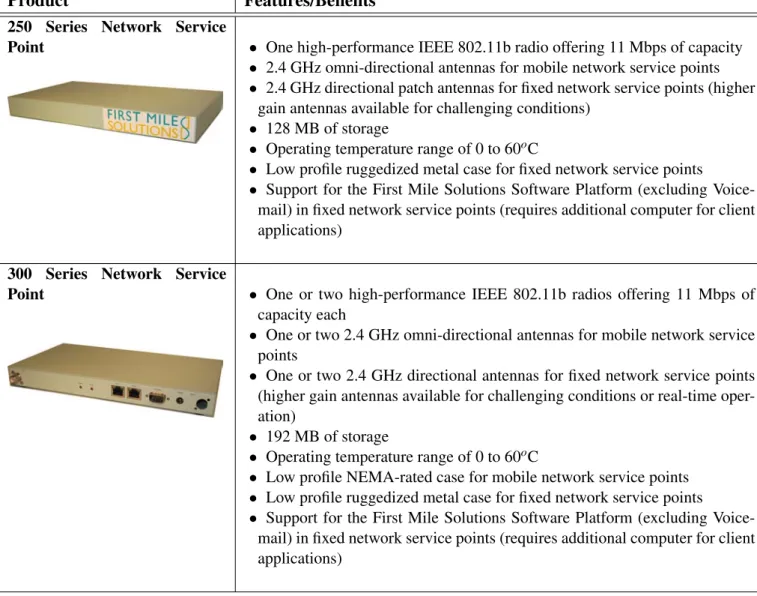
Table 2 summarizes the complete First Mile Solutions family of Network Service Points
Table 2: Network Service Points
Product Features/Benefits
250 Series Network Service
Point • One high-performance IEEE 802.11b radio offering 11 Mbps of capacity • 2.4 GHz omni-directional antennas for mobile network service points • 2.4 GHz directional patch antennas for fixed network service points (higher
gain antennas available for challenging conditions) • 128 MB of storage
• Operating temperature range of 0 to 60oC
• Low profile ruggedized metal case for fixed network service points
• Support for the First Mile Solutions Software Platform (excluding Voice-mail) in fixed network service points (requires additional computer for client applications)
300 Series Network Service
Point • One or two high-performance IEEE 802.11b radios offering 11 Mbps of capacity each
• One or two 2.4 GHz omni-directional antennas for mobile network service points
• One or two 2.4 GHz directional antennas for fixed network service points (higher gain antennas available for challenging conditions or real-time oper-ation)
• 192 MB of storage
• Operating temperature range of 0 to 60oC
• Low profile NEMA-rated case for mobile network service points • Low profile ruggedized metal case for fixed network service points
• Support for the First Mile Solutions Software Platform (excluding Voice-mail) in fixed network service points (requires additional computer for client applications)
500 Series Network Service
Point • One or two high-performance IEEE 802.11b radios offering 11 Mbps of capacity each
• One or two 2.4 GHz omni-directional antennas for mobile network service points
• One or two 2.4 GHz directional antennas for fixed network service points (higher gain antennas available for challenging conditions or real-time oper-ation)
• 256 MB of storage
• Operating temperature range of 0 to 60oC
• Low profile NEMA-rated case for mobile network service points • Low profile ruggedized metal case for fixed network service points • Support for real-time network routing and bridging
• Support for the First Mile Solutions Software Platform (excluding Voice-mail) in fixed network service points (requires additional computer for client applications)
1000 Series Network Service
Point • One high-performance IEEE 802.11b radio offering 11 Mbps of capacity • 2.4 GHz directional patch antennas for fixed network service points (higher
gain antennas available for challenging conditions) • 1 GB of storage
• Operating temperature range of 0 to 60oC
• Low profile ruggedized metal case for fixed network service points
• Support for the First Mile Solutions Software Platform in fixed network service points (including integrated Voicemail support; requires additional computer for client applications)
5000 Series Network Service
Point • One high-performance IEEE 802.11b radio offering 11 Mbps of capacity • 2.4 GHz directional patch antennas for fixed network service points (higher
gain antennas available for challenging conditions) • 40 GB of storage
• Operating temperature range of 0 to 60oC • Low profile case for fixed network service points
• Support for the First Mile Solutions Software Platform in fixed network ser-vice points (including integrated Voicemail support; requires no additional computer for client applications)
For more information about first mile solutions from First Mile Solutions, contact us or visit: http://www.firstmilesolutions.com
For more information about United Villages, contact us or visit: http://www.unitedvillages.com
Corporate Headquarters United Villages, Inc. 3 Bow Street, 1stFloor Cambridge, MA 02138 USA Sales: +1.617.395.6605
Customer Service: +1.617.395.8172 Fax: +1.617.497.6314