econstor
www.econstor.eu
Der Open-Access-Publikationsserver der ZBW – Leibniz-Informationszentrum Wirtschaft
The Open Access Publication Server of the ZBW – Leibniz Information Centre for Economics
Nutzungsbedingungen:
Die ZBW räumt Ihnen als Nutzerin/Nutzer das unentgeltliche, räumlich unbeschränkte und zeitlich auf die Dauer des Schutzrechts beschränkte einfache Recht ein, das ausgewählte Werk im Rahmen der unter
→ http://www.econstor.eu/dspace/Nutzungsbedingungen nachzulesenden vollständigen Nutzungsbedingungen zu vervielfältigen, mit denen die Nutzerin/der Nutzer sich durch die erste Nutzung einverstanden erklärt.
Terms of use:
The ZBW grants you, the user, the non-exclusive right to use the selected work free of charge, territorially unrestricted and within the time limit of the term of the property rights according to the terms specified at
→ http://www.econstor.eu/dspace/Nutzungsbedingungen By the first use of the selected work the user agrees and declares to comply with these terms of use.
zbw
Leibniz-Informationszentrum Wirtschaft Leibniz Information Centre for EconomicsRauscher, Michael
Working Paper
Interjurisdictional competition and the efficiency of
the public sector: The triumph of the market over the
state?
Kiel Working Papers, No. 732
Provided in cooperation with:
Institut für Weltwirtschaft (IfW)
Suggested citation: Rauscher, Michael (1996) : Interjurisdictional competition and the efficiency of the public sector: The triumph of the market over the state?, Kiel Working Papers, No. 732, http://hdl.handle.net/10419/47083
Kieler Arbeitspapiere
Kiel Working Papers
Kiel Working Paper No. 732
Interjurisdictional Competition and
the Efficiency of the Public Sector:
The Triumph of the Market over the State?
by
Michael Rauscher
Institut fur Weltwirtschaft an der Universitat Kiel
The Kiel Institute of World Economics
Kiel Working Paper No. 732
Interjurisdictional Competition and the Efficiency of the Public Sector: The Triumph of the Market over the State?
by
Kiel Institute of World Economics Dusternbrooker Weg 120, D - 24105 Kiel
Kiel Working Paper No. 732
Interjurisdictional Competition and the Efficiency of the Public Sector: The Triumph of the Market over the State?
by Michael Rauscher
March 1996
The author, not the Kiel Institute of World Economics, is solely responsible for the contents of each Kiel Working Paper.
Since the series involves manuscripts in preliminary form, interested readers are requested to direct criticism and suggestions directly to the author and to clear any quotations with him.
interjurisdictional Competition and the Efficiency of the Public Sector: The Triumph of the Market over the State?
Abstract
It has been argued in the literature that, interjurisdictional competition
forces the public sector to increase its efficiency and thus helps to tame Leviathan governments. The paper addresses this hypothesis by means of a simple tax-competition model with a Leviathan state. It is seen that the effects of increased factor mobility on the efficiency of the public sector are ambiguous. A calibration of the model shows that a reduction in public-sector efficiency is possible for parameter constellations which are not unrealistic.
JEL categories F20,H2l, H40, H73
1 Introduction
It is almost a commonplace in economic theory that free international trade and factor movements improve the allocation of the private factors of production in the economy. If barriers to mobility and to trade are removed, factors of production can move to the industries or to the locations where they are utilized most efficiently. It has been argued in the literature that not only the allocational efficiency of the private factors of production is enhanced by increased mobility but that also the public sector is driven to provide its goods in a more efficient way. The most prominent reference is BrennanlBuchanan (1980, ch. 9.2) but the idea has been taken up by others, e.g. by Dreze (1993), Giersch (1993) and
SiebertlKoop (1993). According to this view, mobility induces competition
amongst jurisdictions for mobile factors of production. The public sector, which provides the institutional and infrastructural framework in which economic activ-ities take place, plays an essential role for the attractiveness of a jurisdiction for these mobile factors. Increased competition from abroad, so the argument goes,
forces the public sector to become more efficient in the provision of its goods and services: the market triumphs over the state. Although there are plausible arguments as to why this hypothesis may be true, a closed model framework for its analysis is still missing. This paper fills the gap.
The inherent inefficiency of the public sector can be explained by a lack of control and supervision. Voters are rationally ignorant (see Downs (1957)) and this gives the policy maker discretion and the possibility to generate rents. A part of these rents are given to idiosyncratic interest groups in exchange for political support, but another part are appropriated by the public sector itself. See Niskanen (1977). Examples are leisure on the job in the public administration, status-seeking activities in bureaucratic hierarchies and insufficient care in the planning of public projects. From the point of view of the voter, this constitutes a waste of resources. I will join other authors and call such a state a Leviathan. 1
Like an X-inefficient firm, a Leviathan state does not produce on the edge of its production possibility set.2 The mechanism by which interjurisdictional compet-ition may reduce this inefficiency can be imagined as follows. With increased opennness, mobile factors of production leave jurisdictions with high levels of tax-ation and/or an insufficient supply of public goods and move to other jurisdictions where a. more attractive combination of tax rates and public-sector services is available. Emigration and capital flight reduce the incomes of the owners of immobile factors of production. The ^government, which is held responsible for these income losses, loses political support and its re-election probability declines. In order to regain political support, the government has to improve the
The Leviathan of Hobbesian political philosophy, in contrast, is a legitimate omnipotent state. Waste of resources is not among the criteria that constitute a Hobbesian Leviathan.
See Leibenstein (1966) and Frantz (1989) for X-inefficiency theory and Peacock (1983) for an attempt to apply the concept to the public sector.
attractiveness of the jurisdiction for mobile factors. This implies that the tax rates must be reduced, the supply of government services must be improved or both. In other words, the public sector is forced to increase its efficiency. Of course, the same argument applies to all jurisdictions involved in the inter-jurisdictional competition. Thus, so the argument goes, the forces of competition may help to repair an important deficiency of representative democracies: the waste of resources by the public sector of the economy.
Is this story logically consistent? In the literature, there are amazingly -only a small number of papers that are dealing with this question. Perhaps the first paper raising a question similar to the one to be addressed in this paper is the article by EpplelZelenitz (1981). They use a model of a Tiebout economy where residents are mobile but land is not. They show that even though people can vote with their feet, governments can still earn rents if the number of jurisdictions goes to infinity. The issues of competition for mobile factors of production and government efficiency are, however, not raised in this paper. Edwards/Keen (1994) address the question of whether welfare is increased when the mobility of a part of the tax base is increased. They show that there are two effects: the Leviathan state tends to be tamed and this raises welfare but a fiscal externality is created and this implies a sub-optimal provision of public consumption goods and, hence, a welfare reduction. Their model addresses questions that are different from those raised in the present paper: (i) they assume that government services are consumed but not used to attract the mobile factor of production and (ii) they do not explicitly deal with the question of whether or not the public sector is driven to use its resources more efficiently. The only author who deals with the issues raised here is Sinn (1992). He develops some building stones of a model framework and looks at the government of a single jurisdiction which reacts to capital flight induced by better mobility. The conclusion is that there are good reasons to assume that the Leviathan is tamed by the possibility of capital to move abroad. However, his
model is not closed since the behaviour of the rest of the world is not modelled explicitly. In my paper, in contrast, 1 use a Nash equilibrium approach in which the best responses of all governments are taken into account. It will be seen that the results differ from Sinn's (1992) conclusions.
The remainder of the paper is organized as follows. The next section introduces a very simple model of inter-jurisdictional competition which contains the elements essential for the discussion of the hypothesis. I will then in a first step derive a political-economic equilibrium for the closed economy. Afterwards, I introduce international factor mobility into the model and show how this affects the government efficiency. Since the results turn out to be ambiguous, I then use a cal-ibration of the model to obtain some rough estimates as to whether real-world Leviathans tend to be tamed by interjusrisdictional competition. The final section is devoted to, extensions of the basic model and some policy implications.
Before getting started, I wish to emphasize that the model underlying the analysis is hot meant to be a realistic picture of what is going on in the world. In contrast, I try to concentrate on the essentials and keep the model as simple as possible. This is no methodological problem here since the results are ambiguous already for the simplistic model. Adding realism and complexity would only introduce additional sources of ambiguity but would not alter the basic result.
2. A simple model of inter-jurisdictional competition
The basic structure of the model is borrowed from Zodrow/Mieszkowski (1986), and it is extended by the introduction of a Leviathan state. The world consists of many small identical jurisdictions, that will be labelled "countries" in what follows. The identity assumption makes the analysis rather convenient. Al-though factor mobility is considered, there will never be factor movements in this model ex post. However, government policies are influenced by the ex-ante mobility of factors, and this generates the interesting results of the model. 1 use a
Nash equilibrium framework: each government seeks the best response vis-a-vis the decisions made by the governments in the rest of the world. Since all countries are identical, we can use the notion of a representative country and avoid the use of subscripts or superscripts to identify particular countries.
There is a single aggregate good that can be used for different purposes. It may be consumed or it may be used as an input in the production process. Production of this good requires two factors of production, capital, k, and an input provided by the government, g. Capital is internationally mobile and each country
is endowed with a capital stock k0. Since k is the capital stock actually employed
in a country, k-k0 is the foreign capital installed in the country under consideration.
Ex ante, k-k0 matters; ex post, k-k0 is always zero. The two factors are combined
in a neoclassical production function f(k,g) exhibiting non-increasing returns to scale and the usual properties (positive first and negative second derivatives and a positive cross derivative). Let t be the tax revenue collected by the government and let r be the world market interest rate, which is given since the country is small. Then, consumable private income is
(1) y = f(Kg) -1 - r (k-k0).
A benevolent government would attempt to maximize y. The Leviathan has different objectives. They are described by a utility function with two arguments,
t-g and y. The same type of utility function has been used by Edwards/Keen (1994).
y is a proxy for political support. The larger the income of the representative individual, the larger the probability of the government to be re-elected. The other argument of the utility function is the consumption of the public sector itself, i.e. the share of the tax revenue which is not spent on the provision of the government good. This has to be imagined as a proxy for all kinds of inefficiencies of the public sector, including for instance leisure on the job, lacking care in the planning and monitoring of public-sector projects, status-seeking activities inside the
6
bureaucracy and the like. It is important to note that t-g is not a budget surplus. Let the utility function be strictly quasi-concave and have positive partial derivatives.
(2) u(t-g,y).
Tax revenue, t, is composed of two components. There is a lump-sum tax,
ft, and a tax on the mobile factor of production, fi. Thus the tax revenue is
(3) i = ft + fit
We look at a perfectly competitive world. Thus the capital stock installed in a single country is determined by the arbitrage condition
(4) --./ft--'* = r
where/^ is the marginal productivity of capital in the country under consideration. The marginal productivity of capital in this country exceeds the world market interest rate since capital owners have to pay the tax rate, fi. By application of the implicit-function theorem, we have
dk 1 (5) TT = 7 ~< 0 ,
dt hk
These results are intuitive. Low tax rates on capital and abundance of the public-sector input attract foreign capital. This concludes the exposition of the model.
The ultimate objective of this paper is to determine the effects of interjuris-dictional competition on the efficiency of the public sector. Before 1 define a measure of this efficiency, I wish to make more explicit what I mean by efficiency. In this model, there are two sources of government inefficiency. On the one hand, interjurisdictional competition affects the way in which the government generates its resources. An example is the fiscal-externalities problem known from the tax-competion literature, which leads to inefficent taxation and welfare losses. See
7
interjurisdictional competition affects the way in which the government uses its resources, in particular which share of the tax revenue it appropriates itself as a rent. Since it is the second type of inefficiency that constitutes a Leviathan state ans since my objective is to find out whether or not this Leviathan .is tamed by increased interjurisdictional competition and not to carry out a welfare analysis, I will use the this concept of efficiency. The appropriate efficiency measure then is the input-output ratio of the public sector.3 The input is the tax revenue and the output is the government good, g. Thus, the smaller tig, the smaller the tax revue necessary to finance the public-sector services and the greater the public sector's efficiency. For the graphical representation to be used later on it is convenient to modify this ratio slightly such that we have:
8 '
3. The closed economy
The reference case is that of complete capital immobility. All countries are autarchic. Maximisation of the government's objective function, (2) with respect to
g and / gives^
(7) fg = 1,
(8) u\ =
U2-A variable which measures the overall efficiency of the public sector including the efficency of the tax system is the income of the private sector, y. A similar cncept has been used by Edwards/Keen (1994). The underlying idea is that if the capital endowment and the technology-parameters are given the policy of the government ultimately determines the well-being of the people in the country. An efficient government should generate a larger income than an inefficient one. But this measure does not indicate whether or not a Leviathan government is tamed.
Note that the capital stock in a closed economy is fixed and, therefore, the incidence of a tax of capital is not different from that of a lump-sum tax.
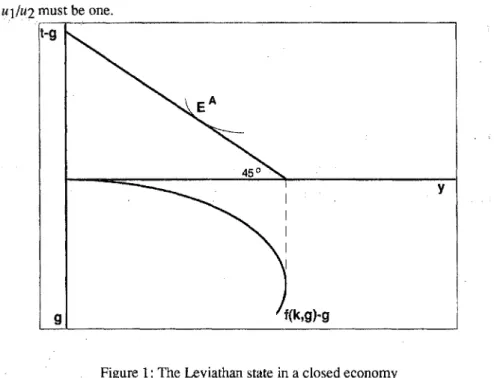
where the subscripts at the utility function denote its derivatives with respect to its first and second arguments, respectively. Equation (7) states that the public-sector input should be provided such that its marginal product equals its marginal cost. Since one unit of the aggregate good is used for the provision of one unit of the input, the marginal cost is one. Equation (8) describes the behaviour of the government vis-a-vis the trade-off between political support and its own con-sumption. Since one additional unit of political support (private income) costs the government one unit of its own consumption, the marginal rate of substitution,
u\/u:2 must be one.
Figure 1: The Leviathan state in a closed economy
These results can be illustrated by a simple diagram consisting of two parts. See figure 1. The lower part of this figure represents technology. It depicts the net production function, i.e. the output minus the quantity of the aggregate good which has been used up as an input: f{k,g)-g. This is a bell-shaped curve and its maximum is chosen by the government according to equation (7). The corresponding net
9 :
output would determine the private consumable income if the government were benevolent and maximized welfare. However, it is not benevolent but "steals" a part of the consumable income from the private sector. Each additional unit of con-sumption by the public sector is accompanied by a reduction in private consumption by exactly one unit. This is represented by the 45-degree line in the upper part of the diagram. This line is the locus along which the redistribution from the private to the public sector takes place. Finally, we introduce a system of indifference curves representing the government's preferences and the government's choice of the tax revenue is determined as the tangency solution, FA.
4. The open economy
Let us now turn to the case of an open economy. Initially I consider the case in which the government is not constrained in the choice of its tax instruments. Maximization of the objective function yields the following .first-order conditions: (9) MI = «2>
(10) fi = 0, (11) fg = I.5
It is seen that mobile capital is not taxed and that the supply of the government good and the distribution of income between the private and the public sectors is the same as in the case of the closed economy. The zero tax rate for the mobile factor is a well-established result in the tax-competition literature. See Diamond/
Mirrlees (1971). If the mobile factor were taxed, this would induce a distortion.
The pie to be shared between the private and the public sectors of the economy would be reduced. The leviathan wishes to maximize this pie and, therefore,
pre-Equation (9) follows from maximization of «(.,.) with respect to the lum-sum tax rate. The other two equations are derived from maximization with respect to g and ft, respectively. If (9) is used to eliminate the marginal utilities from the first-order conditions, one arrives at (10). (9) and (10) can then be used to derive (11).
10
fers non-distortive taxes. fg-\ follows from the fact that the capital tax rate is zero. Thus the positive effect of g on the tax base k cannot lead to increased tax revenue.
Let us now turn to the more interesting case where the government's set of instruments is constrained. We assume that there is an exogenous limit on the use of lump-sum taxes. The discussion on the poll tax in Great Britain and its failure in the end have demonstrated vividly that such an assumption is by no means unreal-istic. In this case, there is no interior maximum with respect to t° and the first-order conditions with respect to g and ft are
jt dk
0 3 ) • • . ; • • • di,
Equation (12) states that the government is indifferent between spending a marginal unit of income for trie provision of the government good and consuming this marginal unit. The direct gain from an increase in g is an increase in political support,/«, times the marginal utility derived from this support, u2- The direct cost is a reduction of the rent by one unit. This direct cost is diminished by an indirect effect since the increase in g helps to attract foreign capital and, thus, the tax revenue is raised by ft dkldg. The change in the rent is evaluated by its marginal utility, u\ . Equation (13) states that the utility gain from consuming an additional unit of tax revenue has to equal the loss due to the reducuon in political support that results from the corresponding reduction in private income. In the computation of the additional tax revenue, the government has to take into account that higher capital taxes induce capital flight and that, therefore, the marginal tax revenue is smaller than the tax base.
Let us define the capital-flight elasticity of the tax rate as dktk
T? = — r - < 0 dtk k
11
Then, the first-order conditions can be rewritten:
l-tkdk
(15)
7"
Using equations (5) and (6), one can rewrite equation (14) such that
These results can be interpreted as follows:
- From equation (14), we see that there are two effects of tax competition on the supply of the government good. The first one is to be found in the denominator and it is well-known from the tax-competition literature. The mobility of the tax base constitutes a fiscal externality and in the attempt to attract the tax base each single jurisdiction is forced to set a too-low tax rate. This reduces the tax revenue and, therefore, the supply of public-sector services. See Wilson (1986) and
ZodrowlMieszkowski (1986) for example. The second effect is due to the fact
that an increase in the supply of government goods attracts capital and therefore tends to raise tax revenue. There are, however, good arguments as to why the first effect dominates the second one here. From equation (14') it follows that
fg>\ and that, therefore, g will be smaller than in autarky,6 unless either the tax
rate is negative or the capital elasticity of the marginal productivity of the government good is larger than one. Both cases can be ruled out. The tax rate can be negative only if there is a binding lower bound to lump-sum taxation. This is the opposite of what has been assumed above. The empirical value of
6 fg>\ directly implies that g is smaller, since the capital stock does not change due to the assumption of identical countries.
12
capital elasticity of the marginal productivity of the government good is likely to be close to one third and, thus, smaller than one7
From equation (15), we have that the marginal rate of substitution is smaller than one. I.e. the opportunity cost of raising political support in terms of foregone utility from consumption of rent income has been reduced. Or - to put it the other way around - public-sector prodigality has become more expensive in terms of political support. The reason is that a part of the tax revenue the public sector hopes to consume vanishes through capital flight. This may be interpreted as a taming-of-leviathan effect.
A
g
t-g
g
v u
2/u, = *
)
1
y
Figure 2: The Leviathan state and the open economy
The empirical evidence is that the output elasticity of capital is close to one third. In the case of a Cobb-Douglas technology, the capital elasticity of marginal productivity takes the same value.
ies Instituts fur Weltwirtschef
13These two effects are depicted in figure 2. The autarky case is represented by bold lines. If capital is mobile, g is smaller than in autarky and, therefore, net production is no longer maximized. This means that the 45-degree redistribution line is shifted inwards. In this figure I assume homothetic government preferences and this explains in the positively sloped expansion paths depicted in the north-east quadrant of figure 2.8 The change in the rate of substitution implies that the equilibrium is moved downwards along the 45-degree line.9 The income share of the private sector has been increased.
It is seen that the impact of economic integration on consumable income, y, is ambiguous. It is reduced if the fiscal-externality effect dominates; it is raised if the taming-of-the-Leviathan effect dominates. *P In order to depict the prodigality measure, I map the quantity of the public-sector input, g, into the north-west quadrant via a 45-degree line and compare it to the public sector's consumption,
t-g. This gives two points, A for the autarky situation and / for the integrated
economy with perfect capital mobility. From these points, one can draw lines to the origin and the tangents of the angles included by these lines and the horizontal axis equal the inefficiency measure (t-g)/g. It is seen that for the example drawn here inefficiency has been increased. This shows that the efficiency of the public sector is not necessarily enhanced by an increase in factor mobility.
8 Homotheticity is used here to rule out income effects as a trivial source of "perverse" results. They will be discussed in the final section of the paper.
9 The 45° line is still the relevant budget line, at least ex post, when the fact is revealed that all governments have done the same thing and capital does not move. Ex ante, when each government takes the policies of the other countries as given, the budget line has the shape of a transformation curve and the marginal rate of transformation equals the marginal rate of substitution. This is what equations (12) and (13) express. 10 A similar result has been derived by Edwards/Keen (1994) in their model where the
14
Of course, the opposite result is also possible. Factor mobility may force the government towards more efficiency. The decisive parameters for these results are those determining the shapes of the indifference curves and the production function.
- In the preferences sphere of the model, the decisive parameter is the elasticity of substitution (as long as we confine ourselves to the case of homothetic prefer-ences). The elasticity of substitution between political support and public-sector consumption determines the size of the taming-of-the-Leviathan effect. The larger the elasticity of substitution, the larger will the reaction of the government be when the opportunity cost of consuming tax money is raised. Therefore, a large elasticity of substitution increases the likelihood of an increase in public-sector efficiency.
- The other parameter is the curvature of the net-production function, which depends on the production elasticity of the government good. Since this function is strictly concave in g, a reduction in g will always result in a less-than-proportional reduction in net output. This implies that the trade-off between rent appropriation and political support becomes less severe and, therefore, the propensity of the public sector to waste tax money is increased.
5. A Calibration of the model
It has been shown that it is by no means sure that interjurisdictionai competition forces the public sector to use its resources more efficiently. But is this result, intellectually challenging as it may be, of any practical relevance? In order to. get an intution, I calibrated the model using simple utility and production functions with realistic parameters. The production function is Cobb-Douglas and the utility function is CES:
15
a and fi are the production elasticities of private and public capital, respectively.
The empirical evidence concerning a is rather clear: a reasonable estimate of a is one third. In contrast, the value of fi is disputed. Aschauer (1989) has provided estimates exceeding 0.4. But recent research has shown that these values are un-reasonably high. See Gramlich (1994) for a survey and Holtz-Eakin (1994) for results based on more appropriate econometric methods. Some of the recent studies even come to the conclusion that fi is insignificantly different from zero, but the general punchline is that one should not expect j3 to be larger than 0.2. Thus, I used 0.1 and 0.2 as parameter values for fi.
The utility function has two parameters, o and <j). o is the elasticity of substitution, and I used different values ranging from 0 to 2 in the calibration, (j) is the ratio of the rent appropriated by the public sector to the income of the private sector. For the following simulations I used (j)=0.05, i.e. the public sector consumes 5 per cent of what the private sector consumes. Alternative values of (j> did not change the qualitative results of the model.
Equations (16) and (17) can be used to solve (141) and (15). Since the
resulting equations are not explicitly solvable, numerical procedures have been used to find the solutions. An additional assumption had to be made on the role of the lump-sum taxes. I assumed that it is possible to generate 50 per cent of the tax revenue by lump-sum taxation and that remainder that is covered by taxes on the mobile factor of production.
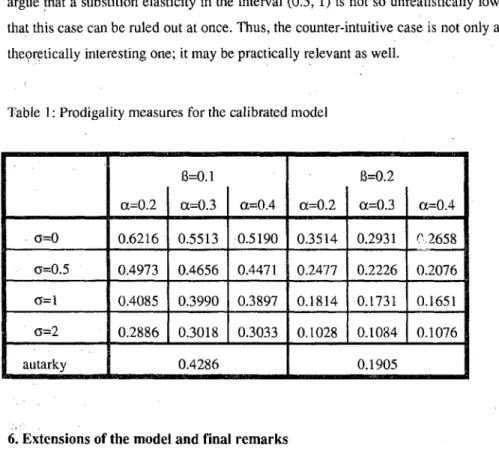
Table 1 shows the prodigality measures (t-g)/g. For instance the value 0.4286 in the last row means that the tax revenue collected exceeds the tax revenue necessary to provide the government good by 42.86 per cent. The last row represents the reference case, i.e. a situation without capital mobility and inter-jurisdictional competition. The other rows contain the results for the case where
16
capital is mobile. It is seen that the critical value of a where effect of inter-jurisdictional competition on public-sector efficiency changes from positive to negative is somewhere between 0.5 and 1, depending on the other parameters of the model. Empirical estimates of a , however, do not exist. Nonetheless, I would argue that a substition elasticity in the interval (0.5, 1) is not so unrealistically low that this case can be ruled out at once. Thus, the counter-intuitive case is not only a theoretically interesting one; it may be practically relevant as well.
Table 1: Prodigality measures for the calibrated model
o=0 a=0.5 G=l o=2 autarky a=0.2 0.6216 0.4973 0.4085 0.2886 8=0.1 a=0.3 0.5513 0.4656 0.3990 0.3018 a=0.4 0.5190 0.4471 0.3897 0.3033 0.4286 a=0.2 0.3514 0.2477 0.1814 0.1028 6=0.2 a=0.3 0.2931 0.2226 0.1731 0.1084 a=0.4 0.2658 0.2076 0.1651 0.1076 0.1905
6. Extensions of the model and final remarks
Interjurisdictional competition may enhance or reduce the efficiency of the public sector. The model framework in which this ambiguity has been derived is extremely simple. Would more realistic models come to different conclusions. I will discuss some possible extensions of the model of them briefly:
Non-homothetic preferences. If preferences are non-homothetic, anything
17
The most interesting case seems to be the one where the movement along the re-distribution line is reverted. This is possible if public-sector consumption is an in-ferior good, which is demanded in increased quantities as the pie to be shared , between the private and the public sector shrinks. Intellectually exciting as this scenario may be, it is rather unrealistic and probably not of major practical relevance.
Differences across countries. An explicit consideration of barriers to factor
mobility would make sense if countries were different. Although this may cause some inconvenience for the algebraic and diagrammatic derivation of results, the results should not be expected to change drastically. What has to be taken account of is that a removal of trade barriers in world of diverse countries induces gains from trade. These gains from trade will in this model lead to additional political support for the government. Thus it can afford to use a larger share of the tax revenue for its own purposes. In the capital-exporting country, this effect is
amplified by another one. The export of capital reduces the productivity of the;
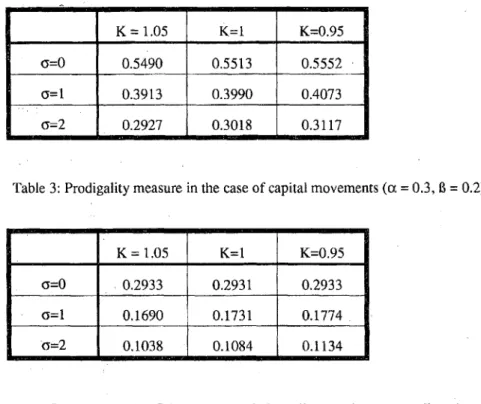
public input. Less of it will be supplied. The reduced necessity to supply g increases the public sector's discretion and, thus, the rent in can appropriate. The public sector, will become more inefficient. In the capital-importing country, in contrast, there is a need for more infrastructure capital and this tends to reduce the discretion of the government. Tables 2 and 3 show the results of the calibrated model for a country that import or export 0.05 units of capital. The reference case is k=l. It is seen that the public sector in a capital-exporting country (k =0.95) indeed becomes more inefficient as that in a country where net capital exports are zero. The effect is unclear for the capital-importing country (fc=1.05), but with the exception of the first row of table 3 the results tend to indicate that the increase in g (which reduces government discretion) dominates the gains-from-trade effect (that raises government discretion).
18
Table 2: Prodigality measure in the case of capital movements (a = 0.3, B = 0.1)
o=0 a=l o=2
K = 1.05 0.5490 0.3913 0.2927 K=l 0.5513 0.3990 0.3018 K=0.95 0.5552 • 0.4073 0.3117
Table 3: Prodigality measure in the case of capital movements (a = 0.3, 6 = 0.2)
o=0 o=l o=2
K = 1.05 0.2933 0.1690 0.1038 K=l 0.2931 0.1731 0.1084 K=0.95 0.2933 0.1774 0.1134
Large countries. I have assumed that all countries are small and cannot
influence the world market interest rate. Large countries would adjust capital taxes such that the international interest rate is changed in a favourable way. See Sinn (1987, ch. 7). But this only introduces another source of ambiguity into the model. The private sector's first-order conditions are constraints to the government's optimization problem. Thus, the government's first-order conditions contain second derivatives and the comparative statics involve third derivatives.
Endogenous determination of taxation schemes. There are good arguments
in favour of the hypothesis that, with an increase in mobility, the tax system changes such that taxes on the mobile factor of production tend to decline. See
19
production" such that the tax system is moved closer to lump-sum taxation. This reduces the fiscal-externality problem which leads to the under-provision of public-sector inputs. In figure 2, this would correspond to a move along the net-production function towards higher income and depending on the other parameters of the model, this could raise or reduce the efficiency of the public sector. In the calibrated model, I changed the parameter determining the share of lum-sum taxes in total tax revenue. The qualitative results remained unchanged. The critical value of a remained in the interval (0.5, 1). Only the sensitivity of the results with respect to o was affected.
To summarize, this simple model has shown that the relationship between international factor mobility and public-sector efficiency is ambiguous. Although, it is at a first glance plausible that the market triumphs over the state, we have established that the converse is also possible. Extensions of the model are unlikely to change the general result. What are the conclusions to be drawn from this? Should we change our views on the favourability of unconstrained factor movements? Probably not. Even if the public sector were induced to behave more inefficiently, gains from trade would remain possible. In the preceding investig-ation, they have been neglected due to the assumption of identical countries. In the (more realistic) case of diverse countries, there will be gains from trade and factor movements. Especially in a dynamic context (see e.g. Romer (1994)), these gains are likely to dominate any welfare losses caused by an increasingly inefficient public sector - if it were to come. Finally, one should keep in mind that interjurisdictional competition does not only affect static efficiency but also induces institutional change. Governments are forced to recover new, better instutional settings and; thus; to expand the production possibility space of the public sector. A dynamic modeling approach should, therefore, be expected to lead to a more optimistic conclusion concerning the impact of interjurisdictional
competition on public-sector efficiency than the purely static model I have used. Future research may establish whether or not this conjecture is correct.
References
Aschauer, D.A., 1989, Is Public Expenditure Productive?, Journal of Monetary
Economics 23, 177-200.
Diamond, P.A., J.A. Mirrlees, 1971, Optimal Taxation and Public Production 1: Produduction Efficiency, II: Tax Rules, Americn Economic Review 61, 8-27, 261-278.
Downs, A., 1957, An Economic Theory of Democracy, New York: Harper and Row.
Dreze, J., 1993, Regions of Europe: A Feasible Status, to Be Discussed, Economic
Policy 17, 206-307.
Edwards, J., M. Keen, 1994, Tax Competition and Leviathan, London: Institute of Fiscal Studies Discussion Paper 94,7.
Epple, D., A. Zelenitz, 1981, The Implications of Competition among Jurisdictions: Does Tiebout Need Politics?, Journal of Political Economy 89, 1197-1217.
Frantz, R., 1989, X-Efficiency: Theory, Evidence and Applications, Boston: Kluwer.
Giersch, H., 1993, Openness for Prosperity, Cambridge MA: MIT-Press. Gordon, R.H., 1992, Can Capital Income Taxation Survive in Open Economies?,
Journal of Finance 47,1159-1180.
Gramlich, E.M., 1994, Infrastructure Investment: A Review Essay, Journal of
Economic Literature32, 1176-1196.
Holtz-Eakin, D., 1994, Public-sector Capital and the Productivity Puzzle, Review of
Economics and Statistics 76,12-21.
Leibenstein, H., 1966, Allocative Efficiency vs 'X-efficiency', American Economic
Review 56,392-415.
Niskanen, W., 1977, Bureaucracy and Representative Government, Chicago. Oates, W.E., R.M. Schwab, 1988, Economic Competition among Jurisdictions:
Efficiency Enhancing or Distortion Inducing, Journal of Public Economics35, 333-354.
21
Peacock, A., 1983, Public Inefficiency: Informational and Institutional Constraints, in: Hanusch, H., ed., Anatomy of Government Deficiencies, Berlin et al: Springer, 125-138.
Romer, P., 1994, New Goods, Old Theory, and the Welfare Costs of Trade Restrictions, Journal of Development Economics 43, 5-38.
Siebert, H., MJ. Koop, 1993, Institutional Competition: Quo Vadis Europe, Oxford
Review of Economic Policy 9,15-30.
Sinn, H.-W., 1987, Capital Income Taxation and Resource Allocation, Amsterdam: North-Holland.
Sinn, S., 1992, The Taming of Leviathan, Constitutional Political Economy 3, 177-196.
Wilson, J.D., 1986, A Theory of Interregional Tax Competition, Journal of Urban
Economics 19,296-315.
Zodrow, G.R., P.M. Mieszkowski, 1986, Pigou, Tiebout, Property Taxation, and the Under-provision of Public Goods, Journal of Urban Economics 19, 356-370.