R E S E A R C H
Open Access
CHEMDNER system with mixed conditional
random fields and multi-scale word clustering
Yanan Lu
1, Donghong Ji
1, Xiaoyuan Yao
1, Xiaomei Wei
1, Xiaohui Liang
2*Abstract
Background:The chemical compound and drug name recognition plays an important role in chemical text mining, and it is the basis for automatic relation extraction and event identification in chemical information processing. So a high-performance named entity recognition system for chemical compound and drug names is necessary.
Methods:We developed a CHEMDNER system based on mixed conditional random fields (CRF) with word clustering for chemical compound and drug name recognition. For the word clustering, we used Brown’s
hierarchical algorithm and Skip-gram model based on deep learning with massive PubMed articles including titles and abstracts.
Results:This system achieved the highest F-score of 88.20% for the CDI task and the second highest F-score of 87.11% for the CEM task in BioCreative IV. The performance was further improved by multi-scale clustering based on deep learning, achieving the F-score of 88.71% for CDI and 88.06% for CEM.
Conclusions:The mixed CRF model represents both the internal complexity and external contexts of the entities, and the model is integrated with word clustering to capture domain knowledge with PubMed articles including titles and abstracts. The domain knowledge helps to ensure the performance of the entity recognition, even without fine-grained linguistic features and manually designed rules.
Background
Chemical and drug names are among the entity types most frequently searched in the PubMed database [1]. The recognition of such names are crucial for biomedical text processing tasks, e.g., detection of drug-protein interac-tions, adverse effects of chemical compounds and their associations to toxicological endpoints or extraction of pathway and metabolic reaction relations. Therefore, a high-performance named entity recognition system for chemical compound and drug names is necessary to ensure the performance of biomedical text processing tasks.
Chemical compound and drug name recognition was listed as a task in BioCreative IV [2], and it included two sub-tasks, i.e., indexing of documents with chemi-cals (chemical document indexing - CDI) and finding the mentions of chemicals in text (chemical entity men-tion recognimen-tion - CEM). Basically, this is a kind of named entity recognition (NER) tasks in natural
language processing area. Similar tasks, such as gene and protein name recognition, have occurred in Bio-Creative II [3].
Several kinds of NER methods have been proposed in both the general domain [4-6] and the field of bioinfor-matics [7]. However, there are some new challenges in this task. First, the chemical compound and drug names may contain a number of symbols mixed with common words, e.g.,‘(22E,24R)-6b -methoxyergosta-7,22-diene-3b,5a-diol’. Another challenge is that the entity may con-sist of multiple phrases, e.g.,‘C35-fluoro, C35-difluoro, and C35-trifluorosolamins’, which is in fact a coordinate structure. Such examples pose a great deal of difficulties in recognition.
In this paper, we presented a method using mixed CRF models and word clustering. The method achieved the highest F-score of 88.20 % for CDI and the second highest F-score of 87.11% for CEM in BioCreative IV. Later, by using multi-scale word clustering based on a deep learning algorithm, we improved the F-score to 88.71% for CDI and 88.06% for CEM.
* Correspondence: [email protected]
2School of Public Health, Wuhan University, Wuhan 430072, China
Full list of author information is available at the end of the article
Methods
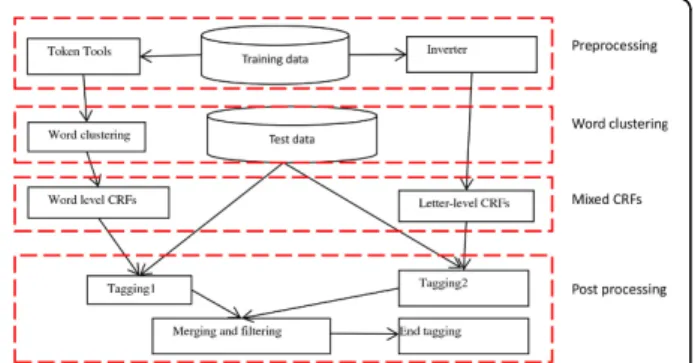
We considered the chemical compound and drug name recognition as a sequence labeling problem. CRF [8] is a classic and competitive method to solve this problem. CHEMDNER system mainly used CRF to recognize the chemical compound and drug names. Figure 1 gives the main framework of the system.
Preprocessing
There are several kinds of symbols in chemical compound and drug names, as can be seen in examples, e.g.,‘[1,1’ -biphenyl]-4,4’-diyldimethanamine’,‘(±)-methamphetamine’ and‘catechin-[5,6-e]-4b-(3,4-dihydroxyphenyl)dihydro-2 (3H)-pyranone’. In the PubMed corpus, some entities occurred with a very low frequency, so if recognizing the string as one unit in the sequence directly, the system would perform badly. One simple method might be to find the special characters, such as‘[’,‘b’,‘Δ’and so on, and design the patterns for the strings, such as regular expressions“[a-z]*-\[\d,\d-[a-z]*\]-\d[b]-\(\d,\d-[a-z]*\) [a-z]*”. However, it would be difficult to pre-define all such patterns manually.
To overcome such difficulties, we constructed a toke-nizer with white space and the symbols listed in Table 1 to segment the sentences into tokens, so that we could obtain features, like prefix, suffix, digit, specific symbols and so on. We considered all non-alphabetic characters as the token symbol. During the training phase for char-acter-level CRF, we took each character as a unit, and the character-level CRF model helped learn the internal features of the entity. In addition, we designed a charac-ter invercharac-ter to transform the corpus to a new one in the reversed order of the character, since previous studies showed that the F-score would be improved in the char-acter level when training from right to left [12].
Word clustering
Previous work showed that word clustering is a good fea-ture for general named entity recognition [9]. Specifically,
the clustering feature was used to improve gene and pro-tein name recognition [12], and Turian et al. used the word representations based on Brown clusters to improve the named entity recognition in the field of news [11].
Our system used the Brown clusters that are created from a hierarchical word clustering algorithm [10]. 74,000 articles were downloaded from PubMed includ-ing titles and abstracts, usinclud-ing the entities in the traininclud-ing data as search keywords. The articles were then segmen-ted with the tokenizer for further word clustering. We acquired 1,000 clusters from those articles and assigned each word a binary representation based on Huffman coding. Table 2 shows some examples. For example, the binary representation of the word “Confirms” is
“10000110”which we used as the feature of the word. In addition, we tried multi-scale word clustering, as shown in Figure 2, to improve the performance of the system.
Finally, we used the multi-level clusters as word features in the CRF model. It was noted that the training time of the Skip-gram model is just a fraction of that required by Brown clustering. Thus, we could use more PubMed data to create the clusters. 400,000 PubMed articles were used to train the Skip-gram model with different size of clusters, and the model finally produced 50, 1000 and 10,000 clusters respectively.
Mixed model
Now that the recognition of the chemical and drug names is seen as a sequence labelling problem, the objective is to identify the boundaries of the entities. In this sense, it becomes a problem of optimizing the model to fit the boundaries of the examples in the training data and improving the generalization ability of the model. In this study, we extended the CRF model to recognize chemical compound and drug names. In order to increase the model’s scalability and flexibility, we utilized CRF++ in open source projects with extensible templates.
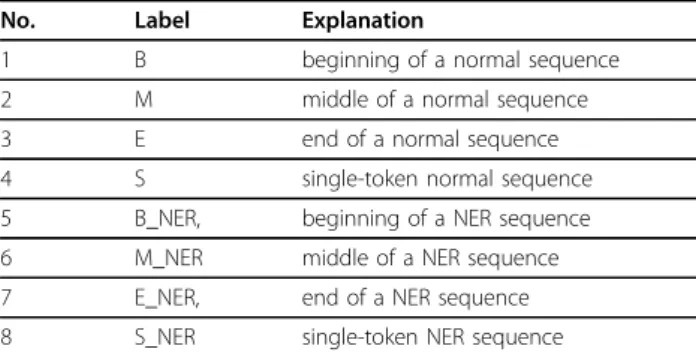
When training the corpus, we used the label set in the Table 3. Compared with the commonly used label set, {B, I, O}, this label set exhibited a more fine-grained distinction for the name components.
In our study, we trained the CRF model in both the character and word level. Character-level features helped to model the internal structure of the chemical compound and drug names, and the word-level features to model the contexts of the names. Table 4 gives the character level features, where Widenotes the character in the ithposition
Figure 1 gives the main framework of the system, which includes four parts: preprocessing, word clustering, mixed CRF and post processing.
Table 1 Symbol tokens included in the tokenizer.
in a sentence, and Wabdenotes the string of the characters
from position a to b in a sentence.
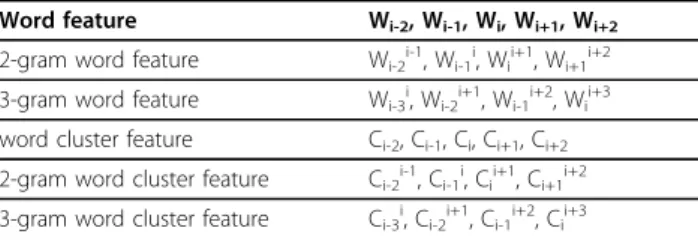
Table 5 gives the word level features in the model, where Widenotes the word in the i-th position in a sentence,
Wabdenotes the string of words from position a to b in a
sentence, Cidenotes the category in the i-th position in a
sentence, and Cabdenotes the category label string of the
words from position a to b in a sentence.
When training the character-based model, we trained the character-based model both from the left to the right and from the right to the left in each sentence. When training the word-based model, we combined the word features and cluster features. Moreover, we tried multi-scale cluster settings to explore their influence for the performance.
Post processing
After the word-based and character-based models were trained, we merged the results in a heuristic method. Con-cretely, if the results from both models have only one same offset, we choose the one with higher confidence if the confidence difference is higher than 0.7; otherwise we keep the longer one. In addition, we filtered the entity if its confidence is lower than 0.0001. Finally, we refined the results using the strategies in Table 6. Take the row 1 as an example, it means that if the count of‘(’is higher than that of‘)’by 1 in the entity, and if to the right of the entity
is‘)’, then we move the offset 1 token further to the right to include the symbol; otherwise, we delete the entity.
Results and discussion
Both the data and evaluation tool were provided by Bio-Creative IV. The data includes 7,000 annotated PubMed data for training and 3,000 PubMed data for testing, and the evaluation tool reports precision, recall and F-scores. In addition to the data, we downloaded PubMed articles including titles and abstracts to produce word clusters. In the BioCreative IV evaluation, our system achieved the highest F-score of 88.20 % in the CDI task and the second highest F-score of 87.11% in the CEM task, which was only 0.28% lower than the highest F-sore of 87.39%.
Baseline results
We chose the CRF models in both character and word levels without word clustering features as the baselines, Table 7 gives the baseline results. It shows that the char-acter-based model performed better than word-based model in the two tasks, mainly because of the lower recall of the word-based model.
The results by our system in CHEMDNER task
Table 8 gives the results for our character-based and word based models. In the table, “Character+invert” means that we converted the sentence from right to left when training the CRF model in the character-based
Table 2 Binary representations for words.
Words Binary representations
Confirms 10000110
Emphasis 10000110
Neighbourhoods 10101111010
Figure 2First, we used a distributed word representations, i.e., Skip-gram model proposed by Mikolov et al.[13], to obtain the word embedding. Then we used K-means algorithm to acquire multi-level clusters based on the word embedding.
Table 3 Labels for the CRF model.
No. Label Explanation
1 B beginning of a normal sequence
2 M middle of a normal sequence
3 E end of a normal sequence
4 S single-token normal sequence
5 B_NER, beginning of a NER sequence
6 M_NER middle of a NER sequence
7 E_NER, end of a NER sequence
8 S_NER single-token NER sequence
Table 4 Character-based feature sets in CRFs model.
Character feature Wi-4, Wi-3, Wi-2, Wi-1, Wi, Wi+1, Wi+2, Wi+3, Wi +4
2-gram character feature
Wi-1 i
, Wi i+1
3-gram character feature
Wi-2i, Wi-1i+1, Wii+2
4-gram character feature
Wi-3i, Wi-2i+1, Wi-1i,Wii+1
5-gram character feature
level, and the test data was handled in the same way.
“Word+Brown”means that we segmented the corpus with the tokenizer, used Brown clustering algorithm to create 1,000 clusters, assigned each token a binary representation. Mixed system means that we merged the recognition results by the two models in character and word levels.
Table 8 shows that the inverted corpus only achieved a little improvement. In comparison, word clustering fea-tures improved the recall rate more explicitly, which ensured that the F-scores were improved by 1.87% in CDI and 2.15% in CEM respectively. By the mixed model, the F-scores were further improved by 0.37% in CDI and 1.29% in CEM. The results indicate that the word cluster-ing can improve the generalization ability of the CRF model. The reason may be that the word clusters, based on distributional similarity, can be seen as a kind of gener-alization over the individual words. Furthermore, such clusters provide more fine-grained distinction than com-monly used parts-of-speech labels of the words.
Improve system’s result
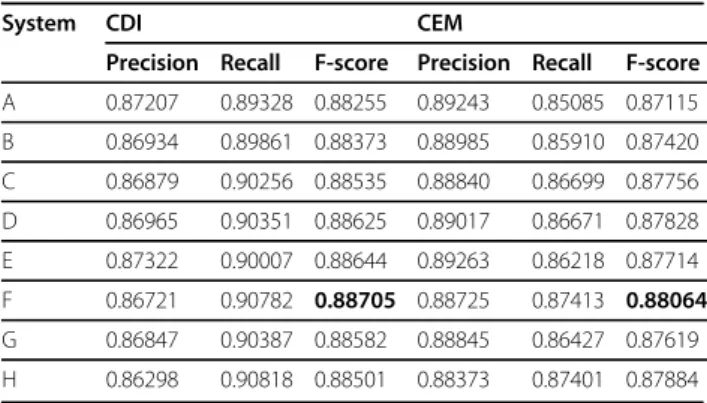
After submission of the results, we made further improvement using multi-scale word clustering based on a skip-gram model. Table 9 gives the results.
Table 9 demonstrates the result was further improved by 0.12% for CDI and 0.3% for CEM by using Skip-gram to get the clustering features, as shown in System B. By increasing the corpus size or the cluster number, the per-formance appeared to have little change, as indicated in System C-E. Via multi-scale clustering of the words, sys-tem F achieved the F-score of 88.71% for CDI, which improved the F-score by 0.45%, the F-score of 88.06% for CEM, which improved the F-score by 0.95% compared to System A. The result indicates that word clustering fea-tures mainly improves the recall rate of the system.
On the other hand, we downloaded 2,400,000 articles randomly from PubMed, and tested the performance using the clusters based on the articles. System G-H in Table 9 shows that the result was not improved as expected. The reason may be that the articles were down-loaded randomly from PubMed, not based on the entities annotated in the training data, and a lot of the articles were unrelated with them.
Conclusions
In this work, we designed a mixed CRF model integrated with word clustering features to resolve the challenges in identifying chemical compound and drug names. The CRF model mixed a character-level with a word-level CRF model, and the clustering features were created from PubMed articles including titles and abstracts based on one-level or multi-level clusters. The system reached the F-score of 88.06% for the CEM task and 88.71% for the CDI task, which can be regarded as a very competitive result compared with the expected upper boundary, i.e., the agreement between two human annotators, i.e., 91% [3]. And our system can be downloaded from https:// github.com/zuiwufenghua/biocreative_CHEMDNER.
The experiment showed that the mixing of the CRF models help to improve the performance, since the char-acter-level CRF models the internal structures of the enti-ties, while the word-level CRF helps to capture the external contexts of the entities. The experiment also showed that the clustering features, whether one-level or multi-level clusters, help to generalize the identified struc-tures, thus improving the recall rates. This indicates that even though the automatically acquired word clusters only reflect course-grained domain knowledge, they can contri-bute to the named entity identification.
With the present task setting as a sequence labeling pro-blem, there would be several future work worth further
Table 5 Word-based feature sets in CRFs model.
Word feature Wi-2, Wi-1, Wi, Wi+1, Wi+2 2-gram word feature Wi-2i-1, Wi-1i, Wii+1, Wi+1i+2
3-gram word feature Wi-3i, Wi-2i+1, Wi-1i+2, Wii+3
word cluster feature Ci-2, Ci-1, Ci, Ci+1, Ci+2
2-gram word cluster feature Ci-2 i-1
, Ci-1 i
, Ci i+1
, Ci+1 i+2
3-gram word cluster feature Ci-3i, Ci-2i+1, Ci-1i+2, Cii+3
Table 6 Post-processing strategies.
Count(symbol) in entity Symbol next to entity Change offset
( = ) + 1 Right is ) Right + 1
( = ) - 1 Left is ( Left - 1
[ = ] + 1 Right is ] Right + 1
[ = ] - 1 Left is [ Left - 1
{ = }+ 1 Right is } Right + 1
{ = } - 1 Left is { Left - 1
Table 7 Baseline result for CDI and CEM.
Baseline CDI CEM
Precision Recall F-score Precision Recall F-score Character 0.90706 0.85121 0.87825 0.91965 0.80450 0.85823
Word 0.90221 0.74536 0.81632 0.91774 0.70632 0.79827
Table 8 CDI and CEM result by our system.
System CDI CEM
Precision Recall F-score
Precision Recall F-score
Character +invert
0.90766 0.85157 0.87872 0.91992 0.80482 0.85853
Word +Brown
0.89322 0.78393 0.83501 0.91069 0.74530 0.81973
Mixed system
investigation. First, a lot of new machine learning techni-ques have been proposed to solve the sequence labelling problem successfully. For example, Mann et al. [18] pre-sented a semi-supervised CRF to improve sequence seg-mentation and labelling. Yu et al. [19] proposed a deep-structured CRF for sequence labelling. Collobert et al. [20] came up with a deep learning architecture for NLP, which can be used to label the sequence. In future, we will apply such methods to chemical and drug name identification.
On the other hand, features would be crucial for the performance of such sequence labeling tasks, so another future work would be exploring various structural, con-textual or categorical features to enrich the CRF models. In addition, future work also includes extending such methods to other labeling tasks in biomedical domain, e. g., gene names or protein-protein relations, etc.
Competing interests
The authors declare that they have no competing interests.
Authors’contributions
YL, DJ and XL conceived the study, YL carried out the implementation. YL, DJ, XY and XW wrote the manuscript. All contributed to the intellectual evolution of this project. All authors have read and approved the final manuscript.
Acknowledgements
Thanks to High performance computing center of computer school, Wuhan University, which supported us to do large-scale experiments.
Declarations
Publication of the work is funded by the following projects: NSF projects of China No.61133012, No. 61373108, No.61202304, Social Science Foundation project No. 11&ZD189, and Hubei NSF project 2012FFA088.
This article has been published as part ofJournal of CheminformaticsVolume 7 Supplement 1, 2015: Text mining for chemistry and the CHEMDNER track. The full contents of the supplement are available online at http://www. jcheminf.com/supplements/7/S1.
Authors’details
1School of Computer, Wuhan University, Wuhan 430072, China.2School of
Public Health, Wuhan University, Wuhan 430072, China.
Published: 19 January 2015
References
1. Smith L, Tanabe LK, Ando RJ,et al:Overview of BioCreative II gene mention recognition.Genome Biology2008,9(Suppl 2):S2. 2. 2013 [http://www.biocreative.org/tasks/biocreative-iv/chemdner/]. 3. Krallinger M, Leitner F, Rabal O, Vazquez M, Oyarzabal J, Valencia A:
CHEMDNER: The drugs and chemical names extraction challenge.J Cheminform2015,7(Suppl 1):S1.
4. Zhou G, Su J:Named entity recognition using an HMM-based chunk tagger.proceedings of the 40th Annual Meeting on Association for Computational Linguistics2002, 473-480.
5. Chieu HL, Ng HT:Named entity recognition: a maximum entropy approach using global information.Proceedings of the 19th international conference on Computational linguistics. Association for Computational Linguistics2002,1:1-7.
6. McCallum A, Li W:Early results for named entity recognition with conditional random fields, feature induction and web-enhanced lexicons.Proceedings of the seventh conference on Natural language learning at HLT-NAACL 2003. Association for Computational Linguistics2003,
4:188-191.
7. McDonald R, Pereira F:Identifying gene and protein mentions in text using conditional random fields.BMC Bioinformatics2005,6(Suppl 1):S6. 8. Lafferty J, McCallum A, Pereira FC:Conditional random fields: Probabilistic
models for segmenting and labelling sequence data2001.
9. Miller S, Guinness J, Zamanian A:Name Tagging with Word Clusters and Discriminative Training.HLT-NAACL2004,4:337-342.
10. Brown PF, Desouza PV, Mercer RL,et al:Class-based n-gram models of natural language.Computational linguistics1992,18(4):467-479.
11. Turian J, Ratinov L, Bengio Y:Word representations: a simple and general method for semi-supervised learning.Proceedings of the 48th Annual Meeting of the Association for Computational Linguistics. Association for Computational Linguistics2010, 384-394.
12. Ganchev K, Crammer K, Pereira F,et al:Penn/umass/chop biocreative ii systems.Proceedings of the second biocreative challenge evaluation workshop 2007,23:119-124.
13. Mikolov T, Sutskever I, Chen K, Corrado GS, Dean J:Distributed representations of words and phrases and their compositionality.
Advances in Neural Information Processing Systems2013, 3111-3119. 14. Tjong Kim Sang EF, De Meulder F:Introduction to the CoNLL-2003 shared
task: Language-independent named entity recognition.Proceedings of the seventh conference on Natural language learning at HLT-NAACL 2003. Association for Computational Linguistics2003,4:142-147.
15. Finkel J, Dingare S, Manning CD, Nissim M, Alex B, Grover C:Exploring the boundaries: gene and protein identification in biomedical text.BMC Bioinformatics2005,6(Suppl 1):S5.
16. Huang HS, Lin YS, Lin KT,et al:High-recall gene mention recognition by unification of multiple backward parsing models.Proceedings of the second BioCreative challenge evaluation workshop2007,23:109-111. 17. Kim JD, Ohta T, Tsuruoka Y,et al:Introduction to the bio-entity
recognition task at JNLPBA.Proceedings of the international joint workshop on natural language processing in biomedicine and its applications. Association for Computational Linguistics2004, 70-75.
18. Mann GS, McCallum A:Generalized expectation criteria for semi-supervised learning of conditional random fields2008.
19. Yu D, Wang S, Deng L:Sequential labeling using deep-structured conditional random fields.Selected Topics in Signal Processing, IEEE Journal 2010,4(6):965-973.
20. Collobert R, Weston J, Bottou L, Karlen M, Kavukcuoglu K, Kuksa P:Natural language processing (almost) from scratch.The Journal of Machine Learning Research2011,12:2493-2537.
doi:10.1186/1758-2946-7-S1-S4
Cite this article as:Luet al.:CHEMDNER system with mixed conditional
random fields and multi-scale word clustering.Journal of Cheminformatics20157(Suppl 1):S4.
Table 9 Result by skip-gram model and multi-scale word clustering.
System CDI CEM
Precision Recall F-score Precision Recall F-score
A 0.87207 0.89328 0.88255 0.89243 0.85085 0.87115
B 0.86934 0.89861 0.88373 0.88985 0.85910 0.87420
C 0.86879 0.90256 0.88535 0.88840 0.86699 0.87756
D 0.86965 0.90351 0.88625 0.89017 0.86671 0.87828
E 0.87322 0.90007 0.88644 0.89263 0.86218 0.87714
F 0.86721 0.90782 0.88705 0.88725 0.87413 0.88064
G 0.86847 0.90387 0.88582 0.88845 0.86427 0.87619
H 0.86298 0.90818 0.88501 0.88373 0.87401 0.87884
System configuration: each configuration includes clustering method, the corpus size (S) and cluster number (N).