ISSN: 2147-611X
www.ijemst.com
Combining Like Terms: A Qualitative
Meta-synthesis of Algebra I Interventions
in Mathematics and Special Education
Rebecca A. Dibbs1, Brittany L. Hott2, Amelia Martin3, Leslie Raymond1, & Taylor Kline1
1
Texas A&M University-Commerce
2 University of Oklahoma 3 University of Mississippi
To cite this article:
Dibbs, R. A., Hott, B. L., Martin, A., Raymond, L., & Kline, T. (2020). Combining like
terms: A qualitative meta-synthesis of Algebra I interventions in mathematics and special
education.
International Journal of Education in Mathematics, Science and Technology
(IJEMST), 8(3), 219-232.
This article may be used for research, teaching, and private study purposes.
Any substantial or systematic reproduction, redistribution, reselling, loan, sub-licensing,
systematic supply, or distribution in any form to anyone is expressly forbidden.
Authors alone are responsible for the contents of their articles. The journal owns the
copyright of the articles.
Volume 8, Number 3, 2020
Combining Like Terms: A Qualitative Meta-synthesis of Algebra I
Interventions in Mathematics and Special Education
Rebecca A. Dibbs, Brittany L. Hott, Amelia Martin, Leslie Raymond, Taylor Kline
Article Info
Abstract
Article History
Received: 18 October 2019
Many students struggle with the transition from arithmetic to algebra. Despite meta-analytic work on algebra instruction and calls for meta-syntheses of mathematics education topics, little has been done to synthesize the corpus of qualitative mathematics education research in algebra. The purpose of this meta-synthesis is to summarize the techniques teachers use to elicit algebraic thinking from students with mathematics difficulty or disability in the mathematics and special education literature. Although both mathematics and special educators used student-centered and collaborative techniques to encourage students to share algebraic reasoning, students with mathematics difficulty and disability struggled to participate meaningfully, and directions for further critical work in algebra are specified.
Accepted: 24 April 2020
Keywords
Algebra
Mathematics difficulty Mathematics disability Mathematics education Meta-synthesis
Introduction
Algebra is both vitally important and difficult for students. Since it is the gatekeeper to many high-paying jobs, algebra is highly valued worldwide (Andersson, Valero, & Meaney, 2015; Esmonde, 2009; Quintos & Civil, 2008); however, students who have poor experiences in mathematics classes often change their educational goals (Braathe & Solomon, 2015), and problems with negative feelings about mathematics (negative mathematics affect) are common (Brown, Brown, & Bibby, 2008; Martinez-Sierra & Garcia-Gonzalez, 2014, 2016). In the United States, introductory calculus is the single biggest leak in the science, technology, engineering, and mathematics (STEM) major undergraduate pipeline. Regardless of school type, student preparedness, or class size, students who leave STEM most often do so after the entry-level calculus course (Ellis, Kelton, & Rasmussen, 2014), and problems with algebra preparation in high school often contribute with difficulties in calculus.
A significant minority of students struggle with algebra. Estimates indicate that 25% to 35% of students struggle with mathematics knowledge and application skills in general education classrooms (Mazzocco, 2007). These students are referred to as having mathematics difficulty. Further, conservative estimates indicate an additional 8% of students experience such difficulties that they are eligible for special education and related services as students with mathematics learning disabilities (Geary, 2004; Hott et al., 2014). These students are referred to as having mathematics disability. Yet, students who struggle with the transition to algebra are under studied, under researched and; thus, potentially underserved (Hott, et al., 2019). Kunsch, Jitendra, and Sood, (2007) called for additional meta-synthesis work that has the potential to greatly benefit educators in understanding the mathematics intervention evidence base and more recently, Thunder and Berry III (2016), suggested that additional qualitative meta-synthesis work has the potential to greatly benefit mathematics educators. Qualitative meta-synthesis involves using clearly defined search procedures to systematically address a specific research question. Findings are then summarized and qualitative evidence combined to construct greater meaning (Erwin, Brotherson, & Summers, 2011).
However, meta-analyses work to provide a pooled effect size to quantitatively measure treatment effects across studies (Hedges, 2014). Because much of the intervention work in special education involves group and single case design studies, meta-analytic approaches are frequently used to synthesize findings and offer suggestions for practice based on evidence levels. Several meta-analyses have synthesized mathematics interventions for students with learning disabilities (Gersten et al., 2009; Marita & Hord, 2017), emotional and behavioral disorders (Templeton, Neel, & Blood, 2008), cognitive disabilities (Browder et al. 2008), and students who are low-achieving (Baker, Gersten, & Lee, 2002). Findings suggest that self-management strategies, computer-assisted instruction, explicit instruction, and mnemonic strategies are most beneficial to students.
Both mathematics and special education researchers have synthesized algebra research. However, the majority of the works summarize findings from group and single case design studies (Losinski, Ennis, Sanders, & Nelson, 2018; Peltier, Vannest, Marbach, 2018). As suggested by Thunder and Berry III (2016) less is known about findings from qualitative work; thus, examining the qualitative special education studies in addition to the mathematics education studies, additional strategies and evidence bases may be found to support students struggling with algebraic thinking. The purpose of this meta-synthesis is to investigate how teachers elicit and support algebraic thinking in learners who are struggling in their Algebra I course. For this analysis, we were guided by the questions (1) What classroom techniques do teachers use to encourage development of algebraic thinking for students in Algebra I? (2) To what extent are these techniques effective for students with mathematics difficulty or disability?
Much of meta-analytic work on Algebra I learners with mathematics difficulty or disability has been conducted in special education. However, both mathematics education and special education meta-analyses yielded similar results. Xin and Jitendra (1999) conducted a meta-analysis for students with mathematics disability and those students categorized as at risk. There were moderate pooled effect sizes on achievement for allowing the use of calculators and similar educational technology and explicitly teaching students how to select an appropriate strategy to solve an algebra word problem.
Similarly, Maccini, McNaughton, and Rohl (1999), in their meta-analysis of intervention research on students with learning disabilities in Algebra I, found that with technology assistance (generally in the form of calculators) having the largest effect on student achievement. The strategy of Concrete-Representational-Abstract, using manipulatives and pictures to introduce algebra topics before formal notation, was also found to have a moderate positive effect on student achievement (Maccini, McNaughton, & Rohl, 1999). More recently, Haas (2005) conducted a meta-analysis of secondary algebra teaching methods and student achievement. Although manipulatives, models, and multiple representations and direct instruction had a moderate effect on student achievement, cooperative learning and the use of technology only had a small positive effect on student achievement and problem-based learning actually had a negative effect on student achievement.
Kunsch, Jitendra, and Sood (2007) updated previous meta-analytic work by investigating Algebra I interventions on achievement for students with learning disabilities and/or classified as at-risk learners. Although peer-mediated interventions were found to be moderately effective, such interventions were far more effective for at-risk learners who generally had more social capital that the students with learning disabilities (Kunsh et al., 2007). A similar meta-analysis in the same year by Macccini, Mulcahy, and Wilson (2007) considered mathematics education articles on the achievement of students with learning disabilities; schema-based instruction, the use of technology, and explicit instruction in strategy selection were all found to have moderate positive effects on students‟ achievement.
Rabes, Valentine, McGatha, and Ronau (2010)‟s meta-analysis was on interventions intended to increase student achievement in algebra for students with learning disabilities. Although most non-drill interventions had a positive effect on students‟ achievement, the largest pooled effect sizes were associated with interventions that focused on both algebra concepts and procedural knowledge (Rabes, Valentine, McGatha, & Ronau, 2010). More importantly, short interventions were found to have no significant difference in learning gains when compared to longer term interventions lasting longer than one unit, and quasi-experimental and experimental designs showed similar student achievement gains (Rabes, Valentin, McGatha, & Ronau, 2010).
included tutoring, explicit instruction in problem solving strategies, and inquiry-based learning, which contrasts with the Haas (2005) findings on PBL.
Lewis and Fisher‟s (2016) meta-analysis looked at mathematics education and learning disabilities. They concluded that algebra was under-researched in mathematics education for this population of students, and there is great variability in how the definition of learning disability is applied throughout research (Lewis & Fisher, 2016). Finally, Jitendra et al.‟s (2018) meta-analysis on students with mathematics disability or difficulty in secondary schools found that mathematics interventions, regardless of type, have moderate influences on student outcomes. Further, Jitendra et al. (2018) argue that the potential of publication bias necessitates the inclusion of dissertations into meta-analytic work.
The previous reviews indicated that Algebra I intervention studies generally results in increased student achievement, but there is little insight into how these interventions are effective, raising questions about the nature of why the interventions worked. Such questions are typically investigated with qualitative research methods, and there has been a considerable amount of research to date on Algebra I intervention studies. However, there has not currently been a systematic effort to investigate these research reports as a whole. The purpose of this inquiry was intended to summarize and integrate the available research into a single narrative and shed light on the state of algebra I intervention research.
Method
After discussing research synthesis and the theoretical perspective, the search procedures are detailed.
Research Synthesis
Much of the work on research synthesis is derived from the medical field with the goal of establishing evidence-based practices. For example, Brackenbury et al. (2008) define research synthesis as “the conscientious, explicit, and judicious use of current best evidence in making decisions about the care of individual patients,” where individual expertise is combined with the most recent, valid research. Federal legislation including the Elementary and Secondary Education Act ([ESSA], 2005) and Individuals with Disabilities Improvement Act ([IDEA], 2004) require the use of evidence-based practices that are derived from research that involves the application of “rigorous, systematic, and objective procedures to obtain reliable and valid knowledge.” Systematic reviews involve replicable search procedures in attempt to include all relevant research studies (Thunder & Berry III, 2016) to offer guidance on overall intervention effects and influence educational decision-making.
The purpose of qualitative meta-synthesis is not to reduce the results of research reports to a common metric like mean effect size. Instead, the goal is to look for themes across reports that promote new insights into the body of qualitative literature that preserves the integrity of the original reports. There are several approaches to meta-synthesis, the most common of which are cross case analysis, meta-ethnography, and meta-grounded theory (Gersten & Baker, 2000; Noblit & Hare, 1998). More recently Scruggs, Mastropieri, & McDuffie (2007) proposed conducting meta-synthesis by conducting an iterative open coding process across the findings where each study is treated as a participant. For this inquiry, we chose to treat each individual study as an individual informant and create a meta-synthesis using the latter approach. Given the large number of research reports, we used NVivo to facilitate the storing and coding of the research reports and store all research memos to maintain an audit trail.
Theoretical Perspective
Search Procedures
The meta-synthesis began by assembling relevant studies through preliminary searches using ERIC, PsychINFO, ProQuest, and JSTOR databases. Search terms included intervention, strategy, algebra, math, mathematics, learning disability, and disability. To be included, a study had to use qualitative or mixed methods, contain and intervention intended to help student learning, be set in the United States, and have algebra as a keyword. We also included variants and wild cards of these terms throughout the search process and kept an audit trail of search terms.
Ancestral searches of reference lists and a descendant search of cited research using the Social Sciences Citation Index were also completed. Next, ProQuest and Google Scholar were used to conduct descendant searches of all relevant articles. Finally, hand searches of prominent special education (e.g., Exceptional Children, Journal of Special Education, Exceptionality, Learning Disabilities Research and Practice, Remedial and Special Education, Learning Disabilities Quarterly, Teacher Education and Special Education) journals were completed and hand searches for mathematics education (e.g., Educational Studies in Mathematics, Journal for Research in Mathematics Education, For the Learning of Mathematics, The Journal of Mathematics Teacher Education, Mathematical Thinking & Learning, ZDM) journals were completed. We did not restrict articles based upon publication date, but the included studies were published between 1981-2016. However, the majority of the qualitative Algebra I interventions were published in 1997 or later, with spikes in publication corresponding to the passage of NCLB and the adoption of the Common Core.
Selection Procedure and Study Quality
The goal of this study was to understand the practices investigated qualitative in Algebra I interventions. An intervention had to target an algebra learning concept, regardless of the course in which the intervention took place. For example, both pre-calculus classes and middle school mathematics classes occasionally include functions, polynomials, solving equations or other Algebra I topics in their courses. We included any study in our initial selection if it was qualitative or mixed methods with an observation, document analysis, or interview component. We did not include studies based upon surveys containing open ended questions, but did include studies that included surveys if there were follow-up interviews conducted that were based on the initial surveys, and studies where an Algebra I intervention was not part of the primary research question were also not included.
After all relevant reports were collected and organized in a common digital file, each member of the research team read each publication at least once. To evaluate the quality of the research, we used Bratlinger et al.‟s (2005) criterion for quality qualitative research: systematic data collection, alignment of data collection and research questions, data triangulation, member checks, and consideration of disconfirming evidence. Two authors independently coded each article using this framework. When the scores did not agree, a third author coded the article.
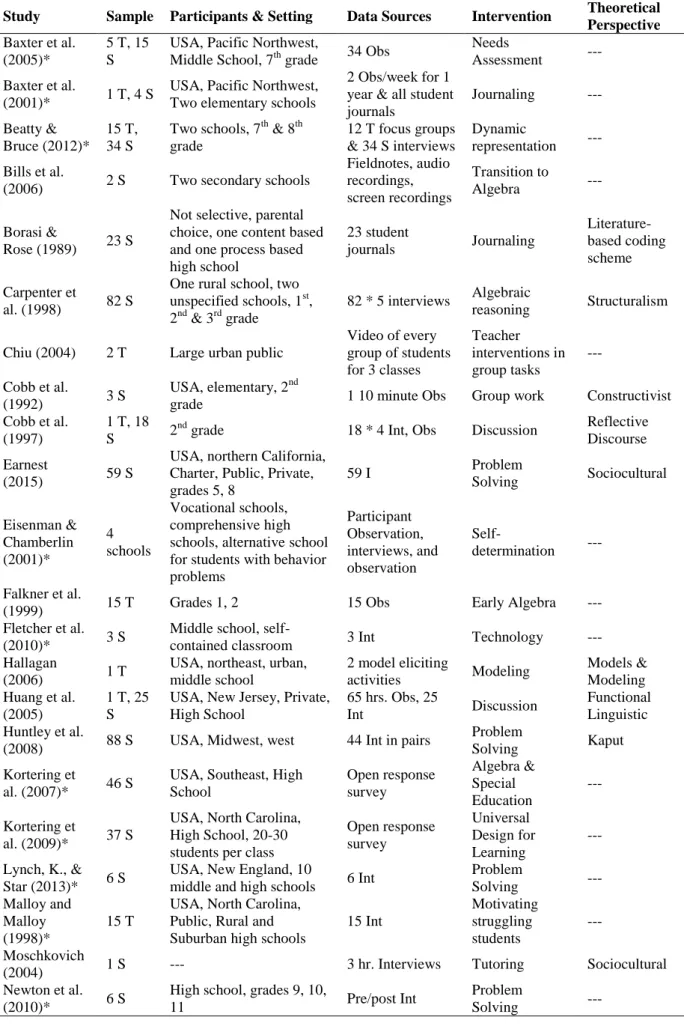
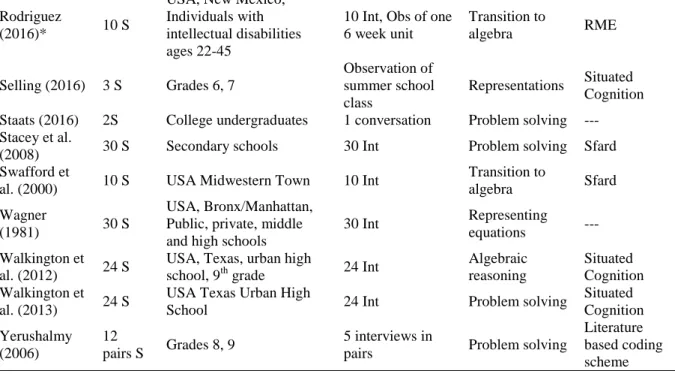
We included all reports that met an at least three of the standards of quality and went through some form of peer review as defined by (Bratlinger et al., 2005). Reports with at least two of the criterion for quality research were reviewed by all authors before a decision was made to include these dissertations and theses; all were ultimately excluded. There were a total of 30 articles that met the inclusion and quality standards for analysis; 19 mathematics education and 11 special education articles. Table 1 provides a summary of the articles included in the study.
Table 1. Summary of Setting Variables by Study
Study Sample Participants & Setting Data Sources Intervention Theoretical Perspective Baxter et al.
(2005)*
5 T, 15 S
USA, Pacific Northwest,
Middle School, 7th grade 34 Obs
Needs
Assessment --- Baxter et al.
(2001)* 1 T, 4 S
USA, Pacific Northwest, Two elementary schools
2 Obs/week for 1 year & all student journals
Journaling --- Beatty &
Bruce (2012)* 15 T, 34 S
Two schools, 7th & 8th grade
12 T focus groups & 34 S interviews
Dynamic
representation --- Bills et al.
(2006) 2 S Two secondary schools
Fieldnotes, audio recordings, screen recordings
Transition to
Algebra ---
Borasi &
Rose (1989) 23 S
Not selective, parental choice, one content based and one process based high school
23 student
journals Journaling
Literature-based coding scheme Carpenter et
al. (1998) 82 S
One rural school, two unspecified schools, 1st, 2nd & 3rd grade
82 * 5 interviews Algebraic
reasoning Structuralism
Chiu (2004) 2 T Large urban public
Video of every group of students for 3 classes
Teacher interventions in group tasks
--- Cobb et al.
(1992) 3 S
USA, elementary, 2nd
grade 1 10 minute Obs Group work Constructivist
Cobb et al. (1997)
1 T, 18
S 2
nd
grade 18 * 4 Int, Obs Discussion Reflective
Discourse Earnest
(2015) 59 S
USA, northern California, Charter, Public, Private, grades 5, 8
59 I Problem
Solving Sociocultural
Eisenman & Chamberlin (2001)* 4 schools Vocational schools, comprehensive high schools, alternative school for students with behavior problems Participant Observation, interviews, and observation
Self-determination ---
Falkner et al.
(1999) 15 T Grades 1, 2 15 Obs Early Algebra ---
Fletcher et al.
(2010)* 3 S
Middle school,
self-contained classroom 3 Int Technology ---
Hallagan
(2006) 1 T
USA, northeast, urban, middle school
2 model eliciting
activities Modeling
Models & Modeling Huang et al.
(2005)
1 T, 25 S
USA, New Jersey, Private, High School
65 hrs. Obs, 25
Int Discussion
Functional Linguistic Huntley et al.
(2008) 88 S USA, Midwest, west 44 Int in pairs
Problem
Solving Kaput
Kortering et
al. (2007)* 46 S
USA, Southeast, High School Open response survey Algebra & Special Education --- Kortering et
al. (2009)* 37 S
USA, North Carolina, High School, 20-30 students per class
Open response survey Universal Design for Learning --- Lynch, K., &
Star (2013)* 6 S
USA, New England, 10
middle and high schools 6 Int
Problem
Solving ---
Malloy and Malloy (1998)*
15 T
USA, North Carolina, Public, Rural and Suburban high schools
15 Int Motivating struggling students --- Moschkovich
(2004) 1 S --- 3 hr. Interviews Tutoring Sociocultural
Newton et al.
(2010)* 6 S
High school, grades 9, 10,
11 Pre/post Int
Problem
Rodriguez
(2016)* 10 S
USA, New Mexico, Individuals with intellectual disabilities ages 22-45
10 Int, Obs of one 6 week unit
Transition to
algebra RME
Selling (2016) 3 S Grades 6, 7
Observation of summer school class
Representations Situated Cognition Staats (2016) 2S College undergraduates 1 conversation Problem solving --- Stacey et al.
(2008) 30 S Secondary schools 30 Int Problem solving Sfard
Swafford et
al. (2000) 10 S USA Midwestern Town 10 Int
Transition to
algebra Sfard
Wagner
(1981) 30 S
USA, Bronx/Manhattan, Public, private, middle and high schools
30 Int Representing
equations --- Walkington et
al. (2012) 24 S
USA, Texas, urban high
school, 9th grade 24 Int
Algebraic reasoning
Situated Cognition Walkington et
al. (2013) 24 S
USA Texas Urban High
School 24 Int Problem solving
Situated Cognition Yerushalmy
(2006)
12
pairs S Grades 8, 9
5 interviews in
pairs Problem solving
Literature based coding scheme Notes:
---: Information not provided T: teacher
S: student
*: Special Education Article Obs: Observation
Int:Interview
Data Analysis
The theory, research questions, and settings were coded for each article using a thematic coding protocol by two researchers working independently. To code each of these portions of the articles, the relevant passages were copied and pasted from the original article into another document, and then the information present was tallied for the theory and setting descriptions. For the research questions, a thematic analysis was conducted to categorize the areas of research. We also coded the participant selection criteria and noted if participants were volunteers or considered exemplary teachers. Interrater agreement on these codes was 100%.
Next, the findings sections of each article was blinded and converted into a word document and imported into NVivo. Fourteen of the documents required that the finding section be retyped manually. To begin analysis, each of the three coders read the blinded reports and journaled initial impressions. Then these documents were open coded in NVivo by three members of the research team. At least two members coded each article, with each coder randomly coding 33% of the other two coder‟s articles. Inter-rater reliability (IRR) was calculated using an agreements formula. Initial IRR was 95% and discrepancies were resolved by consensus to 100%. This open coding process generated 72 initial free nodes. After open coding, we conducted a category analysis to generate more manageable themes. This process yielded four categories, all of which contained at least three of the original free nodes (Table 2). For example, the theme „group work‟ contained the nodes group work, benefits of group work, student mistake identification in group work, and challenges of group work. This category analysis was then verified by two authors who did not conduct the category analysis.
Table 2. Category Analysis Themes
Mathematics Education Special Education
Theme # of Articles # of Codes # of Articles # of Codes
Journaling 7 34 0 0
Discussion 9 30 4 28
Group Work 4 22 5 23
Multiple Representations
Next, three authors, including one who had not participated in the category analysis, conducted axial coding within each category using the constant comparative method (Corbin, Strauss, & Strauss, 2014). The remaining members of the research team, which included both researchers and practitioners, independently confirmed the axial coding. For example, the axial coding in the affect and ownership category indicated that rapport and preserving face were the primary drivers of students‟ increased motivation and persistence. This coding process was inductive, and we used the original articles as potentially disconfirming cases for our analysis. We also considered the credibility of participant data within each study, and triangulated our analysis against the conclusions of the original sources. For instance, hen quoting a participant, we confirmed that the participant was a typical and appropriate participant in the original study whose quote was fully transcribed.
Results and Discussion
Discussions and group work were most often used to create a student-centered learning environment. Students with mathematics difficulty or disability struggled to participate in class discussions and group work. For students without mathematics difficulty or disability, group work helped students identify mistakes in their own work and see multiple representations and strategies for approaching each problem. Journaling, the only technique for eliciting student thinking without a social component, was effective for students with mathematics difficulty and disability and those without.
Journaling
Journal writing was a relatively common technique for eliciting student thinking in the general education classroom. There are several benefits for this approach, as explained in Borasi & Rose (1989):
Journal writing in fact introduces new important dimensions to the mathematics classroom: by writing in the journals, students make use of writing as a learning tool in the context of mathematics; by reading students‟ journals, teachers access a wealth of information usually unavailable to them; and by commenting on students‟ entries, responding to specific questions and posing new ones, teachers engage in a unique and continuous dialogue with each individual student throughout the course. In turn, each of these elements has the potential to provide a variety of benefits for mathematics instruction.
Journals were also a way for students to express their thinking about problems with multiple representations, as a typical student in Selling (2016) demonstrates:
In the later pages of his journal, Jorge used different types of representation to show his thinking, including tables and pictures. Additionally, Jorge also used multiple representations to show his thinking on single problems…He used three different representations to record his work on this problem: pictures of the different cases, a table that recorded the different values for each case, and a verbal explanation of the pattern.
Journaling was not an intervention used in the special education algebra intervention studies included in this meta-synthesis.
Classroom Discussion
One of the characteristics of effective student centered classrooms is the thoughtful use of classroom discussion. Classroom discussions at their best can help all students illustrate their thinking. While there are many paths to effective discussion, Cobb, Boufi, McClain & Whitenack (1997) suggest that eliciting and redirecting student thinking should be the main focus of discussions:
Studies that used classroom discussion as part of their intervention typically used half of the instructional time in small group or whole class discussions:
The lesson also highlights the importance of students' comments: half the class period was devoted to students talking about the problems that they had written. Many lessons included lengthy discussions of students' solutions to problems where the teacher primarily called on students. –Baxter, Woodward and Olson (2001)
There were mixed results on the success of discussions for students with mathematics disability or difficulty. Beatty and Bruce (2012)‟s participating teachers found discussions very helpful for their students:
Teacher 3: The biggest difference for me was seeing IEP kids who are normally petrified of math, and not terribly successful, and believing that they can‟t do it, actually leading the discussion. One of my self proclaimed weak math students got the concept and was questioning typically stronger math students in class about their patterns and explaining why it wasn‟t a linear growing patters – that growth wasn‟t predictable. Our class is a big class with lots of learning needs and for the first time ever they all get it! However, as Baxter, Woodward, and Olson (2001) warn, special education and low achieving students may struggle to participate equally in whole class discussions:
These classroom discussions placed high verbal and cognitive demands on all students, who had to be able to understand and respond quickly to questions and comments by peers as well as their teachers. The rapid exchanges and the confidence required to present a detailed explanation might be daunting to low achievers. In addition, unraveling the comments of peers might also prove to be extremely difficult for target students.
Classroom discussion did not always occur in whole class discussions. Teachers often used group activities to encourage participation from students who may be less willing to participate in full class discussions.
Group Work
Group work was typically used in classroom discussions in a think-pair-share format. This format was popular with students and often requested in student journals, as a student in Stewart (1992) explained, “Something I would like to do in mathematics is have partners to work with. They could check your work and tell you what you did wrong, and you could do the same with their work.” During group work, students typically have three stages: interpret the problem, choose a representation, and reconciling differing group members‟ solutions. This is illustrated in Selling (2016):
As the boys attempted to solve the problem together, this difference in visualization helped the boys see the growth in different ways. The boys engaged in three sequential acts: (1) recognizing that different representations existed for the growth; (2) discussing and making sense of the different representations; and finally, (3) connecting and reconciling the different representations.
The other 20 studies with group work elements focused on teacher‟s facilitation of group work. One of the primary goals of the teacher role in group work was to provide opportunities for students to ask for help, and to interact with as many students as possible, as was illustrated in this vignette in Chiu (2014):
The teachers intervened in every group, suggesting that the teachers were being fair and maintained relationships to facilitate future student requests for help. In the following transcript, for example, the teacher first spoke with this group during the CL activity with only 5 minutes left.
Jay: Twenty times a hundred is two thousand. [Ms. T walks over and looks at their work while Jay is talking]
Nina: Plus one thousand is three thousand. Right, now they‟re the same. Ms. T: You all seem to be working well together. Keep on going. Jay: OK, Ms. T. And Speedy has to cost more.
Nina: So, we add one more. [Ms. T walks away] Jay: Right, so it‟s a hundred and one minutes.
This group worked together toward a correct solution and did not seem to need any help. Still, the teacher stopped by, urged them to continue their good work, and quickly left. Hence, the teacher‟s motive for this interaction seemed more social than instructive.
However, students with mathematics difficulty or disability were often unequal participants in their group, as Baxter, Woodward, and Olson (2001) illustrated:
However, closer examination of these interactions raied questions about the kind of mathematics in which the target [special education] students were engaged. In 24 of the 28 pair-work observations, the target students primarily copied their partner‟s work or organized materials. For example during one less on ordering fractions from smallest to largest, a target student, Ginger, worked with an average-ability peer, Jennifer. The observer noted:
Ginger was quietly finding all of the fraction bars that equaled zero. She collected a green, yellow, blue, white, purple, and red fraction bar that each showed no shaded parts (i.e. each represented zero). Jennifer picked up Ginger’s pile of zero equivalents and reordered then from zero halves through zero twelfths. Ginger watched as Jennifer worked. Jennifer next laid out the following fraction bars in a row: 1/12, 1/10, 1/6, 1/5, ¼, 1/3, ½. Again, Ginger watched silently and then suggested to Jennifer, “You put them in my hand and I’ll put them there.”
Multiple Representations
For general education students, the use of multiple representations had benefits beyond the likelihood of finding an error during group work. For some students, such as Carlos in Selling (2016), the use of multiple representations helped to increase conceptual understanding:
As the summer school progressed, Carlos quickly shifted to using multiple representations to show his thinking on the same problem. Additionally, he began to show connections between the different representations of his thinking…He used a series of pictures, words, and a table to represent his thinking on the problem. Additionally, by deliberately coloring what he saw as the new blocks each time in the diagram and by recording the numbers of blocks next to the different case pictures, Carlos was able to show the connections he understood between the representations.
Multiple representations were not always helpful for students if the representation used was some numerical method such as a table, was Walkington, Sherman, and Perosino (2012) noted:
Students used informal, arithmetic-based strategies to solve algebra word problems, particularly on personalized and normal problems. Students also sometimes directly used their situational knowledge to reason about the actions and relationships in algebra story contexts. However, this informal and situational knowledge was not always well-connected to symbolic reasoning in algebra, even though the teacher had accentuates this connection as being an important benefit of story problems for providing access.
Multiple representation instruction was successful in all four of the special education studies where this teaching strategy was a theme. By the end of a unit, participants were able to recognize and translate between multiple representations in all four studies. Beatty and Bruce (2012)‟s participants showed typical fluency between representations at the end of a unit on linear functions:
Teacher‟s in-class assessments revealed that students with learning disabilities were able to make connections among different representations of linear relationships, and could predict how changes in one representation would affect other representations. Four specific areas of learning were identified. Students were able to:
Determine the underpinning explicit functional rules of linear growing patterns Create a graph of an explicit linear function from a given pattern rule
Determine the explicit linear function, given a graphical representation of a linear relationship Make connections among three representations of linear relationships – pattern rules, patterns, and
graphs. For example, make predictions about the angle of the slope of a trend line given changes in the value m in the pattern rules.
Conclusion
centered approaches, particularly classroom discussions designed to elicit student thinking and group work are effective for general education students who are performing on grade level. These short term interventions, when well-implemented, support student-teacher rapport and shift student‟s perception of what work means in a mathematics class. Formative assessment and student progress monitoring are key to effective student-centered instruction; however, these interventions are difficult to implement long term due to lack of institutional support and the emphasis on pacing guides and high stakes testing. Furthermore, there is some evidence that it is difficult to equally include special education students into student-centered interventions.
This meta-synthesis generally agreed with the prior meta-analytic work when the themes aligned. Representing algebra problems in multiple ways has both qualitative and quantitative (Hass, 2005) evidence. While there is evidence that discussion and group work benefit students (Watt, Watkins, & Abbitt, 2016), Kunsch, Jitendra, and Sood (2007) agreed with this analysis in that students with mathematics difficulty and disability benefit from interventions with a social component, but that general education students benefit more. Overall, the short term interventions in these qualitative studies were effective, as Rabes, Valentin, McGatha, and Ronau (2010) indicated.
There are several sample-based limitations to this conclusion. First, there is little information on how classes were chosen to participate in these studies, so it is possible that the teachers and teacher-researchers who performed the interventions are the ones that were most likely to want to implement a student-centered classroom. Second, when reported, most of the students participating in these studies are white, suburban, middle class students who are currently performing at or above grade level, so the students with difficulties with algebra are higher performing than the typical student.
However, the greatest limitation of the conclusions is how little is known about the classrooms and participants in the algebra I intervention studies. In mathematics education, the only setting characteristic reported more than 50% of the time was whether the district was in an urban, suburban, or rural locality (56%); whereas the only characteristic that special education reported over 50% of the time was the geographic region in which the study occurred (77%). A significant portion of the schools at which the studies took place were suburban (14%), with little attention paid to rural districts (5%), but the large amount of unreported school type data (70%) makes it difficult to draw conclusions. Only three studies reported five of the following characteristics about their setting: country, region/state, school type, rural/suburban/urban, whether the school was public/private/charter, and the grade of the classroom. The only participant variable reported more than 50% of the time was grade, where native language, socio economic status (SES), and ethnicity of participants were reported less than 15% of the time.
This underreporting of setting and participant data suggest that current reports do not accurately represent the students attending our schools students of color, students with mathematics difficulty or disability, students with low SES, emerging bilingual students, and students outside of the well-funded suburban districts may not be included in the algebra I intervention literature base to the same extent as white students performing on grade level. Further, there were no studies found for this meta-synthesis that explicitly used any critical theoretical perspectives to frame the study. Future inquiries into algebra I interventions must report more detailed settings and should incorporate critical theoretical frameworks whenever possible to begin to address this gap in the literature base.
Despite these limitations, there is evidence in the broader literature that supports the findings of this meta-synthesis. For example, students with difficulties or disabilities may choose to avoid participation due to feelings of helplessness and perceptions of inability (Sutherland, Singh, Conroy, & Stichter, 2004). Such students are also unconsciously excluded in classrooms, particularly when such students are in the minority (Shakespeare, 2006).
The participants of these studies are not representative of the population of a whole and cannot be considered a random sample, so the relationship to the relationship to algebra I students in general is unknown. Further, 12 of the studies indicated a role of a teacher-research or some other convenience sample used in the study. It seems likely that these studies are likely to produce a more favorable picture of an intervention than would exist in a general classroom.
However, we should not avoid all generalizations of the findings of a synthesis. The studies in this meta-synthesis represented a substantial number of teachers and students in a variety of institutions. While the participant information was underreported, we were nonetheless struck be the consistency of the use of small group work and discussions as the primary mean of improving algebra I instruction for general education students. It is however worth noting that in those studies special education students received some benefits, though less than their general education peers, and Rodriguez (2016) implemented a successful student centered algebra I intervention with the participants with the most severe disabilities of any study, suggesting that student-centered interventions under the right circumstances for special education outside of the general education classroom like the intervention in this study. Although there needs to be further inquiry on student-centered interventions for special education students in algebra I, the large size and diversity of the sample and consistency of the results argue that the conclusions of the meta-synthesis are supportive of contemporary practice.
Recommendations
Future research could address the equity and sample diversity issues in algebra I interventions. There should also be an increased use of critical theoretical perspectives; it is also worth noting that the special education studies are using realistic mathematics education as a theoretical framework but none of the mathematics education studies did so. It is hoped that the present study represents a call to action in these directions.
References
* Denotes article included in the synthesis.
Andersson, A., Valero, P., & Meaney, T. (2015). “I am [not always] a maths hater”: Shifting students‟ identity narratives in context. Educational Studies in Mathematics, 90(2), 143–161.
*Baxter, J. A., Woodward, J., & Olson, D. (2001). Effects of reform-based mathematics instruction on low achievers in five third-grade classrooms. The Elementary School Journal, 101(5), 529-547.
*Baxter, J. A., Woodward, J., & Olson, D. (2005). Writing in mathematics: An alternative form of communication for academically low-achieving students. Learning Disabilities Research & Practice, 20(2), 119-135.
*Beatty, R., & Bruce, C. (2012). Supporting students with learning disabilities to explore linear relationships using online learning objects. PNA, 7(1), 21-39.
*Bills, L., Ainley, J., & Wilson, K. (2006). Modes of algebraic communication -moving from spreadsheets to standard notation. For the Learning of Mathematics, 26(1), 41-47.
*Borasi, R., & Rose, B. J. (1989). Journal writing and mathematics instruction. Educational Studies in Mathematics, 20(4), 347-365.
Braathe, H. J., & Solomon, Y. (2015). Choosing mathematics: The narrative of the self as a site of agency. Educational Studies in Mathematics, 89(2), 151–166.
Brantlinger, E., Jimenez, R., Klingner, J., Pugach, M., & Richardson, V. (2005). Qualitative studies in special education. Exceptional Children, 71(2), 195-207.
Brown, M., Brown, P., & Bibby, T. (2008). “I would rather die”: Reasons given by 16-year-olds for not continuing their study of mathematics. Research in Mathematics Education, 10(1), 3–18.
*Carpenter, T. P., Franke, M. L., Jacobs, V. R., Fennema, E., & Empson, S. B. (1998). A longitudinal study of invention and understanding in children's multidigit addition and subtraction. Journal for Research in Mathematics Education, 3-20.
Chan, P. E., Konrad, M., Gonzalez, V., Peters, M.T., & Ressa, V. A. (2014). The critical role of feedback in formative instructional practices. Intervention in School and Clinic, 50(2), 96– 104.http://doi.org/10.1177/1053451214536044
*Cobb, P, Boufi, A., McClain, K., & Whitenack, J. (1997). Reflective discourse and collective reflection. Journal for Research in Mathematics Education, 28(3), 258-277
Corbin, J., Strauss, A., & Strauss, A. L. (2014). Basics of qualitative research. Sage.
Cornelius-White, J. (2007). Learner-centered teacher-student relationships are effective: A meta-analysis. Review of Educational Research, 77(1), 113-143.
*Earnest, D. (2015). From number lines to graphs in the coordinate plane: Investigating problem solving across mathematical representations. Cognition and Instruction, 33(1), 46-87. doi: 10.1080/0737008.2014.994634
*Eisenman, L. T., & Chamberlin, M. (2001). Implementing self-determination activities: Lessons from schools. Remedial and Special Education, 22(3), 138-147.
Ellis, J., Kelton, M. L., & Rasmussen, C. (2014). Student perceptions of pedagogy and associated persistence in calculus. ZDM, 1–13.
Erwin, E. J., Brotherson, M. J., & Summers, J. A. (2011). Understanding Qualitative Meta-synthesis: Issues and Opportunities in Early Childhood Education Research. Journal of Early Intervention, 33, 186-200. doi: 10.1177/1053815111425493
Esmonde, I. (2009). Ideas and identities: Supporting equity in cooperative mathematics learning. Review of Educational Research, 79(2), 1008–1043.
*Falkner, K. P., Levi, L., & Carpenter, T. P. (1999). Children's understanding of equality: A foundation for algebra. Teaching Children Mathematics, 6(4), 232-237.
*Fletcher, D., Boon, R. T., & Cihak, D. F. (2010). Effects of the TOUCHMATH program compared to a number line strategy to teach addition facts to middle school students with moderate intellectual disabilities. Education and Training in Autism and Developmental Disabilities, 449-458.
Freeman, S., Eddy, S. L., McDonough, M., Smith, M. K., Okoroafor, N., Jordt, H., & Wenderoth, M. P. (2014). Active learning increases student performance in science, engineering, and mathematics. Proceedings of the National Academy of Sciences, 111, 8410-8415.
Haas, M. (2005). Teaching methods for secondary algebra: A meta-analysis of findings. NASSP Bulletin, 89(642), 24-46.
*Hallagan, J. E. (2006). The case of Bruce: A teacher's model of his students' algebraic thinking about equivalent expressions. Mathematics Education Research Journal, 18(1), 103-123.
Hedges, L. V., & Olkin, I. (2014). Statistical methods for meta-analysis. Academic press.
Hiebert, J., Wearne, D., & Taber, S. (1991). Fourth graders‟ gradual construction of decimal fractions during instruction using different physical representations. The Elementary School Journal, 91(4), 321–341. http://dx.doi.org/10.1086/461658
Hott, B. L., Dibbs, R., Naizer, G., Raymond, L., Martin, A., & Reid, C. (2019). Practitioner perceptions of algebra strategy and intervention use to support students with mathematics difficulty or disability in rural Texas. Rural Special Education Quarterly, 38, 3-14.
Hott, B. L., Isbell, L. J., & Oettinger-Montani, T. (2014). Strategies and interventions to support students with mathematics difficulties and disabilities. International Council for Learning Disabilities. Available for download:
http://www.council-for-learning-disabilities.org/wp-content/uploads/2014/12/Math_Disabilities_Support.pdf
*Huang, J., Normandia, B., & Greer, Sandra (2005). Communicating mathematically: Comparison of knowledge structures in teacher and student discourse in a secondary math classroom. Communication Education, 54(1), 34-51.
Hughes, E. M., Witzel, B. S., Riccomini, P. J., Fries, K. M., & Kanyongo, G. Y. (2014). A meta-analysis of algebra interventions for learners with disabilities and struggling learners. The Journal of the International Association of Special Education, 15(1), 36-47.
* Huntley, M. A., Rasmussen, C. L., Villarubi, R. S., Sangtong, J., & Fey, J. T. (2000). Effects of standards-based mathematics education: A study of the Core-Plus Mathematics Project algebra and functions strand. Journal for Research in Mathematics Education, 328-361.
*Kortering, L. J., deBettencourt, L. U., & Braziel, P. M. (2005). Improving performance in high school algebra: What students with learning disabilities are saying. Learning Disability Quarterly, 28(3), 191-203. *Kortering, L. J., McClannon, T. W., Braziel, P. M. (2008). A look at what algebra and biology students with
and without high incidence conditions are saying. Remedial and Special Education, 29(6), 352-363. Kunsch, C. A., Jitendra, A. K., & Sood, S. (2007). The effects of peer-mediated instruction in mathematics for
students with learning problems: A research synthesis. Learning Disabilities Research & Practice, 22(1), 1-12.
Losinski, M. L., Ennis, R. P., Sanders, S., & Nelson, J. A. (2018). A meta-analysis examining the evidence base of mathematical interventions for students with emotional or behavioral disorders. Journal of Special Education, 52, 228-241.
*Lynch, K., & Star, J. R. (2013). Views of struggling students on instruction incorporating multiple strategies in Algebra I: An exploratory study. Journal for Research in Mathematics Education, 45(1), 6-18.
Maccini, P., McNaughton, D., & Ruhl, K. L. (1999). Algebra instruction for students with learning disabilities: Implications from a research review. Learning Disability Quarterly, 22(2), 113-126.
Maccini, P., Mulcahy, C.A., & Wilson, M.G. (2007). A follow-up of mathematics interventions for secondary students with learning disabilities. Learning Disabilities Research & Practice, 22(1), 58-74.
*Malloy, C. E., & Malloy, W. W. (1998). Resiliency and algebra 1: A promising non-traditional approach to teaching low-achieving students. The Clearing House: A Journal of Educational Strategies, Issues, and Ideas, 71(5), 314-317. doi: 10.1080/00098659809602735
Martínez-Sierra, G., & del Socorro García-González, M. (2016). Undergraduate mathematics students‟ emotional experiences in Linear Algebra courses. Educational Studies in Mathematics, 91(1), 87-106. Martínez-Sierra, G., & García González, M. D. S. (2014). High school students' emotional experiences in
mathematics classes. Research in Mathematics Education, 16(3), 234-250.
*Moschkovich, J. N. (2004). Appropriating mathematical practices: A case study of learning to use and explore functions through interaction with a tutor. Educational Studies in Mathematics, 55(1/3), 49-80.
*Newton, K. J., Star, J. R., & Lynch, K. (2010). Understanding the development of flexibility in struggling algebra students. Mathematical Thinking and Learning, 12(4), 282-305.
Peliter, C. J., Vannest, K. J., & Marbach, J. J. (2018). A meta-analysis of schema instruction implemented in single case experimental designs. Journal of Special Education, 52, 89-100.
Quintos, B., & Civil, M. (2008). Parental Engagement in a Classroom Community of Practice: Boundary Practices as Part of a Culturally Responsive Pedagogy. Adults Learning Mathematics, 3(n2a), 59-71. Rakes, C.R., Valentine, J.C., McGatha, M.B., & Ronau, R.N. (2010). Methods of instructional improvement in
algebra: A systematic review and meta-analysis. Review of Educational Research, 80(3), 372-400. doi: 10.3102/0034654310374880
*Rodriguez, A. M. (2016). Learning to apply algebra in the community for adults with intellectual developmental disabilities. Intellectual and Developmental Disabilities, 54(1), 19-31.
*Selling, S. K. (2016). Learning to represent, representing to learn. Journal of Mathematical Behavior, 41, 191-209.
Schroeder, C. M., Scott, T. P., Tolson, H., Huang, T. Y., & Lee, Y. H. (2007). A meta‐analysis of national research: Effects of teaching strategies on student achievement in science in the United States. Journal of Research in Science Teaching: The Official Journal of the National Association for Research in Science Teaching, 44(10), 1436-1460.
Shakespeare, T. (2006). The social model of disability. The Disability Studies Reader, 2, 197-204.
*Smith, J. E. (2001). The effect of the Carnegie Algebra Tutor on student achievement and attitude in introductory high school algebra (Doctoral dissertation, Virginia Polytechnic University).
*Staats, S. (2016). From speaking to writing: The role of the reversal poetic structure in problem-solving. In Wood, M. B., Turner, E. E., Civil, M., & Eli, J. A. (Eds.). (2016). Proceedings of the 38th annual meeting of the North American Chapter of the International Group for the Pyschology of Mathematics Education. Tucson, AZ: The University of Arizona.
Scruggs, T. E., Mastropieri, M. A., & McDuffie, K. (2006). Summarizing qualitative research in special education: Purposes and procedures. In T. E. Scruggs & M. A. Mastropieri (Eds.). Advances in learning and behavioral disabilities: Vol. 19. Applications of research methodology (pp. 325-346). Oxford: UK: Elsevier.
Scruggs, T. E., Mastropieri, M. A., & McDuffie, K. (2007). Co-teaching in inclusive classrooms: A metasynthesis of qualitative research. Exceptional Children,73, 392-416.
*Stacey, K., MacGregor, M. (2000). Learning the algebraic method of solving problems. Journal of Mathematical Behavior, 18(2), 149-167.
Sutherland, K. S., Singh, N. N., Sutherland, K. S., Conroy, M., & Stichter, J. P. (2004). Learned helplessness and students with emotional or behavioral disorders: Deprivation in the classroom. Behavioral Disorders, 29, 169-181.
*Swafford, J. O., & Langrall, C. W. (2000). Grade 6 students' preinstructional use of equations to describe and represent problem situations. Journal for Research in Mathematics Education, 31(1), 89-112.
Thunder, K., & Berry III, R. Q. (2016). The Promise of Qualitative Metasynthesis for Mathematics Education. Journal for Research in Mathematics Education, 47(4), 318-337.
*Walkington, C. A., Petrosini, A., & Sherman, M., (2013). Supporting algebraic reasoning through personalized story scenarios: How situational understanding mediates performance. Mathematical Thinking and Learning, 15(2), 89-120.
*Walkington, C. A., Sherman, M., Petrosino, A. (2012). "Playing the game" of story problems: Coordinating situation-based reasoning with algebraic representation. The Journal of Mathematical Behavior, 31, 174-195.
Watt, S. J., Watkins, J. R., & Abbitt, J. (2016). Teaching algebra to students with learning disabilities: Where have we come and where should we go?. Journal of Learning Disabilities, 49(4), 437-447.
Xin, Y. P., & Jitendra, A. K. (1999). The effects of instruction in solving mathematical word problems for students with learning problems: A meta-analysis. The Journal of Special Education, 32(4), 207-225. *Yerushalmy, M. (2006). Slower algebra students meet faster tools: Solving algebra word problems with
graphing software. Journal for Research in Mathematics Education, 37(5), 356-387.
Author Information
Rebecca A. Dibbs
Texas A&M University-Commerce Mathematics Department
P.O. Box 3011 Commerce, TX 75429 United States
Contact e-mail: [email protected]
Brittany L. Hott
University of Oklahoma
Department of Educational Psychology Jeannine Rainbolt College of Education 820 Van Vleet Oval
Norman, OK 73019 United States
Amelia Martin
University of Mississippi 312 Falkner
University, MS 38677 United States
Leslie Raymond
Texas A&M University-Commerce
Psychology & Special Education Department P.O. Box 3011
Commerce, TX 75429 United States
Taylor Kline
Texas A&M University-Commerce Mathematics Department
P.O. Box 3011 Commerce, TX 75429 United States