www.ijemst.com
“True to Myself”: Transforming
Secondary Mathematics Teachers’ Beliefs
and Practices
Lorraine M. Baron
University of Hawaiʻi at Mānoa
To cite this article:
Baron, L.M. (2015). “
True to myself”
: Transforming secondary mathematics teachers’
beliefs and practices.
International Journal of Education in Mathematics, Science and
Technology, 3
(3), 193-218.
This article may be used for research, teaching, and private study purposes.
Any substantial or systematic reproduction, redistribution, reselling, loan, sub-licensing,
systematic supply, or distribution in any form to anyone is expressly forbidden.
Authors alone are responsible for the contents of their articles. The journal owns the
copyright of the articles.
Volume 3, Number 3, July 2015, Page 193-218
ISSN: 2147-611X
“True to Myself”: Transforming Secondary Mathematics Teachers’
Beliefs and Practices
Lorraine M. Baron*
University of Hawaiʻi at Mānoa
Abstract
Given the minimal impact in the classroom from the implementation of reform movements internationally, the question remains how researchers and teacher educators can address the learning needs of secondary mathematics teachers. The goal was to implement research that was focused on providing an empowering space for the advancement of teachers’ beliefs and practices. This study showed that it was possible to impact the beliefs and practices of a group of teachers who had varying levels of loyalty to more traditional practices. This was accomplished by considering practitioner-derived knowledge to be trustworthy and relevant. By employing a critical and participatory research methodology informed by Kemmis and McTaggart, and by designing a study that was framed by Fay’s three stages of empowerment, I was able to provide a space where teachers became aware of their beliefs and practices, negotiated barriers, became more grounded in their personal philosophical perspectives, took action to implement novel pedagogies, and knew finally “who they are” as professionals.
Key words: Mathematics education, Secondary school teachers, Beliefs, Educational practices, Professional development.
Introduction
Mathematics education reform, as influenced by the TIMSS studies (The Trends in International Mathematics and Science Study) has been underway internationally for at least 50 years (International Association for the Evaluation of Educational Achievement, 2013). Governments and learning institutions around the world introduced new curricula with the implicit assumption that these initiatives would improve teacher practice (Brown, Hanley, Darby, & Calder, 2007). However, though mathematics education reform movements in New Zealand, Australia, Europe, the UK, and North America have been underway for a number of years (e.g., Australian Education Council, 1990; Common Core State Standards Initiative (CCSSI), 2010; Ministry of Education of New Zealand, 1992; Ministry of Education of the United Kingdom, 1959; National Council of Teachers of Mathematics, 2000, 2006; Office for Standards in Education (OFSTED), 1994), studies continue to show that there is little evidence of adoption by teachers or of changes in classroom practices (Bishop & Glynn, 2003). Transmissive practices still predominate (Brown et al., 2007; Hiebert et al., 2003; Mullis, Martin, Foy, & Arora, 2012; OECD, 2009; Reio Jr., 2005).
There are many documented barriers to the implementation of today’s reform movements, and many agree that it is time to focus on the required shifts in beliefs and practices that are assumed by these movements (Brown et al., 2007; Pehkonen & Törner, 1999). There is promising evidence that constructivism and other empowering pedagogical perspectives or paradigms such as ethnomathematics and criticalmathematics can have an impact on teacher practice (Boaler, 2008; D'Ambrosio, 2001; Fosnot, 1996; Hiebert et al., 1997; Skovsmose, 2004). This study provides a theoretical and practical framework for an actionable methodology that provides support for secondary mathematics teachers as they navigate the implementation landscape.
Secondary mathematics teachers often perceive tensions between their personal philosophies and other views or expectations they face in their work. These expectations can include the pressures of new curriculum reforms that may not match the teacher’s view of teaching mathematics. These tensions and the few pedagogical choices
offered for secondary teachers provided a rationale for this study. I wished to offer learning opportunities and choices that would provide the space for the empowerment of teachers through practices that promote teachers’ adoption of a critically reflective perspective. There are few such studies developed for secondary mathematics teachers, and even fewer that would implement a participatory and critically reflective approach (Moon, 1999; Wildman & Niles, 1987). Many agree that it is time that teachers are acknowledged (Appelbaum & Davila, 2007; Hanley, Darby, Calder, & Brown, 2005; Reio Jr., 2005), and that professional learning be viewed from the perspective of providing an empowering space for teachers rather than as imposed reform (Brown et al., 2007; Cooney, 2001; Woods, 1985).
Rather than a focus on purely evaluative evidence, practitioner-derived knowledge must be considered trustworthy and relevant in research (Lerman, 1994; Smyth, 1989b). This study intended to value practitioner-derived knowledge. It focused on the teachers’ work through their words and experiences. Informed by Kemmis and McTaggart (2005) seven key features of action research, I was intent on designing a study that could lead teachers through Fay’s (1987) three stages of understanding, empowerment, and transformation. If the teachers’ discourse could be shown to progress through these three stages, then the research design could be said to bridge the dichotomy between research and practice as Kemmis and McTaggart had envisaged. I sought to “illuminate particular practices and practical settings” (p. 568) to develop insights about how teacher practice might be transformed. By examining their beliefs, and engaging with multiple philosophies and pedagogies for teaching mathematics, teachers could describe their experiences and growth through the reflective practices supported by Kemmis and McTaggart’s (2005) key research tenets.
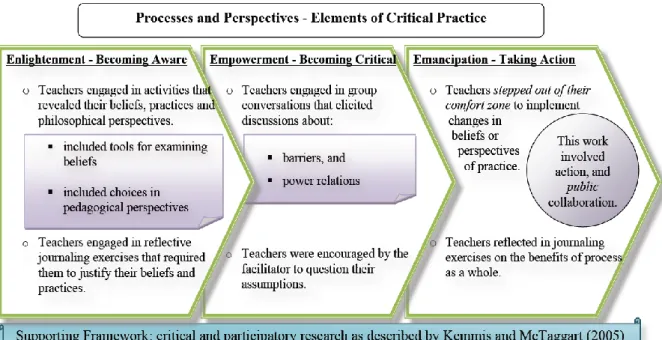
Teacher education “should provide practitioners with the tools and resources they need to recognize, analyze, and address the contradictions, and in so doing, open-up the possibility that conditions in schools can be different” (Smyth, 1989b, p. 4). There is still a need to apply research methods that emphasize “the importance of being able to see, talk about, and then try a practice with support” (Levine, 2010, p. 121). My challenge was to develop effective processes and tools for teacher educators and researchers to support mathematics teachers in the examination of their beliefs and in the exploration of alternate mathematics pedagogies for the purpose of developing a greater self-awareness of their beliefs and practices. To address these concerns, I asked the following research question: Do Fay’s stages of empowerment provide a useful framework for describing the progress of a group of teachers engaged in processes designed to reveal self-knowledge of participants’ beliefs and alternate practices? According to Fay (1987), consciousness can be developed through a three-stage process that is enlightening, empowering and emancipatory. This E1E2E3 (Enlightenment-Empowerment-Emancipation) model was discussed by Johns (2004) to explain the reflective process that occurs during the practice of nursing. Johns described Fay’s three stages as shown in the table below. The parallels between Fay’s work, Johns’ interpretation and this study are shown in Table 1.
Table 1. Three Stages of Empowerment (Johns, 2004) – Based on Fay (1987) Stages
(Fay, 1987)
Johns (2004) This Study: Based on Fay (1987) Enlightenment
(understanding)
Understanding why things have come to be as they are in terms of frustrating self’s realization of desirable practice.
Participants come to understand their personal knowledge, beliefs and practices and make sense of any tensions between them.
Empowerment Creating the necessary conditions within self whereby action to realize desirable practice can be undertaken.
Participants articulate and learn to question barriers and discourses that have become embodied (reified). They begin to see themselves within a larger framework, they notice their positioning within that structure, and that things can change. Emancipation
(transformation)
A stable shift in practice congruent with the realization of desirable practice.
Participants are driven to “socially transformative action”. They also experience a liberation - or a “state of reflective clarity”. They step out of their comfort zone and become agents of change.
Given my purpose of supporting teachers’ reflective process during their practice, I selected the E1E2E3 framework as an important supporting element for the design and analysis of my work with teachers.
This study took an emancipatory perspective and supported its purpose by providing choice to the participants. It was informed by Kemmis and McTaggart’s (2005) seven key features of participatory action research, and had the goal of providing an empowering space for its participants (Guba & Lincoln, 2005). Research studies tend to investigate teachers’ pedagogical choices as limited to either a transmissive or reform mode (Lerman, 2003). I intended to offer a choice between these teaching perspectives as well as other possibilities and pedagogical stances from the literature which are not typically promoted in reform documents but are, nonetheless, appropriate for addressing critical thinking and social justice issues for 21st century learners (e.g., D'Ambrosio, 2001; Skovsmose, 1994; Stinson, Bidwell, Powell, & Thurman, 2008). I intended that participants would be introduced in more detail to the two dominant perspectives, one based on a behaviorist model of learning (referred to as transmissive according to Lerman, 2003) and one based on a constructivist view of learning (referred to as reform according to Lerman, 2003), but also that they would have the opportunity to become familiar with two other emergent critical pedagogies for cultural and political empowerment of students (e.g., ethnomathematics and criticalmathematics).
Importance of Teachers Reflecting on their Beliefs
This study investigated teachers’ espoused beliefs within the context of teaching and learning mathematics. As Thom (1972) reminded us, “whether one wishes it or not, all mathematical pedagogy, even if scarcely coherent, rests on a philosophy of mathematics” (p. 204). Secondary mathematics teachers’ voices and beliefs are under-represented in the literature, and the concern that those expert teachers “may be particularly susceptible to an expert blindspot” (Nathan & Koedinger, 2000, p. 209) needs to be addressed and researched. Furthermore, the
theoretical perspective that teachers hold, whether implicitly or explicitly, is essentially linked to their practice. As Kemmis (2005) articulated, “[p]ractice is always ‘theoretical’ – it refers to the theory that informs it (of
which practitioners may or may not be aware)” (p. 8). This work attended to secondary mathematics teachers’ beliefs, and was designed to recognize their voices as they worked through a process of reflection and self-empowerment.
Teachers’ philosophical beliefs are a more powerful determinant of their practice than reform documents or prescribed pedagogical texts (Hofer, 2006; Schwab, 1974). Because unexplored teachers’ beliefs can be a barrier to pedagogical growth, teachers’ beliefs must be examined. Teacher development researchers have recommended that reform be viewed from a teacher’s standpoint and as a liberation rather than a prescription (Brown et al., 2007; Cooney, 2001; Lerman, 1994; Reio Jr., 2005; Smyth & Shacklock, 1998; Woods, 1985). In order to examine secondary mathematics teachers’ beliefs from the point of view of the participants, a reflective approach to research and practice is required. Through the reflective practices designed for this study, I anticipated that teachers would become able to make sense of their beliefs and practices (Schein, 1996).
The following quote is from one of the participant’s first journal reflections:
I think the [traditional] mode of teaching math is more effective in school, especially at the younger grades. Following and carrying out procedures, repetition, strong work habits, and learning from your mistakes are all important factors in the work world. I think the more traditional approach to learning math is far more effective at achieving all these goals. It’s fine to try the [reform/problem-based] mode once in a while, but to push to have this be the main instructional approach in a math classroom is just silly (Raymond’s First Journal).
When he wrote this at the beginning of this study, this teacher may have been unaware that he held a particular philosophy about mathematics, teaching, and learning. He saw his statements as facts, and had not necessarily reflected critically upon them. Kagan (1992) noted that “[t]eacher belief is defined broadly as tacit, often unconsciously held assumptions about students, classrooms, and the academic material to be taught” (p. 65), and that “[i]n a landscape without bearings, teachers create and internalize their own maps” (p. 65). Many educators appear to be adrift in a landscape without bearings. This study intended to expose these bearings so that teachers could situate their beliefs and practices and learn to know themselves better (Kegan & Lahey, 2007). What we think is a truth can simply be a strongly held belief that we have never challenged. When considering the difference between knowledge and beliefs, Wilson and Cooney (2002) described the concepts of knowledge and beliefs as being blurred; if an individual feels that his beliefs have reasonable evidence to support them, he will consider them to be knowledge.
...underlie dispositions to engage in certain practices and not others. They help people to understand themselves, to understand their environment and to form social groupings around shared values, thus reducing discord. Beliefs thus become comfortable, reified as “the way things are”, and are often resistant to change. (p. 59)
Some assert an urgency that teachers should become more aware and critical about their beliefs and about the structures that surround them in their work. For Lesser and Blake (2006), for example, if teachers do not reflect on their personal philosophies, they will continue to re-create the “reified typifications of mathematics” (p. 167) in the classroom. There are several implications for teacher educators when taking into account the considerable importance of teachers’ beliefs. Ernest (1988) explained that a “shift to a problem solving approach to teaching requires deeper changes. It depends fundamentally on the teacher’s system of beliefs, and in particular, on the teacher’s conception of the nature of mathematics and mental models of teaching and learning mathematics” (p. 1). Many agree that teachers must attend to their beliefs through professional learning experiences (Barkatsas & Malone, 2005; Kagan, 1992; Pajares, 1992), and Swan (2006) argued that changes in beliefs might be the best indicator of growth for teachers. Hofer (2006) agreed that “[r]esearchers in this area need to do more to educate teachers about the power of epistemic beliefs as well as to help educators at all levels consider the value of addressing epistemic understanding” (p. 93).
Determining Whose Reality Counts
This research paradigm is interpretivist. It assumes that reality, as we know it, is constructed intersubjectively through the meanings and understandings that we develop socially and experientially. “Knowledge is a dynamic product of the interactive work of the mind made manifest in social practices and institutions” (Paul, 2005, p. 46). It includes an “enacted, or constructed, reality, composed of the interpretive, meaning-making, sense-ascribing…activities which produce meaningfulness and order in human life” (Lincoln, 2005, p. 61). Since we cannot separate ourselves from what we know, truth cannot be grounded in an objective reality. The axiological implication is that researchers must make “extraordinary efforts to reveal, or uncover, beliefs and values that guide and generate individual and group constructions” (Paul, 2005, p. 36).
Since it is argued that beliefs about practice must be attended to in research studies that concentrate on teacher development, qualitative researchers are tasked with designing and enacting studies with trustworthiness and catalytic validity. According to Guba and Lincoln (2005) catalytic validity describes a research process that is able to prompt action on the part of research participants. Kemmis (2006) argued that transforming realities “requires truth-telling both with respect to the truths that arise from our work (our findings) and the methods by which we arrive at them. It requires that we critically evaluate how we have done our work – whether our findings are justified by our methods” (pp. 474-475). Too often, it is assumed that another’s (researcher’s) observed interpretation of classroom practice is more objective, and therefore more valid than a participating teacher’s interpretation. Taking into account the interpretivist research stance, rather than a focus on observed
evidence, this study considers practitioner-derived knowledge to be trustworthy and relevant (Lerman, 1994; Smyth, 1989b).
Teachers’ self-reported practice, particularly as reported to colleagues in the public sphere about one’s practice should be considered valid. In research methodology, this implies that particular texts, including what might be considered indirect observations such as reflective journals should count as a good representation of what those participating teachers know. Focus group methodology is strongly supported. Kemmis (2006) argued that it is important to establish “public sphere in which people realise and enact their communicative freedom”, and that we must “open communicative spaces in which ‘the way things are’ is open to question and exploration” (p. 474). If this can be accomplished in a research setting, then surely, the teacher’s own public declarations about her practice can count as the truth.
Exploring Barriers and Power Relations
An awareness of barriers was necessary in the process of this study because they tend to block teacher professional growth if they are not discussed. As Kemmis and McTaggart (2005) described: “[p]eople not only are hemmed in by material institutional conditions, they frequently are trapped in institutional discourses that channel, deter, or muffle critique”(p. 571). Given this perspective, I chose to ask questions of my participants with the purpose of eliciting conversations about the barriers they felt they encountered in their practice. I expected these probing questions to result in discourses where participants claimed certain truths about the world of teaching. As Miller (1994) explained: “[i]nstitutional discourses are made up of the assumptions, concerns, and vocabularies of members of socially organized settings, and the ways in which they interact” (p. 280). These are the stories and assumptions about schooling that are told and retold and are accepted as the norm in schools. The conversations that repeat themselves in teachers’ discourses reflect their truth about the world of teaching.
What is interesting about institutional discourses is that they are repeated and rarely challenged. They create and sustain unconscious assumptions that nothing can be done about these facts, because the stories just describe the way it is (Singh, 1993). Generally, teachers will not be aware of the assumptions they make until they are challenged. This limits them because they cannot be agents of change unless they understand that things can change. It is possible to help teachers learn to recognize the assumptions they are making, and research and teacher development can be designed to address them. As Kegan and Lahey (2007) described:
[p]eople often form big assumptions early in life and then seldom, if ever, examine them. They’re woven into the very fabric of our lives. But only by bringing them into the light can people finally challenge their deepest beliefs and recognize why they’re engaging in seemingly contradictory behavior (p. 50).
Kegan and Lahey call these narratives that impede our growth and learning subconscious competing commitments, and describe how it is important to design professional environments where those barriers can be made explicit, and to provide the space where participants can engage in challenging those subconscious competing beliefs or discourses. A critical and participatory methodology can be applied in such a way that participants are provided with opportunities for empowerment through greater knowledge and self-development.
Fay (1987) viewed critically reflective practice as moving through three stages: enlightenment (E1), empowerment (E2) and emancipation (E3). These stages of enlightenment are necessary for teachers so that they may come to understand their personal knowledge, beliefs and attitudes, and make sense of any tensions between them. Fay described how reflective practitioners would experience a liberation or a “state of reflective clarity” (p. 205) bringing harmony to those tensions. Fay’s model requires the articulation of barriers such as social norms, power relationships and previous learning. He argued that the reified barriers can become so embodied that it does not seem possible to question their existence, let alone work to transform them. These norms are responsible for the maintenance of the status quo in societies and organizations, and they tend to remain unquestioned. These norms are re-created through discourses or narratives that reconfirm their truth. Through critical reflection and understanding, individuals can learn to question and possibly alter what they might have originally believed to be unalterable realities. Fay also suggested that an atmosphere be created in which research participants can exercise their voice and develop a sense of human agency. Critical reflection is not passive. To be an agent of change is to practice what one believes. As was described in Ford and Profetto-McGrath (1994), “action ensues from critical reflection; nevertheless, the action involves risk taking, as the individual engages in a process that challenges and changes the status quo” (p. 343). This unifies critical thought and practice, and forms the notion of praxis. Fay’s (1987) E1E2E3 stages are central in the supporting framework of this study, and provide the rationale for the process, method and results.
Methodology
The Perspective and Practices of the Critical Researcher as Facilitator
I employed a critical and participatory (Guba & Lincoln, 2005) stance, and informed this work by employing Kemmis and McTaggart’s (2005) seven key features of action research. The ontological perspective was understood to be that knowledge is co-created and participative, and was shaped by social, political, and cultural values. It was appropriate that the methodology was collaborative and dialogic. The internal validity in this study resulted from its fidelity to a critical perspective supported by its theoretical design, the logic of the arguments made in the research literature, and the use of individual and collective data. This study moved its participants to take action, which gives evidence of catalytic validity. “Catalytic validity points to the degree to which research moves those it studies to understand the world and the way it is shaped in order for them to transform it” (attributed to Patti Lather in Kincheloe & McLaren, 2005, p. 324).
A critical researcher who is employing Guba and Lincoln’s (2005) idea of practical philosophy, and working to help teachers develop McCutcheon and Jung’s (1990) concept of a lived theory would need to practice Gadamer’s (2004) and Towers’(2010) notion of phronetic knowledge. Phronesis is a kind of practical knowledge that “presupposes a moral attitude, which it continues to develop” (Gadamer, 2004, p. 20). As Towers (2010) explains, a “sense of ethical purpose is, then, central to the work of teaching (and teacher education)” (p. 246). From this perspective, the “participant-researcher” (Kemmis & McTaggart, 2005, p. 572) works in collaboration with teachers as a “critical friend” (p. 571). Critical action researchers must practice in-action in accordance with their values and theoretical perspective.
I kept my role in balance, and critically, intentionally, and regularly reflected on my practices and my influence upon the group. I applied a critical researcher’s perspective upon my own actions and honed my facilitation skills during the course of this research. This allowed me to practice what I understood to be an ethical and phronetic praxis. I kept a researcher’s journal, I regularly reflected critically upon the scripts as I prepared for our next work together, I attended to the group’s discussion in-action, and asked probing questions during our discourse to augment awareness and metacognition as well as to clarify my role, and I worked hard to include all voices during the course of the study.
Design of the Study – Seven Key Features
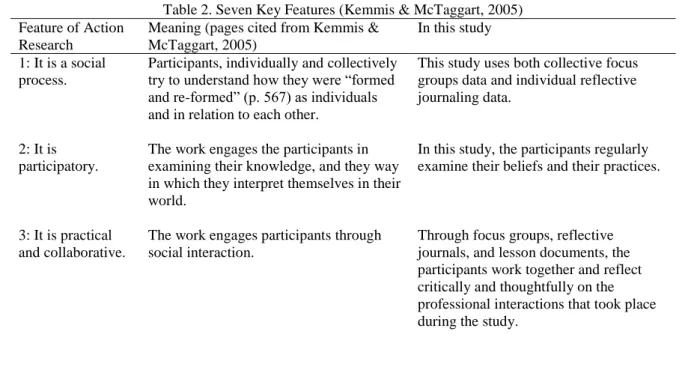
In Kemmis and McTaggart’s (2005) re-examination of their work on participatory action research, the authors noted that, even though many people identify the image of the spiral of cycles of self-reflection (planning, acting, observing, and reflecting, etc.) to their work, there are seven other key features of action research that are “at least as important as the self-reflective spiral” (p. 566). This study was designed to attend to these tenets.
Table 2. Seven Key Features (Kemmis & McTaggart, 2005) Feature of Action
Research
Meaning (pages cited from Kemmis & McTaggart, 2005)
In this study 1: It is a social
process.
Participants, individually and collectively try to understand how they were “formed and re-formed” (p. 567) as individuals and in relation to each other.
This study uses both collective focus groups data and individual reflective journaling data.
2: It is participatory.
The work engages the participants in examining their knowledge, and they way in which they interpret themselves in their world.
In this study, the participants regularly examine their beliefs and their practices.
3: It is practical and collaborative.
The work engages participants through social interaction.
Feature of Action Research
Meaning (pages cited from Kemmis & McTaggart, 2005)
In this study 4: It is
emancipatory.
The work aims to help people to release themselves from the “social structures that limit their development and self-determination” (p. 567).
This is evident in the intentional framing of the study using Fay’s E1E2E3 model.
5: It is critical. The work aims to help people to release themselves from their language
discourses, their “modes of work” (p. 567), and their social relationships of power.
Focus group and reflective journals emphasize questions about barriers and power relations. These questions are exercised throughout the study.
6: It is reflexive. The participants in the study engage in a deliberate process intended to transform their practices through self-critical action and reflection.
The application of the E1E2E3 model and the regular reflective journaling intend to support participants through a critical and participatory research process.
7: It aims to transform both research and practice.
The work intends to bridge research and practice by helping to “illuminate particular practices and practical settings as a basis for developing critical insights and ideas about how things might be transformed” (p. 568).
This study offers a number of pedagogical practices with the aim of establishing promising research practices for teachers to transform their practice.
Participants and Context
In qualitative studies, research validity is often associated with the development of ethical relationships between participants and the researcher. The reason for this is that more credible data can be collected if the study has been designed to establish a trusting climate. Guba and Lincoln (2005) deepened this idea by asserting that “[t]he way in which we know is most assuredly tied up with both what we know and our relationships with our research participants” (p. 209). I came to be involved in this study through my work with teachers locally, nationally and internationally. For more than two decades I had been supporting teachers with conferences, workshops and websites, and my reputation was of someone who was a strong curriculum leader and coach, and could be trusted. According to Elsbach (2004), the teachers almost certainly had an “enhanced perception of trustworthiness” (p. 282) because I am a teacher (I am like them), and because I had a reputation for trustworthiness - competence, generosity, and integrity.
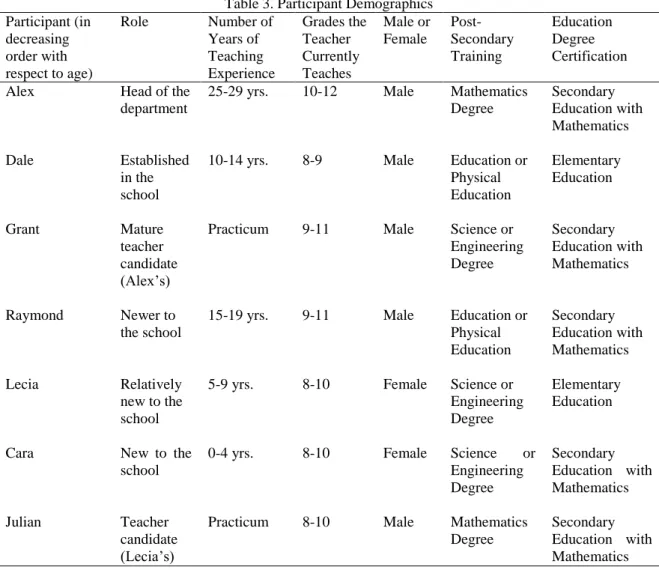
This research involved a group of seven secondary mathematics teachers (pseudonyms used) comprising a mathematics department in a small high school with grades from 8 to 12 that enrolled approximately 700 students. There were three experienced male teachers, two female teachers who were newer to the profession, and two teacher candidates on practicum. The school was in a rural area outside a larger city center with a greater population of approximately 55 000 (which included the rural area).
This school district was relatively small and had limited resources to supply professional development on an ongoing basis. It had, however, a district-level administrator who very much supported the work of professional learning communities when possible. After my call for participants, this school’s mathematics department was eager to engage in professional learning that was ongoing, and in particular, in the proposed study.
This work occurred between February and June of the school year. We met on Tuesdays after the school day, every two or three weeks, according to the teachers’ preferred days. I had met some of the teachers at previous times during state-level professional activities, but I had not met all teachers, and was not previously associated with the school or the school district. The teachers were not compensated.
The table below describes the group of teachers in this study.
Table 3. Participant Demographics Participant (in
decreasing order with respect to age)
Role Number of
Years of Teaching Experience Grades the Teacher Currently Teaches Male or Female Post-Secondary Training Education Degree Certification
Alex Head of the
department
25-29 yrs. 10-12 Male Mathematics Degree
Secondary Education with Mathematics
Dale Established
in the school
10-14 yrs. 8-9 Male Education or Physical Education
Elementary Education
Grant Mature
teacher candidate (Alex’s)
Practicum 9-11 Male Science or Engineering Degree
Secondary Education with Mathematics
Raymond Newer to
the school
15-19 yrs. 9-11 Male Education or Physical Education
Secondary Education with Mathematics
Lecia Relatively
new to the school
5-9 yrs. 8-10 Female Science or Engineering Degree
Elementary Education
Cara New to the
school
0-4 yrs. 8-10 Female Science or
Engineering Degree
Secondary Education with Mathematics
Julian Teacher
candidate (Lecia’s)
Practicum 8-10 Male Mathematics
Degree
Secondary Education with Mathematics
Method and Design of the Inquiry
The literature review supported the design, and informed the process through which teachers participated in the study. The study (designed with five sessions) was facilitated over a period of approximately six months. Data were collected through audio-recordings of focus group sessions, reflective journals, researcher’s field notes and reflections, and document analysis of the teachers’ written lesson plans and reported lessons. In this study, Focus Groups (FG) are defined using Kitzinger’s (1994) definition. As a group, we explored questions and ideas collectively, and the group’s interaction was expressly included as research data.
Session I
Table 4. Overview: Sessions I - V Session Description of What Each Session Entailed
Session I)
(FG1) Orientation to the Study (Research Perspective); Focus Group Questions; Investigate Beliefs
PD*: (Introduction to Alternate Mathematics Pedagogies) Readings: Constructivism and “Radical Mathematics”
Session II)
(FG2) Focus Group; Explore and Investigating Beliefs as a Group - Four Mathematics Pedagogical Perspectives
(J1) First Electronic Reflective Journaling Exercise; Teachers are asked to justify their beliefs and practices
Reading: Ethnomathematics
Session III)
(FG3) PD*: (Mathematics Lesson Example: Focus on Constructivism); Lesson and Focus Group Questions
Action Research by Teachers:
Plan: Teachers plan
Act and Observe: Teachers deliver a lesson and elicit feedback from their students
(J2) Reflect: Second Electronic Reflective Journaling Exercise
Session IV)
(FG4) Reflect: Group Sharing - Individual Teachers’ Lesson Presentations
(J3) Third Electronic Reflective Journaling Exercise
Session V)
(FG5) PD*: (Mathematics Lesson Example: Focus using Social Justice Perspectives – Ethnomathematics and Criticalmathematics)
(J4) Fifth and Final Electronic Reflective Journaling Exercise *PD indicates Professional Development Support
After the short introduction, I asked the participants (in a focus group situation) a number of questions about who held the power in their work situations, and about their perceptions of the barriers and factors that facilitated their work. The focus group questions (FG1) were:
1. In my job, who (or what) has power or influence over my work? 2. In my job, over whom (or what) do I have power or influence?
3. What are the biggest barriers that stop me from implementing the best lessons? 4. What are the factors that facilitate my best work as a teacher?
of concepts” (p. 4) and would affect practices. When hard questions are asked, these can serve as jolts or nudges
for the teachers participating in reflective practice. Researchers and educators of adults must develop and apply practices that help participants “become critically aware of the cultural and psychological assumptions that have influenced the way we see ourselves and our relationships and the way we pattern our lives” (Mezirow, 1978, p. 101).
There are few practical examples in the literature that give detailed information about exactly which questions facilitators might ask when working with teachers in this way. Smyth (1989a, 1989b) suggests that the following questions are appropriate and necessary to nudge teachers:
What do my practices say about my assumptions, values, and beliefs about teaching?
Where did these ideas come from?
What social practices are expressed in these ideas?
What is it that causes me to maintain my theories?
What views of power do they embody?
Whose interests seem to be served by my practices?
What is it that acts to constrain my views of what is possible in teaching? (p. 7)
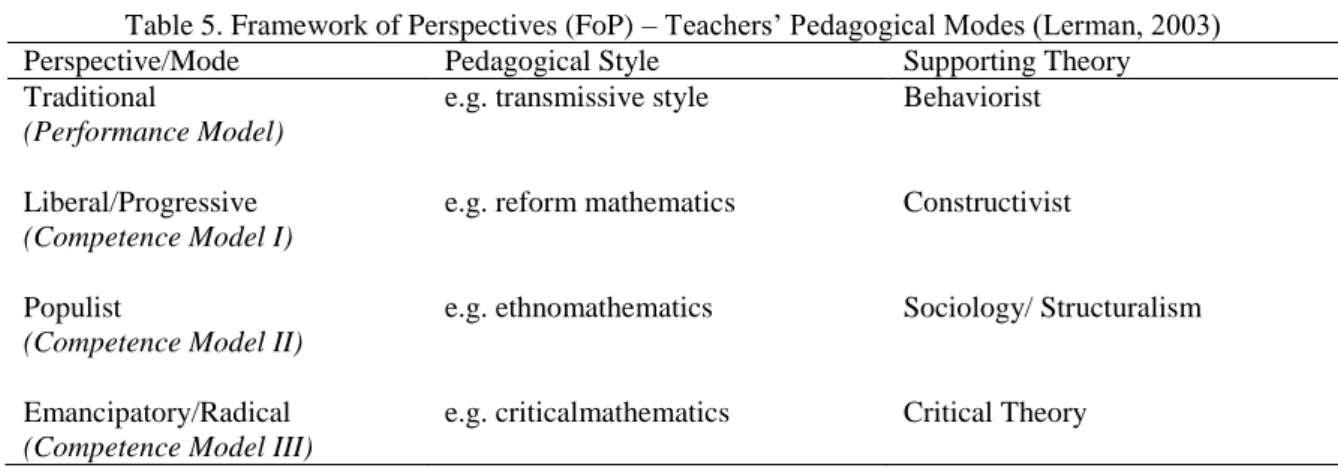
Smyth’s hard questions offered important guidance to the structure and facilitation of this study. Following the focus group discussions of questions (FG1), a Framework of Perspectives (see Table 5) was introduced as a professional development activity and used to guide an audio-recorded group discussion (FG1) about alternate pedagogies. As a structuring device to implement Fay’s E1E2E3 model, I chose Lerman’s framework of perspectives to allow me to scaffold and organize the range of beliefs that might be held by secondary mathematics teachers.
Table 5. Framework of Perspectives (FoP) – Teachers’ Pedagogical Modes (Lerman, 2003)
Perspective/Mode Pedagogical Style Supporting Theory
Traditional
(Performance Model)
e.g. transmissive style Behaviorist
Liberal/Progressive
(Competence Model I)
e.g. reform mathematics Constructivist
Populist
(Competence Model II)
e.g. ethnomathematics Sociology/ Structuralism
Emancipatory/Radical
(Competence Model III)
e.g. criticalmathematics Critical Theory
The intent of introducing this framework to teachers was also to advance the participants’ knowledge about various perspectives or paradigms for teaching mathematics. Later, during Session II, the charts in Appendix A (also provided in Figure 1) would provide more detailed information for the teachers about the pedagogical stances described in the Framework of Perspectives. The teachers’ understanding of the perspectives was also deepened with the readings that were assigned and with the discussions that ensued.
The idea that mathematics teachers should be offered the opportunities to explore their beliefs, and that they should not be coerced into a predetermined conception or definition of improvement is supported by Brown et al. (2007):
[M]athematics education research and development should seek to recognise differences in teachers’ understandings, experiences and context of action and assist them in making informed professional judgements about how their practice might be developed in situ, rather than supposing that external evaluative judgements should be based on movement to a consensually preferred conception of teaching. (p. 198)
Besides providing a framework for teachers to learn about different perspectives and practices, the offering of all four possibilities gave teachers choices. This study did not assume that the reform movement in education was the best or only possible stance for secondary mathematics teachers to adopt. Because a critical research approach was taken, this “demands an ideology of teacher education different from that traditionally employed, which usually involves models of ‘best practice’, emphasis on competencies, and unrecognised conflicts between institutional ideals and workplace socialisation” (Hatton & Smith, 1995, p. 38). Moreover, it is well recognized in adult education that adult learners respond better when they are given choices rather than when they are told there are specific best practices (Brookfield, 1988; Merriam, 2004).
Session II
As McCutcheon and Jung (1990) described, it is against a lived theory (or practical philosophy) that teachers view research or other educational problems. Teachers hold unexplored beliefs, and their lived theories may or may not be articulated nor apparent to them. Teachers, even if aware of their views, may have difficulty expressing those beliefs unless there is an initial stimulus for discussion (Cooney, 1985; McCutcheon & Jung, 1990; Thompson, 1984). Kagan (1992) recommended that facilitators use a reflection tool, or some form of information, as a foundation for the exploration of beliefs and practices. This is important for the enlightenment (E1) stage of empowering practices.
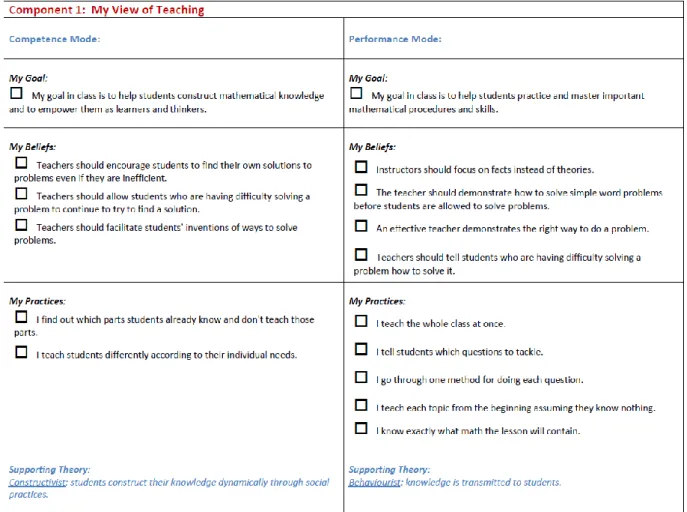
In Session II, a second exploratory tool was introduced. Practices and beliefs statements were sorted and organized in charts, and were categorized as either supported by a behaviorist view of learning, a constructivist theory of learning, or by one of the Social Justice teaching paradigms (e.g., ethnomathematics or criticalmathematics). Figure 1 shows a sample of the charts used as an investigation and discussion tool during the second session. The entire set of charts used for this purpose can be found in Appendix A.
Figure 1 shows Component 1, also presented in Appendix A, and is the first page of the tool that teachers used to help describe their teaching beliefs and practices. This process involved a participant’s self-assessment of where he or she stood on a beliefs and practices scale. Teachers self-assessed their beliefs and practices by rating themselves according to the charts. They were asked to select a position on a continuum between two modes as described in the charts, and then share their stances with the group.
It was intentional, in this study that this exercise was not meant to objectively measure participants’ beliefs and practices, but rather to serve as a tool to help teachers self-identify their beliefs and practices. Participants responded to each component (see Appendix A) of mathematics, teaching, learning, and critical pedagogies, and the group’s responses were discussed. The teachers were then provided the opportunity to negotiate their beliefs and practices individually and with the group. Following this activity, questions and concerns about the responses were elicited, and the link to power relations was further explored. Specifically, the focus group questions (FG2) were as follows:
1. Were you surprised about any of the results from this group’s beliefs?
2. Do you have any concerns, questions or positive comments about this group’s beliefs? 3. Do you see the power relationships in our job in a new or different light, or not?
I used open questioning techniques to elicit more detailed information from the participants. This focus group discussion was audio-recorded and transcribed verbatim. One benefit of action research as described by McCutcheon and Jung (1990) is that participants are given the opportunity to examine more formal epistemologies, and have time to become somewhat familiar with what these formal epistemologies of practice have to offer. As previously argued, critical social science practice requires that participants be given choices rather than be guided towards a researcher’s predetermined conclusion (Brown, et al., 2007; Kemmis & McTaggart, 2005; Leitch & Day, 2000). An important purpose for this study was to provide participants with information about teaching pedagogies and philosophies that might be new to them. Reflective journaling work for Session II included the participants taking the Component charts of their beliefs with them, and studying their answers carefully to see if, after reflection, they would decide to keep their choices, or change them. The first written journal reflection was based on questions about how they placed themselves on the various continua, and how those responses might be connected to their practice or other aspects of their world of work. The reflective journal questions for J1 were:
1. Would you change your responses to any of the chart items given more time to reflect?
2. What, if anything, do you notice about the three components (teaching, learner, nature of math)? 3. What, if anything, do you notice when you compare your beliefs and your practices?
4. Are you confident about your position in any of the charts? 5. Are you concerned or confused about any of your beliefs?
6. Write two statements for each component explaining why you selected each of the choices you made.
7. Provide any further thoughts about how this exercise may or may not have helped you explain or understand your world of work.
These questions were the participants’ first opportunity to show their journaling skills. Participants reflected about their beliefs and practices throughout the sessions of the study. They did so orally, during recorded focus group discussions, and through journal entries. The articulation and negotiation of their beliefs and practices were important steps towards supporting their self-awareness and reflection.
Session III
mathematics lesson to refocus the group after the learning activity. These focus group questions (FG3) were designed to have the participants reflect deeply on the activity they recently engaged in:
1. What did you experience as a learner in this lesson? 2. What are the benefits of teaching/learning this way? 3. What are the barriers?
4. How, if at all, might experiences like this affect your practice?
After the audio-recorded focus group conversations, I described the next assignment. The participants were to
step outside of their comfort zone and try a lesson that they believed would be empowering for their students. Specifically, I asked them to “plan and deliver one exciting lesson as if there were no barriers”. This session was important because “teachers need first-hand experiences working on specific innovative investigations and activities that they are attempting to use in their classrooms” (Wilson & Cooney, 2002, p. 142).
Critical thought cannot occur without critical action, and vice-versa. In her work, which is especially significant because it reveals the effects of critically reflective practice with secondary mathematics teachers, Jaworski (1998) concluded that “[a]ction, a key concept in the research, led thinking initially and became ultimately inseparable from thinking. The teachers’ research was described as evolutionary to recognise the dialectical relationship between thinking and action as the two developed symbiotically” (p. 26). This finding is valuable evidence that describes how reflective professional learning practices generated a clarity between teachers’ beliefs and practices. Fay (1987) determined that his E1E2E3 model requires “socially transformative action” (p. 205), and that we are driven to action by our enlightenment. In this study, teachers were acting as they participated in focus groups, as they worked actively through their journaling processes, and as they designed and implemented a lesson based on choices of epistemological teaching pedagogies.
The participants’ journal questions (J2) for this session were: 1. What stands out about your students’ responses? 2. What, if anything, surprised you?
3. What went well in your best lesson? 4. How could you improve the lesson?
5. How could you improve the beliefs of the students in your class over the long run?
As reflective journaling work (J2), teachers were to write about their students’ responses and to plan a short presentation in order to report their experiences back to the group during the next session.
Session IV
During Session IV, each member shared her/his best lesson experience. This focus group session (FG4) was also audio-recorded. Participants’ names were chosen at random for the presentation order. Each teacher presented his or her lesson, which took almost all of the time for this session. The reflective journaling work was to write about what they learned from their colleagues’ presentations. In their journals, they were asked to answer the same power relations questions and best lesson questions that were asked in the first focus study session. Specifically, for J3, they were asked:
1. What did you learn from your colleagues’ presentations? 2. In my job, who (or what) has power or influence over my work? 3. In my job, over whom (or what) do I have power or influence?
4. What are the biggest barriers that stop me from implementing the best lessons? 5. What are the factors that facilitate my best work as a teacher?
It is important that the teachers reflected directly on what they had recently implemented in the classroom. As M. S. Wilson and Cooney (2002) described: “[i]t is through the act of reflecting on specific events that those centrally held beliefs can be affected in fundamental ways” (p. 142).
Session V
This final session (FG5) was also audio-recorded. I facilitated a professional development segment using a social justice lesson called Poverty and World Wealth: Recognizing Inequality from Gutstein and Peterson (2005, pp. 64-67), and the Piles of Tiles activity from Burns, Wickett, and Kharas (2002, pp. 197-221). As a group, we worked through these tasks very quickly to get a sense of the lessons. I then provided a number of other ideas for social justice lessons using the same resource (Gutstein & Peterson, 2005). Ideas included sweat shop math - asking students where their clothing comes from, taking chances using the lottery, where that money goes, and cultural issues regarding gambling, BarbieTM and KenTM doll measurements, Mercator and Peters projections of world maps, and individual and world spending and wealth. My intent was to show the range of possibilities if teachers chose to get more political and show students how they could use mathematics as a tool for empowerment. We used the Piles of Tiles activity to show a more constructivist activity that could be done before the Dipping Cubes activity to introduce students to arithmetic progressions, linear functions and to the idea of generalizing using algebra.
For reflective journaling work (J4), teachers answered the following questions:
1) Have my beliefs changed over the course of this research project? If so, how have they changed? 2) What, if anything, have I gained from using the charts of survey items to pinpoint my beliefs? 3) What, if anything, have I gained from writing reflections?
4) What, if anything, have I gained from participating in reflective discussions with colleagues? 5) How has our group benefited, or not, from the work we have done together.
6) What, if anything, have I gained with respect to how I interpret the social institution in which I work, and how I interpret the traditions and pressures embedded in my work?
7) Do I believe that what I have learned in this study will affect my practice? Why or why not?
Data Sources and Analysis
Data sources included audio recordings of the five 2-hour focus group sessions, 28 written reflective journals, seven lesson plans, and other lesson documents and web resources over the course of the study. I transcribed all audio data within a few days of each session in order to capture the conversations accurately. All transcribed audio-data conversations and journal data were read and re-read with the themes in Table 1 and the research question in mind. Upon immersing myself into the data, sub-themes became evident. The teachers’ expressions of Enlightenment, Empowerment and Emancipation in conversation and journal transcripts were coded into the sub-themes using a two-column content analysis method and NVivoTM software. I summarized coded and categorized focus group and journal data. Once the data were classified according to Fay’s three-stage description of the E1E2E3 transformative process and according sub-themes that emerged, the data were re-read and re-classified when necessary, according to themes and sub-theme categories that had been clarified and refined through the re-reading process. This produced the coding structure shown in Table 6.
Table 6. Data Themes (Informed by Table 1)
Themes Sub-Theme Coding
Theme I) Enlightenment (E1):
Becoming Aware
Teachers become aware of their beliefs and practices, and of alternate pedagogies for teaching mathematics.
Teachers examine, articulate, and justify their beliefs and practices.
Teachers notice tensions between their beliefs and practices. Teachers notice the impact of self-reflection exercises. Theme II)
Empowerment (E2):
Becoming Critical
Teachers recognize their beliefs within the larger framework of cultural structures. They are driven to action.
Teachers discuss “hard questions”, barriers and power relations to implementing change in their practice (e.g., cultural, organizational, and psychological).
Themes Sub-Theme Coding Theme III)
Emancipation (E3):
Taking Action
Teachers realize their ability to make changes by taking action in their classroom and reflecting together.
Teachers reformulate their alternate hypotheses or philosophies.
Teachers take action by testing their new hypotheses in their classrooms.
Teachers reflect on the benefits of collaboration. Teachers know “finally who they are” (Fay, 1987).
The findings are presented in three themes. The first group lists evidence of discovering, examining and awareness of self. This is the E1 stage according to Fay (1987), and, in this study, it was where participants developed consciousness about their beliefs, practices, and alternate pedagogies for teaching mathematics. The second set of data lists evidence of critical thought, awareness of their work as within society, politics, and a particular teaching culture and other assumptions. According to Fay, this is the empowerment (E2) stage, and was evident when teachers discussed barriers and power relations, and recognized their beliefs within a larger framework of cultural structures. The third group of data encompasses actions and a sense of who they were as participants. Fay refers to this period as the emancipatory stage, and teachers here recognized their ability to make changes to themselves or to their environment by taking action.
Results
Data Theme 1: Enlightenment – Becoming Aware
The evidence pointed to teachers’ emerging awareness that they needed to understand, explore, articulate and justify their own beliefs and practices. This data theme also includes the participants’ comments about how they benefited from reflective journaling. The theme describes the stage of becoming aware.
In the reflective journal (J1), Grant explained: “This exercise has helped me to clarify my beliefs” (Grant’s Journal - J1), and Cara also noted that she had never thought about certain ideas such as whether or not students were born with an innate ability to do mathematics. She stated: “Many of the questions related to beliefs I felt were tricky questions ...there were some questions that I have never really thought about such as ‘[s]ome people have a knack for learning and others don’t’” (Cara’s Journal - J1).
Lecia wondered why her practices didn’t match her beliefs:
I think I’m also a little confused with the way that I teach if I believe something contradictory. Why am I teaching the way that I am if I believe that students can learn better by figuring things out on their own as opposed to me just showing them the “right way” to do things? I find that my practices are often very different from my beliefs. Why? (Lecia’s Journal - J1)
She was also taken by the first journaling exercise that asked her to justify her beliefs, and enjoyed it even though she found it very difficult:
I think it helps to explain what I’m confused about and maybe why I haven’t changed anything yet... I loved doing this exercise. I found it very challenging, but I wanted to really think about all my answers and dig deep to be able to get a lot out of this. Thank you for getting us to do this! (Lecia’s Journal - J1)
Teachers were able to make their beliefs explicit, justify them. The most experienced participant explained: I’ve got to admit that this reflection process has been challenging and insightful. It has made me aware that trying something different can be more beneficial for the students. I’ve never questioned my practices before!! It’s the first time someone has asked me why and I had to support my reasoning. (Alex’s Journal - J1)
This teacher, who had more than 25 years of experience, reflected that he had never been asked to justify his beliefs. Participants noticed inconsistencies between their beliefs and practices. Julian wondered: “It appears that I am not entirely implementing what I believe, how can I change this?” (Julian’s Journal - J1).
The most productive part of this for me is that I was suggesting what I believe. Stating your beliefs, even in a relatively safe anonymous environment makes you take ownership and solidfy [sic] why you do what you do. It requires introspection and self-understanding. (Dale’s Journal - J4)
Learning to be critically reflective was a difficult task. As one participant wrote:
To tell you the truth I find writing reflections a little bit annoying because it forces you to look in the mirror and sometimes I don’t always like what I see. Although making me feel guilty about myself, it makes me want to change and that might be a good thing. (Raymond’s Journal - J4)
Writing a reflective journal was also difficult for most teachers, but they appreciated the benefits. Dale, an established teacher in the group, wrote: “I think reflection time is one of the most under-rated aspects of productive teaching” (Dale’s Journal - J4). Cara explained how difficult it was for her to write her ideas, and described how beneficial journaling was when it came to sharing and expressing herself about her beliefs. She wrote: “I do not really enjoy writing; I struggle with getting my thoughts down on paper. The more we have had to write, the easier it has become for me to share my opinions and ideas and reflect on myself” (Cara’s Journal - J4).
Julian described the journal writing in this study as being more effective than his last year of schooling (his teacher preparation year), which was current in his mind since he was a teacher candidate on practicum. He explained: “For starters, I really don’t like writing journals, reflections, or any kind of paper (that is why I went into math ). However, these journals really helped me, more so than my last year of schooling” (Julian’s Journal – J4). Interestingly, Raymond, whose belief system was very traditional at the beginning of this study, described how difficult it was for him to be reflective because he found it very hard to admit to his beliefs and practices. In the E1: Becoming Aware stage of Enlightenment, teachers articulated and justified their beliefs and
practices, noticed tensions between them, and noticed the impact of the self-reflection exercises.
Data Theme 2: Empowerment – Becoming Critical
When asked questions about power relations and barriers during focus group sessions, the participants discussed and unmasked the pressures and supports that pushed and pulled them in their work. Barriers included cultural, organizational, and psychological concerns such as their own comfort zones. The ability to become critical is to be able to place oneself within these structures, and come to realize that something can be done to improve, in this case, our practice. In this category, teachers also noticed and described how things could change. This is the empowerment stage.
When engaged in journaling exercises and when participating in focus groups, the teachers reflected critically as they developed an awareness of the social constructs that acted as barriers to implementing change in their practices. I was able to question and challenge beliefs about barriers and was careful to support teachers’ concerns. A number of barriers were uncovered and discussed during the focus group discussion in Session II. Barriers described by the participants included: (1) not having enough time to cover the curriculum, (2) not having enough preparation time, (3) a concern about the assessment practices of the government bodies that distract from instruction, (4) the problems of low government funding and large classes, and (5) issues of students coming to teachers with low motivation or skills.
Once barriers were made explicit and discussed by the group, teachers were able to put them aside. Although the barriers were ever-present, every teacher in the group chose to plan and implement a lesson that they described as “outside their comfort zone”. They engaged in action research and planned and taught a lesson, observed student feedback, and reflected both personally and as a group on their lessons. After the group presentations of their lessons in Session III, Julian described in his journal (J2) his difficulty in relinquishing his presumed role as main source of knowledge in his classroom, and he described the benefits he perceived for the students.
Giving control over, and stepping away from the norm was not easy, but it made the lessons more engaging for both the students and myself. I am going to try and do this more often. The responses, and energy in the room really changes when students think that they are steering the ship (even if you are holding the wheel). (Julian’s Journal – J2)
my best lesson doesn’t have to be perfect, I think I am willing to try more things outside of my comfort zone” (Lecia’s Journal – J3). Participants in the study were pleased with each other’s risk taking and testing of their philosophies in the classroom. As Alex expressed: “I was quite impressed with everyone wandering out of their comfort zones and doing these amazing group investigations” (Alex’s Journal – J3).
As a result of beginning to adopt a critically reflective stance, the participants reformulated their hypotheses and showed evidence of being motivated “into socially transformative action” (Fay, 1987, p. 205). The moment when teachers are nudged towards taking action is when they can see that they have reformulated their philosophies. This is like an emancipatory catalyst when it occurs. Evidence of participants achieving that understanding can be found in their journals. In his last journal reflection, when asked to look back on the important aspects of his experience, Raymond was self-critical about his practice as he wrote in his journal (J4). He disclosed that he did not allow his students to learn for themselves often enough. He described: “I am more aware of the need to try a constructivist approach to learning in my class more often. Far too often I tell/show my students exactly what I want them to do and they are not given enough opportunities to figure things out for themselves” (Raymond’s Journal – J4).
Lecia described her change of consciousness as a critically important event. She stated: “It has awakened me from being stuck in my own way of doing things from year to year” (Lecia’s Journal – J4), and later in the same journal entry, she described how she needed a catalyst such as this study to get her started: “I just need to be pointed in a direction and kick-started with some ideas” (Lecia’s Journal – J4).
As Lecia explained in her journal (J3):
[M]y new goal is to implement one best lesson in each unit that I teach...whether it’s directly related to the curriculum or not. And if I try to tell myself that I can’t afford to lose a class for it, I have to remind myself that I can’t afford to not do it either, otherwise what kind of a teacher would I be? (Lecia’s Journal – J3)
Cara declared: “I would love to introduce more social justice problems to my students to help empower them in their lives through mathematics. I would also like to adjust my teaching style to follow a more constructivist model where the students can take ownership in their learning” (Cara’s Journal – J4).
In the E2: Becoming Critical stage of Empowerment, teachers appeared to benefit from discussing the power
relations and barriers inherent in their work. The stage was set for them to consider and discuss barriers, and for them to notice that they have chosen a position within the structure of teaching, which now means that they can chose another. Because the conditions were met for them to notice that things could change, they began to shift their beliefs towards what they felt would be more student-empowering practices, and they were able to indicate their plans to take action.
Data Theme 3: Emancipation – Taking Action and Reflecting on their Transformation
The teachers in the study acted on their beliefs, and implemented a lesson that they considered to be a risk-taking experience. They then shared their lesson with the group, and reported on their successes and difficulties. The participants presented rich pedagogical ideas and practices, and important instructional themes became apparent as teachers shared the salient aspects of their lessons. This process of communicative action and collaboration was critical in building trust within the group. This data theme includes examples of participants’ reflections about how they were able to take action and make changes in their practice, how the collaborative and public aspect of the group was essential, and how, after this experience, they were able to know themselves better as practitioners.
Action
The action that was taken is mostly evident with respect to the research process itself. Teachers took action by participating in the public sphere during focus groups, they implemented lessons that were outside their comfort zone, and they were able to describe their shifts in beliefs and practices.
my classes since I started this project and I know that over time I will add more to build on these lessons” (Lecia’s Journal – J4).
Cara was very thoughtful in her description of her personal change. She explained how she learned to appreciate the complexity of teaching, and described her implementation of teaching mathematics through social justice.
I think that my main belief that has changed over the course of this research project is that there are so many more issues/ problems/ questions that can be involved in and related to the math curriculum. I am able to introduce social justice issues and political issues in a way that can be related to some of the targeted [curriculum learning outcomes]. (Cara’s Journal – J4)
Action as a Group
Raymond described what he saw as a change in consciousness of the whole group. He explained how the team of participants in the study benefited from the reformulation of their pedagogical philosophies. Raymond wrote: “Our group has benefited because it has made us more open to discussing alternative methods for teaching mathematics” (Raymond’s Journal – J4). The importance of the collaboration between colleagues was hard to deny. Cara’s comment is a good example of the experiences of the members of the group.
The lesson sharing was really beneficial. Simply getting more ideas of lesson plans that vary from the
norm as a way to intrigue students and motivate their learning. Hearing each other’s opinions and struggles is always beneficial. It allows me to realize that I am not alone in my struggle to change and develop new methods of instruction. It is reassuring to know that even teachers with way more teaching experience than I have encounter the same constraints and obstacles. (Cara’s Journal – J4)
Grant had also noted: “[m]y colleagues displayed new and intriguing ways to get students interested in math, using games, because all students seem to enjoy games, or at the very least, enjoy fun. The different lessons were interesting and hands on, another aspect that many teenagers enjoy” (Grant’s Journal – J3).
Knowing Myself Better
As Kemmis and McTaggart (2005) contended, the participants’ communicative action opened the “communicative space…[and built] …solidarity between the people who open their understanding to one another” (p. 576). The participants expressed that the processes in the study had a positive impact on them, and most felt that they knew themselves better as teachers by the end of the study.
Having done this project, I feel more confident in my choices for my teaching style and more certain of what I want my classroom to look like. (Lecia’s Journal – J4)
It has given me the chance to figure out who I am as a teacher, and what I want to do, or how I want to teach. (Julian’s Journal – J4)
During this stage of taking action, teachers’ beliefs were more solidified:
I do feel like I am better equipped to teach in a constructivist way as opposed to a teacher-directed way (like I currently do). I also feel like a constructivist classroom is more attainable than I first thought. After doing this research project, I am more motivated, inspired, and committed to doing more constructivist-type lessons (Lecia’s Journal – J4).
After describing how the charts that contained the beliefs items helped him to reflect, Dale described how the activity helped to solidify his beliefs:
Then, once you know why you believe what you believe or how you feel, you can then try new things to change to further develop yourself. I think it is a good idea to begin with this before you try to begin to reflect. The activities helped to solidify your belief system. (Dale’s Journal – J4)
Lecia used the charts in a similar way, and described how it helped her be more true to herself: “I think reflections are always a useful learning tool. I think it makes me more compelled to make change and to be true to myself” She then described how the study made her more sure of herself: “Having done this project, I feel more confident in my choices for my teaching style and more certain of what I want my classroom to look like” (Lecia’s Journal – J4).
The appeal of this study was strong for the teacher candidates on practicum. They wrote about how it helped them to gain confidence and strength to be themselves within the complex world of teaching. Grant wrote: