Address for correspondence Dr. S.K. Singh, Associate Professor Dept. of Dermatology & Venereology, Institute of Medical Sciences
Banaras Hindu University, Varanasi (U.P.) – 221005, India E-mail: [email protected]
Original Article
Prevalence of pruritus in psoriatic skin lesions
and its relations to different variables
Satyendra Kumar Singh
Department of Dermatology & Venereology, Institute of Medical Sciences, Banaras Hindu University, Varanasi (U.P.), India
Abstract
Objective To examine the prevalence of itching in psoriatic skin lesions and its relation with different variables.Methods A simple questionnaire and a verbal four point intensity scale were used. Severity of disease was calculated by using Psoriasis Area Severity Index (PASI).
Results Six hundred and fourteen patients of psoriasis were examined in which majority were chronic plaque type. Pruritus was present in 79% of the patients, and was severe in 34%; moderate in 15% and mild in 29%.
Conclusion Pruritus was common in chronic plaque psoriasis. It was more severe in more severe type of psoriasis and was more common in females in comparison to males. But there is no difference between pediatric and adult psoriasis.
Key words
Pruritus, psoriasis, severity, PASI.
Introduction
Pruritus is the predominant symptom of skin diseases. It is also a common complaint in psoriasis. But, many leading textbooks do not
mention it as a symptom in psoriasis.1-3A few
workers had studied the prevalence of itching
among hospitalized psoriatic patients.
Newbold studied 200 consecutive hospitalized psoriatic patients and found that 92% had pruritus at some time.4 Gupta et al.5 studied 82
hospitalized patients with psoriasis and found
that 67% reported moderate itching.
Yosipovitch et al.6 studied the prevalence and
clinical characteristics of pruritus among 101 patients with extensive psoriasis and found that 84% had generalized pruritus. Despite its high prevalence, the data regarding itching in
psoriatic skin lesions and its relation to different variables are sparse. The aim of this study was to find prevalence of pruritus in all types of psoriatic skin lesions with different disease severity and its relation to different variables.
Methods
examination was done in almost all cases to rule out fungal infection. Simple questionnaire was used. In cases of infants and small children, history of pruritus was taken from their parents. All patients were examined carefully, evaluated and data analyzed.
Pruritus was graded on 0-3 scale (0, no pruritus; 1, mild pruritus; 2 moderate and 3,
severe pruritus). Disease severity was
calculated by using PASI (Psoriasis Area Severity Index) which has a maximum score of 72. A PASI score ≤10 was grouped in mild psoriasis and >10 PASI score in severe psoriasis.
Statistical analysis was done by using MSTAT. For statistical analysis, intensity of pruritus was divided in two groups (absent or mild and moderate to severe).
Results
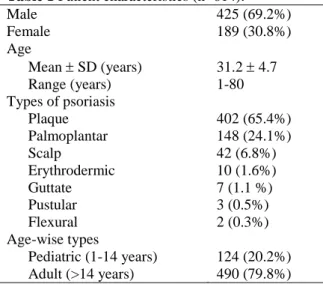
A total of 614 patients were taken. Males constituted 68.2% and females 30.8%. Majority of patients had plaque type of psoriasis followed by palmoplantar psoriasis.
Patients’ characteristics were given in Table1.
Age of the patients ranged from 1 year to 80 years. Pruritus was present in 484(79%) cases and was mild is 30%; moderate in 15% and
severe in 34%. Table 2 shows presence of
pruritus and its intensity in different types of
psoriasis. In Table 3, the relation between
intensity of pruritus and disease severity is shown. There was some difference in the prevalence and intensity of pruritus between mild psoriasis and severe psoriasis but it was statistically not significant (x2=3.88, p>0.05). Pruritus was more common and intense in females. In females, it was present is 84% and severe in 46%, while in males it was 75% and 28.5% respectively. Difference in prevalence and intensity of pruritus was statistically highly significant (x2=18.78, p<0.001). There was no significant
Table 1 Patient characteristics (n=614).
Male 425 (69.2%)
Female 189 (30.8%)
Age
Mean SD (years) 31.2 4.7
Range (years) 1-80
Types of psoriasis
Plaque 402 (65.4%)
Palmoplantar 148 (24.1%)
Scalp 42 (6.8%)
Erythrodermic 10 (1.6%)
Guttate 7 (1.1 %)
Pustular 3 (0.5%)
Flexural 2 (0.3%)
Age-wise types
Pediatric (1-14 years) 124 (20.2%) Adult (>14 years) 490 (79.8%)
difference in prevalence and severity of pruritus in adult and pediatric type of psoriasis.
Discussion
The current study covered a large group of ambulatory psoriatic patients with different types of psoriasis and all grades of severity of disease. It provides a further evidence of high prevalence of pruritus in psoriasis. This prevalence is almost similar to previous
studies,4,5 which concerned only hospitalized
patients who might be more acutely ill than those cared for in ambulatory centre; a factor that might had biased the results. Yosipovitch
et al.6 studied the prevalence and clinical
characteristics of pruritus among 101 patients
with extensive psoriasis (>30% body
involvement) which again may have biased the results. They studied prevalence of pruritus in overall psoriatic patients (not specifically in psoriatic skin lesions) which may include other types of itches. Twycross et al.7 proposed
Table 2 Pruritus in different types of psoriasis.
Types of psoriasis Pruritus
Absent N (%)
Mild N (%)
Moderate N (%)
Severe N (%)
Plaque 65 (16.2) 127 (31.6) 67 (16.6) 143 (35.6)
Palmoplantar 47 (31.71) 29 (20.1) 20 (13.5) 52 (35)
Scalp 9 (21.4) 21 (50) 5 (11.9) 7 (16.7)
Erythrodermic 1 (10.1) 3 (30) 1 (10) 5 (50.1)
Guttate 1 (14.2) 3 (42.9) 3 (42.9) 0
Pustular 1 (33.3) 2 (66.6) 0 0
Flexural 0 0 2 (100) 0
Table 3 Intensity of pruritus and disease severity.
Disease severity Intensity of pruritus
Absent or mild N (%)
Moderate to severe N (%)
Mild 248 (53.3) 217 (46.7)
Severe 65 (43.6) 84 (56.4)
x2 = 3.88, p>0.05
Table 4 Pruritus (male versus female).
Sex
Intensity of pruritus Absent or mild
N (%)
Moderate to severe No (%)
Male 244 (57.4) 181 (42.6)
Female 72 (38.1) 117 (61.9)
x2 = 18.78, p<0.001
Table 5 Pruritus (adult versus pediatric psoriasis)
Type of psoriasis
Intensity of pruritus Absent or mild
N (%)
Moderate to severe N (%)
Adult 252 (51.4) 238 (48.6)
Pediatric 63 (50.8) 61 (49.2)
x2 = 0.001, p>0.05
psoriasis is usually given when PASI score is more than 10. This study showed that the prevalence and intensity of pruritus does not increase with the increase in severity of the disease. The prevalence of pruritus in previous studies might be biased again. In our first 50 patients, pruritus was present in 41cases. It was present only in lesional skin in 40 patients and in one patient pruritus was also seen in nonlesional skin. Thus the present study provides a strong evidence of a high prevalence of pruritus in psoriatic skin lesion.
The high frequency and intensity of pruritus among females may be due to iron deficiency. Iron deficiency is very common in our country due to worm infestations, multiple subsequent pregnancies and some other reasons. Although
the patients with less than 10g% of Hb were excluded from the study but the Hb percentage in majority of females was lower than in males. Iron deficiency may be one of the possible reasons for itching. However, a study of a large series of patients with severe iron deficiency revealed no evidence of pruritus in
any of these over a period of 6 months.8
There was no difference in pruritus between adult and pediatric psoriasis. Adult psoriasis also included patients in elderly age group. Itching in senescence is well known. In many of these cases, the cause is desiccation of the skin due to decline in natural moisturizing
factors in aging skin. Skin dryness
other types of itch like neurogenic and psychiatric are more common. Pruritus in psoriatic skin lesions may be due to involvement of cutaneous nervous system and increased number of mast cells. In psoriatic lesional skin the number of neuropeptide-containing nerve fibers, as well as, the overall number of skin nerve fibers in the upper dermis and especially in the epidermis, is increased as compared with nonlesional
psoriatic skin and normal skin.9-11Alteration in
cutaneous sensory innervation during surgery or by trauma has been shown to induce the remission of psoriatic plaques at the site of sensory enervation but not in skin areas with intact sensory innervation.12,13 The ability of
locally applied capsaicin, which depletes neuropeptides from the peripheral nerve endings of afferent C fibers improved psoriatic lesions14and the pruritus within psoriatic skin
lesions.15 Mast cells which are multifactorial
immune effectors cells, may contribute to the perpetuation of the cutaneous inflammatory process in psoriatic lesions by releasing
various mediiators.16An increased number of
mast cells has been detected in lesional psoriatic skin compared with nonlesional or normal human skin. The driving force for the migration of mast cells in psoriatic skin lesions appears to be the increased expression of IL-8 by keratinocytes within lesional psoriatic skin.16
Current study provides a strong evidence regarding itching in psoriatic skin lesions. Pruritus should be mentioned as a symptom of psoriasis. At present, current treatment modalities are not so effective in treating pruritus in psoriasis, as a long-term effect.6 If it
is not considered as a symptom, the proper treatment modalities cannot be searched out.
Acknowledgements
The author gratefully acknowledges Prof. T. B. Singh, Department of Biostatistics, Institute
of Medical Sciences, B.H.U., Varanasi, for helping in statistical analysis.
References
1. Roenigk HH, Epstein E, Maibach HI. Skin manifestations of psoriasis and eczematous psoriasis: maturation. In: Roenigk HH. Maiback HI, editors. Psoriasis. 3rd edn. New York: Marcel Dekker; 1998. P.3-12.
2. Christophers E, Mrowietz U. Psoriasis. In: Freedberg IM, Eisen AZ, Wolff K, Austen K.F, Goldsmith LA and Katz SI editors. Fitzpatrick’s Dermatology in General Medicine, 5th ed. New York: McGraw-Hill; 1999. P. 495-521.
3. Stern R, Wu J. Psoriasis. In: Arndt KA, LeBoid PE, Robinson JK et al., editors. Cutaneous Medicine and Surgery. Philadelphia: WB Saunders; 1996. P. 295-321.
4. Newbold PCH. Pruritus in psoriasis. In: Farber EM, Cox AJ, eds. Psoriasis: Proceedings of the Second International Symposium. New York: Yorke Medical Books; 1997. P. 334-6.
5. Gupta MA, Gupta AK, Kirby S et al. Pruritus in psoriasis. A prospective study of some psychiatric and dermatologic correlates. Arch Dermatol. 1998;124:1052-7.
6. Yosipovitch G, Goon A, Wee J et al. The prevalence and clinical characteristics of pruritus among patients with extensive psoriasis. Br J Dermatol. 2000;143:969-73.
7. Twycross R, Greaves MW, Handwerker H et al. More than scratching and the surface. QJM. 2003;96:7-26.
8. Tucker WFG, Briggs C, Challoner T. Absence of pruritus in iron deficiency following venesection. Clin Exp Dermatol. 1984;9:186-9.
9. Naukkarinen A, Nickoloff BJ, Farber EM. Quantification of cutaneous sensory nerves and their substance P content in psoriasis. J Invest Dermatol. 1989;92:126-9.
10. Al’ Abadie MS, Senior HJ, Bleehen SS, Gawkrodger DJ. Neuropeptides and general neuronal marker in psoriasis-an immunohistochemical study. Clin Exp Dermatol. 1995;20:384-9.
P in psoriasis. Arch Dermatol Res. 1997;289:611-6.
12. Raychaudhari SA, Farber EM. Neuroimmunologic aspects of psoriasis. Cutis. 2000;66:357-62.
13. Dewing SB. Remission of psoriasis associated with cutaneous nerve section. Arch Dermatol. 1971;104:220-1.
14. Bernstein JE, Parish LC, Rapaport M et al. Effect of topically applied capsaicin in
moderate to severe psoriasis vulgaris. J Am Acad Dermatol. 1986;15:504-7. 15. Reimann S, Luger T, Metze D. Topical
application of capsaicin in dermatology for treatment of itching and pain. Hautarzt. 2000;51:164-72.