http://www.sciencepublishinggroup.com/j/ajmcm doi: 10.11648/j.ajmcm.20180302.11
Computing Banhatti Indices
of Hexagonal, Honeycomb and
Derived Networks
Fazal Dayan
1, *, Muhammad Javaid
1, Muhammad Zulqarnain
1, Muhammad Tariq Ali
2,
Bilal Ahmad
21
Department of Mathematics, University of Management and Technology, Lahore, Pakistan
2
Department of Mathematics and Statistics, the University of Lahore, Lahore, Pakistan
Email address:
*Corresponding author
To cite this article:
Fazal Dayan, Muhammad Javaid, Muhammad Zulqarnain, Muhammad Tariq Ali, Bilal Ahmad. Computing Banhatti Indices of Hexagonal, Honeycomb and Derived Networks. American Journal of Mathematical and Computer Modelling. Vol. 3, No. 2, 2018, pp. 38-45. doi: 10.11648/j.ajmcm.20180302.11
Received: February 13, 2018; Accepted: May 5, 2018; Published: June DD, 2018
Abstract:
Banhatti indices of a graph were introduced by Kulli. In this paper we have computed the general K-Banhatti indices, first and second K-Banhatti indices, K hyper Banhatti indices, modified K Banhatti indices and sum connectivity Banhatti indices for hexagonal, honeycomb and honeycomb derived networks.Keywords:
Banhatti Indices, K-Banhatti Indices, K-Hyper Banhatti Indices, Modified K Banhatti Indices, Hexagonal and Honeycomb Networks1. Introduction
Kulli introduced the first and second K-Banhatti indices of a graph in [1]. These are defined as,
∑ , ∑
where indicate that the vertex and edge are incident in . Kulli also defined some properties of these newly defined indices. The coindices of K-Banhatti indices were also defined in his work. Later kulli defined K hyper-Banhatti indices of V-Phenylenic nanotubes and nanotorus [2]. Gutman et al developed relations between Banhatti and Zagreb indices and discussed the lower and upper bounds for Banhatti indices of a connected graph in terms of Zagreb indices [3]. Kulli et al also computed Banhatti indices for certain families of benzenoid systems [4]. Moreover, Kulli introduced multiplicative hyper-Banhatti indices and coindices, Banhatti geometric-arithmetic index connectivity Banhatti indices for certain families of benzenoid systems [5-7]. The Banhatti indices were also introduced and computed by Kulli [8].
Graph theory has found considerable use in modeling chemical structures. Chemical graph theory is an important branch of mathematical chemistry that uses graph theory in
the mathematical modeling of chemical phenomena1-3. Chemical graph theory has an important effect in the development of mathematical chemistry and chemical sciences.
Computing topological indices in mathematical chemistry is an important branch. Topological index has become a very useful tool in the prediction of physio chemical and pharmacological properties of a compound.
The number of vertices and edges are the topological index molecular structure matters. The main ingredients of the molecular topological models are topological indices which are the topological characterization of molecules by means of numerical invariants. These models are instrumental in the discovery of new applications of molecules with specific chemical, pharmacological and biological properties. Applications of graph theory have led to the emergence of a number of graph-theoretical indices [9]. These indices are used by various researchers in their studies. The first use of a topological index was made by the chemist Harold Wiener in 1947 [10]. In recent years many researchers have worked on computing topological indices [11-19]. Bharati, R. et al. have calculated the Zagreb, Randić, and ABC index of silicate, honeycomb and hexagonal networks [20].
molecular graph and calculated atom bond connectivity reverse index and product connectivity reverse index for oxide and honeycomb networks [21], the direct and inverse sum Banhatti indices for some graphs [22], multiplicative connectivity banhatti indices of benzenoid systems and polycyclic aromatic hydrocarbons [23] and reverse zagreb and reverse hyper-zagreb indices and their polynomials of rhombus silicate networks [24].
S. Hayat et al. [25] derived some new classes of networks from honeycomb network by using some basic graph operations like stellation, bounded dual and medial of a graph and denoted these n-dimensional honeycomb derived network of first type as 1 . We give analytic formulas of the general K-Banhatti indices, first and second K-Banhatti indices, K hyper Banhatti indices, modified K Banhatti indices and sum connectivity Banhatti indices of the hexagonal, honeycomb and honeycomb derived networks.
2. Calculating Banhatti Indices for the
Hexagonal Network
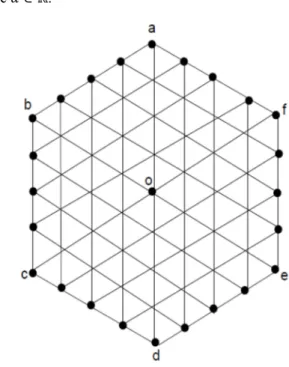
Triangular, square, and hexagonal are three regular plane tessellations, composed of the same kind of regular polygons. The triangular tessellation is used to define Hexagonal network and this is widely studied in [26]. A hexagonal network is shown in figure 1. There are three types of vertices based on their degree in a hexagonal network. There are only 6 vertices of degree 3, 6 12 vertices of degree 4 and 3 9 7 vertices of degree 6.
The general first and second K-Banhatti indices of a graph are defined as:
∑ (1)
∑ , (2)
where ∈ !.
Figure 1. Hexagonal network.
Table 1. The edge degree partition of " based on degree of end vertices.
#$% , #$'( #$' |* +,-. / |
3,4 5 12
3,6 7 6
4,4 6 6 3
4,6 8 12 2
6,6 10 9 33 30
Theorem: For a hexagonal network " of dimension , the general first and second K-Banhatti indices are given by
" 12 8 9 6 10 13 12 3 10 12 2 12 14 2 9 33 30 16 (3)
4 " 12 15 20 6 21 42 12 3 24 12 2 32 48 2 9 33 30 60 (4) Proof: Let be the graph of hexagonal network " of dimension , with |6 " | 3 3 1 and
|7 " | 9 15 6, where is the number of vertices on one side of the hexagon. There are five type of edges based on degree of end vertices in a hexagonal network shown in table 1.
a)We compute 8 as follows:
" ∑
12 8 9 6 10 13 12 3 10 12 2 12 14 9 33 30 16
b)We compute 8 as follows:
" 9
12 15 20 6 21 42 12 3 24 12 2 32 48 2 9 33 30 60 Corollary: Thefirst and second K-Banhatti indices for a hexagonal network " are given by
" 64800 − 236352 + 214014 (6) Proof: Putting = 1 in equation (3), we get
= 12(17) + 6(23) + 120( − 3) + 312( − 2) + 512(9 − 33 + 30) = 4608 − 16464 + 14718
Putting = 1 in equation (4), we get
= 12(35) + 6(63) + 288( − 3) + 960( − 2) + 7200(9 − 33 + 30) = 64800 − 236352 + 214014
Corollary: Thefirst and second K-hyper Banhatti indices for a hexagonal network "( ) are given by
( "( )) = 4608 − 11616 + 6954 (7)
( "( )) = 64800 − 190752 + 136122 (8) Proof: Putting = 2 in equation (3), we get
= 1740 + 1614 + 1200 − 3600 + 4080( − 2) + 4608 − 16896 + 15360 = 4608 − 11616 + 6954
Putting = 2 in equation (4), we get
= 7500 + 13230 + 6912 − 20736 + 39936 − 79872 + 64800 − 237600 + 216000 = 64800 − 190752 + 136122
Corollary: Thefirst and second modified K Banhatti indices for a hexagonal network "( ) are given by
: ( "( )) =;< − ;;< + =>?; (9)
: ( "( )) = =? +@? + 140 (10)
Proof: Putting = −1 in equation (3), we get
= 12 A18 +19B + 6 A10 +1 13B +1 1210 ( − 3) + 12( − 2) A12 +1 14B +1 18 (9 − 33 + 30) =98 −2998 +1092361
Putting = −1 in equation (4), we get
= 12 A15 +1 20B + 6 A1 21 +1 42B +1 2 ( − 3) + 12( − 2) A1 32 +1 48B +1 30 (9 − 33 + 30) =1 10 +3 40 + 1401
Corollary: Thefirst and second sum connectivity Banhatti indices for a hexagonal network "( ) are given by
4 ( "( )) = 4.5 − 6.03403029 − 9.106540386 (11)
4 ( "( )) = 2.323790008 − 2.217702468 − 2.390835824 (12)
Proof: Putting = −1 2D in equation (3), we get
= 12 A1
√8+
1
√9B + 6 A
1
√10+
1
√13B +
12
√10( − 3) + 12( − 2) A
1
√12+
1
√14B +
1
2 (9 − 33 + 30)
=92 + A12
√10+
12
√12+
12
√14−
33
2 B + 4 +√106 +√1312 −√1012 −√1036 −√1224 −√1442 + 15
= 4.5 − 6.03403029 − 9.106540386
Putting = −1 2D in equation (4), we get
= 12 A 1
√15+
1
√20B + 6 A
1
√21+
1
√42B +
12
√24( − 3) + 12( − 2) A
1
√23+
1
√48B +
2
√60(9 − 33 + 30)
= 18
√60 + A
12
√24+
12
√32+
12
√48−
66
√60B +
12
√20+
6
√21+
6
√42−
36
√24−
24
√32−
24
√48+
3. Calculating Banhatti Indices for the
Honeycomb Network
Figure 2. Honeycomb network.
A honeycomb network 8( ) is obtained from 8( −
1 by adding a layer of hexagons around the boundary of
8 1 , where determines the number of hexagons between the boundary and center of 8 . Honeycomb networks are used in image processing, mobile phone base stations and computer graphics. In chemistry it is used as a representation of benzenoid hydrocarbons.
A honeycomb network is shown in figure 2. There are 6 vertices of degree 2 and the remaining vertices are of degree 3.
Table 2. The edge degree partition of 8 based on degree of end vertices.
#$% , #$'( #$' |* +,-. / |
2,2 2 6
2,3 3 12 1
3,3 4 9 15 6
Theorem: For a honeycomb network 8 of dimension , the general first and second K-Banhatti indices are given by
8 12 F 4 12 1 5 6 2 9 15 6 7 (13)
8 12 F 4 12 1 6 9 2 9 15 6 12 (14) Proof: Let be the graph of honeycomb network 8 of dimension , with |6 8 | 6 and |7 8 |
9 3 . There are three types of edges based on degree of end vertices in a honeycomb network shown in table 2. a)We compute 8 as follows:
8 ∑
6 4 4 12 1 5 6 9 15 6 7 7
12 F 4 12 1 5 6 2 9 15 6 7
b)We compute 8 as follows:
" 9
12 4 4 12 1 6 9 9 15 6 12 12
12 F 4 12 1 6 9 2 9 15 6 12
Corollary: Thefirst and second K-Banhatti indices for a honeycomb network 8 are given by
8 129 78 (15)
8 216 180 12 (16)
Proof: Putting 1 in equation 13 , we get
48 132 1 14 9 15 6 129 78
Putting 1 in equation 14 , we get
48 180 1 24 9 15 6 216 180 12
Corollary: Thefirst and second K-hyper Banhatti indices for a honeycomb network 8 are given by
8 882 738 48 (17)
8 2592 2916 516 (18)
=192 732 1 98 9 15 6 882 738 48
Putting 2 in equation 14 , we get
192 1404 1 288 9 15 6 2592 2916 516
Corollary: Thefirst and second modified K Banhatti indices for a honeycomb network 8 are given by
: 8 G< =H@ =H (19)
: 8 = H> = (20)
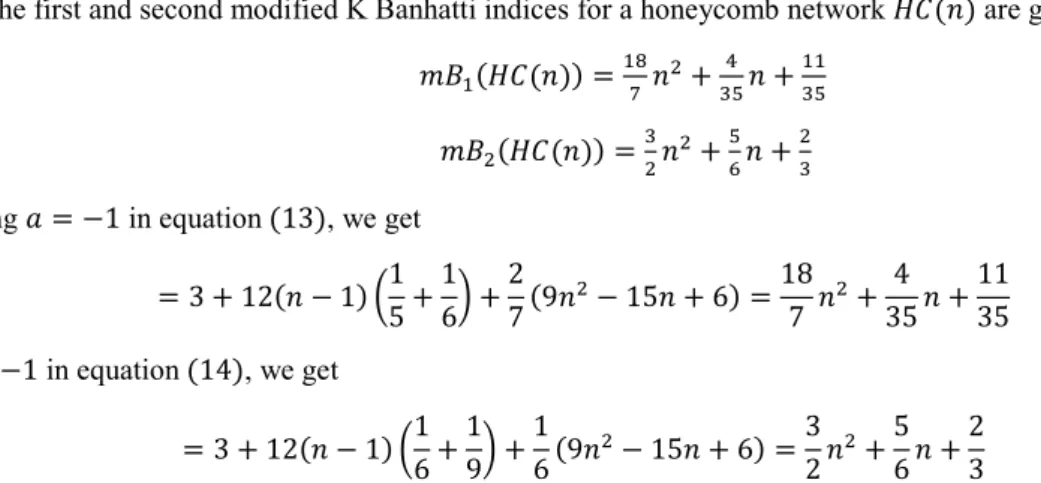
Proof: Putting 1 in equation 13 , we get
3 12 1 A15 16B 27 9 15 6 187 354 1135
Putting 1 in equation 14 , we get
3 12 1 A16 19B 16 9 15 6 32 56 23
Corollary: Thefirst and second sum connectivity Banhatti indices for a honeycomb network 8 are given by
4 8 6.803360514 1.073391559 15.43455316 (21)
4 8 5.196152423 0.2387254477 0.5651221296 (22)
Proof: Putting 1D2 in equation 13 , we get
12
√4 12 1 A 1 √5
1 √6B
2
√7 9 15 6
18
√7 I2√6
12√5
5 √730J 6 2√6 √712 6.803360514 1.073391559 15.43455316
Putting 1D2 in equation 14 , we get
12
√4 12 1 A 1 √6
1 √9B
2
√12 9 15 6 18
√12 A
12 √6 4
30 √12B 2
12 √6
12 √12 5.196152423 0.2387254477 0.5651221296
4. Calculating Banhatti Indices for the
Honeycomb Derived Networks
Figure 3. Honeycomb derived network 1 with dimension 3.
In figure 3 a honeycomb derived network 1 with dimension 3 is given, where the black colored graph is 3-dimensional honeycomb network and blue colored graph is its stellation. Now we compute the general K-Banhatti indices, first and second K-Banhatti indices, K hyper Banhatti indices, modified K Banhatti indices and sum connectivity Banhatti indices of the honeycomb derived networks. First, we compute these indices for honeycomb derived network of first type, 1 in the following theorem.
( 1( )) = 12 × 7 + 12( − `1)(9 + 11 ) + 6 (10 + 13 ) + 18( − 1)(14 + 15 ) + 2(27 − 57 + 130) × 16 (23)
( 1( )) = 12 × 12 + 12( − `1)(18 + 30 ) + 6 (21 + 42 ) + 18( − 1)(45 + 54 ) + 2(27 − 57 + 130) × 60 (24)
Proof: We compute the required results as follows: (i)To compute ( 1( )),
= 12(7 + 7 ) + 12( − `1)(9 + 11 ) + 6 (10 + 13 ) + 18( − 1)(14 + 15 ) + (27 − 57 + 130)(16 + 16 ) = 12 × 7 + 12( − `1)(9 + 11 ) + 6 (10 + 13 ) + 18( − 1)(14 + 15 ) + 2(27 − 57 + 130) × 16
(ii)To compute ( 1( )),
= 6(12 + 12 ) + 12( − `1)(18 + 30 ) + 6 (21 + 42 ) + 18( − 1)(45 + 54 ) + (27 − 57 + 130)(60 + 60 )
= 12 × 12 + 12( − `1)(18 + 30 ) + 6 (21 + 42 ) + 18( − 1)(45 + 54 ) + 2(27 − 57 + 130) × 60
Corollary: Thefirst and second K-Banhatti indices for a honeycomb derived network 1( ) are given by
( 1( )) = 864 − 924 + 282 (25)
( 1( )) = 3240 − 4104 + 1386 (26)
Proof: Putting = 1 in equation (23), we get
= 12 × 7 + 12( − `1)(9 + 11) + 6 (10 + 13) + 18( − 1)(14 + 15) + 2(27 − 57 + 130) × 16 = 864 − 924 + 282
Putting = 1 in equation (24), we get
= 12 × 12 + 12( − `1)(18 + 30) + 6 (21 + 42) + 18( − 1)(45 + 54) + 2(27 − 57 + 130) × 60 = 3240 − 4104 + 1386
Corollary: Thefirst and second K-hyper Banhatti indices for a honeycomb derived network 1( ) are given by
( 1( )) = 1382 − 17586 + 5946 (27)
( 1( )) = 194400 − 293544 + 114102 (28) Proof: Putting = 2 in equation (23), we get
= 12 × 49 + 12( − `1)(81 + 121) + 6 (100 + 169) + 18( − 1)(196 + 225) + 2(27 − 57 + 130) × 256 = 1382 − 17586 + 5946
Putting = 2 in equation (24), we get
= 12 × 144 + 12( − `1)(18 + 30 ) + 6 (21 + 42 ) + 18( − 1)(45 + 54 ) + 2(27 − 57 + 130) × 60 = 194400 − 293544 + 114102
Corollary: Thefirst and second modified K Banhatti indices for a honeycomb derived network 1( ) are given by
: ( 1( )) = 3.375 − 1.153504829 + 13.054329 (29)
: ( 1( )) = ;? +G?= +H (30)
Proof: Putting = −1 in equation (23), we get
=127 + 12( − `1) A19 +11B + 6 A1 10 +1 13B + 18( − 1) A1 14 +1 15B +1 16 (27 − 57 + 130)2
= 3.375 − 1.153504829 + 13.054329
=1212 + 12( − `1) A18 +1 30B + 6 A1 21 +1 42B + 18( − 1) A1 45 +1 54B +1 60 (27 − 57 + 130)2
=10 +9 2370 +15
Corollary: Thefirst and second sum connectivity Banhatti indices for a honeycomb derived network 1( ) are given by
4 ( 1( )) = 13.5 − 1.86211431 + 52.45915517 (31)
4 ( 1( )) = 6.971370023 − 2.33012604 + 26.87786861 (32)
Proof: Putting = −1 2D in equation (23), we get
=12
√7+ 12( − `1) A
1
√9+
1
√11B + 6 A
1
√10+
1
√13B + 18( − 1) A
1
√14+
1
√15B +
2
√16(27 − 57 + 130)
= 13.5 − 1.86211431 + 52.45915517
Putting = −1 2D in equation (24), we get
= 12
√12+ 12( − `1) A
1
√18+
1
√30B + 6 A
1
√21+
1
√42B + 18( − 1) A
1
√45+
1
√54B +
2
√60(27 − 57 + 130)
= 6.971370023 − 2.33012604 + 26.87786861
5. Conclusion
In this paper hexagonal, honeycomb and honeycomb derived network 1( ) are studied and the analytical closed formulas are determined for the general K-Banhatti indices, first and second K-Banhatti indices, K hyper Banhatti indices, modified K Banhatti indices and sum connectivity Banhatti indices of hexagonal, honeycomb and honeycomb derived network 1( ). It will help to understand the physical features, chemical reactivities and biological activities of the hexagonal and honeycomb and honeycomb derived network 1( ). These results can provide a significant determination in the pharmaceutical industry.
Acknowledgements
The authors would like to express their sincere gratitude to the anonymous referees for their insightful comments and valuable suggestions, which led to a number of improvements in the earlier version of this manuscript.
References
[1] V. R. Kulli, K-Banhatti indices of graphs, Journal of Computer and Mathematical Sciences, 7(4), 213-218, 2016. [2] V. R. Kulli, On K Banhatti indices and K hyper-Banhatti
indices of V-Phenylenic nanotubes and nanotorus, Journal of Computer and Mathematical Sciences, 7(6), 302-307, 2016. [3] Gutman, V. R. Kulli, B. Chaluvaraju and H. S. Baregowda,
On Banhatti and Zagreb indices, Journal of the International Mathematical Virtual Institute, 7, 53-67, 2017.
[4] V. R. Kulli, B. Chaluvaraju and H. S. Boregowda, Connectivity Banhatti indices for certain families of benzenoid systems, Journal of Ultra Chemistry, 13(4), 81-87, 2017.
[5] V. R. Kulli, Multiplicative hyper-Banhatti indices and coindices of graphs, International Journal of Mathematical Archive, 7(6), 60-65, 2016.
[6] V. R. Kulli, A new Banhatti geometric-arithmetic index, International Journal of Mathematical Archive, 8(4), 112-115, 2017.
[7] V. R. Kulli, B. Chaluvaraju and H. S. Boregowda, Connectivity Banhatti indices for certain families of benzenoid systems, Journal of Ultra Chemistry, 13(4), 81-87, 2017.
[8] V. R. Kulli Computing Banhatti Indices of Networks, International Journal of Advances in Mathematics Volume 2018, Number 1, 31-40, 2018.
[9] Mehdi Alaeiyan, Amir Bahrami, Javad Yazdani, Schultz Index of Nanoporous, Australian Journal of Basic and Applied Sciences, 5(6), 250 - 252, 2011.
[10] Wiener, H. Structural determination of paraffin boiling points. J. Am. Chem. Soc. 1947, 69, 17–20.
[11] Gutman, I. Degree-Based topological indices. Croat. Chem. Acta, 86, 315–361, 2013.
[12] Garcia, I.; Fall, Y.; Gomez, G. Using topological indices to predict anti-alzheimer and antiparasitic GSK-3 inhibitors by multi-target QSAR in silico screening. Molecules 15, 5408– 5422, 2010.
[14] Hao, J. Theorems about Zagreb Indices and Modified Zagreb Indices. MATCH Commun. Math. Comput. Chem, 65, 659– 670, 2011.
[15] Xu, K.; Liu, M.; Das, K. C.; Gutman, I.; Furtula, B. A survey on graphs extremal with respect to distance-based topological indices. MATCH Commun. Math. Comput. Chem., 71, 461– 508, 2014.
[16] Klavzar, S.; Deutsch, E. M-Polynomial and Degree-Based Topological Indices. Iran. J. Math. Chem., 6, 93–102, 2015. [17] Dobrynin, A. A.; Entringer, R.; Gutman, I. Wiener index of
trees: Theory and applications. Acta Appl. Math., 66, 211– 249, 2001.
[18] Kier, L. B.; Hall, L. H. Molecular Connectivity in Structure-Activity Analysis; John Wiley & Sons: New York, NY, USA, 1986.
[19] Zhong, L.: The harmonic index for graphs. Appl. Math. Lett., 25, 561–566, 2012.
[20] Bharati Rajan, Albert William, Cyriac Grigorious and Sudeep Stephen, On Certain Topological Indices of Silicate, Honeycomb and Hexagonal Networks, J. Comp. & Math. Sci. 3 (5), 530-535, 2012.
[21] [21]V. R. Kulli,, Atom bond connectivity reverse and product connectivity reverse indices of oxide and honeycomb networks, Intern. J. Fuzzy Mathematical Archive, 15(1), 1-5, 2018.
[22] [22]V. R. Kulli, Direct and inverse sum Banhatti indices, International Research Journal of Pure Algebra-7(9), 823-827, 2017.
[23] V. R. Kulli, Multiplicative connectivity banhatti indices of benzenoid systems and polycyclic aromatic hydrocarbons, Journal of Computer and Mathematical Sciences, 9(3), 212-220, 2018.
[24] V. R. Kulli, Reverse zagreb and reverse hyper-zagreb indices and their polynomials of rhombus silicate networks, Annals of Pure and Applied Mathematics, 16(1), 47-51, 2018.
[25] Sakander Hayat, Mehar Ali Malik and Muhammad Imran, Computing topological indices of honeycomb derived networks, Romanian journal of information science and technology, Volume 18, Number 2, 144-165, 2015.