Original Research Article
A study on profile of poisoning in pediatric population
Ranganatha A. Devaranavadagi*, Shruthi Patel, Poornima Shankar
INTRODUCTION
Poisoning is an important emergency as well as major problem in all age groups throughout the world. The cause and poisoning type varies in different parts of the world and within the country also depending upon factors such as education, demography, socioeconomic factors, customs and local belief.1 The mortality and morbidity
due to poisoning is preventable in children. Poisoning is the fourth leading cause of unintentional injury following
road traffic accident, burns and drowning.2
Approximately 2 million people each year under 6 years come to emergency department with history of poisoning.3 Although Poisoning never accounted for a
large number of accidental deaths, the rate of decrease in deaths due to poisoning have not been as drastic as infectious diseases, hence have assumed more prominence now.4-6 As we all know, Children are curious
about surrounding and explore their world with all their senses like taste and smell. Due to this, its surroundings
ABSTRACT
Background: Children are curious and explore their world with all their senses. As a result, surroundings can be a dangerous place when poisonous substances are inadvertently ingested - every year millions of calls are made to poison control centres when this happens and thousands of children are admitted to emergency departments. Poisoning patterns change according to age group, the nature and dose of the poison, type of exposure. This study is aimed at understanding the incidence, aetiology and manner of poisoning, outcome among children less than 18 years admitted to Paediatric department KIMS.
Methods: Prospectively, 38 poisoning cases admitted to Paediatric intensive care, KIMS Bangalore from August 2015 to July 2016 were included in this study. The age and sex of the patient, poisoning agent, manner of poisoning, duration of hospital stay and outcome of all the patients were recorded and analysed.
Results: Out of 38, 16 (42%) are males, 22 (58%) are females. 13 (34%) cases are <5years of age, 2(5%) cases are between 5-10 year, 23 (61%) cases are above 10 years. Among all, 13 (34%) cases of drugs consumption, among these 11 cases were above 10 years representing purposeful consumption. 5 (13%) cases of kerosene consumption. Out 4 (11%) cases of Organophosphorous poison, 3 cases are above 10 years representing purposeful consumption. 4 (10%) cases of acid consumption. 4 (11%) cases of aluminium phosphide poisoning. 3 (8%) cases of Good night oil consumption. 2 (5%)cases of eucalyptus oil consumption. 3(8%) cases of camphor poisoning. 2 (5%) cases died due to aluminium phosphide poisoning. Duration of hospital stay varied from 1 day to 6 days.
Conclusions: Accidental poisoning is common in children below 5 years of age. Suicidal poison incidence is increasing among teenagers either due to exam stress or peer pressure. Accidental poisoning can be reduced by simple measures like parental education, replacing the poisoning agent with one of lower toxicity, legislation regarding the child resistant packaging of necessary poisons.
Keywords: Camphor, Drugs, Eucalyptus oil, Poisons
Department of Pediatrics, Kempegowda Institute of Medical Sciences and Research Centre, Bangalore 560004, Karnataka, India
Received: 30 March 2017
Accepted: 03 April 2017
*Correspondence:
Dr. Ranganatha A. Devaranavadagi, E-mail: [email protected]
Copyright: © the author(s), publisher and licensee Medip Academy. This is an open-access article distributed under the terms of the Creative Commons Attribution Non-Commercial License, which permits unrestricted non-commercial use, distribution, and reproduction in any medium, provided the original work is properly cited.
can be a dangerous place when poisonous substances are ingested or inhaled - when this happens, every year millions of calls are witnessed to poison control centres and many of them are admitted to emergency departments. Pattern of Poisoning varies according to age, the nature and dose of the poison and type of exposure.7 Among the accidental poisoning, even though
there is no significant decrease in the number, the pattern of poisoning has shown a change with new hazards constantly appearing due to introduction of newer drugs and chemicals for domestic use, farming.8 Most cases
reported when parents or caregivers are not paying attention at home. The most common agents involved in poisoning are over-the-counter (OTC) medications, prescription medications, household products, pesticides, kerosene, poisonous plants and animal or insect bites.9
Poisoning is a significant global public health problem. The extent of the problem is varying from one country to the other. In developed countries like USA, it is been major cause of hospital admission as well emergency presentation.10 In acute poisoning, sudden onset of
symptoms appear after the ingestion, inhalation or after coming in contact with poisonous substance. In chronic poisoning, symptoms develop gradually over a period of time and there is complete disappearance of symptoms on the removal of patients from exposure. Acute poisoning in childhood is an important cause of morbidity and mortality and can be effectively controlled by preventive measures.
Poisonings occur when substances are ingested, injected, inhaled or absorbed through the skin in quantities that are toxic to the body.11 Children aged 1 to 2 year are most
frequently seen in emergency departments after consuming medications, this account for 68% of medication-related visits among young children.12 For
every 10 poison exposures, approximately nine occur at home in children.13,14 Unlike adults, childhood poisoning
is usually accidental thus making it preventable with some simple and intelligent interventions. Poisoning in older children and adolescents is more often intentional, especially due to increasing stress.15,16 The most common
cause of acute medical illness in many countries has been exposure to toxic substances.9,17-20 General
epidemiological data should be used to assist emergency department on proper management of poisoning cases especially for effective preventive and therapeutic approaches.21,22
METHODS
This is a Prospective observational study conducted in Department of Paediatrics, KIMS hospital and Research centre, Bangalore between August 2015 to July 2016.All children and adolescent who were admitted to KIMS pediatric intensive care unit with history of poisoning between Aug 2015 to July 2016 were included in this study. Total 52 cases came to emergency with history of poisoning during this period. We included all children
below 18 years who came with history of poisoning and who had signs and symptoms of poisoning at admission. Those cases with history of contact poisons, food poisoning, animal bite, insect bite, chronic poisoning and those having no signs and symptoms of poisoning were excluded from the study. Out of 52 cases only 38 cases met our inclusion criteria. Study was conducted after obtaining verbal and written consent from the parent or guardian. These cases admitted to Paediatric intensive care after initial assessment. In each case detailed history was taken-time when poison was ingested or come in contact with it, substance taken, its dose, cause for poisoning, manner of poisoning, any intervention done before reaching our hospital and time brought to casualty was noted. Detailed general physical examination and systemic examination done. Data regarding age of the patient, sex, etiological agent, nature of poisoning (accidental or intentional), clinical presentation, duration of hospital stay and outcome were collected and filled in a predesigned Performa. The data collected were then transferred into excel format and analysed as percentage.
RESULTS
Total 513 cases admitted to PICU during our study period. Out of these 52 cases came with history of poisoning. Out of which 38 cases met our inclusion criteria. This accounts for 7.4% of PICU admission during this period, Figure 3. The incidence of poisoning in our study found to be 1.29%. Coming to sex distribution, 22 cases were females accounting for 58%, 16 cases were males accounting for 42% as shown in Figure 1.
Figure 1: Distribution of sex.
There is slight female predominance observed in our study. Figure 2 demonstrates majority of cases were above 10 year, there were 23 cases aged above 10 years accounting for 60.5%. Under 5 year, there were 13 cases accounting for 34.2%. Between 5-10 year, 2 cases of poisoning accounting for 5.26%. Even though we observed overall female predominance in our study, there is a male predominance observed in age group below 5 years.
42% 58%
Percentage
MalesFigure 2: Age and sex distribution.
Figure 3: Incidence of poisoning cases.
In this study time taken to reach hospital from the time they consumed poison was also calculated. Majority of the cases reached within 1 to 4 hour accounting for 47.3%, 12 cases reached within 1 hour of consumption accounting for 31.5%. 8 cases reached after 4 hours accounting for 21.05% (Table 1).
Table 1: Time since poison consumption to arrival at casualty.
Time No. of cases P-Value
Less than 1 hour 12(31.5%) 0.00 Between 1 to 4 hour 18(47.3%) 0.00 More than 4 hour 8(21.05%) 0.08
Significant p≤ 0.01
Time taken to reach emergency since poison consumption is very important. Because the early the intervention better is the outcome. Those cases which presented early can be given gastric lavage to prevent further absorption. However 2 cases of aluminum phosphide poison died even though they came to emergency within 1 hour of consumption.
Figure 4 demonstrates, out of 38 cases of poisoning, 2 cases (5.2%) died both due to aluminum phosphide poisoning. In both these cases we did gastric lavage
immediately but these cases died within half an hour of presentation. Duration of hospital stay ranged from 0-6 days. 13 cases (34.2%) stayed in hospital ranging between 0-2 days. 22 cases (57.9%) stayed in hospital for 2-4 days. Only 3 cases (7.9%) stayed between 4-6 days Table 2.
Table 2: Duration of hospital stay.
Duration No. of cases Percentage P-Value
0-2 days 13 34.2% 0.00 2-4 days 22 57.9% 0.00 4-6 days 03 7.9% 0.82
Figure 4: No. of deaths.
Table 3 demonstrates that among the cases admitted, drug ingestion accounted for maximum number of cases 34.21%. Among the drug ingestion 4 cases of anti epileptics ingestion, 3 cases of anti histamines, 2 cases of anti hypertensives, 2 cases of thyroid drugs and 2 cases of antipsychotic and anti depressants each. Among 8 (21%) insecticides and pesticide cases, 4 were organophosphates and 4 were aluminium phosphide poisoning. Among the others, kerosene consumption were 5 cases, 4 cases were cleaning agent consumption, 3 cases of good night oil consumption, 2 cases each of camphor and eucalyptus oil consumption and 1 cannabis poisoning.
The corresponding age group with reference to poison involved is mentioned in Table 3. We can observe the easily available household things like kerosene and good night oil are the poisoning agents involved in children below 5 years representing accidental poisoning. On the other hand drugs as etilogical agent more frequently found in teenagers, representing suicidal poison.
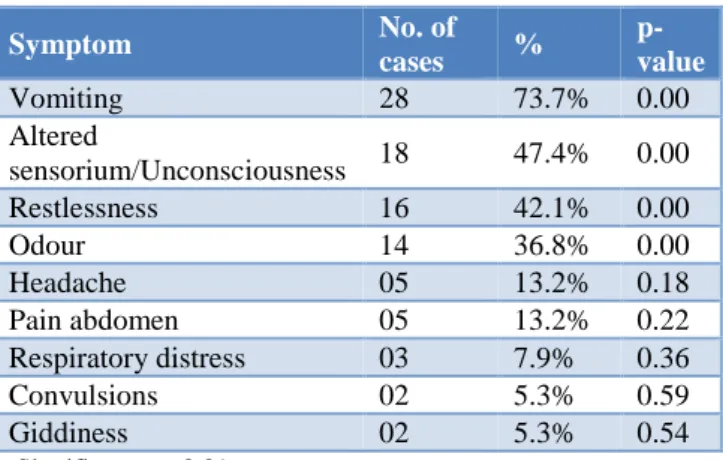
Table 4 demonstrates, most common symptoms at the time of presentation, vomiting being the most common symptom noted in 28 cases accounting for 73.7%, followed by altered sensorium present in about 47.4% of cases. Restlessness was present in 42.1% of cases. Poison odour in 36.8%of cases. Headache and Pain abdomen in 13.2% of cases each. Respiratory distress at the time of
0 5 10 15 20 25
< 5 years 5 to 10 years > 10 years
Females Males
92.6% 7.4%
OTHERS(92.6%)
NO. OF POISONING CASES( 7.4%)
(5.2%)
(94.7%)
No. of cases Death
presentation was present in 7.9% of cases. Convulsion and giddiness was present in 5.3% of cases.
Table 3: Etiological agent involved.
Poisoning agent Type of poison No. of cases Percentage Age Group P-Value
Insecticides and pesticides
organophosphates 04 10.5% >10Yr 0.11 Aluminium phosphide 04 10.5% >10Yr 0.18
Drugs
Anti epileptics 04 10.5% >10Yr 0.18
Anti histamines 03 7.8% >10Yr 0.16
Anti hypertensives 02 5.3% <5Yr
>10Yr 0.22
Thyroid drugs 02 5.3% >10Yr 0.22
Antipsychotics and anti
depressants 02 5.3% >10Yr 0.23
Cleaning agent Acid 04 10.5% <5Yr-2cases
5-10Yr-2cases 0.19
Kerosene 05 13.2% <5 Yr 0.16
Good night oil 03 7.8% <5 Yr 0.18
Eucalyptus oil 02 5.3% <5 Yr 0.12
Camphor 02 5.3% <5 Yr 0.11
Cannabis 01 2.6% >10Yr 0.10
Significant p≤ 0.01
Table 4: Presenting symptoms.
Symptom No. of
cases %
p-value
Vomiting 28 73.7% 0.00
Altered
sensorium/Unconsciousness 18 47.4% 0.00 Restlessness 16 42.1% 0.00
Odour 14 36.8% 0.00
Headache 05 13.2% 0.18
Pain abdomen 05 13.2% 0.22 Respiratory distress 03 7.9% 0.36 Convulsions 02 5.3% 0.59 Giddiness 02 5.3% 0.54
Significant p≤ 0.01
DISCUSSION
Poisoning in children is important cause of morbidity and mortality in developing countries like India. Our study aimed at describing magnitude of clinical problem and clinical profile of poisoning cases presented to KIMS Bangalore. In this study, the incidence of poisoning found to be 1.29%. Similar incidence has been reported in other studies.23-25 With respect to sex preponderance, incidence
was more common in males in less than 5 years of age group, whereas female predominance was seen in adolescent age group; with overall female predominance, while other studies showed overall incidence to be more common in males.8,15,17,23-27 Majority of the children are
aged above 10 years (60.5%) followed by less than 5 years (34.2%). Similar results are observed in study done by Sharma et al.25 Other studies reported the most
common age group being 1-6 years.23,26-28 Study done by
Singh M et al reported maximum number of cases in children aged above 5 years.29
Most of the cases (47.3%) arrived to casualty between 1 and 4 hours of poison consumption. A study done from south East Asia also reported most cases presented between 1 and 6 hour of poisoning.30 A study done by
Ahmed et al reported most of the cases (80%) arrived to casualty within 1 hour of consumption.31 The earlier the
arrival to emergency department better will be the outcome. This is because we can intervene earlier. Duration of hospital stay varied from 0 to 6 days. Most of the cases stayed in ICU ranging 2 to 4 days (57.9%). Almost similar results were reported in another study where most cases stayed ranging 1 to 3 days (55.03%).32
Coming to clinical presentation, there was wide variety of clinical presentation according to type of poison and age group. However most common presenting complaint being vomiting (73.7%), altered sensorium (47.4%), restlessness (42.1%), odour from the mouth (36.8%), Headache (13.2%). Almost similar presenting complaints observed in study done by Sharma J et al.25 Other studies
also reported the most common presenting complaint being gastrointestinal followed by central nervous system.19,25
According to Ahmed et al, the most common type of poisons experienced by children was medicine (72.6 %), and the most common type of non-medicine related poisons was household items (14.9 %).31 In the results of
anti-psychotic and anti-depressant intake, each group accounting for 5.3%. Insecticides and pesticides accounted for 20.1% (8 cases), among these 4 cases of each aluminium phosphide (10.5%) and organophosphate intake (10.5%). Acid consumption were 4 cases (10.5%), 5 cases of kerosene intake (13.8%), 3 cases of good night oil consumption (7.8%), 2 cases of eucalyptus oil consumption (5.3%), 2 cases of camphor consumption (5.3%), 1 case of cannabis intake (2.6%). Kerosene oil intake, good night oil consumption, eucalyptus oil consumption, camphor intake, all these were found below 5 years age. In our study most common poisoning agent being drugs (34.21%) followed by Insecticides and Pesticides (20.1%), kerosene (13.4%), cleansing agents (10.5%). The other studies done in past showed kerosene is the most common poisoning agent accounting for 25%-50%.24,26-27 But in our study kerosene is the 3rd most
common poisoning agent. This probably due use of gas instead kerosene for cooking. A study done by Vasanthan et al reported kerosene being the most common etiological agent followed by drugs.33 The other studies
reported drugs followed by kerosene are the most common poisoning agent in their study.34-36 Out of 38
cases, 2 cases died. Both cases are of alluminium phosphide poisoning.
CONCLUSION
Preventable accidental poisonings are still a significant cause of morbidity among younger children in developing countries, which can be reduced by keeping toxic agents out of reach of children, endorsing child proof packaging of potentially toxic agents and parental education regarding poison proofing a child’s environment. Suicidal poisoning has been shown to be more predominant in adolescents and teenagers especially girls, hence need for a guidance and counselor at every school to help child deal with stressful situations, and to guide parents as well. In either case, the most important step is to bring child to the emergency room at the earliest this has been proven reduce the morbidity and mortality significantly.
Funding: No funding sources Conflict of interest: None declared
Ethical approval: The study was approved by the Institutional Ethics Committee
REFERENCES
1. Narayan Reddy KS. The essential of Forensic Medicine and Toxicology, 27th edition, Medical Book Company. 2008;95:440-456.
2. Hyder AA, Wali S, Fishman S, Schenk E. The burden of unintentional injuries among the under-fi ve population in South Asia. Acta Paediatrica. 2008;97:267-75.
3. American Academy of Pediatrics. Poison Prevention and Treatment Tips National Poison Prevention Week, March 19-25;2017.
4. Parikh CK. Toxicology. In: Parikh CK (ed). Parikh’s text book of medical jurisprudence and toxicology. 5th Edn. Bombay. CBS publisher;
1990:660- 690.
5. Modi NJ. Toxicology. In: Modi NJ (ed). Modi’s Textbook of medical jurisprudence and toxicology. 20th Edn. Bombay. NM Tripathi Pvt Ltd.;
1980:455-470.
6. Reddy NKS. Toxicology. In: Narayan Reddy KS (ed). The synopsis of forensic medicine and toxicology. 14th Edn. Hyderabad. Medical book
company; 2000:221-293.
7. WHO-UNICEF. Children and poisoning: world report on child injury prevention. World Health Organization. 2008.
8. Singh S, Singhi S, Sood NK, Kumar L, Walia BNS. Changing pattern of childhood poisoning (1970-1989): Experience of a large North Indian hospital. Indian Pediatr. 1995;32:331-6.
9. Lam LT. Childhood and adolescence poisoning in NSW, Australia: an analysis of age, sex, geographic, and poison types. Inj Prev. 2003;9:338-42.
10. Litovitz TL, Klein-Schwartz W, Rodgers GC. Annual report of American association of poison control canters toxic exposure surveillance system. Am J Emerg Med 2002; 20: 391-452.
11. The global burden of disease: A comprehensive assessment of mortality and disability from diseases, injuries, and risk factors in 1990 and projected to 2020. Murray, CJ and Lopez, AD, eds. Harvard School of Public Health (on behalf of the World Health Organization and The World Bank); 1996:120-122.
12. Ferguson RW, Mickalide AD. An In-Depth Look at Keeping Young Children Safe Around Medicine. Washington, DC: Safe Kids Worldwide, March 2013.
13. Juris E. Personal communication. Washington, DC: American Association of Poison Control Centers; 2006.
14. Consumer Product Safety Commission. CPSC warns that 9 out of 10 unintentional child poisonings occur in the home. News from CPSC, March 18, 2009. U.S. Consumer Product Safety Commission Website. Available from: http://www.cpsc.gov/cpscpub/prerel/prhtml09/0915 9.html. Accessed: November 3, 2014.
15. Dutta AK, Seth A, Goyal PK, Agarwal V, Mittal SK, Sharma R et al. Poisoning in children, Indian scenario. Indian J Pediatr. 1998;65:365-70.
16. Krishankumar P, Geeta MG, Gopalan AV. Deliberate Self-Poisoning in Children. Indian Pediatr. 2005;42:582-6.
17. Budhathoki S, Poudel P, Bhatta NK, Dutta AK, Shah GS, Bhurtyel KK, et al. Clinical profile and outcome of poisoning and intoxication in children: A hospital based study. Nepal Med Coll J. 2009;11(3):170-5.
attending a hospital at Kolkata. Indian J Public Health. 2005;49:25-6.
19. Shoter AM. Kerosene poisoning in childhood: a 6-y prospective study at the Princess Rahmat Teaching Hospital. Neuro Endocrinal Lett. 2005;26:835-38. 20. Rashid Mamunur AKM, Sultana R, Nazmul Ahasan
HAM, Rasul CH, Seasonal variation of acute childhood Poisoning, Pak J Med Sci. 2007;23(3):443-5.
21. Desalew M, Aklilu A, Amanuel A, Addisu M, Ethiopia T. Pattern of acute adult poisoning at Tikur Anbessa specialized teaching hospital, A retrospective study, Ethiopia. Hum Exp Toxicol. 2011;30:523-7.
22. Abula T, Wondmikun Y. The pattern of acute poisoning in a teaching hospital, north-west Ethiopia. Ethiop Med J. 2006;44:183-9.
23. Bhat NK, Dhar M, Ahmad S, Chandar V. Profile of poisoning in children and adolescents at a North Indian tertiary care centre. JIACM. 2011;13:37-42. 24. Sitaraman S, Sharma U, Saxena S. Accidental
Poisoning in children. Indian Paediatrics. 1985;22:757-60.
25. Sharma J, Kaushal RK. Profile of poisoning in children. Pediatric Oncall. 2014;11:40-2.
26. Kohli U, Kuttait VS, Lodha R, Kabra SK. Profile of Childhood Poisoning at a Tertiary Care Centre in North India. Indian J Pediatrics. 2008;75:791-4. 27. Akhtar S, Rani GR, Al-Anezi FA. Risk factors in
acute poisoning in children-A retrospective study. Kuwait Med J. 2006;38(1):33-6.
28. Gupta SK, Peshin SS, Srivastava A, Kaleekal T. A study of childhood poisoning at National Poisons Information Centre, All India Institute of Medical
Sciences, New Delhi. J Occup Health. 2003;45:191-6.
29. Singh M, Hessam MY et al. Spectrum of poisoning among children in Afghanistan. Indian J Pediatrics. 1984;51:313-6.
30. Aqeel M, Munir A, Khan A. Paern and frequency of acute poisoning in children. Pak J Med Sci 2009;25(3):479-83.
31. Ahmed A, Aljamal A, Ibrahim M. Poisoning emergency visits among children: A 3-year retrospective study in Qatar. BMC Pediatr. 2015;15,104:1-7.
32. Gangan R, Haroon R. J Indian Acad Forensic Med. 2015;37(2):155-59.
33. Vasanthan M, James S, Shuba S, Abhinaya J. Clinical profile and outcome of poisoning in children admitted to a tertiary referral center in South India. Indian J Child Health. 2015;2(4):187-91.
34. Bacha T, Tilahun B. A cross-sectional study of children with acute poisoning: A three-year retrospective analysis. World J Emerg Med. 2015;6(4):265.
35. Sadeghi BS, Khajeh A. Chronological variations of children poisoning causes in Zahedan, South of Iran. Int J High Risk Behav Addict. 2014;3(3):e19223. 36. Esmaeili MD, Bayati Z, Gholitabar ZM. A report of
childhood poisoning in Babol. Arch Iranian Med. 2004;7(4):297-9.