A human capital predictive model for agent
performance in contact centres
Authors:
Chris Jacobs1 Gert Roodt1
Affiliations:
1Department of Industrial Psychology and People Management, University of Johannesburg, South Africa
Correspondence to:
Gert Roodt
Email:
Postal address:
PO Box 524, Auckland Park 2006, South Africa
Dates:
Received: 01 Oct. 2010 Accepted: 08 July 2011 Published: 13 Oct. 2011
How to cite this article:
Jacobs, C., & Roodt, G. (2011). A human capital predictive model for agent performance in contact centres. SA Journal of Industrial Psychology/SA Tydskrif vir Bedryfsielkunde, 37(1), Art. #940, 19 pages. doi:10.4102/sajip.v37i1.940
Orientation: Currently no integrative model exists that can explain the phenomena contributing to agent performance in the South African contact centre industry.
Research purpose: The primary focus of this article was to develop a theoretically derived human capital predictive model for agent performance in contact centres and Business Process Outsourcing (BPO) based on a review of current empirical research literature.
Motivation for the study: The study was motivated by the need for a human capital predictive model that can predict agent and overall business performance.
Research design: A nonempirical (theoretical) research paradigm was adopted for this study and more specifically a theory or model-building approach was followed. A systematic review of published empirical research articles (for the period 2000–2009) in scholarly search portals was performed.
Main findings: Eight building blocks of the human capital predictive model for agent performance in contact centres were identified. Forty-two of the human capital contact centre related articles are detailed in this study. Key empirical findings suggest that person– environment fit, job demands-resources, human resources management practices, engagement, agent well-being, agent competence; turnover intention; and agent performance are related to contact centre performance.
Practical/managerial implications: The human capital predictive model serves as an operational management model that has performance implications for agents and ultimately influences the contact centre’s overall business performance.
Contribution/value-add: This research can contribute to the fields of human resource management (HRM), human capital and performance management within the contact centre and BPO environment.
© 2011. The Authors. Licensee: AOSIS OpenJournals. This work is licensed under the Creative Commons Attribution License.
Introduction
The contact centre and business process outsourcing (BPO) industry, established about a decade ago in South Africa, is comprised approximately of 1500 operational contact centres that employed 150 000 – 175 000 agents with a further 30 000 management and support staff in 2008 (Jones, 2008). Frost and Sullivan Consulting (2009) estimated the 2007 South African BPO market revenue at $885.2 million and the global value of the sector at $220 billion. The Everest Research Institute (Witham, 2009) estimated that the growth rate of the offshore BPO market in South Africa will reach 20% – 30% by 2011–2012 to eventually grow at 50% per annum which is expected to lead to 100 000 new jobs. This window of opportunity is why the government earmarked the industry for work creation (Mpahlwa, 2008). But it certainly does have its own unique challenges – specifically from a human resources and operational perspective.
Increasing technological complexity in contact centres, variations and changes in customer expectations, as well as product and knowledge intricacies, make the critical work of the agent in tightly constrained work environments very difficult (Bagnara & Marti, 2001; Kinnie, Hutchinson & Purcell, 2000). The human factor still constitutes the strategic and competitive edge in managing customer relationships as no technology can replace skilled communication, problem solving and customer focus.
operations with the work controlled by automatic systems which virtually distribute work, determine the pace thereof and monitor performance (Ellis & Taylor, 2006; Richardson & Gillipsie, 2003). Customer-employee interactions take place with the use of display screen equipment (Holman, 2003) with access to, or inputting of, information whilst facilitating inbound, outbound, blended calls or multimedia interactions (e-mail, web and text messaging). Multimedia interactions are becoming more and more prevalent (Dimension Data, 2007) as the modern contact centre is a super-user of information and communication technology systems. The industry is the benefactor of two trends namely Internet Protocol and the convergence of voice, data and Internet services over common networks and systems.
Bagnara (2000) already reported in 2000 that the following human activity issues in European Union call centres had to be analysed: work organisation, training, limited career development, health, monitoring and surveillance that lead to stress and labour relations. The 2008 Global Contact Centre Benchmarking Report (Dimension Data, 2008) tracked various human capital trends over a 10-year period from 1997 to 2007; the percentage annual agent attrition rate increased by 13% from 14% to 27% and the percentage agent absenteeism rate increased by 6% from 5% to 11%. Stress responses, high absenteeism and high turnover were considered as ‘normal’ occurrences in modern contact centres (Bagnara & Marti, 2001). This is often associated with difficulties in personnel recruitment, management of the contact centre and staff retention whilst still meeting overall business objectives. Management actions further impact agents’ job satisfaction that affect agent retention and contact centre performance (Whitt, 2006).
These trends highlight the need for empirically tested human capital models that can successfully predict overall business performance and provide a coherent multidisciplinary view that explains the phenomenon contributing to performance in a relatively new South African contact centre industry. Good models:
provide causal accounts of the world, allow one to make predictive claims under certain conditions, bring conceptual coherence to a domain of science and simplify our understanding of the world.
(Mouton, 2001, p. 177) Models like these are essential for enhancing decision making in the contact centre and BPO industry.
Most of the studies found in the initial literature review focused only on a particular purpose, namely on agent and/ or business performance. Examples included the impact of satisfaction on retention resulting in higher experience levels that lead to better performance; job demands-resources linked to performance; emotional intelligence linked to agent performance; and management of quantitative performance at the cost of overall performance (Aksin, Armony & Mehrotra, 2007; Dwyer & Fox, 2006; Higgs, 2004; Nel & De Villiers, 2004; Robinson & Morley, 2006). Other research mostly concentrated on elements of the interaction between
operations and human resources (Aksin et al., 2007) such as the trade-off between efficiency and quality; staffing problems with learning and turnover; and staffing problems with absenteeism and random demand.
It was therefore clear from the initial literature search, that there were no comprehensive predictive model(s) that explored or attempted to explain the causality of human capital variables on agent and contact centre performance. Published research on this topic seemed to be unsystematic and lacked an integrative research approach.
The primary focus of this article was therefore to develop a theoretically derived human capital predictive model for agent performance in contact centres based on current empirical research literature. Secondary objectives included the determination of what constitutes the building blocks of a human capital contact centre predictive model of agent performance; the description of the micro level theory that constructs each building block; and to understand how these building blocks integrate to form a coherent multidisciplinary view that explains human capital phenomena contributing to agent performance. It should be noted that the multidisciplinary view incorporated perspectives from human resource management (inclusive of human capital that refers to the knowledge, skills and abilities of employees that have an economic value to the company as per Brewster, Carey, Grobler, Holland & Wärnich, 2008, p. 323), industrial and organisational psychology, operational management and financial disciplines. In view of the fact that human capital is a developing field within Human Resource Management (HRM), this research can contribute to the fields of HRM, human capital and performance management of the contact centre and BPO environment. And lastly, an objective of the study was to develop and explicate a research method appropriate for such a theoretical, model building study.
The article is structured as follows: a brief literature review is followed by the research design; the results of the literature study are detailed under ‘Findings’; and the discussion features the last section of the article.
A literature review
An initial, high-level overview of the literature suggested specific themes that could be identified and that could constitute the potential building blocks of a predictive model. These were as follows.
Person–environment Fit: Person–Environment Fit (P–E fit) is defined as the compatibility between an individual employee and a work environment that occurs when the employee’s characteristics are well matched (Cox, Griffiths & Rial-González, 2000, p. 37; Kristof-Brown, Zimmerman & Johnson, 2005, p. 288). Billsberry, Marsh and Moss-Jones (2004) identified five dimensions of P–E fit:
1. Person–Organisation (P–O) fit that refers to the individual– organisation value congruence
3. Person–Job (P–J) fit that refers to the match between the employees knowledge, skills and abilities (KSAs) and the job-demands
4. Person–Group (P–G) fit refers to the compatibility between individuals and their work groups
5. Person–People (P–P) fit that refers to the similarity between a person’s culture preferences and those preferences of others.
A mismatch between the employee and the environment in any of these dimensions could result in stress (Le Fevre, 2003).
General (noncontact centre specific) literature states that generally the degree of P–E fit relates to job satisfaction, mental well-being, physical well-being and turnover intention (Arthur, Bell, Doverspike & Villado, 2006; Yang, Che & Spector, 2008). Recruiters considered Person–Job (P–J) fit in assessing whether the candidate can do the job and the Person–Organisation (P–O) fit in order to market the candidate to the client organisation (Kristof-Brown, 2000; Werbel & Gulliland, 1999).
Job demands-resources: Bakker et al. (2003, p. 394) and Dwyer and Fox (2006, p. 128) describe the Job Demands-Resources (JD-R) model as a heuristic model that specifies how engagement and health problems may be produced by two sets of working conditions namely job resources and job demands. Engagement is the direct opposite of burnout (Simpson, 2008, p. 7). High energy, high involvement and high efficacy are characteristic of engagement, whereas exhaustion (low energy), cynicism and inefficacy are characteristic of burnout.
Job resources, according to Bakker et al. (2003, p. 395) and Dwyer and Fox (2006, p. 129), concern the extent to which the job offers resources to individual employees that contribute to retention. Job demands (Bakker et al., 2003, p. 395; Dwyer & Fox, 2006, p. 128) concerns job characteristics that potentially cause strain in that it exceeds the employee’s capability to adapt; it’s an energy depletion process that starts with high job demands that lead to health problems and to longer periods of absenteeism. Demerouti, Bakker, Nachreiner and Schaufeli (2001) found that job resources and demands are the predictors of work engagement.
Human resources management: The term human resources as referred to in this section implicates employees as assets (Liu, Combs, Ketchen & Ireland, 2007, p. 504) as opposed to the term personnel that views employees as a ‘cost’. The term ‘human capital’ refers to the knowledge, skills and abilities of employees that have an economic value to the company (Brewster, Carey, Grobler, Holland & Wärnich, 2008, p. 323). Liu et al. (2007) grouped nine key human resource management (HRM) practices together according to three key categories that impact organisational performance most based on a meta-analysis of 92 scientific investigations. These investigations include data from over 19 000 organisations of the effects on performance of HRM practices.
Social competence, with its implications on recruitment and training, was considered as critical to agent performance by management (Belt, Richardson & Webster, 2002; Hallier, 2001). Limited cross training with two skills per agent resulted in considerable performance improvements (Ahghari & Balciog, 2009; Askin et al., 2007). Agents adjusted better to the culture of the call centre and changed from just being task orientated to a balance of focusing on interpersonal needs after training (Wassenaar, 2008). Training contributed to employee satisfaction and confidence in their jobs, which enhanced their commitment to the organisation (Malhotra, Budhwar & Prowse, 2007). Frenkel, Tam, Korczynski and Shire (1998) and Houlihan (2000) contended that training was reactive because of the pressure of making targets, solving operational issues and providing the knowledge and skills to work effectively in the shortest possible time with the emphasis on narrow contextual knowledge (company products, systems and procedures) and customer-related skills.
Literature focused on incentives observed that individual goals coupled with appropriate extrinsic incentives may improve some motivational aspects (Rose & Wright, 2005) and that incentive schemes can be used as a retention initiative (Robinson, 2006). Pay for performance compensation strategies were popular in sales contact centres with an average of 20.69% of the agent’s pay reported as performance based across countries(Batt, Holman & Holtgrewe, 2009).
Regarding promotion in the contact centre industry, literature reflected the occurrence of a limited use of promotion; contact centre jobs were not necessarily low quality jobs but a diverse range of jobs was offered (Batt, 2002). Visser and Rothmann (2008) suggested that an internal promotion policy might influence affective commitment in conjunction with defining a career path and a career cycle that might prove beneficial for the reduction of burnout and turnover intentions. Monotony and repetitiveness of the job content (Carrim, Basson & Coetzee, 2006; Spies, 2006) lead to unhappiness and was aggravated by limited promotion opportunities that lead to high turnover rates.
Agent competence: Agent competence, for the purposes of this study, is defined as the skills (or abilities), knowledge, attitudes, attributes and values required in performing a task within a particular context or environment; these competencies can be technical or social in nature (Grobbelaar et al., 2004, pp. 16–17). Bagnara and Marti (2001, p. 227) summarise contact centre agents’ core competence as ‘understanding clients’ requests and finding, accessing and manipulating knowledge in the organisation and in the cognitive artefacts’ as well as having knowledge about the content of interactions.
2003). The focus, however, was still on relationship building and trust building. Axtell, Parker, Holman and Totterdell (2007) found that a prerequisite for assisting customers was the capacity to take the customer’s perspective. Burgers, De Ruyter, Keen and Streukens (2000) identified key customer expectations as adaptability, assurance, empathy, and the ability to deal with authority.
Hampson, Junor and Barnes (2009) and Lloyd and Payne (2008) alluded to the debate about whether routine interactive service work was skilled because it required agents to perform emotion work and articulation work. The amount of task variation, discretion and control was limited and required more clarification. But the work required simultaneous and multifaceted work with people, information and technology; articulation work was often performed within tight timeframes and required the ability to integrate individual tasks into an ongoing line of work (requiring awareness skills, interaction management skills and coordination skills) and collaboration in maintaining the overall workflow.
Well-being: Henn and Barkhuizen (2009, p. 150) defined health as a ‘state of complete physical, mental and social well-being and not merely the absence of disease or infirmity’. Mental health is defined as:
a state of well-being in which every individual realises his or her own potential, can cope with the normal stresses of life, can work productively and fruitfully, and is able to make a contribution to her or his community.
(Henn & Barkhuizen, 2009, p.150) The definition incorporates the absence of negative aspects such as sickness and the presence of positive factors, such as happiness. Well-being indicators are nonspecific such as live satisfaction and more specific such as job satisfaction. The notion of job satisfaction incorporates three types namely intrinsic, extrinsic and social satisfaction (Frenkel et al., 1998, pp. 969–970).
Job demands were important predictors of health problems (Bakker, Demerouti & Schaufeli, 2003; Dwyer & Fox, 2006). Dladla (2009) reported that there was a strong positive relationship between organisational climate and job satisfaction.
Contact centre agents reported musculoskeletal symptoms in the neck and/or shoulder or arm and/or hand region (Kerstin, 2005) caused by discomfort of the work environment, low complexity of work, long total time of customer calls per day, continuous computer work without a break, high psychological demands, low decision latitude, lack of social support from colleagues and lack of support from a supervisor.
Turnover intention: According to the South African Bureau of Standards (2008, p. 6), attrition is defined as the ‘turnover rate of staff members by staff category’ where the turnover rate of agents is expressed as a percentage of the total number of agents within a specified time. This definition includes agents who have left the contact centre’s employ
for voluntarily or involuntarily reasons. Feinberg et al.’s (2000) defined turnover intention similarly as the number of agents who left in a period of time. For purposes of this study turnover intention is defined as the intention to quit one’s job.
Lutrin (2005) found that stress was caused by aspects such as support from outside of work, organisational factors, feelings of being undervalued, support at work and the nature of the work itself impacted on the psychological well-being and physical well-being of employees resulting in increased absenteeism and a desire to leave the organisation. Feinberg, Kim, Hokama, De Ruyter and Keen (2000) and Fulcher (2003) referred to the link between customer satisfaction and agent retention; the performance measures in most contact centres did not reward accordingly. Arthur et al. (2006), Kristof (2006) and McCulloch and Turban (2007) established that P–O fit was a predictor of turnover intention. Batt (2002) found that turnover intention was lower when high skills, agent participation in decision-making, high relative pay and employment security were empathised. Morison (2002), in her study of the effects of electronic performance monitoring on a sample of 388 contact centre agents, reported that job dissatisfaction, alongside with age, were the only variables that predicted staff turnover.
Agent performance: The study of performance management focuses on two areas according to Strydom (2005), namely performance management on an individual level (the focus of human resource performance management) and performance management on an organisation level (the focus of organisational performance management). The South African Bureau of Standards (2008, p. 24) defined agent performance as ‘individual performance to established targets and performance standards’.
Agent competence, for purposes if this study is defined as the skills (or abilities), knowledge, attitudes, attributes and values required in performing a task within a particular context or environment, these competencies can be technical or social in nature (Grobbelaar et al., 2004, pp. 16–17). Bagnara and Marti (2001, p. 227) summarised contact centre agents core competence as ‘understanding clients’ requests and finding, accessing and manipulating knowledge in the organisation and in the cognitive artefacts’ as well as having knowledge about the content of interactions.
(percentage of agents that terminate their employment in a given period) and cost metrics. Witham (2009) mentioned that the use of detailed financial measures such as the cost per call technique was not widely used in the assessments of agent and team-level cost-effectiveness.
Wood, Holman and Stride (2006) found strong links between performance monitoring and both customer satisfaction and absence. Whitt (2006) developed a mathematical model to analyse the benefit in contact centre performance obtained from increasing agent retention that was caused by increasing agent job satisfaction; her findings indicated that the average agent performance was a function of agent experience.
Business performance: The South African Bureau of Standards (2008) defined the contact centres performance as: periodic and methodical measurement of performance in accordance with defined metrics promotes personal accountability and responsibility at all levels of the operation and serves to identify, in a timely manner, strengths and weaknesses that might impact on, or compromise, the ability to meet targets. (The South African Bureau of Standard, 2008, p. 24) Holland (2003) stated that contact centres should really be measuring the value delivered to the customer and to the business.
The aforementioned themes or building blocks were used as key words to conduct a more in-depth literature review and to structure the model building study. The next section will consider the research design under the subheadings of research approach and research method.
Research design
Research approach
A nonempirical research paradigm was adopted and a theory or model-building approach was followed with this study. This approach enabled the development of a human capital predictive model that represented the associated variables as reported in empirical studies on the prediction of agent performance in contact centres.
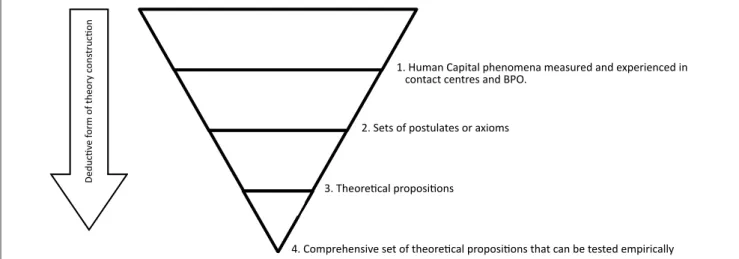
A conceptual model is defined as a set (or sets) of statements that represent a phenomenon as accurately as possible (Mouton, 2001, p. 177). A deductive form of theory construction was utilised whereby sets of postulates or axioms were formulated about the phenomena measured and experienced in contact centres. Theoretical propositions were deduced from the sets of postulates until a comprehensive set of theoretical propositions were developed that could be empirically tested. See diagram 1 for a graphical representation of the model building research approach.
Research method
The systematic approach followed in the collection of relevant empirical research articles described below ensures a replicable research method that is a prerequisite of the scientific method.
Location of the data and sampling procedure
The unit of analysis was quantitative, textual and/or hybrid data relating to contact centre performance related issues that were retrieved through literature searches. The sampling frame was narrowed down to include data, written in English, found in scientific journal articles, theses, dissertations and text books that relate to contact centre performance related issues limited to the period between 2000 and 2009.
This data was found primarily in e-journals located in databases such as EBSCOhost (Academic Search Premier, Business Source Premier and PsycInfo), Emerald, Gale Group (RDS Business & Management Practices), SAePublications and ScienceDirect that covers business, management and multidisciplinary subjects. EBSCOhost, through which the majority of the articles were found, is an academic and business resource boasting a powerful search engine that provides online access to full text collections of thousands of e-journals as well as more than 100 indexing and abstracting databases. Admittance to these databases was facilitated through the http://www.uj.ac.za/library web portal. Table 1 details the literature search-tracking sheet that was used to record the number of articles accessed for each search item.
Source: Compiled from Mouton, J. (2001). How to succeed in your master’s and doctoral studies: A South African guide and resource book. Pretoria: Van Schaiks. FIGURE 1: The model building research approach.
D
ed
uc
tiv
e
fo
rm
o
f t
he
or
y
co
ns
tru
ct
io
n
1. Human Capital phenomena measured and experienced in contact
centres as per research literature
2. Sets of postulates or axioms
3. Theoretical propositions
4. Comprehensive set of theoretical propositions that can be tested empirically
Diagram 1: The Model Building Research Approach (compiled from Mouton, 2001, pp. 176-177).
1. Human Capital phenomena measured and experienced in contact centres and BPO.
2. Sets of postulates or axioms
3. Theoretical propositions
4. Comprehensive set of theoretical propositions that can be tested empirically
Deductiv
e
form
of theor
y
cons
Reference lists of articles were also reviewed for additional publications that may not have been properly indexed or found during the database searches. Internet searches of professional organisations such as http://www.bpesa.org.za, http://www.callcentres.co.za, http://www.callingthecape.org and http://www.kznonsource.co.za were also conducted. South African online journals were also included in the search.
Data found in electronic masters’ dissertations, doctoral theses and academic books located in academic libraries such as the libraries of the University of Cape Town, University of Johannesburg, University of Pretoria, University of South Africa, University of Stellenbosch, University of the Freestate, University of the North-West and University of Witwatersrand were also used.
The Google Scholar functionality was utilised to cross-reference the aforementioned findings.
Data gathering methods
An initial scan was conducted in order to extract relevant research from the literature (Simpson, 2008). Key words used in the search included: call centres, contact centres, person–environment fit, job demands, job resources, human resource management (inclusive of selection, compensation, training, incentive compensation, internal promotion, participation programmes, flexitime, grievance procedures and employment security), agent competence, well-being, turnover and performance. The strategy was to focus and isolate data that indicated descriptions and/or correlations between variables that were utilised in formulating postulates. Only articles with the research purpose that directly related to the key words and that demonstrated linkage to performance were considered.
Articles in journals were searched based on the aforementioned keywords and retrieved via the databases mentioned under ‘Location of data and sampling procedure’. Retrieval of data in dissertations and textbooks was facilitated by utilising the respective library search engines. Reference lists of articles were reviewed for additional publications and Internet searches of professional organisations delivered some results. Articles were downloaded where possible in Portable Document Format (PDF) format and saved to a communal folder.
Research procedure
Approximately 411 manuscripts were sourced by means of the mentioned key words used in the articles in order to
classify, identify descriptions and/or correlations between selected variables. Only articles that reported empirical research findings on these mentioned variables were recorded for the purpose of this study.
The exact location of textbooks and journal and other articles were accurately noted and recorded. In this manner trustworthiness was ensured in that the results can be replicated by utilising the same databases and library search engines.
Data analysis
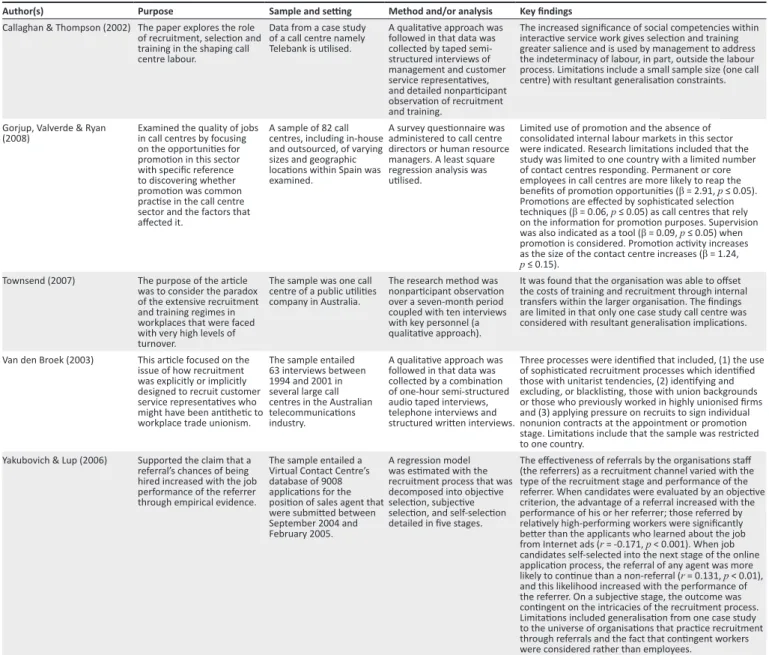
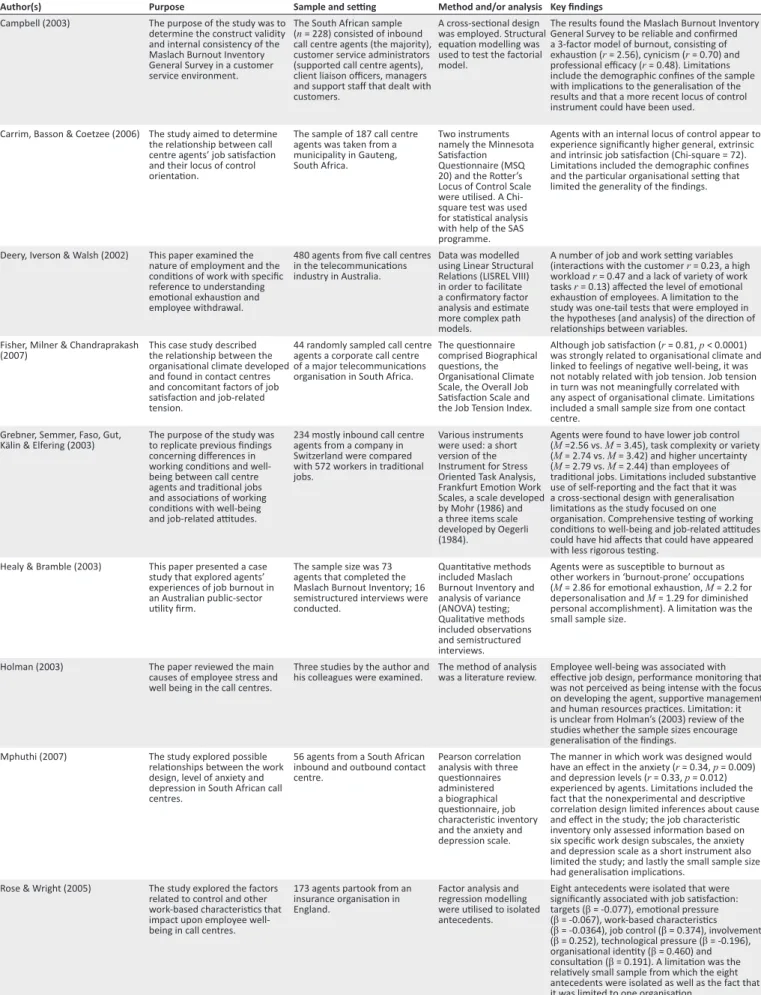
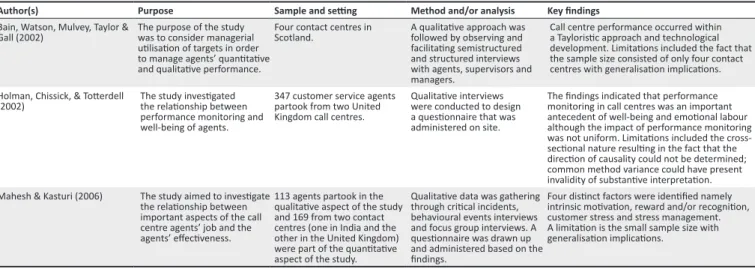
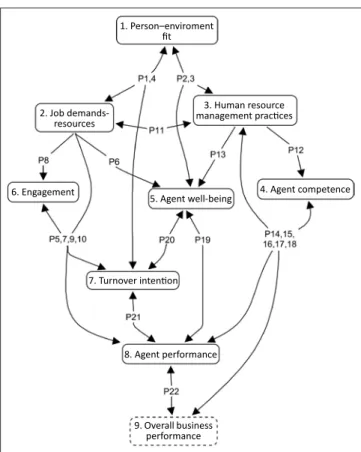
Forty-two articles were summarised in a tabular format (in Tables 2–9) detailing the study purpose, sample and setting, method and key findings (which included reference to the limitations and methodological issues) for easy replication. These tables were compiled according to the eight building blocks mentioned earlier. The listed research articles refer to empirical linkages between theoretical constructs that were analysed. Propositions that explain empirical linkages between variables were formulated, and perceived strengths and weakness of the links were discussed for further research purposes.
Presentation of the data
The retrieved data is presented in table format for each of the different building blocks. Articles are alphabetically sorted under each heading (key words) in Tables 2–9.
Findings
The review of empirical research findings pertaining to contact centres are summarised in Tables 2–9 and are discussed under the following section headings.
Person–environment fit
Table 2 summarises the one relevant article that was found.
Reiterating Table 2, McCulloch and Turban (2007) examined the value of P–O fit as a selection tool beyond cognitive ability for predicting continued length of service and performance for call centre agents. The P–O fit added significant incremental variance in predicting employee retention, but was not related to performance. Cognitive ability, on the other hand, predicted job performance but was not related to employee retention.
TABLE 1: Literature search tracking sheet.
Date of search Search items Number of articles
Accessed Eliminated
02 June 2009 Person–environment fit 38 37
04 June 2009 Job demands, job resources 56 52
30 June 2009 Human resource management 119 114
16 September 2009 Agent competence 71 63
24 September 2009 Well-being 88 73
24 November 2009 Turnover 24 22
09 December 2009 Performance 15 8
Job demands-resources
Table 3 details the four studies that were found to be relevant.
Recapping Table 3, Bakker et al.’s (2003) and Swart’s (2006) results suggested that in order to reduce or prevent absenteeism, job demands should be reduced; and in order to increase engagement and lower turnover intentions, the availability of job resources should be considered. Involvement (commitment and dedication) acted as a mediator between job resources and turnover intentions. Job resources also resulted in a higher probability when work-related flow was experienced (Swart, 2006). Job resources’ influence resulted in differential effects on performance
(number of calls, call duration and customer waiting time) although demands negatively affected performance (Dwyer & Fox, 2006). One anomaly is that call duration increased as the level of certain job resources increased even whilst job demands increased. Agents who understood the wholeness of what they do in that they solve customer problems and use their abilities, spent more time with the client, handled more incoming calls and adjusted performance in the event of increased workload, role conflicts and pace. Customer service training and employee control were found to be crucial in providing coping mechanisms for demanding tasks. Feedback, task identity and task significance interacted with role demands to predict the number of calls.
TABLE 2: Person–environment fit.
Author(s) Purpose Sample and setting Method and/or analysis Key findings
McCulloch & Turban (2007) The incremental value of a measure of actual Person– Organisation fit (P–O fit) was examined as a selection tool beyond cognitive ability for predicting continued length of service and performance for call centre agents.
280 contact centre employees from 11 contact centres in two provinces in Canada and in the East and Midwest regions of the United States.
Concurrent validation strategy. Participants completed a cognitive ability test (Performance Skills Index, PSI) and a P–O fit instrument (CultureFit).
P–O fit was operationalised as the correlation between managers’ descriptions of the work culture with participants’ work preferences.
P–O fit added significant incremental variance in predicting employee retention (R2 = 0.09), but was not related to performance. Limitations included that the extent to which P–O fit predicted retention or performance outcomes was not determined and generalisation to outbound environments was limited as the sample was inbound related.
TABLE 3: Job demands-resources.
Author(s) Purpose Sample and setting Method and/or analysis Key findings
Bakker, Demerouti & Schaufeli
(2003) Examined the predictive validity of the job resources-demands model (JR-D) for self-reported absenteeism and turnover intentions.
A sample of 477 employees working in the call centre of a Dutch telecom.
Self-reporting questionnaires and Structural equation modelling analysis were utilised.
Job demands (work pressure, computer problems, emotional demands and changes in tasks) were predictors of health problems (r = 0.57), which were related to absence as a result of sickness. Job resources (social support, supervisory coaching, performance feedback and time control) were predictors of involvement (r = 0.56) that was related to turnover intentions. Job resources had a weak negative relationship with health problems (r = -0.25), and health problems positively influenced turnover intentions (r = 0.20). Limitations included a cross-sectional design that did not provide evidence for causal relationships between the variables and self-reporting.
Dwyer & Fox (2006) The study tested the effects of job resources (control, training, supervisor support, task identity, task significance, skill variety and feedback) on the relationship between job demands (role demands, workload demands and work pacing demands) and indicators of performance (call duration, number of calls and customer waiting time).
A sample of 145 agents (91 and 54 respectively) from two inbound call centres in northwest Ohio.
The method included self-reporting questionnaires and hierarchical multiple regression analysis.
It was found that training moderated the relationships between role demands and performance (β = -1.27, p < 0.05), and customer waiting time and performance (β = -2.43, p < 0.05). Secondly, the three job content variables (task identity, β = 1.92, p < 0.01; task significance, β = 1.48, p < 0.05; feedback, β = 1.89, p < 0.01) had significant moderating effects on the relationship between workload demands and performance outcomes. Thirdly, control (β = -0.78, p < 0.05) and feedback (β = -2.64, p < 0.05) both interacted with work pacing demands to predict performance. A limitation was the small sample size.
Lewig & Dollard (2003) Examined the emotional demands (labour) of call centre work and its relationship to job satisfaction and emotional exhaustion within the theoretical frameworks of the job demand–control model, the effort–reward imbalance model and the job demands–resources model.
A sample of 98 South Australian call centre workers from nine call centres in Adelaide
Self-reporting questionnaires and Bivariate correlation analyses were utilised.
The central role of emotional labour variables was qualitatively confirmed in the experience of emotional exhaustion and satisfaction at work. Of the three components of emotional labour examined (frequency of interactions, duration of interactions and emotional dissonance) only emotional dissonance (the dissonance between felt emotions and emotional display rather being able to express positive and negative emotions) was associated with emotional exhaustion (r = 0.43, p < 0.01) and job satisfaction (r = –0.27, p < 0.01). Emotional dissonance fully mediated the relationship between positive emotional display and emotional exhaustion (β = 0.40, p < 5.001). A limitation was the small sample size.
Swart (2006) The objective of the study was to investigate the relationship between job characteristics (JDR), work wellness (burnout and work engagement) and work-related flow of call centre agents.
The sample was n = 176 from a South African insurance company.
A quantitative cross-sectional design with a self-constructed instrument to measure the unique job demands and resources (JDRS). Alongside the JDRS, the Oldenburg Burnout Inventory, the Utrecht Work Engagement Scale and the Work-Related Flow Scale were used.
Job demands were found to be pressure, working conditions, workload and job security; resources were supervision, resources availability, task freedom, pay and benefits, opportunity for growth and support. Work engagement correlated positively with work-related flow (r = 0.71) and corwork-related with pay and benefits (r = 0.53), opportunity for growth (r = 0.54), supervision (r = 0.47), and task freedom (r = 0.46). Limitations included the use of a cross-sectional survey design, the sample size and the fact that results were obtained solely by self-reported measures.
Human resources management practices
Three key categories impact organisational performance as per Liu et al. (2007); this framework was adopted for discussing contact centre related HRM practices. The three key categories that impacted organisational performance were competence (selection, compensation level and training), commitment (incentive compensation and internal promotion) and context (participation programmes, flexitime, grievance procedures and employment security).
The five articles that were found are summarised in Table 4 and are discussed thereafter according to the three key categories that were mentioned earlier in the article.
Competence: Recruitment and selection, training and
compensation
Three relevant studies were identified regarding selection. Callaghan and Thompson (2002) observed the increased significance of social competencies within interactive service
work that gave selection and training greater salience and was used by management to address the indeterminacy of labour or (as per Van den Broek, 2003) manage unionism. The recruitment process was a means to select employees who brought the skills to potentially engage in emotional labour (Townsend, 2007). Yakubovich and Lup (2006) found that when candidates were evaluated by an objective criterion, the advantage of a referral increased with the performance of his or her referrer. When job candidates self-selected into the next stage of the online application process, the referral of any agent was more likely to continue than a nonreferral, and this likelihood increased with the performance of the referrer.
One article referred to training. Townsend (2007) found that new recruits underwent a three phase training programme: • two weeks of learning computer applications that was
then consolidated with two weeks of taking calls in a
TABLE 4: Human resources management practices.
Author(s) Purpose Sample and setting Method and/or analysis Key findings
Callaghan & Thompson (2002) The paper explores the role of recruitment, selection and training in the shaping call centre labour.
Data from a case study of a call centre namely Telebank is utilised.
A qualitative approach was followed in that data was collected by taped semi-structured interviews of management and customer service representatives, and detailed nonparticipant observation of recruitment and training.
The increased significance of social competencies within interactive service work gives selection and training greater salience and is used by management to address the indeterminacy of labour, in part, outside the labour process. Limitations include a small sample size (one call centre) with resultant generalisation constraints.
Gorjup, Valverde & Ryan
(2008) Examined the quality of jobs in call centres by focusing on the opportunities for promotion in this sector with specific reference to discovering whether promotion was common practise in the call centre sector and the factors that affected it.
A sample of 82 call centres, including in-house and outsourced, of varying sizes and geographic locations within Spain was examined.
A survey questionnaire was administered to call centre directors or human resource managers. A least square regression analysis was utilised.
Limited use of promotion and the absence of consolidated internal labour markets in this sector were indicated. Research limitations included that the study was limited to one country with a limited number of contact centres responding. Permanent or core employees in call centres are more likely to reap the benefits of promotion opportunities (β = 2.91, p ≤ 0.05). Promotions are effected by sophisticated selection techniques (β = 0.06, p ≤ 0.05) as call centres that rely on the information for promotion purposes. Supervision was also indicated as a tool (β = 0.09, p ≤ 0.05) when promotion is considered. Promotion activity increases as the size of the contact centre increases (β = 1.24, p ≤ 0.15).
Townsend (2007) The purpose of the article was to consider the paradox of the extensive recruitment and training regimes in workplaces that were faced with very high levels of turnover.
The sample was one call centre of a public utilities company in Australia.
The research method was nonparticipant observation over a seven-month period coupled with ten interviews with key personnel (a qualitative approach).
It was found that the organisation was able to offset the costs of training and recruitment through internal transfers within the larger organisation. The findings are limited in that only one case study call centre was considered with resultant generalisation implications.
Van den Broek (2003) This article focused on the issue of how recruitment was explicitly or implicitly designed to recruit customer service representatives who might have been antithetic to workplace trade unionism.
The sample entailed 63 interviews between 1994 and 2001 in several large call centres in the Australian telecommunications industry.
A qualitative approach was followed in that data was collected by a combination of one-hour semi-structured audio taped interviews, telephone interviews and structured written interviews.
Three processes were identified that included, (1) the use of sophisticated recruitment processes which identified those with unitarist tendencies, (2) identifying and excluding, or blacklisting, those with union backgrounds or those who previously worked in highly unionised firms and (3) applying pressure on recruits to sign individual nonunion contracts at the appointment or promotion stage. Limitations include that the sample was restricted to one country.
Yakubovich & Lup (2006) Supported the claim that a referral’s chances of being hired increased with the job performance of the referrer through empirical evidence.
The sample entailed a Virtual Contact Centre’s database of 9008 applications for the position of sales agent that were submitted between September 2004 and February 2005.
A regression model was estimated with the recruitment process that was decomposed into objective selection, subjective selection, and self-selection detailed in five stages.
The effectiveness of referrals by the organisations staff (the referrers) as a recruitment channel varied with the type of the recruitment stage and performance of the referrer. When candidates were evaluated by an objective criterion, the advantage of a referral increased with the performance of his or her referrer; those referred by relatively high-performing workers were significantly better than the applicants who learned about the job from Internet ads (r = -0.171, p < 0.001). When job candidates self-selected into the next stage of the online application process, the referral of any agent was more likely to continue than a non-referral (r = 0.131, p < 0.01), and this likelihood increased with the performance of the referrer. On a subjective stage, the outcome was contingent on the intricacies of the recruitment process. Limitations included generalisation from one case study to the universe of organisations that practice recruitment through referrals and the fact that contingent workers were considered rather than employees.
controlled environment (assistance provided by a training partner)
• two weeks learning about more advanced processes followed again by a two-week period of consolidation • new recruits were allocated to teams and entered a
twelve-month probation period with a more than 80% completion success ratio. Most of the training focused on technical skill development and product knowledge rather than emotional labour.
No relevant studies were found focusing specifically on compensation; Benner, Lewis and Omar (2007), however, reported that in 2007 the average call centre agent was paid R76 800 a year that varied by industry and type of call centre. Batt et al. (2009) reported the annual earnings of a typical agent as $11.736. Aksin et al. (2007) mentioned that many call centres included in their compensation to their agents a number-of-resolved-calls component as a result of the significance of first call resolution on overall customer satisfaction as well as on the system load.
Commitment: Incentive compensation and internal
promotion
Limited research was available regarding incentives. Aksin et al. (2007), however, stated that incentives in inbound contact centres were typically based on quantitative (calls per hour, average call times, time between calls) and qualitative (content, style, adherence to policies) aspects of calls.
One study was found on promotion. Gorjup et al.’s (2008) study reported limited use of promotion in the contact centre sector. More than half of the contact centres analysed had not promoted any agents or supervisors in the previous year. It also suggested the absence of structured promotion policies. Call centre managers use promotion more frequently if they had a higher proportion of permanent employees and incorporated sophisticated selection techniques and work monitoring practices as supervisory tools.
Context: Participation programmes, flexitime, grievance
procedures and employment security
Limited research was available; other literature was therefore referred to in this section. Regarding participation programmes, Batt (2002) found that quit rates were lower (and sales growth was higher) where employee participation in decision making was at the order of the day.
In considering flexitime, Cox et al. (2000) mentioned that control over work schedules was an important factor in job design and work organisation; this was enhanced by flexitime. Other literature mentioned that flexitime could have a positive effect on workers (Narayanan & Nath, 1982) probably because the perceived control over work schedules assisted in reducing stress; it did not necessarily change behaviour (Ronen, 1981).
Grievance procedures provided a formal mechanism to change unsatisfactory work situations and resolve workplace conflict when it arose (Liu et al., 2007). It empowered employees by offering a dispute resolution valve with
managers and other employees – this contributed to retention if the procedures were fair and effective.
Employment security was important for ‘high commitment’ service contact centres where the tasks were complex with a high level of control in the contact centre and the market volume was lower with higher value-added than compared with mass service environments (Batt, 2002; Zapf, Isic, Bechtoldt & Blau, 2003).
Agent competence
The eight relevant studies that were found are detailed in Table 5.
Reiterating Table 5, Grobbelaar et al. (2004) identified 11 competencies as being threshold competencies in order to be minimally effective. Four competencies, however, were indicated as being performance differentiators: cross-functional awareness, initiative, persuasiveness and understanding (HRM) practices. White and Roos (2005) stated the ability to listen and to be attentive to detail and information whilst yet understanding the customer’s circumstances and needs as important. Agents should stay in control of the call at all times and be knowledgeable about the product, services and methodologies.
Emotional intelligence elements correlated the highest with performance and were associated frequently with the contact centre recruitment attributes according to Higgs (2004). Nel and De Villiers (2004) found that the strongest correlation with performance in the contact centre environment occurred in the cluster of self-management and the emotional competency of self-confidence in their study to determine the relationship between emotional intelligence and job performance in a contact centre environment.
Moller et al. (2004) identified that a self-assertive personality type was dissatisfied with the extent of work variety in contact centres. Van der Linde’s (2005) study indicated a relationship between work performance measured by the level of financial incentives of agents and five personality traits namely, (1) analytical thinking, (2) detail consciousness, (3) conscientiousness, (4) ‘structuredness’ and (5) work performance. Nicholls (2006) utilised the same instrument as Van der Linde (2005) and found small to moderate correlations between personality traits and performance, and moderate to high correlations between ability and performance. Ojha and Kasturi (2005) found that agents who experience high intrinsic motivation in their work and those that were team players achieve high levels of performance.
Agent well-being
Fifteen relevant studies were found and are summarised in Table 6 and discussed thereafter.
burnout, was predicted by four categories of daily hassles as per Visser and Rothmann (2009). Visser and Rothmann (2008) found that burnout had a direct effect on turnover intentions; affective commitment partially mediated the relationship between burnout and turnover intention.
Fisher et al. (2007) reported neutral overall responses for job specific well-being measures, job satisfaction and job tension levels with rewards being the most negative. Emotional pressure, as a dimension of control, underpins all the factors impacting upon job satisfaction (Rose & Wright, 2005); work-based characteristics, computer-facilitated and supervisory control were found to be direct antecedents of satisfaction. The results of Unterslak’s (2009) study indicated that affective disposition and job features affected well-being.
Carrim et al. (2006) found that agents with an internal locus of control experience higher extrinsic and intrinsic job satisfaction; job satisfaction was related to a positive organisational orientation whereas job dissatisfaction was related to tardiness, absenteeism and high labour turnover.
Aspects that had strong positive effect on agents’ well-being (Healy & Bramble, 2003; Holman, 2003) included a high control over work methods, procedures and communication to the customer; a degree of variety; performance monitoring that was not perceived as being intense with the focus on developing the agent; supportive team leader management; supportive human resources practices; repetitive nature of the work itself; and emotional labour. According to Grebner et al. (2003), job control and task complexity and/or variety TABLE 5: Agent competence.
Author(s) Purpose Sample and setting Method and/or analysis Key findings
Grobbelaar, Roodt & Venter
(2004) The research focused on the individual competencies that lead to a customer service core capability in a Human Resources Call Centre.
The sample included 18 Call Centre agents, three supervisors and 25 customers.
Data was obtained by means of five focus group interviews, three individual interviews and 25 telephonic interviews. A transcendental realism research procedure was applied within a qualitative research paradigm.
The following key competencies were identified: appropriate questioning, cross-functional awareness, friendly tone of voice and/or willingness to assist, interpersonal sensitivity, listening and understanding, networking ability, oral communication skills, passion, persuasiveness, portraying a professional image, product knowledge and technical skills, quality orientation, reliability, resilience, respect for others, teamwork, time management skills, understanding human resources practices and using initiative. Limitations included that the study was conducted in a Human Resources Call Centre environment within in a financial institution with a small number of participants; this could have generalisation limitations.
Higgs (2004) This research detailed a study designed to explore the relationship between the emotional intelligence of contact centre agents and ratings of their performance.
A sample of 289 agents from three United Kingdom organisations was studied from inbound contact centre environments.
A quantitative cross-sectional correlational design was employed using the Environmental Impact Quotient measure.
Results included a strong relationship between overall emotional intelligence as well as several elements of the model performance and individual performance. These elements include: conscientiousness (r = 0.254, significance = 0.000), emotional resilience (r = 0.186, significance = 0.001), motivation (r = 0.183, significance = 0.002) and interpersonal sensitivity (r = 0.170, significance = 0.004). Limitations included that the sample was an inbound environment with subsequent generalisation implications; the performance measures were limited in objectivity and cross-organisational consistency.
Moller, Crous & Schepers
(2004) Investigation into the personality traits of call centre consultants who experienced work satisfaction.
The sample included 103 agents from a South African organisation in the healthcare industry.
A correlation analysis based on the Minnesota Satisfaction Questionnaire and the Jackson Personality Research Form.
The results showed that there was not a unique personality profile in respect of work satisfaction. A limitation was that the study was based on one contact centre with resultant generalisation constraints.
Nel & De Villiers (2004) The study aimed to determine whether there was a relationship between emotional intelligence and job performance in a call centre environment.
The sample comprised 135 call centre agents from client services, sales and administrative environments in a life insurance company.
Emotional intelligence was measured by means of the Emotional Competency Inventory that is a multi-rater survey instrument based on the Self-Assessment Questionnaire.
A statistically significant and positive correlation between emotional intelligence and job performance was found. The combination of emotional competencies namely emotional awareness, trustworthiness, self-confidence and influence explained the greatest degree of variance in job performance in the contact centre environment as a whole (adjusted R-square = 42.8%). Limitations include that agents’ team managers (n = 31) completed the questionnaires and that the sample was insurance industry specific.
Nicholls (2006) The purpose of the study was to determine whether personality and measures of ability predicted job performance of call centre agents.
The sample size was 140 contact centre agents from a South African communications company.
The Customer Contact Styles Questionnaire (CCSQ 7.2), Basic Checking (CP7.1) and Audio Checking (CP8.1) were utilised as predictors and the Customer Contact Competency Inventory, completed by the supervisors, as a measure of performance with agents’ performance statistics. Correlation and multiple regression analysis were conducted.
Small to moderate correlations were found between personality traits and performance (average handling time as a performance measure correlated as follows with: sociable r = 0.21, participative r = 0.21, persuasive r = 0.24 and average quality as a performance measure correlated as follows with: detail conscious r = 0.28, conscientious r = 0.35, structured r = 0.38, results orientated r = 0.42) and moderate to high correlations between ability (average quality as a performance measure correlated as follows with: basic checking r = 0.28, audio checking r = 0.39) and performance. Limitations included that the study was conducted from a concurrent validity perspective as opposed to a predictive validity perspective; a relatively small sample size might have generalisation limitations if applied to the broader population.
Ojha & Kasturi (2005) The study identified some of the attributes salient to the performance of call centre agents.
169 agents responded from two call centres, one in India and the other in the UK.
A 95-item questionnaire was developed and surveyed by conducting critical incident, behavioural event and focused group interviews in three contact centres. This was correlated with agent performance.
Agents who experienced high intrinsic motivation in their work (b = 0.202, p = 0.062) and those that were team players (b = 0.253, p = 0.016) achieved high levels of performance. Limitations included generalisation of the results that could be impacted by the fact that the sample was restricted to two contact centres and that a random subject identification method was not followed.
TABLE 6: Agent well-being.
Author(s) Purpose Sample and setting Method and/or analysis Key findings
Campbell (2003) The purpose of the study was to determine the construct validity and internal consistency of the Maslach Burnout Inventory General Survey in a customer service environment.
The South African sample (n = 228) consisted of inbound call centre agents (the majority), customer service administrators (supported call centre agents), client liaison officers, managers and support staff that dealt with customers.
A cross-sectional design was employed. Structural equation modelling was used to test the factorial model.
The results found the Maslach Burnout Inventory General Survey to be reliable and confirmed a 3-factor model of burnout, consisting of exhaustion (r = 2.56), cynicism (r = 0.70) and professional efficacy (r = 0.48). Limitations include the demographic confines of the sample with implications to the generalisation of the results and that a more recent locus of control instrument could have been used.
Carrim, Basson & Coetzee (2006) The study aimed to determine the relationship between call centre agents’ job satisfaction and their locus of control orientation.
The sample of 187 call centre agents was taken from a municipality in Gauteng, South Africa.
Two instruments namely the Minnesota Satisfaction Questionnaire (MSQ 20) and the Rotter’s Locus of Control Scale were utilised. A Chi-square test was used for statistical analysis with help of the SAS programme.
Agents with an internal locus of control appear to experience significantly higher general, extrinsic and intrinsic job satisfaction (Chi-square = 72). Limitations included the demographic confines and the particular organisational setting that limited the generality of the findings.
Deery, Iverson & Walsh (2002) This paper examined the nature of employment and the conditions of work with specific reference to understanding emotional exhaustion and employee withdrawal.
480 agents from five call centres in the telecommunications industry in Australia.
Data was modelled using Linear Structural Relations (LISREL VIII) in order to facilitate a confirmatory factor analysis and estimate more complex path models.
A number of job and work setting variables (interactions with the customer r = 0.23, a high workload r = 0.47 and a lack of variety of work tasks r = 0.13) affected the level of emotional exhaustion of employees. A limitation to the study was one-tail tests that were employed in the hypotheses (and analysis) of the direction of relationships between variables.
Fisher, Milner & Chandraprakash
(2007) This case study described the relationship between the organisational climate developed and found in contact centres and concomitant factors of job satisfaction and job-related tension.
44 randomly sampled call centre agents a corporate call centre of a major telecommunications organisation in South Africa.
The questionnaire comprised Biographical questions, the Organisational Climate Scale, the Overall Job Satisfaction Scale and the Job Tension Index.
Although job satisfaction (r = 0.81, p < 0.0001) was strongly related to organisational climate and linked to feelings of negative well-being, it was not notably related with job tension. Job tension in turn was not meaningfully correlated with any aspect of organisational climate. Limitations included a small sample size from one contact centre.
Grebner, Semmer, Faso, Gut,
Kälin & Elfering (2003) The purpose of the study was to replicate previous findings concerning differences in working conditions and well-being between call centre agents and traditional jobs and associations of working conditions with well-being and job-related attitudes.
234 mostly inbound call centre agents from a company in Switzerland were compared with 572 workers in traditional jobs.
Various instruments were used: a short version of the Instrument for Stress Oriented Task Analysis, Frankfurt Emotion Work Scales, a scale developed by Mohr (1986) and a three items scale developed by Oegerli (1984).
Agents were found to have lower job control (M =2.56 vs. M = 3.45), task complexity or variety (M = 2.74 vs. M = 3.42) and higher uncertainty (M = 2.79 vs. M = 2.44) than employees of traditional jobs. Limitations included substantive use of self-reporting and the fact that it was a cross-sectional design with generalisation limitations as the study focused on one organisation. Comprehensive testing of working conditions to well-being and job-related attitudes could have hid affects that could have appeared with less rigorous testing.
Healy & Bramble (2003) This paper presented a case study that explored agents’ experiences of job burnout in an Australian public-sector utility firm.
The sample size was 73 agents that completed the Maslach Burnout Inventory; 16 semistructured interviews were conducted.
Quantitative methods included Maslach Burnout Inventory and analysis of variance (ANOVA) testing; Qualitative methods included observations and semistructured interviews.
Agents were as susceptible to burnout as other workers in ‘burnout-prone’ occupations (M = 2.86 for emotional exhaustion, M = 2.2 for depersonalisation and M = 1.29 for diminished personal accomplishment). A limitation was the small sample size.
Holman (2003) The paper reviewed the main causes of employee stress and well being in the call centres.
Three studies by the author and
his colleagues were examined. The method of analysis was a literature review. Employee well-being was associated with effective job design, performance monitoring that was not perceived as being intense with the focus on developing the agent, supportive management and human resources practices. Limitation: it is unclear from Holman’s (2003) review of the studies whether the sample sizes encourage generalisation of the findings.
Mphuthi (2007) The study explored possible relationships between the work design, level of anxiety and depression in South African call centres.
56 agents from a South African inbound and outbound contact centre.
Pearson correlation analysis with three questionnaires administered a biographical questionnaire, job characteristic inventory and the anxiety and depression scale.
The manner in which work was designed would have an effect in the anxiety (r = 0.34, p = 0.009) and depression levels (r = 0.33, p = 0.012) experienced by agents. Limitations included the fact that the nonexperimental and descriptive correlation design limited inferences about cause and effect in the study; the job characteristic inventory only assessed information based on six specific work design subscales, the anxiety and depression scale as a short instrument also limited the study; and lastly the small sample size had generalisation implications.
Rose & Wright (2005) The study explored the factors related to control and other work-based characteristics that impact upon employee well-being in call centres.
173 agents partook from an insurance organisation in England.
Factor analysis and regression modelling were utilised to isolated antecedents.
Eight antecedents were isolated that were significantly associated with job satisfaction: targets (β = -0.077), emotional pressure (β = -0.067), work-based characteristics (β = -0.0364), job control (β = 0.374), involvement (β = 0.252), technological pressure (β = -0.196), organisational identity (β = 0.460) and consultation (β = 0.191). A limitation was the relatively small sample from which the eight antecedents were isolated as well as the fact that it was limited to one organisation.
Please see full reference list of the article, Jacobs, C., & Roodt, G. (2011). A human capital predictive model for agent performance in contact centres. SA Journal of Industrial Psychology/SA Tydskrif vir Bedryfsielkunde, 37(1), Art. #940, 19 pages. doi:10.4102/sajip.v37i1.940
¹, Correlated with job satisfaction; ², Correlated with anxiety–comfort; ³, Correlated with depression–enthusiasm.