A Routing Delay Predication Based on Packet Loss
and Explicit Delay Acknowledgement for Congestion
Control in MANET
Y. Narasimha Reddy
1and P V S. Srinivas
21
Rayalaseema University, Kurnool, A. P., India 2
Sreenidhi Institute of Technology and Science, Hyderabad, India,
Abstract: In M obile Ad hoc Networks congestion control and prevention are demanding because of network node mobility and dynamic topology. Congestion occurs primarily due to the large traffic volume in the case of data flow because the rate of inflow of data traffic is higher than the rate of data packets on the node. This alteration in sending rate results in routing delays and low throughput. The Rate control is a significant concern in streaming applications, especially in wireless networks. The TCP friendly rate control method is extensively recognized as a rate control mechanism for wired networks, which is effective in minimizing packet loss (PL) in the event of congestion. In this paper, we propose a routing delay prediction based on PL and Explicit Delay Acknowledgement (EDA) mechanism for data rate and congestion control in M ANET to control data rate to minimize the loss of packets and improve the throughput. The experiment is performed over a reactive routing protocol to reduce the packet loss, jitter, and improvisation of throughput.
Keywords: Routing, Delay prediction, Packet Loss, Rate control, EDA, Congestion.
1.
Introduction
A mobile ad-hoc network (MANET) is a collection of self-sufficient mobile nodes that communicate us ing a shared wireless multi-hop link without a fixed infrastructure. It has unique features consis t of dynamic network topology, asymmetry, multi-hop communication, and inadequate bandwidth and energy resources. The attributes make difficult for the provision of quality of service (QoS) and raise diverse problems in congestion control (CC) design [3], [9], [12]. In MANET, intensive streaming traffic can result in more packet loss, longer delay, and QoS-related performance degradation caused by congestion. Congestion among various problems of communication is a measurement method that affects network performance [1], [2], [4].
Congestion in node mainly causes because of buffer overflow, link interference or collision. The TCP / IP is the protocol most commonly used for communications. However, it goes after the strict hierarchical constitution of the "OSI model" and has some limitations at every layer. Every layer is allocated a preset assignment to control communication. Although it can occur when the data rate exceeds the rate of data reception, it is significant to regulate the data rate used by each source to avoid overloading the network where numerous sources participate for linkage bandwidth. Lost packets often lead to retransmissions and excessive amoun ts of packets cause network bottlenecks so
that more control packets arrive on congested networks [5], [6]. Researchers focus on congestion prevention because congestion causes great losses in related to throughput and energy consumption.
Conventional TCP end-to-end congestion CC methods have data rate control and coordination capabilities [7], [11], [13]. A congestion window is typically assigned a value of 1 when a TCP connection is initiated. The bandwidth available for a connection can be a great deal above the "maximum segment size (MSS)" of every "round trip time (RTT)". The TCP Source prolongs to enhance the baud rate exponentially in anticipation of a loss instance occurs. Later whichever loss observe from the destination, the transmitter node executes the stream control method. The main effects of congestion are routing delays and packet loss (PL) [5], [8], [18], [23]. For high traffic rates, it is important to have a way to detect congestion. In an "end-to-end CC approach", in the network layer does not offer precise sustain for the transport layer. Even the occurrence of network congestion has to be experiential with the end system depend on network nature, PL, packet arrival delay, jitter, etc.
In this paper, we propose a routing delay prediction (RDP) based on PL and Explicit Delay Acknowledgement (EDA) mechanism for data rate and CC in MANET. It will efficiently control data rate for streaming application to minimize the loss of packets and improve the throughput. It tries to focus on the problem of TCP-CC mechanism in MANET. The extensively utilized transport protocol is TCP [9], [10], [14] is not appropriate for the streaming applications on MANET. This is due to the reality that TCP infers missing packets as a suggestion of a network congestion that does not always correspond to MANET. Packet loss (PL) can be caused by the unique nature of the MANET, such as "node mobility", "link bit errors", "media contention", and "path errors". On account of this unusual nature, the PL rate of a wireless link is much advanced than its wired link. The TCP protocol responds to this wireless loss in the identical way as it reacts to PL because of congestion. This proposed work will contribute two assessment parameter for the RDP. 1). Detecting of packet losses because of congestion, 2) Controlling the data Rate using EDA.
2.
Related Works
As the existing of wireless media on mobile devices has increased, multimedia applications have become a well-liked means of communication [1], [4], [13], [16], [17]. Because MANET is a particular variety of network, the CC mechanism for this area must be tailored to the particular features of the MANET. In the initial study, streaming is performed through "UDP flow" [X22]. However, UDP is a variable protocol because of it not able to have a CC method, and because of this nature of UDP, it is appropriate for multimedia application communication with an invariable data rate. Because it cannot organize CC mechanisms, multimedia streams that are not replicated by UDP will unfairly struggle with former response TCP flows. Congested networks can therefore seriously degrade network performance. Many studies [13], [20], [21], [24], [25] have shown that audio and video respond more slowly to packet loss than streaming and better match congestion mechanisms to achieve smooth throughput changes. A lot of Internet propose models have changed with the advent of new multimedia usages. In addition, as wireless networks happen to offered on "mobile devices" and "multimedia applications " which are becoming more widespread. However, compared to MANET, multimedia applications face some problems due to the inherent characteristics of MANET.
The rate control technique widely applied in wired networks is an "equation-based rate control" recognized as "TCP Friendly Rate Control (TFRC)" [22], [25], [27]. There are basically three benefits to rate control by means of TFRC. First, it has no reason for network unsteadiness and congestion fail can be avoided. Second, the TCP flow, which is the main source of traffic on the Internet, is fair. Third, TFRC's rate variability is inferior to TCP, construct it further suitable for streaming applications that necessitate continuous video superiority. The main supposition of "TCP" and "TFRC" is that PL is an indication of congestion. Nevertheless, PL on a wireless network is a violation of this assumption, which can be caused by physical link errors. TFRC or TCP cannot differentiate amongst PL because of buffer overflow and physical link failure, so it does not take full advantage of the bandwidth. Therefore, streaming rate control over wireless and CC are current open concerns. As a consequence, several attempts have been made to advance the performance of "TCP" [7], [9], [10] or "TFRC" [22], [25] over a wireless network. This approach provides the ability to hide the end host from PL because of wireless link failure or to distinguish PL caused by congestion and link failure on the end host. It can use to inform TCP/TFRC sources of "explicit loss notification (ELN)" when PL occurs because of network errors other than congestion [3], [5]. In this scenario, the TFRC can only consider PL because of the congestion when regulating the streaming data rate.
J. Pan et al. [1] presents a mechanism to perform vehicular traffic re-routing for congestion avoidance in a scalable and privacy-preserving manner. The designed mechanism implements several routing schemes for assign new route to avoid congestion. The new route is selected based on actual time need to reach the destination, instead of using simply the shortest route. It helps to manage the network balance and efficient routing instead of waiting for long for the short
route for routing. N. Li et al. [2] propose a "cross-layer and reliable opportunistic routing algorithm (CBRT)" for providing efficient and reliable routing in MANET. It implements a fuzzy logic and topology control to design the routing algorithm. It takes a variable metric as input to reduce fuzzy rules for improving routing reliability and reduce the control overhead. The routing mechanism show better throughput performance in a moving direction and speed. This routing algorithm can be enhanced for congestion control as it even show low computation complexity. Y. Mai et al. [3] present a new congestion control scheme for AODV routing protocol term as CC-AODV, it also support to manage the routing congestion condition to reduce the packet drop rate.
In the past, many end-to-end measures are being proposed to predict congestion and delay to minimize the packet losses [11], [12], [18], [24], [25], [26]. The accurate estimation of the congestion and delay will improvise the TCP throughput. The development of multipath routing such as "Multipath -TCP" or "SCTP" supports the higher potential to the routing mechanism. M. Coudron et al. [18] propose a technique to alleviate the delay in the routing through estimating the difference in one-way delay between the routes. This techniques will be effective to avoid congestion in multipath routing.
J. Wu et al. [13] recommends a method to advancement in video streaming multipath routing in the existence of wireless link errors and the congestion bottlenecks. It suggest a parallel transmission over multiple path to minimize the throughput delay and suggest an joint congestion control mechanism to minimize the quality distortion in video streaming. A. Betances et al. [4] propose an optimal routing mechanism for air tasking order by means of the dynamic MANET routing protocol. It determine the optimal route to perform quick and quality of service to determine the high accuracy performance and minimize the impact of congestion. The evaluation result over MANET reduce the loss of packets and improves the throughput.
it always selects the shortest path to reach the target first, regardless of the congestion state of the nodes in the identified path, and (2) reroutes multiple paths without any prediction. The data. Traffic congestion causes delays and PL. It has been observed that most existing proposals prefer the shortest path to data transmission, but at the same time, it can be highly crowded. Therefore, it is essential to make sure that delays and packet losses are handled efficiently before routing data in the route.
Other techniques such as [15], [19], [28], [29], [30], [31], that identify congestion using endpoint statistics are capable of to unite with TFRC for data rate control. Congestion detection schemes employed to resolve whether monitored PL is as a result of congestion, TFRC is only considered PL because of congestion when regulating the streaming rate. A shortcoming of the "end-to-end statistical-based approach" is that statistical-based congestion detection design is inappropriate enough and impose cross -layer information or adjustment to the transport layer stack. However, existing studies demonstrate that the TCP friendly method for CC uphold a smooth throughput over TCP in mobile ad hoc networks, but achieves less throughput than challenging TCP flows. In MANET, CC also based on the features and features of the application being transmitted.
Based on the above observation, we improve this mechanism through dynamic intermediate node selection to efficiently reduce the congestion depending on the specific route, through design a routing delay prediction (RDP) based on the PL and Explicit Delay Acknowledgment (EDA) mechanism for data rate and congestion control in MANET as discussed below.
3.
Proposed Routing Delay Prediction Approach
3.1 Problem Overview
In addition, when any congestion event occurs, TCP will make a conservative response and halve its communication rate. This extreme alteration in communication rate can degrade the execution of these streaming applications. Therefore, consistently pertaining the CC to each one failure will result in intolerable execution deprivation, even though, TCP controls the congestion of the "end-to-end method". It reacts conventionally to PL because of it not able to get a precise message concerning the state of network congestion. As well, TCP not able to permit for a quick enhance in throughput. A maximum of one packet to be added to the "RTT" which is not appropriate for streaming applications. Infrequently streaming applications require to include further to sustain a uniform rate. Besides, the TCP retransmission proposal perhaps avoidable for the loss of streaming applications.
An end-to-end methodology to CC [1], [3] deficient in knowledge of network congestion. In this way, the end host treats the router as a "black box" and not able to determine the definite congestion of the network. In addition, a significant attribute of multimedia streaming applications is to sustain a more stable data transfer rate. In MANETs the problems are becoming more important because of the MANET attributes such as mobility, link errors, media contention, and routing failures. Therefore, you must identify the actual congestion and respond accordingly. If the
network becomes congested, the router must respond to this situation because it has to delete the packet.
As a result of the exclusive characteristics of MANET, the TCP cannot sustain a uniform data transmission rate and is a prerequisite of streaming applications. TCP utilizes a conventional "end-to-end mechanism" to control network congestion. In this paper, we solve this problem by controlling the data rate and congestion through the routing delay prediction based on the PL estimation and the explicit delay confirmation of the intermediate node.
3.2 Packet Loss (PL) in MANET
Congestion causes a lot of PL on the network. As discussed earlier, congestion in MANET is not the only reason for PL. Special properties of MANETs such as node mobility, routing failure, and media contention also play a key role in this loss. However, TCP, the end-to-end protocol, cannot distinguish loss due to conges tion, so the number of error detections occurs.
Network congestion may not be detected, or on the contrary, congestion perhaps identifies whilst the network is not congested whatsoever. By means of end-to-end evaluations, the possibility of no congestion being detected if it not extreme. Whilst the congested status indicates such as "RTT" or coming in interval does enhance. Nevertheless, herewith particular value calculate, the possibility of bogus congestion recognition in a non-congested MANET is very extreme because of noise end-to-end observation. Since, TCP not having information about the nature of failure that occurs at an intermediate node, it consistently pertains CC to the entire of these lost applications , because error recognition can make things substandard.
This unpredictable behavior leads to rigorous data rate degradation, which is simply undesirable. When streaming through MANET, TCP does not maintain a uniform data transfer rate caused by CC mechanisms. Therefore, identifying the variety of PL is very important in MANET.
3.3 Explicit Delay Acknowledgment (EDA)
EDA tries to control congestion in streaming media applications through explicit message transmission with regard to congestion. The CC scheme relies on an acknowledgment to form an intermediate node. The intermediate node uses the current buffer length to send the rate information to the optional fact in the IP header of the packet. Every intermediate node in the route from the source to the destination displays the data rate as it passes with an IP header of the transmitting data packet. After receiving the message from the intermediate node, the receiving side transmits rate message to the source side by the ED acknowledgment packet. The source uses this feedback to adjust it using the current data rate.
3.4 Routing Delay Prediction
3.4.1 Determining the Packet Loss
Since TCP uniformly performs CC on each loss occurring in the network without knowing the kind of packet loss; this seriously declines the throughput of the network. To explain this difficulty, it utilizes a routing delay parameter as "delay".
Every intermediate node will configure the variable of the
RDelay on every transient to 1, if the percentage of buffer
length "Blen", of the receiving node completed to the
pre-configured congestion threshold value as, "Tc", it is
configured to "0.9" for the rate control. In case of packet transient, if the Blen is below the Tc configured then the value
of RDelay is set to 0 value. After reception of the tailored
packet, the destination alteration this variable beside with former message to a newly created packet and transmits the packet to the source.
The source node on receiving the EDA message, store a copy of the RDelay to a variable known as RDprv . If the
retransmission expires it activate the loss happening by the source node, it first tries to recognize the cause after the loss before degrading the transmission rate. This activity is executed by examining the value of RDprv. The indication of
the probability of congestion is high if the RDprv and RDelay
both are 1, which means the node buffer is filled with 90%. On determining the congestion through the assignment of
RDprv value as 1, the source node slows down the data
transmission to reduce the PL. If the assignment of RDprv
value as 0, then the process of data transmission will continue in a normal rate, and if any PL happens in this period might due to some other cause instead of congestion.
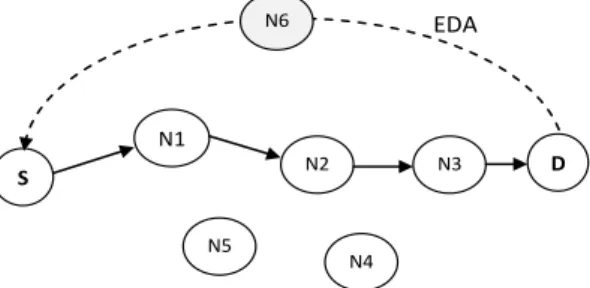
This clears the determination of packet loss is because of congestion and another network issue for the source node. An outline of the transmission is depicted in Fig. 1.
Figure 1. An overview of the EDA transmission The Fig.1 show the route of data flow in a solid line from the source S, to the destination node D, with the support of the intermediate node 1,2 and 3. To determine the congestion at each node in the route it finds their Blen and compare against
the configured Tc congestion and assign the RDelay variable
accordingly in the data packet header.
On complete packet transverse through the intermediate node and when reaching the destination it transmits an EDA message through the shortest path to the source. Source on receive EDA verify the RDelay variable updated by the
intermediate nodes and utilize for the further data rate transmission control.
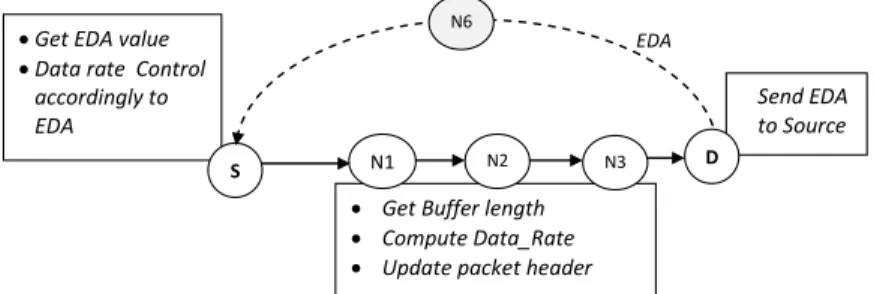
The functional activities of the source, intermediate and destination nodes for handling the congestion and packet loss is being described below in Table-1.
Table-1: Functional Activities of the Nodes
The process of EDA mechanism between these nodes supports to control the rate of packet transmission and will minimize the PL in case congest network. By means of this control methodology, it is able to achieve the better throughput and lower the delay and PL in compare to the conventional TCP-CC approaches.
3.4.2 EDA based Congestion Control
The mechanism of congestion control based on the EDA supports to enhance the uniform transmission of the data packets through effective rate control, mostly in the streaming application. The proposed method explicitly control the packet rate through determining the Blen of each
intermediate nodes in the route to the destination. On every data packet received by the destination transmit an EDA message having the Blen updated during the current
transverse through. A flow structure of the data flow is being shown in Fig.2.
The idea of the explicit message is likely the conventional TCP, where based on the feedback from an intermediate node TCP control the rate of transmission over a path, but a link failure among the path or PL due to any other can cause a major loss. The intercommunication of EDA message among the three types of nodes makes it's to control and prevent congestion. The execution of the tasks for each individual node makes the proposed methodology more uniform and fair transmission over the MANET environment. The role of the intermediate node is the primary functions of all three nodes. It measures and informs the point of congestion through a forward routing path instead of backward feedback as TCP. This support in minimizing the chances of missing of feedback message due to link failure or congestion, whereas in case of forwarding route to the destination and the message carrying delay information routed through an alternate route make it more reachable and complete congestion status of each routing node in this proposal through an EDA message.
S D
N1
N2
N5
N3
N4
N6 EDA
Source Node Intermediate Node Destination Node
Method: Pkt_Recieved( )
RDprv ← Packet. RDelay
If RDprv = = 1
date_rate = slow;
else
date_rate = normal;
Method: Pkt_Recieved( ) If Blen > = 0.9
Packet. RDelay = 1;
else
Packet. RDelay = 0;
Method: Pkt_Recieved( )
EDA ← Packet. RDelay
Figure 2. A data flow and EDA congestion control mechanism
We considered a normalizing factor for the routing and transmission rate as α, which is being assigned to a constant value as, α = 0.2. The data rate DRack,is updated by the
intermediate nodes in every data packet transient, through computing with utilizing the current data rate status DRcur, of
buffer length Blen and α. The process of computation is being
performed using the equation Eq. 1 and Eq. 2 as given below.
𝐷𝑅
𝑐𝑢𝑟= 1 𝐵
𝑙𝑒𝑛 (1)
𝐷𝑅
𝑎𝑐𝑘= 𝛼 × 𝑅𝐷
𝑝𝑟𝑣+ 1 − 𝛼 × 𝐷𝑅
𝑐𝑢𝑟 (2)Based on the Eq.1 and 2 the data rate DRack is computed and
according to the value of DRack the value of routing delay
RDelayis assigned. If the value of DRack is above 90% then the
value of RDelay is assigned to 2, if the DRack value is below
90% and above 85% then RDelayis assigned to 1, and in case
of below 85% RDelay is assigned to 0. The assigned RDelayis
updated in the packet to transmit further till it reached the destination. This mechanism is presented in Algorithm-1.
Algorithm-1:
EDA based Routing Delay Prediction
//-- On receiving Data Packets
B
len← Get_ Current_ Node_Buffer_length
RD
prv← Packet. R
Delayif B
len> 0.9 then {
Packet. R
Delay← 2
}
else if Q
len> 0.85 then {
Packet. R
Delay← 1
DR
cur= 1/B
lenDR
ack= α * RD
prv+ (1 - α ) * DR
curif DR
ack> RD
prvthen {
Packet. DR
ack= DR
ack}
}
4.
Experiment Analysis
4.1 Simulation Setup and Measure
The process of the simulation is performed by using Glomosim network simulator. A topology model is constructed using RWP mobility model over a 1000 x 1000m simulation area having 100 node distribution. A 20 number of source-destination pairs are configured to perform data transmission simultaneously. Each data packet size is
configured to 512 bytes having an additional selection field to configure EDA value during execution by the intermediate nodes. The evaluation of the congestion and packet loss is performed by varying the mobility rate as, "5 m/s, 10 m/s, 15 m/s, 20 m/s and 25 m/s". An "Ad hoc On-Demand Distance Vector (AODV)" [32] dynamic routing protocol is being considered as the base routing, which is modified to have a routing delay prediction (RDP) according to the proposal. We compare the outcomes of AODV [32], TADR [11] and proposed RDP to evaluate the improvisation with the following performance measure defined.
Pack et Loss: A measure of the "total number of the packet
being a loss" from the "number of a data packet transmitted" from source.
Throughput: A measures of the "number of data packets
being delivered" by the "number of data being transmitted by the source" in the complete simulation period.
Jitter: A measure of the "average variation in the
end-to-end delay" between transmitted and received packets in a continuous stream by the number of transmissions made during the entire simulation.
Control Overhead: A measure of a total number of
network control packets and EDAbeing transmitted to manage congestion network routing.
4.2 Result Analysis
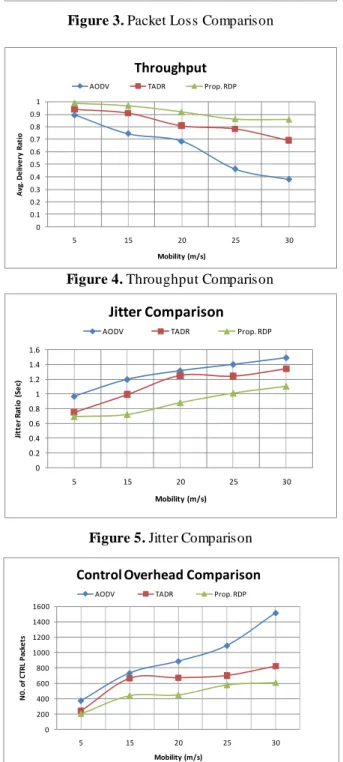
The following present the data packet transmission comparison results between the AODV, TADR, and Prop. RDP. The transmission data packet is simulated at the rate of 20pkts/sec to raise high traffic. The increased rate of the transmission results in high throughput by TADR and Prop. RDP as shown in Fig.4 because of the efficient streaming node selection based on EDA, whereas AODV and TADR show an average of 20% less because of its random streaming node selection and the effect mobility. A variation of 20% less throughput makes AODV to a high number of packets loss compared both TADR and Prop. RDP routing as shown in Fig.3. Because of the high throughput of TADR and Prop. RDP minimize the jitter delivery time as shown Fig.5 and also reduce the control overhead as shown in Fig.6. It concludes that the improvisation in throughput is due to appropriate CC based on packet loss and EDA, which provide the efficient node streaming based on EDA threshold. Even though every data has its own data rate traffic during streaming but with a selection of low congestion node show higher throughput in compare to the TADR and AODV.
Get EDA value
Data rate Control
accordingly to EDA
Get Buffer length
Compute Data_Rate
Update packet header
Send EDA to Source
S N1 N2 N3 D
N6
0 500 1000 1500 2000 2500 3000
5 15 20 25 30
N
o.
P
ac
ke
t
Los
s
Mobility (m/s)
Packet Loss Comparison
AODV TADR Prop. RDP
Figure 3. Packet Loss Comparison
0 0.1 0.2 0.3 0.4 0.5 0.6 0.7 0.8 0.9 1
5 15 20 25 30
A
vg
. D
e
liv
e
ry
R
at
io
Mobility (m/s) Throughput
AODV TADR Prop. RDP
Figure 4. Throughput Comparison
0 0.2 0.4 0.6 0.8 1 1.2 1.4 1.6
5 15 20 25 30
Ji
tt
e
r
R
at
io
(S
e
c)
Mobility (m/s) Jitter Comparison
AODV TADR Prop. RDP
Figure 5. Jitter Comparison
0 200 400 600 800 1000 1200 1400 1600
5 15 20 25 30
N
0
. of
C
TR
L
P
ac
ke
ts
Mobility (m/s)
Control Overhead Comparison
AODV TADR Prop. RDP
Figure 6. Control Overhead Comparison
The role of EDA support in computes the RDA weight at each node linked to the source and routing data reduce the congestion and minimize the jitter in between. The comparison between TADR and Prop. RDP shows a low jitter
rate in comparison to AODV, but with increasing mobility all attains is nearby jitter due to frequent link fails between node. The cause of PL majorly in MANET is due to congestion and link failure. The Prop. RDP reduce congestion through an efficient selection of node for streaming based on congestion level. It average increase in PL being observed with increasing mobility as link failure in high mobility is common and in such case PL difficult to control. The comparison result of control overhead between AODV, TADR, and Prop. RDP shows quite reasonable for data stream ov er MANET. But Prop. RDP shows low overhead in both due to the effective streaming node selection through the prediction mechanism for communication which minimizes the packet drop and reduces the control overhead over the network.
5.
Conclusions
The essential difficulty of the dynamic and random behavior of MANET are the cause of packet loss and congestion . The activities of TCP over MANET is being considered and inferred from the outcomes that a well-liked of the mechanism of TCP are not appropriate for the exceptional quality for the MANET. In this paper, we propose a routing delay prediction (RDP) based on packet loss and Explicit Delay Acknowledgement (EDA) mechanism for data rate and CC in MANET. It will efficiently control data rate for streaming application to minimize the loss of packets and improve the throughput. An experimental evaluation with existing routing and a traffic aware dynamic routing mechanism shows low packet loss and jitter. The packet loss and EDA based congestion control mechanism deal with the inconvenience of TCP congestion over MANET, and thus it demonstrates a substantial performance enhancement over comparison results. Even though the proposed RDP mechanism shows reduce packet loss attributable to network congestion as evaluated to TCP based congestion control methods, but the routing congestion impact of the EDA path and data rate fluctuation impacts are the directions for future improvement.
References
[1] J. Pan, I. S.Popa, and C. Borcea, "DIVERT: A Distributed Vehicular Traffic Re-Routing System for Congestion Avoidance," IEEE Transactions on M obile Computing, vol. 16(1), pp.58 - 72, 2017.
[2] N. Li, J.-F. M .-Ortega, and V. Hernández Díaz, "Cross-Layer and Reliable Opportunistic Routing Algorithm for M obile Ad Hoc Networks," IEEE Sensors Journal, vol. 18(13), pp.5595 - 5609, 2018.
[3] Y. M ai, F. M . Rodriguez, and N. Wang, "CC-ADOV: An effective multiple paths congestion control AODV," IEEE 8th Annual Computing and Communication Workshop and Conference (CCWC), pp. 1000 - 1004, 2018.
[4] A. Betances, K. M .Hopkinson, and M ark Silvius, "Context aware routing management architecture for airborne networks," IET Networks, vol. 5(4), pp. 85 - 92, 2016. [5] M . F. Stewart, R. Kannan, and A. Dvir, "CASPaR: congestion
avoidance shortest path routing for delay tolerant networks," IEEE international conference on computing, networking and communications, pp.1-5, 2016.
Networks," IJCSNS International Journal of Computer Science and Network Security, vol. 18(1), pp. 155–165, 2018. [7] J. Govindarajan, N. Vibhurani, and G. Kousalya, "Enhanced TCP NCE: A modified non-congestion events detection, differentiation and reaction to improve the end-to-end performance over M ANET," In Advances in Intelligent Systems and Computing, vol. 519, pp. 443-454., 2018. [8] R. M uktiarto N.A, D. Perdana, and R. M . Negara,
"Performance Analysis of M obility Impact on IEEE 802.11ah Standard with Traffic Pattern Scheme," International Journal of Communication Networks and Information Security (IJCNIS), vol. 10, No. 1, April 2018.
[9] H. K. M olia and A.D. Kothari, "TCP variants for mobile adhoc networks: Challenges and solutions," Wireless Pers. Commun. vol. 1 pp. 1-46, 2018.
[10]P. Sreekumari and S.H. Chung, "TCP NCE: A unified solution for noncongestion events to improve the performance of TCP over wireless networks," EURASIP Journal of Wireless Communication Network, vol. 23(1), 2017.
[11]F. Ren, T. He, S. K. Das, and C. Lin, "Traffic-Aware Dynamic Routing to Alleviate Congestion in Wireless Sensor Networks," IEEE Transactions On Parallel And Distributed Systems, vol. 22, No. 9, September 2011.
[12]M . Rath, U.P. Rout, N. Pujari, S.K. Nanda, and S.P. Panda, "Congestion control mechanism for real time traffic in mobile adhoc networks," In: Computer Commun., Netw. and Internet Security, Springer, Singapore, pp. 149-156, 2017.
[13]J. Wu, C. Yuen, M . Wang, and J. Chen, "Content -Aware Concurrent M ultipath Transfer for High-Definition Video Streaming over Heterogeneous Wireless Networks," IEEE Transactions on Parallel and Distributed Systems, vol. 27, pp. 710 - 723, 2016.
[14]D. C. Dobhal and S. C. Dimri, "Performance evaluation of proposed-TCP in M obile Ad Hoc Networks (M ANETs)," IEEE International Conference on Inventive Computation Technologies (ICICT), vol. 2 pp. 1 - 6, 2016.
[15]D. Kanellopoulos, "Congestion control for M ANETs: An overview," ICT Express, https://doi.org/10.1016 /j.icte.2018.06.001, 2018.
[16]X. Song, L. Zhou, H. Zhao, X. Hu, and J. Wei, "Localized Fault Tolerant and Connectivity Restoration Algorithms in M obile Wireless Ad Hoc Network," IEEE Access, vol. 6, pp. 36469 - 36478, 2018.
[17]W. Osamy and A. M . Khedr, "An algorithm for enhancing coverage and network lifetime in cluster-based Wireless Sensor Networks," International Journal of Communication Networks and Information Security (IJCNIS), vol. 10, No. 1, April 2018.
[18]M . Coudron, S. Secci, and G. Pujolle, "Differentiated pacing on multiple paths to improve one-way delay estimations," IEEE International Symposium on Integrated Network M anagement (IM ), pp. 672 - 678, 2015.
[19]B. Soelistijanto and M . P. Howarth, "Transfer Reliability and Congestion Control Strategies in Opportunistic Networks: A Survey," IEEE Communications Surveys & Tutorials, vol. 16, pp. 538 - 555, 2014.
[20]M . D. Sirajuddin, C. Rupa, A. Prasad, "Advanced congestion control techniques for M ANET," Information Systems Design and Intelligent Applications," Advances in Intelligent Systems and Computing, vol. 433, pp. 271–279, 2016.
[21]R. Vadivel, V.M . Bhaskaran, "Adaptive reliable and congestion control routing protocol for M ANET," Journal of Wireless Network, vol. 23 (3), pp. 819–829, 2017.
[22]Y. R. Yang, M .S. Kim, and S.S. Lam. "Transient behaviours of TCP-friendly congestion control protocols," Computer Networks, 41(2):193-210, 2003.
[23]Y. M ai, Y. Bai, N. Wang, "Performance Comparison and Evaluation of the Routing Protocols for M ANETs Using NS3," Journal of Electrical Eng., vol. 5, pp. 187-195, 2017. [24]W. Chen, Q. Guan, S. Jiang, Q. Guan, T. Huang, "Joint QoS
provisioning and congestion control for multi-hop wireless networks," EURASIP Journal of Wireless Communication Network, vol. 1, pp. 19, 2016.
[25]H. Zare, F. Adibnia, and V. Derhami, "A Rate based Congestion Control M echanism using Fuzzy Controller in M ANETs," International Journal of Computer Communication, vol. 8(3), pp. 486-491, 2013.
[26]H. P. Chang, H.W. Kan, and M .H. Ho, "Adaptive TCP congestion control and routing schemes using cross-layer information for mobile ad-hoc networks," Comput. Commun. vol.35 pp. 454-474, 2012.
[27]S. Soundararajan and S. B. Raghuvel, "M ultipath load balancing & rate based congestion control for mobile ad hoc networks," In Digital Information and Communication Technology and Applications (DICTAP), IEEE, pp.30-35, 2012.
[28]G. R. Kamatam, P. V. S. Srinivas, and K. C. Sekaraiah, "Data Prioritization Approach for Congestion Control in M obile Ad Hoc Network," ELSEVIER, Proceddings of the Second International Conference on "Emerging Research in Computing, Information, Communication and Applications," ERCICA, 2014
[29]M . Aamir and M . A. Zaidi "A Buffer M anagement Scheme for Packet Queues in M ANET," Tsinghua Science and Technology Vol. 18(6), pp. 543-553, 2013.
[30]M . Ikeda, E. Kulla, M . Hiyama, and M . Takizawa, "Congestion Control for M ulti-flow Traffic in Wireless M obile Ad-hoc Networks," IEEE Sixth International Conference on Complex, Intelligent, and Software Intensive Systems , pp. 290 - 297, 2012.
[31]M . Ikeda, E. Kulla, M . Hiyama, L. Barolli, M . Younas, and M . Takizawa, "TCP Congestion Control in M ANETS Traffic Considering Proactive and Reactive Routing Protocols". 15th International Conference on Network-Based Information Systems, IEEE, 2012.