Eric J. Murphy, ed. c
2018 Astronomical Society of the Pacific
Cold Gas in High-zGalaxies: The Dense ISM
R. Decarli,1,2C. Carilli,3,4C. Casey,5B. Emonts,6J.A. Hodge,7K. Kohno,8 D. Narayanan,9D. Riechers,10M.T. Sargent,11and F. Walter2,3
1INAF – Osservatorio di Astrofisica e Scienza dello Spazio, via Gobetti 93/3,
40129 Bologna, Italy;roberto.decarli@ inaf.it
2Max Planck Institut für Astronomie, Königstuhl 17, 69117 Heidelberg,
Germany
3National Radio Astronomy Observatory, Pete V. Domenici Array Science
Center, P.O. Box O, Socorro, NM 87801, USA
4Cavendish Laboratory, University of Cambridge, 19 J.J. Thomson Avenue,
Cambridge CB3 0HE, UK
5Department of Astronomy, The University of Texas at Austin, 2515 Speedway
Blvd Stop C1400, Austin, TX 78712
6National Radio Astronomy Observatory, 520 Edgemont Road, Charlottesville,
VA 22903, USA
7Leiden Observatory, Niels Bohrweg 2, 2333 CA Leiden, The Netherlands
8Institute of Astronomy, School of Science, The University of Tokyo, 2-21-1
Osawa, Mitaka, Tokyo 181-0015, Japan
9Department of Astronomy, University of Florida, 211 Bryant Space Science
Center, Gainesville, FL 32611, USA
10Cornell University, 220 Space Sciences Building, Ithaca, NY 14853, USA
11Astronomy Centre, Department of Physics and Astronomy, University of
Sussex, Brighton, BN1 9QH, UK
Abstract. The goal of this chapter is to study physical conditions of the interstel-lar medium (ISM) in distant galaxies. In particuinterstel-lar, its densest component is associ-ated with the inner cores of clouds – this is where star formation takes place. Carbon monoxide is usually used to trace molecular gas emission; however, its transitions are practically opaque, thus preventing astronomers from piercing through the clouds, into the deepest layers that are most intimately connected with the formation of stars. Other dense gas tracers are required, although they are typically too faint to be effectively ob-served in high redshift main sequence galaxies. The ngVLA will offer for the first time the sensitivity at radio frequencies that is needed to detect [Ci]1−0atz≥5, as well as the ground transitions of dense gas tracers of the ISM such as HCN, HNC, HCO+atz
>1, beyond the tip of the iceberg of the hyper-luminous sources that can be studied now. These new tools will critically contribute to our understanding of the intimate interplay between gas clouds and star formation in different environments and cosmic epochs.
in exposing the diversity of properties and the complexity of the multi-phased ISM. For instance, both observational and theoretical studies revealed substantial amount of diffuse molecular gas that is not associated with CO emission (e.g., Langer et al. 2014; Glover & Smith 2016). On the other hand, CO transitions reach optical depth values close to unity even at very modest column densities, i.e., CO-emitting regions appear opaque. Furthermore, the critical density required to collisionally de-excite CO is relatively low (nH2 ∼ 102−103cm−3for the lower-J transitions), meaning that CO
is a fairly poor tracer of the dense molecular cores, where star-formation within distant galaxies is ultimately taking place.
The neutral carbon fine structure lines [Ci] at 609 and 370µm arise in the external
parts of molecular clouds, where the radiation field is too intense for CO molecules to survive, but at not enough to ionize the carbon atoms (optical extinctionAV = 1− 5 mag). The 370 µm transition has been detected even at z ≈ 7 (Venemans et al. 2017). The two neutral carbon fine structure lines are ideal tracers of the more diffuse molecular ISM (see, e.g., Glover et al. 2015). In particular, because of the different critical densities, their ratio is an excellent tracer of the gas density. Furthermore, in combination with other lines (such as CO or [Cii]) they can be used to infer physical properties of the ISM such as the gas density and the intensity of the incident radiation field (see, e.g., Meijerink et al. 2008; Popping et al. 2018). [Ci] is also considered a complementary tracer of the cold gas mass, which can be used to infer either an independent measurement of the CO–to–H2conversion factor,αCO, or to measure the
neutral carbon abundance,XCI(see, e.g., Bothwell et al. 2017; Popping et al. 2017).
To date, only about 40 galaxies at z > 1 have been detected in [Ci]. This list mostly consists of sub-mm galaxies and quasar host galaxies. E.g., Bothwell et al. (2017) use [Ci] 609µm observations, in combination with other ISM lines, to infer
molecular gas mass, density and intensity of the radiation field in 13 dusty, star–forming galaxies at 2 < z < 5 using ALMA. They find a higher density and stronger UV field
for the star–forming medium in these galaxies than estimated by previous studies of similar sources. At higher redshifts, however, the [Ci]1−0transition is shifted outside the
ALMA bands atz>4.8. This ground transition is a better mass tracer than the [Ci]2−1
transition (observable with ALMA at these high redshifts), which is also sensitive to the excitation temperature. Furthermore, only the detection of both these lines provides a direct measure of the neutral gas density. The detection of the [Ci]1−0line at higher
redshift thus requires sensitive observations in the frequency ranges that will be covered by the ngVLA.
In addition to neutral carbon, other molecular gas tracers can provide us with pre-cious complementary information than CO. E.g., high dipole moment molecules like hydrogen cyanide (HCN) are only collisionally de-excited at very high densities, mak-ing them much more reliable tracers of the very dense gas directly associated with the formation of individual stars. Some studies of HCN in the nearby universe have even found evidence that the ratio of HCN luminosity to far-infrared (FIR) luminosity re-mains constant over>8 orders of magnitude in HCN luminosity, suggesting that HCN
Figure 1. Redshifted frequencies of dense gas tracers, many of which will be ac-cessible in single-tuning setups with the ngVLA at high-redshift. In particular, the 1-0 and 2-1 transitions of HNC, HCO+, HCN and SiO lines are spaced very closely in frequency (see inset zoom-in). While ALMA can detect the mid- and high-J tran-sitions of these molecules at high-redshift, significant uncertainties regarding excita-tion mean that the low-Jtransitions accessible with the ngVLA are more suitable as tracers of the total dense gas mass.
of these fundamental star-forming units (e.g., Gao & Solomon 2004; Wu et al. 2005, 2010; Zhang et al. 2014).
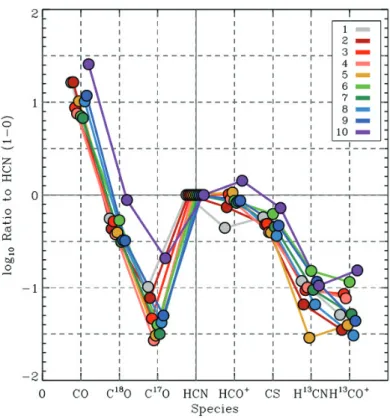
Figure 2. The intensity (in units of temperature) of the ground transitions of CO, C18O, C17O, HCN, HCO+, CS, and H13CNH13CO+ in various clouds (labeled 1– 10) in the local starburst galaxy NGC 253, normalized to the observed HCN(1-0) flux. CO is at least 10×brighter than other dense gas tracers – in order to detect these other lines at high redshift, the unprecedented sensitivity of ngVLA at radio frequencies will be instrumental. Figure adapted from Leroy et al. (2015).
properties of high-z sources, the ALMA-detectable transitions may be unsuitable as tracers of the total dense gas mass.
1.1. Measurements Required
This science goal requires integrated flux measurements of faint lines in high redshift galaxies. The sensitivity and the coverage in the radio bands are prime technical re-quirements for these observations. The targeted lines will be>10×fainter than CO (in
temperature units). A galaxy with stellar massM∗ ≈1011M⊙on the massive main se-quence of star–forming galaxies atz ∼2 has SFR≈ 100M⊙yr−1(Santini et al. 2017). This corresponds to an IR luminosityLIR ≈5×10¹¹L⊙. Assuming the CO–to–IR
lumi-nosity empirical relation from Carilli & Walter (2013), we infer an expected CO(1-0) luminosity of 7.0×10⁹K km s−1pc2, or 345,000L⊙. For a CO(1-0)/HCN(1-0)≈10 (see
Figure 2), we infer an expected flux density for the HCN(1-0) transition of 7µJy
(as-suming a line width of 300 km s−1). Such a line can be detected at 3σsignificance with
26 hr of integration, assuming that the ngVLA will have at least 5×the collecting area of the current VLA. No existing instrument has the sensitivity at radio frequencies to perform the proposed observations.
Imagining requirements are limited at∼1−3′′resolution, in order to avoid confu-sion with other sources in the field, and at the same time limit the risk of out-resolving the faint emission. A large bandwidth would allow to simultaneously cover multiple ISM tracers (see Figure 1) in one shot, i.e., it would be ideal although it is not a strict requirement.
1.2. Longevity/Durability: with Respect to Existing and Planned (>2025) Facili-ties
There are obvious synergies with other key observatories to envision in the context of the characterization of the ISM in high-zgalaxies. In particular, ALMA can provide coverage of the intermediate and high-Jtransitions of the dense gas tracers, as well as of the [Ci]2−1 line, whereas ngVLA will focus on the lower-Jlines and on the [Ci]1−0
transition (see Figure 1). The combinations of CO transitions ranging from low to high
J, together with the denser gas tracers targeted with ngVLA + ALMA, will enable
an unprecedentedly detailed study of the properties of the densest parts of the ISM, which are not currently accessible. This will enable a direct link between the gas prop-erties and the on-going star formation, given that the dense gas tracers are intimately connected with birthplace of stars.JWSTand the 30 m class telescope will provide sen-sitive spectroscopy of rest-frame UV/optical/NIR ISM tracers, mostly associated with the ionized phase of the gas, thus paving the way for a coherent description of the gas cycle in galaxies throughout cosmic history.
References
Aalto S., Spaans M., Wiedner M.C., Hüttemeister S. 2007, A&A, 464, 193 Bothwell M.S., Aguirre J.E., Aravena M., et al. 2017, MNRAS, 466, 2825
Carilli C.L., Solomon P., Vanden Bout P., Walter F., Beelen A., Cox P., Bertoldi F., Menten K.M., Isaak K.G., Chandler C.J., Omont A. 2005, ApJ, 618, 586
Carilli C.L. & Walter F., 2013, ARA&A, 51, 105
Danielson A.L.R., Swinbank A.M., Smail I., Cox P., Edge A.C., Weiß A., Harris A.I., Baker A.J., De Breuck C., Geach J.E., et al. 2011, MNRAS, 410, 1687
Decarli, R., Walter, F., Aravena, M. et al. 2016, ApJ, 833, 69 Gao Y., Solomon P.M. 2004, ApJ, 606, 271
Narayanan D., Cox T.J., Hernquist L. 2008, ApJ, 681, L77 Popping G., Decarli R., Man A.W.S., et al. 2017, A&A, 602, A11
Popping G., Narayanan D., Somerville R.S., et al. 2018, arXiv:1805.11093 Riechers D.A., Walter F., Carilli C.L., Bertoldi F. 2007, ApJ, 671, L13
Riechers D.A., Walter F., Carilli C.L., Cox P., Weiß A., Bertoldi F., Menten K.M. 2011, ApJ, 726, 50
Santini P., Fontana A., Castellano M., et al. 2017, ApJ, 847, 76
Solomon P.M., Vanden Bout P., Carilli C., Guelin M. 2003, Nature, 426, 636 Vanden Bout P.A., Solomon P.M., Maddalena R.J. 2004, ApJ, 614, L97
Venemans B.P., Walter F., Decarli R., FerkinhoffC., Weiß A., Findlay J.R., McMahon R.G., Sutherland W.J., Meijerink R. 2017, ApJ, 845, 154
Wu J., Evans N.J. II, Gao Y., Solomon P.M., Shirley Y.L., Vanden Bout P.A. 2005, ApJ, 635, L173
Wu J., Evans N.J. II, Shirley Y.L., Knez C. 2010, ApJS, 188, 313