628
RESEARCH REGARDING THE DRAFTING OF A COMPILATION OF
LOCAL TABLES REQUIRED TO DETERMINE THE BASE DIAMETER OF
TREES DEPENDING ON THEIR DIAMETER MEASURED
AT THE STUB
Alexandru Săraru Râmnicu Vâlcea Forest Managerꞌs Office, 15 Liviu Rebreanu Street, 240276, Râmnicu Vâlcea
Keywords: diameter at breast height, sessile oak, English oak, common beech, common hornbeam
ABSTRACT
The researches have been conducted in exploitable stands of hill mixed hardwood forestlocated in the north-eastern part of Olteţ Piedmont, with the purpose of drafting a compilation of local tables required to determine more precisely the diameter at breast height of trees depending on their diameter measured at the stub, in order to eliminate some systematic errors for particular cases encountered in practice (trees with advanced age and large diameter at the stub, with strongly developed lateral roots, apparent etc.).
The results of the researches have materialized in determining the correlative associations between the diameters, in the form of linear regression equations, in which the regression coefficients have been obtained by processing the field data in the Excel application.
INTRODUCTION
In forest maintenance practice there are cases that require the determination of the diameter at breast height of trees felled and sent out of the forest (often as a result of illegal acts) to determine their volume.
In such cases, the starting point is the diameter measured at the stub, by applying one of the following three methods of determination:
- general tables procedure; - local tables procedure; - diameter average procedure.
All three working procedures are based on the correlative association between the diameter at breast height of the trees (at a height of 1,30 m above the ground, in the upstream) and their diameter measured at the stub (considering the felling height is at 0,30 m above the ground, in the upstream). This correlation, linear or slightly parabolic, is presented in table 6 from Giurgiu, V., et al., 2004 which, considering the logic presented above, represents the procedure of general tables of determination.
These tables have a general nature and a relative accuracy, containing systematic errors (Giurgiu, V., et al., 2004), due to the manifestation of particular cases: trees grown from sprouts, trees with exaggerated root-swellings at root collar etc.
Furthermore, general tables can not be applied to trees with large sizes and advanced age or trees with diameters measuredat the stub of more than 100 cm.
629
As a result, the general tables can not be used for precise determinations that are specific toscientific research works, to technical expertise and others like that.
To solve individual cases, but also to ensure the required accuracy of determining works, the other two procedures are recommended to be applied: local tables procedure and diameter average procedure.
Local tables procedure, applicable to homogeneous stand in terms of tree provenance, age and form and in terms of stationary conditions, implies measuring the diameter at the stub and the diameter at breast height for a number of trees that is large enough (minimum 150), followed by automatic data processing. By computer data processing, correlative association is established between the two rows of diameters, association which is expressed by adequate linear regression (possibly parabolic) equations.
Diameter average procedure is applicable to a small number of extracted trees, their diameter at breast heightbeing determined as an average of the diameters of three-four existing trees of the same species and provenance and from the same stand, having diameters measured at the stub that are equal or adjacent to diameter measured at the stub of felled trees.
Considering the above mentioned, this paper aims to determine the most appropriate correlative association between diameterat breast height and the diameter measured at the stub for a few important forest species, including some stubs having heights that are by far lower than the standardized ones or derived from trees that have form abnormalities in the area of the stub.
The paper also aims to solve the problem of trees that have large sizes and advanced age and for which there are no general tables elaborated yet.
PLACE OF RESEARCH
The present research was conducted in mixed stands of hill mixed hardwood forest, located in the north-eastern part of Olteţ Piedmont, within Băbeni Forest District, from Vâlcea County Forest Administration, stands that were considered as being representative for the studied area.
These stands have a plurien structure, they are characterized by advanced age and large sizes of the component trees and the trees are frequently characterized by abnormalities in form and structure.
630
Picture 1. Trees characterized by advanced age and large sizes, with irregular forms and form and structure abnormalities
631
MATERIALS AND METHODS OF RESEARCH
For making the determinations, it was realized a sample consistingof a total of 411 trees from species that are most commonly found in the stands composition of the studied area: English oak, sessile oak, common beech and common hornbeam.
There were determined the diameters at the height of 0,10 m and 0,30 m (diameter measured at the stub) and diameters at the height of 1,30 m (diameter at breast height) of the trees that constitute the sample. To determine the diameter measured at the stub, tree circumference was measured with a metric measuring tape, graduated every centimeter, and to determine the diameter at breast height,it was used the caliper, graduated every two centimeters (picture 3).
Picture 3. Measuring the diameters at the stub (left) and measuring the diameters at the stub and diameters at breast height (right)
Based on the size of the circumference measured in this manner, the diameter at the stub was obtained by applying the equation:
dc = C / π (1), where:
dc = diameter measured at the stub (cm); C = stub circumference (cm);
π = 3,1416
RESULTS AND DISCUSSIONS
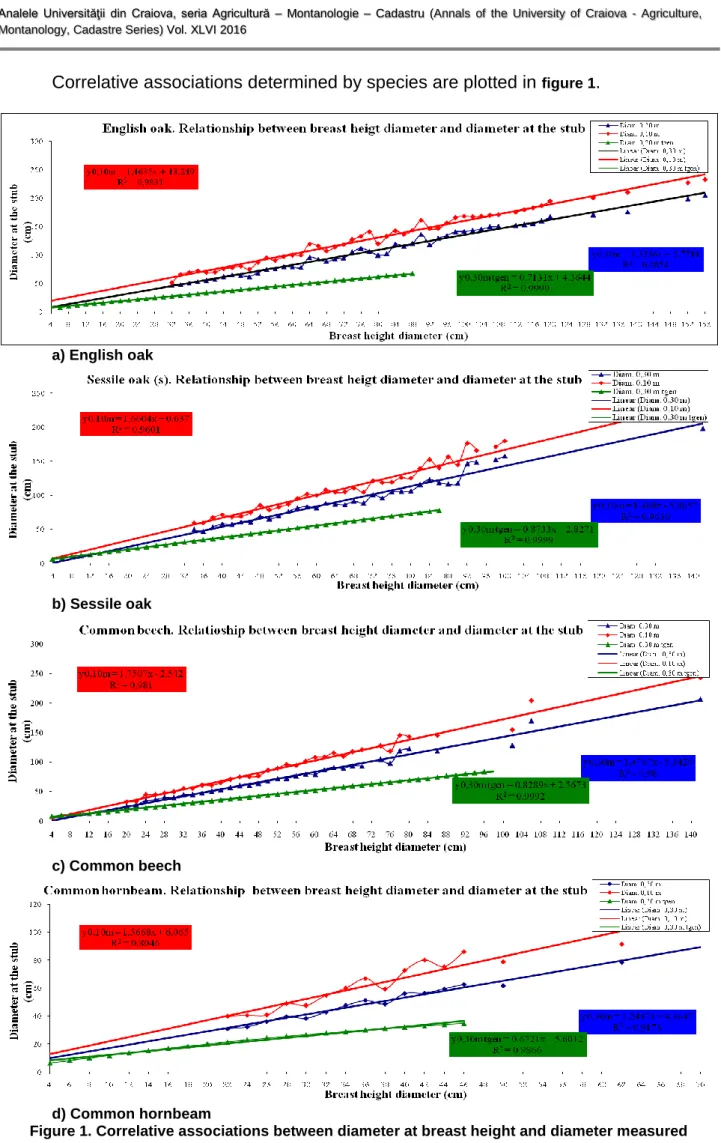
Data were processed using Excel application. After processing them and realizing the graphic representation, local correlative associations were obtained between the diameter at breast height and the diameter measured at the stub at the height of 0,10 m and 0,30 m for four forest species that were considered in this study. The fields of data that were obtained were balanced by linear regression curves, expressed by the following regression equation:
dc = a + bdb (2),
where:
632
Correlative associations determined by species are plotted in figure 1.
a) English oak
b) Sessile oak
c) Common beech
d) Common hornbeam
633
at the stub for English oak, sessile oak (seed), common beech and common hornbeam
For each of the four species, the relations between the diameters measured at the stub and diameter at breast height were represented in red and blue.
The relation between diameter measured at the stub (0,30 m) and diameter at breast height (1,30 m), that underlay the elaboration of general tables, was represented in green (Giurgiu, V., et al., 2004).
The correlation coefficients that were obtained are characterized by values between 0,8046 (common hornbeam) and 0,9831 (English oak) in case of determining the diameter at breast height based on diameter measured at the stub at the height of 0,10 m, and between 0,9173 (common hornbeam) and 0,9854 (English oak) in case of determining the diameter at breast height based ondiameter measured at the stub at the height of 0,30 m, which proves that determined correlative associations have a high and very high significance level, especially for species that are very important through their weight and economic value (English oak, common hornbeam, common beech).
Applying the correlative associations expressed in linear regression equationsthat are specificto every species and each of the two situations (diameter measured at the stub at the height of 0,10 m and 0,30 m), it was possible to calculate the values of the diameter at breast height based on the stub diameter and the elaboration of local tables for four studied species.
The results are presented in table 1, being compared with those registered in general tables (table 6 from Giurgiu, V., et al., 2004).
Table 1
Determination of diameter at breast height(db) based on diameter at the stub (dc)
dc (cm)
at 0,30
m
db (cm) from general tables+ db (cm) calculated (local tables) dc (cm)
at 0,10
m
Db (cm) calculated (local tables)
Species Species Species
En glish oak Sessi le oak (s) Comm on beech Com mon horn beam En glish oak Sessi le oak (s) Comm on beech Com mon horn beam En glish oak Sessi le oak (s) Com mon beech Com mon horn beam
0 1 2 3 4 5 6 7 8 9 10 11 12 13
634
68 51,4 58,6 55,5 49.2 49.6 49.7 51.2 66 37.4 40.6 40.3 39.5 70 52,8 60,4 57,1 50.8 51.0 51.0 52.8 68 38.8 41.8 41.4 40.8 72 54,2 62,1 58,7 52.3 52.3 52.4 54.4 70 40.1 43.0 42.6 42.1
0 1 2 3 4 5 6 7 8 9 10 11 12 13
74 55,6 63,8 60,3 53.8 53.7 53.7 56.0 72 41.5 44.2 43.7 43.4 76 57,0 65,4 62,0 55.3 55.0 55.1 57.6 74 42.9 45.4 44.9 44.6 78 58,5 67,2 63,7 56.8 56.4 56.4 59.2 76 44.2 46.6 46.0 45.9 80 60,0 69,0 65,4 58.3 57.7 57.8 60.8 78 45.6 47.8 47.1 47.2 82 61,4 70,8 66,1 59.8 59.0 59.1 62.4 80 47.0 49.0 48.3 48.5 84 62,8 72,6 67,8 61.3 60.4 60.5 64.0 82 48.3 50.2 49.4 49.7 86 64,2 74,4 68,5 62.8 61.7 61.9 65.6 84 49.7 51.4 50.6 51.0 88 65,6 72,2 64.3 63.1 63.2 67.2 86 51.1 52.6 51.7 52.3 90 67,0 73,8 65.9 64.4 64.6 68.9 88 52.4 53.8 52.9 53.6 92 75,7 67.4 65.8 65.9 70.5 90 53.8 55.0 54.0 54.8 94 77,6 68.9 67.1 67.3 72.1 92 55.2 56.2 55.1 56.1 96 79,5 70.4 68.5 68.6 73.7 94 56.5 57.4 56.3 57.4 98 81,5 71.9 69.8 70.0 75.3 96 57.9 58.6 57.4 58.7 100 83,5 73.4 71.1 71.3 76.9 98 59.3 59.8 58.6 60.0
102 74.9 72.5 72.7 100 60.6 61.0 59.7
104 76.4 73.8 74.0 102 62.0 62.3 60.9
106 77.9 75.2 75.4 104 63.4 63.5 62.0
108 79.4 76.5 76.8 106 64.7 64.7 63.1
110 81.0 77.9 78.1 108 66.1 65.9 64.3
112 82.5 79.2 79.5 110 67.5 67.1 65.4
114 84.0 80.6 80.8 112 68.8 68.3 66.6
116 85.5 81.9 82.2 114 70.2 69.5 67.7
118 87.0 83.2 83.5 116 71.6 70.7 68.9
120 88.5 84.6 84.9 118 72.9 71.9 70.0
122 90.0 85.9 86.2 120 74.3 73.1 71.1
124 91.5 87.3 87.6 122 75.7 74.3 72.3
126 93.0 88.6 88.9 124 77.0 75.5 73.4
128 94.5 90.0 90.3 126 78.4 76.7 74.6
130 96.1 91.3 91.7 128 79.8 77.9 75.7
132 97.6 92.7 93.0 130 81.1 79.1 76.9
134 99.1 94.0 94.4 132 82.5 80.3 78.0
136 100.6 95.3 95.7 136 83.9 81.5 79.1
138 102.1 96.7 97.1 138 85.2 82.7 80.3
140 103.6 98.0 98.4 140 86.6 83.9 81.4
142 105.1 99.4 99.8 142 88.0 85.1 82.6
144 106.6 100.7 101.1 144 89.3 86.3 83.7
146 108.1 102.1 102.5 146 90.7 87.5 84.8
148 109.6 103.4 103.8 148 92.1 88.8 86.0
150 111.1 104.7 105.2 150 93.4 90.0 87.1
152 112.7 106.1 106.6 152 94.8 91.2 88.3
154 114.2 107.4 107.9 154 96.2 92.4 89.4
156 115.7 108.8 109.3 156 97.5 93.6 90.6
158 117.2 110.1 110.6 158 98.9 94.8 91.7
160 118.7 111.5 112.0 160 100.3 96.0 92.8
162 120.2 112.8 113.3 162 101.6 97.2 94.0
164 121.7 114.2 114.7 164 103.0 98.4 95.1
166 123.2 115.5 116.0 166 104.4 99.6 96.3
168 124.7 116.8 117.4 168 105.7 100.8 97.4
170 126.2 118.2 118.7 170 107.1 102.0 98.6
172 127.8 119.5 120.1 172 108.5 103.2 99.7
174 129.3 120.9 121.4 174 109.8 104.4 100.8
176 130.8 122.2 122.8 176 111.2 105.6 102.0
178 132.3 123.6 124.2 178 112.6 106.8 103.1
180 133.8 124.9 125.5 180 113.9 108.0 104.3
CONCLUSIONS AND RECOMMENDATIONS
Use of general tables presented in „Biometria arborilor și arboretelor” (Giurgiu, V.,
et al., 1972) and in „Metode și tabele dendrometrice“ (Giurgiu, V., et al., 2004) to
635
In case it is required a high accuracy of determination (for research works, technical expertise), and the number of trees is large enough, it is recommended to elaborate and use local tables.
Elaboration and use of local tables is also recommended in case the felling of the trees is made by letting stubs of atypical heights, with significant deviations from standard height (1/3 of the diameter at the base of the tree), and also in case of trees with obvious form abnormalities at the base (ovality, root-swelling, flute).
Furthermore, it is mandatory to elaborate and use local tables in case of trees of advanced age and with large diameters measured at the stub, being known the fact that the use of existent general tables does not allow to make the determinations for trees with diameters at the stub larger than 100 cm.
In this case, the correlative association between diameter at breast height and diameter measured at the stub is best represented through the following linear regression equation dc = a + bdb. The high value of the correlative coefficients proves that determined correlative associations have a high and very high level of significance, especially for English oak, sessile oak and common beech, species that are very important through their weight and economic value.
Considering the correlative associations established in this manner, local tables were elaborated as a result of this research in order to determine the diameter at breast height based on the diameter measured at the stub for two frequently used heights of the tree felling (0,10 m and 0,30 m) and for a number of four species that are very common in the forest.
As a result, if there is a sufficient number of standing trees from the category of extracted ones, for which we want to establish dendrometric parameters in order to accurately determine their volume, applying linear or parabolic regression equations is necessary so as to elaborate local tables, characterized by a more accurate determination in contrast with general tables.
REFERENCES
1. Giurgiu, V., Decei, I., Armășescu, S., 1972 – Biometria arborilor și arboretelor din
România, Ceres Publishing, Bucharest, 1155 p.
2. Giurgiu, V., Drăghiciu, D., 2004 – Modele matematico-auxologice și tabele de
producție pentru arborete, Ceres Publishing, Bucharest, 608 p.
3. Giurgiu, V., Decei, I., Drăghiciu, D., 2004 – Metode și tabele dendrometrice, Ceres
Publishing, Bucharest, 576 p.
4. Horodnic, S., Zarojanu, D., 2002 – Despre un model statistic al formei trunchiului
arborilor de molid. Works of „Pădurea și viitorul” scientific session, „Transilvania”
University of Brașov, Faculty of Silviculture and Forest Engineering, pp. 217-222;
5. Horodnic, S., 2006 – Considerații asupra preciziei de estimare a diametrelor de bază
ale arborilor extrași pornind de la caracteristicile dimensionale ale cioatelor. The annals of „Ștefan Cel Mare” University of Suceava, Section of Silviculture, New series – no. 2/2006, pp. 55-60.
6. Nicolescu, N.V., et al., 2004 – O tabelă locală pentru stabilirea legăturii dintre diametrul
de bază și diametrul cioatei la fag și brad, în zona Cristian – Brașov. Forests Magazine, no. 5, year 119, pp. 15-18.
7. ***, 2000 – Norme tehnice pentru evaluarea volumului de lemn destinat comercializării.