http://www.jscdss.com Vol.3 No.1 February 2016: 53-60 Article history:
Accepted 25 December 2015 Published online 25 December 2015
Journal of Soft Computing and Decision
Support Systems
Background Subtraction Methods in Video Streams: A Review
Saba Joudaki
a, Mohd Shahrizal bin Sunar
a,*, Hoshang Kolivand
a, Dzulkifli bin Mohamad
aa MaGIC-X (Media and Games Innovation Centre of Excellence), Universiti Technologi Malaysia, 81310 UTM Johor Bahru, Malaysia b
Faculty of Computing, Universiti Teknologi Malaysia, 81310 UTM Johor Bahru, Malaysia
* Corresponding author email address: [email protected]
Abstract
Background subtraction is one of the most important parts in image and video processing field. There are some unnecessary parts during the image or video processing, and should be removed, because they lead to more execution time or required memory. Several subtraction methods have been presented for the time being, but find the best-suited method is an issue, which this study is going to address. Furthermore, each process needs to the specific subtraction technique, and knowing this issue helps researchers to achieve faster and higher performance in their research. This paper presents a comparative study of several existing background subtraction methods which have been investigated from simple background subtraction to more complex statistical techniques. The goal of this study is to provide a view of the strengths and drawbacks of the widely used methods. The methods are compared based on their memory requirement, the computational time and their robustness of different videos. Finally, a comparison between the existing methods has been employed with some factors like computational time or memory requirements. It is also hoped that this analysis helps researchers to address the difficulty of selecting the most convenient method for background subtraction.
Keywords: Image processing, Computer vision, Background subtraction, Video surveillance
1. Introduction
Background subtraction is a common approach in the image processing and computer vision fields. It means that the foreground of the image is extracted for further processing. Generally a Region of Interest (ROI) of the image can be several objects like humans, cars, texts, and so on in the foreground. After the image preprocessing step which may compose image de-noising, or filtering, object localization is needed that may make use of this method. Background subtraction is a widely used method to detect the moving objects in the videos obtained by static camera. The moving object detection between the source frame and current frame, which called “background model” or “background image” (Piccardi, 2004). Background subtraction is conducted if the image would be a part of a video stream. In shortly, the main goal of the background subtraction process is: obtained the frame sequence by one or more camera, detection of the objects in the foreground, and offer an explanation of the method. It means that detection of the foreground objects are known as the difference between the static background and current frame.
Background subtraction process is usually used in many applications which work on the video, such as video surveillance which is one of the hottest applications today,
gesture recognition for interacting between human and machine, and also traffic monitoring, to name a few (Sebastian et al., 2011). On the other word, the applications of background subtraction can be divided into four categories: Optical Motion Capture, Video Surveillance, Human-Computer Interfaces (HCI) for Interacting goals, and Content-based Video Coding.
According to previous research, too many techniques have been employed for background subtraction, which have different weakness and strength points in performance or computational costs. A robust background subtraction method capable to manage duplicate motions from cluttered backgrounds, lighting changes, and changes in the long-term scenes (Tamersoy, 2009).
2. Method
One easy approach for modelling the background is through a single color/grayscale image of moving objects in the scene which acquired without motion or estimated via a temporal median filter (Cucchiara et al., 2005; Heikkilä and Silvén, 2004; Zhou and Aggarwal; 2001).
A. Conventional Methods
The basic category includes several basic approaches like Frame Difference, Static Frame Difference, Weighted Moving Variance, Adaptive Background Learning, Weighted Moving Mean, Adaptive Median, Temporal Mean (McFarlane and Schofield, 1995), and Temporal Median (Calderara et al., 2006; Cucchiara et al., 2005). These methods can be recursive or non-recursive approaches.
1. Median Filtering
This type of filtering is probably the widespread background subtraction method. Median Filtering is based on the assessment of the background model by calculating the average of each input pixel. Just while after passing more than half of the frame absorbed save, the object is not considered as a background. The benefits of this method are simple construction, very fast process and easy to use. Models and background are not fixed, they change during the time. The drawbacks of these approaches are two important factors. One of them is failing on the track of targets in animated backgrounds and dependent accuracy on the speed of the target and the other is frame rate (Cucchiara et al., 2003; François and Medioni, 1999; Koller et al., 1994; Radke et al., 2005).
2. Frame Difference
This is one of the simplest types of the BS methods. This method considers the previous frame as the background. Consequently in this way, the target is detected by subtracting the current framework of the background (Halevy and Weinshall, 1999; Huwer and Niemann, 2000; Naraghi, 2009).
It is assumed that the background is in the frame at time t and the absolute frame difference is defined at time t + 1. This differentiation value would just display several intensities for the locations of the pixel. It has been changed in two frames and seems that the background has been removed. It should be noted that this technique will only work well when all the background pixels are static and all foreground pixels are moving (Tamersoy, 2009).
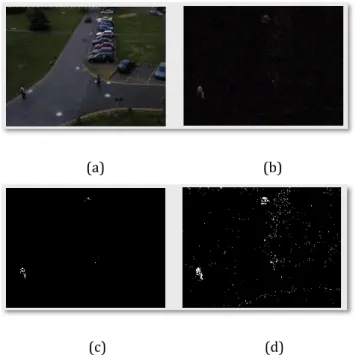
A threshold „Th‟ is defined this obtained difference image for improving the subtraction. The difference pixel intensities of the image are filtered on the basis of the „Th‟ value. The speed of movement objects effects on the accuracy, and faster movements lead to higher thresholds. Then, the computed background is only in the previous frame. It works just in particular conditions of the frame rate and object speed. Shortly, this method is very sensitive to the determined threshold. Fig. 1 shows the process of this method.
(a) (b)
(c) (d)
Fig. 1. Frame difference method, (a) original frame, (b) absolute difference, (c) threshold too high, (d) threshold too low (Piccardi, 2004)
3. Average Filtering
In this method an arithmetic mean is considered for each frame input during the time. The method assumes the object as temporary in time. Background model will affect significantly in a slow or large target (Heikkilä and Silvén, 2004; Zhou and Aggarwal, 2001). Some studies also have been done with the background as the average of the previous n frames (François and Medioni, 1999). These methods are rather fast, but very memory consuming. The memory requirement equals to the n time to size (frame). On the other hand, the background can be considered as the running average. This approach does not need to more memory requirements.
4. MIN-MAX Filtering
Three different values are used in this algorithm to realize which pixel demonstrates the background. The target shows more radiation intensity in the background (Pong and Bowden, 2002)
Another technique with the goal of local adaptation to noise was proposed in (Haritaoglu et al., 2000). Here, every background pixel comes with a maximum Ms, minimum ms, and a maximum of consecutive frames difference Ds observed over a training sequence. Each background pixel is related to three extremum magnitudes rather than a covariance matrix and a mean vector. The main algorithm just acts on grayscale videos. The results of this algorithm compared to color video sequences are in a loss of data. The background can be updated following object-based and pixel-based methods.
methods that they require less storage in contrast with non-recursive approaches. The most of schemes use forgetting factors or exponential weighting to specify the ratio of contribution of previous observations. They can be used for background subtraction and estimation (Pong and Bowden, 2002). The four following methods are non-recursive techniques.
5. Approximated Median Filtering
A recursive filter to estimate the median of each pixel during the time was presented in (McFarlane and Schofield, 1995). This method has been used by several approaches to subtract the background in the urban traffic monitoring because of its significant speed.
6. Single Gaussian filtering
According to discussion in (Mohamad and Osman, 2013), the average image of a frame sequence is computed in this method. Then, new frame is subtracted with calculating the differentiate value considering a predefined threshold. Wren (1997) presented an approach to allocate a normal distribution with a standard deviation and definitive mean to each pixel by YUV color space.
7. Kalman Filtering
This method is place in the recursive methods category. It is assume that the intensity magnitudes of the pixels. This value pursues a normal distribution. In (Boult et al., 1999) this method has been described in detailed. One considerable difference between this method and the previous methods is applying the state space to object tracking process and the simplest algorithms are based just on the luminance (Boult et al., 1999, Dempster et al., 1977, Halevy and Weinshall, 1999, Montacié et al., 1996, Sebastian et al., 2011).
8. Hidden Markov Models
All previous methods are able to reconcile to quantized changes in lighting conditions. So if remarkable changes occur in the intensity value, serious problems may occur. Markov Model means this definition: modelling the variations in the pixel intensity. According to modes of the environment, Hidden Markov Models designs these variations as discrete states. In (Brutzer et al., 2011, Sen-Ching and Kamath, 2004) one type of HMM has been employed for modeling the pixel intensity in traffic monitoring applications.
B. Statistical Methods
Modelling Background with a single image as in basic methods requires a high accuracy in fixed background
without artifacts or noise. This requirement cannot be convinced in real scenario, so some models with background pixel in a probability density function (PDF) learned with a collection of training frames. The background subtraction issue becomes a PDF thresholding problem for a pixel with low probability likely a foreground moving object. The Statistical methods using one Gaussian have two subsequences: Gaussian Averagewas proposed by Wren (1997) and theSimple Gaussianof Benezeth and his colleagues. It does not cope with multimodal backgrounds (Benezeth et al., 2010).
Many researchers have worked on Statistical methods using multiple Gaussians that is called Gaussian Mixture Model (GMM). Some of these research were done by Stauffer and Grimson (1999), Bouwmans et al. (2008), ivkovic (2004), and Hofmann et al. (2012). In order to account for backgrounds created by animated textures like shaken trees by the wind or waves on the water, some researchers proposed the use of multimodal PDFs techniques (Stauffer and Grimson, 1999) and some improvements of this method have been proposed. For instance, for learning the mixture models, an updating algorithm is presented in (Pong and Bowden, 2002, Zivkovic, 2004).
C. Fuzzy Based Methods
Fuzzy logic is determined by the fuzzy set theory. Fuzzy set theory, fuzzy numbers, fuzzy logic, fuzzy periods, and the calculations of fuzzy make it adaptable to an amendment. On the other hand, the fuzzy logic may deal with terms instead of the human language nature (Tripathi and Mukhopadhyay, 2012).
Fuzzy based techniques include three categories. For the first time, Zhang and Xu the worked on Fuzzy Sugeno Integral with Adaptive-Selective Update (Zhang and Xu, 2006). A Fuzzy Choquet Integral with Adaptive-Selective Update was proposed by (Hofmann et al., 2012). Zhao with his colleagues suggested the Type-2 Fuzzy GMM-UM and GMM-UV with MRF (Zhao et al., 2012).
D. Non-Parametric Methods
One unstructured method was also applied for modelling a multimodal probability density function by Mittal and Paragios (2004). They proposed a Parzen-window estimate at each background pixel. The problem of this method is the memory requirement size time to the kernel values reduced by a LUT method.
E. Mean-Shift Based Estimation
This method was proposed in (Piccardi, 2004). A gradient-ascent method detects the multimodal distribution with its covariance matrix. Fig. 2 shows a mean - shift trajectory in the data space.
The problems of this method are too slow pat and also needs to n * size (frame) memory requirements. But there are some solutions to overcome these problems. One of them is computational optimizations, and the other using it to detect the background probability density function modes at initialization time, using computationally lighter which is propagation mode.
Fig. 2. Mean-shift based estimation (Piccardi, 2004)
F. Combined Estimation and Propagation
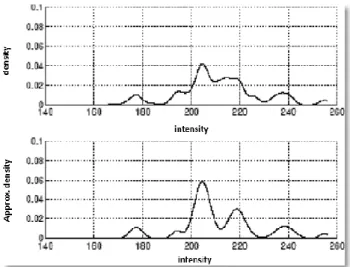
Han and his colleagues studied on Sequential Kernel Density Approximation, that used some mean-shift modes at 56 initialization times. In order to merge the existing modes, the heuristic procedures are applied. It is faster than the KDE, and has low memory requirement as presented in Fig. 3 (Han et al., 2004).
Fig. 3. Above: Exact KDE, below: Sequential KD Approximation (Han et al., 2004)
G. Methods Based on Eigen Features
Eigen background / SL-PCA was proposed by Oliver (2000). The major key factor of Eigen background is about its ability in the background model learning from unconstrained video sequence. While past methods use pixel level statistics, this technique uses neighboring statistics. This method also has more global definition of background that leads to more robust unstable backgrounds. As a result, the Principal Component Analysis (PCA) by Eigen vector decomposition reduces the space dimension. Furthermore, Principal Component Analysis can be applied to a sequence of n frames to calculate the Eigen backgrounds, and finally it is faster than a Mixture of Gaussian approach.
3. Challenges of Background Subtraction for Video Surveillance
BS methods have to deal with various challenges due to the nature of video supervision. Besides the standard challenges, many of the background subtraction challenges have studied in literature before (Sebastian et al., 2011). A comprehensive review is covered in (Calderara et al., 2006). The following challenges are realized as follows:
Gradual or sudden illumination changes: It is necessary to adapt the BS methods to changes of the environment. For instance, in outdoor environments on a day, the light intensity usually varies. On the other hand, the sudden changes are not covered by the background technique. They occur suddenly, for example, with a sudden switch of the light. It may leads to false positive detections.
Dynamic background: Some parts in the video may contain moving objects, but should be regarded as background. Such movement can be irregular or periodical like waving trees.
Bootstrapping: If initialization data regardless objects in the foreground is not available, the background is initialized by the bootstrapping method (Brutzer et al., 2011).
Video noise: Video signal is commonly superimposed by noise. Background subtraction methods for video surveillance has some degraded signals which affected by compression artifacts or sensor noise (Brutzer et al., 2011). Camouflage: Deliberately or not, some objects in a video can differ from the background appearance. It leads to make an incorrect classification. This is an important case in surveillance applications especially.
Fig. 4. Typical process of background subtraction with post processing in surveillance applications (Brutzer et al., 2011)
4. Discussion
Recently, Tian et al. (2013) proposed a selective Eigen background modeling and subtraction method that can keep robust in crowded scenes as shown in Fig. 5. Three “selectivity” mechanisms are integrated with their methods, including selective training, selective model initialization and pixel-level selective reconstruction. Using these mechanisms, their method can significantly increase the purity of the trained Eigen backgrounds and obtain an improved quality of the reconstructed background image, consequently leading to a better subtraction performance in crowded scenes. Extensive experiments on the TRECVID-SED and Road video datasets show that this method outperforms several Eigen and non-Eigen background methods remarkably. They used of three Eigen background algorithms: C-EigenBg, BS-EigenBg, PS-EigenBgNVF and compared the results with other non-Eigen background algorithms like GMM, Bayes, Codebook, PBAS, and Vibe.
Fig. 5. Visualizing several subtraction results of non-Eigen background methods, (a) The original frames, (b) GMM, (c) Bayes, (d) Codebook, (e) PBAS, (f) ViBe, (g) PS-EigenBgNVF, and (h) PS-EigenBg (Tian et al., 2013).
Rai et al. (2013) also present a segmentation method based on the neural network where the moving can be extracted in the video. The proposed framework is multilayer to match the frame complexity in a video stream and address the segmentation problems. The neural network gathers inputs that exploit spatial-temporal correlation between pixels. Each of units produce imperfect
results, but the neural network combines their results, for getting better overall segmentation, although it is trained with noisy outcomes from a simpler technique.
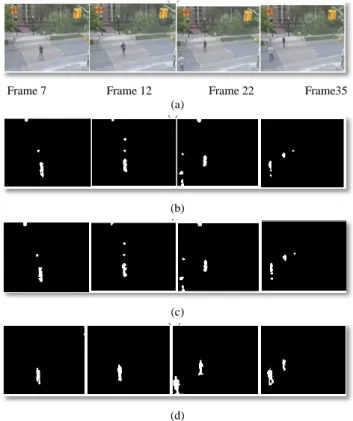
This algorithm converges from an initial step. All pixels are considered as a part of the background to a step where just the appropriate pixels are categorized as background. Results are displayed to demonstrate the effect of the approach compared to a more memory intensive MoG method. As it can be seen in Fig. 6, the video of that method (Luque et al., 2008) fails in segmentation process of the foreground objects. Both false negative and false positive pixels are seen in these results. MoG makes better results than the Luque technique, but the proposed method obtains the best overall results. They have applied experimentally best manual thresholding and morphological operations for three mentioned methods. The Fig. 6 illustrates the results of the three methods on four frames in a video.
Frame 7 Frame 12 Frame 22 Frame35 (a)
(b)
(c)
(d)
Fig. 6. (a) Original frames, (b) Results of R. M. Luque method, (c) Results of Mog method, (d) Results of proposed method (Luque et al., 2008)
Benezeth and his co-workers tested the BS algorithms on series of videos demonstrating different scenarios and different challenges (Benezeth et al., 2010).
Fig. 7. Precision/Recall curves for noise-free videos with static backgrounds (Benezeth et al., 2010)
The MinMax and simple Basic approaches are forcefully penalized as their global and non-adaptive threshold does not suit animated backgrounds. On the other side, results obtained with the 1-G method are good despite its unimodal nature. This can be described by this fact that the 1-G threshold is weighted as local by a covariance matrix. The GMM, KDE, and CBRGB methods caused to the most accurate results. In Fig. 8, seven masks are presented so the researchers can visualize the differentiations between the BS techniques.
Fig. 8. Precision/Recall curves for videos with multimodal backgrounds (Benezeth et al., 2010)
Fig. 8 illustrates the results obtained from Basic and GMM which shows barely any differences. Every method fails in detecting regions for the moving objects whose their color is similar or same to the background. This is a camouflage effect and no background subtraction method is able to dealing with it. Fig. 9 represents the Basic and GMM methods on the static background.
Fig. 9. (a) Input video with static background and large signal-to-noise ratio (b) motion mask with Basic (c) motion mask with GMM. (Benezeth
et al., 2010)
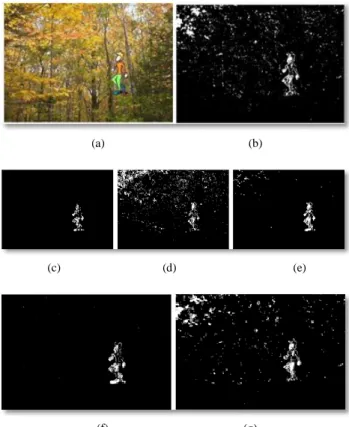
The MinMax approach is not suite in noisy videos as Fig. 10 shows that. The MinMax threshold depends on the maximum inter frame difference. This amount is large in a noisy video, so it causes to generate false positives. The global threshold of the Basic method penalizes significantly the performance factor. Statistical methods such as KDE, 1-G, GMM, or CBRGB showed better results, especially GMM method.
(a) (b)
(c) (d) (e)
(f) (g)
Fig. 10. Motion masks obtained with a video containing a multimodal background, (a) original image, (b) basic, (c) 1-G, (d) MinMax, (e) GMM, (f) KDE, (g) Eigen (Benezeth et al., 2010)
techniques provide on noisy or multimodal videos. Consequently, a combination
of these factors can remove the gap between simple approaches like Basic, MinMax, or 1-G and some sophisticated ones like GMM, and KDE. The curves demonstrate that Basic, MinMax, and Eigen methods commonly underperform while 1-G, GMM, CBRGB, and KDE are more robust. Table 1 shows the memory requirements of the methods
Table 1
Classification of Methods in memory requirement
Memory requirement
Low Intermediate High
Running average Basic: 3 1-G :6 MinMax: 3
Mixture of Gaussians: K*5 that K is the number of Gaussians in the mixture (between 3 and 5)
Eigen backgrounds: M*3+3, M is the number of
Eigenvectors kept (typically 20)
Average median KDE: N*3+3, N is the number of frames in the buffer (between 100 and 200) Mean-shift
Between the reviewed methods, simple techniques like the median filter or running Gaussian average represent reasonable accuracy. It has high frame rate while this method needs to limited memory requirement. Table 2 demonstrates a comparison of speed and accuracy rate between the methods.
Table 2
Average Relative Computation Time and accuracy
The KDE and Mixture of Gaussians show very good accuracy. KDE needs to a high memory requirement. This
is a problem during the implementation on low memory devices. The Eigen background presents a good accuracy against memory complexity and reasonable time.
5. Conclusion
In this paper, we presented a comparative study of implementing background subtraction methods. Some of these techniques have a simple structure like Basic, One Gaussian, MinMax, while the other methods are significantly more sophisticated like Eigen, KDE, and GMM. These methods according to their computation time and memory requirements were compared together. Furthermore, their capability in correct detecting motion of a video in the indoor environments and moving backgrounds were investigated and an overall summary has been concluded. Some techniques on grayscale videos such as MinMax were less accurate than color videos. The complex methods did not provide more accurate results, especially in the videos with little background motion and large signal-to-noise ratio. Likewise, some techniques such as KDE and GMM presented better results only when the level of the noise got significantly large or the background was unstable. The GMM, KDE and Eigen were not suitable for real-time applications because of their memory requirement.
Acknowledgements
We would like to thanks Universiti Teknologi Malaysia for help and support.
References
Benezeth, Y., Jodoin, P.-M., Emile, B., Laurent, H. and Rosenberger, C. (2010). Comparative study of background subtraction algorithms. Journal of Electronic Imaging, 19, 033003-033003-12.
Boult, T., Micheals, R., Gao, X., Lewis, P., Power, C., Yin, W. and Erkan, A. (1999). Frame-rate omnidirectional surveillance and tracking of camouflaged and occluded targets. Visual Surveillance, 1999. Second IEEE Workshop on,(VS'99), 48-55.
Bouwmans, T., El Baf, F. and Vachon, B. (2008). Background modeling using mixture of gaussians for foreground detection-a survey. Recent Patents on Computer Science, 1, 219-237.
Brutzer, S., Höferlin, B. and Heidemann, G. (2011). Evaluation of background subtraction techniques for video surveillance. Computer Vision and Pattern Recognition (CVPR), 2011 IEEE Conference on, 1937-1944.
Calderara, S., Melli, R., Prati, A. and Cucchiara, R. (2006). Reliable background suppression for complex scenes. Proceedings of the 4th ACM international workshop on Video surveillance and sensor networks, 211-214.
Cucchiara, R., Grana, C., Piccardi, M. and Prati, A. (2003). Detecting moving objects, ghosts, and shadows in video streams. Pattern Analysis and Machine Intelligence, IEEE Transactions on, 25, 1337-1342.
Cucchiara, R., Grana, C., Prati, A. and Vezzani, R. (2005). Probabilistic posture classification for human-behavior analysis. Systems, Man and Cybernetics, Part A: Systems and Humans, IEEE Transactions on, 35, 42-54.
Dempster, A. P., Laird, N. M. and Rubin, D. B. (1977). Maximum likelihood from incomplete data via the EM algorithm. Journal of the royal statistical society. Series B (methodological), 1-38. François, A. R. and Medioni, G. G. (Year). Adaptive color background
modeling for real-time segmentation of video streams. Proceedings Speed
Slow Standard mean-shift
Intermediate
Computation time (CT) of the Mixture of Gaussian is 4.91 KDE: CT = 13.80
Eigen backgrounds: CT = 11.98 SKDA, optimized mean- shift
Fast
Basic: CT = 1 1-G: CT = 1.32 MinMax: CT = 1.47
average, median, running average
Accuracy
Acceptable
Running average, Standard average, median
Good
of the International Conference on Imaging Science, Systems, and Technology, 1999. 227-232.
Godbehere, A. B., Matsukawa, A. and Goldberg, K. (2012). Visual tracking of human visitors under variable-lighting conditions for a responsive audio art installation. American Control Conference (ACC), 2012, 4305-4312.
Goyat, Y., Chateau, T., Malaterre, L. and Trassoudaine, L. (2006). Vehicle trajectories evaluation by static video sensors. Intelligent Transportation Systems Conference, 2006. ITSC'06. IEEE, 864-869.
Halevy, G. and Weinshall, D. (1999). Motion of disturbances: detection and tracking of multi-body non-rigid motion. Machine Vision and Applications, 11, 122-137.
Han, B., Comaniciu, D. and Davis, L. (2004). Sequential kernel density approximation through mode propagation: applications to background modeling. proc. ACCV, 4, 818-823.
Haritaoglu, I., Harwood, D. and Davis, L. S. (2000). W 4: Real-time surveillance of people and their activities. Pattern Analysis and Machine Intelligence, IEEE Transactions on, 22, 809-830. Heikkilä, J. and Silvén, O. (2004). A real-time system for monitoring of
cyclists and pedestrians. Image and Vision Computing, 22, 563-570.
Hofmann, M., Tiefenbacher, P. and Rigoll, G. (2012). Background segmentation with feedback: The pixel-based adaptive segmenter. Computer Vision and Pattern Recognition Workshops (CVPRW), 2012 IEEE Computer Society Conference on, 38-43.
Huwer, S. and Niemann, H. (2000). Adaptive change detection for real-time surveillance applications. Visual Surveillance, 2000. Proceedings. Third IEEE International Workshop on, 37-46. Koller, D., Weber, J., Huang, T., Malik, J., Ogasawara, G., Rao, B. and
Russell, S. (1994). Towards robust automatic traffic scene analysis in real-time. Pattern Recognition, 1994. Vol. 1-Conference A: Computer Vision & Image Processing., Proceedings of the 12th IAPR International Conference on, 1, 126-131.
Luque, R. M., Domínguez, E., Palomo, E. J. and Muñoz, J. (2008). A neural network approach for video object segmentation in traffic surveillance. Image Analysis and Recognition. Springer. 151-158. McFarlane, N. J. and Schofield, C. P. (1995). Segmentation and tracking
of piglets in images. Machine vision and applications, 8, 187-193. Mittal, A. and Paragios, N. (2004). Motion-based background subtraction
using adaptive kernel density estimation. Computer Vision and Pattern Recognition, 2004. CVPR 2004. Proceedings of the 2004 IEEE Computer Society Conference on, 2, II-302-II-309 Vol. 2. Mohamad, A. and Osman, M. (2013). Adaptive median filter background
subtractions technique using fuzzy logic. Computing, Electrical and Electronics Engineering (ICCEEE), 2013 International Conference on, 115-120.
Montacié, C., Caratay, M.-J. and Barras, C. (1996). Mixture splitting technique and temporal control in a HMM-based recognition system. Spoken Language, 1996. ICSLP 96. Proceedings., Fourth International Conference on, 2, 977-980.
Naraghi, N. S. (2009). A comparative study of background estimation algorithms. Eastern Mediterranean University.
Oliver, N. M., Rosario, B. and Pentland, A. P. (2000). A Bayesian computer vision system for modeling human interactions. Pattern Analysis and Machine Intelligence, IEEE Transactions on, 22, 831-843.
Piccardi, M. (2004). Background subtraction techniques: a review. Systems, man and cybernetics, 2004 IEEE international conference on, 4, 3099-3104.
Pong, P. and Bowden, R. (2002). An improved adaptive background mixture model for real-time tracking with shadow detection. Video-based surveillance systems. Springer. 135-144.
Radke, R. J., Andra, S., Al-Kofahi, O. and Roysam, B. (2005). Image change detection algorithms: a systematic survey. Image Processing, IEEE Transactions on, 14, 294-307.
Rai, N. K., Chourasia, S. and Sethi, A. (2013). An efficient neural network based background subtraction method. Proceedings of Seventh International Conference on Bio-Inspired Computing: Theories and Applications (BIC-TA 2012), 453-460.
Sebastian, P., Vooi Voon, Y. and Comley, R. (2011). Performance Evaluation Metrics for Video Tracking. IETE Technical Review, 28, 493-502.
Sen-Ching, S. C. and Kamath, C. (2004). Robust techniques for background subtraction in urban traffic video. Electronic Imaging 2004, 881-892.
Stauffer, C. and Grimson, W. E. L. (1999). Adaptive background mixture models for real-time tracking. Computer Vision and Pattern Recognition, 1999. IEEE Computer Society Conference on., 2. Tamersoy, B. (2009). Background Subtraction–Lecture Notes. University
of Texas at Austin.
Tian, Y., Wang, Y., Hu, Z. and Huang, T. (2013). Selective eigenbackground for background modeling and subtraction in crowded scenes. Circuits and Systems for Video Technology, IEEE Transactions on, 23, 1849-1864.
Tripathi, A. K. and Mukhopadhyay, S. (2012). Removal of fog from images: A review. IETE Technical Review, 29, 148-156.
Wren, C. R., Azarbayejani, A., Darrell, T. and Pentland, A. P. (1997). Pfinder: Real-time tracking of the human body. Pattern Analysis and Machine Intelligence, IEEE Transactions on, 19, 780-785. Zhang, H. and Xu, D. (2006). Fusing color and texture features for
background model. Fuzzy Systems and Knowledge Discovery: Third International Conference, FSKD 2006, Xi‟an, China, September 24-28, 2006. Proceedings, 887-893.
Zhao, Z., Bouwmans, T., Zhang, X. and Fang, Y. (2012). A fuzzy background modeling approach for motion detection in dynamic backgrounds. Multimedia and Signal Processing. Springer. 177-185.
Zhou, Q. and Aggarwal, J. K. (2001). Tracking and classifying moving objects from video. Proceedings of IEEE Workshop on Performance Evaluation of Tracking and Surveillance, 46-54. Zivkovic, Z. (2004). Improved adaptive Gaussian mixture model for