Determining The Most Comprehensive Method of Material
’s
Handling For Fabricated Ship’s Blocks
Trisno Susilo1, Elvis Adril2,
1
Teknik Perkapalan,FakultasTeknik,Universitas Karimun, Kepulauan Riau, Indonesia 29661 E-mail:[email protected]
*Teknik Mesin, Politeknik Negeri Padang, Sumatera Barat, Indonesia E-mail:[email protected]
Abstract—The common method to fabricate a ship in shipyard is by fabricating panels than assemble as a block which also widely known as Prefabricated module blocks. Therefore Materials Handling in this journal is refer to the process to collect and transport the fabricated blocks to erection ground or dry dock or in short term we call as Materials Handling for the Blocks. PT. Karimun Sembawang Shipyard, one of biggest shipyard at Tanjungbalai Karimun, Province of Kepulauan Riau located at Teluk Paku Kec. Meral Barat, Tanjung Balai Karimun started operation on 17 March 1997. The main activity of this shipyard is New Builder of Ships and Off-shore’s Oil Rigs beside
continue her services on Ship afloat repair and Tank Cleaning. Base on the Main activity of this company, researcher concluded that this company is the best place for research sand study on the subject. On this journal the writer combine the basic theory of Materials Handling and the common practical of material handling on the ship building industry especially for the fabricated blocks. Starting from the lifting, transporting and unloading from the transporter to joint with other blocks on erection stage. By applying Descriptive-analytical Method, this journal determine the most effective and efficient way on Materials Handling of Fabricated blocks on Ship Building process which will contribute to minimize the time taken and wastage manpower in order to
boost the company’s profit, especially for PT.
Karimun Sembawang Shipyards and any other shipyards in general which have the similar activities.
Key words : Material Handling, Prefabricated Blocks, Erection, Shipbuilding,
Introduction
In modern ship building industry the common method is by fabricating panels than assemble as a block (also widely known as Prefabricated module blocks). Fabrication of blocks will occupy most of fabrication area on both under roof or open spaces which split all over the shipyard area. Some of them for one and other reasons even have to fabricate outside shipyard premises. To built 1 unit of ship, for
example 4500 TEU Container vessel could be split up to 230 blocks on which the mentioned blocks will separate all over the yard and at the end have to collect and transport to one location at erection ground or dry dock. The process to collect and transport the fabricated blocks to erection ground or dry dock in this Research we called as Materials Handling for the Blocks. Therefore the topic will focus and elaborate more on that process of handling the fabricated blocks to the erection ground or dry dock.
PT. Karimun Sembawang Shipyard, one of biggest shipyard at Tanjungbalai Karimun, Province of Kepulauan Riau located at Teluk Paku Kec. Meral Barat, Tanjung Balai Karimun started operation on 17 March 1997 as Ship Repair Yard.
The main activity of this shipyard is New Builder of Ships and Off-shore’s Oil Rigs beside continue her
services on Ship afloat repair and Tank Cleaning. As a
ship’s new builder, this shipyard not only build the
whole ship at Karimun yard but also fabricating blocks for erection stage in Main yard Singapore by transporting the fabricated blocks using Towing Barges.
Occupied 40 hectares land, this company developed and grow as the main player of Ship builder yard in this region. With total workforces 1350 Employees this company able to produce 1800 ton of fabricated blocks per month. The numbers of fabricated blocks monthly are 20 to 30 blocks.
With 30 blocks produced every month, PT. KSS fully busy on how to handle the fabricated blocks transported them to erection ground or shipment bay, loading them to barges for shift the fabricated blocks to her main yard in Singapore than Erected at Erection Ground.
the fabricated blocks till erection or consigned them to Main yard in Singapore.
It is a fact that nowadays the ship building method is very advance and introducing new methods which will speed up the process and reduce the cost. However this method also required heavy and sophisticated equipment to support. For example Samsung Heavy Industries has developed a new shipbuilding system, called the "tera-block" method that allows the company to assemble a vessel from just two large ship blocks. An extra-large ship usually consists of dozens of blocks. But in recent years shipbuilders have been trying to reduce the number of ship blocks they need in order to boost their productivity. Bigger ship blocks allow for more efficient construction of blocks on land. And when they are welded together in a dock, bigger -- and thus fewer -- blocks lead to shorter assembly times.
Samsung Heavy Industries first launched its "mega-block" method in 2001, which requires about ten large ship blocks. Next it came up with the "giga-block" method using just five blocks. The new method cuts the blocks down to just two. Recently the company held an opening ceremony for a new facility in China's Shandong Province that makes the jumbo blocks for the tera-block method. At the ceremony, the company said it will build the 150-m, 10,000-ton ship pieces on land at the plant in China, and then move them to its shipyard in Geoje Island, South Gyeongsang Province to be assembled. To reduce the workload and transport time, the company will tow the ship blocks directly through the water rather than load them on barges. The new construction method will allow Samsung Heavy Industries to build ten more extra-large ships per year using only dry docks.
From the above example we know that although there are new methods on shipbuilding, however that will be use by big shipyard or mega yard with very huge and sophisticated infrastructure on which the number on this world can be count by finger. While for medium shipyard such as PT. Karimun Sembawang Shipyard and smaller shipyard will still adopt the smaller and large numbers blocks method.
The Problem is although there are so many theory
and book’s reference on Material Handling, there are
still need comprehensive study or research on which theory can be applicable in the specific shipyard. As every shipyard has her own specific on the characteristic in term of the Fabrication Method and also the geographical location and Lay-out of their Fabrication ground.
In view of the above, this research will be has limitation on the following :
1. Research will only solve the problem on Material handling at PT. Karimun Sembawang Shipyard with its specific Characteristic.
2. Research will focus only on the problem of Material Handling of fabricated blocks. The Result of this research and study will give positive impact on Ship Building Process especially for Medium size shipyard such as PT. Karimun Sembawang Shipyard and also Smaller Size of shipyard where the Block fabrication Method on ship building still the best alternative on their operations. Therefore the purpose of the research categorized into 2 main purposes as describe below :
The objective of this research is to find and determine the most effective and efficient way (Comprehensive Method) on Materials Handling of Fabricated blocks on Ship Building process which will contribute to minimize the time taken and wastage
manpower in order to boost the company’s profit.
The Final result of this research will contribute major Improvement on Ship Building process, especially on Material Handling which will include the following:
a. To determine the most suitable method for material handling at PT. Karimun Sembawang Shipyard.
b. To improve the skill and knowledge of the employee especially who involve on Material Handling Jobs.
c. Assist the Management of PT. KSS to implement the correct method on Material Handling.
d. Assist the Management of PT. KSS improve the capability of Material Handling team.
e. Assist management to determine the more comprehensive lay out of the shipyard (PT. KSS) in order to shorten the distance for transporting blocks.
f. Assist Management to minimize the wastage of time and workforces to
improve the company’s benefit.
There are many definitions on the materials handling as described by experts such as Lawrence L
Bethel, Franklin G Moore, Harold T Amrine and
Raymond A Kulwiec from American Society of Mechanical engineers (ASME), However in principle
From the above definition, we understand that a materials-handling system is the entire network that include :
– Receives material
– Stores material in inventories – Moves material between processing
points
– Deposits the finished products into vehicles for delivery to customers
To support the above activities, we need tools and equipment on which we can categories as follow :
– Cranes
– Land Transports: Trucks/Low bed Transporter/Multi axels
– Containers/pallets/hand carts – Conveyors
– Automatic transfer devices – Elevators
– Pipelines – Turntables
1. Division of Materials Handling
Lawrence L. Bethel[1]and friends divide Materials handling into 2 Parts :
Part 1 : Internal Transportation.
Is the shifting and transporting within the yard’s
premises such as : receiving the raw materials, transporting from unloading port to the Processing ground.
Part 2 : External Transportation.
Is the shifting and transporting which involve other parts (areas) outside the yard. For example: Shipment (Consignment).
While H.T. Amrine[2]describe the Materials Handling a the Movement of Good that divide into :
- Transfer : Is the movement of the items or materials within a single machinery system.
- Transport : Is the movement of the items of materials which involve other department or sections.
2. Types of Material Handling
Lawrence L. Bethel and Franklin G. Moore
have different perception on the type of Materials handling. Lawrence Bethel divide the type of material handling base on the position of the equipment as follow :
- Floor Type : Is the type of equipment which are put or operated on the floor, such as Trailer, Conveyors, Forklift etc.
- Overhead type : Is the type of Material handling on which the items hang up, such as Cranes.
While Franklin G Moore[3] divide the types of Materials Handling base on the direction of equipment:
- Fix Path Equipment: Is the equipment of materials handling which move only one direction or fix direction, such as Conveyor.
- Variable Patch/Varied Patch direction: Is the equipment of material handling which working on many directions, such as Cranes, Forklift, trucks.
3. Materials Handling Principles
Beside Materials Handling is an art and Knowledge as describe by an experts on basic theory above, not to offence them or disagree with their opinion, the writer seen the Materials Handling is more on the strategy of business with the final goal is to reduce the time and cost as much as possible.
Wikipedia[4]describe the Strategy is refer to a Plan of action designed to achieve a particular goal. Strategy is distinct from Tactics which are concerned with the conduct of an engagement, while strategy is concerned with how different engagements are linked.
Refer to the above definition, Strategy need to describe clearly on the plan or steps to be taken so that the subordinate will not have misunderstanding which may be caused misleading in action taken. Therefore the writer summarize the principles of material handling strategy principle as follow :
– Move directly (no zigzagging/ backtracking)
– Minimize human effort required
– Move heavy/bulky items the shortest distances
– Minimize number of times same item is moved
– MH systems should be flexible
– Mobile equipment should carry full loads
I. THE MATERIAL AND METHOD
1. Type of Research
method where interview will be use to absorb the ideas from the Material Handling Team especially the Supervisor and Foreman in-charge. As such, researcher will have sufficient data and information to generate the Most Comprehensive Method on Handling the Fabricated Blocks.
2. Place and Time of Research.
This research carried out at PT. Karimun Sembawang Shipyard located at Jl. Teluk Paku, Kelurahan Pasir Panjang Kecamatan Meral Barat, Tanjung Balai Karimun.
The Period of Research taken place from year 2010 to 2012.
3. Population and Sampling
a. Population
Population on this research will include all personal involve in Material handling with total number 18 personals.
b. Sampling
Sampling is the part of population which selected as a sample. In this case researcher will not use any formula to calculate the sample, but researches will choose the most competent personal on
this material handling team which will be Supervisor, Foreman and one of the Rigger.
4. Data Collection a. Primary Data
The primary data will be generated during research. There are 15 Blocks Taken as sample.
b. Secondary Data
Secondary data will collected from PT. Karimun Sembawang Shipyard during the period of January 2010 to December 2012.
5. Data’s Analysis Method
There is not necessary to process the data nor validity test on this research as the data taken from the observation has clearly mentioned the duration or time taken from the Material Handling process for every individual block which used for main reference on this research. Therefore researcher does not include the data analysis method on this journal.
7. Secondary Data
The Secondary Data researcher put on the attachment for reference.
II. RESULT AND DISCUSSION
3.1 Block Handling In Shipyard
Similar to any other activities, on blocks
handling “Planning” is the most important part that
must be done properly even on the pre-engineering stage. Planning on this case will be include the determination on where the place to be use for erection Ground or which Dry Dock to be use for erection and launching of the vessel. Thereafter we have to plan also the area for blocks fabrication include the workshop and open spaces for this particular project. As much as possible, for safety and quality reasons or sometimes due to the client requirement, we have to isolate and avoid interfacing with other projects. The
mentioned planning we called as “Projects Lay Out”
Plan.
After the above preliminary study, we can proceed with engineering stage on which in the end of this stage (or in some shipyard will be done by Mould Loft Section) will come out the Block Arrangement drawing complete with Erection sequence drawing as a guidance for production people to plan on blocks fabrication and erection.
When we have been had the erection sequence and detail of block’s weight than it is a time
for us to plan for materials handling of blocks on
completion of block’s fabrication process. The first
step of the planning is to define the location of the
Block’s fabrication by adopting the strategy principle as describe above.
Before define the location for fabricating certain blocks, the writer would like to bring back on the purpose of materials handling as gentle reminder so that all the topics are properly linked. In other hand the knowledge of the purposes of Materials handling will set guidance for us during work out the planning for Blocks materials handling.
Materials Handling General Purposes :
1. Minimize the usage of shipyard’s areas
2. Reduce the workload
3. Reduce the incident and accident 4. Increase the workmanship 5. Reduce handling cost 6. Reduce overhead cost 7. Reduce Production cost.
From the above purposes, we should be able to make a planning for Materials handling for blocks. However to make a proper planning, we have to understand about the basic principle on planning of
block’s handling which summarize as follow :
1. Combine the similar activities and avoid repetition of activities.
2. Shortened the distance and straighten the track lines.
3. Blocks fabrication as near as possible to the erection ground
4. Ensure the blocks are ready before required for erection.
5. It is much easier to move the people rather than Emphasizing to shift the persons rather than shifting the blocks.
Base on the above Material Handling purpose and the general planning principle, we will have clear guidance on determine certain blocks on which location.
3.2 Define Location for Blocks Fabrication.
As described above, the process to define location for blocks fabrication also widely known as Fabrication Lay out Plan. This is the first step on Block Handling process on which we have to consider the weight of the blocks as well as the period on when the block is needed for erection (as per erection sequence). Just for a gentle reminder and further consideration during this first step of planning, following are physical consideration for blocks handling.
Physical Consideration during Blocks Handling ;
- Types of blocks (bottom blocks, bulkhead, accommodation, etc.)
- Physical shape of blocks (Square, semi-curvature or curvature)
- Weight and Sizes of Blocks.
- Distance from Fabrication to erection ground / Dry dock.
- The number of persons (workforces) involve, include the operator.
- Time required for the trip.
- Is there any cross traffic.
- The travelling route.
However for certain blocks, for one or other reasons we must treat them differently or special, in term of that mentioned blocks are not necessary to follow strictly on the planning strategy in general. For example is the first block on the erection sequence. How we will determine the location for fabricating the first block in erection sequence, this is need different strategy. The first block is normally will nominate as 2nd milestone for this particular project (After steel strike ceremony as first milestone) and celebrate for Keel laying ceremony. The block usually located at the mid ship in way of centre line.
should be given to subsequence 2 blocks, 2nd block and 3rdblock.
After determine location of fabricating those 3 blocks, the subsequence blocks must be strictly follow the Planning strategy with considering 2 main factors which tied with nature of the blocks which are : Weight and sequence number.
In other word, if the block is heavy and sequence number is low (says below 20) than the blocks must fabricate nearer to erection ground or dry dock. In other hand if the block heavy but sequence number at medium or last and in other hand the blocks is light but the sequence number at low than the fabrication are for this 2 cases can be compromised.
Fig. 3.2.1 Ship’s Block Fabrication Process
The determination process on where to most suitable location to fabricate certain blocks must be put on the comprehensive plan as Fabrication Lay out Plan as part of overall Project lay out plan in the shipyard.
The Fabrication Lay out plan is the most important step on which they will be give some guidance on the Materials Handling Plan for the blocks. In other word Block Handling plan will be
produce base on the block’s fabrication lay out. If we
change the block fabrication lay out, automatically we also have to change the block handling plan.
Below is the Suggested Location for Fabrication and the arrows showing the Travelling Route to shorten the time consuming :
Fig. 3.2.2
Suggested Block’s Location and
Travelling Route
3.3 Lifting The Blocks
The second step on blocks handling is Lifting the blocks by cranes. For some blocks lifting process required 2 times which are ;
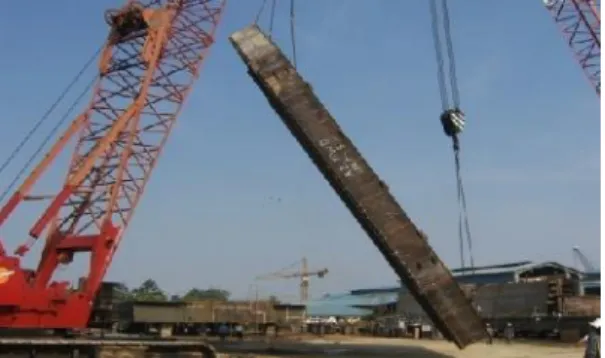
- Overturning Lift
Is the lifting in fabrication process to facilitate the welding or Non destructive test (NDT) for the blocks. Overturning block also need to be done to suit the space requirement on transportation mode i.e Trailer or Low bed Transporter.
Fig. 3.3.1 Block’s Overturning Lift
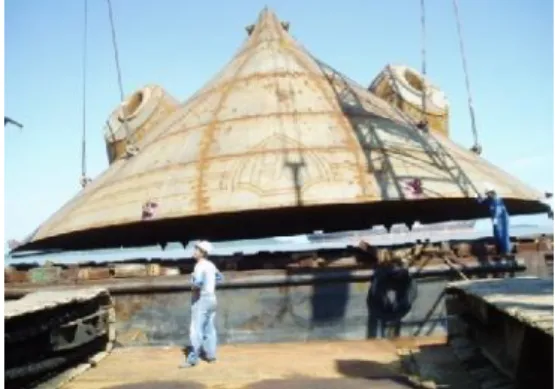
- Loading Lift.
Is the lifting to facilitate the loading process on
completion of the block’s fabrication. It’s mean the
Fig. 3.3.2 Lifting Block for Loading
Care to be taken during the lifting process to avoid deformation or run out from its original dimension. In extreme way, improper lifting even can caused the shape damaged of the fabricated block. Both offenses are not accepted on block handling.
As Lifting of blocks is categorizing “Heavy Lifting”, following factors must be strictly checks and
fulfilled before lifting operation for the blocks :
a. The Types and position of Eye-pieces.
Normally Engineering and Mould loft stages did not cover to include the types and position of lifting pieces. Therefore the Lifting Supervisor playing very important roles to determine the types of Eye-pieces and the correct location to put/install the eye-pieces for both overturning and loading lifting.
b. Physical check and NDT for Welding Quality of Eye-pieces.
For safety reasons the welded eye-pieces should be visually inspected by capable welding inspector and carry out NDT (normally Dye Penetrates test or MPI) before lifting operation.
c. The size of Shackle and Lifting Wire Sling.
The size of shackle will determine the capacity (safe working load) of the shackle and wire sling. Lifting Supervisor must ensure that the shackle and wire sling that going to use for lifting the blocks are correct and installed in correct manner as well.
d. Cranes.
We have to ensure that crane capacity are more than the weight of the blocks which going to be lifted.
e. Lifting Supervisor
Capable Lifting supervisor is mandatory for lifting operation. Lifting Supervisor is the Person In Charge for lifting operation therefore we have to ensure that we deployed the correct persons (Capable
Lifting supervisor) to carry out block’s Handling.
Fail to fulfill the above requirements mean Lifting Operations cannot be carried out and in the end of the day will affect the overall schedule of erection.
3.4
Transporting The BlocksThe process on shifting blocks from Fabrication ground to Erection ground or Dry dock using land transport mode such as Trailer, Forklift (For small blocks/Panels) or Low bed Transporter (Multi axel Transporter) we call Transporting Process. This is the third process on Materials Handling for the blocks.
Following measures must be strictly checks and fulfilled before lifting operation for the blocks : a. Capable Operators or Drivers
The experience and capable operators or drivers is a must as this is such a big operation risk. The capable drivers will minimize the human error factor.
b. Fit Condition of Transporter
Before start operation, Driver/Operator must ensure the transporter is in fit for use condition. If necessary the driver can request the assistance from Maintenance Dept.
c. Capable Signalman.
Capable signalman also required on this operation. He will assist the driver to find the shortest way and ensure the condition of road is fit for this operation. He also play the important role during transporting to guide the Driver.
d. Road and route.
Road condition must be very solid to take the load from transporter plus the blocks. The shortest distance and disturbance free route, to be identified by signalman and driver to avoid zigzagging or backtracking.
e. Positioned Block on the trailer or Transporter.
Block’s position on top of trailer or low bed
transporter must be in the correct manner. As much as possible the Center of Gravity (CG) of the blocks located on the center of the trailer or transporter. This is the most important part and required combination effort from Lifting supervisor, Signalman and driver. In case that due to one and other reason the block has to positioned off-center, extra lashing has to be done.
f. Lashing and Fastening
Lashing and fastening of block to the trailer and
transporter to be done to avoid the shifting of block’s
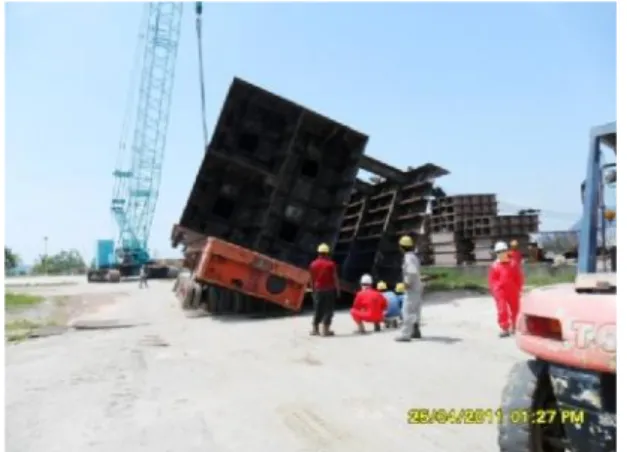
Transporting of blocks will be done very often in ship building process. It could be more than twice a day. However extra care have to be taken on every transporting operation.
Fig. 3.4.1 Unsafe action during Transporting
4.4
Unloading The BlocksThe process of lifting the blocks from transporter / trailer and put on erection ground or direct go to other blocks for erection, we call unloading process.
Similar to Lifting process as basically unloading process is lifting process as well. Therefore the measures for lifting process also must be applied strictly on Unloading Process. However unloading process will be more complicated as the lifting process will take longer time. This is due to on unloading process that direct go for erection, there are need extra time to fit the unloading blocks to the other blocks. When the block is located on correct position and lock by other lifting gear such as chain blocks, lever blocks or others, than only they can release the crane, its mean the unloading operation completed.
In unloading operation we need synergy between transporting team (Driver and Signalman), unloading or lifting team (Lifting Supervisors, Operators and Riggers) and Production team who look after the erection. The successful of unloading operation fully depend on how solid the synergy between the above three parties.
III. CONCLUSIONS
Material handling for the blocks on ship building process is playing very important roles. It contribute a major profit for the overall project as its related in all aspects of Project Management which are : - Safety, Quality, Time schedule and Cost.
If we fail on plan and execute for material handling for the blocks, for example an accident happened during blocks handling it will affect on the above Project management aspects i.e :
1. Safety records will be bad.
2. Quality will be worst affected, as the accident will cause the damaged of blocks or at least the blocks dimensional control will run.
3.Overall project schedule also will automatically affected, as accident will need investigation, reporting and corrective action. Furthermore they will need additional times for repair the damaged due to the accident.
4. Cost, similar to schedule an accident also will create unnecessary additional cost.
To avoid the above, the preventive action must be done to ensure the material handling for the blocks to carry out in the safe manner, effective and efficient on the following steps :
- Define the Fabrication lay out. - Lifting Process
- Transporting process, and - Unloading process.
As a part of project, material handling must be done on the professional manner in the sense of combining the basic theory of material handling and a sufficient experience on an actual material handling in shipyard.
With considering the above and finding fact during research and study, the Researcher concluded that to Determine The professional ways and/or comprehensive ways on Material handling at Shipbuilding yard, we should apply the following :
1. Clear understanding on Material Handling purposes. 2. Apply the basic principle of Material Handling plan 3. Set up the Materials handling Strategy, and
4. Apply the Physical consideration on Block Handling.
By applying the above, its mean we have been done a comprehensive ways on the material handling for Blocks on Ship Building Projects. As final result, Materials Handling for the blocks will give a great contribution in overall Project.
ACKNOWLEDGMENT
We would like to thanks to General Manager and all employees of PT. Karimun Sembawang Shipyard for the excellence support and contribution on this research.
REFERENCES
[2] Harold T. Amrine, Manufacturing Organization and Management, Prentice Hall
–University of Michigan, 1993.
[3] Franklin G Moore, Production / Operation Management, R D Irwin, University of Wisconsin–Madison, 1973.
[4] Wikipedia, Material Handling, The free Encyclopedia, 2016.
[5] Richard L Storch, Ship Production (Second edition), publisher, Cornell maritime press, centreville, MD 1995.
[6] Barabanov, Ship Building Technology, Mir Publisher, Rusia, 1986
[7] Raymond A Kulwiec, Material Handling Handbook, American Society of Mechanical Engineers (ASME), 1985.
[8] Ioannou, G. & Kritikos, M.N. Optimization
of material handling in production and warehousing facilities, European Journal of
Operational Research September 2004, 4:317
http://link.springer.com/article/10.1007/BF 02944149
[9] Jaganathan, J. K, Solution To Large Facility Layout Problems Using Group Technology. Thesis. India, 2007.
http:
//soar.wichita.edu/dspace/bitstream/10057/11 39/1/t07022
[10] Gan Shu San, Didik Wahjudi, Analisa Tata Letak Pabrik untuk Meminimalisasi Material
Handling pada Pabrik Koper, JURNAL TEKNIK MESIN Vol. 2, No. 1, April 2000 : 41–49
http://puslit.petra.ac.id/journal/mechanical/
[11] Unknown, Material Handling Procedure, Jurong Shipyard, Pte Ltd Singapore (updated), 2015.