Hilal Ahmad Bhat Page 561 THE EMERGING PATTERNS OF MARRIAGE AMONG MUSLIMS: A SOCIOLOGICAL STUDY OF
SOUTH KASHMIR
Hilal Ahmad Bhat
Research Scholar at Department of Sociology and Social Work Barkatullah University, Bhopal
Abstract
In Indian society marriage is considered to be an institution through which men and women are initiated into the culture of society. Therefore, they are socialized to identify a set of goals in life which largely revolves around marriage and family. Marriage is the beginning of a new family unit with all the complicated roles and statuses which the members of this unit are expected to play. Socio-cultural and religious practices regarding marriage can have a significant effect on the status of women within family and society. In a traditional society, like India which is known for its cultural diversity the Muslims form a unique group by themselves due to their religious faith and values .among Muslims, like all other aspects of life, the man-woman relationship and the authority structure in the family too are rooted in traditional sanctions as written in sacred texts. However, scientific developments, impact of education, socio-economic changes in the modern industrial society are having their impact on the structure and functioning of marriage patterns. It is proposed to study the emerging patterns of marriage among Muslims in south Kashmir the present study is an attempt to assess the change in marriage patterns of Muslims in south Kashmir. The main objective of the current study is to know the impact of education and income upon marriage patterns among Muslims.
Key words: Muslim, Marriage, Change, Education.
Introduction
The origin to the institution of marriage is traced back to the beginning of the human existence, though it has taken so many different shapes in different societies according to the times and conditions. Marriage is a universal social institution. It is established by the human society to control and regulate the sex life of individuals.
It is closely connected with the institutions of family. Marriage and family are two social institutions, complementary to each other. They are permanent element of our social system. Marriage is an institution which admits men and women to family life. It is a stable relationship in which men and women are socially permitted to have children implying the right to sexual relations (Rao 2004: 334).
Marriage is defined as sexual access between males and females, regulated and legitimized by society. The marriage ceremony is an important cultural institution in every society that signifies the union and grants them socially approved status as husband and wife. Every society has norms about who may have sexual relationship with persons believed to be closely related. It is a universal cultural standard (Abraham 2006: 157). In a traditional society like India, this is known for its cultural diversity the Muslims form a unique group by themselves due to their religious faith and values (Sheikh, 1991:146). Among Muslims like all other aspects of life, the man- woman relationship and the authority structure in the family too are rooted in traditional sanctions as written in the sacred texts. As regards the status and role of woman specific rules are laid down in the religious texts. There is a close link between the authority structures in the family and in religion and this affects decision-making and overall behavior pattern of the members (Sheikh, 1991:147).
Islam has also its own values of marital relationship and the ways of marriage bondage and its declaration before the community. Marriage is performed only when the couples have expressed their willingness according to the preachings of the holy prophet (Siddiqui, 1996:1). The Quran also exhorts the followers of Islam to enter into marriage with chaste women:
Then marry such women as seem good to you (iv.3)
Hilal Ahmad Bhat Page 562 with your property taking them in marriage, not
committing fornication (iv.24).
Research Methodology
The present work is based on both primary data and supported by secondary data. The field work has been carried out in 2017. Being an insider it was the advantage to communicate with the respondents in their own language. The methods of data collection were interview, schedule and observation. The respondents were the male head members of the family and no female respondents were interviewed. The schedule comprised of both open ended and closed ended questions. A total sample size of 300 respondents was drawn for the current study by using the non-probability Judgmental.
The present study will help to understand the perceptions of the people towards the different aspects of marriage in the current scenario. The study will also help the future researchers to conduct research with bigger sampling on the same or different places.
Tabulation, Discussions and Findings
Age of the Respondents
It is a well established fact that age plays a dominant role in shaping the personality and values of responsibility to work and to participate
in different walks of life. Age group of respondent is an important factor for understanding his social behavior. It has been observed by sociologists that the behavior pattern of people vary with their respective age group. Thus an enquiry of the respondent’s age distribution was felt necessary.
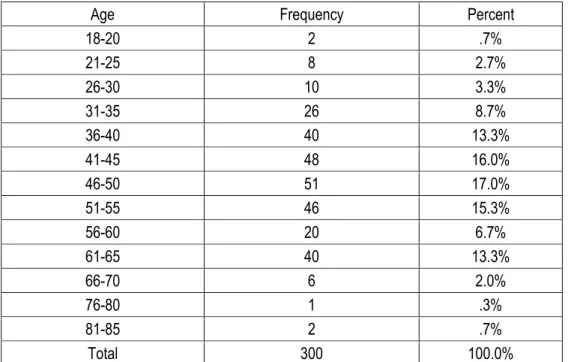
Table 1.1: Age Distribution of the Respondents The table 1.1 shows the respondents of different age groups who were interviewed while data collection. Total of 300 respondents were interviewed among which the highest number of respondents are between the age group of 46-50 and the lowest number of respondents falls in the age group of 76-80.The respondents are male head members of their respective families. It is evident from the table that on an average respondents are about 44 years of age and the range of the age was found to be 67 years starting from 18 to 85 years. Here it is also evident that respondents are almost young who shouldering the responsibilities of family.
Education Qualification of the Respondents Education is one of the most important characteristics that might affect the person’s attitudes and the way of looking and understanding any particular social phenomena. In a way, the response of an individual is likely to be determined by his educational status and
Age Frequency Percent
18-20 2 .7%
21-25 8 2.7%
26-30 10 3.3%
31-35 26 8.7%
36-40 40 13.3%
41-45 48 16.0%
46-50 51 17.0%
51-55 46 15.3%
56-60 20 6.7%
61-65 40 13.3%
66-70 6 2.0%
76-80 1 .3%
81-85 2 .7%
Hilal Ahmad Bhat Page 563 therefore it becomes imperative to know the
educational background of the respondents. Hence the variable ‘Educational level’ was investigated by the researcher and the data pertaining to education is presented in table 1.1.
Table 1.2: Respondents Distributed According to Education Ualification
Table 1.2 shows that about 34 per cent of the respondents were educated up to 12th class and
relatively lesser number of them, 20.7 per cent and 17.3 per cent were educated up to 10th class
and 8th class respectively. Only 9 percent and 3.7
percent of the respondents were educated up to the graduation and post graduate level respectively. A considerable number of respondents i.e. 15.3 percent were illiterates.
Apart from the data from respondents it was also observed that the young generation is more concerned to modern education Therefore it can be concluded from the table above that by and large the respondents were progressive in education which is very important today to create a knowledge based society.
Marriage Preferences Among Muslims
Among the qualifications of the bridegroom, apart from the family status, education, employment, income, health, behaviors, temperament, inclination, social and economic status, are sphere of influence.
Table 1.3: Consideration of Education While Choosing Life Partner
Frequency Percent Education considered less important while choosing life partner 116 38.7% Education considered more important while choosing life partner 184 61.3%
Total 300 100.0%
As far as the merit of the bride is concerned, she must be beautiful, of good character and also possess perfect mental and physical health. She must be well-trained in household management and such accomplishments such as needle-work, knitting, etc. sociability, sensibility, consideration, sympathy, attractiveness, good behavior are also considered necessary elements. Education is one among them and when the researcher interviewed the respondent’s preference about educational level of the life partner they like to
marry, most of the respondents favored that education is more important for their life partner. From the table 1.3 it is evident that 61.3% respondents strongly support that education is more important while choosing the life partner and only 38.7% respondents said that education is not more important while choosing life partner. So here it is evident that education is considered very important while choosing life partner. It reveals that people prefer kin relations with the educated people.
Table 1.4: Different Occupational Respondent’s Consideration Towards Education While Seeking Life Partner for Children
Education qualification Frequency Percent
illiterate 46 15.3%
8th 52 17.3%
10th 62 20.7%
12th 102 34.0%
Graduation 27 9.0%
Post graduation 11 3.7%
Hilal Ahmad Bhat Page 564 Occupation
Education considered less
important Education considered more important
Total
Labour 23 26 49
Govt
employee 23 47 78
Private
employee 6 5 11
Business 13 37 73
Farmer 49 58 89
Total 2 11 300
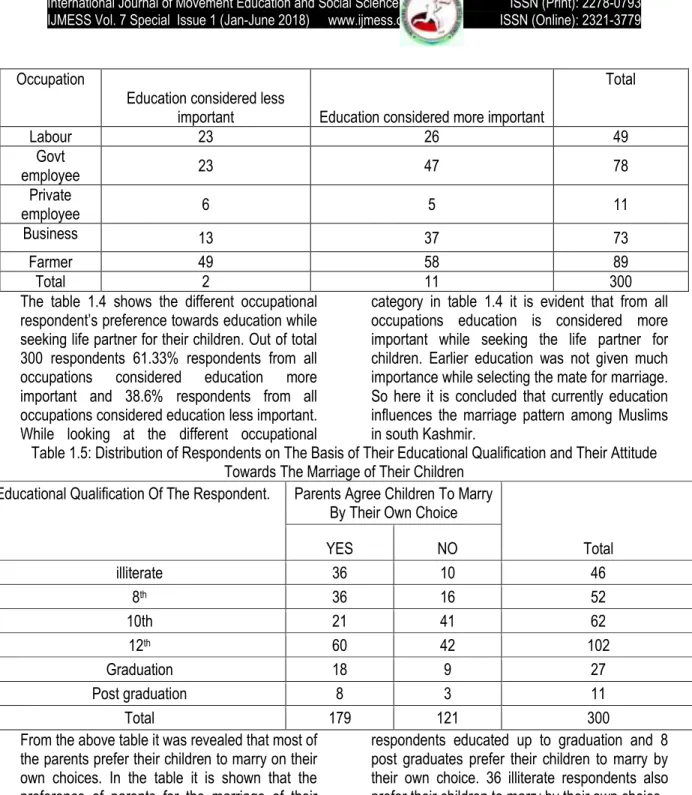
The table 1.4 shows the different occupational respondent’s preference towards education while seeking life partner for their children. Out of total 300 respondents 61.33% respondents from all occupations considered education more important and 38.6% respondents from all occupations considered education less important. While looking at the different occupational
category in table 1.4 it is evident that from all occupations education is considered more important while seeking the life partner for children. Earlier education was not given much importance while selecting the mate for marriage. So here it is concluded that currently education influences the marriage pattern among Muslims in south Kashmir.
Table 1.5: Distribution of Respondents on The Basis of Their Educational Qualification and Their Attitude Towards The Marriage of Their Children
Educational Qualification Of The Respondent. Parents Agree Children To Marry By Their Own Choice
Total
YES NO
illiterate 36 10 46
8th 36 16 52
10th 21 41 62
12th 60 42 102
Graduation 18 9 27
Post graduation 8 3 11
Total 179 121 300
From the above table it was revealed that most of the parents prefer their children to marry on their own choices. In the table it is shown that the preference of parents for the marriage of their children, they provide them opportunity for choosing their life partners. 300 respondents were examined among which 179 prefer their children to marry by their own choice. Among which the highest number 36 is of those who are educated up to 8th standard and they prefer their
children to marry by their own choice. 60 respondents educated up to 12th class, 21
respondents educated to 10th class and 18
respondents educated up to graduation and 8 post graduates prefer their children to marry by their own choice. 36 illiterate respondents also prefer their children to marry by their own choice.
Conclusion
Hilal Ahmad Bhat Page 565 The simplicity of the marriages is observed to be
missing as marriages have become the occasions of festive rejoicing marked with rigid and costly ceremonial functions, and means of ostentatious display of one’s pride and pomp. Even in well – educated and religious –minded families elaborate arrangements are made for marriages, guests are entertained lavishly and the houses decorated colorfully. These vain pretensions have given rise to a contest in extravagant spending and self important useless show of wealth.
The respondents were found very progressive towards education. Education is considered very important while seeking the bride/groom. Respondents were found engage with different occupational activities and the maximum number was found as agricultural farmers. So the study area is found agricultural dominant. The study revealed that maximum respondents with different education qualification prefer their children to marry by choice which indicates the trend of rising love marriages. Therefore here it can be concluded that among Muslims of south Kashmir love marriage is more preferred than arranged one and the trend of arranged marriage is transforming into love arrange marriage. At the end it is concluded that education is found to be the important characteristic for which people are looking while selecting the bride/groom which clearly reveals that education has a great impact upon the marriage patterns among Muslims in south Kashmir.
Bibliography
Abraham, F. M. (2006). Contemporary Sociology:An Introduction to concepts and theories. New Delhi: Oxford University Press. Al-Bukhari, (2012). To Make the Heart Tender (Ar-Riqaq). In Hadith Collection Sahih Bukhari. Volume 008, Book 076, Hadith Number 471. Retrieved from http://www.hadith collection.com/sahihbukhari/ 109-Sahih Bukhari Book
Deborah M. Merrill. (2011). "When Your Children Marry: How Marriage Changes Relationships with Adult Children." Clark University.
Nadvi, Abul Hasan Ali. (2000). Islam- Ennufk Parichay. Rai Bareli. Published by M.H. Trust.
Rao, S. C. (2004). sociology of Indian society. New Delhi: S.Chand and company.
Sheikh, T. F. (1991). Muslim women and Social life. In L. Sebasti, Quest for gender justice. Madras: Satyam Nilayam publication. Sheikh, T. F. (1991). Muslim women and social life. Madras: Satyam Nilayam publication.
Siddiqi, M. (1980). Women in Islam. New Delhi: Adam publishers and distributors.