Design and Analysis of a Highly Reliable and Secure
Method for Authentication
1
Ms.S.RAGADHARSINI, M.E., (CSE), 2Mr.T.YOGANANDH M.E.,
1
PG Scholar, 2Assistant Professor/CSE, Jay Shriram Group of Institutions, Tirupur.
1
Email ID: [email protected], 2Email ID: [email protected]
Abstract- Most of the system breaches are caused by the failure of authentication. Either during the login process or in the post-authentication session, these failures are related to the limitations of the existing post-authentication methods. The recent post-authentication methods such as proxy based and biometrics based is not user-centric and/or endanger user’s (biometric) based security and privacy. In this article, a biometrics based user-centric authentication approach is proposed which involves introducing a reference subject (RS), securely fusing the user’s biometrics with the RS, generating a Bio Capsule (BC) from the fused biometrics, and employing BCs for authentication. This approach is user friendly, identity bearing yet privacy-preserving, resilient, and revocable once a BC is compromised. It also supports “one-click and sign-on” over the systems by fusing the user’s biometrics with a distinct RS on each system. Moreover, active and non-intrusive authentication can be automatically performed during the post-authentication sessions. We formally prove that the secure fusion based approach is secure against the various attacks. Extensive experiments and detailed comparison with existing approaches show the performance (i.e., authentication accuracy) which is comparable to existing typical biometric approaches. The proposed BC based approach also possesses many desirable features such as diversity and revocability.
I.INTRODUCTION 1.1.1 Image processing
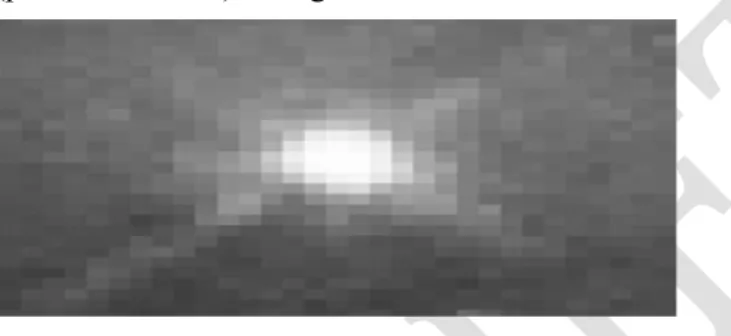
An image is an array, or a matrix, of square pixels (picture elements) arranged in columns and rows.
Figure 1: An image — an array or a matrix of pixels arranged in columns and rows.
In a (8-bit) greyscale image each picture element has an assigned intensity that ranges from 0 to 255. A grey scale image is what people normally call a black and white image, but the name emphasizes that such an image will also include many shades of grey.
Figure 2: Each pixel has a value from 0 (black) to 255 (white).
The possible range of the pixel values depend on the color depth of the image, here
8 bit =256 tones or greyscales.
1.1.2 Colors
For science communication, the two main color spaces are RGB and CMYK.
RGB
The RGB color model relates very closely to the way we perceive color with the r, g and b receptors in our retinas. RGB uses additive color mixing and is the basic color model used in television or any other medium that projects color with light. It is the basic color model used in computers and for web graphics, but it cannot be used for print production.
The secondary colors of RGB – cyan, magenta, and yellow – are formed by mixing two of the primary colors (red, green or blue) and excluding the third color. Red and green combine to make yellow, green and blue to make cyan, and blue and red form magenta. The combination of red, green, and blue in full intensity makes white.
CMYK
The 4-color CMYK model used in printing lays down overlapping layers of varying percentages of transparent cyan (C), magenta (M) and yellow (Y) inks. In addition a layer of black (K) ink can be added. The CMYK model uses the subtractive color model.
1.1.3 Gamut
color space to the other may cause problems for colors in the outer regions of the gamuts.
1.1.4 Fundamental steps of digital image processing
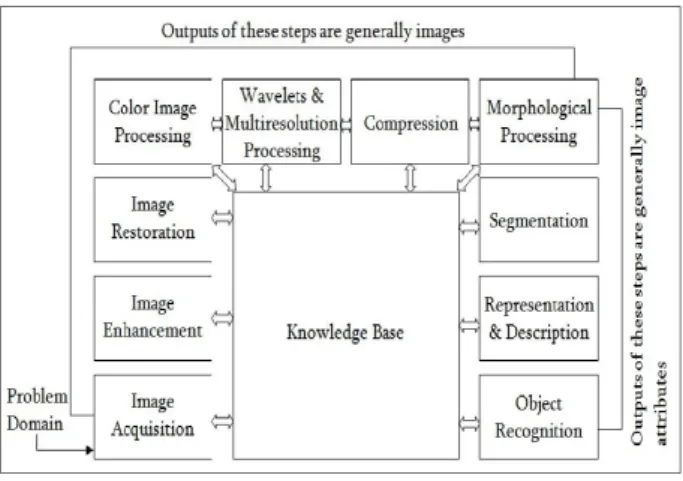
There are some fundamental steps but as they are fundamental, all these steps may have sub-steps. The fundamental steps are described below with a neat diagram.
Figure 3: Fundamental Steps
1. Image Acquisition: This is the first step or process of the fundamental steps of digital image processing. Image acquisition could be as simple as being given an image that is already in digital form. Generally, the image acquisition stage involves preprocessing, such as scaling etc.
2. Image Enhancement: Image enhancement is among the simplest and most appealing areas of digital image processing. Basically, the idea behind enhancement techniques is to bring out detail that is obscured, or simply to highlight certain features of interest in an image. Such as, changing brightness & contrast etc.
3. Image Restoration: Image restoration is an area that also deals with improving the appearance of an image. However, unlike enhancement, which is subjective, image restoration is objective, in the sense that restoration techniques tend to be based on mathematical or probabilistic models of image degradation.
4. Color Image Processing: Color image processing is an area that has been gaining its importance because of the significant increase in the use of digital images over the Internet. This may include color modeling and processing in a digital domain etc.
5. Wavelets and Multi resolution Processing: Wavelets are the foundation for representing images in various degrees of resolution. Images sub division
successively into smaller regions for data compression and for pyramidal representation. 6. Compression: Compression deals with techniques for reducing the storage required to save an image or the bandwidth to transmit it. Particularly in the uses of internet it is very much necessary to compress data.
7. Morphological Processing: Morphological processing deals with tools for extracting image components that are useful in the representation and description of shape.
8. Segmentation: Segmentation procedures partition an image into its constituent parts or objects. In general, autonomous segmentation is one of the most difficult tasks in digital image processing. A rugged segmentation procedure brings the process a long way toward successful solution of imaging problems that require objects to be identified individually.
9. Representation and Description: Representation and description almost always follow the output of a segmentation stage, which usually is raw pixel data, constituting either the boundary of a region or all the points in the region itself. Choosing a representation is only part of the solution for transforming raw data into a form suitable for subsequent computer processing. Description deals with extracting attributes that result in some quantitative information of interest or are basic for differentiating one class of objects from another. 10. Object recognition: Recognition is the process that assigns a label, such as, “vehicle” to an object based on its descriptors.
11. Knowledge Base: Knowledge may be as simple as detailing regions of an image where the information of interest is known to be located, thus limiting the search that has to be conducted in seeking that information. The knowledge base also can be quite complex, such as an interrelated list of all major possible defects in a materials inspection problem or an image database containing high-resolution satellite images of a region in connection with change-detection applications.
1.2 Image Denoising
approach is to use a Gaussian filter, or equivalently solving the heat-equation with the noisy image as input-data, i.e. a linear, 2nd order PDE-model. For some purposes this kind of denoising is adequate. One big advantage of linear noise removal models is the speed. But a back draw of the linear models is that they are not able to preserve edges in a good manner: edges, which are recognized as discontinuities in the image, are smeared out. Nonlinear models on the other hand can handle edges in a much better way than linear models can. One popular model for nonlinear image denoising is the Total Variation (TV)-filter, introduced by Rudin, Osher and Fatemi. This filter is very good at preserving edges, but smoothly varying regions in the input image are transformed into piecewise constant regions in the output image. Using the TV-filter as a denoise leads to solving a 2nd order nonlinear PDE. Since smooth regions are transformed into piecewise constant regions when using the TV-filter, it is desirable to create a model for which smoothly varying regions are transformed into smoothly varying regions, and yet the edges are preserved. This can be done for instance by solving a 4th order PDEd instead of the 2nd order PDE from the TV-filter. Results show that the 4th order filter produces much better results in smooth regions, and still preserves edges in a very good way. Some results showing the behavior of the 4th order model is shown:
Figure 4: Fourth Order Model Result
Here, the leftmost image is the original image, the middle image is imposed with noise, and the rightmost image is the restored image using the 4th order model. Another approach is to combine a 2nd and 4th order method. The idea here is that smooth regions are filtered by the 4th order scheme, while edges are filtered by a 2nd order scheme. To choose in which areas of the image each of the models are to be used, one has to construct a weight function. Another way of denoising images is the following: Instead of working directly with the images, the noisy normal vectors of the image are processed
instead. Then, the smoothed normal vectors are used to reconstruct a denoised image. This approach gives very good results.
The process is illustrated here:
Figure 5: Using Smooth Normal Vector
The three images above show a small excerpt of the normal vectors of the above shown image. The first image shows the normals of the original image, the middle image shows the normals of the noisy image, and the last image shows the smoothed normals.
1.3 Denoising of medical images
Noise suppression in medical images is a particularly delicate and difficult task. A trade-off between noise reduction and the preservation of actual image features has to be made in a way that enhances the diagnostically relevant image content. Image processing specialists usually lack the biomedical expertise to judge the diagnostic relevance of the De-noising results. For example, in ultrasound images, speckle noise may contain information useful to medical experts the use of speckled texture for a diagnosis was discussed in. Also biomedical images show extreme variability and it is necessary to operate on a case by case basis. This motivates the construction of robust and efficient denoising methods that are applicable to various circumstances, rather than being optimal under very specific conditions.
II.OBJECTIVE
Client user
Logical RS Reference
subject BC generatio n
Matching
Yes/No
BC in database
Physical RS
2.And existing BCS and CB approaches cannot fully address one or more of these properties .In this research, we propose a Bio Capsule (BC) and use the BC for user authentication (and identification as well) to address these issues in a comprehensive manner.
3. We have previously proposed the BC concept. The BC generation is based on the difference of the user’s biometric feature and that of a proposed reference subject (RS).
III. EXISTING SYSTEM
We propose a biometrics based user-centric authentication approach. This method involves introducing a reference subject (RS), securely fusing the user’s biometrics with the RS, generating a Bio Capsule (BC) from the fused biometrics, and employing BCs for authentication.
The user’s biometrics is captured via (built in) camera of the authentication client and sent to the authentication server. Through some preprocessing (omitted in the figure), the user biometrics is fused with the RS biometrics which is either sampled against a physical object on-the-fly or a logical one stored in the server. The server matches the generated BC against the BC stored in the BC database for an authentication decision (“Y/N”). The RS biometric is iris.
Disadvantages of existing system
Performance decrease
Few complex method
IV. Proposed system
A central theme of authentication is to authenticate users using characteristics intrinsically linked with human users rather than some external factors. A promising direction emerging from this effort is biometrics. Currently, the further adoption of biometrics is limited by the security of users’ biometric templates extracted in the biometric authentication process: they are irreplaceable once compromised, and original biometric data can be reconstructed from the biometric templates. A biometric template is derived from a user’s biometric data and contains the user’s private information, thus its compromise may divulge sensitive information. The user biometric is fused with biometric reference subject .we proposed a user-friendly, secure, privacy- preserving and revocable secure-fusion based biometric authentication method.
Advantages of proposed system
High security compare to existing
Privacy preserving
Performance increase
Architecture diagram
Figure 6:
Architecture Diagram
Algorithm
Step 1: selection of client user biometric
Step 2: select the reference subject that can be physical RS or logical RS
Step 3: The preprocessing technique is computed before the fusion
Step 4: A user-intrinsic key is extracted from the user’s biometrics
Step 5: The secret key and features can be extracted from biometric reference subject
Step 6: user biometrics and RS biometrics are fused, and from fused biometrics a BC is generated. Step 7: The generated BC is matched with BC in database. That BC is already stored in data base. Step 8: if the matching is true user identity is correct Step 9: else wrong identification
V. MODULE DESCRIPTION
List of Modules
Selection of user biometrics and RS
Preprocessing technique
Key Extraction
Secure Fusion of User and Reference Subject
Performance analysis
The RS can be a physical one or a logical one. A physical RS is some object from which RS biometrics can be sampled on-the-fly, and a logical RS can be a biometric image. RS is a system-wide object and managed by the authentication system, not by a user, which frees users’ burden on carrying or memorizing something. Typically, RS is configured with the authentication server. Here face is biometric reference subject.
Since the compromised RS will not jeopardize the biometric security and users’ privacy, the RS can also be located on client sites. The user’s biometrics is captured via (built-in) camera of the authentication client and sent to the authentication server. For example, a RS can be configured on client computers at security check points which scan the RS and passenger biometrics and send then the computed BC to the authentication server for authentication.
B.Preprocessing technique
The preprocessing of an edge-detection based approach of the RS is done. Image pre-processing can significantly increase the reliability of an optical inspection. In that technique Noise and image edges are evaluated.
C. Key Extraction
The mechanism needs the extracted key and features from the RS. A random secret key may be directly used as the RS. It is not clear whether a random secret key has the characteristics of a biometric image such that the secret key and features can be extracted and then fused with the user biometrics.
To create a personalized RS, a user-intrinsic key is extracted from the user’s biometrics and used as the transformation parameters to the RS. We propose a lightweight key extraction considering the following criterion:
1. To facilitate usability, the key is directly generated from the user biometrics, thus avoiding the need for a user to memorize a password or carry a token to provide transformation parameters. Also, this key is directly generated from user biometrics. 2.Since the keys are not used for authentication, the BC approach does not require 100 percent stable and user-distinct keys (as do some BCSs).
3.The conflict between key stability and distinguish ability should be optimally balanced, since it will create further impact on the fusion of biometrics. The key extraction is applied on the pre-processed images. During the preprocessing the face
image segmentation and polar transformation steps help mitigate the scaling and distortion problems of biometric images.
D.Secure Fusion of User and Reference Subject Our goal of fusion aims to increase the security of the biometrics. Through the fusion, the RS biometrics hides the user biometrics, thus providing biometric security and preserving privacy. Our fusion equally treats the user and the RS and the BC bears no hints that the user is weighted more than the RS. Our security proof, later in this section, also consolidates the contribution of designing equal treatment of the user and the RS.
For registration, user biometrics is sampled and fused with the RS biometrics; from the fused biometrics a user’s BC is generated and stored (in the system database). Upon a verification request, user biometrics is re-sampled and fused with the RS
Figure 7: BC Generation
biometrics. Again from the fused biometrics a user BC is derived which is further compared to the stored BC (of an individual). If the two BCs are close enough according to some distance metric, the user is authenticated as the individual.
E.Performance analysis
The performance of the proposed BC approach has been evaluated.The experiment tested the effects of image quality on BC performance. Such an approach is user friendly, identity bearing yet privacy-preserving, resilient, and revocable once a BC is compromised.
VI.SCREENSHOTS
Fig 8.To Get the Configuration Path
B. Login Page
Fig.9 Login Page
C. Server Connection
Fig.7 Server Connection.
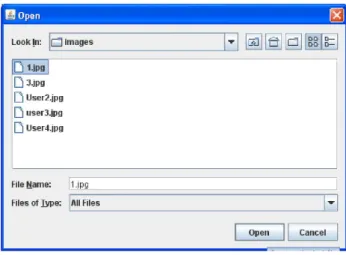
D. Choosing image for Feature Extraction
Fig.8 Choosing image for Feature Extraction
E. Final Feature Extracted Values
Fig 9. Final Feature Extracted Values.
VII. CONCLUSION AND FUTURE WORK
In this paper, we proposed a user-friendly, secure, privacy- preserving and revocable secure-fusion based biometric authentication method. The proposed approach involves key extraction: the extracted key is used in a “secure fusion” for mixing the user’s biometrics and a reference subject’s biometrics, and the fused biometrics is fed into an existing biometric system to generate a Bio Capsule for authentication.
We will continue to extend our study to other biometrics (e.g.palm print, finger print ) and investigate the integration of the fusion at different biometric processing levels. We are also interested in extending the application of the proposed BC mechanism in a broader context, for instance, active and non-intrusive authentication.
1. Theoretical and Practical Boundaries of Binary Secure Sketches, . J. Bringer, H. Chabanne, G. Cohen, B. Kindarji, and G. Zemor,2008.
2. A Quantitative Analysis of Indistinguishability for a Continuous Domain Biometric Cryptosystem, I. Buhan, J. Breebaart, J. Guajardo, K. de Groot, E. Kelkboom,T. Akkermans, 2010.
3. Constructing Practical Fuzzy Extractors Using QIM, I. Buhan, J. Doumen, P. Hartel, and R. Veldhuis, 2007.
4.Fingerprint Image Reconstruction from Standard Templates ,R. Cappelli, A. Lumini, D. Maio, and D. Maltoni, 2007.
5.Biometric Encryption, Encyclopedia of Biometrics, A. Cavoukian and A. Stoianov, Springer, 2009.
6. Finding the Original Point set Hidden Among Chaff, E. Chang, R. Shen, 2006.
7. “High Security Iris Verification System Based on Random Secret Integration C. Chin, A. Jin, and D. Ling, 2006.
8. Neural Network Techniques for Proactive Password Checking, A. Ciaramella, P. D’Arco, A. De Santis, C. Galdi, and R. Tagliaferri, 2006.
9. “Robust and Efficient Ridge-Based Palmprint Matching J. Dai, J. Feng, and J. Zhou, 2012.
10. On Ultra lightweight RFID Authentication Protocols P. D’Arco and A. De Santis,2011.
11. How Iris Recognition Works, Daugman, 2004.
12. Fuzzy Extractors: How to Generate Strong Keys from Biometrics and Other Noisy Data, Y. Dodis, L. Reyzin, and A. Smith, 2004.
13. “Use of One-Dimensional Iris Signatures to Rank Iris Pattern Similarities, Y. Du, R. Ives, D. Etter, and T. Welch
14. Combining Crypto with Biometrics Effectively, F. Hao, R. Anderson, and J. Daugman.
15. Information Leakage in Fuzzy Commitment Schemes T. Ignatenko and F.M.J. Willems, 2010.
16. Biometric Template Security ,A. Jain, K. Nandakumar, and A. Nagar, 2008.
17. Biohashing: Two Factor Authentication Featuring Fingerprint Data and Tokenized Rando Number A.Jin, Ling.
AUTHORS BIOGRAPHY
Ms.S.RAGADHARSINI received her B.E degree in Jay Shriram Group of Institutions, Tirupur and currently pursuing M.E degree in Jay Shriram Group of Institutions, Tirupur, India. Her research interests include Big data, Cloud Computing, Advanced Database, Computer networks, Operating System .S