RESEARCH REGARDING THE BEHAVIOR OF SOME RAPE HYBRIDS
CULTIVATED IN CARACAL PLAIN
MATEI GHEORGHE1, PETRESCU EUGEN2, BĂBEANU CRISTINA3,
DODOCIOIU ANA MARIA4
1University of Craiova, Department of Agricultural and Forestry Technologies.
E-mail [email protected]
2 ARDS Caracal – University of Craiova 3 University of Craiova – Department of Chemistry 4University of Craiova – Department of Horticulture and Food Science
Key words: rape, hybrids, yields
ABSTRACT
The paper aims is to draw the attention of specialists in agriculture and farmers, especially those from the area of influence of the Agricultural Research Development Station Caracal, of the importance of choosing hybrids of rape, taking in account the climate and soil conditions in the region of Caracal Plain.
Precocity of hybrids, blooming period, productivity elements and STAS grain production parameters are investigated and analyzed in the experiences carried out during 2013 - 2014 using vegetable creations from companies’ representative in Romania for rape crops.
The assortment of hybrids tested capitalized very well the climatic conditions of the area, generating productions between 3200 and 4100 kg/ha, values obtained as the average of two years of experimentation, with a small variations of production, which highlights the stability of production and hence quality of the vegetable creations marketed by firms whose portfolio contain.
INTRODUCTION
One of the most important way to obtain high and qualitative yields at all the crops and especially on autumn rape, is to use the new genotypes (varieties and hybrids) with high potential of production (Ceapoiu, 1984; Oplinger, 2011; Buzdugan, 2013).
The obtained genetic progress to new varieties and hybrids of rape create, lately exceed with 10-25% old vegetable creations, as at the output level of quality and in terms of physiological and valuable productions. (Fluerașu, 2006; Diaconu, 2006).
The great diversity and ongoing renewal of the range of varieties and hybrids of rape make so complex the research of the most valuable structure of the genotypes on rape crop for each areal of cultivation in Romania (CETIOM, 2011; Seyis, 2010).
In these conditions, at Agricultural Research Development Station Caracal was initiated a complex research related the most valuable hybrids of colza which have the highest efficiency in using the climate factors from area. The optimization of hybrids structure represent a one of the most important decisions in technique of the rape cultivation because the final purpose is to ensure an equilibrate structure capable to use all the vegetation factors to obtain yields in accordance with market requirements (Săulescu, 1984; Cramer 1990).
MATERIAL AND METHODS
The research was carried out on the Agricultural Research Development Station Caracal, during 2013 and 2014 years, using hybrids from portfolio of the most important Companies who provide seeds of rape for farmers located in Caracal Plain.
Hybrids from BAYER Company:
o BAGIRA
o BELANA
o HERKULES
o JUNPER
o JENIFER
Hybrids from EURALIS Company:
o NEPUNE
o JASON
o CENTURIO
o DANUBE
o MERCURE
Hybrids from KWS Company:
o TRIANGLE
o TASSILO
o BRUTUS
o TURAN
o TRAVIATA
All those 15 rape hybrids were sown in each experimented year having as previous plant winter wheat. The sowing time was in the first decade of September and the harvest time was in the first decade of July. As a density of plants we use 65 seeds per square meter.
As a fertilizers we apply in autumn chemical complexes of NPK (N18 P46 K0) of 200
kg/ha commercial product and in spring time another 250 kg/ha NH4NO3.
During the vegetation were applied an irrigation of 50 mm to stimulate the emergency of plants.
All obtained yields were calculated at 9% humidity of seeds in accordance with Standards.
RESULTS AND DISCUSSION
Results regarding the precocity of hybrids on blooming time
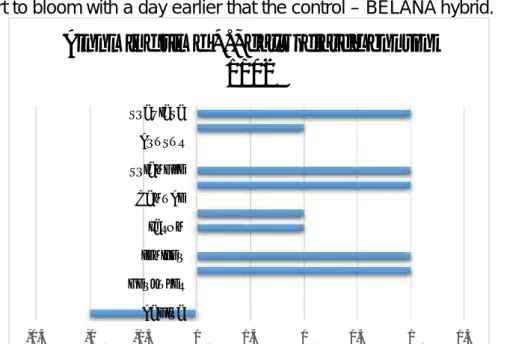
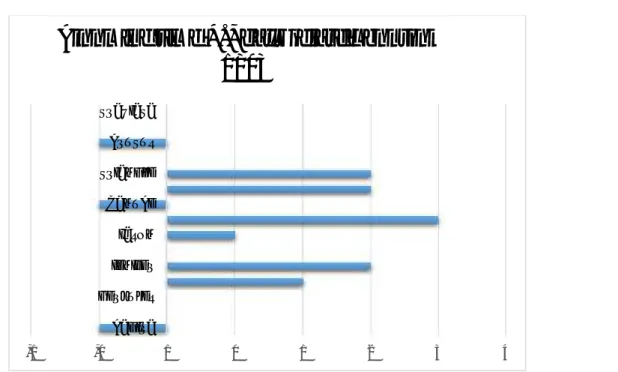
Related to this aspect we can say that the results registered and presented in figure 1 and figure 2, the early hybrid in each experimented year was BAGIRA, which in both years has start to bloom with a day earlier that the control – BELANA hybrid.
Figure 1 – Blooming time and differences in days in comparison with control (Belana hybrid) in 2013
-1,5 -1 -0,5 0 0,5 1 1,5 2 2,5
BAGIRA HERKULES JENIFER JASON DANUBE TRIANGLE BRUTUS TRAVIATA
Figure 2 – Blooming time and differences in days in comparison with control (Belana hybrid) in 2014
For starting blooming stage rape has need almost 300oC and this accumulation
influence the duration of the stage. In normal conditions for winter rape this stage is realized in 20 to 40 days if we taking in account the daily degree accumulation (Buzdugan, 2013). In the two experimented years, related control, the majority of the hybrids had a blooming start with 1 to 4 days later than the BELANA hybrid, this moment being influenced by the climatic conditions of the year and the genetically background. From those hybrids CENTURIO was the latest in 2014.
With the same period of blooming start as control we registered TASSILO and HERCULES hybrids (figure 1 and 2).
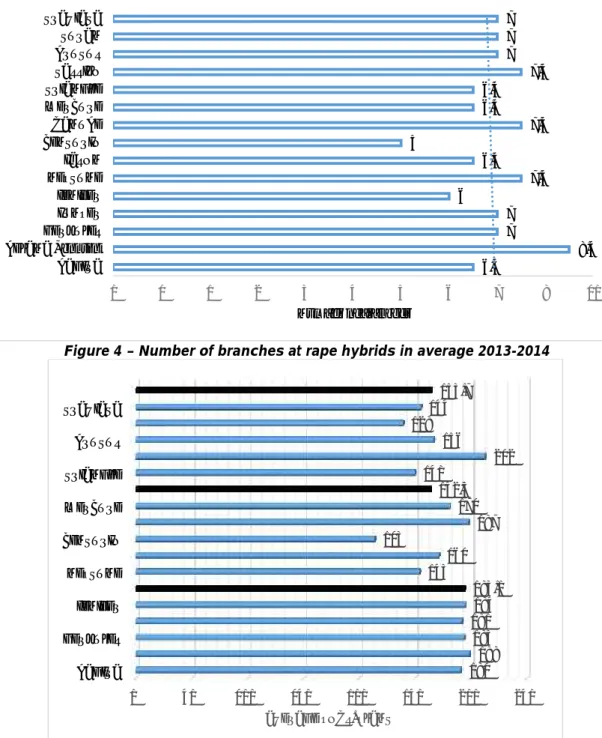
The height of the plants (figure 3) – was another objective that we observe in the experiment. This feature is important for the production elements because the plants grown continuously until and stops when the last flowers going to bloom (Helm, 1996).
From this point of view, in the experiment the highest plants, in average on the 2013 and 2014 years, were observed at JENIFER hybrid, followed by CENTURIO and JASON hybrids. At the opposite side the smallest plant were obtained at TURAN, TRAVIATA and HERCULES hybrids.
Figure 3 – Height of rape hybrids in average 2013-2014
-2 -1 0 1 2 3 4 5
BAGIRA HERKULES JENIFER JASON DANUBE TRIANGLE BRUTUS TRAVIATA
Blooming time +/- days related control
2014
166,5
160 158 162,5 175,5
161
172 173,5 167,5
163 162,5 165 169
155,5 157
145 150 155 160 165 170 175 180
He
ig
ht c
Number of branches/hybrid (figure 4) – is generally between 5 to 12 and is influenced by the nutritional space – density of plants/square meter (Canola Council of Canada, 2011; Muntean, 2008; Cramer, 1990), but also by the level of nutrients in soil at spring moment of growing debut (Buzdugan, 2013).
The branches were formed from lateral buds, under the leafs on the principal stalk of plants (Buzdugan, 2013; Triboi, Blondel, 1998). Those buds will generate 1 to 4 leaves and inflorescences.
In the winter experimented rape sortiment, the highest number of branches were registered at control – BELANA hybrid, with an average of two years of 9.5 branches. As it can be easily observed in the figure 4, the majority of rape hybrids were registered over 7 branches/plant, high values obtained at TASSILO, DANUBE and NEPTUNE hybrids and lowest value at CENTURIO hybrid. The trend line on the sortiment were situated at 7.8 branches/hybrid.
Figure 4 – Number of branches at rape hybrids in average 2013-2014
Figure 5 – Number of pods/plant at rape hybrids in average 2013-2014
7,5 9,5 8
8
7 8,5
7,5
6 8,5
7,5 7,5 8,5
8 8 8
0 1 2 3 4 5 6 7 8 9 10
BAGIRA BELANA - controlHERKULES JUNPER JENIFER NEPTUNEJASON CENTURIODANUBE MERCURE TRIANGLETASSILO BRUTUSTURAN TRAVIATA
Number of branches
0 50 100 150 200 250 300 350
BAGIRA HERKULES JENIFER NEPTUNE CENTURIO MERCURE TRIANGLE BRUTUS TRAVIATA
291299
294
292295
294,2
254271
214 298
281 263,6
250 313
267
239255
264,8
The number of pods/plant(figure 5) at rape hybrids varied generally between 200 to 400, but in some conditions can range 800 (Diaconu, 2004; Buzdugan, 2013). Each pod can have 10 to 25 seeds and sometimes even 25 to 40 (Alpman, 2006; Muntean, 2008).
In years less favorable from precipitations point of view, the pods formed from the inflorescences grows in the first 15 days on the main stalk and those formed on the first three branches has good chances to range maturity (Canola Growers Manual, 2011; Alpman, 2006).
The number of pods/plant varied between 214 at CENTURIO hybrid and 313 pods/plant at TASSILO hybrid. The most homogene hybrids from this point of view are those with the provenience from BAYER Company, with small differences between them. This feature shows that from the genetically point of view is an stable and uniform character - in terms of productivity - and in the conditions of Caracal Plain, the average per two years was 294.2 pods/plant.
The hybrids from KWS and EURALIS Companies has registered an average of 264.8 and respectively 263.6 pods/plant (figure 5).
Taking in account the productivity elements – number of pods/plant and number of branches – was determined a correlation between them, with R2 of 0.3133, which is
presented in figure 6.
Figure 6 – Correlations between pods/plant and branches/plant at rape hybrids in average 2013-2014
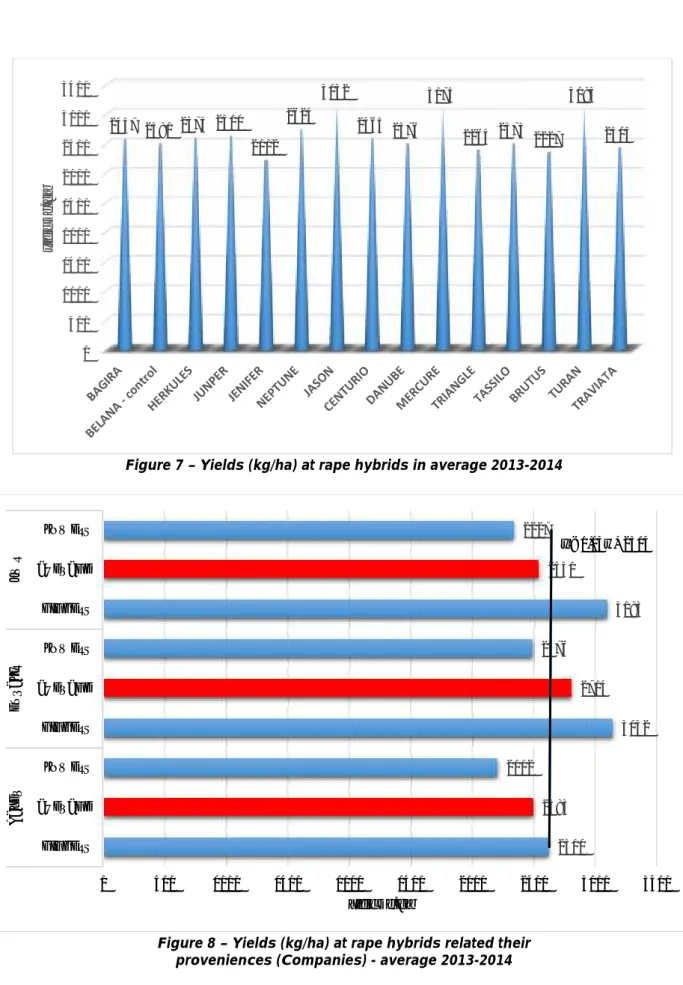
The yields obtained, in average on the experimented years, were very good for the climatic condition in the Caracal Plain and varied between 3203 kg/ha at JENIFER hybrid and 4143 kg/ha obtained at JASON hybrid (figure 7).
The average yields on entire experiment was 3615 kg/ha and related to this value with significant increases in production were registered the follow hybrids: JASON, MERCURE, TURAN, NEPTUNE and JUNPER.
The hybrids JENIFER, BRUTUS and TRANGLE prove to be more sensible to the climatic conditions of the area with productions between 3200 to 3400 kg/ha.
If we take in account the provenience of the hybrids (figure 8) we can say that the average value of production varied between 3494 kg/ha registered at hybrids from BAYER Company to 3542 kg/ha on hybrids from KWS Company and 3805 kg/ha at hybrids from EURALIS Company.
y = -4,8368x2+ 93,178x - 156,66 R² = 0,3133
0 50 100 150 200 250 300 350
0 1 2 3 4 5 6 7 8 9 10
po
ds
/p
lan
t
Figure 7 – Yields (kg/ha) at rape hybrids in average 2013-2014
Figure 8 – Yields (kg/ha) at rape hybrids related their proveniences (Companies) - average 2013-2014 0
500 1000 1500 2000 2500 3000 3500 4000 4500
3568 3492 3586 3621 3203
3735 4143
3576 3487 4086
3375 3486 3338 4094
3416
yi
el
d kg
/h
a
3621 3494 3203
4143 3805 3487
4094 3541
3338
y = 2,25x + 3625
0 500 1000 1500 2000 2500 3000 3500 4000 4500 HIGHEST
AVERAGE LOWEST HIGHEST AVERAGE LOWEST HIGHEST AVERAGE LOWEST
BA
YE
R
EUR
AL
IS
KWS
CONCLUSIONS
The registered expansion of winter rape crop in the last 10 years in Romania, from 50 000 ha to almost 500 000 ha, with special value of utilization, involves in the same time the continuous improvement of cultivation technology and this preoccupation must be a priority for all the researchers.
From the above presented study on rape hybrids which are presented in the market by the BAYER, EURALIS and KWS Companies we can concentrate few conclusion, as follow:
All the tested hybrids commercialized by BAYER, EURALIS and KWS Companies had a very good behavior in the climate condition of Caracal Plain in both experimented years 2013 and 2014;
Related to the physiological features the tested hybrids registered good rhythm of development of plants, with an average high over 155 cm and a number of branches/plant of 7.8;
From the point of view of production, the number of pods/plant ranged between 214 and 313 pods/plant, with a more homogeneity observed at hybrids from BAYER Company;
As a registered yields, we can say that the tested areal proved to be one with a high favorability for winter rape crops;
The average of productions in two years was 3615 kg/ha with highest level of 4143 kg/ha obtained at JASON hybrid – commercialized by EURALIS Company;
With high potential of production we note the follow hybrids: MERCURE, TURAN and NEPTUNE which belongs also to EURALIS Company;
BIBLIOGRAPHY
1. ALPMAN L. 2006 – Aussaat, Raps-Anbau und Verwertung einer Kulturmit Perspective.Land wirtscharftvelag GmnH, 48084 Munster.
2. BEREA N., 1998 – Contribuţii la cuantificarea efectului epocii de semănat asupra duratei principalelor fenofaze şi producţiei la câteva soiuri de rapiţă (Brassica napus L. Ssp. Oleifera Metz), la S.C.A.Z. Secuieni – Neamţ. Teza de doctorat. Iaşi.
3. BUZDUGAN L. 2013–Rapița de toamnă. Editura Academiei Române.
4. CETIOM 2011– Colza d’hiver. CETIOM Colza.
5. DIACONU, PETRE , 2000 – Rapiţa – o plantă ,,invertita genetic,,. USAMV Biucureşti
6. DIACONU P., 2006 – Genotpuri performante recomandate la rapița de toamnă pentru ulei cu utilizări multiple, AN. INCDA Fundulea, Vol LXXIII.
7. GENS JUHUA şi colab., 1999 – An approach to plant population and nitrogen fertilizer application to the new rape cultivar Gaoyou 605, Field Crop Abstract, vol. 52, 2, pag. 291
8. HUHN M., 1999 –A general approach to determine the effect of accuracy of sowing technique on yield per area, Field Crop Abstract, vol. 52, nr.2
9. OPLINGER E. and oth., 2011 – Canola (Rapeseed) Alternative Fields Crops Manual. Retrieved March 15.
10. SEYIS F. and oth., 2010 – Yield of Brassica napus L. hybrids deveped using resynthesised rapeseed material. Anadolu J. Agric. Sci. 25 (3): 159-167.