EVOLUTION OF INFESTATIONS WITH LOOPERMOTH (GEOMETRIDAE) IN
OAK FORESTS FROM ROMANIA
AUTHORS:
Neţoiu Constantin, Univ. Craiova Tomescu Romică, ICAS Bucureşti Vladescu Dumitru, RNP - Romsilva Aldea Dan Ioan, RNP - Romsilva Buzatu Andrei, ICAS Craiova
Keywords: Geometridae, Operophtera brumata, outbreaks, infestation.
ABSTRACT
In the oak forests from Romania, the species of Geometridae develops regular outbreaks with decennal frequencies. This paper presents a historic of infestations on last 52 years (1960-2012) and analyzes the evolution trend of loopermoth populations in the last outbreak in Romania (2007-2010), depending by site conditions and forest stand characteristics. The mixed forests with common oak (Quercus robur) and sessile oak
(Quercus petrea) as dominant species, placed on elevated plain, or on upper sides of the
southern slopes, with ages over 80 years, shown favorable for developing ample outbreaks, with exponential growth rate of loopermoth populations.
1. INTRODUCTION
In deciduous forests of Romania, according with statistics from last six decades, the defoliating insects (Lepidoptera) have had the highest percentage, in terms of infested areas. From the group of defoliating insects, the infestations produced by Tortrix viridana L. represents 44%, Geometridae sp. 31,7%, Lymntria dispar L. 21.6% and other species 2,7%
(Malacosoma neustria L., Euproctis chrysorrhoea L, Thaumaetopoea processionea L. etc).
Between the species of Geometridae, the most frequent, in orders of its importance,
are Operophtera brumata L, Erannis defoliaria Cl., Erannis aurantiaria Hb., Erannis
leucophaearia Schiff., Erannis marginaria F., Phigalia pedaria F., Alsophila aescularia Schiff.
şi Colotois pennaria L. All these species are polyphagous and produce partial or total
defoliation, especialy, on trees of genus Quercus but also on trees of species accompanying like genus Tilia, Carpinus, Corylus, Cornus, Prunus, Fagus ş.a. (Dissescu , 1967).
Mostly, in oak forest of Romania, infestations produced by the species of Geometridae are associated in space and time with infestations produced by Tortrix viridana, with implications on the intensity of defoliation, that are produced very early in spring, specific to these two groups of species (Simionescu, 2012).
2. THE HISTORY OF THE INFESTATIONS
1931-and between 1951-1955 are cited powerfull infestations in some forests in areas Suceava, Iasi si Bucuresti (Arsenescu et al. 1966).
After the year 1960, when it was introduced national sistem for monitoring of forest insects, almost every decade, were recorded powerful infestations on 1-3 years period, depending on the climate of that period and the nature of control methods applied (Tomescu, Netoiu, 2006) (figure 1).
Figure 1. Evolution of surfaces infested with various species of Geometridae during 1960-2013 in Romania
Between 1961-1964, was recorded an outbreak which started in west of the country and it expanded to est (figure 2). It was affected the principal oak forests especialy those with
Quercus robur and Quercus petraea in composition.
Figure 2. Spread of powerfull infestation with various species of Geometridae in the oak forests from Romania, the outbreak between 1961-1964
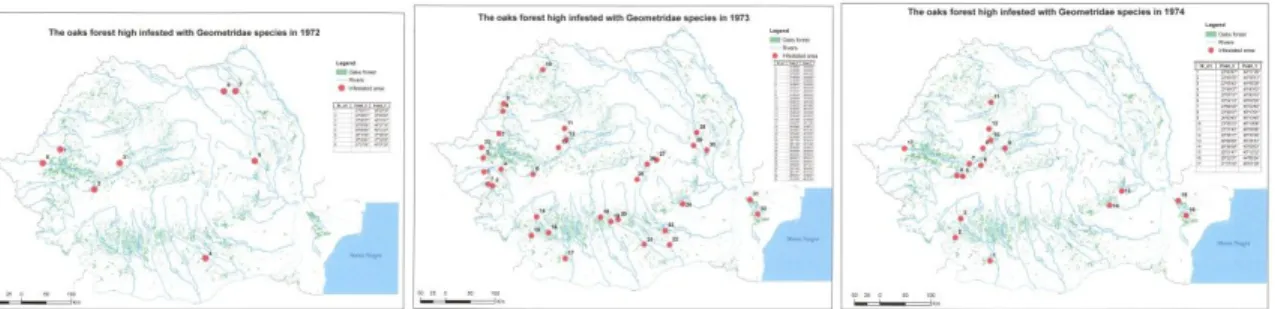
Figure 3. Spread of powerfull infestation with various species of Geometridae in the oak forests from Romania, the outbreak between 1972-1974
It followed a period of 7-8 years with isolated infestations that culminating in 1982 with powerfull infestations on approx. 58000 hectares, extended in oak forests from Carpathian hills of Muntenia (Wallachia) (Vâlcea, Argeş, Dâmboviţa, Prahova, Buzău) but also in Transylvania Plateau and Moldavian Plateau (Simionescu et al., 1992) (figure 4).
Figure 4. Spread of powerfull infestation with various species of Geometridae in the oak forests from Romania, the outbreak between 1980-1984
Between 1991-1993 it was recorded another outbreak, extended on a large area (approx 400000 hectares) but with low-middle infestations, only in the year 1992 the infestations were strong on approx. 13000 hectares (Simionescu, et al. 2001) (figure 5).
Figure 5. Spread of powerfull infestation with various species of Geometridae in the oak forests from Romania, the outbreak between 1991-1993
Between 1993-2006 the infestation had a weak-chronical character, with outbreak trend in the generation 2001/2002, punctiform manifested in some sessile oak forests in Buzau (Forest District Tisau, Forest District Parscov), which was relatively easy to stop by applying aerial treatments at the optimum time.
be considered the signal for beginning of the outbreak development that was to be conducted in other areas, between 2007-2010. Thus, in the fall of 2007, in most oaks forests in Carpathian hills of southern and south-eastern Muntenia (Arges, Dâmboviţa, Prahova, Buzau), there were strong flight of butterflies belonging to species of Geometridae. As a result, in the spring of 2008, in infested forests in these areas, there were partial defoliation (40-70%), manifested especially in sessile and pedunculate oak trees.
In generation 2008/2009, the outbreak had expanded both in surface and in intensity, including most of the deciduous forests in the respective area, sometimes, had recorded partial or total defoliation (figure 6), both on oak trees and in the mixed species(Carpinus,
Tilia , Acer, Prunus, s.a.).
Figure 6. Partial and total defoliation caused by caterpillars of Geometridae in Forest District Cotmeana, 2009
In generation 2009/2010 , infestations have expanded in area, but decreased abruptly in intensity due to the occurrence of biotic limitative factors (figure 7).
Figure 7. Spread of powerfull infestation with various species of Geometridae in the oak forests from Romania, the outbreak between 2008-2010
From the above it is observed that populations of various species of Geometridae from Romania had a cyclic evolution with a decadal perioadicitate nearly regular. This cyclicality of gradations is within the general tendency manifested at continental scale.
in East Europe to travel the same c. 3000 km distance. The average wave speed and wavelenght was 330 km/year and 3135 km, respectively, the high speed being incongruous with sedentary geometrids populations.
3. OUTBREAK CHARACTERISTICS BETWEEN 2007-2010
3.1. Site conditions and forest stand characteristics
Forest stands from Romanian Plain and Carpathian hills south and southeast where the species of Geometridae had developed mass multiplication between 2007-2010, belong to two major phytoclimatic area (***, 1960), namely, the vegetation area of hills and plateaus, subarea of sessile oak and lowland forest vegetation zone, subarea of pedunculate oaks (figure 8).
Figure 8. Map of forests from Romanian Plain and Carpathian hills of southern and south-eastern Muntenia which developed outbreak between 2007-2010. (Source: ***, 2008).
Generally, the specific composition of Geometridae, established in the adult stage, butterflies captured by rings of glue, in those areas was as follows: Opheroptera brumata - 90
%, Erannis defoliaria – 4 %, E. aurantiaria - 3 %, Alsophila aescularia – 2 % and other
species - 1 % (Erannis marginaria, Phigalia pedaria, Colotois pennaria etc.).
An analysis of forest stands structure in that region on groups of forest formations infested with these species of Geometridae, showed that the highest weight had the forest stands located in sessile oak subarea (70.6%) and only 29.4 % of total area of these forest stands were located in pedunculate oak subarea.
Figure 9. The percentage of area of infested forest stands in relation to the types of forest formations
Grouping by age classes of infested forest stands, shown in figure 10, showed that mature stands, between 40-80 years were most attacked by the caterpillars of species of Geometridae.
Figure 10. The percentage of area of infested forest stands (%) in relation to the age class
3.2. Evolution trend of populations
Grouping infested forest stands depending on composition, age, altitude, relief units etc. revealed the trend of the time evolution of outbreak, in relation to these characteristics.
In mixed forest stands, where the basic species was Quercus petraea or Quercus
robur, located on plateaus or in the upper southern slopes, the evolution trend of infestation
intensity differs greatly from that recorded for pure stands of oaks or of mixed but in which mixture species are predominant (figure 11).
Thus, in mixed stands, where the predominant species in composition were Quercus
generation (2009), reinfestion intensity was multiplied by a parabola degree 2, leading to an intensity of about 10 times higher than in the previous generation.
In mixed stands of oaks, but in which composition had higher share other deciduous species, in 2008, the intensity of infestation was higher (5-80%) compared with mixed stands of oaks in which the oak species had dominated in composition. However, the intensity of reinfection has evolved after a right, with a relatively small gradient, in the next generation (2009), leading to multiplier coefficients of infestation intensity only 1-3 times higher than in the previous generation.
Figure 11. Infestation intensity with species of Geometridae in forest stands with different compositions (Forest District Gaesti 2008-2009).
In pure forest stands of pedunculate oak or sessile oak, the trend in infestation intensity from generation 2008 to the next generation (2009) followed a slightly decreasing right, which explains the less favorable character of pure forest stands of oaks for mass multiplication of species of Geometridae.
Figure 12. Infestation intensity with species of Geometridae in forest stands with different ages (Forest District Gaesti 2008-2009)
During outbreak, populations of caterpillars have evolved and manifested differently from one forest to another, depending on the state of forest ecosystems infested and other factors. Such a development can be observed in figure 13 where are shown fluctuations of Geometridae populations in forest Glâmboc, Forest District Cotmeana, 2007-2010.
Figure 13. Evolution of catches of female butterflies on rings of glue, between 2007 - 2010, Glâmboc forest, Forest District Cotmeana, Arges
In the eruption phase (generation 2008/2009), the attacks were uniform both in surface and intensity, have recorded growth coefficients of population higher than unit (15-20), when the infestations were lower in 2007/2008 and smaller (4-5), when the infestations were larger in 2007/2008. The relationship between the rate of increase in intensity of infestations in generation 2008/2009 and the level of infestations in generation 2007/2008 were the type of power (y = axb) (figure 14).
Figure 14. The relationship between the rate of increase in intensity of infestation in generation (n + 1) and the intensity of infestation in generation n (n=2008). Forest District
Cotmeana, Arges
In generation 2009/2010 the infestation declined both in area and intensity, activity of parasitoids have been intensified and defoliation were very low. In november/december 2010, female flight was low, so that in generation 2010/2011 the population entered in latent phase.
CONCLUSIONS
The populations of different species of Geometridae from Romania have a cyclic evolution with a nearly regular decadal periodicity. This cyclicality of outbreaks is within general tendency manifested at continental scale.
At European level, outbreaks developed by species of Geometridae propagates through space as cyclical waves which crossing Europe from east-southeast to west-northwest. Thus, a wave that starts from an initial outbreak, southeastern Europe, reaches the Atlantic coast after 9-10 years (approx. 3000 km), they again form a new outbreak in east-southeast and so the cycle is repeated relatively regularly .
BIBLIOGRAPHY
1. Arsenescu M., Fratian Al., Iliescu Gh., PopescuT., Simionescu A., 1966 - Starea fito-sanitara a padurilor din RSR in perioada 1954 - 1964. Ed. Agro-Silvica, Bucuresti, 200 p.
2. Dissescu G., 1967 - Cercetari privind stabilirea unor metode noi de determinare a elementelor de prognoza la cotarii stejarului. Centrul de Documentare Tehnica pentru Economia Forestiera, Bucuresti, 253 p.
3. Simionescu A., 2012 - Cotari din sudul Romaniei. Editura Musatinii, Suceava, ISBN 978-973-1974-90-3, 188 p.
4. Simionescu A., Nitescu C., Vladescu D., Vladuleasa A., 1992 - Starea fitosanitară a pădurilor şi culturilor forestiere din RSR în perioada 1976-1985. Ed. Inter-Media, Bucuresti, 309 p.
5. Simionescu, A., Mihalciuc, V., Lupu, D., Vlăduleasa, A., Badea, O., Fulicea, T., 2001 - Starea de sănătate a pădurilor din România în intervalul 1986-2000. Ed. Muşatinii, Suceava, ISBN 973-8122-05-08, 934 p.
6. Ştefănescu M., Niţescu C., Simionescu A., Iliescu Gh., 1980 - Starea fitosanitară a pădurilor şi culturilor forestiere din România în perioada 1965-1975. Ed. Ceres, Bucureşti, 524 p.
7. Tomescu R., Neţoiu C., 2006 - Control of the broad leave's mains defoliators in Romania in 2005.Proceedings of IUFRO Working Party 7.03.10 Workshop on " Methodology of Forest Insect and Disease Survey in Central Europe", (CD), Federal Research & Training Centre for Forests, Natural Hazards & Landscape, Gmunden - Austria, 11-14 sept..
8. Tenow, O., Nilssen, A. C., Bylund, H., Pettersson, R., Battisti, A., Bohn, U., Caroulle, F., Ciornei, C., Csóka, G., Delb, H., De Prins, W., Glavendekić, M., Gninenko, Y. I., Hrašovec, B., Matošević, D., Meshkova, V., Moraal, L., Netoiu, C., Pajares, J., Rubtsov, V., Tomescu, R., Utkina, I., 2013 - Geometrid outbreak waves travel across Europe. British Ecological Society, Journal of Animal Ecology, vol.82, Issue 1,p: 84–95. doi: 10.1111/j.1365-2656.2012.02023.x
9. ***,1960 - Monografia Geografică a RPR, Bucureşti.