Developing program objectives in data analytic
field of study using three frameworks
Azad I. Ali, Indiana University of Pennsylvania, USA, [email protected]
David T. Smith, Indiana University of Pennsylvania, USA, [email protected]
Abstract
This paper presents a methodology and results in developing program as well as course objectives to be included in curriculum proposals. This study provide a literature review and uses steps of keyword indexing, thematic analysis, as well as the popular Bloom’s taxonomy field of text in effort to phrase program objectives that follow standards set for this purpose. A set of program objectives for a program in Data Analytics derived by this methodology is presented in the conclusions.
Keywords: Data analytic, business data analytics, big data analytics, and data science.
Introduction
“The era of big data and analytics is upon us and is changing the world dramatically. The field of Information Systems should be at the forefront of understanding and interpreting the impact of both technologies and management so as to lead the efforts of business research in the big data era. We need to prepare ourselves and our students for this changing world of business.” (Baesens, Bapna, Marsden, Vanthienen, & Zhao, 2016, p. 807)
Indeed the field of data analytics has been growing fast - there is increasing need for skills and expertise in this field, while the pressure has been mounting on academic programs to prepare their students for this vast changing field of study (Rahm, 2016). Many departments have responded to this demand and have prepared programs for data analytics (Mills, Chudabo, & Olsen, 2016), while others may still be working on developing data analytics programs. One of the departments that is taking preparatory steps to develop a program in data analytics is an Information Systems department at a university located in Western Pennsylvania.
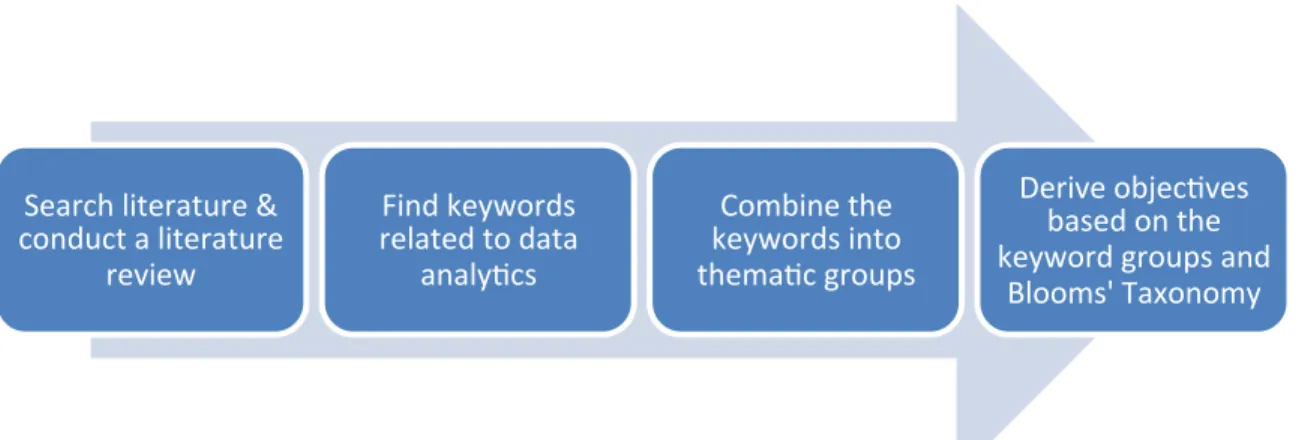
To achieve that goal, this paper outlines the following steps:
1. It first reviews the literature regarding the data analytics as a field of study 2. It identifies keywords that are specific to this fields of study
3. It combines the keywords into themes to be used in the program objectives
4. The paper then using Bloom’s Taxonomy phrases the themes into sentences that represent the program objectives for a program in data analytics.
Figure 1 depicts the steps that we followed in this paper.
Figure 1. Steps Used in Developing Program Objectives
Research Methodology
In this section, we present the methodology we used to derive program objectives for the field of data analytics. Our methodology begins with a literature review of the field. From the literature review we identify keywords using “Keyword Indexing”. Subsequently, the keywords are grouped into themes by applying “thematic analysis”. Lastly, program objectives are derived using “Blooms taxonomy”. Figure 2 shows the application of theses frameworks within the steps of this study. A further discussion of each framework is presented in this section.
Figure 2. Three Frameworks Used in This Study
Search literature & conduct a literature
review
Find keywords related to data
analyBcs
Combine the keywords into themaBc groups
Derive objecBves based on the keyword groups and
Blooms' Taxonomy
Literature
Review Keywords Thematic Groups Objectives Program
Keyword
Keywords Indexing
Keyword indexing is a technique widely used in different fields of study and in technological searches (in particular on the web). Ali and Kohun (2007) used it to identify keywords used to find a pattern in reasons for doctoral student attrition. Sobhi and Son (2010) advocated the use of keywords in studying the job trends in the industry. Smith and Ali (2014) used it to find patterns of jobs to group searches for particular jobs in Information Technology (IT).
The basic steps involved in keyword indexing start by reading through segments of text to identify keywords of the subject. Identified keywords are added to a list for consideration in the next step. In this study, we include a keyword for consideration if it “stands out” in the text. It could be a name of specific technology, method/process/technique for the storage/processing/output of data, or it describes specifics to the field of data analytics.
Thematic Analysis (or Thematic Mapping)
Clarke and Braun (2013) defined thematic analysis as “a method for identifying and analyzing patterns in qualitative data” (p. 120) and identified six phases of thematic analysis:
- Familiarization with the data - Coding
- Searching for themes - Reviewing themes
- Defining and naming themes - Writing up
The main purpose of thematic analysis is to group together keywords, ideas, concepts and others to make it easier to manage the situation. In other words, instead of being overwhelmed with numerous keywords, these keywords can be grouped together based on some kind of similar characteristics or based on certain classifications. These groups can then be explained as one unit that makes it easier to discuss and draw conclusion on each group as oppose to a diverse larger set of smaller discussions. Furthermore, identifying groups will aide in the formulation of the subject component of a program objective. The subject component is explained in the following section.
Bloom’s Taxonomy
Table 1. Example of a course objective
Object Verb Keyword Subject
The student Shall be able to remember Law of supply and demand In economics
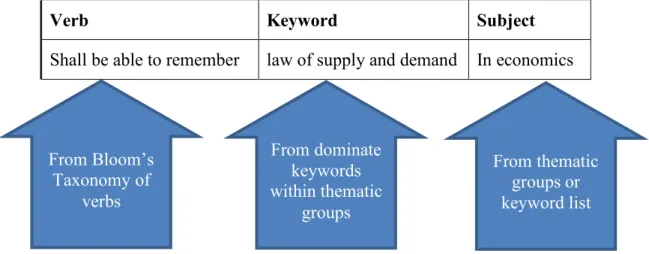
Krathwohl (2002) further suggested that most institutions omit from an objective sentence the first column (the object) listed in Table 1. In our study, we followed this suggestion and omitted “The Student” from listing the objectives of the program. Thus, the program objectives that we developed in this study will start with a verb, followed by a keyword and then the subject. The intent of keyword component of a program objective as explained by Krathwobl (2002) is not necessarily the keywords of resulting from step one of our methodology. However, we note that the keywords and thematically groups of our steps one and two can be used in the formulation of keyword and subject of a program objective. The subject may and will often be one of the identified thematic groups. It may also be one of the keywords in our final list. The keyword of the program objective may be one of the final list of keywords or it could be one of the keywords within the thematic group where the keyword appears to be serving as a major characteristic of a theme. Given these observations we formulate program objectives by composing the objective’s keyword and subject from our list of keywords, and thematic groups and selecting a verb from Bloom’s Taxonomy which best reflects the level of depth a topic is to be covered in our program, all of which is based on our determination and judgment. Figure 3 below shows the development process in formulating a program objective.
Figure 3. Construction of a Program Objective
Literature Review - The Era of Data Analytics
The field of “data analytics” is relatively recent area of study and different factors have contributed to its development. Chen, Chiang, and Storey (2012) explained that the field of data analytics started to emerge in the late 1990s for two reasons:
Verb Keyword Subject
Shall be able to remember law of supply and demand In economics
From Bloom’s Taxonomy of
verbs
From dominate keywords within thematic
groups
- Data became abundant and inexpensive
- The recognition that there is a value that can be gained from understanding the large volume of data extracted from different sources
Ong (2016) clarified that due to the mass increase of structured and unstructured sources of data, new technical solutions and managerial approaches were needed to handle the volume of data. As technical solutions and managerial approaches were developed, new programs emerged to teach these solutions and approaches (Rahm, 2016).
Chen et al. (2012) predicted that this field of study is on its way to significantly grow as the demands increase for experts who can understand how to extract meaning from the vast volume of data. Thus, the field of data analytics started to appear in academic programs in a variety of names. The most common names of programs that we found in our research include the following:
- Big data analytics - Business data analytics
- Business intelligence and analytics (BI&A)
Although the program appears under different names, this paper addresses all the names under one category of “data analytics” program. Thus, the discussion in this paper focuses on these programs as one connecting field of study. Presented in the following sections is our literature review of data analytics as an overview, as related to the input, processing, and output stages, and other issues.
Data Analytics Overview
Patel, Sundararajan, Marangos, and Zimmers (2016) described the development of data analytics as a field of study as follows:
- Historical and operational data may show significant undiscovered trends - These trends could reveal additional opportunities for business
- The existing technologies that existed before the appearance of “data analytics” field of study were not helpful in revealing these additional opportunities
- There was a need to develop technologies that reveal these future opportunities and thus programs that teach these technologies.
The most notable reference point when talking about introducing data analytics field of study is the 4Vs effect factors (Baesens et al., 2016; Bhadani & Jothimani, 2016; Gupta, Goul, & Dinter, 2015; McCafee & Brynjolfsson, 2012; Rahm, 2016). The 4Vs came in reference to four features that characterizes the development of data analytics, all which start with the letter V and they are: Volume, Variety, Velocity, and Value. An added and crucial note here is what mentioned by Davenport (2006) when explained that data analytic transformed technology from a supporting tool to a strategic weapon.
Input in Data Analytics
The advances of technology (including social media, Internet of Things (IoT), etc.) caused the following additions to existing technologies used for data input:
- Led to creating additional data sources
- Substantially added to the volume of data entered into computing resources - Further increased the methods by which data are transmitted and stored for further
processing
Choi, Chun, and Dalsang (2017) explained that the size of digital growth is over 40% a year and that the expected growth in data entry will double every two years, generating a continuous demand for more resources for data input. Furthermore, this is compounded by additional of sources of data. For example, McAfee, Brynjolfsson, Davenport, Patil, & Barton (2012) included Facebook, Twitter, and Smart Phones, as sources for input.
Assunção, Calheiros, Bianchi, Netto, and Buyya, (2015) identified a few sources of data from tweets, blogs, product evaluations and data from social networks. Likewise Choi, Chun, and Dalsang (2017) discussed sources for big data such as Internet based web, emails, social network services, Twitter, Facebook, YouTube, Amazon, etc. Hashem, Yaqoob, Anuar, Mokhtar, and Gani (2015) explained that the continuous increase in the volume and detail of data captured by organizations, such as the rise of social media, IoT, and multimedia has produced an overwhelming flow of data in either structured or unstructured format. Bhadani and Jothimani (2016) discussed other sources of data analytics like financial, healthcare, Internet of Things, media/entertainment, social media, telecommunications, transportation, video surveillance, and others.
Processing in Data Analytics
The increase in the volume of data and in different formats made most existing technologies incapable of processing the large data volume. As a result, new technologies encompassing new procedures, new techniques, and new hardware were needed. Furthermore, time to process the data is a major consideration in the era of data analytics. At the hardware level, the existing ‘one server’ per company proved to be insufficient to process large data volume. Instead, processing was handled on multiple servers and data files were not kept in the ‘structured only’ format that was prevalent in the past (Fowler, 2006). In regards to techniques for processing, Bhadani and Jothimani (2016) suggested to explore practices such as applying rule-based systems, pattern mining, decision trees, and other mining techniques to the large volume data that characterizes data analytics. Similarly, processing of the new volume of data needs to account for processing time. Chiang, Goes, and Stohr (2012) classified data processing according to required turnaround time, which can be divided into three categories: (a) batch, (b) near time, and (c) real-time. Likewise, Russom (2011) classified data processing in terms of four categories: (a) batch, (b) near time, (c) real time, and (d) streams of data.
In regards to the technologies that handle this new volume of data, several new technologies were developed, most notable is the Hadoop performance platform and the map reduce model (Khan, Huang, Taylor, Ashton, & Khan, 2017). Fowler, Walker, Williams, and McDonald (2015) noted that other technologies involved in the selection within the context of processing data in data analytics, like NOSQL database (‘non SQL’ or ‘non relational’) for semi-structured data. For example, CouchDB™ that is often used for processing NOSQL data sets. Data analytics processing may include additional dimensions such as visualization, exploration, simulation, and optimization (Ong, 2016). Likewise, Watson (2014) noted data analytics processing for executive information systems, online analytical processing (OLAP), and dashboard/score board.
Output in Data Analytics
To provide a realizable value from data analytics the output must extend beyond reports and listings in order to aid management in: decision making, enhancing business performance, and increasing business opportunities. This includes charts, graphs, summary reports, and dashboard/scoreboard. For example, Assunção et al. (2015) suggested that the availability of data collected from consumer surveys coupled with private information collected through Internet searches could open a wide range of possibilities for business to better understand the needs of their customers. Polanka (2013) noted that output from data analytics might include pattern attitudes, market trends, and cost analysis. Gupta, Goul, and Dinter (2015) took this a step further and suggested that output generated from data analytics can be used in the Executive Information System (EIS). Other uses of data analytic output include:
• Data segmentation and clustering (Khan et al., 2017)
• Classification and regression analysis (Baesens et al., 2016)
• Data mining analysis, hidden trends, and guided decision making (Patel et al., 2016) • Business bench mark performance management (Chen et al., 2012)
• Predictive analysis (Sitton, 2016)
Data analytics field can also be merged in the emerging fields of cloud computing. Cuzzocrea et al. (2011) noted about the design and the use of Data-as-a-Service (DaaS) and Infrastructure-as-a-service (IaaS) as applications for cloud computing typically uses different data analytic techniques.
Other Issues in Data Analytics
In addition to the three main stages, our literature review found several important topics that span data analytics. For example, Gupta et al. (2015) talked about the ethical issues, security issues, privacy issues, and future emerging issues. Verma and Voida (2016) explained some of the drawbacks, errors, and biases from the use of data analytic programs and the resulting influences on organizations. Verma (2016) also talked about the epistemological biases that could be generated from data analytics. Royster (2013) explained that data entered from various resources could generate a large volume of output that may contain errors. To address this problem an additional stage of “scrubbing” maybe needed to remove errors and limit excess information before final output.
Discussion and Findings
In this section, we describe our findings from sifting through the literature review and going through the different stages of input, processing and output. As noted earlier, we consider keywords when they “stand out” among the words.
Stage 1: Identifying Keywords
Input stage keywords: Internet of Things, Facebook, Twitter, Smart Phones, Tweets, blogs, product evaluations, structured data, unstructured data, semi-structured data, and data extraction.
Processing stage keywords: One server, multiple servers, rules-based, pattern mining, decision trees, structured only, rule based, batch, near time, real-time, Hadoop performance, Map reduce model, NoSQL, CouchDB™, scientific applications, medical information systems, e-government applications, extraction-transformation loading (ETL), and process from low-level data.
Output stage keywords: Chart and graph analysis, data segmentation, classification and regression analysis, data mining analysis, hidden trends, guided decision making, business bench mark performance management, prediction analysis for structured data, pattern recognition, traffic management through data analysis, and predictive analysis.
Keywords from other issues in Data Analytic: ethical issues, security issues, privacy concerns, future emerging issues, epistemological biases, errors in data analytic, and scrubbing of data.
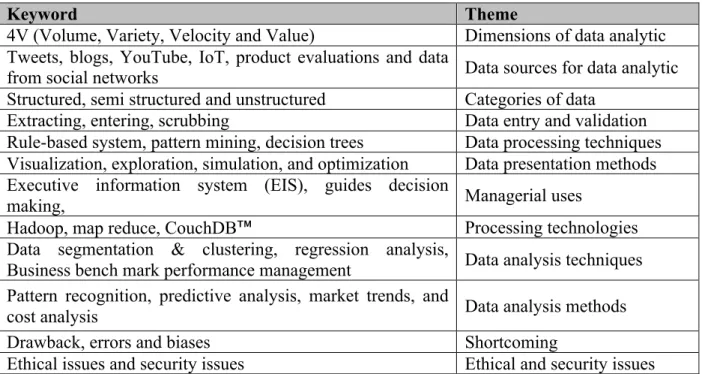
Stage 2: Grouping Keywords
Table 2: Grouping of Keyword into Themes for Data Analytics
Keyword Theme
4V (Volume, Variety, Velocity and Value) Dimensions of data analytic Tweets, blogs, YouTube, IoT, product evaluations and data
from social networks Data sources for data analytic
Structured, semi structured and unstructured Categories of data
Extracting, entering, scrubbing Data entry and validation Rule-based system, pattern mining, decision trees Data processing techniques Visualization, exploration, simulation, and optimization Data presentation methods Executive information system (EIS), guides decision
making, Managerial uses
Hadoop, map reduce, CouchDB™ Processing technologies
Data segmentation & clustering, regression analysis,
Business bench mark performance management Data analysis techniques Pattern recognition, predictive analysis, market trends, and
cost analysis Data analysis methods
Drawback, errors and biases Shortcoming
Ethical issues and security issues Ethical and security issues
Stage 3: Selecting Verbs from Bloom’s Taxonomy
In our selection for verbs to complete our objectives, we relied on verbs suggested in Bloom’s Taxanomy. Bloom’s taxonomy suggests different verbs that can be included in course or program objectives. The benefit of these words listed in the taxonomy is that they are measurable. That is, the outcome from these verbs can be measured and thus achievement can be gauged whether or not the objective is met. Bloom’s taxonomy is divided into a hierarchy that provides measurement according to levels of thinking of complexity. Verbs listed at the higher levels (e.g. design, appraise, & construct) in the hierarchy present more complex and more in-depth understanding. While verbs listed in the lower level (e.g. define, describe, & identify) require less depth coverage and lesser level of knowledge. Our goal was to diversify the inclusion of verbs in our objectives to avoid the use of redundant words and to include different levels of coverage as required and deemed appropriate for the program. For coverage that requires the learning of technologies, we deemed that higher level of coverage is helpful to the students. For other subjects like “security” and “ethical values” they requires less coverage because we cover similar topics in other courses.
Resulting List of Objectives
• Identify data sources that contributed to data analytics field • Compare and contrast the different categories of data sources • Employ various methods for data entry, validation and correction • Compare and contrast the different data processing techniques • Prepare different methods of output presentation in data analytics • Assess the managerial uses of output from data analytics
• Apply appropriate technologies in the processing of data analytics • Appraise the different techniques used in data analytics
• Design means for uses of data analytic methods • Evaluate the shortcoming of data analytics field
• Articulate the ethical and security concerns in data analytics
Summary
In this paper, we presented a methodology to derive program objectives. Our methodology begins with a literature search and then uses keyword indexing to identify a set of keywords. The keywords are then grouped into themes by applying “thematic analysis.” Lastly, program objectives are derived from the keywords and themes by applying Blooms taxonomy. We applied our methodology to the field of data analytics with the goal of developing a set of program objectives for a new program at our university. We found our methodology to be effective and successful in developing program objectives for proposal of a program in data analytics. Given this success, we believe our methodology to be sound and we recommend its use for development of program objectives in other fields of study.
References
Ali, A., & Kohun, F. (2007). Dealing with social isolation to minimize doctoral attrition – A four stage framework. International Journal of Doctoral Studies, 2, 33-49.
Assunção, M. D., Calheiros, R. N., Bianchi, S., Netto, M. A., & Buyya, R. (2015). Big data computing and clouds: Trends and future directions. Journal of Parallel & Distributed Computing, 79/80, 3-15. doi:10.1016/j.jpdc.2014.08.003
Baesens, B., Bapna, R., Marsden, J. R., Vanthienen, J., & Zhao, J. L. (2016). Transformational issues of big data and analytics in networked business. MIS Quarterly, 40(4), 807-818. Benjamins, W. R. (2014). Big data: From hype to reality? Proceedings of the 4th International
Conference on Web Intelligence, Mining and Semantics, 2:1-2:2.
Bhadani, A., & Jothimani, D. (2016), Big data: Challenges, opportunities and realities, In Singh, M.K., & Kumar, D.G. (Eds.), Effective Big Data Management and Opportunities for Implementation (pp. 1-24), Pennsylvania, USA: IGI Global.
https://www.ftc.gov/news-events/press-releases/2016/01/ftc-report-provides-recommendations-business-growing-use-big-data
Buzikashvili, N. (2007). Sliding window technique for the web log analysis. Proceedings of the 16th international conference on World Wide Web, 1213-1214.
Carlberg, C. (2018). Statistical analysis, Microsoft Excel 2016. Indianapolis, IN: QUE Publishing.
Chen, H., Chiang, R., & Storey, V. C. (2012). Business intelligence and analytics: From big data to big impact. MIS Quarterly, 36(4), 1165-1188.
Chiang, R. L., Goes, P., & Stohr, E., A. (2012). Business intelligence and analytics education, and program development: A unique opportunity for the information systems discipline.
ACM Transactions on Management Information Systems, 3(3), Article 12.
Choi, H. Y., Chun, S. G., & Dalsang, C. (2017). An explanatory study on the business analytics program in the U.S. universities. Issues in Information Systems, 18(2), 1-8.
Christozov, D. (2017). Business analytics as a tool to transforming information into an informing system: The case of the on-line course registration system. Informing Science: The International Journal of and Emerging Discipline, 20(1), 167-178.
Clarke, V., & Braun, V. (2013). Teaching thematic analysis: Overcoming challenges and developing strategies for effective learning. The Psychologist, 26(2), 120-123.
Connolly, T., & Begg, C. (2010). Database systems, a practical approrach to design, implementation, and management. Boston, MA: Addison Wesley.
Corsini, P., & Marcelloni, F. (2006). A fuzzy system for profiling web portal users from web access log. Journal of Intelligent & Fuzzy Systems, 17, 503–516.
Cuzzocrea, A., Song, I.-Y., & Davis, K. C. (2011). Analytics over large-scale multidimensional data: The big data revolution! Proceedings of the 14th ACM International Workshop on Data Warehousing and OLAP, 101–104.
Das, R., & Turkoglu, I. (2009). Creating meaningful data from web logs for improving the impressiveness of a website by using path analysis method. Expert Systems with Applications, 36(3), 6635-6644.
Data Processing (2012). In Merriam-Webster.com. Retrieved from http://www.merriam-webster.com/dictionary/dataprocessing
Davenport (2006, January). Competing on analytics. Harvard Business Review, 84(1). 98-107. Fowler, B., Walker, H., Williams, J., & McDonald, D. (2015). Integrating NoSQL in the
classroom. Proceedings of the 2015 Southern AIS Conference, 1-5. Retrieved from http://aisel.aisnet.org/sais2015/25
Gandomie, A., & Haider, M. (2015). Beyond the hype: Big data concepts, methods, and analytics. International Journal of Information Management, 35, 137–144.
Gupta, B., Goul, M., & Dinter, B. (2015). Business intelligence and big data in higher education: status of a multi-year model curriculum development effort for business school undergraduates, MS graduates, and MBAs. Communications of the Association for Information Systems, 36(23), 449-476. Retrieved from http://aisel.aisnet.org/ cais/vol36/iss1/23
Hashem, I., Yaqoob, I., Anuar, N., Mokhtar, S., & Gani, A. (2015). The rise of “big data” on cloud computing: Review and open research issues. Information Systems, 47(1), 98-115. Krathwohl, D. (2002). A revision of bloom's taxonomy: An overview. Theory Into Practice,
41(4), 212-218.
Khan, M., Huang, Z., Li, M., Taylor, G. A., Ashton, P. M., & Khan, M. (2017). Optimizing hadoop performance for big data analytics in smart grid. Mathematical Problems in Engineering, 2017, 1-11. doi:10.1155/2017/2198262
Lim, E. P., Chen, H., & Chen, G. (2013). Business intelligence and analytics: Research directions. ACM Transactions on Management Information Systems, 3(4), 1-10.
Mahapatra, T., Gerostathopoulos, I., & Prehofer, C. (2016). Towards integration of big data analytics in Internet of Things mashup tools. Proceedings of the Seventh International Workshop on the Web of Things, 11-16.
McAfee, A., Brynjolfsson, E., Davenport, T. H., Patil, D. J., & Barton, D. (2012). Big data: The management revolution. Harvard Business Review, 90(10), 60-68.
Mills, R. J., Chudoba, K. M., & Olsen, D. H. (2016). IS programs responding to industry demands for data scientists: A comparison between 2011 - 2016. Journal of Information Systems Education, 27(2), 131-140.
Ong, V. K. (2016). Business intelligence and big data analytics for higher education: Cases from UK higher education institutions. Information Engineering Express, 2(1) 65-75.
Patel, K., Sundararajan, S., Marangos, C., & Zimmers, E. W. (2016). Discovering hidden connections with big data. Industrial Engineer, 48(4), 37-42.
Phillips-Wren, G., Iyer, L. S; Kulkarni, U., & Ariyachandra, T. (2015). Business analytics in the context of big data: A roadmap for research. Communications of the Association for Information Systems, 37(23), 448-472.
Polanka, S. (2013). Big data, little numbers: Sources for ebook statistics. Online Searcher, 71-73. Rahm, E. (2016). Big data analytics. Information Technology, 58(4) 155-156.
Royster, S. (2013). Working with big data. Occupational Outlook Quarterly, 1, 2-9. Russom, P. (2011). Big data analytics. TDWI Best Practices Report, 2011(4).
Smith, D., & Ali, A. (2014). Analyzing computer programming job trend using web data mining.
Issues in Informing Science and Information Technology, 11(1), 203 - 214.
Sobhi, M. S., & Son, B. G. (2010). Content analysis of OR job advertisements to infer required skills. Journal of Operational Research, 61(9), 1315-1327.
Verma, N. (2016). Towards re-orienting the big data rhetoric. Proceedings of the 19th International Conference on Supporting Group Work, 505-508.
Verma, N., & Voida, A. (2016). Mythologies of business intelligence. Proceedings of the 19th International Conference on Supporting Group Work, 2341-2347).
Watson, H. J. (2014). Tutorial: Big data analytics: Concepts, technologies, and applications.
Communications of the Association for Information Systems, 34(65), 1247-1268.
Wixom, B., Aruyachanrdra, T., Goul, M., Gray, P., & Kulkarni, U. (2011). The current state of business intelligence in academia. Communication of the Association for Information Systems, 29(16), 300-313.
Authors’ Biographies
Azad Ali, D.Sc., Professor of Information Technology at Eberly College of Business – Indiana University of Pennsylvania has 34 years of combined experience in areas of financial and information systems. He holds a bachelor degree in Business Administration from the University of Baghdad, an M.B.A. from Indiana University of Pennsylvania, an M.P.A. from the University of Pittsburgh, and a Doctorate of Science in Communications and Information Systems from Robert Morris University. Dr. Ali’s research interests include service learning projects, web design tools, dealing with isolation in doctoral programs, and curriculum.