Water Pumping Arrangement for Solar PV
ImpartialUtilizing PMSM Drive
V.S Lovaraju, S Venkatesh, B.Jagannadha Rao Department Of Electrical And Electronics Engineering Asst..Prof.. inIndo American Institutions Technical campus
Sankaram, Anakapalle, Visakhapatnam , Pin - 531 001 [email protected],[email protected], [email protected]
Abstract:
This paper assesses courses in which they can be made productive. The part of productivity principles in accomplishing this objective and the propriety of existing measures is assessed. With the constant diminishing of the expense of sun oriented cells, there is an expanding intrigue and needs in photovoltaic (PV) framework applications taking after way of life changes. Water pumping framework fueled by sun powered cell generators are a standout amongst the most imperative applications. The variance of sun oriented vitality on one hand and the need to improve accessible sun based vitality on the other, it is valuable to grow new effective and adaptable modes to control engines that entrain the pump. A vectorial control of a no concurrent engine sustained by a photovoltaic framework is proposed. This paper examines a photovoltaic-electro technician chain, made out of a PV generator, DC-AC converter, a vector controlled affectation engine and outward pump. The PV generator is compelled to work at its greatest force point by utilizing a fitting hunt calculation incorporated in the vector control. The enhancement is acknowledged without need to adding a DC-DC converter to the chain. The engine supply is likewise guaranteed in all separation conditions. Reproduction results demonstrate the viability and achievability of such a methodology. Results are displayed in view of MATLAB/SIMULINK. This report proposes another converter for photovoltaic water pumping without the utilization of substance stockpiling components, for example, batteries. The converter is intended to drive a PMSM Motor specifically from PV vitality. The utilization of PMSM Motor gives a superior answer for the business dc engine water pumping framework.
Keywords: photovoltaic power systems, solar power
generation PV system, Water Pumping System. I. Introduction:
The world's expanding vitality request, because of the advanced modern culture and populace development, is spurring a great deal of interests in option vitality arrangements, with a specific end goal to enhance
pumping framework is driven by an AC engine (PMSM or IM), a chopper and/or an inverter ought to be incorporated keeping in mind the end goal to perform the DC-AC transformation stage. For PV water pumping frameworks, two sorts of pumps are broadly utilized, the volumetric pump and the outward pump. It is found that the PVG vitality used by the divergent pump is much higher than by the volumetric pump. Truth be told, on account of the outward pumps, the operation happens for more periods notwithstanding for low protection levels, and the heap trademark is in closer closeness to the PVG most extreme force locus. In PV water pumping frameworks, the most extreme force point following (MPPT) is normally utilized as online control method to track the greatest yield force working purpose of the PVG for diverse working states of protection and temperature of the PVG. Diverse streamlining methodologies have been proposed to enhance the general framework proficiency.
II. Problem Definition:
The majority of the available commercial converters are based on an intermediate storage system, performed with the use of lead-acid batteries, and dc motors to drive the water pump. More sophisticated systems have already been developed with the use of a low-voltage synchronous motor and fuel cell, but these, although presenting higher efficiency, are too expensive to be used in poor communities that need these systems. The batteries allow the motor and pump system to always operate at its rated power even in temporary conditions of low solar radiation. This facilitates the coupling of the electric dynamics of the solar panel and the motor used for pumping [1] Generally, the batteries used in this type of system have a low life span, only two years on average, which is extremely low compared to the useful life of 20 years of a PV module. Also, they make the cost of installation and maintenance of such systems substantially high. Furthermore, the lack of battery replacement is responsible for the failure of such systems in isolated areas. [1] The majority of commercial systems use low-voltage dc motors, thus avoiding a boost stage between the PV module and the motor. Unfortunately, dc motors have lower efficiency and higher maintenance cost compared to induction motors & PMSM and are not suitable for applications in isolated areas, where there is no specialized personnel for operating and maintaining these motors. Another problem is that low-voltage dc motors are not ordinary items in the local markets. Because of the aforementioned problems, this work adopted the use of a PMSM motor, due to its greater robustness, lower cost, higher efficiency, availability in local markets, and lower maintenance cost compared to other types of motors.
The required dc/dc converter for this kind of system needs to have a large voltage conversion ratio because of the low-voltage characteristic of the PV panels and small input current ripple so that it does not cause oscillation over the maximum power point(MPP) of the PV module [20]-[22], thus ensuring the maximum utilization of the available energy. The commonly used isolated voltage-fed converters normally have a high input current ripple, which forces the converter to have large input filter capacitors. These are normally electrolytic, which are known to have a very small lifetime and thus affect the overall life span and mean time before failure of the converter. Furthermore, the inherent step-down characteristic of the voltage-fed converters, the large transformer turns ratio needed to boost the output voltage, the high output diode voltage stress, and the need of an LC output filter [1] make voltage-fed converters not the best choice for this application. When compared to the voltage-fed topologies, current-fed converters have some advantages. Usually, they have an inductor at the input, so the system can be sized to have input current ripple as low as needed, thus eliminating the need of the input capacitor at the panel voltage. Current-fed converters are normally derived from the boost converter, having an inherent high step-up voltage ratio, which helps to reduce the needed transformer turns ratio. The design of a motor drive system powered directly from a PV source demands creative solutions to face the challenge of operating under variable power restrictions and still maximize the energy produced by the module and the amount of water pumped. These requirements demand the use of a converter with the following features: high efficiency-due to the low energy available; low cost-to enable its deployment where it is most needed; autonomous operation-no specific training needed to operate the system; robustness-minimum amount of maintenance possible; and high life span-comparable to the usable life of 20 years of a PV panel.[1] The use of a PMSM Motor presents a better solution to the commercial dc motor water pumping system. The development is oriented to achieve a more efficient, reliable, maintenance-free, and cheaper solution than the standard ones that use dc motors or low-voltage synchronous motors. The developed system is based on a current-fed multiresonant converter also known as resonant two-inductor boost converter.
From above discussion it has been identified that problems are as follows.
Low-voltage synchronous motor and DC motor are costly and require maintenance respectively, again they are not rarely available in market.
Commonly used isolated voltage-fed converters need large input filter capacitors which are normally electrolytic & LC output filter whose lifespan is small.
III. Facilitation Of Pv Pumping
This section looks at what will facilitate the use of PV pumping beyond the financial case which was demonstrated in section 3 and commences with a high level analysis of the approximate number of boreholes which are suitable for Namibia
High Level Market Potential Assessment
This section explores the potential for PVPs through looking at the number of boreholes which are suitable for PVP operation.
The Division of Geohydrology operating under the Department of Water Affairs (DWA) within the Ministry of Agriculture, Water and Rural Development maintains a record of boreholes in Namibia. Although it is mandatory that all boreholes are registered with the DWA, in reality some of the boreholes drilled have not been registered. With the borehole survey of 2003 a database of 51,500 boreholes was established.
The Resource Management Unit at the Department of Water Affairs determines sustainable abstraction rates for the boreholes based on a holistic resource management approach which takes into consideration the overall groundwater resources, the different types of aquifers and the recharging of the groundwater resources, among others. The unit advises the
Directorate of Rural Water Supply (DRWS) on the appropriate abstraction rates for boreholes in the communal areas.
IV. Unit water cost
The unit water cost (UWC) reflects the cost of water and therefore provides a measure for the cost at which water at a particular installation needs to be sold at in order to recover the all-inclusive costs for providing the water supply service.The UWC is calculated from the life cycle cost based on the assumption that the capital for the implementation of the water supply system is borrowed from the bank against the real loan rate. The LCC is therefore amortized into equal annual payments over the project life. The resulting annual payments are divided by the annual water delivery to yield the UWC. Table lists the calculated UWC for a range of heads and daily flow rates based on the pumping schedule as described in section 3.2.3.2 and the reference case parameters described in Table. From the UWC figures it is evident that the cost of water increases with increasing head (more solar PV required) and decreases with increasing water volume pumped (higher efficiency). The yellow fields represent single PVP solutions, the orange fields represent parallel Grundfos systems in the same borehole and the blue fields represent Total Energie TSP 2000+ PVPs. The UWC reflect these changes in systems through a discontinuity in the trends.
The UWCs of DPs are listed in Table. The same pricing trends are observed as for the UWCs of PVPs, i.e. the UWC at high head and low volume has the highest value and the UWC at lowest head and highest daily flow rate has the lowest value.
V. Proposed Work
The proposed IM photovoltaic pumping system considered in this work is shown in Fig. typical model of proposed system is Photovoltaic based water pumping system is one of the most common applications of distributed energy generation system. The three-phase inverter generates a variable frequency output waveform to drive the IM and the motor drives a centrifugal pump that delivers the water output.
In general IM drive can be based on v/f control, indirect field oriented control (IFOC) and slip control. The IFOC and the slip control ensure the decoupling between the flux control and the torque control. Those control methods are necessary in order to ensure the consumption of energy by the machine acting on the electromagnetic torque, Te. Several
types of pumps and motors are available on the PV pumping market. The most commonly employed pump type is the Centrifugal pump. Single-stage centrifugal pumps are frequently used in PV shallow [m] 20 40 60 80 120 160 200
Daily volume flow [m³/day]
3 6 8 13 17
25
33 50
6.33 3.38 2.09 1.54 1.27 0.99 0.85 0.87
5.64 3.15 2.53 1.90 1.59 1.65 1.40 1.57
6.09 3.51 2.86 2.21 2.49 1.97 2.38 2.08
6.49 3.96 3.33 2.93 2.98 3.18 2.75 2.43
water pumping for low head applications. For PV subterranean water pumping and surface water pumping with higher heads, multistage centrifugal pumps are more suitable. Other pump types such as progressive cavity pumps and piston pumps have also been utilized. The centrifugal pump is characterized by its head-flow rate performance curve at the nominal speed. The flow rate is directly proportional to the impeller speed, the head is proportional to the square of the speed and the hydraulic power is proportional to the cube of the speed. The performance curves of the pump with good accuracy at high speeds but they are not very accurate at low speeds and/or with constant head applications. For very low speeds, the pressure produced by the pump is less than the static pressure and the rotation just circulates the water within the pump.
Fig. The proposed IM photovoltaic pumping system configuration
Fig.: Typical model of proposed system VI. RESULTS AND DISCUSSIONS
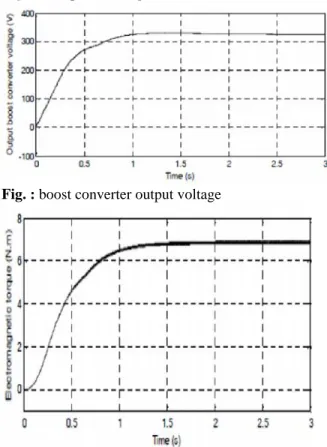
Results are presented based on individual performances of system components and those are:Fig. shows the response of dc-link voltage which is equals to the photovoltaic voltage and from Fig., it is clear that stable dc link voltage is achieved by proposed controller. The replies in depicted dc voltage are mainly due to rapidly change in temperature and solar irradiance. The dc voltage of PV system is almost stable at t=0.6sec. Initially (at t=0) it is starting from open circuit voltage because of MPPT algorithm and boost converter. The corresponding output of boost converter is presented in Fig. 5. From Fig. 5, due to boost controller, it mitigates the ripples in input voltage, i.e., solar panel
voltage.From Figures and, it proves that system is working in maximum power point level with constant voltage algorithm. Corresponding electromagnetic torque generated by motor and speed of induction motor are shown in Fig. 6 and Fig. respectively. The motor speed and torques are reached their reference value, after settling dc-link voltage. And from Fig. 6 and 7, clearly observed that speed and torques are gradually increasing because of proper control algorithm implemented in proposed system. And also, noted that due to good and dynamical enhance of proposed system, almost ripples in both speed and torque are zero.
Fig.: Solar panel voltage
Fig. : boost converter output voltage
Figure. Run-up response of a SyncRel motor with and without control for different insolation levels. (Color figure available online)
VII. Conclusion
The converter used here has low input current ripple, low cost and high step-up characteristics. The multi-resonant tank provides high voltage gain and absorbs the parasitic parameters of the transformer. By employing the voltage doubler at the load side, the turns-ratio of transformer could be halved. With this TIBC system, the input voltage of 18 Volts is boosted to 35 volts. The output of the converter system is given to the inverter system. Here SPWM control is used. MPPT control is provided to operate the PV cell in maximum power. Solar PV water-pumping systems are simple, reliable, conserve energy and need less maintenance.Control strategies to regulate the flow of water supply of a PV based water pumping system through induction motor is presented in this paper. Hence, proposed system provides cost effective solution for PV based water pumping system for Agricultural sector. Moreover, for best utilization of PV, MPPT is incorporated to system. The power balance between PV generation and load is achieved by maintaining dc link voltage at its reference value (Vmpp) and controlling the speed of
induction motor within permissible limits based on vector control. The proposed integrated controller requires only measurements of dc link voltage and load current and no need to measure the power. Through the simulation results it is concluded that performance of the controllers is satisfactory under steady state as well as dynamic conditions.
References
[1] J. Mapurunga Caracas, G. De Carvalho Farias, L. Moreira Teixeira, and L. De Souza Ribeiro, “Implementation of a highefficiency, high-lifetime, and lowcost converter for an autonomous photovoltaic water pumping system,” Industry Applications, IEEE Transactions on, vol. 50, pp. 631–641, Jan 2014.
[2]akihiro oi, “Design and simulation of photovoltaic water pumping system,” thesis presented to the faculty of California polytechnic state university san luis obispo, Jan 2005.
[3] M. Maupoux, Solar PV Water pumping. Practical Action, The Schumacher Centre, Bourton on Dunsmore, Rugby, Warwickshire, CV23 9QZ, UK, 2010.
[4] A. Doig, Solar Photovoltaic energy. Practical Action, The Schumacher Centre, Bourton on Dunsmore, Rugby,
Warwickshire, CV23 9QZ, UK, April 2012.
[5] M. Vitorino, M. Beltrao de Rossiter Correa, C. Jacobina, and A. Lima, “An effective induction motor control for photovoltaic pumping,” Industrial Electronics, IEEE Transactions on, vol. 58, pp. 1162– 1170, April 2011.