Editor in Chief
Alfonso Vargas-Sánchez, University of Huelva, Spain
Associate Editor
T.C. Huan, National Chiayi University, Taiwan
Books Review Editor
Steve Watson, York St. John University, United Kingdom
Secretariat
Cinta Borrero-Domínguez, University of Huelva, Spain Mirko Perano, University of Salerno, Italy
Style reviewer and text editor
Beatriz Rodríguez-Arrizabalaga, University of Huelva, Spain
Editorial Board
José Manuel Alcaraz, Barna Business School, República Dominicana
Mario Castellanos-Verdugo, University of Seville, España José Antonio Fraiz-Brea, University of Vigo, España José Manuel Hernández-Mogollón, University of Extremadura, España
Shaul Krakover, Ben Gurion University, Israel
Jean Pierre Levy-Mangin, University of Quebec, Canadá Tomás López-Guzmán, University of Córdoba, España Alfonso Morvillo, National Research Council (CNR), Italia Yasuo Ohe, Chiba University, Japón
María de los Ángeles Plaza-Mejía, University of Huelva, España
Nuria Porras-Bueno, University of Huelva, España João Albino Silva, Algarve University, Portugal
Advisory Board (Spanish Members)
César Camisón-Zornoza, Jaume I University, Spain Enrique Claver-Cortés, University of Alicante, Spain María Teresa Fernández-Alles, University of Cádiz, Spain José Luis Galán-González, University of Seville, Spain Félix Grande-Torraleja, University of Jaén, España Inmaculada Martín-Rojo, University of Málaga, Spain Antonio Manuel Martínez-López, University of Huelva, España
Francisco José Martínez-López, University of Huelva, Rector, España
María Jesús Moreno-Domínguez, University of Huelva,
Francisco Riquel-Ligero, University of Huelva, España Josep Francesc Valls-Giménez, ESADE, España
Advisory Board (Other European
Members)
Paulo Aguas, Algarve University, Portugal Gustavo Barresi, University of Messina, Italy Carlos Costa, Aveiro University, Portugal
Salvatore Esposito de Falco, University of Rome “La Sapienza", Italy
Sheila Flanagan, Dublín Institute of Technology, Ireland Tania Gorcheva, Tsenov Academy of Economics, Bulgaria Tadeja Jere-Lazanski, University of Primorska, Slovenia Metin Kozak, Mugla University, Turkey
Álvaro Matias, Lusiada University, Portugal Claudio Nigro, University of Foggia, Italy
Angelo Presenza, University "G. D'Annunzio" of Chieti-Pescara, Italy
Renee Reid, Glasgow Caledonian University, United Kingdom
Advisory Board (Members from the rest
of the world)
John Allee, American University of Sharjah, United Arab Emirates
Nestor Pedro Braidot, National University of La Plata, Argentina
Roberto Elias Canese, Columbia University, Rector, Paraguay
Luca Casali, Queensland University of Technology, Australia Nimit Chowdhary, Indian Institute of Tourism and Travel Management, India
Steven Chung-chi Wu, National Pingtung University of Science and Technology, Taiwán
Dianne Dredge, Southern Cross University, Australia Daniel Fesenmaier, Temple University, United States Babu George, University of Southern Mississippi, United States
Dogan Gursoy, Washington State University, United States Kanes Rajah, Tshwane University of Technology, South Africa
Albert Yeh Shangpao, I-SHOU University, Taiwán Pauline Sheldon, University of Hawaii, United States Germán A. Sierra-Anaya, University of Cartagena de Indias, Rector, Colombia
201
Enlightening Tourism. A Pathmaking Journal, Vol 5, No 2 (2015), pp. 201-221 ISSN 2174-548X
THE PROFESSIONALIZATION PROCESS OF
CULTURAL MANAGER: AN ISOMORPHIC VIEW
*
Claudio Nigro
University of Foggia (Italy)
[email protected]
Enrica Iannuzzi
University of Foggia (Italy)
[email protected]
Flora Cortese
Giustino Fortunato University (Italy)
[email protected]
Petracca, Miriam
Giustino Fortunato University (Italy)
[email protected]
*
202
Enlightening Tourism. A Pathmaking Journal, Vol 5, No 2 (2015), pp. 201-221 ISSN 2174-548X
ABSTRACT
The paper investigates the ‘professionalization’ process of the Italian cultural heritage. In particular, it aims to propose an own interpretation of the ‘professionalization’ process, as a dissemination of ‘good’ practices, adopting the point of view of new institutionalism theory. This theoretical approach frames the professionalization process, and then that of managerialization, as the material and symbolic conditioning that the institutions have on human behavior: the professional has the ability of government and management; through professional training will be ensured the dissemination of the same capacity and then the ‘good’ practices. In this scenario Italian universities seem to contribute to the dissemination of artistic-cultural heritage management practices. This research, which has purely theoretical aims, starts from a quick reference to the regulatory framework evolution and a synthesis of scientific debate on the governance of cultural heritage; then, it will propose a reflection of the role that Universities currently have in the diffusion process of professions for the government and management of cultural heritage. In this way, the paper links the governance of the artistic-cultural heritage with the ‘training process’ that universities do for professionalizing human resources. University nowadays are conducting training projects for ‘cultural manager’, sometimes anticipating the decision of Public Administration, trying to condition them, sometimes following its strategic directions.
KEYWORDS
Cultural heritage; Professionalization; New-institutionalism; Isomorphism; Dissemination; Training process.
ECONLIT KEYS L83; O17.
1.INTRODUCTION
This paper investigates the ‘managerialization’ process of the Italian cultural heritage, with particular reference to the dynamics of governance of the Italian state museums. The inspiration comes from the large literature on the theme of governance of cultural heritage and, moreover, from the recent reform of the Italian museums’ system (Franceschini’s Decree).
203
Enlightening Tourism. A Pathmaking Journal, Vol 5, No 2 (2015), pp. 201-221 ISSN 2174-548X
Attività Culturali e del Turismo’), to declare that he will select future directors/executives of museums organizations according to the possession of rewarding capacity of government and management, on the basis of best practices of governance and management found in the territory.
In this scenario, the paper will develop the following reflections:
1. What is the professionalization of the people in charge of government and
management of cultural heritage, i.e. what are the capabilities that these figures
should possess?
2. How are identified the best practices of governance and management of
cultural heritage of a country?
In this paper, which has purely theoretical aims, will be proposed an own interpretation of the professionalization and dissemination of ‘good’ practices process, adopting the point of view of new institutionalism. In particular, the work will focus on those processes that belong to the field of cultural heritage, without resting on their intrinsic scientific validity and/or more operational effectiveness. The new institutionalism perspective see, in fact, the process of professionalization and dissemination of practices (in this case managerial) in the research of legitimacy and consensus in a certain area of action (organizational field), based on the processes of homogenization of conducts and structures (institutional isomorphism) operating at individual and organizational level. Therefore, this different lens frames those processes as the material and symbolic conditioning that the institutions have on human behavior: the professional has the ability of government and management; through professional training will be ensured the dissemination of the same capacity and then the ‘good’ practices.
204
Enlightening Tourism. A Pathmaking Journal, Vol 5, No 2 (2015), pp. 201-221 ISSN 2174-548X
museums, as established by the Franceschini’s Decree, and the identification of structures and curricula appropriate is an objective which is emerging with strong determination.
Currently the Italian Universities seems to creep in, trying to interpret, the scientific debate, interpreting the views of the legislator regarding the managerialization and professionalization of cultural heritage governance. Italian universities participate, as actors of the organizational field, to the institutionalization of the new governance structure of the Italian cultural heritage, contributing to the dissemination of its management practices.
2. THE EVOLUTION OF THE REGULATORY FRAMEWORK
December 23rd 2014: this is the date announced to be the day of ‘great change’ in cultural heritage sector. Minister Franceschini, current Minister of MiBACT, in that day signed the ‘Museums Decree’. This decree, in its view, ‘revolutionizes’ the organization and functioning of the national state museums. According to it, the Italian museums system is composed by 20 independent museums and by a network of 17 Regionals poles, responsible for promoting the continuous dialogue between the various public and private museums and to create an integrated offer to the public. The principal change of this decree, considered by Minister Franceschini as ‘revolutionary’, is the appointment of museum directors, sought among the top experts in the field of governance and management. This is because museums, too much limited in their potential, are reevaluated not just as places of protection and promotion, but as places of culture. In this view the Director emerges as distinctive element, which will be chosen trough a ‘public international selection among qualified people in the cultural heritage sector’i.
It is not the intention of the writers to give an interpretation of the ‘qualified people’ concept, much less to analyze the criteria of this selection. Rather, in this section will be provided the guidelines that have guided the legislator over time. This has led to the definition of the current regulatory framework, which aims to limit the action of National state museums’ governance.
205
Enlightening Tourism. A Pathmaking Journal, Vol 5, No 2 (2015), pp. 201-221 ISSN 2174-548X
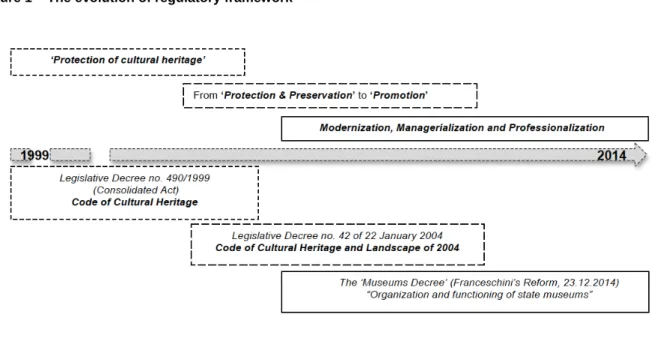
from a vision of museum’s governance focused, in a first period, on the protection and preservation of cultural heritage, in a second one, on the close interdependence between preservation and promoting, and, in a third phase, on the modernization of the governance of the cultural heritage, where modernization is the starting point of the process managerialization.
Figure 1 – The evolution of regulatory framework
Source: own elaboration.
The Code of Cultural Heritage, D.L. N° 490/1999, focuses its attention on the
‘protection’ of the cultural heritage. This decree overlaps the Law n° 1089/1938, absorbing rules and definitions and integrating them with other fitting provision. In particular, the Code better identify the participation of Italian Regions and local governments to the protection and preservation of cultural heritage (art. 11) and refers exclusively to the enjoyment of it by an elitist group of people, therefore unconstitutional.
206
Enlightening Tourism. A Pathmaking Journal, Vol 5, No 2 (2015), pp. 201-221 ISSN 2174-548X
In this Code the legislator mark the transition from the concept of ‘protection and preservation’ of the artistic and cultural heritage to that of ‘promotion’, opening up the political debate on several aspects:
- The Shift to the goal of increasing the value rather than merely protecting and preserving the cultural heritage. In fact, for decades the orientation to protection of cultural heritage was predominant, regardless of the needs, perceptions, and preferences of consumers (Wizemann, Alberti, 2005);
- The evaluation of the action exerted by the Italian central governments, which have: developed the concept of ‘increasing the value of cultural heritage’; designed the new structures of corporate governance, compatible with the public sector; set out the different responsibilities of actors involved in increasing the value of artistic-cultural heritage of the Country; in general, legitimating the strategic action of museums.
In an attempt to address these issues, the political debate has highlighted: the strategic dimension of governance and management of the cultural organizations headed by actors (public and private, simple or complex), in general directly appointed by the central government; the role played by the actors to start isomorphic processes of government and to adopt organizational structure and management processes, according to the provisions of existing legislation.
The change sanctioned by the ‘new’ Code no. 42 reveals, first of all, that artistic and cultural heritage serves the purpose of improving the standard of education and training of the community, aiming at increasing the value of ‘human capital’ of a country and, consequently, its potential in terms of economic development.
The concept of promotion of cultural heritage was further enriched by the Legislator thanks to the provision of Legislative Decree no. 156/2006, where the ‘cultural heritage’ is recognized as added value for the community belonging to the same territory. This new point of view is consistent with the Articles of Italian Constitution no.2ii and no.9iii, because it condemns an elitist vision in favor of a greater enjoyment of the cultural heritage through the promotion of its collective use and an increasing participation of citizens in the generation of new culture. “Culture with its inherent elements of creativity and innovation is a value in itself. It has a
significant public value and contributes to the achievement of smart, sustainable, and
207
Enlightening Tourism. A Pathmaking Journal, Vol 5, No 2 (2015), pp. 201-221 ISSN 2174-548X
The inclusion of the ‘promoting’ concept among the goals of museums organizations and, therefore, the shift from a ‘static approach’ to a ‘dynamic approach’ of the artistic and cultural heritage management is reflected on the assessment of strategic and operative actions falling within the competence of directors and executives, in charge of the adoption of an effective decision-making process aimed at exploiting the cultural heritage.
In addition, the promotion of the artistic and cultural heritage requires significant policies and actions in the continuity of commitment and consistency with the guidelines provided by the central and local governments (Ministry of cultural heritage and tourism-MiBACT, Regions and Provincial Superintendents). The Legislator, in performing its institutional role, outlines the objectives of development, identifies the principles, criteria and toolbox that should guide the actors accountable for achieving the goals (Scuillo, 2010).
“The promotion would thus translate in setting the conditions that would allow an
increasing number of people to contribute to their own acknowledgement of added
value through several paths of knowledge and care of the individual and collective
memory” (Petraroia, 2010, p.148).
On the one hand, the brief analysis proposed facilitates the reconstruction of the museums’ governance purposes but, simultaneously, it brings out its complexity. It is clear the peculiar role considerably played by these actors (directors/executives), responsible of museums’ management, in contributing to the protection and preservation activities, as well as on the promotion of National cultural heritage. The actors act in the attempt to preserve their autonomy margin and, at the same time, to respond to the pressure coming from political actors who have contributed to their appointment (sometimes flowing into practices of favoritism).
The analysis becomes more complex if we refer to the traits of the contemporary political debate which draws the listener’s attention to the chronic lack of autonomy of the Italian museums which actually limits their potential. To date, the museums appear devoid of real autonomy and managerial qualifications and subject to the decision-making power exercised by the central and peripheral government (e.g.
208
Enlightening Tourism. A Pathmaking Journal, Vol 5, No 2 (2015), pp. 201-221 ISSN 2174-548X
3. THE MANAGERIALIZATION OF CULTURE IN THE SCIENTIFIC DEBATE
In this section the Italian reforms, mentioned before, are evaluated in the framework of a more general international modernization process of public administration. It should be noted that cultural heritage, in Italy, is a prerogative (almost) exclusive of public administration. For this reason, the Italian cultural heritage can not be separated, nor in regulatory, operational or at the analysis level, from the public system as a whole, and by the powerful phenomenon of ‘managerialization’ who has recently invested it (Bonini Baraldi, 2007), both nationally and internationally.
Over the time, the management approach to the artistic and cultural heritage moved from a ‘static approach’ (protection/preservation of heritage), to a ‘dynamic approach’ (value creation/promotion). This resulted in a revision, sometimes only theoretical, of the museums’ governance structures with important effects on their organization and management. According to the management theory, in fact, the most critical issues affecting the museums’ organizational structures are linked to the ultra-complex governance of the Italian cultural heritage. The legislator is attempting to reduce this complexity through the re-direction of the political debate towards the ‘modernization’ of the administration of the cultural heritage. But, since ‘modernization’ is translated in ‘managerialization’, it implies autonomy of conduct for managers of cultural institutions that political representatives tend to deny.
209
Enlightening Tourism. A Pathmaking Journal, Vol 5, No 2 (2015), pp. 201-221 ISSN 2174-548X
a ‘managerial rhetoric’ without real effects in practice (Bonini & Baraldi, 2007; Cerqueti & Montella, 2011). Therefore, there was an evolution of the New Public Management in a New Public Governance logic, promoting those measures designed to improve the capacity of governance of public actor (Meneguzzo, 1995; Mercurio & Martinez, 2009).
The NPG postulates the transition “from a logic of government to a logic of governance” (Marcon & Russo, 2008) and the conception of the public body as a ‘node’ of a network system and ‘network manager’, which have to coordinate, stimulate, persuade, encourage (and discourage). A good governance, therefore, is one that sees each public administration to develop its capacity to govern, perfecting the functions, coordination and control tools, to improve the level of efficiency and effectiveness in the public sphere, and coordinate the activities of a number of parties, public and private (Bonollo, 2012).
Parallel to the development of these new paradigms, the scientific debate on the governance of the museums has been enriched by business management studies, especially after the introduction of ‘promoting the value’ concept in the regulatory framework. This because the museums are, on the one hand, public organizations (or joints of these) and, on the other, they are heavily dependent by funding and events of the entire public sector (Zan, 1999). The rapid evolution of the social, economic, legal, and institutional context, the change in the demand for culture, the spread of information technology, the reduction of State support to the cultural sector, and the lack of services for visitors have asked more research for new organizational structures and management of museums, like all public services (Dainelli, 2007).
This field of study described the main features of the organization and management of the museums according to the efficient and effective use of scarce resources (Bagdadli, 2003; Bagdadli & Paolino, 2006; Jalla, 2000; Lord & Lord, 1997) and linking the success of management to the improvement of economic performance (Chirielison, 1999; Solima, 1998).
210
Enlightening Tourism. A Pathmaking Journal, Vol 5, No 2 (2015), pp. 201-221 ISSN 2174-548X
skills of the ‘professionals of culture’ has contributed to emphasize the shift from an essentially ‘static’ vision of governance and management of the cultural heritage to a ‘dynamic’ vision of the same, consistent with the provisions of the Code of Cultural
Heritage and Landscape of 2004iv.
In particular, these paths of analysis allowed Scholars to detect several critical factors that could have adversely affected the capacity to express the real potential of a territory or a country with a natural vocation to the tourism. Just to mention some of these factors: the complexity of the institutional framework that rules the dynamics of governance of the artistic and cultural heritage; the discontinuity of public policies in support of heritage; the inadequate forms of financing; the overlapping competencies between different public entities, sometimes conflicting each other.
Nevertheless, most of the managerial studies, trying to propose corrective actions to these problems, have handed to the museums sector general schemes of interpretation, explaining them through a myopic and, at times, rhetoric language. In fact, as stated in the premise, the scholars have mainly focused their attention to the strategies and the ‘outputs’ of organizations seen as institution, in order to explore the actual ‘ability to create value’ (Dragoni, 2010; Montella, 2010).
4. A BRIEF RECONSTRUCTION OF THE NEW INSTITUTIONALISM. FOCUS ON
ISOMORPHIC PROCESS
According to the new institutional perspective, the choice of organizational solutions or the adoption of best practice of management responds to pressures to isomorphism, a source of political power and legitimacy (DiMaggio & Powell, 1983).
The neo-institutional perspective, focusing on the material and symbolic conditioning that institutions pose against individuals and organizations, puts at the center of its analysis the isomorphism. Through it the actors, searching legitimacy, tend to look alike, joining institutionalized rules, often leaving aside their immediate effectiveness.
To be clearer, it is appropriate to specify that:
211
Enlightening Tourism. A Pathmaking Journal, Vol 5, No 2 (2015), pp. 201-221 ISSN 2174-548X
example norms, moral principles, codes of conduct, procedures, and conventions;
- The ‘research of legitimacy’ leads the organizations to obey to the pressures of the institutional environment to demonstrate to act in an appropriate and adequate way for the purposes evaluated positively by the community (Dowling & Pfeffer, 1975; Meyer & Rowan, 2000); not infrequently organizations, searching legitimacy, make efforts conflicting with the demands of efficiency (Meyer & Rowan, 2000).
In this way organization obtains benefits from isomorphism: looking at the competitive and institutional dynamics, a greater compliance can facilitate relations with other organizations, increase the chances of attracting highly motivated staff, and obtain financing. Looking at the intra-organizational relationships, the isomorphism reduces the internal disorder, because the conformity to the legitimized rules also solves the internal conflict on the objectives of the organization, while maintaining the stability of the pro-tempore dominant coalition.
It is necessary to specify that when we say ‘institutional pressures’, we refer to institutional isomorphism and, so, to ‘coercive’, ‘mimetic’ and ‘normative’ isomorphism (DiMaggio & Powell, 2000). In particular:
- Coercive isomorphism derives from the pressures exerted on formal and informal organizations by other organizations considered influential. These pressures are perceived by the actors as impositions, demonstrations of force and persuasion;
- The isomorphism is mimetic when companies, facing the uncertainty of the environment, start spontaneously imitative processes. In this case the imitation acts as a surrogate of certainty, that is to say “if all act in this way, it means there is a reason”;
- The normative isomorphism is connected to the professionalization and the role that it has in the institutionalization of the rules. Formal education creates professionals for a certain position, ‘interchangeable’ for way of thinking, acting, and schemes to meet.
212
Enlightening Tourism. A Pathmaking Journal, Vol 5, No 2 (2015), pp. 201-221 ISSN 2174-548X
efficient and effective use of scarce resources, the promotion of cultural heritage, the sustainability of the territory, etc.
The search for legitimacy is the basis of the homogenization process for all types of institutional isomorphism. In the coercive isomorphism the organization must comply with the imperatives of the environment; on the contrary, it excludes itself from the competitive environment.
In the mimetic isomorphism, uncertainty is an important factor that encourages imitation. When the competitiveness conditions are unclear, it may happen that organizations model themselves to the other organizations to avoid the risk of ‘ being wrong’.
In the normative isomorphism, to appear professional, actors are called to conform their behavior to institutionalized rules this produce a normative and symbolic framework for the category. The compliance with this framework makes the actors ‘rational’, legitimizing their act. The adoption of a ‘deviant’ behavior creates conditions for the failure of themselves and the organization. Membership of professional associations of manager is undoubtedly the cause of the spread of practices considered legitimate, but not necessarily effective (Goshal, 2005).
The early new institutionalism, however, have not provided only a classification of institutional pressures, caring also the study of the transmission of the rules in the network of organization’s relationships. The reasons are identified by Meyer & Rowan in the ‘rationalized myths’, bearers of beliefs and practices socially approved, because they are believed to be rationally effective or to have a legal basis. The professions were raised to rationalized myths as it is believed they check a series of behaviors and effects, through the requirements of the role and expectations of the company (Meyer & Rowan, 2000). The myth of the profession then becomes an instrument of external evaluation of its performance. The spread of the myths is a consequence: if an organization has to adopt certain technologies, is essential to train people for that purpose; training, in a vicious circle, leads firms to organize themselves according to the institutionalized rules, the control of certain institutionalized rules asks the law to intervene on the same, and so on.
213
Enlightening Tourism. A Pathmaking Journal, Vol 5, No 2 (2015), pp. 201-221 ISSN 2174-548X
developed in it. The literature describes it as a recognized area of institutional life that carries out action of standardization and control on organization’s action, exerting pressure so that they conform to shared standards of performance (isomorphism). These standards find their legitimacy in being adopted over time, rather than in their own rationality (DiMaggio, Powell, 1983; Camuffo, Cappellari, 1996; Scott, 1998; DiMaggio PJ, Powell WW, 2000; G. Bonazzi, 2002; Greenwood, Oliver, Sahlin, Suddaby, 2008), directing the operation of social organizations inserted in institutionalized contexts, limiting de facto the behaviors alternative. At the organizational fields belong all the actors that even indirectly contribute to define certain standards in management, technology, research and new product development, human resource management, personnel policy.
Another issue to be considered is the effect of institutional pressures on organizations. In the same time Zucker focused her attention on the effect of institutional pressures on organizations (DiMaggio & Power, 2000). She argues that the processes of institutionalization have different force in preserving and transmitting certain cultural content: the more an institutionalized act shows high degree of formality and solemnity, the more effective and lasting will be the transmission of its cultural content and less freedom will be left to the parties in breaking and rebuilding the framework of rules and standards. The exogenous shocks that interrupt the process of reproduction of institutionalized patterns, enabling change, can be identified as opportunities to be exploited for the recovery of margins of maneuver by actors. It can be said, therefore, that the margins of intervention on the institutional framework are a function of the degree of ‘cultural persistence’. This means that some organizations respond to external pressures faster than other, becoming homogeneous more quickly, while others change only after a long period of resistance.
214
Enlightening Tourism. A Pathmaking Journal, Vol 5, No 2 (2015), pp. 201-221 ISSN 2174-548X
of institutionalization of such standards, due to the spread in the field of management practice as well as the influence of the relevant professional groups, more and more actors will conform to these standards, adopting legitimized practices.
5. ‘MODERNIZATION’ OF CULTURAL MANAGEMENT VERSUS
‘PROFESSIONALIZATION’ OF EXPERTS
The evolution of the regulatory framework allow us to see the legislator’s rediscovered attention for museums’ autonomy and, at the same time, for the responsibility of management (Director/Executive). The Museum’s Decree, recently emanated, recognize the necessity to start a managerialization process of cultural heritage and a professionalization of experts aimed at management and governance. The reference is to the process of professionalization and managerialization of the scientific debate, although with a limit of proposing the ‘myopic’ extension of the managerial principles of enterprise to the management of cultural heritage and, so, to the museums organizations.
The managerialization process, according to the new institutional views, is the rationalized myth of modernization’s culture. The culture’s spread require a rediscovery of ‘modernity’, where modernity stands for the adoption, by the organization aimed at protect and promote the National cultural heritage, of a ‘new’ modality of management. Therefore, there is a need to identify the managerial professionalism. This not just for the development of technical and administrative requirements, but that adopt an approach to governance and management that cover all the decisions, up to include the identification of governance and the development of financial policies in support of cultural mission and its strategic and operational actions.
215
Enlightening Tourism. A Pathmaking Journal, Vol 5, No 2 (2015), pp. 201-221 ISSN 2174-548X
their development, seem to contrast with the basis of the subsidiarity principle”
(Farneti et al., 2011).
Hence, the ‘managerialization’ and, therefore, the ‘professionalization’ of human resources themes involved at all levels of governance. The latter, intended to the protection, preservation, and promotion, today becomes the leitmotif of the political debate, insomuch to induce the same Minister of MiBACT, Franceschini, to declare that he will select future directors/executives of museums organizations according to the possession of rewarding capacity of government and management, on the basis of best practices of governance and management found in the territory.
The professionalization theme, and so that of education of ‘custodian-manager’,
becomes the central item of the recent institutional and scientific debate.
Coherently with the new institutional perspective, with particular reference to the role of the isomorphic dynamics in the institutionalization process of ‘good’ and ‘new’ management and governance practices, the professionalization is close related to the process of formal education. This could ensure the achievement of working standards of museums (not only related to its financial structure), with particular reference to innovation in the method of museums conducts.
The strategic objective of this actors becomes the plan for training goals able to make available on market, as soon as possible, a professional figure who meets the requirements of the director/executive manager. These training circuits will help to “create a group of people almost interchangeable, occupying similar positions in a number of organizations and have an orientation and a way of thinking so similar as to counteract the weight - otherwise decisive - of differences of tradition and control systems between the individual organizations” (Spagnoletti, 2011, p. 31).
216
Enlightening Tourism. A Pathmaking Journal, Vol 5, No 2 (2015), pp. 201-221 ISSN 2174-548X
6. CONCLUSION AND NEW RESEARCH PERSPECTIVES
The reflections proposed in this study raise the following questions: ‘What is the real role played by universities and training institutions in the process of diffusion of ‘good’ management practices?’; ‘Is it possible, in Italy, to find a training process that evolves together with the evolution of the regulatory framework? Is it consistent to support that training institutions, fist of all public Universities, de facto, contribute to the spread of such managerial practices in the field of cultural heritage? And, according with the new institutionalism’s view, could it be argued that these actors contribute, or have contributed, to the institutionalization of the same practices, participating, albeit unintentionally, to the configuration of the current framework?’
Not entering into the merits of the real opportunities offered by the processes of professional training, the research team is currently attempting to give answer to this questions proposed. For this reason, it is currently conducting an on-field study to explore the role that universities have in the institutionalization process of the art and culture managerial practices. In particular, the research objective is to find and to analyze the presence of training courses (1° and 2° level Master) offered by the Italian State Universities, exclusively and/or in collaboration with third parties, aimed at the creation of managerial profiles suitable to the government and management of cultural heritage (as well as by Franceschini Museums’ Decree).
Coherently with the theoretical framework proposed, this investigation is qualitative and uses the technique of content analysis (Berelson, 1952) to analyze the titles of masters activated by Italian universities. The aim is to detect the recurring keywords in titles that belong to the professionalization in the artistic-cultural sector. From the research we expect to find an active role promoted by the University in the process of institutionalization of the ‘management of culture’.
217
Enlightening Tourism. A Pathmaking Journal, Vol 5, No 2 (2015), pp. 201-221 ISSN 2174-548X
References
Bagdadli, S. Museum and theatre networks in Italy: determinants and typology.
International Journal of Arts Management. Vol. 6, Nº 1, 2003, pp. 19-29.
Bagdadli, S.; Paolino, C. The Institutional Change of Italian Public Museums Between Legitimacy and Efficiency: Do Museum Directors Have a Role?
International Journal of Arts Management, Vol. 8, Nº 3, 2006, pp. 4-18.
Berelson, B. Content analysis in communication research. Glencoe, Illinois: The Free Press, 1952. ISBN 9780028412108.
Berger, P.L.; Luckmann, T. La realtà come costruzione sociale. Bologna: Il Mulino, 1969. ISBN 9788815061584.
Bonazzi, G. Come studiare le organizzazioni. Bologna: Il Mulino, 2002. 9788815113061.
Bonini Baraldi, S. Management, beni culturali e pubblica amministrazione. Milano: Franco Angeli, 2007. ISBN 9788846486080.
Bonollo, E. La rendicontazione della regione. Verso una nuova informativa
economico-finanziaria e sociale. Milano: Franco Angeli, 2012. ISBN 9788856846157.
Camuffo, A.; Cappellari, R. L’economia dei costi di transazione. In Costa, G., & Nacamulli, R.C.D. Manuale di organizzazione aziendale. Le teorie
dell’organizzazione. I. Torino: UTET, 1996. ISBN 9788843019755.
Chirielison, C. La valutazione delle performance nelle gestioni museali: problematiche operative e tecniche. Studi e Note di Economia, 1, 1999, pp. 143-168.
Crismani, A. I musei tra l’immaginario collettivo e la realtà giuridica e gestionale.
218
Enlightening Tourism. A Pathmaking Journal, Vol 5, No 2 (2015), pp. 201-221 ISSN 2174-548X
Dainelli, F. Il sistema di programmazione e controllo del museo. Milano: Franco Angeli, 2007. ISBN 9788846479877.
DiMaggio, P.; Powell, W.W. Institutional Isomorphism: The Iron Case. American
Sociological Review, Vol. 48, Nº 2, 1983. pp. 147-160.
DiMaggio, P.J.; Powell, W.W. La gabbia di ferro rivisitata. Isomorfismo istituzionale e razionalità collettiva nei campi organizzativi. In Powell, W.W. & DiMaggio, P.J. Il
neoistituzionalismo nell’analisi organizzativa, Torino: Edizioni di Comunità, 2000.
ISBN 9788824505895.
Dowling, J.; Pfeffer, J. Organizational Legitimacy: Social Values and Organizational Behaviour. The Pacific Sociological Review. Vol. 18, Nº 1, 1975. pp. 122-136.
Dragoni, P. Antimarketing dei musei Italiani? Sinergie, 68, 2005, pp.55-74.
Dragoni, P. Processo al museo. Sessant’anni di dibattito sulla valorizzazione
museale in Italia. Firenze: Edifir, 2010. ISBN 9788879704892.
Farneti, G.; Del Sordo, C.; Levy Orelli, R. Working towards the advanced management of cultural heritage. Conservation Science in Cultural Heritage, 11, 2011, pp. 153-177.
Golinelli, G.M. Patrimonio culturale e creazione di valore. Verso nuovi percorsi. Padova: Cedam, 2012. ISBN 9788813322199.
Goshal, S. Le cattive teorie manageriali distruggono le buone pratiche. Sviluppo e
Organizzazione, 210, 2005, pp. 51-69.
Greenwood, R.; Oliver, C.; Sahlin, K.; Suddaby, R. The sage handbook of
219
Enlightening Tourism. A Pathmaking Journal, Vol 5, No 2 (2015), pp. 201-221 ISSN 2174-548X
Hinna, L.; Monteduro, F. Lezioni di economia aziendale. Santarcangelo di Romagna: Maggioli Editore, 2012. ISBN 9788838765704.
Hood, C. A public management for all seasons? Public Administration, Vol. 69, Nº 1, 1991, pp. 3-19.
Jalla, D. Il Museo Contemporaneo, Introduzione al Nuovo Sistema Museale Italiano. Torino: Utet, 2000. ISBN 9788877508034.
Lord, B.; Dexter Lord, G. The Manual of Museum Management. London: The Stationary Office, 1997. ISBN 978-0759102491.
Manfredi, G. La valorizzazione dei beni culturali come compito costituzionalmente necessario. Il Capitale culturale. Studies on the Value of Cultural Heritage, 3, 2011, pp. 25-31.
Marcon, G., Russo, S. Significatività dell'informazione contabile nel Bilancio Sociale delle Aziende Pubbliche. Azienda Pubblica, Vol. 2-3, 2008, pp.199-233.
Meneguzzo, M. Dal New Public Management alla Public Governance: il pendolo della ricerca sulla amministrazione pubblica. Azienda Pubblica, Vol. 8; Nº 3, 1995, pp. 491-510.
Mercurio R.; Martinez M. Modelli di governance e processi di cambiamento nelle
public utilities. Milano: Franco Angeli, 2009. ISBN 9788856824889.
Meyer, J.W.; Rowan, B. Le organizzazioni istituzionalizzate. La struttura formale come mito e cerimonia. In Powell W.W. & DiMaggio, P.J. Il neoistituzionalismo
nell’analisi organizzativa. Torino: Edizioni di Comunità, 2000. ISBN 9788824505895.
Montella, M. Approccio manageriale ai musei Italiani. In Fiocca, R. & Battaglia, L. Il
220
Enlightening Tourism. A Pathmaking Journal, Vol 5, No 2 (2015), pp. 201-221 ISSN 2174-548X
Montella, M. Valore e valorizzazione del patrimonio culturale storico. Milano: Mondadori, 2009. ISBN 9788837068103.
Montella, M. Valore culturale. In Golinelli, G.M. Patrimonio culturale e creazione di
valore. Verso nuovi percorsi. Padova: Cedam, 2012. ISBN 9788813322199.
Montella, M.; Manacorda, D. Per una riforma radicale del sistema di tutela e valorizzazione. In Volpe, G. (ed.). Patrimoni culturali e paesaggi di Puglia e d’Italia tra
conservazione e autonomia. Atti delle Giornate di Studio. Bari: EdiPuglia, 2014. ISBN
9788872287323.
Montella, M.; Cerquetti, M. Economia, cultura, territorio. Quaderni del Dipartimento di Beni Culturali. Macerata: EUM, Edizioni Università di Macerata, 2011. ISBN 9788860562487.
Osborne, D.; Gaebler, T. Reinventing Government: How the Entrepreneurial Spirit is
Transforming the Public Sector. Reading, MA: Addison-Wesley, 1992. ISBN
9780452269422.
Petraroia, P. Storia (storie?) dell’arte (della arti) e valorizzazione. Il Capitale Culturale. Studies on the Value of Cultural Heritage, 1, 2010, pp. 143-148.
Russo, A.P.; Segre, G. Destination models and property regimes: an exploration.
Annals of Tourism Research, Vol. 36, Nº 4, 2009, pp. 587-606.
Sciullo, G. Il ruolo della produzione legislativa per la valorizzazione. Il Capitale Culturale. Studies on the Value of Cultural Heritage, 1, 2010, pp. 119-122.
221
Enlightening Tourism. A Pathmaking Journal, Vol 5, No 2 (2015), pp. 201-221 ISSN 2174-548X
Solima, L. La gestione imprenditoriale dei musei. Percorsi strategici e competitivi nel
settore dei beni culturali. Padova: Cedam, 1998. ISBN 9788813208691.
Spagnoletti, P. Le dinamiche di diffusione della pratica del riuso software. Open
Studies for Public Administrations, 2011, pp.15-43.
Wizemann, A.; Alberti F.G. L’assetto organizzativo della fondazione per la gestione dei beni e delle attività culturali. Liuc Papers, Serie Management ed Economia della
Cultura, Nº 175, 2005, pp. 1-32.
Zan, L. Conservazione e innovazione nei musei Italiani. Management e processi di
cambiamento. Milano: ETAS, 1999. ISBN 9788845309649.
i
“On January 8th, 2015, the Italian Ministry of Cultural Heritage and Tourism issued an international call for applications for the position of Director for each of the 20 independent museums”. This is a section of the international call of MiBACT on the Economist.
http://jobs.economist.com/job/8738/directors-of-italian-museums/?TrackID=3807#sc=socialmedia&me=socialmedia&cm=0
ii
Art. n°2 of Italian Constitution: “The Republic recognize the inviolable rights of man, both as single and as social formations, where he carries out his personality”.
iii
Art. n°9 of Italian Constitution: “The Republic promote the development of culture and scientific and technical research, protect landscape and historical and artistic heritage of the Nation”.
iv
The Government, with the Decree n. 42/2004, in accordance with the law 137/2002 “Proxy for the reform of organization of Government and Presidency of Council of Ministers, as well as public authority, has enacted the “Code of Cultural Heritage and Landscape”.
v