www.ijtes.net
Parental Involvement in Developing
Students’
Perseverance
in
Solving
Mathematical Problem through the Use
of Social Media
Areti Panaoura
Frederick University, Cyprus
To cite this article:
Panaoura, A. (2017). Parental involvement in developing students‟ perseverance in solving
mathematical problem through the use of social media.
International Journal of Technology
in Education and Science (IJTES), 1
(1), 36-47.
This article may be used for research, teaching, and private study purposes.
Any substantial or systematic reproduction, redistribution, reselling, loan, sub-licensing,
systematic supply, or distribution in any form to anyone is expressly forbidden.
Authors alone are responsible for the contents of their articles. The journal owns the
copyright of the articles.
Volume 1, Issue 1, Winter 2017
Parental Involvement in Developing Students’ Perseverance in Solving
Mathematical Problem through the Use of Social Media
Areti Panaoura
Abstract
The present study aims to contribute on the understanding of the relationships between parental involvement during the school homework in mathematics with students‟ perseverance in problem solving ability in mathematics and their self-regulatory performance in problem solving. The whole framework of the intervention program concentrated on affecting parents‟ beliefs about their role on children‟s homework in mathematics, by using the contribution of social media in order to affect indirectly their children‟s behaviour. The pre and post intervention tests on students‟ behaviour were followed by a 3rd measurement in
order to examine the further impact of the possible initial changes. Data were selected by 183 students at the 5th grade (10 years old) and one of their parents. Dynamic modelling indicated that the three factors (parents‟ beliefs, students‟ self-regulation and their problem solving persistence) were interrelated at each one of the measurement waves and that the growth in each of the ability was affected by the state of the others. The role of the use of social media, as means of communication with parents is discussed.
Keywords: Parental involvement, perseverance, problem-solving, social media.
Introduction
Learning is a complex, multifaceted process which asks students to activate the whole cognitive, metacognitive and affective system. Mathematics education underlines the value to use teaching processes in order to oblige students to solve real-life problems by using strategies, by reflecting on them and by self-regulating their behaviour in order to face difficulties and to overcome cognitive obstacles. Although children are expected to act as autonomous personalities during problem solving, their behaviour is affected by their teachers‟ practices, their parents‟ involvement and their previous cognitive and affective experiences. The present study concentrates on the assumption that in order to improve students‟ cognitive and affective behaviour during problem solving and mainly their strategies to insist on encountering the difficulties without external contribution, we can influence their parents‟ contribution on their children as part of the everyday experiences and the school homework. The parental involvement has to be moved from parents‟ engagement in school-based activities into parents‟ informal development of everyday activities with their children related to their homework or not.
Most studies concentrated on the ages of secondary education (e.g. Fernandez-Alonso et al., 2017) and indicated that parental involvement styles have an effect on achievement at an individual and school level. However, parents emphasize more on their children‟s achievements earlier, during the ages of primary education. According to Suriyon, Insprasitha and Sangaroon (2013) little is known about the nature of elementary students‟ use of self-regulatory strategies and mainly how those strategies are applied when students solve problems out of the classroom. However many studies were conducted by constructing a learning framework and developing appropriate teaching activities. The present study aims to enable students to use and develop self-regulation strategies in mathematics out of the typical and formal school environment in order to take advantage of using their daily activities and their parental involvement. We want to use the homework context (as a part of the daily activities which is structured by the formal educational setting) in order to examine the role of the parental involvement. The purpose of the present study was to evaluate the impact of the parental involvement on students‟ problem solving ability in mathematics and on students‟ self-regulation in order to overcome cognitive obstacles. An intervention program was developed in order to affect parents‟ beliefs about their role on improving their children perseverance on working on the same problem in order to overcome the faced difficulties. The study aimed to examine the influence of parental involvement after an intervention program on children‟s self-regulatory performance during problem solving and their respective problem-solving ability. The following research questions were posed:
1. Which were the relations among the parents‟ beliefs about school-homework involvement, the students‟ self-regulation in mathematics and their performance in mathematical problem solving, at the initial phase of the study?
2. Which were the dynamic relations at the three consecutive measurements among the parents‟ beliefs about homework involvement, students‟ self-regulation in mathematics and their problem solving performance in mathematics?
Theoretical Framework
Problem-solving Perseverance and Self-regulation
Problem-solving is the area within mathematics education where the use of self-regulatory skills is apparent, particularly in cases that students face difficulties and cognitive obstacles during their attempt to solve authentic and realistic mathematical problems. Although self-ergulation is a concept which has been related with cognitive and motivational aspects (Samo, 2016), according to Lavasani, Hejazi and Varzaneh (2011) it acts in cognitive domain rather than affective domain. Students usually try to understand the problem, pose a schedule that they follow and present a solution. When they face a difficulty and something seems to be unexpected for them, they do not react flexibly by self-reflecting on the whole process. The first of the eight NCTM‟s mathematical practices is the students‟ ability to make sense of problems and persevere in solving them.
In most cases in the classroom context students ask for an external contribution, such as their teacher‟s feedback and guidelines or they insist on following the same procedure without indicating flexibility. Similarly in most cases during homework when they face a difficulty they ask for parents‟ guidance or they are waiting for the teachers‟ contribution on the following up day. By this behaviour they actually do not follow one of the main features of the nature of mathematics which asks for flexibility and repeated attempts to overcome cognitive difficulties and mistakes in order to find out something new. This flexibility and insistence on overcoming the difficulties define the concept of “perseverance.”
provided to parents in order to guide them further on asking their children persevere in problem solving activities, at everyday life and school homework.
Many studies indicated that the students‟ self-regulation is a basic differential factor on students‟ mathematical proficiency (e.g. Zimmerman, 2013; English & Kitsantas, 2013). The mathematically proficient students monitor and evaluate their progress and make the necessary changes, while the less proficient students either they do not realize their misunderstandings or they are not able to change the cognitive process they follow and handle the cognitive interruption of a schedule which proved to be inappropriate during a mathematical problem solving. Khadijeh, Faezhe and Masume (2014) evaluated the effect of self-regulation strategies components on performance-approach and performance–avoidance. Their results indicated that training components of self-regulation strategies affects positively on performance–approach, but there was no significant relationship between training components of self-regulation strategies and performance–avoidance.
Engaging students to persist requires them to understand that hard work is a natural part of learning. Milburne, Wildmann, Morret and Stipanovic (2014) asked students to keep a logbook of the different strategies they used in order to find a solution at an open problem, how they checked their solution and what they learned from each problem. By this way they gave students a report on their efforts to persevere, in order to evaluate the processes they had followed and in order to become conscious of those processes.
A fundamental issue during problem solving is the persistence (as opposite of avoidance) to face the difficulties and obstacles and the perseverance to change the cognitive strategy based on the metacognitive self-evaluation. Task persistence has been found to be related to children‟s math achievement (Kikas, Peets & Hodges, 2014). In respect to the links between parental involvement in homework and children‟s task persistence, it can be expected that children‟s perceptions of supportive homework involvement may relate to autonomous learning and higher task persistence (Silinskas & Kikas, 2017).
Parental Involvement in Students’ Performance
The importance of parental involvement in students‟ performance and behaviour has recognized by researchers, educators and educational systems (e.g. Epstein, et al., 2009). “Parental involvement defined as motivated parental attitudes and behaviours intended to influence children‟s educational well – being” (Vukovic, Roberts & Wright, 2013, p. 447). Documents such as Principles and Standards for School Mathematics (NCTM, 2000) underline the importance to recognize parents as partners in our efforts to bring change to the mathematics education. It is an issue which has recently received attention in an attempt to clarify mainly the contribution of homework involvement to children‟s learning (Gonida & Cortina, 2014). Research concentrated on different dimensions of this involvement such as on study habits (Pattal, Gooper & Robinson, 2008), on homework involvement (Dumont, Trautwein, Ludtke, Newmann, Niggli, Schnyder, 2012) and on students‟ perceptions of parental involvement (Nunez, Suarez, Rosario, Vallejo, Valle & Epstein, 2015). Different studies indicate that different types of parental involvement in homework are associated with different results, but all of them emphasize the quality rather than the quantity of involvement.
Epstein and her colleagues distinguish the parental involvement in six dimensions: family obligations, communication with the school, parental involvement with school, parental involvement in learning activities at home, decision making in school and cooperation with community. Eipstein (2011) describes learning at home as teachers and schools assisting parents to help their children with schoolwork related to activities at home. Cai, Moyer and Wang (1999) asked parents of middle school students to complete the Parental Involvement Questionnaire which assess their in-home support. Results indicated that students with the most supportive parents demonstrate higher mathematics achievement and positive attitudes towards mathematics.
Vukovic et al. (2013) investigate whether children‟s mathematics anxiety serves as a pathway between parental involvement and children‟s achievement. Results indicated that parents influence children‟s mathematics achievement by reducing mathematics anxiety and they underline that the policy to target parental involvement in mathematics should focus on home-based practices. Jay, Rose and Simmons (2017) encouraged parents to work with their children to “find the math” in everyday life and activity. Results indicated that as parents become more confident in their analysis of mathematics in life, they develop new strategies for sharing their thinking and awareness with their children.
parental involvement and students‟ achievements in maths, science and language. Dumont et al. (2012) indicated that students‟ results depend on the nature of parental involvement. Although the impact of an autonomy support is expected to be different than a control where parents make decisions for the children‟s schedule for homework, O‟Sullivan, Clen and Fish (2014) indicated that parental involvement in mathematics homework in the focus of direct assistance and autonomy support does not predict children‟s grades. Actually research on the influence of homework assistance on achievements has yielded mixed findings, with positive effects (e.g Patall, Cooper & Robinson, 2008) and no relations (e.g. Hill & Tyson, 2019). Lorenz and Wild (2007) emphasized the impact of the autonomy supportive practices and emotional involvement. Cooper and Valentine (2001) related self-regulation with students‟ homework by emphasizing on the development of time management skills. Gonida and Cortina (2014) indicated that different types of parental involvement in homework are predicted by their goals for their child and predict his/her achievements and efficacy beliefs. Students with high academic achievement have more careful parents who created a suitable environment for learning and they are involved more in homework (Kashahu, Bushatti, Dibra & Priku, 2014). Silinskas and Kikas (2017) examined the longitudinal associations between children‟s perceptions of parental involvement in math performance and motivation. Children (grade 3 and 6) completed math tests, evaluated their math self-concept and their mothers evaluated their task persistence during homework. Results indicated that perceived mother‟s support was related to increased task persistence.
The Use of Social Media as Tools for Communication with Parents
Few years ago the emphasis was on the use of internet and on the respective communication through the use of e-mails (Carpenter & Rothschuh, 2009). Nowadays the interest has to be concentrated on more direct ways of communication through technology. Social networking is changing the way the world works and mainly the way people communicate. “Social media is media for social interaction as a superset beyond social communication” (Baruah, 2012, p.1). Some examples of social media network sites include Facebook, Twitter, Instagram and blocs. We concentrate our attention on Facebook which is more popular for different demographic groups (Duggan & Smith, 2013).
The rapid technological advances and the declining cost of mobile technology have introduced a communication factor that affects parental involvement (Patrikakou, 2016). Research has shown that communication through the use of technology between parents and teachers play on important role in the academic progress and students‟ socialization (Paltis & Kalmus, 2015). Using the social media as tools for communication, by creating close groups, enables fast and relevant information exchange in a minimal cost. Many parents are already on Facebook, so it is easy to communicate with them on a platform with which they are already familiar. At the same time they are able to send a private message to ask questions about homework.
Through school websites parents become aware of specific activities, topics and assessments in which their child is involved (Olmstead, 2013). When schools invite and encourage parental involvement, parents are more likely to become engages. One of the biggest benefits of using social media in this case is the ease, convenience and speed of access and distribution of information. With the technology devices available to both teachers and parents, information can be communicated almost instantly. At the same time Palts and Kalmus (2015) present the limitations of communication problems which are related with socio-economic reasons and the lack of experiences which lead to fear.
Methodology
The present study was divided into two main phases: a) The preparation of the research tools, the development of the training program for the parents and the use of all the research tools in order to select data during the first measurement wave b) the implementation of the training program, the post test data during the 2nd measurement wave and the examination of the stability of any change by collecting data during the 3rd wave of measurement, three months after the intervention.
their perception about the value of persistence during problem solving in everyday situations in general and in mathematics education in particular.
The second phase of the study consisted of the implementation of the intervention program, the second wave of measurement, immediate after the intervention program and the third wave of measurement three months later in order to examine the stability of the results and the dynamic relations between the three factors (parents‟ beliefs, students‟ self-regulation and students‟ problem-solving ability) at the three consecutive measurement waves. Qualitative data were selected as well, such as parents‟ reactions and comments at the online forum which was constructed and used, during the implementation of the intervention programme. However there are not presented here, as there are not related directly with the aims of the present study.
Participants: The sample of the study consisted of 117 students at the 5th grade of elementary education (mean age 10 years and 3 months at the first measurement) and one of their parents (83 mothers and only 34 fathers). The parent who declared that usually deal with his/her child homework, participated at the study (8 parents who were not able to attend the training meetings for personal reasons, they were excluded from the study. The selection of the students was not random and the sample was not representative of the respective population. All the students attended the 5th grade of three elementary schools. We had easy access to those schools (two classrooms at each school) and by this way we had more easily access to the sample of students, to their teachers in order to explain them the philosophy of the homework in mathematics and to their parents.
Instruments: Three main instruments were used in order to measure parents‟ beliefs about their role during homework, students‟ self-regulatory abilities in mathematics and students‟ problem solving ability.
The questionnaire on parents‟ beliefs was consisted of 18 statements (Likert scale) on their knowledge about the aims of mathematics education, the role of homework, their expected role and their activities with their children during homework. For example they had to react in statements such as “I ask my child to look for examples in his/her textbook in order to understand how to solve the problem”, “Children have to apply the new acquired knowledge in activities for practice during homework”. The Cronbach a of the questionnaire was 0.83. The construct validity of the questionnaire was examined at a previous pilot study with a different sample of parents.
The questionnaire which was used in order to measure students‟ self-regulatory performance on mathematics was constructed and used at a previous study (Panaoura, Gagatsis & Demetriou, 2009). The questionnaire consisted on two parts. The first part comprised of ten couples of sentences and students had to choose which one expressed better their behaviour during problem solving in order to flexibly use self-regulatory strategies. The second part comprised of twelve items on their perseverance in solving difficult mathematical tasks and overcoming cognitive obstacles.
The third instrument was a test on mathematical problem solving performance. The test was developed based on the National Curriculum for primary education. We are talking about a centralized educational system with a common curriculum, common textbooks and similar teaching processes and teaching guidelines are given to all the teachers by the Ministry of Education. It was comprised of 6 mathematical problems which were scored in respect to their correctness and the justification of the process. In order to immunize the appropriateness of the problems we asked five teachers to evaluate them in respect to the Math Curriculum. Those mathematical problems were expected to be demanding for children and new for them in order to oblige them use self-regulatory strategies in order to solve them. An indicative problem is the following: “From the 25 students of a class, 13 of them have a mobile phone, 11 of them have tablet and 8 of them have neither mobile phone nor tablet. How many students have mobile phone and they do not have tablet?” (Students do not know anything about the use Venn diagram).
Procedure: The whole procedure involved children, their teachers and mainly one of their parents. Firstly we had a meeting with the 6 teachers of the 3 schools in order to present them the aims of the study. Their only contribution would be to remind their students to work on the mathematical problems, as part of their homework and to follow the guidelines they had to follow in order to assign the problem solving as part of the homework. They had to pose as homework two given problems by the researchers every week. Those problems were presented to them through an online platform and in order to be sure that they posed them to their students they had to upload the image of their solutions (those qualitative data are used for a study with a different aim). The duration of the program was for five weeks, so children had to solve 10 mathematical problems.
difficulties students face during problem solving. For example a video was used as an introduction to a group discussion, where they watched daily facts where parents leave their children to gain in board games in order to be happy, help them to overcome physical obstacles without trying to do it alone, do not permit them to have initiatives in respect to family decisions. The third and fourth meetings concentrated on the role of homework, the parental contribution on their children‟s cognitive behaviour, the value of self-regulation during solving everyday problems, the significance of self-regulation during mathematical problem solving and their role on developing their children‟s perseverance on working flexibly on the same problem in order to overcome any cognitive obstacle or difficulty. We have explained them that they would have frequent guidelines on how to react to their children‟s insistence to have external contribution in order to solve the problems (for example by giving them ideas to react by saying “why not trying with a different way?”, or “rest your mind for a few minutes and try again by starting from a different idea”). We had created a close page at Facebook where we had presented all the main ideas and guidelines. We had created a close page at Facebook where we had presented all the main ideas and guidelines; we uploaded activities with relevant issues. We had at the same time created a close group where they were able to share their comments, suggestions and feedback. The data of the group and the page permitted us to ensure about the quantity of their participation. It was impressive that only few of them were passive members of the group, the majority used to share experiences, videos and photos, relevant to the project. Interesting qualitative data were selected which are not presented at the present study. Students had to work their homework as usual and they had to solve the mathematical problems as part of their homework, as well. Their teachers do not give them immediate feedback for those problems.
Statistical analyses: In order to confirm a model with the interrelations of the factors which derived by the items of the research instruments at the first measurement, a CFA model was used. In order to specify the dynamic relations during the three waves of measurements, dynamic modelling was used. For both the analyses the EQS (Bentler & Liang, 2002) was used. A series of models tested in order to specify the best fitting models in relation to typical standards (CFI>0.9, x2/df<1.9, RMSEA<0.05). In the first model we examined the structure of the variables which were regressed on the three main factors (parents‟ beliefs, students‟ self-regulation in mathematics and students‟ problem solving ability) at the initial condition. Then the dynamic model examined the relations among the three dimensions across the three waves of measurements.
Limitations of the present study: Every study concentrates only on examining few of the aspects of a multidimensional phenomenon. The present study did not have a representative sample and it did not include data about the parents‟ occupation, education, socioeconomic position and their general involvement on their children‟s upbringing. At the same time researchers were unable to control the real parents‟ involvement during the intervention program, we based only on the ethical commitment which was created and our belief that they understood that their children would gain positive experiences.
Results
Although for the project many qualitative and quantitative data were selected by students, parents and teachers, at the present study we concentrate our attention on the analyses which enabled us to examine the two main research questions which were posed. Firstly we present the results of the relations among the parents‟ beliefs about their role during the homework, their children‟s problem solving ability and their self-regulatory behaviour. And secondly we present the dynamic relations among the same factors during three consecutive measurements.
Parents’ Beliefs, Students’ Self-regulation and Student’s Problem Solving Ability
Parents‟ knowledge
Parents‟ role
Strategy flexibility
Parents‟ beliefs
Self-regulation
Problem Solving Ability Perseverance
in PS
PS performance
PS justification
.654*
.596* .818*
.735*
.435*
.523*
.482*
.793*
.676*
the processes they used. The a priori model hypothesized that the variables would be explained by those factors and each item would have a nonzero loading on the factor it was supposed to measure. Multiple criteria were used in the assessment of the model fit. The model was tested under the constraint that the error variances of some pair of scores associated with the same factor would have to be equal. This was an indication of the LMTEST, in order to arrive at an elaborated model in which the goodness of fit-index would be good in relation to typical standards. Additionally the model examined the statistical significant interrelations between the three second order factors.
Figure 1. The CFA model of students‟ self-regulatory performance, parents‟ beliefs and students‟ problem solving achievements. Note: PS: problem-solving in Mathematics
impact of parents‟ beliefs is direct in the case of problem solving ability and indirect in the case of the self-regulatory behaviour.
Dynamic Relations among Parents’ Beliefs, Students’ Self-regulation and Students’ Problem Solving Ability
The main hypothesis tested by the dynamic model was that the variables at the 2nd measurement were affected by the same variable at the 1st measurement and that those at the 3rd measurement were affected by the same variables at the 1st measurement and the residuals of the variables at the 2nd measurement. Using the residuals of the 2nd measurement ensured that this factor was purified from the component of the 1st measurement involved in it, so that we would specify the relation of the 2nd measurement as such with the 3rd measurement. According to Bentler (1995) “if you want a dependent variable to covary with another you much have its residual variable carry that covariance” (p.244). The second hypothesis at the same dynamic model was that significant relations would connect the different factors at each one of the measurement waves.
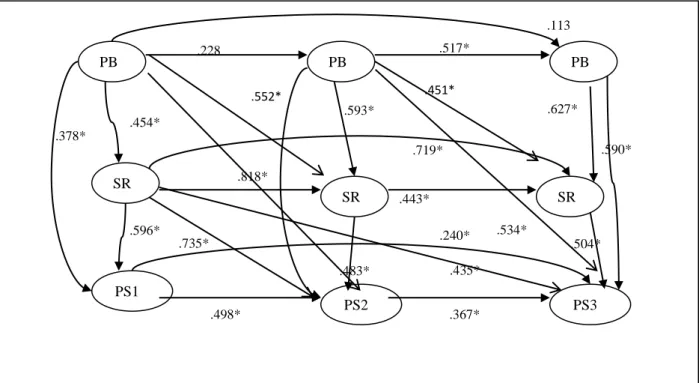
As it was expected, the model with the above hypotheses was good (x2 =163.243, df=80, x2/df=2.04, p<0.01, CFI=0.86, RMSEA=0.054). After allowing a few error variances to correlate the fit of the model was excellent (x2 =158.171, df=85, x2/df=1.8608, p<0.01, CFI=0.967, RMSEA=0.042). The parameter estimates of this model are presented in Figure 2. Results indicate that the inter-individual differences at self-regulatory performance appeared on problem solving ability as well. However at the same time the problem solving ability is affected by the parents‟ beliefs about their contribution during homework in mathematics.
The results of the dynamic model (Figure 2) reveal and underline the coordinative role of the students‟ initial self-regulatory performance. Students with high self-regulatory performance at the first measurement are students with high problem solving ability at the first (.596), second (.498) and third measurement (.367). The impact of the self-regulatory performance on problem solving ability at the second measurement was significant as well (.483), but it was not confirmed in the case of the third measurement, probably because of the significant impact of the initial self-regulation. The impact of the self-regulatory performance on problem solving at that third measurement was significant (.504).
Figure 2. The dynamic model on parents‟ beliefs (PB), self-regulatory ability (SR) and problem-solving ability (PS). (*) significance at the level 0.05; (1) First measurement; (2) second measurement; (3) third measurement
Parents‟ beliefs at the second and third measurement changed in comparison to the respective beliefs at the first measurement. That means that many of the parents who did not have strong beliefs about their role during
PB 1
SR 1
PS1
PB 2
SR 2
PS2
PB 3
SR 3
PS3 .228
.454*
.596* .378*
.517*
.818*
.735*
.483*
.240*
.435*
.504*
.593* .627*
.590* .113
.719*
.443*
.552* .451*
.498* .367*
homework, they had changed them after the intervention program and for this reason there is not any statistically significant relation. The initial differences at the first measurement did not remain at the second measurement indicating that many parents changed their initial beliefs. However there is a significant stability on the new established beliefs at the following up measurement, as parents with strong beliefs at the second measurement keep them strong at the third measurement (.517) as well. Those beliefs have highest impact on students‟ self-regulation in the case of the second measurement (.593) than in the first measurement (.454) and on problem solving ability respectively (first measurement .378 and second measurement .552).
The parents‟ beliefs at the second measurement had a strong relation with students‟ self-regulation at the second measurement (.593) and at the third measurement (.451). What was impressive was the strong impact of parents‟ beliefs on problem solving abilities at the second measurement (.552) and on their problem solving abilities at the third measurement (.534). The statistically significant impact of parents‟ beliefs at the second measurement on students‟ self-regulation and problem solving ability at the third measurement indicated that parents with high beliefs about their role have at the same time children with high problem solving ability and self-regulatory performance.
Discussion
Family and school are two important dimensions in children‟s lives, playing a crucial role in their overall development (Chairatchatakul, Jantaburom & Kanarkard, 2012). Rarely do parents have the opportunity to present their beliefs, ideas and concerns. The present study concentrates on how the use of Facebook as a tool of direct communication creates a better relationship of home-school partnership and increases positively the parental involvement; it seems that the “world of education” is more open.
The findings of the present study lead us to some potentially important results about the parental involvement during homework on their children‟s self-regulatory performance in mathematics and consequently their problem-solving performance. Many studies indicated that children did not show perseverance in encountering the difficulties they face during problem-solving; they prefer to ask for external contribution (Perels, Gurtler & Schmitz, 2005). In the case of the homework the external contribution in the ages of primary education is coming by their parents. The present study indicates that by offering the appropriate training to parents, they can affect positively their children‟s cognitive and self-regulatory behaviour. They need to know how to be involved into their children‟s activities without destroying children‟s creativity and natural tendency to investigate their world.
The CFA model confirms the interrelations between parents‟ beliefs on their role, the students‟ self-regulatory behaviour and their respective problem-solving ability. Those interrelations can be the base for the development of interventions in order to affect a factor by an indirect way. Generally in education and particularly in mathematics education many studies aim to develop directly abilities or skills. Many studies interfere on students‟ self-regulation and examine the results on maths achievements. The present study by indicating the relation between parents‟ beliefs and students‟ performance, constructed an intervention programme on parents‟ beliefs in order to impact indirectly the students‟ performance. The use of Facebook as a specific social media permitted us to ensure parents‟ participation during their free time, in an attempt to face economical or occupational difficulties.
Lifelong learning aims (EU‟s framework of key competencies for Lifelong Learning, 2017) and most of the Curriculum in Mathematics Education ask for the development of learning strategies in order to regulate cognitive processes and persist on working on the mathematical problems by facing and overcoming misunderstandings and cognitive obstacles. The present study indicates that the aims could be fulfilled in a way, by taking advantages of using the non-formal educational setting, during homework where parents have the major role. Parental involvement during homework can be used as a helpful and potential tool in order to improve students‟ perseverance, students‟ self-regulation and students‟ problem-solving performance in mathematics. Undoubtedly there are not any prescriptions appropriate for all students; however the qualitative data analysis can be used in order to shed light in inter-individual differences. At the same time the suggestion of the present study is for cooperation and not the transfer of the teaching responsibility to parents.
The present study contributes, by presenting few elements in understanding how to use the parental involvement, in developing students‟ self-regulation in mathematics and consequently problem-solving ability in mathematics. There is much more to investigate in respect to the parents‟ inter-individual differences concentrating on different socioeconomic and cultural backgrounds and the necessity for developing different trainings. A future study could investigate further the use of social media in order to impact parents‟ beliefs and knowledge about their role by offering online training which would encounter further parents‟ difficulties to attend face-to-face meetings.
References
Baruah, T. (2012). Effectiveness of social media as a tool of communication and its potential for technology enabled connections: A micro-level study. International Journal of Scientific and Research Publications, 2 (5), 1-10.
Bentler, P.M. (1995). EQS 6: Structural Equations Program Manual. USA.
Bentler, P.M. & Liang, J. (2002). Two-level mean and covariance structures: Maximum likehood via an EM algorithm. In S.P. Reise & N. Duan (Eds.), Multilevel modelling: Methodological advances, issues and applications (pp.53-70). Mahwah, NJ.
Boekaerts, M. (1999). Self-regulated learning; where we are today. International Journal of Educational Research, 31, 445-457.
Cai, J., Moyer, J. & Wang, N. (1999). Parental roles in students‟ learning of mathematics: An exploratory study. Research in Middle Level Quarterly, 22 (3), 1-18.
Chairatchatakul, A., Jantaburom, P. & Kanarkard, W. (2012).Using social media to improve a parent-school relationship. International Journal of Information and Education Technology, 2 (4), 378-381.
Civil, M. (2001). Redefining parental involvement: Parents as learners of Mathematics. Paper presented at the NCTM Research Presession. Orlando, FL.
Cooper, H. & Valentine, J. (2001). Using research to answer practical questions about homework. Educational Psychologist, 36 (3), 143-153.
De Corte, E., Verschaffel, L.& Op „t Eynde P. (2000). Self-regulation: A characteristic and a goal of mathematics education. In P. Pintrich, M. Boekaerts, & M. Zeidner (Eds.), Self-regulation: Theory, research, and applications (pp. 687-726). Mahwah, NJ: Lawrence Erlbaum Associates.
Duggan, M. & Smith, A. (2013). Social Media Update 2013. Washington, DC: Pew Research Center‟s Internet & American Life Project.
Dumont, H., Trautwein, U., Ludtke, O., Newmann, M., Niggli, A. & Schnyder, I. (2012). Does Parental Homework Involvement Mediate the Relationship between Family Background and Educational Outcomes? Contemporary Educational Psychology, 37 (1), 55-69.
English, M. & Kitsantas, A. (2013). Supporting Student Self-Regulated Learning in Problem- and Project-Based Learning. Interdisciplinary Journal of Problem-Based Learning, 7 (2), 128-150.
Eipstein, J. L. (1996). School family and community partnerships. Overview and international perspectives. Paper presented to the Education in Partnership Conference. Copenhagen.
Eipstein, J. L. (2011). School, family and community partnerships: Preparing educators and improving schools. Boulder, CO: Westview press.
Godina, E. & Cortina, K. (2014). Parental involvement in homework: Relations with parent and student achievement – related motivational beliefs and achievement. British Journal of Educational Psychology, 84, 376-396.
Hill, N.E. & Tyson, D. F. (2009). Parental involvement in middle school: A meta-analytic assessment of the strategies that promote achievement. Development Psychology, 45, 740-763.
Jay, T., Rose, J. & Simmons, B. (2017). Finding “Mathematics”. Parents questioning school – centered approaches to involvement in children‟s mathematics learning. School Community Journal, 27 (1), 201-230.
Kashahu, L., Bushati, J., Dibra, G. & Priku, M. (2014). Parental involvement in a teenager‟s academic achievement in mathematics and native language courses. European Scientific Journal, 10 (13), 8-26. Khadijeh, H., Faezhe , H. & Masume, A. (2014) The effect of teaching how to use the self-regulation strategies
for teaching mathematics on orientation toward mathematical performance and authority of the female students. Advances in Environmental Biology, 8(11), 539-545.
Kerman, M. (2012). A review of research, policy and good practice: Parental Involvement in early learning. International Child Development Initiatives. 1-54.
Kikas, E., Peets, K. & Hodges, E. (2014). Collective student characteristics alter the effects of teaching practices on academic outcomes. Journal of Applied Development Psychology, 35, 273-283.
Kolovou, A. & van den Heuvel-Panhuizen, M. (2010). Online game-generated feedback as a way to support early algebraic reasoning. International Journal of Continuing Engineering Education and Life-Long Learning, 20 (2), 224-238.
Lavasani, M., Hejazi, E. & Varzaneh, J. (2011). The predicting model of math anxiety: the role of classroom goal structure, self-regulation and math self-efficacy. Procedia Social and Behavioral Sciences, 15, 557-562.
Lorenz, F., & Wild, E. (2007). Parental involvement in schooling: Results concerning its structure and impact on students‟ motivation. In M. Prenzel, & Allolio-Näcke (Eds.). Studies on the educational quality of school: The final report on the DFG priority program (pp. 299–316). Münster, Germany: Waxmann. Milburne, J., Wildmann, T., Morret, M. & Stipanovic, J. (2014). Classroom strategies to make sense and
persevere. Mathematics Teaching in the Middle School, 20 (3), 144-151. NCTM (2000). Principles and Standards for School Mathematics, 7 (3), 137-153.
Nokali, N., Bachman, H., & Vortuba, E. (2010). Parent Involvement and Children‟s Academic and Social Development in Elementary School. Child Development, 81 (3), 988-1005.
Nunez, Suarez, Rosario, Vallejo, Valle & Epstein (2015). Relationships between Perceived Parental Involvement in Homework, Student Homework Behaviors, and Academic Achievement: Differences among Elementary, Junior High, and High School Students. Metacognition and Learning, 10 (3), 375-406.
O‟ Sullivan, R., Chen, Y. & Fish, M. (2014). Parental mathematics homework involvement of low-income families with middle school students. School Community Journal, 24 (2), 165-188.
Panaoura, A. (2006). The development of young pupils´ self-representation and mathematical performance in relation to processing efficiency and working memory. Educational Psychology, 26 (5), 634-676. Panaoura, A., Gagatsis, A., & Demetriou, A. (2009). An intervention to the metacognitive performance
self-regulation in mathematics and mathematical modeling. Acta Didáctica Universitatis Comenianae Mathematics, 9 , 63-72.
Patall, E. A., Cooper, H., & Robinson, J. C. (2008). The effects of choice on intrinsic motivation and related
outcomes: A meta-analysis of research findings. Psychological Bulletin, 134, 270–300.
Samo, D. (2016). An analysis of self-regulated learning on mathematics education student fkip Undana. Journal of Mathematics Education, 5 (2), 67-74.
Silinskas, G. & Kikas, E. (2017). Parental involvement in math homework: Links to children‟s performance and motivation. Scandinavian Journal of Educational Research, DOI: 10.1080/00313831.2017.1324901 Suriyon, A., Inprasitha, M., & Sangroon, K. (2013). Students‟ metacognitive strategies in the mathematics
classroom using open approach. Psychology, 4 (7), 585-591.
Van Voorhis, F. (2011). Adding Families to the Homework Equation: A Longitudinal Study of Mathematics Achievement. Education and Urban Society, 43 (3), 313-338.
Vukovic, R., Roberts, S. & Wright, L. G. (2013). From parental involvement to children‟s mathematical performance: Ther role of mathematics anxiety. Early Education and Development, 24, 446-467.
Wang, F., Kinzie, M., McGuire, P. & Pan, E. (2010). Applying Technology to Inquiry-Based Learning in Early Childhood Education. Early Childhood Education Journal, 37(5), 381-389.
Zumbrunn, S., Tadlock, J., & Roberts, E. D. (2011). Encouraging Self-Regulated Learning in the Classroom: A Review of the Literature. Unpublished manuscript Metropolitan Educational Research Consortium (MERC), Virginia Commonwealth University.
Author Information
Areti Panaoura
Frederick University
Y. Frederickou 7, 1036 Pallouriotissa Nicosia Cyprus