Central Securities Depositories Regulation 1
Client Asset Segregation
Risk Disclosure
Central Securities Depositories
Regulation
Article 38 legally required participant risk disclosure
Introduction
The purpose of this document is to disclose the levels of protection associated with the different levels of segregation in respect of securities held directly for clients with Central Securities Depositories (CSDs) within the European Union (EU), including a description of the main legal implications of the respective levels of segregation offered and information on the insolvency law applicable.
This disclosure is required under Art.38 (6) of the Central Securities Depositories Regulation (CSDR) in relation to CSDs domiciled in the EU.
Under CSDR, CSDs of which we are a Participant have their own disclosure obligations and we include links to those disclosures in this document.
This document is not intended to constitute legal or other advice and should not be relied upon as such. You should seek your own legal advice if you require any guidance on
the matters discussed in this document.
CREDIT SUISSE (UK) LIMITED (“Credit Suisse” or “we”) is a Participant of CSDs domiciled in the EU. CSDR requires we offer our clients the choice of omnibus client segregation and individual client segregation at each CSD we are a Participant of and inform our clients of the costs and risks associated with each option including a description of the main legal implications of the respective levels of segregation offered and information on the insolvency law applicable.
Background
In our own books and records, we record each client’s individual entitlement to securities that we hold for that client in a separate client account. We also open accounts with a CSD in our own name (i.e. the account is held in the name of Credit Suisse but designated as client account) in which we hold clients’ securities. As a general rule, we make two types of accounts
Central Securities Depositories Regulation 2
with CSDs available to clients: Individual Client Segregated Accounts (ISAs) and Omnibus Client Segregated Accounts (OSAs).
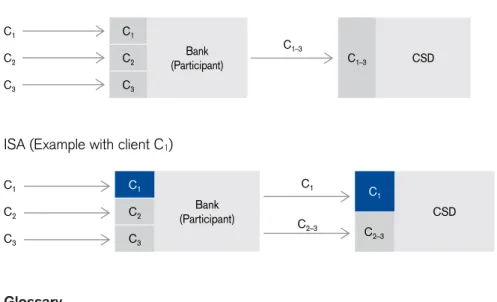
An ISA is used to hold the securities of a single client and therefore the client’s securities are held separately from the securities of other clients and our own proprietary securities. An OSA is used to hold the securities of a number of clients on a collective basis. However, we do not hold our own proprietary securities in OSAs.
Main legal implications of levels of segregation Insolvency (bankruptcy)
Clients’ legal entitlement to the securities that we hold for them directly with CSDs would not be affected by our insolvency, whether those securities were held in ISAs or OSAs.
The distribution of the securities in practice on an insolvency would depend on a number of factors, the most relevant of which are discussed below.
Application of English insolvency law
Were we to become insolvent, our insolvency proceedings would take place in England and would be governed by English insolvency law.
Under English insolvency law, securities that we held on behalf of clients would not form part of our estate on insolvency for distribution to creditors, provided that they remained the property of the clients. Rather, they would be deliverable to clients in accordance with each client’s proprietary interests in the securities.
As a result, it would not be necessary for clients to make a claim in our insolvency as a general unsecured creditor in respect of those securities. Securities that we held on behalf of clients would also not be subject to any bail-in process (see glossary), which may be applied to us if we were to become subject to resolution proceedings (see glossary).
Accordingly, where we hold securities in custody for clients and those securities are considered the property of those clients rather than our own property, they should be protected on our insolvency or resolution. This applies whether the securities are held in an OSA or an ISA.
Nature of clients’ interests
Although our clients’ securities are registered in our name at the relevant CSD, we hold them on behalf of our clients, who are considered as a matter of law to have a beneficial proprietary interest in those securities. This is in addition to any contractual right a client may have against us to have the securities delivered to them.
This applies both in the case of ISAs and OSAs. However, the nature of clients’ interests in ISAs and OSAs is different. In relation to an ISA, each client is beneficially entitled to all of the securities held in the ISA. In the case of an OSA, as the securities are held collectively in a single account, each client is normally considered to have a beneficial interest in all of the securities in the account proportionate to its holding of securities.
Our books and records constitute evidence of our clients’ beneficial interests in the securities. The ability to rely on such evidence would be particularly important on insolvency. In the case of either an ISA or an OSA, an insolvency practitioner may require a full reconciliation of the books and records in respect of all securities accounts prior to the release of any securities from those accounts.
We are subject to the client asset rules of the UK Financial Conduct Authority (CASS Rules), which contain strict and detailed requirements as to the maintenance of accurate books and records and the reconciliation of our records against those of the CSDs with which accounts are held. We are also subject to regular audits in respect of our compliance with those rules. As long as books and records are maintained in accordance with the CASS Rules, clients should receive the same level of protection from both ISAs and OSAs.
Central Securities Depositories Regulation 3
Shortfalls
If there were a shortfall between the number of securities that we are obliged to deliver to clients and the number of securities that we hold on their behalf in either an ISA or an OSA, this could result in fewer securities than clients are entitled to being returned to them on our insolvency. The way in which a shortfall could arise would be different as between ISAs and OSAs (see further below).
How a shortfall may arise
A shortfall could arise for a number of reasons including as a result of administrative error, intraday movements or counterparty default following the exercise of rights of reuse.
Where we have been requested to settle a transaction for a client and that client has insufficient securities held with us to carry out that settlement, we generally have two options:
(i) in the case of both an ISA and an OSA, to only carry out the settlement once the client has delivered to us the securities needed to meet the settlement obligation; or
(ii) in the case of an OSA, to make use of other securities held in that account to carry out settlement subject to an obligation on the part of the relevant client to make good that shortfall and subject to any relevant client consents required.
Where option (ii) is used, this increases the risks to clients holding securities in the OSA as it makes it more likely that a shortfall in the account could arise as a result of the relevant client failing to meet its obligation to reimburse the OSA for the securities used.
In the case of an ISA, only option (i) above would be available, which would prevent the use of securities in that account for other clients and therefore any resulting shortfall. However, it also increases the risk of settlement failure which in turn may incur additional buy in costs or penalties and/or may delay settlement as we would be unable to settle where there are insufficient securities in the account.
Where clients’ securities are held in an OSA, we will use option (ii) in accordance with agreed contractual terms.
Treatment of a shortfall
In the case of an ISA, the whole of any shortfall on that ISA would be attributable to the client for whom the account is held and would not be shared with other clients for whom we hold
securities. Similarly, the client would not be exposed to a shortfall on an account held for another client or clients.
In the case of an OSA, the shortfall would be shared among the clients with an interest in the securities held in the OSA (see further below). Therefore, a client may be exposed to a shortfall even where securities have been lost in circumstances which are completely unrelated to that client.
The risk of a shortfall arising is, however, mitigated as a result of our obligation under the CASS Rules in certain situations to set aside our own cash or securities to cover shortfalls identified during the process of reconciling our records with those of the CSDs with which securities are held.
If a shortfall arose and was not covered in accordance with the CASS Rules, clients may have a claim against us for any loss suffered. If we were to become insolvent prior to covering a shortfall, clients would rank as general unsecured creditors for any amounts owing to them in connection with such a claim. Clients would therefore be exposed to the risks of our insolvency, including the risk that they may not be able to recover all or part of any amounts claimed. In these circumstances, clients could be exposed to the risk of loss on our insolvency. If
securities were held in an ISA, the entire loss would be borne by the client for whom the relevant account was held. If securities were held in an OSA, the loss would be allocated between the clients with an interest in that account.
Central Securities Depositories Regulation 4
In order to calculate clients’ shares of any shortfall in respect of an OSA, each client’s
entitlement to securities held within that account would need to be established as a matter of law and fact based on our books and records. Any shortfall in a particular security held in an OSA would then be allocated among all clients with an interest in that security in the account. It is likely that this allocation would be made rateably between clients with an interest in that security in the OSA, although arguments could be made that in certain circumstances a shortfall in a particular security in an OSA should be attributed to a particular client or clients. It may therefore be a time consuming process to confirm each client’s entitlement. This could give rise to delays in returning securities and initial uncertainty for a client as to its actual entitlement on an
insolvency. Ascertaining clients’ entitlements could also give rise to the expense of litigation, which could be paid out of clients’ securities.
Security interests
Security interest granted to a CSD
Where the CSD benefits from a security interest over securities held for a client, there could be a delay in the return of securities to a client (and a possible shortfall) in the event that we failed to satisfy our obligations to the CSD and the security interest was enforced. This applies whether the securities are held in an ISA or an OSA. However, in practice, we would expect that a CSD would first seek recourse to any securities held in our own proprietary accounts to satisfy our obligations and only then make use of securities in client accounts. We would also expect a CSD to enforce its security rateably across client accounts held with it.
Furthermore, the CASS Rules restrict the situations in which we may grant a security interest over securities held in a client account.
Security interest granted to third party
Security interests granted over clients’ securities could have a different impact in the case of ISAs and OSAs.
Where a client purported to grant a security interest over its interest in securities held in an OSA and the security interest was asserted against the CSD with which the account was held, there could be a delay in the return of securities to all clients holding securities in the relevant account, including those clients who had not granted a security interest, and a possible shortfall in the account. However, in practice, we would expect that the beneficiary of a security interest over a client’s securities would perfect its security by notifying us rather than the relevant CSD and would seek to enforce the security against us rather than against such CSD, with which it had no relationship.
CSD disclosures
Set out below are links to the disclosures made by CSDs in the EU in which we are a Participant:
https://my.euroclear.com/eb/en/reference/csdr---euroclear-bank.html
If you click on those links, you leave this information/website. These disclosures have been provided by relevant CSD. We have not investigated or performed due diligence on the
Central Securities Depositories Regulation 5
Graphic representation of OSA and ISA
OSA (example with three clients C1–C3)
ISA (Example with client C1)
Glossary
Central Securities Depository (CSD) is an entity which records legal entitlements to dematerialised securities and operates a system for the settlement of transactions in those securities.
Central Securities Depository Regulation (CSDR), refers to EU Regulation 909/2014 which sets out rules applicable to CSDs and their participants.
Individual Client Segregated Account (ISA), is used to hold the securities of a single client. Omnibus Client Segregated Account (OSA), is used to hold the securities of a number of clients on a collective basis.
Participant means an entity that holds securities in an account with a CSD and is responsible for settling transactions in securities that take place within a CSD.
The information presented in this document is provided for informational purposes only. Nothing contained in this document is intended and should not be construed as tax, accounting or legal advice. The information provided was produced by Credit Suisse (UK) Limited ("Credit Suisse") with due care and to the best of its knowledge and belief. Any information including facts, opinions or quotations, may be condensed or summarised and is expressed as of the date of writing. The information may change without notice. Credit Suisse does not accept any responsibility or liability (whether in contract, tort or otherwise) for any loss or damage, which may arise directly or indirectly from use of or reliance on such information presented in this document.
Your personal data will be processed in accordance with the Credit Suisse Privacy Policy published at https://www.credit-suisse.com/uk/en/private-banking/important-disclaimer.html
Credit Suisse (UK) Limited is authorised by the Prudential Regulation Authority and regulated by the Financial Conduct Authority and the Prudential Regulation Authority for the conduct of investment business in the United Kingdom. The registered address of Credit Suisse (UK) Limited is Five Cabot Square, London E14 4QR.
If you have any questions, please contact your Relationship Manager. © Credit Suisse (UK) Limited 2019.
C1 C1
Bank (Participant)
C1–3
C1–3 CSD
C2 C2
C3 C3
C1 C1
Bank (Participant)
C1 C
1
CSD
C2 C2
C2–3 C 2–3