The Journal of Educators Online, Volume 6, Number 1, January 2009 1
Comparing AACSB Faculty and Student Online Learning Experiences:
Changes between 2000 and 2006
Melody W. Alexander, Ball State University Heidi Perreault, Missouri State University Jensen J. Zhao, Ball State University
Lila Waldman, University of Wisconsin-Whitewater
Abstract
This study identified and compared the online learning experiences of faculty and students in 2006 and compared results with those found in 2000. Data were collected from faculty and students participating in online learning courses at AACSB accredited business colleges in the United States. The findings indicate that (a) although faculty and students in both 2000 and 2006 reported satisfaction with the online learning experience, students in 2006 reported significantly higher satisfaction levels than did faculty for online administrative support (b) while faculty and students in both 2000 and 2006 reported few serious concerns with online learning courses, there were differences relating to the concerns noted in 2000, and (c) although faculty and students in 2000 and 2006 agreed that two important motivating factors for enrolling in online learning courses were flexibility and increased learning opportunities. There were several directional changes between faculty and students perceptions of motivational factors in 2006 when compared to 2000.
The authors are grateful to the Delta Pi Epsilon Research Foundation for providing a grant used in undertaking the study on which this article is based.
The Journal of Educators Online, Volume 6, Number 1, January 2009 2 Introduction
Jones (2002) reported that although students indicated that their online learning courses were satisfying learning experiences, most still preferred the traditional face-to-face classroom format. Online courses were viewed as a way to supplement, not replace, other educational experiences. Faculty members also have some reservations toward online learning. They indicated that the learning experience may not be as rich because traditional classroom interaction experiences are not available to students (Mansour & Mupinga, 2007). Despite the hesitations relating to online learning that have been expressed by students and faculty, online learning is part of the long-term institutional strategy for most universities (Allen & Seaman, 2006). To understand the
implications of online learning at the university level, more research is needed according to Gibson and Harris (2008).
The fast growth of distance learning programs is impressive according to GetEducated.com, an online degree clearinghouse that began reporting on distance education programs in 1989. As an example, no business schools accredited by the Association to Advance Collegiate Schools of Business (AACSB) were offering online education in 1989. By 2008, however, such schools were offering a third of all online business graduate programs (GetEducated.com, 2008). AACSB executive committee members recognized that that the haste with which online programs were developed likely caused some problems and encouraged all institutions to
examine online programs for inefficiencies (AACSB International, 1999). Singh and Pan (2004a) noted that most of the research related to the adoption or expansion of online learning by
business schools has been focused on administrative reasons. They encouraged researchers to focus more on the reasons why business students select or avoid online learning. Another issue needing further research is the perceptions of online learning by faculty members (Maguire, 2005). Improvements to online learning environments can be made only when full information is known (Mansour & Mupinga, 2007). The purpose of this study is to examine and compare business student and faculty perceptions relating to online learning experiences at AACSB-accredited institutions.
The Journal of Educators Online, Volume 6, Number 1, January 2009 3 Literature Review
U.S. business schools are under pressure to offer students a variety of course options (Bisoux, 2007). The traditional face-to-face course delivery model is not meeting the flexibility
expectations of today’s graduate student. Singh and Pan (2004a) reported that MBA students want more time flexibility than is typically offered with traditional courses. The importance associated with the time flexibility factor may be related to students’ work and family
responsibilities outside of the academic setting. About two-thirds of the MBA students in the United States are working on their degrees part time while balancing professional and family demands (Fortino & Wolf, 2007).
Online learning provides flexibility by removing the barriers of time and space that are
associated with courses offered in the traditional classroom setting. Although faculty members realize that online learning can provide increased opportunities for participation in graduate education opportunities, they have expressed concerns that online learning courses may not offer the full learning benefits provided through traditional face-to-face courses (Mansour & Mupinga, 2007). Getting faculty members to accept and be involved in online learning remains a struggle. Wilkes, Simon, and Brooks (2006) noted that almost 30 percent of business faculty members surveyed stated that they never intend to teach an online learning class.
The perception that online learning may not provide as rich a learning experience as can be obtained through traditional learning formats is shared by college administrators. Forty percent of administrators participating in a nation-wide study indicated that they felt online course quality was inferior to traditional course quality (Allen & Seaman, 2006). Negative attitudes expressed by faculty members and administrators frustrate faculty members who are involved in creating and delivering online courses. They worry that their contributions will be minimized during tenure and promotion decisions (Grenzky & Maitland, 2001). Negative attitudes thwart program acceptance, development, and support. Fortino and Wolf (2007) stressed that successful programs need the support of the entire faculty and administration. As a means for providing proof that online course quality meets expectations, a systematic evaluation system comparing traditional and online delivery formats was recommended.
The Journal of Educators Online, Volume 6, Number 1, January 2009 4 At schools where online learning is a part of the course delivery system, administrators need to address faculty concerns. One factor that may prevent faculty from embracing online courses delivery is the time required to develop and deliver an online course (Tastle, White, & Shackleton, 2005). Most administrators recognize that the time commitment is a barrier to
getting more faculty members involved in online learning (Allen & Seaman, 2006). A suggestion for reducing the time barrier is for administrators to provide a reduction in course load or
additional compensation to reward those willing to develop and deliver online courses (Fortino & Wolf, 2007).
Access to quality technical support and training is another faculty concern needing to be
addressed. Faculty members expect help during both the course development and delivery stages (Maguire, 2005). At a minimum, technical training should be provided on using the features of the course management system and incorporating basic instructional support technologies such as streaming media (Mansour & Mupinga, 2007). Training on how to organize and deliver material in an online learning format can help educators create satisfying learning experiences that engage students (Palloff & Pratt, 2000).
Student engagement continues to be an issue for online course delivery. Wilkes, Simon, & Brooks (2006) reported that students felt their traditional courses offered more opportunity for interaction and discussion than did their online learning courses. Feelings of being isolated or disconnected from other learners are a common concern expressed by online learning students (Richardson & Swan, 2003). The shared purpose or sense of community that is typical with traditional courses can be missing from online courses. De Verneil and Berge (2000) encouraged online course designers to foster a sense of community by providing frequent opportunities for online students to interact with other students and their instructor.
Sustaining a high level of interaction, however, can be problematic. Multiple demands on a faculty member’s time and large course enrollments can prevent faculty members from being as engaged in the course as desired (Woods, 2002). Woods and Baker (2004) cautioned that a high level of interaction does not necessarily correspond to increased learning. The interactions, while socially satisfying, may not be intellectually challenging or meaningful. Singh and Pan (2004b)
The Journal of Educators Online, Volume 6, Number 1, January 2009 5 agreed and stressed that it is the faculty member’s responsibility to incorporate meaningful interactions including focused feedback into online courses. If group activities are part of the online course expectation, the instructor must be ready to monitor the groups. Piezon and
Donaldson (2005) noted that online team activities are difficult to organize and monitor. Students often became frustrated with team members resulting in a compromised learning experience.
Wilkes, Simon, and Brooks (2006) shared issues that students rated as important for online course success. Issues included timely feedback from instructors, ready access to course-related resources, and organized course presentations. Portugal (2006) also documented the need for well-planned interactions and easy access to course-related information. Technical support is considered a crucial element leading to the success of online learning programs (Campbell, Concannon, & Flynn, 2005). Students reported high levels of stress when network problems occurred and when adequate technical support was not available.
Students and faculty members experienced with online courses shared similar perceptions relating to online delivery issue. Although faculty members expressed greater levels of concern over possible problems such as access to resources and technical support, overall students and faculty members indicated they were satisfied with online courses at AACSB-accredited business schools (Alexander, Zhao, Perreault, & Waldman, 2003). Campbell, Concannon, and Flynn (2005) stressed that institutions offering online learning must make a continuous
commitment to provide the resources needed to adequately deliver and support the courses.
Purpose
This study compared faculty and student experiences with online learning courses in 2006 to examine if both groups had similar experiences and attitudes toward their online learning participation. It then compared the 2006 experiences with findings from a 2000 study. Documenting the changes in online learning faculty and student experiences can aid with identifying factors that may influence the success or failure of online learning courses. Only when full information is available can improvements be made to online learning environments (Mansour & Mupinga, 2007).
The Journal of Educators Online, Volume 6, Number 1, January 2009 6 Statement of the Problem
The problem of this study is twofold. The first part of the study compared 2006 faculty and student online learning experiences at AACSB-accredited business schools. The second component of the study compared those experiences to the experiences noted in a 2000 study. Specifically, the areas of research studied included (a) faculty and student satisfaction with online learning, (b) faculty and student concerns with online learning, and (c) faculty and student perceptions of the motivational factors influencing enrollment in online learning offerings.
To address these areas, the following research questions were asked:
1. Are there any differences between faculty and students’ level of satisfaction with online learning experiences in 2006? How do these differences compare with those found in 2000?
2. Are there any differences between faculty and student concerns with online learning experiences in 2006? How do these differences compare with those found in 2000? 3. Are there any differences between faculty and student perceptions of the motivational
factors influencing participation in online learning offerings in 2006? How do these differences compare with those found in 2000?
Method
This study was conducted to identify differences between faculty and student experiences with online learning courses in 2006 and discuss any differences in relation to those found in 2000. A survey approach was used in both 2006 and 2000. In 2000 two questionnaires were developed that identified (1) faculty experiences with online learning courses, and (2) student experiences with online learning courses. Both questionnaires included sections on the satisfactions,
concerns, and motivating factors for taking online learning courses. The questionnaires were examined by a panel of experts and pilot tested with a group of students and faculty members who had experience with online learning courses. In order to use the questionnaire to gather information in 2006, the questionnaire used in 2000 was again tested for validity and clarity.
The Journal of Educators Online, Volume 6, Number 1, January 2009 7 Faculty 2006 questionnaire
Following the validation procedures used for the 2000 study, the 2006 faculty questionnaire was again validated by a ten-member panel of online learning faculty and administrators. Changes in the original panel were made as necessary due to retirement or sabbatical leave. Each panel member had over five years of teaching, designing or administration experience with online learning. The panel agreed that the 2006 questionnaire items still addressed the stated objectives of the 2000 study. Following validation, the questionnaire was again tested for clarity by
experienced online education faculty members, who indicated the questionnaire items were still easily understood.
Student 2006 Questionnaire
The student questionnaire used in 2000 was reviewed by the same panel of experts used for the faculty survey. After validation, the questionnaire was tested for clarity by a pilot group of online learning students. The 2006 student pilot group indicated the questionnaire items from the 2000 study were still easily understood.
Questionnaire Content
Based on the feedback from the validation panel members and the student pilot group, minor design changes were made to the 2006 questionnaires. No other changes were made to the questionnaire used in 2000 in order to be able to conduct the comparison study. The questionnaire identified student experiences with online learning courses and included the following sections: (1) satisfaction with online learning courses, (2) concerns with online learning courses, and (3) perceived motivational factors for taking online learning courses.
Faculty Online Learning Participants in 2000
There were 355 AACSB accredited business schools in the United States in 2000. Each school was contacted through website e-mail addresses and phone numbers, and asked to provide the names of professors teaching a business online learning course. Sixty-one institutions were identified that offered online learning courses, and names and mailing addresses of 184 faculty members who taught online learning courses were obtained. With Institutional Review Board (IRB) approval, the faculty members were sent a cover letter and questionnaire. After six weeks
The Journal of Educators Online, Volume 6, Number 1, January 2009 8 a follow-up was sent to non-respondents. Of the 184 mailed questionnaires, 98 were returned; however, 17 questionnaires were returned due to faculty members who were on sabbatical leave and/or out of the country. A total of 81 usable responses were received, resulting in a response rate of 44%.
Faculty Online Learning Participants in 2006
There were 436 AACSB accredited business schools in the United States in 2006. A search completed on the AACSB website resulted in 414 schools that offered business online learning courses. Mailing labels were ordered from AACSB that provided the names of the business school deans and the school address. With IRB approval, the 414 business school deans were sent a cover letter requesting that they give the survey with another cover letter to up to five of their faculty members who taught online learning courses. Of the 414 business school deans who received the mailing, 34 called to report that they were not currently offering online learning courses, although many were in the development phase and planned to offer them in the future. An additional 9 sent back the surveys blank, and indicated that they did not have programs in place. The usable surveys received totaled 140. As AACSB labels were received with a stipulation of one-time use only, no follow-up could be mailed.
Student Online Learning Participants in 2000
In 2000 using the researchers’ three AACSB accredited schools of business within mid-sized public universities, nine faculty members teaching online learning courses gave questionnaires to the students in their courses. Data from students were collected at the end of spring, summer, and fall semesters in 2000. Following human subjects protocol from the researcher’s universities, students were told that participation was voluntary and would have no effect on final grades. A letter that accompanied the survey informed students that responses and comments were
confidential and would be combined with responses from students at other universities enrolled in business online learning courses. Pre-addressed envelopes were provided to the students to return questionnaires to the researchers. A total of 153 questionnaires were received from students.
The Journal of Educators Online, Volume 6, Number 1, January 2009 9 Student Online Learning Participants in 2006
In 2006, again using the researchers’ three AACSB accredited schools of business within mid-sized public universities, 18 graduate online learning faculty members distributed or informed their students of the study. Student data were collected at the end of three academic semesters; spring, summer, and fall during 2006. Following human subjects protocol from the researcher’s universities, student participation was voluntary and had no effect on final grades. The original questionnaire used in 2000 was redesigned to include a Website with an interactive questionnaire version. The Website homepage explained the purpose of the study and assured students that all results would be confidential. Professors had a choice of distributing surveys with information letters and pre-addressed envelopes, as done in 2000, or directing students to the Website. A total of 152 questionnaires were received through surface mail, and 148 responses were received electronically, resulting in a total n of 300.
Analysis of Data
Data were analyzed using descriptive statistics, including percentages and frequencies, as appropriate. Following the analysis that was conducted in 2000, t-tests were used to identify any areas of significant differences between online learning faculty and student experiences with courses in 2006. Statistical significance was determined at the .05 level.
Profile of Faculty Teaching Online Learning Course in 2000 and 2006
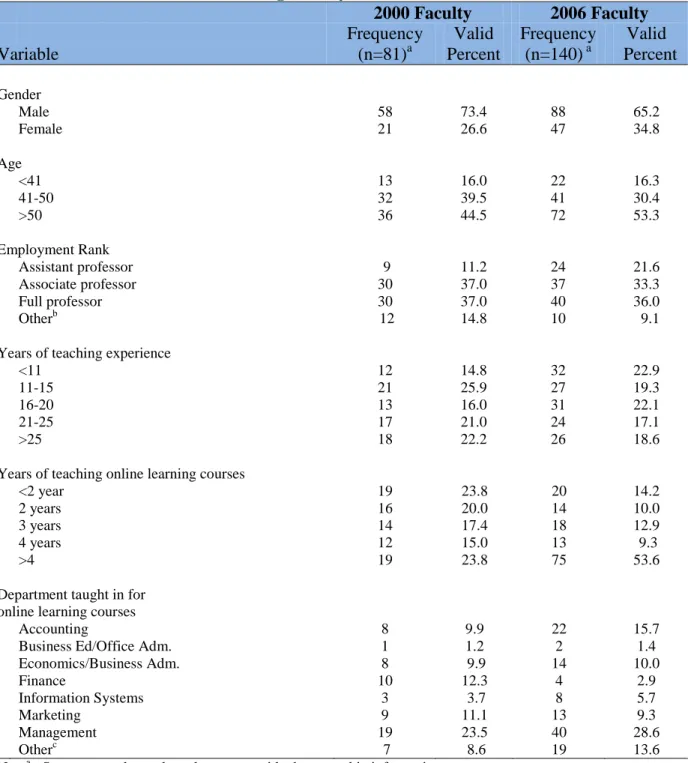
Of the 81 faculty respondents in 2000, 73 percent were male and 84 percent were over the age of 40. About three-quarters (74%) were associate or full professors, and over 85 percent had 11 or more years of teaching experience. Over three quarters had been teaching online learning courses for 2 or more years.
Of the 140 respondents in 2006, 65 percent were male and 84 percent were over the age of 41. Approximately 70 percent (69%) were associate or full professors and over 77 percent reported 11 or more years of teaching experience. About 86 percent indicated they had been teaching online learning courses for two or more years. In both years, online learning faculty participants
The Journal of Educators Online, Volume 6, Number 1, January 2009 10 reported teaching a variety of business courses in various business departments, but most commonly affiliated with management departments (see Table 1.)
TABLE 1: Profile of Online Learning Faculty
2000 Faculty 2006 Faculty
Frequency Valid Frequency Valid
Variable (n=81)a Percent (n=140) a Percent
Gender
Male 58 73.4 88 65.2
Female 21 26.6 47 34.8
Age
<41 13 16.0 22 16.3
41-50 32 39.5 41 30.4
>50 36 44.5 72 53.3
Employment Rank
Assistant professor 9 11.2 24 21.6
Associate professor 30 37.0 37 33.3
Full professor 30 37.0 40 36.0
Otherb 12 14.8 10 9.1
Years of teaching experience
<11 12 14.8 32 22.9
11-15 21 25.9 27 19.3
16-20 13 16.0 31 22.1
21-25 17 21.0 24 17.1
>25 18 22.2 26 18.6
Years of teaching online learning courses
<2 year 19 23.8 20 14.2
2 years 16 20.0 14 10.0
3 years 14 17.4 18 12.9
4 years 12 15.0 13 9.3
>4 19 23.8 75 53.6
Department taught in for online learning courses
Accounting 8 9.9 22 15.7
Business Ed/Office Adm. 1 1.2 2 1.4
Economics/Business Adm. 8 9.9 14 10.0
Finance 10 12.3 4 2.9
Information Systems 3 3.7 8 5.7
Marketing 9 11.1 13 9.3
Management 19 23.5 40 28.6
Otherc 7 8.6 19 13.6
Notea: Some respondents elected not to provide demographic information.
Noteb: “Other” responses included instructors, administrators, and visiting professors.
Notec: : “Other” responses included communications, commercial law, operations management, marketing and
The Journal of Educators Online, Volume 6, Number 1, January 2009 11 Profile of Students in Online Learning Courses in 2000 and 2006
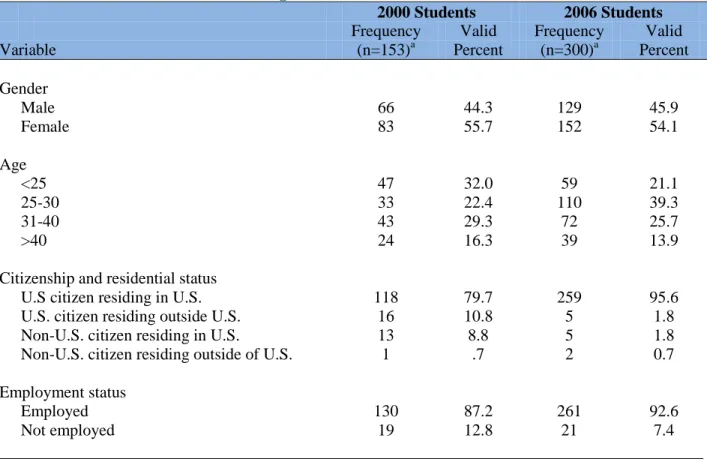
A profile of the 153 student respondents in online learning courses in 2000 and the 300 student respondents in online learning courses in 2006 are presented in Table 2. In 2000 over half of the 153 respondents were female (56%) and under the age of 31 (54%). Approximately eighty percent were U.S. citizens residing in the United States (80%) and were employed (87%).
In 2006 over half of the 300 respondents were female (54%) and under the age of 31 (60%). Approximately ninety percent were U.S. citizens residing in the United States (96%) and were employed (93%). This profile is shown in Table 2.
TABLE 2: Profile of Online Learning Students
2000 Students 2006 Students
Frequency Valid Frequency Valid
Variable (n=153)a Percent (n=300)a Percent Gender
Male 66 44.3 129 45.9
Female 83 55.7 152 54.1
Age
<25 47 32.0 59 21.1
25-30 33 22.4 110 39.3
31-40 43 29.3 72 25.7
>40 24 16.3 39 13.9
Citizenship and residential status
U.S citizen residing in U.S. 118 79.7 259 95.6
U.S. citizen residing outside U.S. 16 10.8 5 1.8
Non-U.S. citizen residing in U.S. 13 8.8 5 1.8
Non-U.S. citizen residing outside of U.S. 1 .7 2 0.7
Employment status
Employed 130 87.2 261 92.6
Not employed 19 12.8 21 7.4
The Journal of Educators Online, Volume 6, Number 1, January 2009 12 Findings
An analysis of the findings of online learning faculty and student comparisons of course experiences are presented as follows: (1) faculty and student satisfaction with online learning courses, (3) faculty and student concerns with online learning courses, (4) faculty and student perceptions of the motivational factors for taking online learning courses.
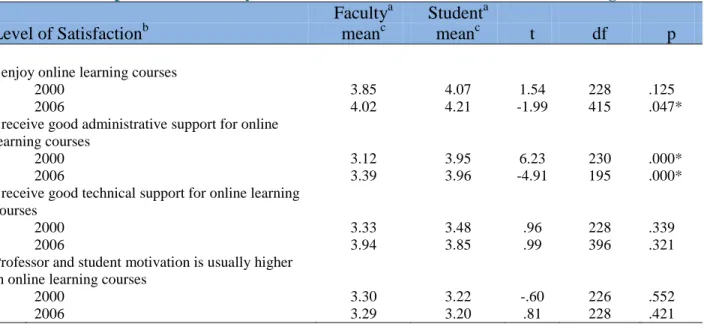
Comparison between Faculty and Student Satisfaction with Online Learning Courses A comparison between faculty and student satisfaction with online learning courses in 2006 resulted in two areas of statistically significant difference. Students reported they enjoy online learning courses: t(230) = 6.23, p < .05, and had received good administrative support for their online learning courses significantly more than faculty: t(195) = -4.91, p < .05 . In 2000, this difference was not significant. Students in 2000 indicated they had received good administrative support for their distance learning courses significantly more than faculty: t(230) = 6.23, p < .05 . Table 3 illustrates this analysis.
TABLE 3: Comparison of Faculty and Student Satisfaction with Online Learning Courses Facultya Studenta
Level of Satisfactionb meanc meanc t df p
I enjoy online learning courses
2000 3.85 4.07 1.54 228 .125
2006 4.02 4.21 -1.99 415 .047*
I receive good administrative support for online learning courses
2000 3.12 3.95 6.23 230 .000*
2006 3.39 3.96 -4.91 195 .000*
I receive good technical support for online learning courses
2000 3.33 3.48 .96 228 .339
2006 3.94 3.85 .99 396 .321
Professor and student motivation is usually higher in online learning courses
2000 3.30 3.22 -.60 226 .552
2006 3.29 3.20 .81 228 .421
Notea: Not all respondents answered all questions, and respondents had the option to report “not applicable” or “don’t know”. The largest possible number of respondents was used for each analysis.
Noteb: Although respondents were offered an “other” option to report additional areas of satisfaction, little (if any) information was provided.
Notec: Means were based on a 5 point Likert scale, from a 5 indicating strongly agree, to a 1 indicating strongly disagree.
The Journal of Educators Online, Volume 6, Number 1, January 2009 13 Comparison between Faculty and Student Concerns with Online Learning Courses
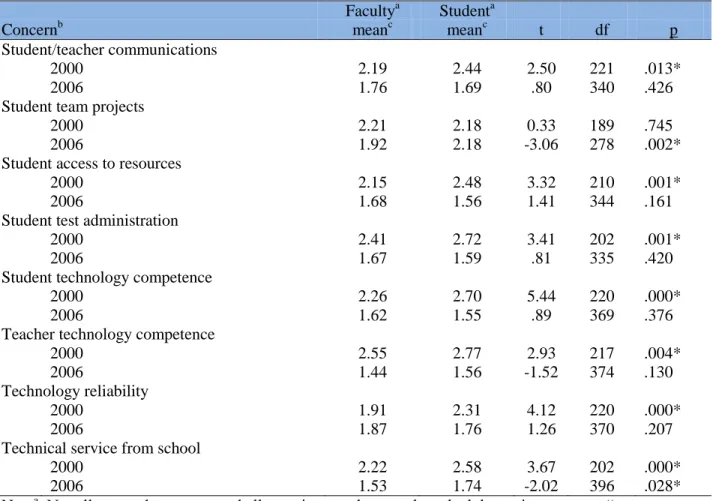
In 2006, two of the eight areas investigated resulted in statistically significant differences between faculty and student concerns with online learning courses. Faculty identified student team projects: t(278) = -3.06, p < .05; and technical service from the school: t(396) = -2.02, p < .05; as significantly less of a concern with online learning courses when compared to students.
In 2000, seven of the eight areas evaluated resulted in statistically significant differences between faculty and student concerns with distance education courses (see table 4).
TABLE 4: Comparison of Faculty and Student Concerns with Online Learning Courses
Facultya Studenta
Concernb meanc meanc t df p
Student/teacher communications
2000 2.19 2.44 2.50 221 .013*
2006 1.76 1.69 .80 340 .426
Student team projects
2000 2.21 2.18 0.33 189 .745
2006 1.92 2.18 -3.06 278 .002*
Student access to resources
2000 2.15 2.48 3.32 210 .001*
2006 1.68 1.56 1.41 344 .161
Student test administration
2000 2.41 2.72 3.41 202 .001*
2006 1.67 1.59 .81 335 .420
Student technology competence
2000 2.26 2.70 5.44 220 .000*
2006 1.62 1.55 .89 369 .376
Teacher technology competence
2000 2.55 2.77 2.93 217 .004*
2006 1.44 1.56 -1.52 374 .130
Technology reliability
2000 1.91 2.31 4.12 220 .000*
2006 1.87 1.76 1.26 370 .207
Technical service from school
2000 2.22 2.58 3.67 202 .000*
2006 1.53 1.74 -2.02 396 .028*
Notea: Not all respondents answered all questions, and respondents had the option to report “not
applicable” or “don’t know”. The largest possible number of respondents was used for each analysis.
Noteb: Although respondents were offered an “other” option to report additional areas of concern, little (if
any) information was provided.
Notec: Means were based on a 3 point Likert scale, from a 3 indicating not a problem, to a 1 indicating a
problem.
The Journal of Educators Online, Volume 6, Number 1, January 2009 14 Faculty identified student/teacher communications: t(221) = 2.5, p < .05; student access to resources: t(21) = 3.32, p > .05, student test administration: t(202) = 3.41, p < .05; student
technology competence: t(22) = 5.44, p < .05; teacher technology competence: t(217) = 2.93, p < .05; technology reliability: t(22) = 2.31, p < .05; and technical service from the school: t(202) = 3.67, p < .05; as significantly more of a concern with distance education courses when compared to students.
Comparison between Faculty and Student Perceptions of the Motivational Factors for taking Online Learning Courses
A comparison of faculty and student perceptions of the motivational factors for taking online learning courses in 2006 resulted in four areas of statistically significant differences. Students perceived the cost efficiency: t(241) = -4.89, p < .05; flexibility of time/place: t(224) = -2.59, p < .05; more learning opportunities: t(417) = -3.17, p < .05; and student-centered learning: t(213) = -2.37, p < .05; as significantly higher motivational factors for taking online learning courses as compared with faculty.
In 2000, there were five areas of statistically significant differences. Faculty identified flexibility of time/place: t(231) = -4.05, p < .05; having a faculty member as the facilitator: t(229) = -3.13, p < .05; more learning opportunities: t(226) = -2.19, p < .05; and new teaching/learning
approaches: t(226) = -2.35, p < .05; as significantly higher motivational factors for taking distance learning courses as compared with students. Students identified the cost efficiency of distance education courses: t(226) = 2.13, p < .05, as a more significant motivational factor than faculty. This analysis is shown in Table 5.
The Journal of Educators Online, Volume 6, Number 1, January 2009 15 TABLE 5: Comparison of Faculty and Student Perceptions of the Motivational Factors for Taking Online Learning Courses
Factorb
Facultya meanc
Studenta
meanc t df p
Cost efficiency for students
2000 2.41 2.70 2.13 226 .034*
2006 2.53 3.04 -4.89 241 .000*
Flexibility of time/place
2000 3.50 2.88 -4.05 231 .000*
2006 3.71 3.84 -2.59 224 .010*
Faculty member as facilitator
2000 3.23 2.79 -3.13 229 .002*
2006 3.27 3.28 -.47 231 .639
More learning opportunities
2000 3.04 2.72 -2.19 226 .029*
2006 3.09 3.38 -3.17 417 .002*
New teaching/learning approaches
2000 3.04 2.75 -2.35 226 .020*
2006 3.03 2.92 -.08 421 .939
Student-centered learning
2000 2.86 2.70 -1.22 227 .224
2006 2.90 3.06 -2.37 213 .019*
Notea: Not all respondents answered all questions, and respondents had the option to report “not applicable” or “don’t know”. The largest possible number of respondents was used for each analysis.
Noteb: Although respondents were offered an “other” option to report additional areas of perceived motivational factors, little (if any) information was provided.
Notec: Means were based on a 4-point Likert scale, from a 4 indicating very important, to a 1 indicating not important.
*Significant at the .05 level.
Conclusions and Implications
Faculty and Student Satisfaction with Online Learning
Research question one documented differences between faculty and student satisfaction with online learning experiences in 2006, and compared differences with those identified in 2000. Although both faculty and students in 2000 indicated high levels of satisfaction with online learning courses, students were more satisfied in three of the four areas (course enjoyment, administrative support, and technology support). In the area of administrative support, this difference was significant. Again in 2006, both faculty and students indicated high levels of satisfaction, but faculty indicated higher levels of satisfaction than students in the areas of
The Journal of Educators Online, Volume 6, Number 1, January 2009 16 technical support and professor/student motivation. In addition, 2006 students reported a significantly higher level of course enjoyment when compared with faculty.
In the six year span studied, both students and faculty satisfaction levels with their online
learning experiences have risen for three of the satisfaction items measured. Those items include enjoying distance learning courses, receiving good administrative support, and receiving good technical support. The last satisfactions area, higher motivation exhibited by professor and students in online courses, showed a very small decline in the level of satisfaction.
Overall, the findings relating to satisfaction indicate that by 2006 online learning courses were being viewed as a more satisfying experience by both students and faculty than they were in 2000. The reason may be that both groups had more experience with online learning by 2006. The decrease in satisfaction relating to professors and students being more motivated in online courses than in traditional courses also may be due to experience. What may have been a new and exciting experience in 2000 is no longer a novel experience in 2006.
It is important to note that both in 2000 and in 2006 faculty members’ satisfaction was
significantly lower than students’ levels in regard to the quality of administrative support. The two groups apparently view administrative support differently. Students may be expressing satisfaction relating to administrative tasks such as course enrollment and scheduling procedures. Faculty, however, may be including other aspects such as administrative support relating to the time required to develop and deliver online learning or to the level of administrative support they receive during tenure and promotion decisions. Administrators are encouraged to work with faculty members to address issues that may be deemed unfair or unrealistic.
Faculty and Student Concerns with Online Learning
Research question two documented differences between faculty and student concerns with online learning experiences in 2006, and compared the differences with those identified in 2000. In 2000, students rated seven of the eight potential concerns as significantly less of a problem than did faculty. By 2006, only two of the potential concerns were rated by students as being
The Journal of Educators Online, Volume 6, Number 1, January 2009 17 themselves are still evident. In fact, faculty and students rated all eight of the concerns as being as much or more of a problem in 2006 than they did in 2000. It is obvious that work is still needed to improve student/teacher communications, team projects, access to resources, and technology competence, reliability, and support.
The two concerns still noted as significantly different in 2006 were technical service from school and student team projects. Students considered both potential concerns as being less of a problem than did faculty members. Faculty members should provide opportunities for students to share their concerns relating to team projects so that solutions can be found to minimize the problems associated with team activities. Technical support typically is not within the faculty member’s control. Access to quality and responsive technical support, however, is a student expectation and must be addressed by administration (Tastle, White, and Shackleton, 2005).
Faculty and Student Perceived Motivational Factors
Research question three documented differences between faculty and student perceived motivational factors for taking online learning courses in 2006 and compared differences with those identified in 2000. In 2000 faculty rated motivating factors as more important in five of the six areas. In four of the areas, these differences were significant. In 2006, however, students rated motivating factors higher than faculty on five of the six items. The only item in 2000 that students perceived as a more important motivating factor when compared with faculty was in the area of cost efficiency. Students in 2006 perceived “cost efficiency”, “flexibility of time and place”, “more learning opportunities”, and “student-centered learning” as significantly more of a motivating factor for taking online learning courses, when compared to faculty.
Faculty and students are in more agreement in 2006 relating to the factors that motivate students to enroll in online learning courses. It is interesting that the factor the faculty members rated as being the least motivational in both 2000 and in 2006 was a factor on which they and the students disagreed in both time periods examined. Students rated “cost efficiency” as a significantly more important motivational factor than did the faculty in both 2000 and 2006. Students are concerned with the cost of classes and certainly faculty members are aware of those concerns. Faculty members, however, may have been reacting to the fact that many schools
The Journal of Educators Online, Volume 6, Number 1, January 2009 18 charge a premium for online courses. Students pay more per credit hour for an online course than for a traditional course. Faculty may interpret the fact that students are enrolling in the more expensive online courses as a disregard for the extra cost. When students are considering the cost, they may be factoring in the travel and time costs as well as tuition when making the determination of enrolling in an online course or a less expensive traditional course.
Students and faculty members agreed that the factor that is most motivational is the flexibility of time and place. They also agreed that the next two most highly rated motivational factors are faculty members as facilitators and more learning opportunities. Fortino and Wolf (2007)
encouraged educators to embrace online learning because it provides everyone the opportunity to pursue higher education no matter what the individual’s time constraints or geographic location.
Recommendations for Future Research
This study examined the experiences of faculty and students involved with online learning courses in 2006, and compared these experiences with those found in 2000. As there are many types of online learning issues, future research should focus on the following:
1. Since this research focused on online learning faculty and students experiences, future research should evaluate administrative experiences.
2. Further research should focus on identifying differences in perceptions between undergraduate and graduate students online learning experiences.
3. Because online learning is evolving so rapidly, this study should be replicated periodically to identify changes in faculty and student concerns with online learning courses
The Journal of Educators Online, Volume 6, Number 1, January 2009 19 References
AACSB International, (1999, Summer). AACSB issues quality guidelines amidst rapid growth of distance learning programs. Retrieved, December 8, 2008, from
http://www.aacsb.edu/Publications/printnewsline/NL1999/smquality.asp.
Alexander, M., Zhao, J., Perreault, H., & Waldman, L., (2003). Distance education courses: a comparative study of faculty and student experiences. NABTE Review, 30(1), 16-28. Allen, I. E., & Seaman, J. (2006). Making the grade; online education in the United States, 2006.
The Sloan Consortium. Retrieved January 28, 2008, from http://www.sloan-c.org/publications/survey/pdf/making_the_grade.pdf.
Bisoux, T. (2007). The evolution of e-learning. BizEd,6(1), 22-29.
De Verneil, M., & Berge, Z. L. (2000). Going online: guidelines for faculty in higher education. International Journal of Educational Telecommunications, 6, 227-242.
Campbell, M., Concannon, F., & Flynn, A. (2005). What campus-based students think about the quality and benefits of e-learning. British Journal of Educational Technology, 36(3), 501-512.
Fortino, A., & Wolf, P. P. (2007). Going the distance. BizEd, 6(1), 30-35.
GetEducated.com. (2008, February 27). National survey ranks top 30 best online and distance learning MBAs-AACSB. Retrieved, December 8, 2008, from
http://www.geteducated.com/press/prBBMBA_AACSB0208.asp.
Gibson, S.G., & Harris, M.H. (2008). Predicting student preference for face-to-face versus distance education. Business Education Forum, 62(3), 50-52.
Grenzky, J., & Maitland, C. (2001). Focus on distance education. Update, 7(1), 1-6.
Jones, S. (2002). The internet goes to college: how students are living in the future with today’s technology. Pew Internet Project. Retrieved January 27, 2008, from
http://www.pewinternet.org/report_display.asp?r=71.
Maguire, L. L. (2005). Literature review—faculty participation in online distance education: barriers and motivators. Online Journal of Distance Learning Administration, 8(1). Retrieved January 27, 2008, from
http://www.westga.edu/~distance/ojdla/spring81/maguire81.htm.
Mansour, B. E., & Mupinga, D. M. (2007). Students’ positive and negative experiences in hybrid and online classes. College Student Journal, 41(1), 242-248.
The Journal of Educators Online, Volume 6, Number 1, January 2009 20 Palloff, R. M., & Pratt, K. (2000). Making the transition: helping teachers to teach online. Paper
presented at EDUCAUSE: Thinking it through. Nashville, TN. Retrieved January 28, 2008, from http://www.educause.edu/ir/library/pdf/EDU0006.pdf.
Piezon, S. L., & Donaldson, R. L. (2005). Online groups and social loafing: understanding student-group interactions. Online Journal of Distance Learning Administration, 8(4). Retrieved January 29, 2008, from
http://www.westga.edu/~distance/ojdla/winter84/piezon84.htm.
Portugal, L. M. (2006). Emerging leadership roles in distance education: current state of affairs and forecasting future trends. Online Journal of Distance Learning Administration, 9(3). Retrieved January 27, 2007, from
http://www.westga.edu/~distance/ojdla/fall93/portugal93.htm.
Richardson, J. C., & Swan, K. (2003). Examining social presence in online courses in relation to students’ perceived learning and satisfaction. Journal of Asynchronous Learning Networks, 7, 68-88.
Singh, P., & Pan, W. (2004a). Factors affecting student adoption of online education. Academic Exchange Quarterly, 8(1), 7-10.
Singh, P., & Pan, W. (2004b). Online education: lessons for administrators and instructors. College Student Journal, 38(2), 302.
Tastle, W. J., White, B. A., & Shackleton, P. (2005). E-learning in higher education: the challenge, effort, and return on investment. International Journal on E-Learning, 4(2), 241-251.
Wilkes, R. B., Simon, J. C., & Brooks, L. D. (2006). A comparison of faculty and undergraduate students’ perceptions of online courses and degree programs. Journal of Information Systems Education, 17(2), 131-140.
Woods, R. H. (2002). How much communication is enough in online courses? International Journal of Instructional Media, 29, 377-394.
Woods, R. H., & Baker, J. D. (2004). Interaction and immediacy in online learning. International Review of Research in Open and Distance Learning, 5 (2). Retrieved January 27, 2008, from http://www.irrodl.org/index.php/irrodl/article/view/186/801.