An Evaluation of a Development Program for New Principals
John F. Eller
Virginia Polytechnic Institute and State University, Virginia, USA
The evaluation of a program designed to assist principals recently appointed to their positions is the focus of this article. Researchers conducted a variety of qualitative assessments including focus group interviews, a review of training session feedback forms, participant reflective writing, and an assessment of training materials and program agendas. Researchers analyzed this data to look for aspects of participant knowledge, skills, and applications of program information. Participant feedback provided insights into program benefits and needed refinements. Article provides insights into assessment tools that people responsible for delivering principal support programs could consider to provide them with a more comprehensive examination of their program than traditional session feedback forms provide. Article also provides program recommendations that other program designers could consider to improve their existing principal support programs. Key Words: New Principals, Support Programs, Skill Development, Principal Professional Development, and Principal Leadership Development
Introduction
An ongoing educational theme over the last several years has been the importance of leadership development. Agencies such as colleges and universities, regional principal centers, state and national organizations, and other entities have developed programs to provide potential school leaders the support they need to be successful.
One such program is being conducted in SW Virginia. The program is entitled the Recently Appointed Principals Program. This program is a collaboration between the Western Virginia Public Education Consortium and the Center for (COTA) at Virginia Polytechnic Institute and State University.
This article highlights the evaluation of this program beyond just gathering participant perceptions at the end of a particular program session. The program directors asked us to construct and operate a comprehensive evaluation of the program. The readers of this article will learn how this evaluation was conducted, the results of the evaluation, and the recommendations we made to improve the delivery of the program. Our work could be the foundation for others charged with evaluating or organizing other similar leadership development programs.
Content and Training Needs of School Leaders and Principals
Today’s school leader faces many difficult challenges. Authors point to the increased scrutiny of schools, budget shortfalls, and student achievement challenges are among the many problems facing today’s school leader. As the challenges of society
have increased, the role of a principal or school leader has become increasingly difficult and complex. Crow (2006) outlined the increased accountability and complexity that makes the role of the principal difficult. He stated “…higher expectations for…principals in the area of instructional leadership… increased public scrutiny of public schools, and the promotion of privatization as a public policy agenda, have significantly changed the role of school principal” (p. 310).
This high level of complexity can make it difficult for new principals to successfully acclimate into the job. The public looks to schools and their leaders to be able to work through the chaos and operate in a focused and effective manner. This can be a daunting and overwhelming task, especially for new principals or leaders. Walker and Qian (2006) state, “The dominant modern myth portrays the school principal as an underpaid workhorse tangling with the conflicting demands of instructional leadership, bureaucracy, official mandates and adverse interest groups…” (p. 298).
In schools where problems are becoming more complex, there may be little time to prepare or plan for the succession of new principals into leadership positions. Some new school leaders are simply placed in a building and left to discover how to lead, satisfy the needs of the community, and support their teachers and students. Left on their own, some principals successfully figure out how to successfully navigate the environment but others flounder and even fail. New principals need support and guidance as they assume the role of school leader.
Educational administration professors, universities, and leadership organizations typically provide support and assistance to aspiring school leaders and principals through principal preparation programs. Principal preparation programs are usually organized around standards. The Interstate School Leaders Licensure Consortium (ISLLC) standards are one type of standard used by principal preparation programs. Murphy and Shipman (1996) point out that the knowledge, disposition, and performance sections of the original ISLLC standards contain many technically-based skills. The original ISLLC standards also do not address strategies to enable principals to actually implement the standards. The 2008 revision of these standards does provide more insight into the implementation of the standards and the “human element” needed for success. New principals need to know the how as well as the what of leadership.
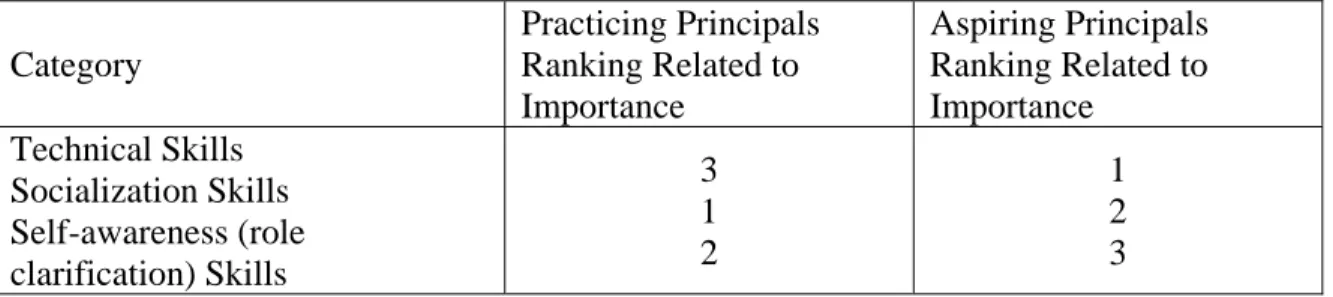
Daresh and Playko (1994) identified three classifications of learning related to leadership skills important to new principals. They provide the following classifications from one of their studies of the topic “…beginning principals’ concerns were in three areas: problems with role clarification… limitations on technical expertise… and difficulties with socialization to the profession and to individual school systems...” (p. 36).
Daresh and Playko (1994) also found differences in the expressed needs of aspiring and practicing principals. These results are summarized in Figure 1.1.
Daresh and Plyko’s (1994) research indicates that aspiring principals express different needs than practicing principals. Walker and Carr-Stewart (2006) also confirm the importance of role clarification and socialization for new and practicing principals. Walker and Qian (2006) point out the importance of a focus on socialization and self-awareness in programs designed for new principals and how the development of these skills helps new principals as they work to define their values and in determining how they will work with their school community. Clearly the mastery of role clarification and
socialization is much more complicated than just following a written set of technical standards.
Figure 1.1. Daresh and Playko’s (1994) Aspiring and Practicing Principals’ Ranking of Important Developmental Areas (Daresh & Playko, p. 39)
Roland Barth (1986) pointed out some of the challenges principals pose for staff developers when he referred to the fact that they “build up antibodies” (p. 156) toward efforts to training. Barth further contends that practicing principals are accustomed to leading rather than being led.
Walker and Qian (2006) state, “…research holds strongly that beginning principals continue to learn through multiple pathways, such as reading, attending professional meetings, and conversing with professional friends…” (p. 303). Petzko (2004), Rich and Jackson (2005), and Browne-Ferrigno and Muth (2004) discuss the importance of professional networking and building meaning through discussion and dialog.
This brief literature review was provided to help the reader understand the components of the program evaluated in this study and the perceived need of the organizers of the program to move beyond just gathering participant perceptions of each session. We were asked to construct an evaluation process that would assess several of the important learning processes such as multiple methods for learning, the impact of networking, the influence of reflection, and other techniques designed to be delivered within the Recently Appointed Principals Program.
Description of the Leadership Development Program
The Recently Appointed Administrators Program is the result of a collaborative effort between The Western Virginia Public Education Consortium (WVPEC) and the Center for Organizational and Technological Advancement (COTA) at Virginia Polytechnic Institute and State University. The program is facilitated by three coordinators coming from a variety of roles in public education. Four, 2 ½ day sessions are held each year, starting on Wednesday evenings and ending early in the afternoon on Friday. The program utilizes instruction from leaders in the field, interaction opportunities between participants, discussion of reading materials, and connections with a mentor. Category Practicing Principals Ranking Related to Importance Aspiring Principals Ranking Related to Importance Technical Skills Socialization Skills Self-awareness (role clarification) Skills 3 1 2 1 2 3
Researcher Context
The primary researcher for this project was Dr. John F Eller. Dr. Eller is a faculty member in the Leadership and Policy Studies Program at Virginia Polytechnic Institute and State University. He works in the National Capital Region in Northern Virginia working with Masters and doctoral students. The organizing groups responsible for delivering the Recently Appointed Principals Program in SW Virginia asked Eller to conduct the study as a disinterested third party. He has no connection or involvement with the program or any vested interest in the outcome of the evaluation.
John F. Eller is interested in principal development programs and is the coordinator of the Principal Preparation Program in the Northern Virginia Region. He is interested in studying leadership development and learning about participant reflections based on their experiences. His intentions related to this study were to gather and share participant perceptions of the program and make accurate recommendations for its improvement.
Eller also worked with another professor in his department who provided technical support and checked Eller’s coding and assessment processes.
Program Evaluation Methods
We conducted the study of the Recently Appointed Administrators Program from May through October of 2007. The initial program review was conducted using 16 members of the 2005-2006 program cohort. Program data were gathered using a questionnaire, two different focus group sessions (each conducted with about ½ of the participant group), program session agendas, training materials, participant session feedback forms, and participant reflective writing samples. These data were initially sorted into the categories of knowledge, skills, and applications. Since program coordinators initially promised this participant group information related to their participation would be kept confidential, researchers were not allowed to contact principals directly beyond the focus group meeting or visit schools to gather additional data.
Data were analyzed related to the major themes of the program and in relation to the knowledge, skills, and applications the participants gained from the sessions. The study/evaluation was also designed to examine the relationship between the “planned” curriculum, the “delivered” curriculum, and the “applied” curriculum. This examination enabled the researchers to study what participants were able to actually use from their experiences in the program back at their school sites.
Data were also plotted related to Daresh and Playko’s (1994) three major learning areas related to the needs of practicing principals. These are:
Role clarification (who they are as principals and how they should use their new power)
Technical expertise (how to do what they were supposed to do according to their job description)
Specific Participant Feedback Regarding Program Strengths
Focus group comments and session feedback from participants provided specific information related to the strengths of the program:
The collegial and networking aspects of the program were identified as a major area of strength by participants. In addition to meeting and talking with other principals, participants reported benefit in discovering colleagues that struggled with similar problems and who could help generate solutions to issues they faced.
Program guest speakers and presenters were seen as another area of strength. Comments highlighted presenter preparation, credibility, clarity, and a focus on practical information during sessions. Some participants expressed concern that several presenters went over their allotted time and caused other presenters to omit important content.
Program participants openly expressed their gratitude for their participation in the program and said they had personally thanked their superintendent for supporting them in the program.
Many comments about the positive learning atmosphere established and maintained in the program and how it positively impacted their professional learning.
Specific technical content was provided in the sessions and was related to issues that these new principals face such as teacher evaluation, data driven decision making, school safety and emergency preparedness, and compliance with state and national regulations.
Group role playing and interaction sessions related to content were seen as helpful and necessary for success. Participants commented that role playing helped them implement ideas from the seminars back at their schools.
Participants reported that areas that related to understanding and working with staff members, clarifying their role as a leader, attaining and maintaining balance, and delegation and involvement were among the most important but unexpected outcomes of the program. They reported that this knowledge helped them back at their buildings even more than some of the more technical aspects of the program.
Participant Comments Classified According Need Areas
Participant written comments on questionnaires administered prior to focus group meetings were classified in relation to Deresh and Playko’s (1994) need areas. The results of this sorting is included in Figure 1.2.
Figure 1.2. Focus Group Written Comments Based on the Deresh’s (1994) Need and Potential Use Levels
Socialization Role Clarification Technical Content Knowledge 6 6 7
Skills 2 6 18
Applications 17 7 17 Totals 25 19 41 Focus group verbal comments were also classified in relation to need areas. The results of this classification is included in Figure 1.3.
Figure 1.3. Focus Group Verbal Comments based on the Deresh’s (1994) Need and Potential Use Levels
Socialization Role Clarification Technical Content Knowledge 6 6 8
Skills 3 4 10
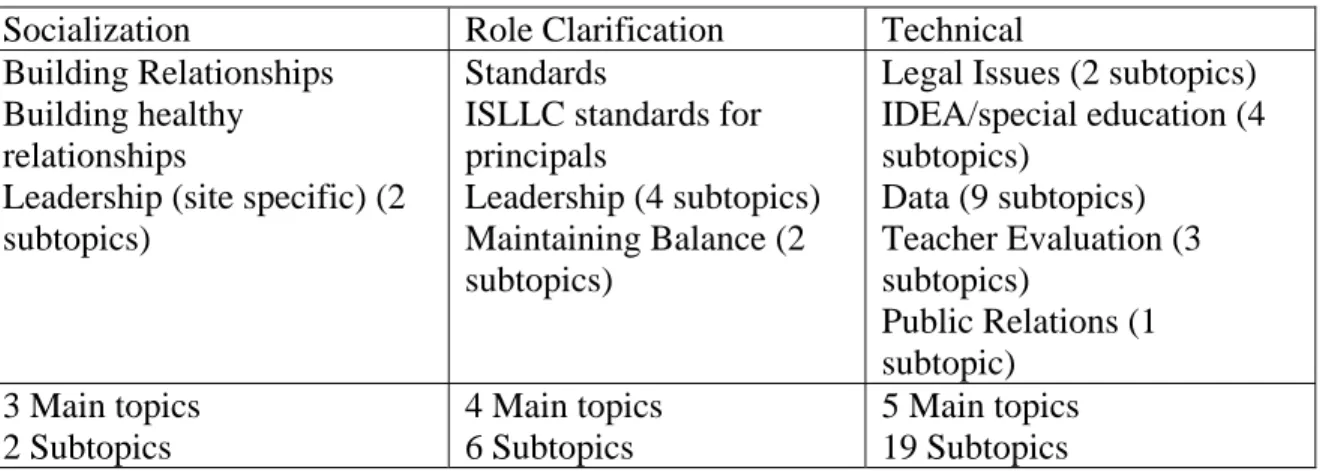
Applications 3 5 8 Totals 12 15 26 Training materials and session agenda topics were analyzed according to need areas. The results of this analysis are included in Figure 1.4.
Figure 1.4. Program Content Themes Plotted in Relation to Socialization, Role Clarification, and Technical Skills
Socialization Role Clarification Technical Building Relationships
Building healthy relationships
Leadership (site specific) (2 subtopics)
Standards
ISLLC standards for principals
Leadership (4 subtopics) Maintaining Balance (2 subtopics)
Legal Issues (2 subtopics) IDEA/special education (4 subtopics) Data (9 subtopics) Teacher Evaluation (3 subtopics) Public Relations (1 subtopic) 3 Main topics 2 Subtopics 4 Main topics 6 Subtopics 5 Main topics 19 Subtopics
Participant Recommendations for Program Refinement
Participants offered their recommendations regarding areas of refinement for future programming.
Increase Informal Networking and Problem Solving Opportunities: Participants said they would have liked to have less time structured for
them and more unstructured time scheduled to be used for discussion, informal problem solving, and networking.
Use of Current Technology: Participants addressed the need for more use of technology both at formal sessions and as a way to communicate and network between sessions(laptops, Internet, E-mail) Clear Presenter Guidance and Expectations: Participants recommended
that session presenters stay within their assigned times. This would allow all presenters to have the time they need in order to fully develop their topic areas.
Focus on Role Clarification and Socialization Content Early in the Program: Participants outlined the need for introducing information regarding balance (role clarification) and understanding their staff and community (socialization) into the program early to help them use the information in their schools earlier in the process.
Future assessment plans and evaluation procedure refinements.
Yearly program evaluations to assess program effectiveness and the match between its objectives and the needs of the principals it serves are planned by program coordinators. In order to assist with this ongoing longitudinal assessment we made the following program recommendations:
Program and Individual Session Agenda Design: Sessions seemed to be content/topic driven rather than outcome driven. We recommended that clear, outcome-based objectives based on the general categories of knowledge, skills, and applications be developed for the program. Once these categories are in place, program planners should use these objectives to drive the development of materials, content presentations, agendas, and program measurement tools. Participants should be made aware of the particular outcomes to be highlighted at the beginning of each session. These outcomes could also be classified in relation to whether they provide information related to technical skills, role clarification, or socialization.
Material and Presentation Guidance: As we examined the materials used by presenters, it was obvious that the quality and length of the materials provided by presenters was inconsistent in the program. Some presenters provided extensive but seemingly irrelevant material for short sessions while other presenters who were allotted more agenda time provided brief materials. Researchers recommended that presenters and resource people be provided clear guidelines to guide the development of their session content and learning materials. These guidelines should include material length and type, a focus on session outcomes, and application assignments to increase the chance of implementation success at the school level. In addition to providing a road map for implementation, this guidance would also raise the expectation that the knowledge and skills provided in the program need to be applied by participants.
Consistent Session Feedback Forms:Three different variations of the evaluation form were used in the program. Researchers recommended that consistent feedback forms should be used in all future program sessions. Higher Level Feedback: Many of the questions on the evaluation forms were either general in nature or related to perceptions of the learning environment. Future feedback forms should be redesigned to gather information related to the application of program information at participant schools. Feedback could also be gathered related to the categories of socialization, role clarification, and technical applications. By making the feedback forms more specific, program staff will be able to better understand what participants claim they are applying from their experience and by making the feedback forms more specific; program staff will be able to better understand what participants claim they are applying from their experiences in the program.
Study Limitations
This article highlights the work of two researchers conducting an initial program evaluation for a support program for recently appointed principals. Readers of this article should remember that the results of this study are subject to several limitations. First, this is one study of an isolated program in a specific geographic region of the country. The issues examined here may not be the same issues other programs will face. Also, the researchers selected to examine this program and sorting information into the classifications of knowledge, skills, and applications. These categories made sense in light of the program we examined so the data is sorted in this manner. These categories may not make sense for other programs wishing to examine their structure. We also selected the work of Daresh and Playko (1994) to use as a secondary classification structure. Again, these characteristics may not be appropriate for other programs considering an evaluation.
Recommendations for Planners of Leadership Support Programs
An ongoing area of need in the future will be the induction and support of new school leaders to the profession. While any program that is designed will provide principals with some level of support, there were some important lessons learned from this program evaluation that may be of benefit to others who are planning programs designed to support new or existing leaders. The following recommendations are offered:
Organize programs around the themes of knowledge, skills, and applications-By organizing program content and activities around the themes of knowledge, skills, and applications, program leaders provide a way for participants to sort what they are learning. Program organizers should also consider using the concepts of role clarification, socialization, and technical skills as an organizing framework for their participants.
Understand and utilize the importance of informal networking opportunities- Program leaders should consider setting aside open and unstructured time to allow participants to informally network and learn from each other.
Feedback related to the application of program skills should be utilized-Principal support program organizers should consider developing session feedback forms that move beyond gathering information related to the “feel” of the workshop or the quality of the food and facilities and ask participants to provide information related to their ability to use and apply program content.
Presenter and Handout Guidance-By providing clear and specific guidance to resource people and presenters and asking them to include implementation and follow-up strategies in their training materials, program organizers increase the chances that principals will be able to understand and apply what they are learning in the sessions at their schools.
The support and development of principals or school leaders in the field are rewarding and challenging. If programs are designed to take into account the learning and processing needs of these professionals, they can be extremely valuable. We hope that what was learned in the initial evaluation of the Southwestern Virginia Recently Appointed Principals Program provides ideas and strategies to program organizers and others in the field to consider as they are designing and implementing principal staff development programs.
References
Barth, R. S. (1986). Principal centered professional development. Theory into Practice,
25(3), 156-160.
Browne-Ferrigno, T., & Muth, R. (2004). Leadership mentoring in clinical practice: Role socialization, professional development, and capacity building. Educational Administration Quarterly, 40(4), 468-494.
Crow, G. (2006). Complexity and the beginning principal in the United States: Perspective on socialization. Journal of Educational Administration, 44(4), 310-325.
Daresh, J., & Playko, M. (1994). Aspiring and practising principals’ perceptions of critical skills for beginning leaders. Journal of Educational Administration, 32(3), 35-45.
Murphy, J., & Shipman, N. (1996). Interstate school leaders licensure consortium: Standards for school leaders. Washington, DC: Council of Chief State School Officers.
Petzko, V. N. (2004). Tailoring professional development for a better fit. Principal Leadership: High School Edition, 5(3), 16-21.
Rich, R., & Jackson, S. (2005). Peer coaching principals learning from. Principal,84(5), 30-33.
Walker, K., & Carr-Stewart, S. (2006). Beginning principals: Experiences and images of success. International Studies in Educational Administration (Commonwealth Council for Educational Administration & Management [CCEAM]), 34(3), 17-36. Walker, A., & Qian, H. (2006). Beginning principals: Balancing at the top of the greasy
pole. Journal of Educational Administration, 44(4), 297-309.
Author Note
John Eller is Assistant Professor in Educational Leadership for the School of Education at Virginia Polytechnic Institute and State University. He previously taught at Southwest State University in Minnesota where he was Associate Professor in Educator Development and Leadership and Department Chair for Teacher Center Coordinator. While in this position, Dr. Eller completed his Ph.D. in Administration and Supervision: Leadership and Policy Studies, Organizational Behavior in 2004. Correspondences regarding this article can be addressed to: Telephone: (703) 538-8496; E-mail: [email protected]
Copyright 2010: John F. Eller and Nova Southeastern University
Article Citation
Eller, J. F. (2010). An evaluation of a development program for new principals. The Qualitative Report, 15(4), 956-965. Retrieved from http://www.nova.edu/ssss/QR/QR15-4/eller.pdf