EDUCATI
ONAL
FACI
LI
TI
ES
CARE
CALLER Emergency Call Systems are perfect
for any School that is concerned with the safety
and security of their students and teachers.
It was not long ago that school security was not a
topic often discussed by parents and school faculty.
Unfortunately, the reality of increasing violence in
schools has changed all of that.
CARE
CALLER
Emergency Call Systems has the perfect security
solution for your school or campus. High schools
can issue wireless emergency call pendants to
teachers, and universities can issue pendants to
both faculty and students. Other security systems
such as door alarms and asset protection can be
seamlessly integrated into this system.
Wireless emergency call pendants can be worn by
teachers, administrators, other faculty and even
by students so that they are able to call for help
immediately should a threatening situation occur.
The
CARE
CALLER Emergency Call System will
accommodate thousands of these devices if
needed. Other wireless transmitters may be used
to monitor doors, motion detectors, glass break
detectors, or other equipment.
Wireless Emergency Call Pendants
Location
Locators will reveal the location of a person who
is in need of help so that you know who is in
trouble and where they are. All wireless devices
are continually supervised by the system so that
you know they are functioning. This system is
also capable of locating personnel on demand.
Each wireless emergency call pendant is
constantly transmitting a heartbeat signal.
Wireless locating devices placed according to
need and design throughout the campus log
the location of the person as they move from
place to place.
Hand Held Two Way Radio Monitoring
Alarms or events will be broadcast as a user
defined computer voice message over existing
facility hand held two way
radios. Security personnel
will hear a message such as
"Wireless pendant pressed
in Main Hall, room 210" or
"Door alarm at north kitchen
entrance". This message will
continue to broadcast
every fifteen seconds until
acknowledged either at the
computer or by entering a
unique personal ID number
into a hand held two way radio.
An emergency call and security system, no matter how technologically advanced, is only
as good as the people who support it. At
CARE
CALLER
, we have found that the main
reason our customers continue to purchase and install our system is not only because of its
countless technical advantages, but more importantly because of our absolute concern,
service, and responsiveness to clients. With our toll-free number, you or your staff can get a
helping hand from
CARE
CALLER
24 hours a day, 365 days a year; this is backed by Lifetime
Technical Support absolutely free. This means no costly service contracts and hassles.
The basic principle behind our company, our golden rule, is to treat our customers exactly
as we would want to be treated. It is our pleasure to offer you the most comprehensive
and trouble free system on the market, and we strive to bring this system to you in the best
way possible.
*
FREE Lifetime Technical Support
*
Friendly, helpful and knowledgeable sales and technical support
*
Our sales team of system technicians will quickly and happily help your company design
the perfect system to satisfy all of your specific facility requirements.
*
The ultimate emergency call system, time tested and completely Reliable. Is easily
integrated with virtually any other system or electronics.
*
Long range Wireless Pendants
*
Custom Wall Mounted Switches
*
2 Way Voice / Intercom
*
Wirelessly Monitors Smoke Alarms, Fire Alarms, and Equipment
*
Wandering Patient Notification
*
Door and Window Alarms
*
Access Control system to allow facility entry remotely
*
Resident Services Billing
*
2 Way Digital Radio-Phones for alarm annunciation, and staff to staff communication.
*
Resident Check-In Status
*
No Comparable pricing can be found anywhere on a system with similar features.
THE TOTAL SOLUTION
The
CARE
CALLER
System provides for every security need with the most comprehensive and
varied selection of hardware and software solutions available today. This includes totally
hardwired systems, totally wireless systems, or any combination of the two. The
CARE
CALLER
system
can
also be seamlessly integrated with other security functions such as door access
control, intrusion alarm systems, intercom, enter phone, phone systems and fire alarm
systems. With a broad repertoire of system solutions and highly trained system specialists
the
CARE
CALLER
system can be customized to fit your every need.
CARE
CALLER
BEST SERVICE
BEST SYSTEM
FACILITY MARKETING
CARE
CALLER
is designed as the centerpiece in the family of features your marketing staff
may offer to prospective residents. These options clearly demonstrate your concern,
diligence, and willingness to provide residents with the best emergency call and life safety
system available. No other single investment in your facility will yield a greater return in
attracting residents than the comforting and reassuring features of the
CARE
CALLER
Emergency Call System.
WIRELESS PENDANT AND PULL SWITCH
Wireless, water-resistant emergency call pendants are available with
belt clips, neck lanyards or wrist bands. Pendants are fully supervised;
meaning staff are alerted if they stop working or develop a low
battery. This is vital when lives depend on your Emergency Call System.
Spread spectrum technology transmits alarm signals on multiple
frequencies, ensuring the greatest possible degree of reliability.
Staff can also easily pinpoint the location of any person whose
pendant has been activated; this is achieved using our wireless
CARE
CALLER
locators. The CARE
CALLER
system can also be setup to
visually map the position of the pendant which has been pressed, if
provided with building layouts .
2 WAY VOICE / INTERCOM
The CARE
CALLER
system offers nearly every technology and type of voice
communication including but not limited to,
c
eiling speakers with built in
microphone, speakers in pull stations, hands free speaker phones, and Last
Alarm Auto Dial (LAAD). LAAD allows the carrier of the digital radiophone to
issue a simple command from their keypads which automatically looks up
the telephone or extension number of the last apartment to activate an
emergency call, dials the number and connects the call directly to the staff
radio. If a digital phone with a speaker phone is used throughout the building,
calls can be pushed right to the speakers in case the residents are unable to
answer the call.
Smoke Alarms – Fire Alarms
Apartment smoke detectors may be incorporated into the CARE
CALLER
system’s monitoring
duties. Any standard Smoke detectors can easily be connected to a wireless transmitter.
In doing so the CARE
CALLER
system is notified of all smoke alarms and the exact location
and room which they originated. This allows the staff to check in and make sure a fire
isn’t about to start, and that the resident is safe. The general fire alarm system may also
be connected so that specific smoke detectors, sprinklers, and pull switch alarms will be
broadcast over the radios with a clear and concise description of the location. This saves
time by eliminating the need for staff to check fire panels.
Door Alarms
Door Alarm sensors protect the staff and residents from unwanted or dangerous intruders.
This valuable marketing tool provides staff and residents with a great sense of security, as
they will know that when any perimeter door is opened, an alert will be broadcast instantly
over the radios. A sophisticated scheduler allows you to customize the arm / disarm times
for individual doors, using this feature each door may be alarmed for a different time of day.
Access Contro
l
Doors can be locked and unlocked according to your specific time and date
schedule. During locked times, access can be granted by a variety of entry
ID technologies including proximity cards, swipe cards, keypads or an entry
phone. Individual cards or proximity tags can be carried by staff and residents
allowing staff to go places residents may not.
Resident Services Billing
Specific services performed in apartments such as vacuuming, linen change, and help with
medications may be logged into the computer to generate a report for the accounting
department. This allows your facility to tailor its support by resident and create additional
revenue.
Equipment Monitoring
The CARE
CALLER
system can be setup to monitor most any equipment. Staff will then be
notified immediately of critical building alarms, such as failure of the walk in freezer,
elevator emergency, boiler pressure alert, hot water tank temperature, water presence,
failure of sewage ejector pumps, chiller alarm, or other devices which show an on/off,
true/false status. The CARE
CALLER
will give detailed instructions to personnel such as whom
to call or a sequence of actions that must be initiated.
Total Building Control
The CARE
CALLER
system is so diverse a relay can be added to control literally any aspect of
your building. Relays allow you to set a time schedule that turns lights, equipment or other
devices on or off when triggered by an alarm, or by entering a predefined code from any
radio. For example, if an emergency call is activated, the front door may be unlocked
automatically to allow emergency personnel to respond. The CARE
CALLER
system may also
be customized to activate alarm dialers, open doors, and turn lights on or off according to
your security philosophy and specific facility needs.
Upgrading or adding to Existing Systems
The powerful benefits of CARE
CALLER
computer based Nurse call systems can be added to
any previously installed Nurse call system. The System is so advanced our programmers
can add or integrate literally any electronic system. Our sales representatives would be
happy to assist you in integrating other systems such as digital phone networks and door
entry systems.
CARE
CALLER
www.carecaller.com
sales: [email protected]
customer service: [email protected]
technical support: [email protected]
(866) 252 2255
SOFTWARE
The Sentry system by CARECALLER uses our powerful software engine to provide the comprehensive
communication required for effective security response. It is designed to receive alarms and signals from almost any type of system and integrate them into one command and control center. “The CARECALLER software has
virtually unlimited input and output capabilities allowing it to be easily tailored to any use.”
I N P U T
The software works with any system that provides standard ASCII output, including addressable fire alarm panels, intrusion alarm systems, HVAC alarms and events, intercoms, telephone systems, and access control systems.
CARECALLER’s Data Control Modules can provide up to 7,000 hardwired inputs.
The software supports up to 65,000 uniquely coded wireless transmitters and can monitor facilities covering several square miles. Wireless devices use true frequency-hopping spread spectrum transmission technology to provide
rock-solid reliability. Compatible transmitters include personal duress pendants, universal input transmitters, door and window transmitters, numeric keypads, motion detectors, glass break detectors, wireless pull switches and smoke detectors. All wireless devices are supervised for operational readiness and low battery conditions.
Standard digital communicators can use any dial-up telephone line to transmit alarms from anywhere in the world to the software.
Staff can communicate with the software by entering a number code into their hand-held radios, walkie talkies, or portable telephones. They can use their keypads to perform such functions as acknowledging an alarm by individual ID, controlling gates or other equipment, answering intercom or telephone calls, and calling 911. Any typical security desk audio function can be transferred to hand-held radios and telephones, and for ultra
high security, encryption and access may be controlled by radio ID number.
UNIVERSAL DATA INPUT
HARDWIRED INPUT
WIRELESS INPUT
DIGITAL COMMUNICATOR INPUT
RADIO AND TELEPHONE INPUT
O U T P U T
The software can designate that an alarm go out through any combination of output methods, including radio, telephone, email, pager or fax. This allows users to tailor alarm communication to the existing devices, personnel, and applications.
When an alarm comes in, a computer-generated voice announcement can be instantly transmitted to hand-held radios.
CARECALLER’s patent-pending Radio Interface can designate specific radio groups, so that all transmissions do not go to all radios. For example, security alarms may be broadcast only to security personnel, and HVAC events
only to maintenance personnel. Alarms may also be partitioned by location and areas of assignment, and are even available in multiple languages.
The software can output to portable or fixed
telephones by displaying a description of the alarm in the caller ID window of the telephone. A staff person can then answer the call, hear the computer voice description of the alarm, and use the telephone keypad to acknowledge it with their personal ID number. Staff members may also call the computer to access functions such as turning on lights or requesting a status report. Status reports are delivered via the computer’s voice module. For enhanced security, the computer may be accessed from anywhere in the world via passwords or specified codes.
To keep managers and supervisors apprised of day-today events, the software can be programmed to send them email alarm messages, including failure to restore a device and equipment supervisory alerts. The system can transmit
messages to on-site pagers or world-wide, to telephone dial-up subscription pagers. Pagers can be either numbers only or may receive
user defined text messages.
Users can also set up the criteria to have the software fax events or messages to locations worldwide.
2-WAY RADIOS
TELEPHONES
PAGERS
FAX
CARE
CALLER
UNIVERSAL DATA OUTPUT
F E A T U R E S
Send any alarm data or control commands via serial RS232output to any other system or equipment that speaks ASCII.
CARECALLER’s Data Control Module hardwire panels support up to 4,000 SPDT relay outputs. Relay outputs can be
programmed from 1 to 9,999 seconds (about 2 hours and 45 minutes), latching or following. The system can be activated by time schedule, by another alarm, or by entering a code number at a hand-held radio, telephone, or wireless keypad. Users can transmit any of 65,000 available wireless codes to stand-alone wireless receivers to provide latching, following or momentary SPDT relay outputs. Uses are endless:
door locks, gate operators, pumps, motors, lighting, and other functions may be controlled without installing an inch of connecting wire. Users can specify methods of activation, including by time schedule, by other alarms, or by entering a code number into a hand-held radio, telephone or wireless keypad.
HARDWIRED RELAY OUTPUT
WIRELESS RELAY OUTPUT
To ensure that messages are not momentarily lost in the drone of typical command-center noise, the computer announces all alarms in a clear, computer-generated voice. At the same time, alarm data is posted to the computer screen and can be color-coded by alarm type to aid recognition; for instance, fire alarm data may be red and intrusion alarms blue.
CARECALLER’s computer-controlled digital communicator can use dial-up telephone lines to transfer alarms to any digital receiver. This feature can be used by facilities that are not staffed 24 hours a day to post alarms to a central monitoring station after hours and on weekends.
OUTPUT AT THE COMPUTER
DIGITAL COMMUNICATOR
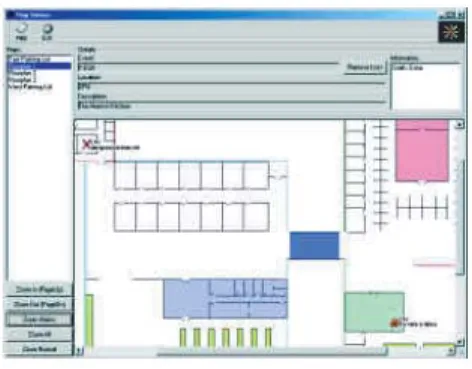
The computer video monitor displays graphic maps and floor plans to indicate alarm locations. An icon on the map clearly marks the alarm. After the alarm is resolved, the icon may be removed manually, by a timer, by another event, or by restoral of the event. In addition to video display, large custom printed maps with LED indicator lights may also be part of the overall alarm annunciation strategy. To further alert staff, scrolling LED displays can be positioned in strategic locations and controlled by wireless signal.
GRAPHIC DISPLAY
Users can track and find important staff persons with a small wireless pendant transmitter.
Wireless transmitters can be attached to important assets, sounding an alarm if they are removed from their defined areas. The wireless system can alarm an area up to several square miles.
To provide an increased level of security, the software offers real-time guard tour monitoring. To offer immediate response if a guard is disabled, the system monitors guard stations for activity, generating an alarm if a station has not been visited within a specified time window. Guards can also wirelessly input incidents at each station.
The software makes every staff person accountable, allowing them to enter their unique acknowledge ID number at the computer or by hand held radio, portable telephone, wireless keypad or wireless pendant.
An unlimited number of passwords allow users to customize access to system and software functions.
PERSONAL TRACKING
ASSET TRACKING AND CONTAINMENT
GUARD TOUR
ACKNOWLEDGEMENT OF
ALARMS BY PERSONAL ID
PERSONAL SECURITY
VARIOUS INPUT AND SENSOR DEVICES
SCHEDULER
Users can also define time schedules for bypassing alarms, activating relays, or other outputs. This allows operators to disable a door alarm during the day but report its opening at night, or put anything, including lights and locks, on a time schedule. A holiday override is also included in the program.
A robust report generator filters all alarm information fields up to four levels deep and sorts three levels deep. Report formats can easily be saved and re-used.
Users can assign staff to specific acknowledge groups, limiting them to alarms only in their assigned areas. For example, a staff person assigned to floor 3 would only be able
to acknowledge alarms from that floor, leaving other alarms that are not assigned to them in the acknowledge cue. The ability to group alarm devices together produces an unlimited number of independent alarm systems. This is especially necessary at large facilities where buildings may cover many acres, because it enables users to treat all the alarms in a specific area as a single unit. For instance, all the alarms in a particular building, including motion sensors, door contacts, etc., can be in the same arming group, so that one key command turns all of them on or off. These groups can also be set to arm and disarm on a time schedule. Users can pre-define an amount of time to disable and rearm any alarm. For instance, they can use a wireless or hardwired keypad to override a door alarm and allow ingress and egress. A second computer may also be installed to run on a standby basis and assume full operation if the main computer fails.
REPORTS
ACKNOWLEDGE GROUPS
ARMING GROUPS
MOMENTARY DISABLE
REDUNDANT COMPUTERS
A tardy acknowledge or tardy restoral alarm occurs if staff do not respond to or reset an alarm within a specific time period. These types of alarms can also be programmed to activate a dialer, email, pager, or fax to alert supervisors.
To allow for ultimate flexibility and to accommodate exact user requirements, Boolean logic commands can be used to create IF, THEN, ELSE, AND, OR scenarios and apply them to any combination of monitoring devices and time schedules. For example, door “A” must already be open for door “B” to generate an alarm when opened. This might be true from 8 AM to 5 PM, but at any other time the doors can generate alarms independently.
A command from a hand-held radio or telephone can alert the computer to locate and dial the number of a location originating an alarm, allowing the radio or telephone user to offer assistance and follow up immediately on the situation.
An information window may be programmed to display specific instructions, such as who to call if a lower level sump pump is activated. It also provides a place for staff to enter notes on action taken or particular circumstances, compiling more information for the historical archive of the event.
The software is the ultimate control machine. Its infinite flexibility lets users turn lights on or off, open parking gates, release door locks, pumps or fans, activate the lawn sprinkler and even turn on the coffee pot. It also provides options on how to trigger the activities: via time schedule, designated alarm, or even manually through a computer, hand-held radio or telephone.
Users can also program an alarm to delay activation for a specified period of time. For example, to allow free use of a door without propping it open, the alarm can be set to sound if the door is not closed in 5 seconds.
The software can oversee scheduled activities and generate an alarm if they do not occur on time. For example, if the backup generator is to be exercised every Friday at noon and it does not happen by 12:15 PM, or if the exercise does not stop on time, the system triggers an alarm.