Warranty management is the next frontier in the ongoing battle to cut costs. Companies that use a best-practice approach to warranty management can provide better value to cus-tomers while improving the bottom line.
T
raditionally, warranty expense has beenregarded as a cost of doing business— and its magnitude has been rising. A 2008 study by Warranty Week estimated that the top 50 U.S.-based manufacturers spend more than $28 billion annually on warranty expense. For some of these manu-facturers, warranty costs represent as much as 5% of total revenue.
Best-run companies, however, have learned how to leverage warranty manage-ment as a significant source of cost competitiveness. PRTM research and expe-rience shows that companies that have mastered the discipline of warranty manage-ment not only reduce costs but also increase customer satisfaction and service revenue. Take the high-technology industry as an example. Our research shows that total war-ranty and maintenance service costs of top performers are almost 60% lower than those of other companies.
Why Are Warranty Costs Rising?
All manufacturers feel the pain of warran-ty costs to some extent, but technology-based companies—such as automotive, computers, medical equipment, electronics, and telecommunication—bear the brunt of it. Four trends coalesce to increase the
pressure on warranty costs. First, rapidly declining product prices, especially in the electronics and high-tech industries, are eroding profit margins. Second, ever-ris-ing product complexity increases the number of potential problems with the product. Third, heightened expectations from consumers, who expect flawless prod-uct performance, place additional pressures on companies to provide robust after-sale services. Fourth, decreasing product life-cycles are forcing companies to introduce more reliable products to the market from the start. Fewer companies can now afford a warranty hiccup in the early stages of product introduction, expecting to recov-er the margins during the rest of the long product life.
The increasing magnitude of warranty costs has not gone unnoticed by the Securities and Exchange Commission (SEC). Filing regulations and Sarbanes-Oxley compliance requirements now obligate companies to report costs associat-ed with their warranty obligations. However, many financial managers still complain that they lack clear definitions for measur-ing warranty costs.
In fact, warranty management remains an uncharted territory for many organiza-tions as they struggle to understand, communicate, and analyze their warranty performance. This situation is exacerbated by the lack of a cross-industry warranty man-agement framework that defines warranty elements and costs. As a result, most com-panies tend to use ad hoc approaches to measuring and managing this performance.
Warranty
Management—A
Neglected
Source of
Competitive
Advantage
Drawing on our research and client expe-rience, the following discussion explains how companies can achieve best-in-class warranty cost performance. This approach entails understanding the primary drivers, measuring and managing warranty costs, and aligning the decision making across different functions.
Understanding the Primary Drivers of Warranty Costs
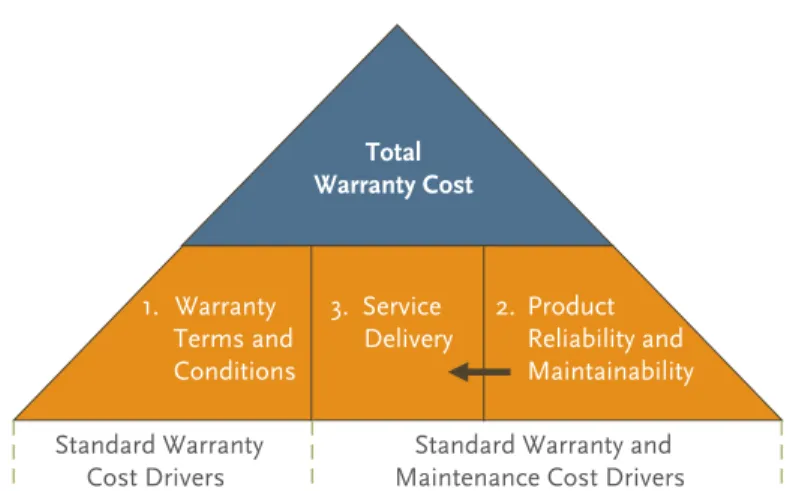
Warranty costs are determined by three key factors: warranty terms and conditions (Ts&Cs), product reliability and maintain-ability, and service delivery. Understanding their impact as well as their relationship to each other is an important first step in controlling warranty costs. Together, Ts&Cs and product reliability determine the ulti-mate service-delivery costs. For example, a company with poor product reliability that goes to market with an aggressive war-ranty offering will likely face debilitating service-delivery costs. Since each of these three cost drivers is controlled by a differ-ent function, making optimal warranty decisions is no small feat.
1. Warranty terms and conditions.Ts&Cs depend on the length of the warranty peri-od and the breadth of the warranty program. Companies that face rising war-ranty costs typically adjust the warwar-ranty period by reducing the length of standard service coverage. However, they often neg-lect to adjust the breadth of their program
by tailoring such variables as service response time or the type of support (on-site versus remote). This rigid “one size fits all” approach to service coverage prevents companies from using it as a competitive lever. For example, in some situations, a company may want to tailor its standard warranty program in order to win a contract or generate incremental revenue through up-selling.
In fact, leading warranty programs sup-port a tiered service model (e.g., “preferred, silver, gold”) by tailoring warranty services to the key customer segments. Best performers have taken this a step further by offering carefully controlled custom services that address the specific needs of each customer segment. Having a range of well-managed warranty options gives the sales staff flexibility to negotiate effec-tively in competitive situations by selecting,
as well as bundling together, the right warranty services.
2. Product reliability and maintainability.
Since product failures and, consequently, the probability that the warranty will be invoked stem directly from poor product quality, rigorous pre-release testing can help avoid expensive product recalls later. But it is equally important to design prod-ucts that are easy to maintain and repair. This allows customers to service the prod-uct themselves, using tools provided by the company, such as downloadable software patches. In addition, a modular product design goes a long way toward allowing an easy replacement of defective components. For example, in the case of Dell’s laptop battery recall in 2005, the company sim-ply mailed new batteries to its customers to replace the old ones.
Figure 1: Warranty Cost Drivers
1. Warranty Terms and Conditions 2. Product Reliability and Maintainability Total Warranty Cost 3. Service Delivery Standard Warranty Cost Drivers
Standard Warranty and Maintenance Cost Drivers
3. Service delivery.Measuring and manag-ing total warranty cost depends on measuring and managing service-delivery costs. These costs can be effectively man-aged internally, unlike other cost drivers such as warranty period. For example, if customers expect a three-year standard car warranty, it would be difficult to sell cars with a shorter standard warranty.
How do leading companies distinguish themselves in service delivery? They can provide warranty services more efficiently and cost-effectively than others because they have optimized their service supply chain processes, such as repair, material parts usage, and reverse logistics.
Measuring and Managing Warranty Costs
It’s no coincidence that companies that excel at tracking and reporting warranty costs are also better able to control them. To track costs correctly, it is important to clear-ly distinguish between the warranty and maintenance categories. Warranty costs, in essence, are service-delivery costs asso-ciated with products under standard warranty (see Sidebar 1 for definitions).
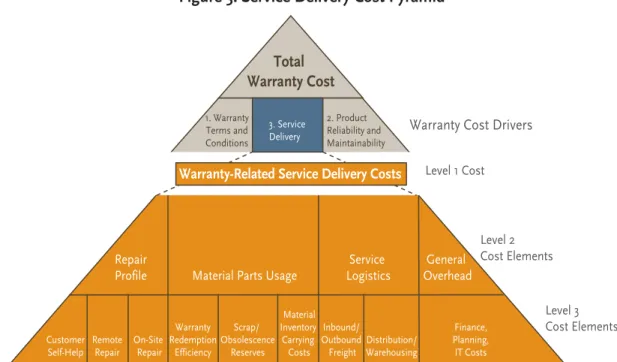
The effectiveness of a company’s serv-ice-delivery operations depends largely on how well the company manages four cost areas: repair, material parts usage, reverse logistics processes, and overhead costs.
Repairsusually account for more than half of total warranty costs. Given this lia-bility, leading organizations focus on proactive cost avoidance and preventive
What Are Warranty and Maintenance Costs?
While warranty-and-maintenance services are often lumped together and considered synonymous with after-sales support, it is important to distinguish between the two. Warranty services are associated with products that are under the standard, or base, war-ranty included the product’s original price. Extended warwar-ranty (or contracted maintenance) services, on the other hand, are revenue-generating service agreements that have been pur-chased by the customer, over and above the standard warranty coverage terms. For example, when purchasing a television set, a buyer may get a one-year standard warran-ty and an option to buy an extended warranwarran-ty for three additional years. Alternatively, a manufacturing company may attempt to contain its warranty costs by sliding back the stan-dard warranty to only 90 days. This approach incurs greater maintenance costs, which are then covered under revenue-generating extended warranty contracts.
Companies often account for service expenses rendered to support a product under stan-dard warranty as a budgeted cost, while revenues and expenses associated with servicing products under extended warranty or maintenance agreements are treated as a profit cen-ter. This classification has important implications for cost allocation and accounting practices. If the services organization is treated as a stand-alone profit center, it may be less likely to allocate costs to the profit-center side of the ledger relative to the standard war-ranty cost center, which is often charged back to the product business unit. Therefore, while it is important to measure and track standard and extended warranty costs separately, an aggregated metric provides a more complete view and allows a more consistent cross-com-pany comparison of warranty performance.
Sidebar 1
Figure 2: Standard versus Extended Warranty
Warranty Costs
Standard Warranty
Extended Warranty
maintenance. They also reduce costs by adopting appropriate service strategies, such as encouraging customer self-help and repair services guided by a call center. This strategy is particularly important for “mission critical” facilities or equipment for which remote diagnostic capabilities can identify potential service problems, preventing the prohibitive costs of system downtime.
Material parts, which represent about 15% of total warranty costs, are calculated net of supplier redemptions, either in the form of charge-backs or as credits for part replacement. An effective supplier cost-recovery program, where suppliers are charged back for warranty claims related to faulty components, can significantly improve warranty cost performance. Companies that establish clear supplier accountability are more likely to improve overall product quality in the long run. When calculating the overall costs of mate-rial parts usage, best performers include inventory carrying costs and obsolescence costs related to service parts.
Service logisticsinclude warehousing and transportation costs associated with moving the defective part from the cus-tomer to the repair center or the supplier, and then shipping the repaired/replace-ment part back to the customer. Leading companies develop strategies to optimize these “reverse logistics” network opera-tions. For example, they cut costs by minimizing the number of touch points (staging locations or central sorting opera-tions) and by shipping the parts directly to
the nearest supplier warranty-redemption center.
General overheadincludes the costs of managing a warranty program, as well as all finance, planning, and information tech-nology costs that support the service organization. These costs must be captured to provide a complete view of operational warranty efficiency.
Aligning Decision Making across Functions
Since warranty management typically lies at the intersection of three functions— product development, sales and product management, and service and supply chain
management—who “owns” it is a critical issue. Best companies coordinate the actions and decisions of different functions for the most effective warranty manage-ment.
The product development group owns the overall design and quality of the prod-uct. It’s important to ensure that the product is designed in a way that facilitates its future use. For example, if a company wants to encourage customer self-service, then those serviceability specifications should be an integral part of the product design.
The development team faces the conflict-ing pressures of meetconflict-ing its time-to-market and cost goals while at the same time ensur-ing high product quality and serviceability.
Figure 3: Service Delivery Cost Pyramid
Repair
Profile Material Parts Usage
Service Logistics Customer Self-Help Remote Repair On-Site Repair Warranty Redemption Efficiency Scrap/ Obsolescence Reserves Inbound/ Outbound Freight Distribution/ Warehousing General Overhead Finance, Planning, IT Costs Material Inventory Carrying Costs 1. Warranty Terms and Conditions 2. Product Reliability and Maintainability Total Warranty Cost 3. Service Delivery
Warranty-Related Service Delivery Costs
Warranty Cost Drivers
Level 1 Cost
Level 2 Cost Elements
Level 3 Cost Elements
These different goals must be carefully bal-anced. For example, if a target launch date is too aggressive, should the team launch a product with a known defect with the expec-tation that it will need to be fixed later in the field? Or is it better to delay the launch date?
The sales and product management teams also face conflicting pressures. On the one hand, they must provide competi-tive warranty Ts&Cs to make the sale. On the other hand, management must care-fully weigh cost implications of its proposed Ts&Cs to ensure that the estimated war-ranty liability will be within the prescribed range. For example, to compete in the U.S. market, Hyundai provided a warranty with 10-year standard coverage, while its estab-lished competitors offered only three- to
four-year warranty periods.
For their part, service and supply chain managers must deliver high-quality service to customers at the lowest possible opera-tional cost. This requires efficient execution of the repair, material parts, and logistics strategy to meet warranty terms and condi-tions. For example, these managers must decide how to transport replacement parts: Should they use next-day, second-day, or ground shipment options?
These three functions need to work in alignment to make effective warranty man-agement decisions in a timely manner. Since the majority of the warranty costs are locked in during the early stages of the product development cycle, this is when the company can best influence future war-ranty costs. The key product design
decisions are made by product develop-ment, sales, and product management groups. After the launch, the service and supply chain management function is left with managing the predetermined warran-ty costs. Effective communication between service and supply chain managers and the product development team on warranty claim incidents is crucial to improving the quality of future products.
Not surprisingly, high warranty costs can often be traced to the decisions made dur-ing early stages of product development. For example, if a company is designing a product for a short warranty period but extends the period significantly after the launch, warranty costs are sure to exceed the planned levels. Since recalls and field changes are often expensive, warranty con-siderations must be taken into account early on.
Once a product is launched, it’s up to service and supply chain managers to exe-cute effectively on the promised warranty terms through efficient service planning and delivery practices. Finally, as a prod-uct is gradually phased out toward the end of its lifecycle, the groups responsible for all three functions must collaborate again to ensure continuity of warranty and service provision. This collaboration will help limit the overall obsolescence charges for parts inventory, both within the company and across the supply chain.
So what should an ideal cross-functional warranty governance structure look like? The answer depends on many factors, including industry, type of
product/serv-Figure 4: Cross-Functional Nature of Warranty Management
Maintainability and Reliability Product Development Service and Supply Chain Management Sales and Product Management Service Delivery Efficiency Terms and Conditions Warranty Management
ice, and existing organization. The most common approach is to manage warranty as a cost center and to charge warranty costs back to sales and product P&Ls. The group primarily responsible for making decisions about product reliability design trade-offs and warranty policies should also have the corresponding accountability for warranty-related expenses.
Taking Warranty Management to the Next Level
To improve your company’s warranty management performance, first assess the maturity of your current warranty strate-gy, policies, organization, and practices. Next, develop a practical road map for advancing to higher levels of warranty man-agement maturity.
The following best practices will help you accomplish this goal:
Align warranty strategy with business and operational strategies. For example, the Briggs & Riley luggage company offers a lifetime warranty for its high-end, premi-um-priced products, regardless of usage. This approach is in line with the company’s strategic objective of using warranty Ts&Cs and customer service as a competitive dif-ferentiator. In contrast, companies that compete in more cost-conscious market segments set their standard warranty levels low but offer many options for extended coverage. This menu of options allows them to customize their warranty offerings rather than pursue a one-size-fits-all approach.
Figure 5: Management Ability to Influence Warranty Costs
Design Development Verification Introduction Growth/ Maturity
End of Life Cost Impact High High Low Medium Low Medium Management
Influence High High Medium Low Low Medium Product quality specifications Supplier selection Serviceability specifications Terms and conditions Development to specifications Pre-release testing Serviceability testing Engineering changes Field engineering Stable usage Software updates End planning Product Development Product Lifecycle
Manage Warranty Costs Influence Warranty Costs
Key Activities/ Decisions
Figure 6: Warranty Management Maturity Model
Major
Elements Sub-Elements Stage I Stage II Stage III Stage IV
Strategy Overall Strategy Product Strategy Operations Strategy Pricing Strategy Policies Market Research/Analysis Terms and Conditions Internal Policies
Organization/ Infrastructure
Organizational Alignment Roles and Responsibilities Measures and Metrics Accounting and Controls
Practices
Service Planning Service Delivery Logistics Management Supplier Management
Establish and enforce clear warranty policies. Using research tools such as “voice of the customer,” identify key customer warranty requirements and integrate them into the design stage of product develop-ment. At the same time, formulate warranty policies and programs that will optimize service revenue by promoting aggressive cross-selling and up-selling opportunities.
Align the governance, roles, responsibili-ties, and metrics. Ensure that people in product development, sales and market-ing, and service management are all working toward shared goals. Align the accountability with responsibility using integrated performance metrics. This will ensure appropriate cross-functional input to manage the complex trade-off decisions.
Develop effective service supply chain practices. Use top-notch logistics and plan-ning practices to reduce cycle time in your supply chain and avoid excess parts inven-tory. Work collaboratively with suppliers and partners to deliver on warranty commit-ments. Agree on equitable warranty recovery contracts.
As warranty management becomes an increasingly important factor in manufac-turers’ cost-reduction strategies, this approach will provide better customer value at lower costs—clearly a win-win proposi-tion in today’s customer-centered market.
C O N T A C T S
PRTM Manager Meraj Mohammad at [email protected] or
+1 212.915.2600
PRTM Associate Shruti Mandana at [email protected] or
+1 781.434.1200