PREFERRED ARGUMENT STRUCTURE IN AZAJO DIALECT P’URHEPECHA
Tristan Andrew Bavol
A thesis submitted to the faculty at the University of North Carolina at Chapel Hill in partial fulfillment of the requirements for the degree of Master’s of Arts in the Linguistics
Department in the Graduate School.
Chapel Hill 2020
Approved by: David Mora-Marín
ii © 2020
iii
ABSTRACT
Tristan Bavol: Preferred Argument Structure in Azajo Dialect P’urhepecha Under the direction of David Mora-Marín
This thesis tests the Azajo dialect of P’urhepecha for evidence of Preferred Argument Structure (PAS) as outlined by Du Bois (1987; 2003). This thesis examines three
formulations of the proposal, namely the Strong PAS theory, which includes the proposed PAS constraints (ibid.) as well as a proposed universal ergative-patterning of discourse as seen in Du Bois (1987), the Weak PAS theory, which includes the PAS constraints but not the universal ergative-patterning of discourse, and a counter-proposal made by Everett (2009), in which an alternative explanation of humanness is advanced to explain the PAS phenomena. This thesis does not find evidence supporting the Strong PAS proposal, in that there is no evidence found supporting an ergative-patterning of discourse in Azajo
iv
ACKNOWLEDGMENTS
I would like to first and foremost thank Adriana and Francisco Cuaraque for their countless hours of work in helping me learn about their culture and their language. Without their extraordinary help this thesis would never have been possible. It has been a wonderful experience working with both of you and I hope to continue to do so in the future.
Diosmeyamyueya!
I would also like to thank my partner, Mackenzie Marques, for being so loving, helpful, and supportive throughout the hundreds of hours I have spent preparing this thesis, as well as the immense amount of help she has been with running the statistical analyses in this thesis. You are the love of my life, and I will treasure you always.
I must also thank my steadfast advisor, Dr. David Mora-Marín, who for the last several years has been a crucial guide in my research on P’urhepecha. I have immensely enjoyed my time working with you and taking your classes, and I can honestly say that you are my favorite teacher I have ever had. Thank you so much for your time, your dedication, and your compassion for your students.
v
TABLE OF CONTENTS
List of Tables ... vii
List of Figures ... viii
List of Abbreviations ...x
1. Introduction ...1
2. Theoretical Background ... 5
2.1 Introduction to Preferred Argument Structure ...5
2.2 Du Bois (1987) ...14
2.3 Du Bois (2003) ...19
2.4 Kärkkäinen (1996) ... 24
2.5 England & Martin (2003)... 26
2.6 Everett (2009) ...30
2.7 Huang (2012) ...33
2.8 Haig & Schnell (2016) ... 36
2.9 Summary ...40
3. Methods... 41
3.1 Corpus Overview ... 41
3.2 Coding Methodology ... 46
3.3 Statistical Methodologies ...62
vi
4.1 Data Presentation ...64
4.2 Data Analysis ... 75
4.3 Implications of Analysis ...93
5. Conclusions ...95
5.1 Summary ...95
5.2 Future Work ...95
Appendix A: Note on access to Cuaraque Corpus ... 97
vii
LIST OF TABLES
Table 1- Preferred Argument Structure Constraints ...11
Table 2- Strong PAS vs. Weak PAS Proposals ...12
Table 3- Strong PAS vs. Weak PAS vs. Humanness Proposals ...14
Table 4- Cuaraque Corpus Summary ...42
Table 5- Cuaraque Corpus Genre Overview ...44
Table 6- Coding Methodology Summary ...47
Table 7- Clause Type Distribution ...65
Table 8- Number of Lexical Items per Clause Core ...66
Table 9- Number of New Items per Clause Core ...67
Table 10- Data Summary ...68
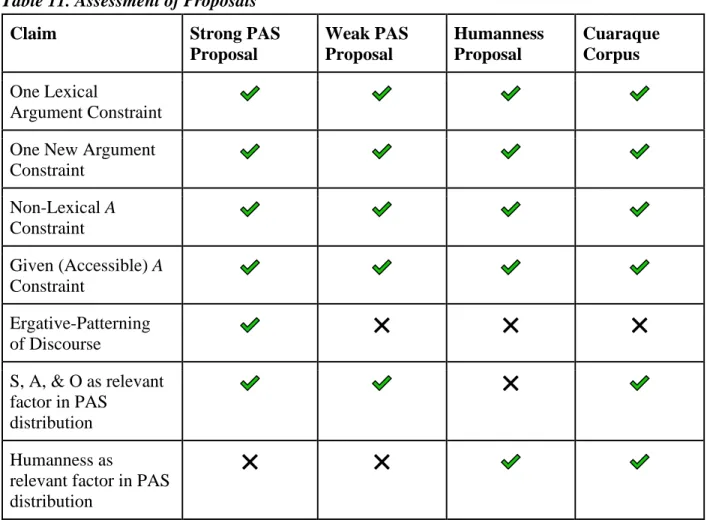
Table 11- Assessment of Proposals ...93
viii
LIST OF FIGURES
Figure 1- Michoácan, Mexico ...2
Figure 2- Distribution of P’urhepecha Speakers in Michoácan ...3
Figure 3- S, A, O Relationship Chart ...3
Figure 4- Lexical Argument Quantity...9
Figure 5- Lexical Argument Role ...9
Figure 6- New Argument Quantity ...10
Figure 7- New Argument Role ...10
Figure 8- Preferred Argument Structure Constraints ...11
Figure 9- Example from Du Bois (2003) ...22
Figure 10- Discourse Ergativity Index ...39
Figure 11- Number of Clauses in Corpus by Speaker ...43
Figure 12- Number of Clauses in Corpus by Genre ...44
Figure 13- JMP Logo ...63
Figure 14- Clause Type Distribution ...65
Figure 15- Number of Lexical Items per Clause Core ...66
Figure 16- Number of New Items per Clause Core ...67
Figure 17- Number of Occurrences of Each Role in Corpus ...69
Figure 18- Distribution of Roles by Referential Form...70
Figure 19- Relative Distribution of Roles by Referential Form ...70
Figure 20- Distribution of Roles by Lexicality ...71
ix
Figure 22- Distribution of Roles by Information Status ...73
Figure 23- Relative Distribution of Roles by Information Status ...73
Figure 24- Distribution of Roles by Humanness ...74
Figure 25- Relative Distribution of Roles by Humanness ...75
Figure 26- Graphical Representation of Lexicality Distribution by Role ...80
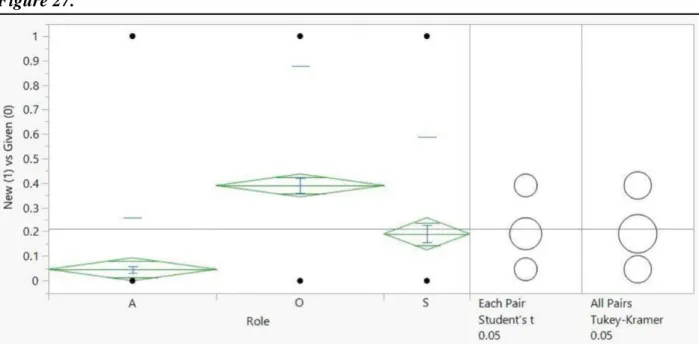
Figure 27- Graphical Representation of Newness Distribution by Role ...82
Figure 28- Graphical Representation of Humanness Distribution by Role ...84
Figure 29- Comparison of Human vs. Nonhuman Roles for Lexicality ...85
Figure 30- Relative Comparison of Human vs. Nonhuman Roles for Lexicality ...86
Figure 31- Comparison of Human vs. Nonhuman Roles for Information Status ...86
Figure 32- Relative Comparison of Human vs. Nonhuman Roles for Information Status ...87
Figure 33- Graphical Representation of Lexicality by Role controlled for Humanness-H ...88
Figure 34- Graphical Representation of Lexicality by Role controlled for Humanness-NH ..88
Figure 35- Graphical Representation of Newness by Role controlled for Humanness-H ...89
Figure 36- Graphical Representation of Newness by Role controlled for Humanness-NH ....89
Figure 37- Graphical Representation of Lexicality by Humanness controlled for Role-S ...90
Figure 38- Graphical Representation of Lexicality by Humanness controlled for Role-O ...90
Figure 39- Graphical Representation of Newness by Humanness controlled for Role-S ...91
x
LIST OF ABBREVIATIONS
1 First Person
2 Second Person
3 Third Person
A Subject of a transitive clause ABS Absolutive
ANTIP Anti-Passive
AOR Aorist
APPL Applicative ASS Assertive CAUS Causative CENTRIF Centrifugal CENTRIP Centripetal COND Conditional CMPR Comparative DEM Demonstrative
EQ Equational
ERG Ergative EXCL Exclusive
FOC Focus
FT Formative
xi HAB Habitual
IN Intransitive
INA Inanimate
IO Indirect Object
ITR Iterative
MOD Modal
NEG Negative
NF Non-Finite
O Object (Coding)
OBJ Object (Gloss)
PAS Preferred Argument Structure PASS Passive
PL Plural
POSP Post-Position PROG Progressive PST Past REC Reciprocal REL Relative
REFL Reflexive (Gloss) RFL Reflexive (Coding) RJ Rejected from analysis
S Singular
xii SBJ Subject (Gloss)
SBJV Subjunctive
ST Stative
SUB Subordinating Conjunction
TR Transitive
1
1. Introduction
This thesis tests whether the Azajo dialect of P’urhepecha represented by the
2
either pattern with A if S is human, or O if S is nonhuman, which appears to mirror the
clustering of these roles in languages with split-ergativity. These findings suggest that careful analysis of how grammatical role and humanness interact may relate to the cross-linguistic typology of morphosyntactic alignment. However, far more research is needed to determine the extent of this relationship.
1.1 Background on P’urhepecha Figure 1. Michoácan, Mexico
Michoácan, Mexico Image via Wikipedia Commons https://commons.wikimedia.org/wiki/File:Michoacan_in_Mexico_(location_map_scheme).sv
g Date Accessed: November 6th, 2019 P’urhepecha, formerly known as Tarascan (alternatively spelled P’urépecha,
3
Michoácan, Mexico with a speaking population of about 110,000 (Chamoreau, in press: 1). There is also a substantial diaspora population in the United States with concentrations in California and North Carolina. Prior and coextensive with Spanish contact, the Tarascan state was a powerful Mesoamerican empire though when it emerged as such is uncertain, with some estimates being between 1,000-1,250 C.E. (Adams 2005: 345). Although there have been attempts to classify P’urhepecha as belonging to a larger language family, such as Greenberg (1987) placing it under the Chibchan subgroup of Chibchan-Paezan, and Swadesh (1968) hypothesizing a relation between Quechua, Zuni, and P’urhepecha, these have been unconvincing to put it generously. Further, there has been recent scholarship questioning considering P’urhepecha as being a member of the Mesoamerican linguistic area due to it not conforming to certain traits considered to be necessary attributes of this sprachbund (see Campbell et al. 1986; Chamoreau in press.).
Figure 2. Distribution of P’urhepecha Speakers in Michoácan
4
In terms of dialectology, there are two dialectal dimensions of note: the first
separating an eastern linguistic area, comprising the regions of Zacapu and Lake Patzcuaro, and a western linguistic area, comprising the northwest valley of the eleven villages and the Sierra region (Chamoreau, in press: 4; Friedrich 1971). The second involves various sub-areas which seem to be different enough to cause difficulties in mutual intelligibility with other villages, these sub-areas being the villages Angahuan and San Lorenzo in the south of the western area, and the villages of Santa Fe de la Laguna, Chupicuaro, San Jeronimo P’urhenchecuaro, and San Andrés Tzirondaro in the eastern area (ibid.). The native-speaker consultants that provided the data for this thesis are both from Azajo, found in the Zacapu dialectal region, but which is apparently known (personal communication with speakers) for being different from other areas in terms of dialect.
5
study of basic constituent order is lacking for other regional dialects of P’urhepecha (ibid.). The two speakers in this corpus vary in their basic constituent orders, with Francisco using SOV and Adriana varying between SOV and SVO. This variation is not expected to cause any methodological issues for this thesis.
2. Theoretical Background
2.1 Introduction to Preferred Argument Structure
In this section, the theoretical background relevant to the argument of this thesis will be examined. Of particular note are the concepts of morphosyntactic alignment, the labels S, A, & O, as well as the notion of Preferred Argument Structure in its several iterations.
The labels S, A, & O are crucial to examining Preferred Argument Structure because they divide into three categories that which is often only conceived of in two, these
6
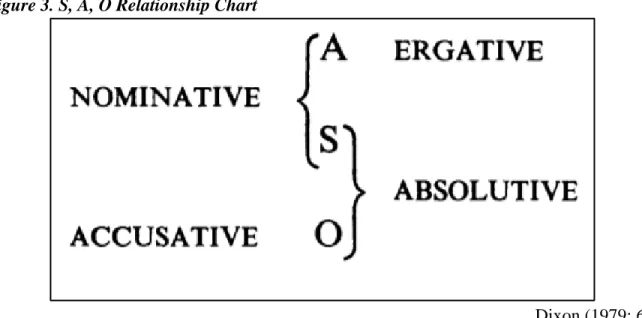
alignment. Dixon refers to these categories as being “universal semantic-syntactic primitives” (Dixon 1973: 59). With these labels in place, it is now much simpler to think about how these distinct categories relate to one another in particular languages and under particular morphosyntactic alignments as elegantly done in the below figure from Dixon (1979):
Figure 3. S, A, O Relationship Chart
Dixon (1979: 61) As can be seen in above Figure C, morphosyntactic alignment consists of groupings of these three categories, S, A, & O, into either a unity between S and A to the exclusion of O as is the case with nominative-accusative languages such as English and P’urhepecha, or a unity between S and O to the exclusion of A as is the case with ergative-absolutive languages such as Mayan languages and Basque. Based on morphosyntactic alignment, the
7 (1) ji ireka-p-ka
I live-PST-ASS.½S
S IN
“I lived” [CuaraqueCorpusText4, 40] (2) ji nompe-ni mite I nothing-OBJ know
A O TR
“I know nothing” [CuaraqueCorpusText6, 7]
Example (1) shows an intransitive sentence, (2) a transitive one; the S role of (1) and the A role of (2) are both expressed by the same personal pronoun ji, while the O role in the transitive sentence nompe ‘nothing’ takes the case marker -ni indicating object.
Below are two examples from Basque which show an ergative-absolutive language treats the S and O categories as one group to the exclusion of A:
(3) gizona-∅ etorri da the.man-ABS has arrived
S IN
“The man has arrived” (Campbell & King, 2011: 62)
(4) gizona-k mutila-∅ ikusi du the.man-ERG boy-ABS saw
A O TR
“The man saw the boy” (ibid.)
Example (3) shows another intransitive sentence, (4) another transitive one; in which the S role and the O role both have the same phonologically null marking -∅ for the absolutive case to the exclusion of the A role, which is marked with the ergative case marker -k.
Now, understanding why a unity between S and A would emerge to the exclusion of O is not particularly difficult and is related to the previously mentioned concept of
8
ought to arise in such languages; why ought there be a unity between the S and O roles to the exclusion of the A role.
In his seminal paper “The Discourse Basis of Ergativity,” Du Bois attempts to find said basis for ergativity at the level of discourse, arguing that by examining how referential form and information status occur in these S, A, and O roles at the level of discourse, the pressures causing the ergative-absolutive alignment to emerge could be discovered. These pressures or ‘constraints’, as Du Bois calls them, give rise to a Preferred Argument Structure. The specifics of Du Bois (1987) will be discussed in greater detail later in this section, but for now we shall examine some of the data he presents in his 2003 paper “Discourse and
Grammar”.
9 Figure 4. Lexical Argument Quantity
Du Bois (2003: 62) Figure 5. Lexical Argument Role
10
from this statistical analysis of the distribution of lexical and new core arguments into the roles S, A, & O that Du Bois formulates his proposal of a Preferred Argument Structure, the constraints for which can be seen in the below Figure 8. The constraints are summarized below in Table 1.
Figure 6. New Argument Quantity
ibid.: 69 Figure 7. New Argument Role
11 Figure 8. Preferred Argument Structure Constraints
ibid.: 71 Table 1. Preferred Argument Structure Constraints
Constraint Name Description
One Lexical Argument Constraint Avoid more than one lexical core argument. One New Argument Constraint Avoid more than one new core argument. Non-Lexical A Constraint Avoid lexical A.
Given (Accessible) A Constraint Avoid new A.
Du Bois (1987; 2003) From these discourse-pragmatic constraints, Du Bois in his 1987 paper posits that the basis for ergativity is at the level of discourse, with the dispreference for the role A as the recipient of nominal arguments that are lexical or new, whereas S and O being preferred for such arguments being why there exists a pressure for ergative-absolutive alignment to emerge. Moreover, Du Bois claims in this 1987 piece that this pressure exists as a universal of language and that there is a universal ergative-patterning of discourse, which should be visible in all languages, even those that are nominative-accusative in alignment. Du Bois argues that it is due to the cognitive costs associated with managing new lexical information that pressures these more semantically-loaded arguments to be introduced either
12
transitive clause, while the A role remains a non-lexical, non-new argument. Du Bois argues that the preference for only one lexical/new core argument per clause is pragmatic, so that a listener hearing a given clause is not presented with too much new information at once, which Du Bois claims would have a higher cognitive processing cost. This neurological basis for the PAS phenomenon is not rigorously interrogated by Du Bois and somewhat
speculative, as well as the subject of criticism by Everett (2009) as well as Haig & Schnell (2016). However, this thesis will not investigate whether there is validity to these cognitive cost claims due to this being beyond its scope.
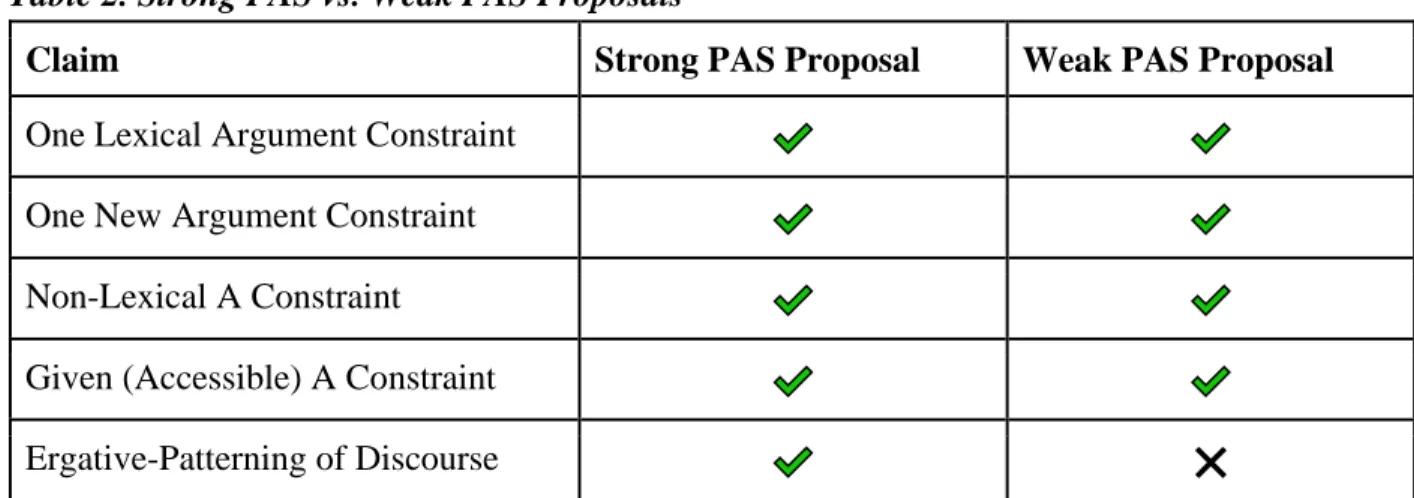
In this thesis, the distinction between the Strong Preferred Argument Structure and Weak Preferred Argument Structure proposals deals specifically with this aforementioned logical step from the patterns Du Bois posits exist in discourse to there being an ergative-patterning of discourse. The following Table 2 summarizes the distinctions between the two proposals:
Table 2. Strong PAS vs. Weak PAS Proposals
Claim Strong PAS Proposal Weak PAS Proposal
One Lexical Argument Constraint
One New Argument Constraint
Non-Lexical A Constraint
Given (Accessible) A Constraint
Ergative-Patterning of Discourse ❌
13
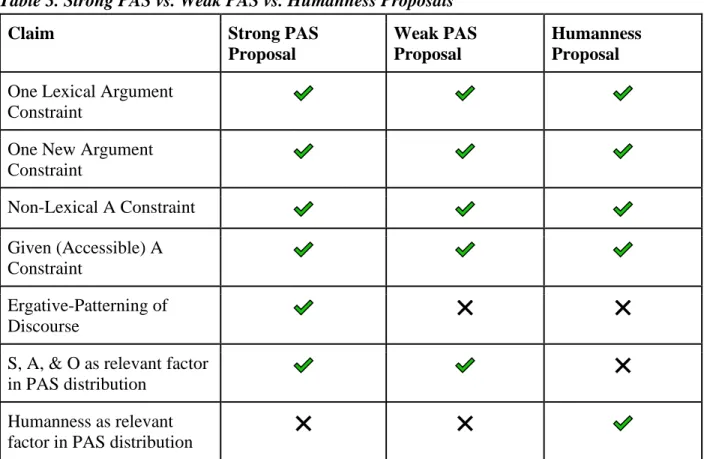
referred to pronominaly and being given information in discourse, that it shows this distinct pattern in contrast to roles S and O (Everett 2009). As such, Everett rejects the ergative-patterning of discourse explanation for the PAS ergative-patterning and posits a humanness
14
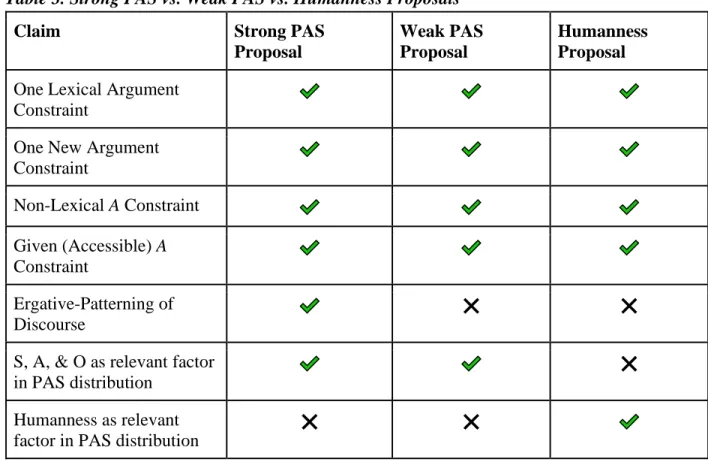
Table 3. Strong PAS vs. Weak PAS vs. Humanness Proposals
Claim Strong PAS
Proposal
Weak PAS Proposal
Humanness Proposal
One Lexical Argument Constraint
One New Argument Constraint
Non-Lexical A Constraint
Given (Accessible) A Constraint
Ergative-Patterning of Discourse
❌ ❌
S, A, & O as relevant factor in PAS distribution
❌
Humanness as relevant factor in PAS distribution
❌ ❌
In the subsections that follow, a number of studies relevant to Preferred Argument Structure will be examined in more depth, as they have been very helpful in informing the methodological choices of this thesis. A summary of these choices appears at the end of the section.
2.2 Du Bois (1987)
Du Bois asks the question of why do ergative-absolutive languages exist. “Long constitut[ing] a ‘problem’ for general linguistics,” (Du Bois 1987: 805) the motivation behind the existence of these languages has long plagued linguistic study.
15
since it breaks up this notion of subject, since in N/A alignment S and A have the same treatment to the exclusion of O. Why some languages break apart this notion of subject is argued by Du Bois as unclear at the level of linguistic inquiry that excludes analysis of discourse, and as such seems to stand as a formidable challenge against the discovery of linguistic universals. The key to solving the problem of the existence of ergative-absolutive languages, Du Bois posits, is at the level of discourse: “The ergative pattern of discourse constitutes the basis . . .of the grammatical phenomenon of ergativity” (ibid.: 806). Du Bois goes further to say that it is precisely because “linguists have not previously been aware of the ergative-patterning of discourse” that they have “lacked information crucial to
understanding the ergative grammatical phenomenon” (ibid.). While it is commonplace in linguistics to understand how, say, a syntactic construction may grammaticalize into a morphological one, this idea of the grammaticalization of discourse into syntax and semantics is a more controversial step for many in the field. However, it is this theoretical bridge that Du Bois seeks to build, between discourse and grammar, with his theory of Preferred Argument Structure.
Du Bois’ methodology involved having Sakapultek Mayan language consultants watch the “Pear Film”, a languageless film involving people doing various actions such as picking a pear off of a tree, and then having these participants relay the plot of the film to a native-speaker interlocutor, which is recorded. The reason for using this film is the particular genre of text it is able to elicit, namely the third-person narration about strangers. The utility of this genre is the relative lack of active background information shared between
16
information pressure’, which Du Bois argues allows for the easier “identification of any quantity and role constraints that may be operating in a given language” (ibid.:835). I found this to be potentially very useful information to keep in mind when evaluating elicitation methods and strategies as well as for conducting cross-genre analyses of texts in a corpus. These texts are then analyzed statistically to determine the relative distributions of A, O, and S’s.
In analyzing information flow in discourse, Du Bois pays close attention to the concept of the packaging of information, by which speakers better aid in the assimilation of new semantic content to their interlocutors via situating it in already existing, shared, old information. This is highly relevant to Du Bois’ argument because, if “Grammars code best what speakers do most,” (Du Bois 1985: 363) as Du Bois claims, how speakers encode and extract packaged information and the linguistic patterns speakers most regularly use will be critical in any grammaticalization of alignment.
17
at the statistical prevalence of lexical arguments within the corpus. The resulting data show that S and O, the two grouped roles in ergative-absolutive alignment, are far more prevalently overt lexical mentions than A, the excluded role. This leads Du Bois to introduce the Non-Lexical A Constraint, which in conjunction with the One Non-Lexical Argument Constraint results in Preferred Argument Structure, or PAS. PAS “partitions the arguments along the same lines as the grammatical opposition of ergative vs. absolutive,” (ibid.: 823) thus
resulting in the unity of S and O as a class resulting from the discourse distribution of lexical mentions.
The next question Du Bois asks is why? Is there a pragmatic justification for the unity between these argument roles, or is this merely a statistically justified but arbitrary constraint on language? Du Bois’s explanation harkens back to the aforementioned concepts of
packaging and information flow. Within the totality of his corpus, not a single clause
contained two new argument mentions, leading to the One New Argument Constraint, which dictates “Avoid more than one new argument per clause” (ibid.: 826). Further, when
18
patient, O role, is, in contrast, far more likely to be a new, lexical mention. The S role seems to be a bit more complicated, but still patterns more like O. Du Bois then interrogates why the S role ought to pattern with O, containing so many more frequent new mentions in
comparison to A. To answer this, Du Bois analyzes the discourse function of intransitive verb clauses, which he claims is managing information flow. Du Bois finds that the most typical means of introducing new human referents is in the S role, which he explains as a means of avoiding the problems that immediate introduction into the A role would cause with the Given A Constraint. Speakers, thus, often select an intransitive verb, not for its conceptual content or its semantic argument structure, but instead for its compatibility with constraints on information flow. The purpose of constraining information flow, Du Bois continues, is then to accommodate listeners in the introduction of new mentions. Du Bois posits that “simultaneous introduction of a second new referent within the same clause core is
excessively burdensome” (ibid.: 834). The function of the absolutive then, is not to denote, mark, or signal something, but rather to allow for the processing necessary for the arguments in these roles. “The absolutive does not mark new information, it accommodates it” (ibid.).
Du Bois goes further to posit that the pressures of the PAS are universal, switching the argument from its initial why do ergative-absolutive languages exist, to why do
nominative-accusative languages exist? Du Bois answers this by positing a counterbalancing motivation pushing for N/A alignment in the fact that {S, A} mentions are typically “human, agentive, and topical” (ibid.: 839). This further explains how split ergativity can exist, in which the pressures of PAS and {S, A} type win over in different situations.
19
outlined in this paper are the basis for my own analysis and this paper characterizes the Strong Preferred Argument Structure proposal that, alongside its weaker counterpart, this thesis evaluates. Here we have Du Bois centering his observations about PAS as explaining the ergative-absolutive alignment as well as positing that an ergative-patterning of discourse is a language universal, which the subsequent sections of this paper will evaluate critically. 2.3 Du Bois (2003)
Du Bois’ “Discourse and Grammar” seeks to bridge the gap between two long-thought-as -distinct branches of language, discourse and grammar. In this paper, he proposes a more clear and refined iteration of his Preferred Argument Structure than in his previous work and this paper is useful as a guide in testing for a weak version of PAS, since in this presentation of the theory, Du Bois does not focus so much on the idea of an
ergative-patterning of discourse and instead turns his attention to the patterns in discourse he had also described in his 1987 paper which are summarized in Figure 8 reproduced below.
Figure 8. Preferred Argument Structure Constraints
Du Bois (2003: 71) PAS for Du Bois “represents neither a discourse structure nor a syntactic structure per se, but a preference in discourse for a particular syntactic configuration of linguistic
20
tendency but “not a categorical rule,” (ibid.) which he claims is “evidenced widely in the spontaneous discourse of virtually all languages investigated to date” (ibid.). This tendency, Du Bois claims, is that “In spontaneous discourse, the distribution of nominal referential forms (such as full lexical noun phrases or pronouns) across the various syntactic positions (subject, object, oblique) is systematically skewed” (ibid.). More specifically, new and lexical mentions are strongly dispreferred from appearing in the A role. These constraints should be familiar to the reader from the previous section, since they are identical to that previous formation except for that the Given A Constraint has been adjusted minorly and is now the Accessible A Constraint, with more on this difference appearing below in the later review of England & Martin (2003). In his previously reviewed work, this dispreference for new and lexical mentions in A is the pressure that brings about the ergative-absolutive
alignment because, Du Bois claims, the ability for the S (subject of an intransitive clause) and O (object) roles to take new and lexical mentions is what unifies them as a group against A in ergative-absolutive languages. As previously mentioned, while that may have been the telos of his earlier work, namely explaining the existence of the ergative-absolutive alignment, here Du Bois focuses on his observed statistical tendencies and how they might inform us about how cognitive costs, information status, and referential continuity are managed by speakers.
21
utterance tokens necessarily become an object of study in its own right.” (ibid.: 51) Historically linguistics has used discourse tokens as examples to substantiate their claims about grammar, but have relegated discourse as too untamed, wild, and free as to be the subject of more sophisticated theory. Du Bois, in what he calls the token aggregate (ibid.), posits that there can be productive theoretical work done on discourse by looking at very large quantities of it and looking for patterns. Du Bois claims that “this aggregate of realized tokens of language use exhibits patterning that in its broad outlines, allowing for a certain degree of analytical and statistical abstraction, remains remarkably constant from one speaker to the next and even from one language to the next” (ibid.: 52).
As seen above, these tendencies are said to affect the referential forms and ‘newness’ of the core arguments of a clause, here clause meaning specifically a predicate plus its nominal arguments and the core arguments being the roles S, A, O, as well as the indirect object role henceforth abbreviated IO. In order to facilitate the discourse-pragmatic goals of cognitive cost, referential continuity, information status, etc. Du Bois argues that there emerges a preferred structure to core arguments with certain roles becoming specialized as to what kinds of nominal arguments they take, with the pressure for this coming from the level of discourse and grammaticalization at the level of syntax. Du Bois provides the example in Figure 9 to show the noun-pronoun alternation at the level of syntax and its correlated effects on speaker judgments. While in theory it may be true that in isolated sentences a noun and a pronoun may be in free variation with one another without negative effects on
22 Figure 9. Example from Du Bois (2003)
ibid.: 57 At the level of discourse, additional discourse-pragmatic factors influence how core arguments are manifested, with this pressure resulting in long-term grammaticalization of these roles into specialized ones with preferences as to which kinds of nominal arguments they abide. As Du Bois says “Grammars code best what speakers do most” and if there are statistically significant differences in how speakers treat different roles, within Du Bois’ framework grammars should evolve based on these discourse-level pressures.
More in this iteration of PAS than in the previously reviewed paper by Du Bois, there is an emphasis on the purported motivation for the phenomena Du Bois observes, namely the cognitive-processing cost for accessing an intended referent. To preview a little some of the criticism that later papers will make against Du Bois’ argument, Everett (2009) and and Haig & Schnell (2016) will make this explanation key in their attacks on PAS in that Du Bois posits this explanation without any real psychological or neurological evidence, a major weakness to Du Bois’ proposal. Du Bois’ reasoning is as follows:
“When there is a new entity to be introduced into a discourse, this will
23
intended referent. A full noun phrase, characteristically deployed when new
information is being introduced, is thus taken to be an index of relatively high effort in accessing the referent. A pronoun, invoked when the referent is more or less obvious from context, is interpreted as an index of relatively low cognitive effort to access.” (ibid.: 65)
Du Bois does mention that the opposite argument could be made, that recalling the
antecedent of a pronoun could be more cognitively costly, whereas a lexically full NP may be less so, but dismisses this by arguing that speakers “use pronouns precisely when warranted,” namely “when the contextual ground has been sufficiently prepared in advance that no more than a hint is needed” (ibid.: 66) to indicate the correct referent, with that hint being the pronoun. This thesis will not seek to test whether Du Bois’ cognitive cost explanation is valid or not due to this being beyond the scope of this thesis and the much higher costs required for neurological research.
24
Overall, this paper represents a succinct explanation by Du Bois of his weaker Preferred Argument Structure proposal and provides a clear set of claims to test for with the Cuaraque Corpus. Namely, these are the constraints dispreferring more than one lexical or new nominal argument in a clause core and the dispreference for A’s to be lexical or new. With this in mind, I can test whether Du Bois’ claim that “the distribution of cognitive costs across the grammatical architecture of the clause is neither random nor constant, but
systematically skewed” (ibid.: 81). 2.4 Kärkkäinen (1996)
This paper is useful to the present study for a number of reasons: first, that it deals directly with English, a nominative-accusative language, and second, that it analyzes conversational discourse, both of these making this paper a useful guide in conducting an analysis on Preferred Argument Structure on something like the Cuaraque Corpus, since P’urhepecha is a nominative-accusative language and the corpus contains a much wider variety of text genres as compared to the quite controlled methodology for text collection seen in Du Bois (1987). Kärkkäinen tests Du Bois’ theories on the constraints of Preferred Argument Structure as well as the ergative-patterning of discourse, and finds that PAS, as understood as referring to the tendency for speakers to avoid expressing more than one piece of new information in one clause, as well as avoiding lexical or new referents in the transitive subject position, is substantiated by her analysis of American English conversational
25
wrench in the aforementioned hypothesis, which is the explanation she finds more compelling (ibid.).
Her methodology involves taking 3-5 minute segments from three different
conversations taken from the Santa Barbara Corpus of Spoken American English, which she transcribed into 1008 intonation units, in this case referring to a spurt of talk produced under a coherent intonation contour, which was often bounded by a pause (ibid.). A key unit of her analysis was the “clause role”, which consisted of a predicate and its core argument NPs, but excluded oblique nominals (ibid.). All of the NPs were identified and were coded for
grammatical role, which could be either A, referring to the subject of a transitive verb; S, referring to the subject of an intransitive verb; or O, referring to the direct object of a
transitive verb. These were also coded for morphological type, which could be either lexical or pronominal referent, and for activation state of the NP, either given, meaning referents that “have already been activated at the point in the conversation where the NP appears,” (ibid.: 678) or new, which were not “given”. She also coded for semantic class, which is of less relevance to this thesis.
26
hold, with lexical arguments avoiding the S role as well as the A role, pushing back against a notion of an ergative-patterning of discourse.
Overall, this paper is useful to the present study in that it provides a guide for my own testing for Preferred Argument Structure in a greater variety of genres, as well as some expectations to compare my P’urhepecha data to, since both English and P’urhepecha are Nominative-Accusative in alignment, especially regarding Kärkkäinen not finding evidence of an ergative structure of discourse.
2.5 England & Martin (2003)
England & Martin, in their paper, undertake a test of Du Bois’ analysis of Sakapultek Maya (Du Bois 1987), against a larger corpus of texts, from more Mayan languages and more diverse genres. Du Bois, in his Preferred Argument Structure analysis of Sakapultek Maya, had used texts elicited in a uniform manner (his pear stories) and England & Martin sought to see if his data and the PAS hypothesis stemming from it would be discounted with the inclusion of a larger, more varied data set. In addition to the Sakapultek Mayan data from Du Bois (1987), the authors analyzed three folktales from Mam, four folktales from
27
argument structure,” (ibid.) however the paper is useful in its further confirmation of Du Bois’ claims. This paper is of utility in preparing for a discourse analysis of P’urhepecha, in that it provides a framework for using a broader array of genres for this kind of analysis, since the currently collected corpus for P’urhepecha is much more varied than Du Bois’ pear film corpus. This variety, I had initially worried, would be a liability to performing a
convincing discourse analysis of P’urhepecha, but based on my interpretation of England & Martin’s paper, this variety of texts increases the power of discourse analysis. The authors note that, while the analysis of the data itself in the paper is not particularly novel or interesting in its own right, that “the decisions that [they] needed to make in order to count clause and NP types in [their] less controlled data are of some intrinsic interest in terms of understanding Mayan grammar and discourse” (ibid.: 134). This discussion is useful in that it makes more explicit how to go about determining which categories to assign textual data to in order to perform this sort of analysis.
The first such question they examine is what exactly constitutes a full lexical
mention. This is of note, because much of Du Bois’ analysis of which roles receive said full lexical mentions depends on how these are classified. The authors found two related
28
nouns as their realizations. Counting the pronouns and verbal affixes that are the typical realization of such arguments as “instances of nonlexical reference” (ibid.) is problematic because in such circumstances they probably ought to be considered the equivalent of a full NP representation. Direct discourse, as well, may also introduce “the possibility of vocative constructions in which full NP’s, namely the vocative, could be construed as arguments” (ibid.: 137). These differences in categorization are important to note when dealing with the P’urhepecha corpus because many of those texts have first- and second-person arguments.
The next question the authors pose is what exactly constitutes a new mention. Here the authors interrogate Du Bois’ categorization of new and given information, calling specifically to the forefront his addition of the intermediary category of accessible. This accessible category he defined as being the case if “it was part of a previously evoked entity-based frame…, although previously unmentioned; or if it had been mentioned previously, but more than 20 intonation units previously” (Du Bois 1987: 816). What the authors more thoroughly elaborate on, however, is how there may potentially be many mentions that appear to be new within sole analysis of the text itself, but that are in fact already “assumed by both narrators and listeners to be part of the narrative context” (England & Martin 2003: 133). Such accessible information may come from that which transpires before the tape starts recording, or shared cultural context, which may not be understood by those without such context. While I have the luxury of having been personally present during the recording of the texts in the P’urhepecha corpus, it is probably a good idea to pay close attention to the context of each text anyway.
29
associated NP’s include reflexives, clauses with embedded infinitives, and directionals. Further questions the authors pose include dealing with instances of direct quotation as previously noted, which Du Bois’ narratives lack, but pose the problems of how to count pronominal reference in first- and second-person, as well as the counting of quote verbs. The authors also outline the particular differences stemming from the different languages
analyzed, as well as dealing with unanalyzable residue.
Using this revised criteria, the authors analyzed the larger, more diverse data set. Some of their findings from analyzing these “more than 2300 clauses in four languages,” (ibid.: 150) include different kinds of variation. These kinds of variation include variation in genre, variation among speakers, and variation among topics by the same speaker (ibid.). This is an area of particular interest due to the fact that Du Bois outlines several predictions for what kinds of variation would be likely across different kinds of texts. Du Bois’ having a very restricted variety of text gives England & Martin a good opportunity to test these
predictions. They found that variation across genres was not nearly as wide as may have been expected, and the prediction that higher “information pressure” would cause more Zero NP clauses was found to hold, though not by as much of a margin as one might expect. The authors suggest that the concept of information pressure may need some refining in order to be applicable to genres that have fewer human participants. Variation by speaker and
30
Overall, this paper is most useful in its clarification of how to apply a discourse analysis of Preferred Argument Structure to a more diverse collection of texts, while also clarifying different methods of categorization of several terms used in Du Bois (1985; 1987). 2.6 Everett (2009)
In his paper, Caleb Everett argues against the “putative cognitive motivations for PAS,” (Everett 2009: 1) presented in the abounding literature and originating in Du Bois (1987) and claims that PAS is “likely epiphenomenal and due to basic semantic and pragmatic factors,” (ibid.) as opposed to being a product of an ergative-patterning of discourse or “staging area”. Everett posits instead of Du Bois’ explanation that the real explanation for the PAS phenomenon is that there is a “marked tendency for human referents to be distributed entirely within the S role of intransitive clauses and the A role of transitive clauses” (ibid.). Everett proposes that “the motivations for Preferred Argument Structure suggested by Du Bois (1987b, 2002) and accepted by many researchers do not actually need to be appealed to in accounting for the data on Preferred Argument Structure” (ibid.).
Everett provides a synopsis of Du Bois’ proposals to which he makes a few augmentations for his own purposes including “collapsing the lexical and pragmatic dimensions of PAS,” (ibid.: 3) from two constraints, the Given A and Non-lexical A constraints, into just one Given/Non-Lexical A Generalization. Another point of note regarding how to categorize lexicality, Everett provides his own definition for lexical mentions: non-anaphoric nouns (ibid.). While praising Du Bois’ work for providing “a clear ligature between the S and O roles” and therefore assisting “our understanding of
31
primarily because “quality data supporting the aforementioned cognitive motivations of PAS are generally absent in the literature” (ibid.: 4). In place of this unsubstantiated cognitive explanation, Everett posits that “PAS is motivated by well-established semantic and pragmatic correlates of the S, A, and O roles” (ibid.). To advance his argument, Everett conducts an analysis of discourse data from English and Portuguese, two languages for which the PAS phenomenon has been well established (cf. Dutra 1987 for Portuguese). From this analysis, Everett proposes that “the true ligature between S and O roles is not based on the onerous nature of new or lexical referent introduction” but rather “due to the tendency of the S and O slots to house non-human referents and for the A slot to host to [sic] human
referents” (ibid.: 5).
Everett highlights a number of potential issues with the motivations for PAS as established in the literature claiming that many confounding variables have been ignored. For example, Everett states that many studies “simply cite the presence of a greater number of lexical arguments and new referents in the S or O roles, when contrasted with lexical and new As” (ibid.). Everett claims doing so would “superficially lend support for the existence of the QUANTITY GENERALIZATION and the GIVEN A GENERALIZATION as independently cognitively-motivated constraints,” while “omitting the possibility that such constraints on grammar are in fact dependent on other factors” (ibid.). For example, Everett points out the fact that there is an “inherently greater rate of Ss, when contrasted to As, in discourse,” (ibid.) a factor that I, too, found potentially problematic in my pilot study on child English. When examining raw totals of lexical mentions in different roles, this can make the
32
care to present both absolute and relative distributions in this thesis. Another factor that Everett elucidates is “the typically human (and therefore topical) nature of A referents, which are prototypically animate agents” (ibid., 6). Everett goes on to mention that in Du Bois’ Sakapultek data all 187 or the A role-mentions are human (ibid.). In Everett’s study, a similarly high percent (92 percent in the English, and 87 percent in the Portuguese) of the A role nominals refer to humans as well (ibid.). Everett claims that this data “illuminates the extent to which the A-role slot of transitive clauses is correlated with human referents,” (ibid.) which Everett contends is not something that has been explored in the PAS literature. Further, Everett mentions how human mentions have a very high tendency to be represented “via anaphoric or non-lexical means” due to “most human mentions tend[ing] to be given and from the natural topicality associated with human referents” (ibid.). Due to the fact that most human referents in discourse are speech act participants, it makes sense that these referents are “given and non-new” (ibid.). Everett suggests that “the inherent tendency for the A role to be dissociated with lexical and new mentions is related to a basic semantic factor” which is “the natural tendency for agents of semantically transitive verbs to be human,” as well as “a basic pragmatic factor,” namely the “correlation between human arguments and topical, non-lexical, non-new arguments” (ibid.).
33
no independent evidence for the One Lexical Argument Constraint, which he claims is just a result of the very low frequency of lexical As due to their usual humanness, rather than being the product of having two lexical arguments being a “cognitively onerous task” (ibid.: 15). Everett also did not find evidence that the intransitive clause functions in a significant way to introduce referents, indeed finding many examples of transitive clauses introducing referents (ibid.: 17).
Overall, this is a useful counterproposal to the pressures behind PAS, which is argued convincingly and forces a more robust and careful analysis of the subject. It has elucidated a number of considerations that will be important in my own analysis, and provides another set of criteria, namely humanness, that I code for in my discourse analysis.
2.7 Huang (2012)
This paper is one of the very few examples of Preferred Argument Structure being tested for in child language. In this study, Huang tests for PAS in early child Mandarin (2,1-3,1), and finds that similarly to Kärkkäinen (1996), the results conform to the constraints of PAS but not an ergative-patterning of discourse (Huang 2012). Huang also tests the proposals made by Everett (2009) of humanness as a counter-explanation for the patterns in her data, which is useful to this thesis because this paper acts as a methodological guide as to how I can do the same. Huang summarizes as the following: “Everett suggests that it is the
34
A well-founded point that she begins her paper with is that “Research on adult grammar includes a long and flourishing tradition of theoretical approaches that consider discourse pragmatics as crucial for understanding grammar”, yet, she continues, “In language acquisition research, however, grammar and discourse are frequently treated as separate domains that do not interact in any significant way” (ibid.: 119). This is interesting from a theoretical perspective because if there are notable discourse-pragmatic constraints on
argument structure and this is a universal feature of language, then this ought to be a relevant factor in child-acquisition of language.
Huang’s methods involve analysis of naturalistic data from eight hours of video recordings of two Mandarin speaking Taiwanese girls in their homes speaking with their mothers. The girls were each recorded four times between the ages of 2 years 2 months and 3 years 1 month, and they had MLUs of 3.04 and 2.58 (ibid.). Huang’s coding scheme involved analyzing each clause containing an overt verb in terms of clause type, these being either transitive or intransitive clauses. The core arguments of each of these clauses were then coded for grammatical roles, the A role, O role, and S role, that we have seen before, for referential forms, either lexical or non-lexical (null or pronominal), for information status, either new or non-new, and for humanness, either human or non-human (ibid.). In contrast to my coding scheme (my coding scheme is presented in the coding methodology section later in the thesis) Huang counts 1st and 2nd person pronouns such as the wo ‘I’ in her example (ibid.: 129) as being non-lexical, which my coding based on England & Martin (2003) counts as lexical.
35
alignment between A and S, with both lexical A’s and lexical S’s being avoided, again not supporting the ergative-patterning of discourse (ibid.). Huang’s analysis of humanness found that each role was statistically significantly distinct from one another for humanness with A being the most human, O being the least, and S being an intermediary level of human. Based on this data and the relative lexicality and newness of the arguments in these roles, Huang was able to conclude that it may be due to the significantly lower level of humanness for the O role that this role had the highest level of newness and lexicality (ibid.: 145). However, Huang’s more detailed analysis into humanness as an account for the observed PAS patterns in the discourse showed that even though humanness was relevant to level of newness and lexicality, controlling for humanness resulted in the roles still showing significant differences in newness and lexicality. For example,
“the A role was significantly less likely to be lexical, that the O role was significantly more likely to be lexical, and that the distribution in the S role did not reach
significance. In other words, a human referent was less likely to be represented by a lexical form if the referent was mentioned in the A role. In contrast, a human referent was more likely to be represented by a lexical form if the referent was mentioned in the O role.” (ibid.: 149)
This leads Huang to push back against the Everett’s attacks on PAS since her data shows that it is not the case that only role or only humanness parsimoniously explain the data.
36
as to how to compare how well both Du Bois’ as well as Everett’s proposals fit my own data and how to evaluate these two different explanations.
2.8 Haig & Schnell (2016)
This paper is a detailed and sharp examination of the discourse basis of ergativity outlined by Du Bois most notably in Du Bois (1987), the seminal work itself, and its later exposition in Du Bois (2003). Haig and Schnell compile and analyze the largest cross-linguistic corpus of texts used to examine Preferred Argument Structure and find that
although there is validity to some of Du Bois’ claims, particularly about the low frequency of lexical mentions in the A role, however they also find that Du Bois’ formulation of a
37
Haig and Schnell begin their paper by going into depth about the paper that they are revisiting (Du Bois 1987) and establishing the central argument it makes, namely that “INTRANSITIVE SUBJECTS (S) and TRANSITIVE OBJECTS (P)[sic] are freely realized by full lexical noun phrases (NPs),” while “TRANSITIVE SUBJECTS (A) tend to be realized by some nonlexical form, either a pronoun or zero” (Haig & Schnell 2016: 592). Du Bois then postulates a diachronic relationship between this distribution of lexical noun phrases into these roles and “the ergative patterns of argument encoding in morphosyntax” (ibid.). However, the authors in their paper “aim to demonstrate that in natural connected discourse, outside of Du Bois’s Sakapultek [sic] data, there is very little evidence for a ‘discourse basis’ of ergativity at all”, that in fact “S and P[O] simply do not cluster to the extent that would justify the assumption of ergative patterning in discourse” (ibid.: 593). The authors further examine “to what extent the observed tendencies in argument realization in discourse can indeed be related to considerations of information management, or whether other factors provide simpler more robust explanations” (ibid.). Everett’s work will be of relevance to this latter goal. In their analysis, the authors’ find that “the discourse basis of ergativity clearly attested in Du Bois’s original Sakapultek [sic] data appears to be a very isolated
phenomenon, and the original explanation in terms of universal strategies of information management does not stand up to closer scrutiny” (ibid.). While admitting that the initial discovery of “robust crosslinguistic [sic] regularities in the way grammatical categories are distributed” is a remarkable discovery on the part of Du Bois, the authors “differ in the details of the patterns and the kinds of explanations that account for them” (ibid.).
38
(1) QUANTITY CONSTRAINT: Avoid more than one lexical core argument per clause. (2) NONLEXICAL A CONSTRAINT: Avoid lexical A, that is, expressing the A function
through a lexical NP.
Haig and Schnell argue that “the ergative pattern found in the Sakapultek discourse data cannot actually be explained by the quantity and nonlexical A constraints in 1 and 2” (Haig & Schnell, 2016: 595). This is because ergativity involves both the marked status of A, as well as an identity between S and P [O] (ibid.). The constraints above do entail a special status for A but do not form a relationship between S and P [O] because the constraints would be satisfied even if there was a great deal of difference in the relative lexicality of S and P [O]. The authors claim that the Preferred Argument Structure constraints, which are
confirmed by the data, are “logically distinct from the discourse ergativity claim”, and thus that “the validity of the PAS constraints does not mean that discourse has an ergative bias” (ibid.). This is a similar conclusion to the one I reached in my pilot PAS study in which I was able to confirm in my data the specific claims of the PAS constraints but not Du Bois’s larger theoretical leap to a discourse basis of ergativity. This distinction is also the same that I make in testing the Strong PAS versus Weak PAS proposals.
39 Figure 10. Discourse Ergativity Index
DISCOURSE ERGATIVITY INDEX
= (O − S) − (S − A)(Haig & Schnell 2016: 601) This formula takes in the aggregate lexicality in percentage form as the inputs for each
grammatical role and outputs a value that if negative means that the “S clusters more strongly with P in lexicality” thus meaning the text leans toward discourse ergativity, while if there is a positive value, then the distance between S and A is smaller and this shows a tendency toward discourse accusativity (ibid.).
40
Overall, the authors thoroughly heap doubt on the theoretical underpinnings of PAS, which is useful to my work, since they have included a number of useful forms of analysis and practices of good scholarship that I model in my thesis. They also find Everett’s notion of humanness to be a good explanation for the phenomena originally found by Du Bois. 2.9 Summary
41
the S, A, & O roles themselves. Huang (2012) is of great utility as a methodological model in terms of her statistical analysis and comparison of the Du Bois versus Everett account of the PAS patterning and as such is a crucial source for this thesis in its providing an example for how to critically evaluate these two accounts. Huang (2012) is also of note for its finding that for her data neither account completely explains the distribution, which is a notable further possible outcome of this kind of analysis. Haig & Schnell (2016) one of the most recent and the most robust analysis of PAS is of note in its not finding evidence of the Strong PAS proposal, and is of methodological use to this thesis in that it pioneers the use of the
Discourse Ergativity Index, which is a critical tool in evaluating the Strong PAS proposal for this thesis.
3. Methods
3.1 Corpus Overview
The Cuaraque Corpus was collected via working with two native speaker consultants who are brother and sister, Francisco and Adriana Cuaraque. I worked mostly one-on-one with these native speaker consultants, though with the occasional (see Parhana) elicitation with both brother and sister present. The elicitations were conducted using a Logitech headset microphone for consistent and decent audio recording. The stimulus for each
42
English or Spanish of these texts, significantly aiding the work of transcribing these recordings.
Table 4. Cuaraque Corpus Summary
# Title Consultant Date Recorded Duration Topic 1 Pampasuecha F.C. 4 September
2018
2:12 Recipe and history of a kind of torta
2 Banderecha F.C. 10 September 2018
3:08 About the flags hung up for a festival
3 Chararant’ani F.C. 4 October 2018 5:11 About fireworks at the festival 4 Sacristanueni F.C. 23 March 2018 5:04 Personal history of time as altar
boy 5 Pirericha F.C. 28 November
2018
2:13 About the P’urhepecha music genre
6 Xanichu F.C. 18 January 2019 1:58 About Janitzio 7 Kiroka F.C. 18 January 2019 2:35 About Quiroga and the carnitas
famous there. 8 Parhana F.C. &
A.C.
5 February 2019
2:23 A description of their kitchen in Azajo
9 Pampasu A.C. 5 February 2019 1:19 Recipe and description of a kind of torta
10 Morueri Warhani
A.C. 2 April 2019 1:23 A description of the Dance of the Moors
11 Tale Chorhonarhicha
A.C. 2 April 2019 1:43 A description of the Dance of the Viejitos
12 Karnita A.C. 26 March 2019 1:15 About the carnitas sold in Quiroga
3.1.1 Speaker Overview
43
in her 20s. Both are native speakers of P’urhepecha, and speak Spanish fluently as a second-language. Both have some degree of competence in English, though Francisco is far stronger in this language due to his having lived in the United States a good deal longer than Adriana. They both grew up in Santiago Azajo, which has a high percentage of native speakers of P’urhepecha compared to surrounding towns. Below is Figure 11, which shows the amount of clauses in the corpus that come from a text by each speaker. Multiparty here refers to the one text that both native speakers collaborated on.
Figure 11.
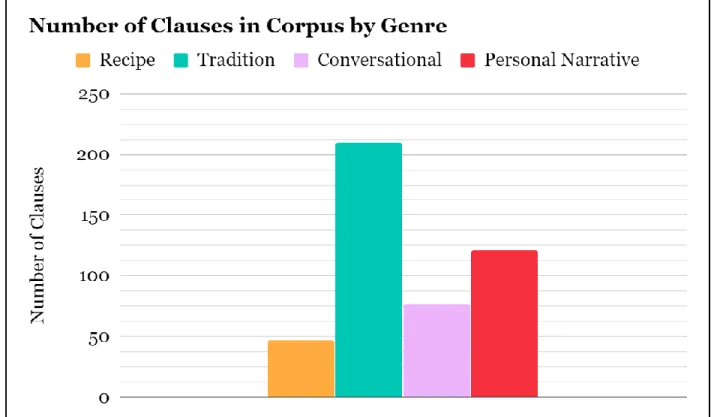
3.1.2 Genre Overview
44 Figure 12.
Table 5. Cuaraque Corpus Genre Overview
Genre Title Consultant Topic
Recipe Pampasuecha F.C. Recipe and history of a kind of torta
Recipe Pampasu A.C. Recipe and description of a kind of torta
Tradition Banderecha F.C. About the flags hung up for a festival
Tradition Chararant’ani F.C. About fireworks at the festival Tradition Pirericha F.C. About the P’urhepecha music
genre Tradition Morueri
Warhani
A.C. A description of the Dance of the Moors
Tradition Tale Chorhonarhicha
A.C. A description of the Dance of the Viejitos
45 Personal
Narrative
Sacristanueni F.C. Personal history of time as altar boy
Conversation Xanichu F.C. About our trip to Janitzio Conversation Kiroka F.C. About Quiroga and the carnitas
famous there. Conversation Parhana F.C. &
A.C.
A description of their kitchen in Azajo
The most well-attested genre present is the tradition genre, which is due to the collection methodology in that the prompting I have given in eliciting these texts has been primarily asking about various traditions and practices performed at the festival for Santiago in Azajo. The tradition genre is similar in many respects to the recipe, though the latter has some characteristics of its own, namely repetition, which differentiate it. There is often, however, portions of the recipe genre texts that could likely be categorized much the same way as the tradition texts, in that the discourse style encapsulating the recipe seems to virtually identical to the tradition genre, which makes sense when one thinks about how modern-day recipes online are bookended with usually unhelpful backstory.
Similarly to how the tradition and recipe genres pattern together in many respects, so do the personal narrative and conversation genres. The personal narrative genre includes only one text in this corpus Sacristanueni, which is a recollection of a few episodes in Francisco’s life as a young altar boy and some related mischief. It would be useful for purposes of
comparison, to at some point elicit a personal narrative from Adriana. The conversation genre is a fairly varied one in terms of collection methodology in that only one is an actual real-life conversation in P’urhepecha, though they all have some elements of
46
natural of conversations. The text Kiroka is a mock conversation in which Francisco pretends to have a conversation with me in P’urhepecha playing both himself and myself in the
conversation, which is less than ideal, but still elucidating in terms of variation between the conversation genre and the other genres. The text Xanichu is the most difficult to categorize and straddles the line between the conversation genre and the personal narrative genre, which is due to the fact that it is about our trip to Janitzio, which means that although it is a
monologue, it also has elements of conversationality due to the shared experiences and knowledge between the speaker and audience and the use of 2nd person. There are two recordings that would be excellent to eventually add to this corpus and this genre in
particular, which are 24July2018PureGodfather.m4a and 24July2018bPureGodfather.m4a. These are highly natural P’urhepecha conversations involving four native speakers of varying ages and genders, though the recording is very long and only some of it has been transcribed so far.
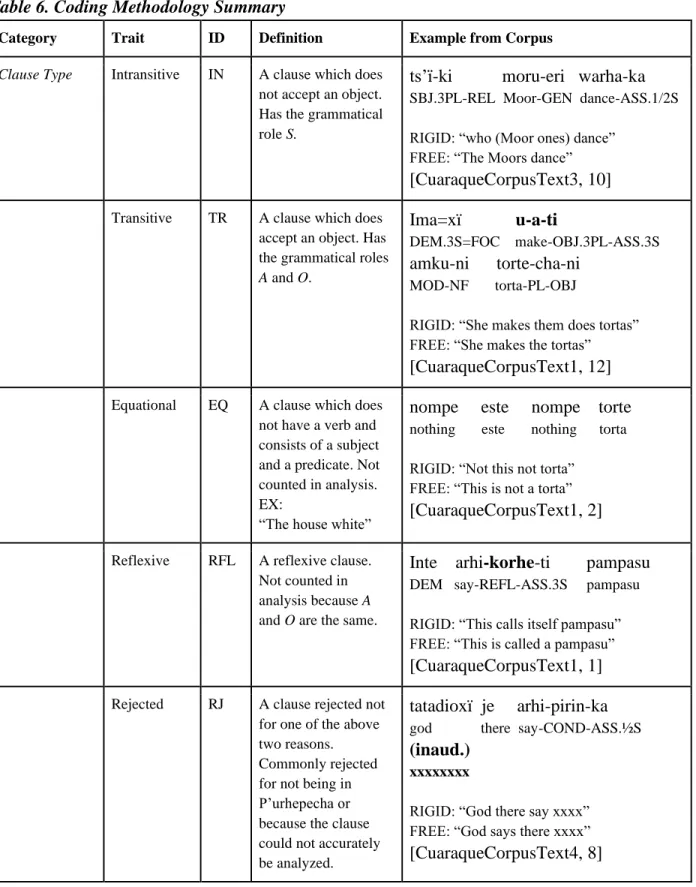
3.2 Coding Methodology
In order to test for Preferred Argument Structure in the Cuaraque Corpus, I will code the texts in my corpus for a number of traits: clause type, which will be transitive,
47
to test the proposal of Everett (2009) I will also be coding for humanness, which will either be human or nonhuman. Below is Table 6 that explains the coding methodology:
Table 6. Coding Methodology Summary
Category Trait ID Definition Example from Corpus
Clause Type Intransitive IN A clause which does not accept an object. Has the grammatical role S.
ts’ï-ki moru-eri warha-ka SBJ.3PL-REL Moor-GEN dance-ASS.1/2S RIGID: “who (Moor ones) dance”
FREE: “The Moors dance” [CuaraqueCorpusText3, 10] Transitive TR A clause which does
accept an object. Has the grammatical roles
A and O.
Ima=xï u-a-ti DEM.3S=FOC make-OBJ.3PL-ASS.3S amku-ni torte-cha-ni MOD-NF torta-PL-OBJ
RIGID: “She makes them does tortas” FREE: “She makes the tortas” [CuaraqueCorpusText1, 12] Equational EQ A clause which does
not have a verb and consists of a subject and a predicate. Not counted in analysis. EX:
“The house white”
nompe este nompe torte nothing este nothing torta RIGID: “Not this not torta”
FREE: “This is not a torta” [CuaraqueCorpusText1, 2]
Reflexive RFL A reflexive clause. Not counted in analysis because A
and O are the same.
Inte arhi-korhe-ti pampasu DEM say-REFL-ASS.3S pampasu
RIGID: “This calls itself pampasu” FREE: “This is called a pampasu” [CuaraqueCorpusText1, 1] Rejected RJ A clause rejected not
for one of the above two reasons. Commonly rejected for not being in P’urhepecha or because the clause could not accurately be analyzed.
tatadioxï je arhi-pirin-ka
god there say-COND-ASS.½S
(inaud.)
xxxxxxxx
48
Grammatical Role
S S The subject of an intransitive clause.
ts’ï-ki moru-eri warha-ka SBJ.3PL-REL Moor-GEN dance-ASS.1/2S RIGID: “who (Moor ones) dance”
FREE: “The Moors dance” [CuaraqueCorpusText3, 10]
A A The subject of a transitive clause.
Ima=xï u-a-ti DEM.3S=FOC make-OBJ.3PL-ASS.3S amku-ni torte-cha-ni MOD-NF torta-PL-OBJ
RIGID: “She makes them does tortas” FREE: “She makes the tortas” [CuaraqueCorpusText1, 1]
O O The object of a transitive clause.
Ima=xï u-a-ti DEM.3S=FOC make-OBJ.3PL-ASS.3S amku-ni torte-cha-ni MOD-NF torta-PL-OBJ
RIGID: “She makes them does tortas” FREE: “She makes the tortas” [CuaraqueCorpusText1, 12] Indirect
Object
IO The indirect object of a transitive clause.
kargu kargu ima-n-ki=kxï charge charge DEM-OBJ-REL=SBJ.3PL ints-a-ka
give-OBJ.3PL-ASS.1/2S
RIGID: “Charge charge to whom they give it”
FREE: “They give the charge to someone” [CuaraqueCorpusText3, 4]
Oblique Ob Obliques are mentions (not including
possessors) that are not cross-referenced on the verb. (Du Bois, 1987, 815)
ka musika jinkon=ya and musica with=ST RIGID: “And music with” FREE: “And with music” [CuaraqueCorpusText3, 19] Possessor PO Possessors are
mentions that are not heads of their NP’s, but which are
49 referenced as possessors of nouns which are heads. (ibid.)
FREE: “Priest’s money”
[CuaraqueCorpusText4, 16]
Referential Form
Lexical L An NP that is fully lexical (not an affix, pronominal, nor null).
Ima=xï u-a-ti DEM.3S=FOC make-OBJ.3PL-ASS.3S amku-ni torte-cha-ni MOD-NF torta-PL-OBJ
RIGID: “She makes them does tortas” FREE: “She makes the tortas” [CuaraqueCorpusText1, 12] Complement
-izer Phrase
CP A CP that is a fully lexical argument of a verb.
ka ixï makwe-ni and asi iguales-OBJ
juka-n-xïn-t=ya para
dress-PASS-HAB-ASS.3S=ST para
tatatioxï-ni=xï warha-ku-ni
God-OBJ=FOC dance-APPL.OBJ3-NF RIGID: “And like so equals are habitually dressed for God to dance for him”
FREE: “And they dress the same and dance for God”
[CuaraqueCorpusText10, 6] Pronominal PR An NP that is
represented as a pronominal.
Ima=xï u-a-ti DEM.3S=FOC make-OBJ.3PL-ASS.3S amku-ni torte-cha-ni MOD-NF torta-PL-OBJ
RIGID: “She makes them does tortas” FREE: “She makes the tortas” [CuaraqueCorpusText1, 12] Affixal AF A nominal argument
represented via an affix.
ampe-ma cocinari-ka thing-one cocinar-ASS.½ RIGID: “Thing one cook” FREE: “We cook something” [CuaraqueCorpusText8, 2] Null NL A nominal argument
that is null.
50
RIGID: “And it do”
FREE: “And (someone) does it” [CuaraqueCorpusText1, 7]
Information Status
New N A referent that has NOT been activated already either in the discourse or the context by the time the NP appears.
ima-ki mero ni-ka=ya DEM.3S-REL mero go-ASS.1/2S=ST ima-n-ki yamentu k’wiripu that-OBJ-REL every person mite-ka
know-ASS.1/2S
ima arhi-korhe-ti Chavela
DEM.3S say-REFL-ASS.3S Chavela RIGID: “Who merely goes whom every person knows she calls herself Chavela” FREE: “She goes (there) whom every person knows she is called Chavela”
[CuaraqueCorpusText1, 4] Given G A referent that has
been activated already either in the discourse or the context by the time the NP appears.
ima=xï u-a-ti
DEM.3S=FOC make-OBJ.3PL-ASS.3S amku-ni torte-cha-ni
MOD-NF torta-PL-OBJ
RIGID: “She makes them does tortas” FREE: “She makes the tortas” [CuaraqueCorpusText1, 5]
Humanness Human H A referent that is
human.
ima-ki mero ni-ka=ya DEM.3S-REL mero go-ASS.1/2S=ST ima-n-ki yamentu k’wiripu that-OBJ-REL every person mite-ka
know-ASS.1/2S
ima arhi-korhe-ti Chavela
DEM.3S say-REFL-ASS.3S Chavela RIGID: “Who merely goes whom every person knows she calls herself Chavela” FREE: “She goes (there) whom every person knows she is called Chavela”
[CuaraqueCorpusText1, 4] Non-
Human
NH A referent that is not human.