Effective Methods
for Software Testing
William E. Perry
Effective Methods
for Software Testing
Wiley Publishing, Inc. 10475 Crosspoint Boulevard Indianapolis, IN 46256 www.wiley.com
Copyright © 2006 by Wiley Publishing, Inc., Indianapolis, Indiana Published simultaneously in Canada
ISBN-13: 978-0-7645-9837-1 ISBN-10: 0-7645-9837-6
Manufactured in the United States of America 10 9 8 7 6 5 4 3 2 1
3MA/QV/QU/QW/IN
No part of this publication may be reproduced, stored in a retrieval system or transmitted in any form or by any means, electronic, mechanical, photocopying, recording, scanning or otherwise, except as permitted under Sections 107 or 108 of the 1976 United States Copy-right Act, without either the prior written permission of the Publisher, or authorization through payment of the appropriate per-copy fee to the Copyright Clearance Center, 222 Rosewood Drive, Danvers, MA 01923, (978) 750-8400, fax (978) 646-8600. Requests to the Publisher for permission should be addressed to the Legal Department, Wiley Publishing, Inc., 10475 Crosspoint Blvd., Indianapolis, IN 46256, (317) 572-3447, fax (317) 572-4355, or online at http://www.wiley.com/go/permissions.
Limit of Liability/Disclaimer of Warranty:The publisher and the author make no repre-sentations or warranties with respect to the accuracy or completeness of the contents of this work and specifically disclaim all warranties, including without limitation warranties of fit-ness for a particular purpose. No warranty may be created or extended by sales or promo-tional materials. The advice and strategies contained herein may not be suitable for every situation. This work is sold with the understanding that the publisher is not engaged in ren-dering legal, accounting, or other professional services. If professional assistance is required, the services of a competent professional person should be sought. Neither the publisher nor the author shall be liable for damages arising herefrom. The fact that an orga-nization or Website is referred to in this work as a citation and/or a potential source of fur-ther information does not mean that the author or the publisher endorses the information the organization or Website may provide or recommendations it may make. Further, read-ers should be aware that Internet Websites listed in this work may have changed or disap-peared between when this work was written and when it is read.
For general information on our other products and services or to obtain technical support, please contact our Customer Care Department within the U.S. at (800) 762-2974, outside the U.S. at (317) 572-3993 or fax (317) 572-4002.
Library of Congress Control Number: 2005036216
Trademarks:Wiley and related trade dress are registered trademarks of Wiley Publishing, Inc., in the United States and other countries, and may not be used without written permis-sion. All other trademarks are the property of their respective owners. Wiley Publishing, Inc., is not associated with any product or vendor mentioned in this book.
“testing” my ability to live in accordance with our marriage vows. She
taught me that testing is a lifelong process, that testing is necessary to
ensure that you are meeting your objectives, and that testing can be fun
if it is performed correctly. Thank you, Cynthia. What you have taught me
William E. Perry holds degrees from Clarkson University, University of Rochester, and Rochester Institute of Technology. Bill also holds the following professional certifica-tions: CPA (Certified Public Accountant), CIA (Certified Internal Auditor), CISA (Cer-tified Information Services Auditor), CSQA (Cer(Cer-tified Software Quality Analyst), and CSTE (Certified Software Tester). He has been an examiner for the Malcolm Baldrige National Quality Award, and served on standards committees for NIST (National Institute of Standards and Technology), IEEE (Institute of Electrical and Electronics Engineers), AICPA (American Institute of Certified Public Accountants) and ISACA (Information Systems Audit and Control Association).
In 1980, Bill founded the Quality Assurance Institute (QAI), a professional associa-tion for testers. QAI offers professional certificaassocia-tion for Quality Assurance, Software Testing, Software Project Leaders and Business Analyst Professional. More than 27,000 individuals have been certified since the inception of the program.
Bill has authored more than 50 books, many published by John Wiley & Sons. He recently founded the Internal Control Institute (ICI). ICI and St. Petersburg College recently formed the Internal Control Center of Excellence to share best internal control practices, hold conferences on emerging internal control practices, and to offer e-learning courses and a professional certification in internal control.
About the Author
Credits
vii Executive Editor
Robert Elliott
Production Editor
Felicia Robinson
Editorial Manager
Mary Beth Wakefield
Production Manager
Tim Tate
Vice President and Executive Group Publisher
Richard Swadley
Vice President and Executive Publisher
Joseph B. Wikert
Project Coordinator
Michael Kruzil
Graphics and Production Specialists
Carrie Foster Mary J. Gillot Lauren Goddard Denny Hager Joyce Haughyey Stephanie D. Jumper Rashell Smith
Quality Control Technicians
John Greenough Brian H. Walls
Proofreading and Indexing
Introduction xxv
Part I
Assessing Testing Capabilities and Competencies
1
Chapter 1 Assessing Capabilities, Staff Competency, and User
Satisfaction 3
The Three-Step Process to Becoming a World-Class Testing
Organization 3
Step 1: Define a World-Class Software Testing Model 5 Customizing the World-Class Model for Your Organization 7 Step 2: Develop Baselines for Your Organization 8 Assessment 1: Assessing the Test Environment 8
Implementation Procedures 9
Verifying the Assessment 13
Assessment 2: Assessing the Capabilities of Your Existing
Test Processes 13
Assessment 3: Assessing the Competency of Your Testers 14
Implementation Procedures 14
Verifying the Assessment 16
Step 3: Develop an Improvement Plan 16
Summary 18
Part II
Building a Software Testing Environment
35
Chapter 2 Creating an Environment Supportive of Software Testing 37
Minimizing Risks 38
Risk Appetite for Software Quality 38
Risks Associated with Implementing Specifications 39
Faulty Software Design 39
Data Problems 39
Contents
Risks Associated with Not Meeting Customer Needs 40 Developing a Role for Software Testers 43 Writing a Policy for Software Testing 45
Criteria for a Testing Policy 45
Methods for Establishing a Testing Policy 46
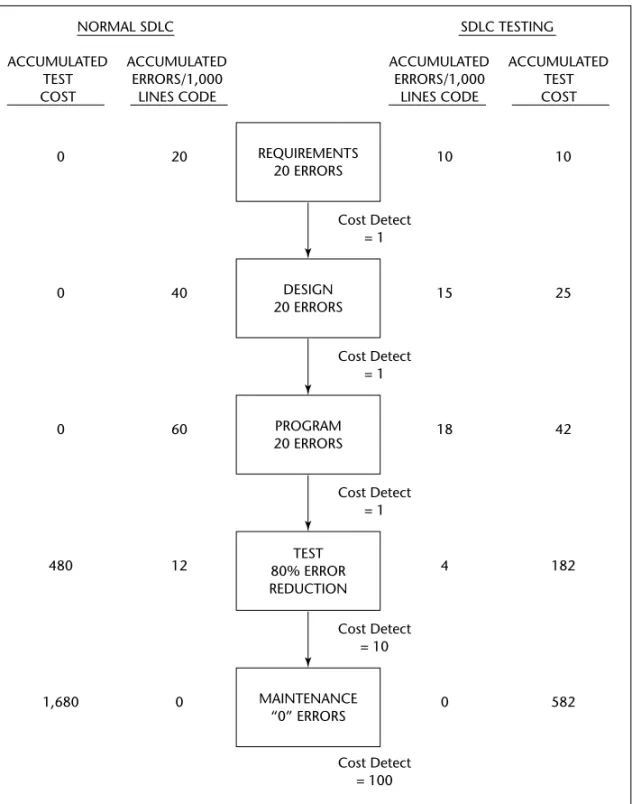
Economics of Testing 47
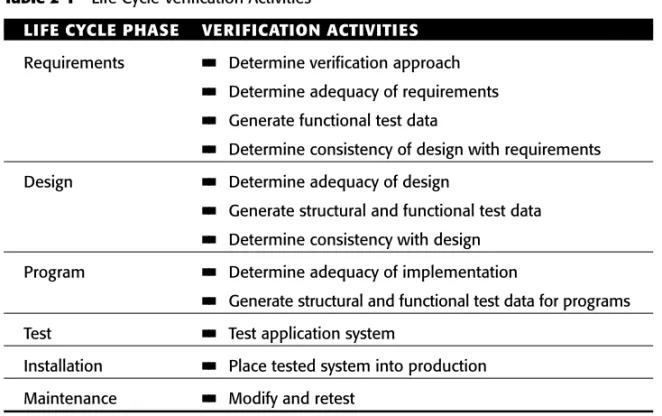
Testing—An Organizational Issue 50 Management Support for Software Testing 50 Building a Structured Approach to Software Testing 51
Requirements 54
Design 54
Program 55
Test 55
Installation 55
Maintenance 55
Developing a Test Strategy 56
Use Work Paper 2-1 58
Use Work Paper 2-2 58
Summary 60
Chapter 3 Building the Software Testing Process 63
Software Testing Guidelines 63
Guideline #1: Testing Should Reduce Software Development
Risk 64
Guideline #2: Testing Should Be Performed Effectively 65 Guideline #3: Testing Should Uncover Defects 65
Defects Versus Failures 65
Why Are Defects Hard to Find? 66
Guideline #4: Testing Should Be Performed Using Business
Logic 67
Guideline #5: Testing Should Occur Throughout the
Development Life Cycle 68
Guideline #6: Testing Should Test Both Function and Structure 69
Why Use Both Testing Methods? 69
Structural and Functional Tests Using Verification and
Validation Techniques 69
Workbench Concept 71
Testing That Parallels the Software Development Process 72 Customizing the Software-Testing Process 74 Determining the Test Strategy Objectives 74 Determining the Type of Development Project 75 Determining the Type of Software System 76
Determining the Project Scope 77
Identifying the Software Risks 77
Defining the Unit Test Plan Standard 83 Converting Testing Strategy to Testing Tactics 83
Process Preparation Checklist 86
Summary 86
Chapter 4 Selecting and Installing Software Testing Tools 103
Integrating Tools into the Tester’s Work Processes 103 Tools Available for Testing Software 104 Selecting and Using Test Tools 108
Matching the Tool to Its Use 109
Selecting a Tool Appropriate to Its Life Cycle Phase 109 Matching the Tool to the Tester’s Skill Level 111
Selecting an Affordable Tool 114
Training Testers in Tool Usage 116
Appointing Tool Managers 117
Prerequisites to Creating a Tool Manager Position 118
Selecting a Tool Manager 118
Assigning the Tool Manager Duties 119
Limiting the Tool Manager’s Tenure 120
Summary 120
Chapter 5 Building Software Tester Competency 125
What Is a Common Body of Knowledge? 125 Who Is Responsible for the Software Tester’s Competency? 126 How Is Personal Competency Used in Job Performance? 126
Using the 2006 CSTE CBOK 127
Developing a Training Curriculum 128 Using the CBOK to Build an Effective Testing Team 129
Summary 131
Part III
The Seven-Step Testing Process
151
Chapter 6 Overview of the Software Testing Process 153
Advantages of Following a Process 153
The Cost of Computer Testing 154
Quantifying the Cost of Removing Defects 155
Reducing the Cost of Testing 156
The Seven-Step Software Testing Process 156 Objectives of the Seven-Step Process 159 Customizing the Seven-Step Process 160
Managing the Seven-Step Process 161
Using the Tester’s Workbench with the Seven-Step Process 162
Workbench Skills 163
Summary 164
Chapter 7 Step 1: Organizing for Testing 165
Objective 165
Workbench 166
Do Procedures 167
Task 1: Appoint the Test Manager 167
Task 2: Define the Scope of Testing 168
Task 3: Appoint the Test Team 168
Internal Team Approach 169
External Team Approach 170
Non-IT Team Approach 170
Combination Team Approach 170
Task 4: Verify the Development Documentation 171
Development Phases 171
Measuring Project Documentation Needs 174 Determining What Documents Must Be Produced 175 Determining the Completeness of Individual Documents 179 Determining Documentation Timeliness 180 Task 5: Validate the Test Estimate and Project Status
Reporting Process 181
Validating the Test Estimate 182
Testing the Validity of the Software Cost Estimate 185 Calculating the Project Status Using a Point System 189
Check Procedures 200
Output 200
Summary 200
Chapter 8 Step 2: Developing the Test Plan 209
Overview 209
Objective 210
Concerns 210
Workbench 211
Input 212
Do Procedures 212
Task 1: Profile the Software Project 212 Conducting a Walkthrough of the Customer/User Area 212 Developing a Profile of the Software Project 213 Task 2: Understand the Project Risks 215 Task 3: Select a Testing Technique 222 Structural System Testing Techniques 223 Functional System Testing Techniques 229 Task 4: Plan Unit Testing and Analysis 235
Functional Testing and Analysis 236
Structural Testing and Analysis 238
Error-Oriented Testing and Analysis 240 Managerial Aspects of Unit Testing and Analysis 243
Task 5: Build the Test Plan 244
Setting Test Objectives 245
Developing a Test Matrix 245
Defining Test Administration 250
Task 6: Inspect the Test Plan 254
Inspection Concerns 255
Products/Deliverables to Inspect 256
Formal Inspection Roles 256
Formal Inspection Defect Classification 258
Inspection Procedures 259
Check Procedures 262
Output 262
Guidelines 262
Summary 263
Chapter 9 Step 3: Verification Testing 291
Overview 292
Objective 293
Concerns 294
Workbench 294
Input 296
The Requirements Phase 296
The Design Phase 296
The Programming Phase 297
Do Procedures 298
Task 1: Test During the Requirements Phase 298
Requirements Phase Test Factors 299
Preparing a Risk Matrix 302
Performing a Test Factor Analysis 310 Conducting a Requirements Walkthrough 312
Performing Requirements Tracing 314
Ensuring Requirements Are Testable 315 Task 2: Test During the Design Phase 316
Scoring Success Factors 316
Analyzing Test Factors 318
Conducting a Design Review 320
Inspecting Design Deliverables 322
Task 3: Test During the Programming Phase 323
Desk Debugging the Program 325
Performing Programming Phase Test Factor Analysis 326
Conducting a Peer Review 328
Check Procedures 330
Output 331
Guidelines 331
Summary 332
Chapter 10 Step 4: Validation Testing 409
Overview 409
Objective 410
Concerns 410
Workbench 410
Do Procedures 412
Task 1: Build the Test Data 412
Sources of Test Data/Test Scripts 412
Testing File Design 413
Defining Design Goals 414
Entering Test Data 414
Applying Test Files Against Programs That Update
Master Records 414
Creating and Using Test Data 415
Payroll Application Example 416
Creating Test Data for Stress/Load Testing 430
Creating Test Scripts 430
Task 2: Execute Tests 434
Task 3: Record Test Results 436
Documenting the Deviation 437
Documenting the Effect 438
Documenting the Cause 438
Check Procedures 439
Output 439
Guidelines 439
Summary 440
Chapter 11 Step 5: Analyzing and Reporting Test Results 459
Overview 459
Concerns 460
Workbench 460
Input 461
Test Plan and Project Plan 461
Expected Processing Results 461
Data Collected during Testing 461
Test Results Data 462
Test Transactions, Test Suites, and Test Events 462
Defects 462
Efficiency 463
Storing Data Collected During Testing 463
Do Procedures 463
Task 1: Report Software Status 464
Establishing a Measurement Team 465
Creating an Inventory of Existing Project Measurements 465 Developing a Consistent Set of Project Metrics 466
Defining Process Requirements 466
Developing and Implementing the Process 466
Monitoring the Process 466
Task 2: Report Interim Test Results 470
Function/Test Matrix 470
Defects Uncovered Versus Corrected Gap Timeline Report 473 Average Age of Uncorrected Defects by Type Report 475
Defect Distribution Report 475
Normalized Defect Distribution Report 476
Testing Action Report 477
Interim Test Report 478
Task 3: Report Final Test Results 478
Individual Project Test Report 480
Integration Test Report 480
System Test Report 480
Acceptance Test Report 482
Check Procedures 482
Output 482
Guidelines 482
Summary 483
Chapter 12 Step 6: Acceptance and Operational Testing 491
Overview 491
Objective 492
Concerns 493
Workbench 494
Input Procedures 495
Task 1: Acceptance Testing 496
Defining the Acceptance Criteria 497
Developing an Acceptance Plan 498
Executing the Acceptance Plan 499
Developing Test Cases (Use Cases) Based on How
Software Will Be Used 500
Task 2: Pre-Operational Testing 503
Testing New Software Installation 509 Testing the Changed Software Version 509
Monitoring Production 512
Documenting Problems 513
Task 3: Post-Operational Testing 513
Developing and Updating the Test Plan 514 Developing and Updating the Test Data 515 Testing the Control Change Process 517
Conducting Testing 518
Developing and Updating Training Material 518
Check Procedures 522
Output 522
Is the Automated Application Acceptable? 522 Automated Application Segment Failure Notification 523
Is the Manual Segment Acceptable? 523
Training Failure Notification Form 524
Guidelines 524
Chapter 13 Step 7: Post-Implementation Analysis 571
Overview 571
Concerns 572
Workbench 572
Input 574
Do Procedures 574
Task 1: Establish Assessment Objectives 574
Task 2: Identify What to Measure 575
Task 3: Assign Measurement Responsibility 575 Task 4: Select Evaluation Approach 575
Task 5: Identify Needed Facts 576
Task 6: Collect Evaluation Data 577
Task 7: Assess the Effectiveness of Testing 577
Using Testing Metrics 577
Check Procedures 580
Output 580
Guidelines 581
Summary 581
Part IV
Incorporating Specialized Testing Responsibilities
583
Chapter 14 Software Development Methodologies 585
How Much Testing Is Enough? 585
Software Development Methodologies 586
Overview 586
Methodology Types 587
Software Development Life Cycle 588
Defining Requirements 592
Categories 592
Attributes 593
Methodology Maturity 596
Competencies Required 598
Staff Experience 600
Configuration-Management Controls 600
Basic CM Requirements 600
Planning 602
Data Distribution and Access 602
CM Administration 602
Configuration Identification 603
Configuration Control 605
Measuring the Impact of the Software Development Process 605
Summary 606
Chapter 15 Testing Client/Server Systems 611
Overview 611
Concerns 612
Workbench 613
Do Procedures 614
Task 1: Assess Readiness 614
Software Development Process Maturity Levels 615 Conducting the Client/Server Readiness Assessment 621 Preparing a Client/Server Readiness Footprint Chart 621
Task 2: Assess Key Components 622
Task 3: Assess Client Needs 622
Check Procedures 624
Output 624
Guidelines 624
Summary 624
Chapter 16 Rapid Application Development Testing 633
Overview 633
Objective 634
Concerns 634
Testing Iterations 634
Testing Components 635
Testing Performance 635
Recording Test Information 635
Workbench 635
Input 636
Do Procedures 636
Testing Within Iterative RAD 636
Spiral Testing 638
Task 1: Determine Appropriateness of RAD 639
Task 2: Test Planning Iterations 640
Task 3: Test Subsequent Planning Iterations 640 Task 4: Test the Final Planning Iteration 642
Check Procedures 642
Output 643
Guidelines 643
Summary 643
Chapter 17 Testing Internal Controls 655
Overview 655
Internal Controls 657
Control Objectives 657
Preventive Controls 658
Source-Data Authorization 658
Data Input 659
Source-Data Preparation 659
Turnaround Documents 659
Prenumbered Forms 659
Input Validation 659
File Auto-Updating 661
Detective Controls 662
Data Transmission 663
Control Register 663
Control Totals 664
Documenting and Testing 664
Output Checks 664
Corrective Controls 665
Error Detection and Resubmission 665
Audit Trails 665
Cost/Benefit Analysis 666
Assessing Internal Controls 666
Task 1: Understand the System Being Tested 666
Task 2: Identify Risks 668
Task 3: Review Application Controls 668
Task 4: Test Application Controls 668
Testing Without Computer Processing 669 Testing with Computer Processing 669
Transaction Flow Testing 672
Objectives of Internal Accounting Controls 673
Results of Testing 677
Task 5: Document Control Strengths and Weaknesses 677
Quality Control Checklist 678
Summary 678
Chapter 18 Testing COTS and Contracted Software 685
Overview 686
COTS Software Advantages, Disadvantages, and Risks 686
COTS Versus Contracted Software 686
COTS Advantages 687
COTS Disadvantages 687
Implementation Risks 688
Testing COTS Software 689
Testing Contracted Software 690
Objective 691
Concerns 691
Workbench 692
Input 693
Do Procedures 693
Task 1: Test Business Fit 693
Step 1: Testing Needs Specification 693
Step 2: Testing CSFs 695
Task 2: Test Operational Fit 696
Step 1: Test Compatibility 697
Step 2: Integrate the Software into Existing Work Flows 698 Step 3: Demonstrate the Software in Action 700
Task 4: Acceptance-Test the Software Process 702 Step 1: Create Functional Test Conditions 702 Step 2: Create Structural Test Conditions 703 Modifying the Testing Process for Contracted Software 704
Check Procedures 705
Output 705
Guidelines 706
Summary 706
Chapter 19 Testing in a Multiplatform Environment 717
Overview 717
Objective 718
Concerns 718
Background on Testing in a Multiplatform Environment 718
Workbench 719
Input 720
Do Procedures 721
Task 1: Define Platform Configuration Concerns 721 Task 2: List Needed Platform Configurations 723 Task 3: Assess Test Room Configurations 723 Task 4: List Structural Components Affected by the Platform(s) 723 Task 5: List Interfaces the Platform Affects 725
Task 6: Execute the Tests 726
Check Procedures 726
Output 726
Guidelines 726
Summary 727
Chapter 20 Testing Software System Security 733
Overview 733
Objective 734
Concerns 734
Workbench 734
Input 735
Where Vulnerabilities Occur 735
Functional Vulnerabilities 736
Vulnerable Areas 737
Accidental Versus Intentional Losses 738
Do Procedures 739
Task 1: Establish a Security Baseline 739
Why Baselines Are Necessary 740
Creating Baselines 740
Using Baselines 749
Task 2: Build a Penetration-Point Matrix 751 Controlling People by Controlling Activities 751
Selecting Security Activities 752
Characteristics of Security Penetration 756 Building a Penetration-Point Matrix 757 Task 3: Analyze the Results of Security Testing 760 Evaluating the Adequacy of Security 761
Check Procedures 762
Output 762
Guidelines 762
Summary 762
Chapter 21 Testing a Data Warehouse 765
Overview 765
Concerns 765
Workbench 766
Input 767
Do Procedures 768
Task 1: Measure the Magnitude of Data Warehouse Concerns 768 Task 2: Identify Data Warehouse Activity Processes to Test 769
Organizational Process 769
Data Documentation Process 769
System Development Process 770
Access Control Process 771
Data Integrity Process 771
Operations Process 772
Backup/Recovery Process 773
Performing Task 2 774
Task 3: Test the Adequacy of Data Warehouse Activity
Processes 774
Check Procedures 780
Output 780
Guidelines 780
Summary 780
Chapter 22 Testing Web-Based Systems 799
Overview 799
Concerns 800
Workbench 800
Input 801
Do Procedures 802
Task 1: Select Web-Based Risks to Include in the Test Plan 802
Security Concerns 803
Performance Concerns 803
Correctness Concerns 804
Compatibility Concerns 804
Reliability Concerns 806
Data Integrity Concerns 806
Usability Concerns 806
Task 2: Select Web-Based Tests 807
Unit or Component 807
Integration 807
System 807
User Acceptance 808
Performance 808
Load/Stress 808
Regression 808
Usability 808
Compatibility 808
Task 3: Select Web-Based Test Tools 809
Task 4: Test Web-Based Systems 809
Check Procedures 809
Output 810
Guidelines 810
Summary 811
Part V
Building Agility into the Testing Process
817
Chapter 23 Using Agile Methods to Improve Software Testing 819
The Importance of Agility 819
Building an Agile Testing Process 820
Agility Inhibitors 821
Is Improvement Necessary? 822
Compressing Time 823
Challenges 824
Solutions 825
Measuring Readiness 826
The Seven-Step Process 826
Summary 827
Chapter 24 Building Agility into the Testing Process 831
Step 1: Measure Software Process Variability 831
Timelines 832
Process Steps 833
Workbenches 833
Time-Compression Workbenches 834
Reducing Variability 835
Developing Timelines 836
Improvement Shopping List 841
Quality Control Checklist 841
Conclusion 842
Step 2: Maximize Best Practices 842
Tester Agility 842
Software Testing Relationships 843
Tradeoffs 845
Capability Chart 847
Improvement Shopping List 856
Quality Control Checklist 856
Conclusion 857
Step 3: Build on Strength, Minimize Weakness 857
Effective Testing Processes 857
Poor Testing Processes 860
Improvement Shopping List 860
Quality Control Checklist 860
Conclusion 861
Step 4: Identify and Address Improvement Barriers 861
The Stakeholder Perspective 861
Stakeholder Involvement 863
Performing Stakeholder Analysis 863
Red-Flag/Hot-Button Barriers 864
Staff-Competency Barriers 865
Administrative/Organizational Barriers 865 Determining the Root Cause of Barriers/Obstacles 866 Addressing the Root Cause of Barriers/Obstacles 867
Quality Control Checklist 869
Conclusion 869
Step 5: Identify and Address Cultural and Communication
Barriers 869
Management Cultures 870
Culture 1: Manage People 871
Culture 2: Manage by Process 873
Culture 3: Manage Competencies 874
Culture 4: Manage by Fact 876
Culture 5: Manage Business Innovation 878
Cultural Barriers 879
Identifying the Current Management Culture 879 Identifying the Barriers Posed by the Culture 879 Determining What Can Be Done in the Current Culture 879 Determining the Desired Culture for Time Compression 879 Determining How to Address Culture Barriers 880
Open and Effective Communication 880
Lines of Communication 881
Information/Communication Barriers 882
Effective Communication 882
Quality Control Checklist 884
Conclusion 885
Step 6: Identify Implementable Improvements 885
What Is an Implementable? 885
Identifying Implementables via Time Compression 886
Prioritizing Implementables 888
Documenting Approaches 890
Quality Control Checklist 890
Step 7: Develop and Execute an Implementation Plan 891
Planning 891
Implementing Ideas 891
Requisite Resources 893
Quality Control Checklist 894
Conclusion 894
Summary 895
Most books about software testing explain “what” to do. This book, on the other hand, takes more of a “how-to” approach. It provides the procedures, templates, checklists, and assessment questionnaires necessary to conduct effective and efficient software testing.
The book is divided into five parts, as follows:
■■ Part One: Assessing Testing Capabilities and Competencies.It is difficult to make any significant change until you know where you are. A baseline tells not only where you are, but lets you measure your progress as your testing strate-gies and techniques improve. Part One provides three baseline assessments: the capabilities of your software testing group, the competencies of your individ-ual testers, and the effectiveness of your test processes.
■■ Part Two: Building a Software Testing Environment.Software testers are most effective when they work in an environment that encourages and supports well-established testing policies and procedures. The environment includes the procedures and tools for testing, as well as the support and encouragement of management. Part Two begins by describing how to build an environment con-ducive to testing, and then expands the discussion by describing how to develop a testing process, select testing tools, and build the competency of your testers.
■■ Part Three: The Seven-Step Testing Process.Part Three comprises the core material in the book. It defines a world-class software testing process, from its initiation through testing changes made to operational software systems. This material can be used two ways. First, it contains sufficient procedures and tem-plates so that an organization can use the process as their own. Of course, most organizations inevitably will make some changes to accommodate local vocab-ulary, specific needs, and customs. This customization process, the seven-step process in this book becomes “owned” by the software testers.
Introduction
■■ Part Four: Incorporating Specialized Testing Responsibilities.The seven-step testing process is a generic process that almost all software testing organiza-tions can use. However, the mission of software testers may incorporate spe-cialized activities, such as testing security. Rather than incorporating these specialized testing activities directly into the seven-step process, they are pre-sented as individual, specialized activities. As appropriate, they can be incor-porated into the seven-step process.
■■ Part Five: Building Agility into the Testing Process.Part Five, which draws on what you’ve learned earlier in the book, is designed to help you identify the strengths and weaknesses of your current software testing process, and then modify it to become more usable or agile.
Getting the Most Out of This Book
This book is not designed to be read like a novel, from beginning to end, nor is it filled with human interest stories about testers. The book focuses on how to conduct software testing. It is designed to help you improve your testing competencies and processes. The self-assessments in Part One will help you identify which parts of the book you need to read first.
The following guidelines will help you maximize the benefit from this book:
■■ Establish a baseline of current performance.Part One of this book (and Chap-ter 5) contains four self-assessments for establishing baselines. You need to know where you are so that you can develop a good plan for moving forward.
■■ Define the software testing organization you would like to have.It has been said that if you do not know where you’re going, all roads lead there. Too many software testing groups just add new testing programs, processes, and tools without knowing if they will integrate effectively.
■■ Develop a plan for moving from your baseline to your goal.Few organiza-tions can quickly and effectively install an entirely new software testing process. Gradual change is normally much better than radical change. There-fore, identify the gaps between where you are and where you want to be. Determine which of those gaps if closed would provide the greatest benefit to your organization. That becomes the part of the plan you implement first. Over time you will move the entire testing process from your current baseline to your desired goal.
For additional information on software testing conferences and training programs, visit www.taiworldwide.org. For information on software testing certifications, visit www.softwarecertifications.org.
What’s New in the Third Edition
A major addition to this edition is the self-assessment in Chapter 5, which testers can use to identify their strengths and weaknesses and then build a personal improvement plan. The self-assessment is based on the Common Body of Knowledge (CBOK) for the Certified Software Tester (CSTE).
Other significant additions include
■■ A new chapter on testing internal control
■■ An expanded chapter on testing security
■■ A new chapter on adapting testing to the developmental methodology used to build the software
■■ Two new chapters on how to incorporate agile methods into the testing process
What’s on the CD
This book includes a CD that contains the work papers and quality control checklists to help you implement the software testing process.
To use the CD, first you need to select a software testing activity that you want to implement in your organization—for example, test planning. Then, from the chapter on test planning, identify those work papers and checklists that you believe would be beneficial to your organization. You can extract those work papers and checklists from the CD and begin a customization process. For example, you can include the name of your organization, add or delete portions of the work papers, and change the termi-nology to be consistent with your organization.
Effective Methods
for Software Testing
One
3 It has been said, “If you do not know where you are going, all roads lead there.” Tra-ditionally, many IT organizations annually develop a list of improvements to incorpo-rate into their operations without establishing a goal. Using this approach, the IT organization can declare “victory” any time it wants.
This chapter will help you understand the importance of following a well-defined process for becoming a world-class software testing organization. This chapter will help you define your strengths and deficiencies, your staff competencies and deficien-cies, and areas of user dissatisfaction.
The objective of this chapter is threefold: to define a world-class software testing model, to provide a self-assessment process for your software testing organization to measure yourself against the world-class model, and to provide some planning con-siderations for moving to a world-class level.
The Three-Step Process to Becoming a
World-Class Testing Organization
The roadmap to become a world-class software testing organization is a simple three-step process, as follows:
1. Define or adopt a world-class software testing model.
2. Determine your organization’s current level of software testing capabilities, competencies, and user satisfaction.
Assessing Capabilities, Staff
Competency, and User
Satisfaction
3. Develop and implement a plan to upgrade from your current capabilities, com-petencies, and user satisfaction to those in the world-class software testing model.
This three-step process requires you to compare your current capabilities, compe-tencies, and user satisfaction against those of the world-class software testing model. This assessment will enable you to develop a baseline of your organization’s perfor-mance. The plan that you develop will, over time, move that baseline from its current level of performance to a world-class level. Understanding the model for a world-class software testing organization and then comparing your organization will provide you with a plan for using the remainder of the material in this book.
Software testing is an integral part of the software-development process, which comprises the following four components (see Figure 1-1):
1. Plan (P): Devise a plan. Define your objective and determine the strategy and supporting methods to achieve it. You should base the plan on an assessment of your current situation, and the strategy should clearly focus on the strategic initiatives/key units that will drive your improvement plan.
2. Do (D): Execute the plan.Create the conditions and perform the necessary training to execute the plan. Make sure everyone thoroughly understands the objectives and the plan. Teach workers the procedures and skills they need to fulfill the plan and thoroughly understand the job. Then perform the work according to these procedures.
3. Check (C): Check the results.Check to determine whether work is progressing according to the plan and whether the expected results are being obtained. Check for performance of the set procedures, changes in conditions, or abnor-malities that may appear. As often as possible, compare the results of the work with the objectives.
4. Act (A): Take the necessary action.If your checkup reveals that the work is not being performed according to the plan or that results are not what you antici-pated, devise measures to take appropriate actions.
Figure 1-1 The four components of the software-development process.
PLAN
CHECK
Testing involves only the “check” component of the plan-do-check-act (PDCA) cycle. The software development team is responsible for the three remaining compo-nents. The development team plans the project and builds the software (the “do” com-ponent); the testers check to determine that the software meets the needs of the customers and users. If it does not, the testers report defects to the development team. It is the development team that makes the determination as to whether the uncovered defects are to be corrected.
The role of testing is to fulfill the check responsibilities assigned to the testers; it is not to determine whether software can be placed into production. That is the responsi-bility of the customers, users, and development team.
Step 1: Define a World-Class
Software Testing Model
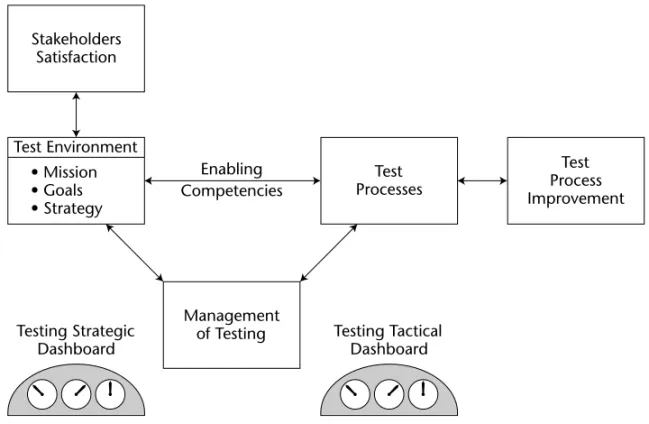
There is no generally accepted model for a world-class software testing organization. However, analyzing the best testing organizations among the more than 1,000 IT orga-nizations affiliated with the Quality Assurance Institute (QAI) enabled QAI to identify the attributes of the best software testing organizations (see Figure 1-2). Organizations that follow this model report more effective and efficient testing than those that do not.
Figure 1-2 Model of a world-class software testing organization.
Stakeholders Satisfaction
Test Processes
Test Process Improvement Test Environment
• Mission • Goals • Strategy
Enabling Competencies
Management of Testing Testing Strategic
Dashboard
The world-class software testing model includes
■■ Test environment.The conditions that management has put into place that both enable and constrain how testing is performed. The test environment includes management support, resources, work processes, tools, motivation, and so forth.
■■ Process to test a single software project.The standards and procedures testers use to test.
■■ Tester competency.The skill sets needed to test software in a test environment. The three self-assessments that follow are for the above three attributes of a world-class software testing organization.
N O T E
The three self-assessments in this chapter correspond to the precedingthree attributes of a world-class software testing organization.
The world-class model of a software testing organization focuses on stakeholder sat-isfaction. This assumes a greater role for a world-class software testing organization than just testing against documented software requirements. Chapter 2 defines the many roles that software testing can adopt; however, those roles include much more than testing documented software requirements. They include testing for quality fac-tors such as ease of use, meeting testing schedules and budgets, and minimizing the risks involved with any software project.
According to the world-class model, the following parties have a vested interest in software testing:
■■ Software customer.The party or department that contracts for the software to be developed.
■■ Software user.The individual or group that will use the software once it is placed into production. (Note: This may be the customer or it may be parties other than the customer.)
■■ Software developer.The individual or group that receives the requirements from the software user or assists in writing them, designing, building, and maintaining the software, as needed.
■■ Development tester.The individual or group that performs the test function within the software development group.
■■ IT management.The individual or group with responsibility for fulfilling the information technology mission. Testing supports fulfilling that mission.
■■ Senior management.The CEO of the organization and other senior executives who are responsible for fulfilling the organization mission. Information tech-nology is an activity that supports fulfilling that mission.
■■ Project manager.The individual responsible for managing the building, main-taining, and/or implementing of software.
The test mission, strategy, and environment must be focused on stakeholder satis-faction. The mission defines the testing objectives; the strategy defines how the mission will be accomplished; and the environment provides the culture, processes, and tools that are conducive to effective and efficient software testing.
The test processes are those step-by-step procedures that the testers will follow to accomplish their assigned tasks. Test processes executed by trained and competent testers enable those testers to accomplish the defined test mission.
The test processes need to be improved continually for two reasons: to make them more effective and efficient to use, and to incorporate updated approaches into testing new technologies and software development methodologies.
The responsibility for ensuring that the execution of the test processes meets the defined test mission lies with management. Management must ensure that testers are following and can accomplish the test plan, and that the plan will, in fact, accomplish the test objectives. If not, management should modify the plan to meet those objectives. Management and testers need tools to enable them to fulfill their responsibilities. Two very important tools are the testing strategic dashboard and the testing tactical dashboard. The testing strategic dashboardincludes key indicators such as user satisfac-tion, staff competency, and the percent of tests completed. The testing tactical dashboard
includes test indicators such as the number of requirements tested and percent correct, defects uncovered, defects corrected and uncorrected, and the schedule and budget status.
Management must ensure that if you meet the testing tactical key indicators, you will, in fact, meet the objectives defined by the strategic key indicators.
Customizing the World-Class Model for Your
Organization
You can customize the world-class model for software testing by defining the attrib-utes of each of its components (refer to Figure 1-2). The material in this book explains the attributes of all the components: stakeholder satisfaction, test mission, test man-agement and enabling competencies are discussed in Part 2. The test processes are explained in Parts 3 and 4. Test process improvement is described in Part 5 of this book.
Step 2: Develop Baselines for Your Organization
This section presents the following three self-assessment categories to enable you to compare your testing organization against the world-class model:
1. Assessing the test environment.This includes user satisfaction, management support, environment, planning, tools, test processes, measurement, quality control, and training.
2. Assessing the process for testing individual software projects.This category of assessment will assess your testing process against the seven-step process for testing individual software projects presented in Part 3 of this book.
3. Assessing the competencies of software testers.This self-assessment will be based on the 2006 Common Body of Knowledge (CBOK) developed by the Certification Board of the Software Certifications Organization. Each of the recommended ten competencies for software tester will be assessed. A more detailed assessment to be used in individuals to compare their specific test competencies against the 2006 CBOK is provided in Chapter 5.
Assessment 1: Assessing the Test Environment
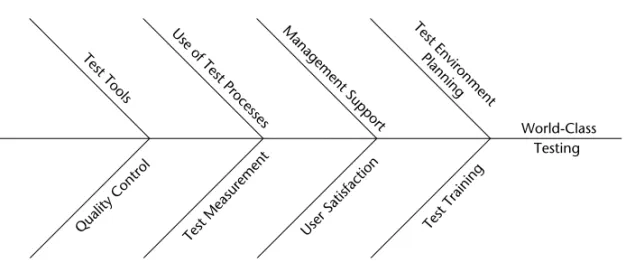
During the past 25 years, the Quality Assurance Institute (QAI) has been studying what makes software testing organizations successful. As a result, QAI has identified the following eight criteria:
Test environment planning
Management support
Use of test processes
Test tools
Quality control
Test measurement
User satisfaction
Test training
When these eight criteria are in place and working, the result is normally a world-class testing organization.
Figure 1-3 Overview of the testing environment.
Software testing organizations can use the results of this assessment in any one of the following three ways:
1. To determine their current testing environmental status versus the environment of a world-class testing organization. The responses to the items address will indicate an organization’s strengths and weaknesses compared to the environ-ment of a world-class testing organization.
2. To develop the goal/objectives to accomplish becoming a world-class testing organization. QAI’s world-class criteria indicate a profile of the environment of a world-class testing organization. Achieving those objectives can lead you to become a more effective software testing organization.
3. To develop an improvement plan.
By doing the assessment, you will develop a Footprint Chart that shows where improvement is needed. Those criteria in which you are deficient become the means for improving the environment of your software testing organization.
Implementation Procedures
This practice involves the following four tasks:
■■ Build the assessment team.
■■ Complete the assessment questionnaires.
■■ Build the footprint chart.
■■ Assess the results.
DRIVERS OF WORLD-CLASS TESTING DESIRED RESULTS
Test Tools
Use of Test
Pr ocesses M ana ge m en t Suppo rt Test E nvi ro nm en t Pl ann
ing
Test T
rain
ing
Use
r Satisf
actio n
Test Me asu
rem ent
Qua lity Co
ntrol
Building the Assessment Team
The assessment team should combine people who in totality possess the knowledge of how your organization manages software testing. Before the team is established, the areas to address should be reviewed to determine the makeup of the team. It is recom-mended that a matrix be prepared with the seven assessment criteria on one dimension and the recommended assessment team on the other. The matrix should indicate which assessment team member is knowledgeable about each of the seven assessment criteria. Once all seven criteria have been associated with an assessment team member, it can be concluded that the team is adequate to perform the assessment.
Completing the Assessment Questionnaire
The assessment questionnaire in Work Paper 1-1 consists of eight categories, with five items to address for each category. A Yes or No response should be made, as follows:
■■ A Yes response means all of the following:
■■ Criteria items are documented and in place.
■■ Criteria items are understood by testers.
■■ Criteria items are widely used, where applicable.
■■ Criteria items have produced some possible results.
■■ A No response means any of the following:
■■ No formal item in place.
■■ Criteria items are applied differently for different test situations.
■■ No consistency as to when used or used very seldom.
■■ No tangible results were produced.
The assessment team should read aloud each item and then discuss how that item is addressed in their testing environment. The results should be recorded on Work Paper 1-1. The assessment team may also wish to record comments that clarify the response and/or to provide insight in how that area may be improved.
Building the Footprint Chart
Assessing the Results
You should make the following two assessments regarding the footprint developed on the Work Paper 1-2:
1. Assess the status of each criteria versus what that criteria should be in the world-class testing environment.To do this, you need to look at the number of Yes responses you have recorded for each criterion versus a world-class organi-zation, which would have five Yes responses. For example, three Yes responses for test training would indicate that improvements could be made in your test training process. The two items that received No responses are indications of where improvements are needed to move your test training activities to a world-class level.
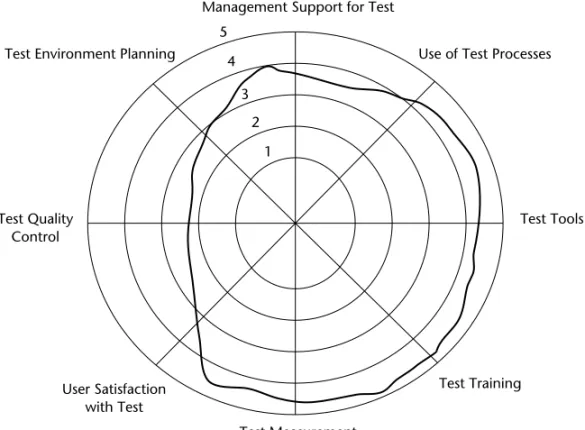
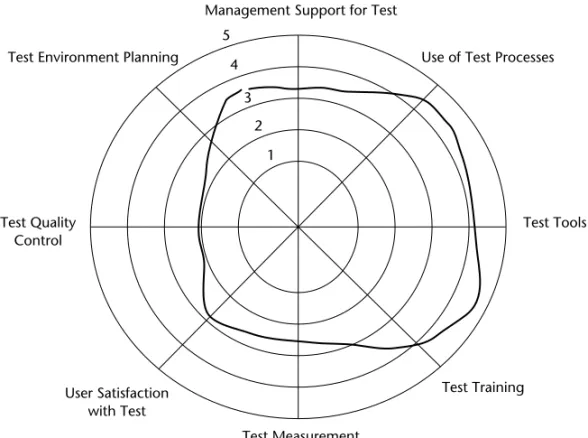
2. Interpret your testing environment footprint chart.The footprint in your Work Paper 1-2 provides an overview of your testing environment. Given the footprint, your assessment team should attempt to draw some conclusions about your testing environment. Three examples are given to help in drawing these conclusions, as shown in Figures 1-4, 1-5, and 1-6.
Figure 1-4 Example of a software testing organization using a test as a part of development.
Test Environment Planning
Test Training Use of Test Processes
User Satisfaction
with Test
Test Tools Test Quality
Control
Management Support for Test
Test Measurement 5
4
3 2
Figure 1-5 Example of a testing organization using, but not enforcing, the test process.
Figure 1-6 Example of a testing organization practicing testing as an art.
Test Environment Planning
Test Training Use of Test Processes
User Satisfaction
with Test
Test Tools Test Quality
Control
Management Support for Test
Test Measurement 5
4
3 2
1 Test Environment Planning
Test Training Use of Test Processes
User Satisfaction
with Test
Test Tools Test Quality
Control
Management Support for Test
Test Measurement 5
4
3 2
Verifying the Assessment
The following list of questions, if responded to positively, would indicate that the assessment has been performed correctly:
1. Does the assessment team comprise the knowledge needed to answer all of the items to address within the seven criteria?
2. Are the individual assessors free from any bias that would cause them not to provide proper responses to the items to address?
3. Was there general consensus among the assessment team to the response for each item to address?
4. Are the items to address appropriate for your testing organization?
5. Have the items to address been properly totaled and posted to the Footprint Chart Work Paper?
6. Does the assessment team believe the Footprint Chart is representative of your testing environment?
7. Does your assessment team believe that if they improve the items to address, which have No responses, the testing organization will become more effective?
8. Does your organization believe that the overall assessment made is representa-tive of your environment?
Assessment 2: Assessing the Capabilities
of Your Existing Test Processes
To assess the capabilities of your existing test processes, follow the same procedure that you used to assess your test environment. Note that you should use the same team for both assessments. The only change you will need is to substitute self-assessment ques-tionnaires in assessing the test environment process with the self-assessment question-naires for assessing the test processes included in this section.
The assessment of test processes will be divided into the following seven categories:
Preparing for a software testing project
Conducting test planning
Executing the test plan
Conducting acceptance testing
Analyzing test results and preparing reports
Testing the installation of software
Post-test analysis
you determine your strengths and weaknesses in each of the seven steps of the pro-posed software testing process.
To conduct this self-assessment, answer the questionnaire in Work Paper 1-3 and post your results to Work Paper 1-4, as described in the preceding section.
Assessment 3: Assessing the Competency of Your Testers
This practice will enable you to assess your testing competencies against the ten skill categories in the Common Body of Knowledge (CBOK) for the Certified Software Tester (CSTE) certificate. At the conclusion of the assessment, you will develop a Foot-print Chart that shows your competencies against the skill categories needed to become a CSTE. You can use the results to design a program for improving your per-sonal test competencies.
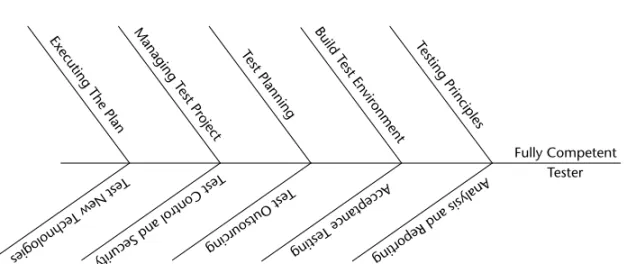
Figure 1-7 shows a cause-effect diagram indicating the areas of competency assess-ment. In the diagram these are called the drivers that result in becoming a fully com-petent software tester. The drivers are, in fact, the ten CBOK skill categories.
Implementation Procedures
This practice involves performing the following four tasks:
1. Understand the CSTE CBOK.
2. Complete the assessment questionnaires.
3. Build the footprint chart.
4. Assess the results.
Figure 1-7 Test competency cause-effect diagram. Te st C ont ro l an d S ec u rity Exec u
ting The Plan
Te st Ne w Te chn olo gies Managing T est Project Te st P la nn in g Te st O u tso u rcing Acc ept ance T esting An alys is a nd Rep ort ing Bu ild T est Envi ronm ent Te stin g P rin cip les
Fully Competent
Tester
Understanding the CSTE CBOK
Before you can effectively evaluate your software test competencies, you need to under-stand the 2006 CSTE CBOK. The final version of the 2006 CSTE CBOK is available through the Software Certification Organization. The discussion draft version of the 2006 CSTE CBOK is included in Chapter 5 as a detailed skill-assessment questionnaire. This step requires you to read through the CBOK and to obtain clarifications of the material as necessary. The best source for these clarifications is the CSTE CBOK study guide, which is available from the Quality Assurance Institute (www.QAIworldwide.org).
Completing the Assessment Questionnaires
The assessment questionnaire in Work Paper 1-5 contains ten knowledge categories with 5 items in each category, for a total of 50 items to assess. For each item, a Yes or No response should be made. The meanings of the Yes and No responses are as follows:
■■ A Yes response means all of the following:
■■ You have had formal training, experience, or self-study supporting this skill item.
■■ You have actively used the skill in your personal or work life.
■■ You have accomplished some positive result using this skill item.
■■ A No response means any of the following:
■■ You do not understand the theory and concepts supporting the skill item.
■■ You have never used the skill item in a personal or work situation.
■■ You have used the skill item but you have never achieved any positive results.
Prior to answering each question, you should think through the meaning of the question. This may require referring back to the CSTE study guide. Using the Yes/No response criteria, you need to come to a consensus on whether a Yes/No response should be indicated for the skill item. The result of your assessment should be recorded on the appropriate questionnaire.
You need to progress sequentially through the self-assessment questionnaires. Note that you may wish to make notes on the questionnaire to clarify your response or to indicate ideas on how you could improve your competency in that skill item.
Building the Footprint Chart
Assessing the Results
You should make the following two assessments regarding the footprint you devel-oped on Work Paper 1-6:
1. Compare your results for each knowledge category versus what the knowl-edge category should be as indicated in the CSTE CBOK.Any rating less than five Yes responses indicates a potential area of improvement in that knowledge category. An analysis of the CBOK knowledge categories will be helpful in determining where to focus improvement, as will studying the CSTE guide to identify areas for potential improvement.
2. Compare your testing competencies against your current job responsibilities.
The footprint provides an overview of your current competencies. Using your current job description, develop another footprint, which you believe is needed to achieve your current job responsibilities. Any deficiencies should be your first objective for improvement; your second for improvement would be to achieve the skill competencies needed to become a CSTE.
Verifying the Assessment
A positive response to the following questions indicates that you have correctly per-formed the competency assessment: (Note: Any negative response to the following five questions would reduce the value in using this self-assessment to measure an individ-ual tester’s competency.)
1. Do you have enough knowledge of the CSTE CBOK to understand the assess-ment questions?
2. Do you understand the skills required for each of the 50 assessment items in the questionnaires?
3. Do you understand the Yes and No response criteria, and have you used them in developing the competency assessment?
4. Do you believe the 50 assessment items fairly represent the competencies needed to be fully effective in software testing?
5. Do you believe that the 2006 CSTE CBOK used for this assessment is represen-tative of your personal testing competencies?
Step 3: Develop an Improvement Plan
The practices outlined in this book correspond to the three self-assessment foot-prints. If your organization is deficient in one or more components of the footprints, refer to the related chapter in this book that will help you develop your improvement plan, as shown in the following table:
ASSESSMENT
NUMBER ASSESSMENT CRITERIA CHAPTER
1 Test environment assessment:
Test Environment Planning 2
Management Support 2
User Satisfaction 2
Use of Process 3
Test Tools 4
Test Training 5
Test Measurements 11
Test Quality Control 2, 23, 24
2 Test Process Assessment:
Preparing for a Software testing Project 6
Test Planning General 6, 7, 8
Planning for specialized areas:
The Impact of Software 14 Developmental Methodology When Testing
Testing Client/Server Systems 15
Testing Rapid Application 16 Development
Testing the Adequacy of Internal 17 Control
Testing Off-the-Shelf Software 18
Testing in a Multi-Platform 19 Environment
Testing Security 20
Testing a Data Warehouse 21
Testing Web-based Systems 22
ASSESSMENT
NUMBER ASSESSMENT CRITERIA CHAPTER
Test Execution 9, 10
Acceptance Testing 12
Test Analysis and Reporting 11
Testing Software Installation 12
Post Test Analysis 13
Improving the test processes 23, 24
3 CSTE Knowledge Category
1 Software Testing Principles and 2 to 24 Concepts
2 Building the Test Environment 2 to 5
3 Managing the Test Project 6, 7
4 Test Planning 8
5 Executing the Test Plan 9, 10
6 Test Analysis and Reporting 11
7 User Acceptance Testing 12
8 Testing Software Developed by 18 Outside Organizations
9 Testing Software Controls and the 17, 20 Adequacy of Security Procedures
10 Testing New Technologies 14, 15, 16, 19, 21, 22
Summary
This chapter described how to assess your software testing processes and the compe-tency of your testers. The chapter also briefly addressed specialized testing responsi-bilities and the need to improve your testing process and/or make your testing process more agile.
WORK PAPER 1-1 Self-Assessment on Software Testing Environment
ITEMS TO ADDRESS ON TEST
ENVIRONMENT PLANNING YES NO COMMENTS
1. Does your IT organization have a policy on software testing?
2. Does your software testing organization have a test strategy?
3. Does your software testing organization have software processes and tools to support that testing strategy?
4. Does your software testing approach include both erificationand validation testing (i.e., testing the software in both a static and executable mode)?
5. Does your testing strategy address the various roles that testing canassume, and determine which of those roles will be incorporated into your organization’s testing strategy (e.g., testing userneeds inaddition to software specifications)?
ITEMS TO ADDRESS ON MANAGEMENT
SUPPORT YES NO COMMENTS
1. Does management provide the resources necessary (including calendar time) to adequately train, plan, conduct, and evaluate results for software testing assignments?
2. Are testers involved from the inception through termination of software projects to ensure that testing concerns are continuously addressed?
3. Does management allocate as many resources to the test processes and tools as it does to the development process and tools?
4. Does management spend as much time on test planning and test executionas it does on development planning and development execution?
5. Is management knowledgeable and sufficiently trained in test theory, processes, and tools to effectively manage test planning and execution, and understand and effectively act on test results?
WORK PAPER 1-1 (continued )
ITEMS TO ADDRESS ON THE USE OF TEST
PROCESSES YES NO COMMENTS
1. Do testers follow processes to plan tests, prepare test data, execute tests, and develop and report test results?
2. Can testers correctly interpret documented test processes so that the test procedures can be followed as intended?
3. Do the processes provided for testing coverall the activities that are needed to perform effective testing?
4. Has a plan been developed and put in place to mature the test processes so that they become more effective and efficient and are performed on time?
5. Do the owners/users of the test processes (the testers) build the processes used for testing?
ITEMS TO ADDRESS ON TEST TOOLS YES NO COMMENTS
1. Do testers use anautomated tool to generate and reuse test data?
2. Are test tools selected ina logical manner?
3. Can testers use test tools only after they have received adequate training in how to use them?
4. Is test tool usage specified in the test plan?
5. Has a process for obtaining assistance in using test tools been established, and does it provide testers with the needed instructional
WORK PAPER 1-1 (continued )
ITEMS TO ADDRESS ON TEST TRAINING YES NO COMMENTS
1. Does a career training plan for testers exist, and is it in use to develop a tester froman unskilled state to amaster tester state?
2. Are testers adequately trained in test processes before using those processes for testing?
3. Are testers trained in the theory of testing, risk analysis, the various approaches to testing, and so forth so that they understand “why” they perform certain test tasks?
4. Are testers trained in statistics so that they understand the level of confidence they can provide a user by different test approaches and how to interpret test results?
5. Are testers trained in how to measure process performance, and do they use the results of that measurement to improve the test processes?
ITEMS TO ADDRESS ON USER SATISFACTION YES NO COMMENTS
1. Do users get the information they need to track test progress and assess results prior to placing software into production?
2. Are surveys conducted to determine user satisfaction with test planning, test execution, test results, communications, and so forth?
3. Do users participate in tests that determine whether the software is acceptable for use?
4. Are users presented with a plan for testing, and do they “approve” (i.e., agree) that if that plan is followed, they will consider testing to be satisfactory?
5. Are the user support activities (such as data entry, output usage, terminal usage, manual usage, and so forth) validated as part of testing?
WORK PAPER 1-1 (continued )
ITEMS TO ADDRESS TO TEST MEASUREMENT YES NO COMMENTS
1. Does a set of test measures and metrics exist, and are they used to measure the efficiency and effectiveness of software testing?
2. Has ameasurement process been installed to measure the efficiency of the test processes?
3. Is compliance to the budget and schedule measured and variances addressed effectively?
4. Is tool usage measured to assess the contribution received fromautomated testing?
5. Is the percentage of defects removed versus the total defects eventually attributable to a development phase measured?
ITEMS TO ADDRESS TO TEST QUALITY
CONTROL YES NO COMMENTS
1. Are defects made by testers during testing recorded and effectively addressed?
2. Is the test planreviewed/inspected during/after completion by peers foradequacy and compliance to test standards?
3. Does the test plan include the procedures that will be used to verify that the plan is executed inaccordance with the plan?
4. Are regularreports prepared that show the full status of testing individual software systems?
WORK PAPER 1-2 Test Environment Assessment Footprint Chart
5
4
3
2
1
Test Measurement
User Satisfaction with Test Test Quality
Control
Test Environment
Planning
Management Support for Test
Use of Test Processes
Test Tools
WORK PAPER 1-3 Self-Assessment on Test Processes
ITEMS TO ADDRESS ON PREPARING FOR A
SOFTWARE TESTING PROJECT YES NO COMMENTS
1. Have the objectives and requirements for this software system being developed been defined?
2. Are the requirements testable?
3. Have adequate time and resources beenallotted for both development and testing?
4. Has the process to be used for testing software been defined?
5. Are the testers familiar with the methodology that will be used to develop the software?
ITEMS TO ADDRESS ON TEST PLANNING YES NO COMMENTS
1. Have the risks associated with the software been defined?
2. Have the test objectives been defined?
3. Do the testers have a well-structured process to follow to develop the test plan?
4. Have the constraints that will be imposed on testing been defined?
5. Does the test plan include amatrix that relates the test objectives to the tests that will be conducted?
ITEMS TO ADDRESS ON TEST EXECUTION YES NO COMMENTS
1. Is there a process to follow to design test data?
2. Will verification testing be performed during the requirements phase of development?
3. Will verification testing be performed during the designand build phases of development?
4. Is a process in place to record and track defects?
WORK PAPER 1-3 (continued )
ITEMS TO ADDRESS ON ACCEPTANCE
TESTING YES NO COMMENTS
1. Have the users defined acceptance criteria?
2. Do the users have a planning process to follow in developing anacceptance test plan?
3. Do the users have the competencies needed to conduct acceptance testing? (Note that the competencies may include professional software testers involved inacceptance testing)
4. Will acceptance testing simulate real-world processing conditions?
5. Prior to acceptance testing, has the user determined the actions that will be taken based on the software meeting ornot meeting the acceptance test criteria?
ITEMS TO ADDRESS ON TEST ANALYSIS
AND REPORTING YES NO COMMENTS
1. Will test reporting be tied to the testing planas defined in the test plan?
2. Will test reporting follow the test plan’s reporting standards?
3. Will both interimand final test reports be issued?
4. Will reporting report back on status of the function/test matrix included in the test plan?
5. Will the test report include ananalysis and recommendation by the software test team?
WORK PAPER 1-3 (continued )
ITEMS TO ADDRESS ON TESTINGSOFTWARE
INSTALLATION YES NO COMMENTS
1. Does a software configuration plan exist and is that plan effective and operational?
2. Does version control exist as part of the software configurationmanagement plan?
3. Does the installation plan include the appropriate training and use of personnel?
4. Have all the interfaces to other software systems been identified and addressed in the installation process?
5. Will the installed software be tested to ensure its correct prior to moving to an operational status?
ITEMS TO ADDRESS ON POST-TEST
ANALYSIS YES NO COMMENTS
1. Will ananalysis of the testing process be conducted after the software is placed into an operational status?
2. Will that analysis include the operational results of the software?
3. Will that analysis identify good and bad testing practices?
4. Does that analysis include a set-up matrix that will be used to quantitatively assess the effectiveness of testing?