Difficulties Posed and Overcoming Challenges in Modular
Construction: A Case Study
Matthew W. Meehleis
California Polytechnic State University San Luis Obispo, California
Introduction
The goal of this research is to bring awareness to the wide variety of challenges that are specific to modular construction. Qualitative, free-flowing interviews will be conducted to determine how successful modular
companies are able to overcome these challenges. The objective is to provide insight on techniques that successful modular companies use. The hypothesized conclusion of this research is that utilizing repeated processes will allow modular fabricators to understand common problems as well as how to overcome them.
Literary Review
The roots of modular construction go back in 1908 when Sears Roebuck and Co. first started selling prefabricated home kits. Since then, the industry has been slowly developing newer and hotter commodities (Pearltrees, 2019). This did not happen overnight or without many failures to perfect the modular construction approach. The
construction industry is one of the riskiest and most volatile markets in the entire U.S. economy. Some claim that it is the second most volatile market with only restaurants taking on more risk (Culnen, 2009). The modular
construction sector operates under the dual burdens of managing all of the usual risks and difficulties of
conventional construction and managing the added risks and difficulties that are specific to modular construction.
The key differentiator of modular construction, simply put, is that modular is produced off the job site, transported, and then assembled once it arrives at the jobsite. This process adds obstacles that are not present with conventional construction. These challenges are specific to modular. They occur throughout the entirety of a project. Obstacles include unique pre-construction processes, constructability issues, fabrication, shipment, and assembly. Each obstacle poses different problems. Each problem can severely hurt a project’s chance of being successful.
The modular construction delivery method presents specific challenges that other construction delivery methods often do not. These challenges are present in all parts of the delivery process, including the design, pre-construction, fabrication, shipping, and assembly onsite. These challenges often create reluctance to go the modular delivery method. To understand the modular sector requires an understanding of how successful modular companies overcome these challenges. Qualitative interviews with experienced modular builders were conducted to gain an understanding how they overcame these obstacles, grow, and eventually run smooth and successful projects. Experience gained from facing these challenges help to aid in solving new problems. As a fabricator, do not push modules down the production line and instead incentivize workers to learn. Think like a general contractor on a job to understand the bigger picture of a project and deliver a successful project. New challenges will continue to arise with every project, but the more familiar you are with the delivery method and overcoming similar challenges, the better you can adapt and become successful.
It can be hard to understand why anyone would undertake modular construction in the first place, given the added risks and difficulties. Figures 1 and 2, provided by the Modular Building Institute, suggest that there are benefits that make modular construction worth the risk. The key to managing risks is overcoming the challenges that modular presents. Some 90% of General Contractors and Construction Managers indicate to some schedule and budgetary savings over conventional construction. To reach the level of turning a profit, these modular companies must find creative ways to mitigate risks and engage in problem solving throughout the project’s life cycle.
This research will describe the most prominent challenges associated with modular construction. To identify these risks, it will explore pre-construction process, shipping, constructability, and other processes. From there it will hypothesize on how seasoned modular construction companies manage risks to deliver projects on time and on budget consistently.
Design & Pre-Construction
As is the case with a conventional construction project, there are many ways that an idea for a modular facility or building can incubate. The pre-construction process is just as vital to the success of a project as the actual construction. This is even more apparent with modular construction. Unfortunately, many owners and even some architects perceive that modular construction is just low quality and budget portables. In a survey conducted by the Modular Building Institute (MBI), over 60% agreed or strongly agreed that there is a misperception of modular being portable one-story buildings (Salama, 2017). In another study by Dodge Data & Analytics, Stephen Jones (Jones, Pg. 63) says, “Lenders are not used to lending for modular.” He goes on to say, “They understand the parameters and the draw schedules.” (Jones). These parameters can often be grueling when it comes to modularization.
If the owner comes to the architect with an idea of constructing a modular building, the architect can design the building for modular constraints. These constraints include limits on module width. Typically, modules are no wider than 16 feet’ with 12 feet’ and 14 feet’ being the most common widths (MBI, 2019). The modules must also follow strict height restrictions to be transportable down the road. Height limitations range from 11’ to no more than 13’ tall (MBI, 2019). Even the bathroom location must be strategically placed for the “module marriage line” to not split the restroom (MBI, 2019). These constraints can often defeat an owner’s aesthetic vision for a building. Jones says:
Figure 1- How Modular Construction Impacts Schedule Source- Modular Building Institute (MBI, Pg. 38)
“The educat[ed] owner finds [that] there is a trade-off in terms of the limitations of the modular model. You must work within its parameters” and “getting designers to change their processes to design for
prefabrication has also been a challenge for the healthcare owner” (Jones, Pg. 63).
These additional parameters lead to an “increase in the design and engineering cost by approximately 10%; Kliewer cited an engineering cost increase of 15% (De La Torre, 2-10). In Figure 3, you can see how these obstacles can often steer builders away from modular.
A project can benefit greatly if the owner chooses to utilize modular from the start. The design process can go much smoother and quicker knowing they must orientate the building to be adaptable to modular constraints.
Unfortunately, owners often do not think to utilize modular from the start. They are pushed that route because their project is over price and budget. Some serious reconfiguring and modularization must take place to deliver a similar product to their original conventional project. The modular contractor is familiar with the design requirements and “fabrication can be simplified if the modules are standardized” (De La Torre, 2-11). When trying to convert from conventional drawings to modular, every party involved can “expect the need for additional design and engineering effort in modular projects. However, [Sause] states that it should also be expected that the additional design and engineering effort will reduce the effort required to correct design errors and/or omissions onsite” (De La Torre, 2-8).
The design process can be daunting when it comes to modularization of a project and many will shy away because of the additional effort and coordination. Those who are experienced in modular construction can make minor tweaks to these drawings without having to sacrifice the owner and architect’s aesthetic. This takes years of practice, not without failures, to understand how to design an effective modular project.
Fabrication & Production
Modular manufacturers produce many modules in a controlled environment like an assembly line. Workers focus on a few tasks in which they master on each unit before it moves on to the next portion of construction. These workers perfect these few tasks, but as Velamati states, “the advantages of modularity and assembly line production are limited by the lack of multiple master tradespeople at the factory to make changes like swapping the locations of a bedroom and a bathroom” (Velamati, Pg. 29). Workers who only know how to hang sheetrock, since that is all they
do in the factory, are now rendered nearly useless when it comes to major design or construction changes. It can be much easier to make these changes on a site-built project where everyone onsite is required to be skilled and trained.
Height limitations are often very restricting for modular construction because each module must be delivered to site. The building’s number of stories is limited by modular. The structural requirements to the modules on ground level can be extreme if there are multiple floors that will rest on these modules. Aside from the weight bearing down above, the structure must be able to withstand wind loads, snow loads, and various other geotechnical factors. The structural behavior of the group of modules is very complex and there are multiple complicated connections within each module necessary to stabilize the structure. (Velamati, Pg. 36-37).
With each module moving as a functioning part of the assembly, there must be reassurance that the modules will align correctly. This requires very in-depth calculations and coordination between each module and the parties involved. As De La Torre explains, “the interdependence of construction activities increases, the need for communication and control mechanisms between activities increases. The need for additional coordination is a disadvantage of modular construction…” (De La Torre, 2-8). On a conventional project, the inspections can come as the product is being completed on site throughout the duration of the project. The product in the manufacturing plant is not exempt from these inspections. These inspections require heavy coordination between the inspecting party and the fabricators on the timing of these inspections to keep the project running smoothly (Strecker, 2018).
Aside from increased coordination, it is often said that more materials are needed to make modular construction feasible. With the ground level modules taken the brute of the vertical load, the structural members need be sized accordingly to meet these demands. There are additional transportation load requirements as well, to ensure safe delivery to the project site. It is estimated that about 30% more structural steel is required for transportation and rigging which can increase the price of the project up to half of a percent (De La Torre, 2-7). Additional onsite connections are also required between modules which increases the materials necessary to deliver a modular project.
Despite the perception that modular construction utilizes the factory assembly, the challenges to fabrication offsite can lead to a multitude of issues which fabricators must overcome. Being able to overcome these challenges while delivering a faster and cheaper product is difficult. However, there is various ways manufacturers can overcome some of these constructability issues and deliver successful modular projects.
Shipping & On-Site Assembly
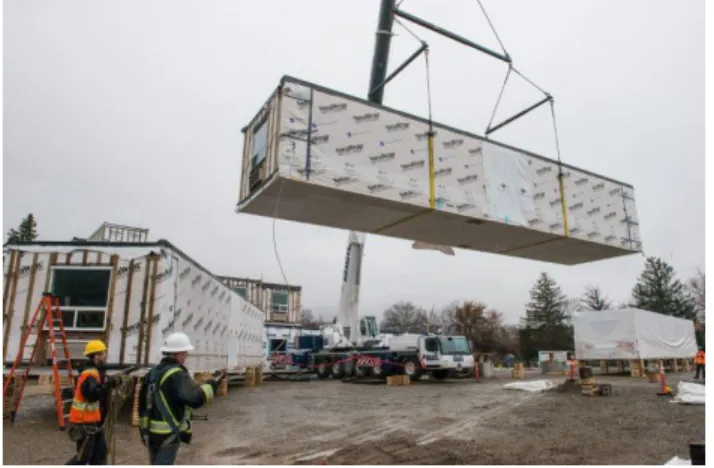
The most glaring disadvantages of modular construction is the transportation of modules from the manufacturing plant to the jobsite. The risk that this process adds is enough to scare away many owners from going the modular route. A building 20’ in the air supported by only 4 cables from a crane can make everyone on the jobsite hold their breath until the module is set in place. If a mistake is made during the transportation or assembly of the modules, it can easily turn a project that is looking profitable, into an absolute nightmare.
Once the modules arrive on site, the chance of serious damage is far from averted. The assembly on site is just as risky as the transportation, if not more so. All the connections must be fastened correctly and after everything is aligned perfectly within each unit. “The tolerances for these connections have decreased considerably of the past 50 years and can be as little as 1/32nd”to 1/16th” (Velamati, Pg. 25). With these modules being transported down
highways, items within the modules, specifically the MEP items, could easily shift with very little disturbance from traveling in transport.
Site restrictions are another major factor that can greatly affect a project’s success. With cranes being the most expensive part of the installation process, at around $4,000 per day, you never want the crane to be unutilized during that time (Velamati, Pg. 26). The drop off, loading, and pick up zones need to be big enough to satisfy the needs of the crane and trucks to run a successful “pick”. This can be increasingly difficult on smaller sites where you may need to figure a larger crane to span long enough to place a module (Velamati, Pg. 26). These are all factors that need to be considered and accounted for when planning for a modular job. A site-specific plan is necessary to keep the job running smoothly for any construction job, especially modular.
Figure 4- Oversize Load being Transported down the road
Source- Modular Building Transportation, Bennett Group, LLC (2009)
Research Design - Methodology
With the added difficulties and challenges that come with modular construction, companies are still able to overcome and have successful business models. If a manufacturer and installer can find a way to deliver profitable projects and expand their company, they have overcome these challenges nearly every project. Understanding what various techniques they use can be extremely beneficial to the construction industry to try and improve the modular sector.
The best way to understand how successful companies operate is to ask those who are among the most experienced in their respective field. Meehleis Modular Buildings, Inc. has been atop the modular construction industry since its inception in 1981, making it California’s most experienced modular company (Meehleis, 2020). Meehleis
specializes in school construction throughout California and even Nevada.
To understand how Meehleis Modular has remained successful while navigating the modular environment, interviews were conducted with the original President, and now three alternating Presidents of the company. Bill Meehleis, Chris Meehleis, Mike Sinclair, and Mark Meehleis have over 150 years of construction experience between the four of them making their knowledge within the modular industry unparalleled. Chris handles the manufacturing and constructability side of plant, which includes a 10-acre facility in Lodi, CA that can produce around 300 modules per year. Mike and Mark are both project managers for Meehleis, and they often take on multiple jobs at a time. They strive to deliver on time and on budget projects consistently. All four work together and bounce ideas off each other to keep owners happy and coming back as repeat customers.
The qualitative, free flowing interviews asked a wide range of questions addressing a multitude of issues. Some of questions were scripted, but the interviews created an open dialogue that allowed those being interviewed to add whatever they felt was important to the study. The issues discussed touched on the following main points as well as many others:
• Difficulties in breaking people’s perception of modular and how to modularize drawings without sacrificing the aesthetic of the building
• Budgeting and the design aspect of modular projects as well as the availability of work
• Main constructability issues like materials, unskilled labor, additional coordination, etc.
• Shipping and transportation concerns and how to make modules fit delivery criteria
• Advice for new modular companies trying to enter the field
• Where they see the modular sector of construction going in years to come
Results
The following sections will address how Meehleis Modular has overcome the challenges addressed earlier in this report along with discussing a multitude of other issues they have come across. These are by no means industry standards, just examples giving by one successful company in their niche of commercial modular school
construction. Some of these practices may or may not be practical for residential or high-rise modular construction.
Owner’s Saving Grace – (Design & Pre-Construction)
Once the client decides to go the modular route, the challenges are just starting. Nearly 50% of Meehleis’ work if not more, was NOT originally planned to be modular. Certain factors lead the owner to come to them in hopes of still building a project that meets the budget and schedule criteria. With modular delivery offering 25% faster and cheaper projects, this is a feasible route for those who could not meet the original budget and schedule. Only in the past 10 years, have the number of projects designated to be modular from the start increased.
When the owner or architect tries to modularize a set of plans without changing how the building looks, it is an extreme undertaking that takes years of expertise to make possible. With the aid of sketches, Mike showed how taking a set of complete drawings and making it modularly compatible would not sacrifice the owner’s look. With a mod-line separation, there can be no windows or doors because the columns need be fastened together onsite and welded down. Shear walls must also be concurrent through all the stories of the building and if a window or doorway disrupts this, they must be moved. This problem can be solved by moving the door or window over a few feet to either side. Splitting them on each side of the columns or shear wall is another minor change that is effective. The same siding and exterior materials can be used to keep the building functioning in its original purpose.
After minor changes to the aesthetic, functionality plays a major role in delivering a successful modular project. Bigger columns are necessary to withstand the vertical load. Roof heights are another challenge because of the strict shipping requirements. If the owner wants an 18’ pitched roof, they are limited by modular, but Meehleis has found a unique way to overcome this challenge. While shipping the modules, the roof is essentially fastened down for shipping. On site, the hinged roof is lifted by crane once the mod is set. When the roof is joined at its intended height and pitch it is welded together and the owner and architect’s vision come to fruition. They use this same hinge system on what is called a “clear story” to provide those high ceilings with the windows along the roofline that provides natural light. Despite the perception that modular can be extremely limiting, if an owner and architect are willing to make some minor changes to the design and work with the fabricator, modularization can deliver a beautiful project.
To many architects and engineers, modular is still a relatively unfamiliar field that requires additional planning and cooperation among all parties. When an owner comes to an architect with an idea for a modularized building, the architect does not give a complete set of plans to the modular contractor. The architect gives a set of preliminary drawings with performance-based specifications the modular contractor must meet. This requires the modular contractor to finalize the design drawings which is exactly what Meehleis does as a Design-Bid-Build company. Mark states that it is cheaper this route because Meehleis does not charge nearly the rates of architects and ultimately adds up to 2-4% of savings. This is because of their experience and familiarity in designing these projects. The design and preconstruction process can be daunting at times especially for modular construction, but there are avenues to explore that lead to a successful design and planning process.
Not Your Typical Assembly Line – (Fabrication and Production)
With an assembly or production line you often get the image of someone installing taillights repeatedly into every car that comes down the line. Modular construction is often associated with this because of process and speed it allows. However, when it comes to the lack of skilled labor that is often associated with modular, Meehleis allows for personal growth and incentivizes employees who learn how to undertake multiple tasks. With Meehleis Modular acting as the General Contractor on the job, it oversees the entire project from fabrication in shop, to assembly and finished product on site. With shop wages being lower than prevailing wages, all the employees want to work in the field. They can earn this by becoming more valuable as a worker and learn a multitude of skills that prove beneficial on a jobsite. This can prevent the monotonous action of focusing on just hanging sheetrock or insulation. With motivated employees and a business model that promotes self-growth, it breaks the stigma that modular construction workers are unskilled.
David Acrell, the plant inspector, is monitoring the production of multiple jobs at a time making sure everything is up to code, compliance, and specifications. He does this by coming to the production facility nearly every day. Once again familiarity rules king when it comes to things running smoothly in the modular sector because the inspector and engineer know what to monitor. The more familiarity, the smoother the delivery runs.
Modular is often associated with using more materials. While this may ring true for some structural members that need to combat added vertical or wind load, there are some unforeseen advantages of utilizing a modular General Contractor. As a business that is aware of its scheduling, modular contractors know what work they have coming up over a year in advance. With a modular production facility, this allows them to store materials for various jobs who often use the same materials. Meehleis can buy materials in bulk at a discounted price and store it for future projects. When a material is suddenly cheaper, they can pursue buying in bulk. Rich Gayton, another long-time employee familiar with modular, orders all the incoming materials for every job along with tools for around the plant. Using the same type of plywood or insulation allows Meehleis to save money and keep familiarity. All these practices became effective only after years of experience and experimentation.
Avoiding the Inevitable – (Shipping and On-Site Assembly)
The aspect that makes modular so unique, is the exact thing that makes it the riskiest and it is impossible to avoid. The transportation process is loaded with risk, some of which is unavoidable. Although some of the modules can fluctuate, Meehleis’ common modules are 10’ and 12’ wide which make the life of the driver easier as compared to a 16’ wide unit. Sometime the massive sizing is unavoidable as was the case with a 95’ long gymnasium roof panel. Shipping pieces like these in the dead of the night are some of the small ways to mitigate risk. There have been multiple instances where tree branches or poles were cut down to make a turn. The height requirements are hard to avoid with overpasses and trees, but the hinged roof system allows for much smoother transport and again
eliminates some of the risk associated with shipping. Unfortunately, the road is an unpredictable place with unpredictable drivers.
Every project has problems arise, and how you handle these problems determines whether you will be able to delivery a prosperous project. Chris, Mike, and Mark all gave nightmare fuel examples of some problems that arose while shipping or assembly. A module was hit by another vehicle and there was substantial damage to the module as it landed on its column. It did delay the project because the sequence of setting the modules was off since the assembly requires each module one after another placed strategically. Another example was one of the units hit a column and bent it in completely. The unit was returned to the shop the same day and overnight workers came and cut the column, re-welded it good as new, and sent it out the next day in order to not delay the project further. An even more unpreventable example was that the crane broke down on the way to the jobsite, which in turn delayed the trucking sequence. Despite these setbacks, Meehleis was able to make up for the lost time both in the plant and on-site by working overtime. Construction knowledge in general not just modular knowledge is extremely valuable when problems like these occur.
Conclusion
Unfortunately, these skills are not developed overnight and take years of overcoming challenges. Every obstacle that you can overcome makes you that more equipped to handle the next unprecedented issue that arises. Meehleis Modular is fortunate to have been in the industry for as long as it has been, and their patience and problem solving has been rewarded. “You have to learn how to crawl before you can walk”, Mark states. Chris related to this concept with, “Those new to the industry think they have the next big idea that will put them over the top, but they often take on big projects they are not prepared for”. Approaching challenges with confidence yet careful calculation is necessary if you want to be successful in the construction industry and specifically modular delivery.
Familiarity can benefit all aspects of construction, not just the modular sector. What sets Meehleis and other successful modular companies apart is the mindset that they do not simply think like a fabricator. They think like a General Contractor and act as the GC for most of their projects. When asked about other valuable information to this research, Mike made sure to touch on this aspect, “We think like a General Contractor, that’s our biggest
advantage”. Seeing a project from start to finish ensures that Meehleis can control all aspects that come with their fabricated units. With Meehleis acting as the GC, they deal directly with the owner and are responsible for owner’s satisfaction. Meehleis must think of the owner’s needs, while a fabricator will construct their modules and be done. There are still major problems that arise on site-built projects and modular is no different. That is why it is extremely important to have general construction knowledge and not be limited to the modular process, Chris expresses.
Modular construction could claim nearly $130 billion worth of the construction market share delivering $22 billion in annual savings by 2030 (Bertram, 2019). The lack of skilled labor is becoming more of a problem for all methods of construction and will eventually reach a tipping point. Modular must adapt to stay alive. Technology like
robotics, plasma cutters and even 3D-printers are possible solutions to this problem, Mark points out. Despite the uncertainty that lies ahead, companies will have to innovate and create newer, faster, even more unrealistic products or processes to keep up with demand. As we look back, some of the things we are accomplishing now were deemed impossible. But with familiarity and hard work, the modular industry and be taken to new heights.
References
Bertram, Nick, (2019, June). et al. Modular Construction: From Projects to Products . McKinsey and Co., Retrieved March 23rd from: modular.org/documents/document_publication/mckinsey-report-2019.pdf.
Culnen Michael. (2009, November 15). “Construction Industry Highly Risky, Volatile.” Business Insurance, Retrieved May 15th from:
www.businessinsurance.com/article/20091115/ISSUE0401/311159997/construction-industry-highly-risky-volatile#.
De La Torre, Mayra L.; Sause, Richard; Slaughter, Sarah; and Hendricks, Richard H., (1994). "Review and Analysis of Modular Construction Practices" (1994). ATLSS Reports. ATLSS report number 94-11:. Retrieved April 26th from :http://preserve.lehigh.edu/engr-civil-environmental-atlss-reports/201
Jones, Stephen A. (2020). “Prefabrication and Modular Construction 2020.” Modular Building Institute, Retrieved April 26th from: www.modular.org/documents/public/PrefabModularSmartMarketReport2020.pdf. 63.
Pearltrees, Mickelreed. (17 Oct. 2019). “History Of Modular Constructions.” Northgate Industries, Retrieved May 15th from: northgateindustries.com/history-modular-constructions/.
Meehleis Modular Buildings, Retrieved April 30th from: meehleis.com/.
Modular Building Institute (MBI), (2019). “About Permanent Modular Construction.” Permanent Modular Construction Annual Report 2019 | Modular Building Institute, Retrieved April 17th from:
Salama, Tarek. (2017). “Modular Industry Characteristics and Barrier to Its Increased Market Share.” Modular Building Institute, Concordia University, Retrieved March 25th from:
www.modular.org/documents/document_publication/Modular_Industry_Characteristics_and_Barrier_to_its_ Increased_Market_Share.pdf.
Strecker, Eveline. (23 May 2018). “The Avalanche Effect: Key Issues in Modular Building.” Construction Blog, Retrieved May 1st from:
constructionblog.practicallaw.com/the-avalanche-effect-key-issues-in-modular-building/.
Velamati, Sri. (2012). Feasibility, Benefits and Challenges of Modular Construction in High Rise Development in the United States: A Developer’s Perspective. Massachusetts Institute of Technology, Retrieved April 17th
from; dspace.mit.edu/bitstream/handle/1721.1/77129/825120099-MIT.pdf. 23-38.